Spray Paints

spray painting laws violation

Spray Painting Laws in California

Spray paints are all fun and exciting until you realize they can cost you serious legal trouble!

That’s right. Are you aware of spray paint laws in California? Because if you don’t, then you should, as ignorance of the law is no excuse. It is imperative to know that selling spray paints to minors or conducting graffiti has serious penalties under penal clauses of California state laws like fines and imprisonment or even both!

Let’s understand what spray paints are,

“Any spray device, can, or bottle that contains dye, ink, paint and a propellant which it dispenses under pressure through pumps in a fine mist or spray is known as spray paints.”

Spray paints are often considered fast-drying painting tools that provide even finishing; however, that’s not what spray paints are all about. Spray paints possess volatile organic compounds (VOCs), which contribute to environmental crises, human respiratory problems, and vandalism which is why California state laws regulates the possession and use of spray paint. Understanding these regulations is important to avoid potential legal trouble and fines.

Therefore, in this blog we will discuss California’s spray painting laws and penalties.

Why Implement Laws of Spray Painting

Spray paint is a type of aerosol paint that is used for a variety of purposes, including graffiti art, street art, and home decor. In California, however, spray paint is subject to strict regulations to prevent minors from using it for vandalism. Spray paint laws in California are designed to control the sale and possession of spray paint, particularly among minors.

California Spray Paint Laws

Spray paint laws falls into vandalism under California Penal Code Section 594 which deals with the sale and use of spray paint regulations and its legal consequences upon violation. The objective is to promote the minor’s safety and prevent them from using spray paint for graffiti and vandalism.

Here are a few key points of spray paint laws in California,

  • It is restricted to selling spray paint to buyers under 18.
  • The retailers are bound to display spray paints in a locked cabinet
  • The spray paint must contain a warning label directing the way to use it
  • It levitates all the legal penalties against the intent to deface other’s properties

Restriction on Selling to Minors

Under California state laws, the penal clause under section 594.1(a)(1)4 makes it illegal to sell spray paint to minors and defines it as,

“This subdivision shall not apply to the furnishing of six ounces or less of etching cream or an aerosol container of paint to a minor for the minor’s use or possession under the supervision of minor’s parents, guardian, instructor, or employer.”

Violation of this subdivision can result in fines and imprisonment of up to 90 days for first-time offenders.

Minors Cannot Possess Spray Paint.

As per section 594.1(5)(b) of California Penal Code,

It shall be considered unlawful and illegal for a minor to purchase and possess etching cream or an aerosol container of paint that is capable of defacing property.

Minors are often seen damaging and defacing public and private properties intentionally, not knowing it’s a crime. While it is imperative to know this act of defacing other’s belongings is called vandalism and is a serious offense punishable by spray paint laws in California.

In many cases, spray paints are associated with graffiti vandalism because it is cheap, easy to use, and spread quickly. Resultantly, it is used to leave a message or mark on buildings, bridges, and walls, which damages valuable public properties.

Considering rising destruction, the authorities discourage the possession of spray paints by minors, and therefore, strict laws have been imposed against them.

 References and Guides for a Quick Look for Spray Painting Laws in California

  1. California Legislative Information: Penal Code Section 594.3: This is the official California law that outlines the penalties for vandalism with graffiti or other inscribed materials, including spray paint.
  2. California Air Resources Board: Consumer Products Program: Information on the California Air Resources Board’s Consumer Products Program, which regulates the volatile organic compound (VOC) content of consumer products, including spray paint.
  3. California Retailers Association: Selling Spray Paint – A Retailer’s Guide: This guide provides information for retailers on the laws and regulations around selling spray paint in California, including age restrictions and storage requirements.
  4. Graffiti Hurts: Understanding Graffiti Laws in California: This website provides an overview of the graffiti laws in California, including those related to spray paint. It includes information on penalties for violating these laws and resources for preventing and cleaning up graffiti.
  5. California Courts: Criminal Penalties for Vandalism:  This page provides information on the criminal penalties for vandalism in California, including graffiti offenses. It includes information on fines, community service, and possible jail time for offenders

Penalties for Violating Spray Paint Laws in California

Graffiti vandalism is a serious offense that is dealt with under section 594 of the California Penal Code. According to this code,

Any property, signs, fixtures, or vehicles belonging to the public entity that is violated shall be penalized with imprisonment for up to 1 year. The fine shall be estimated according to the value of the damage.

For instance,

  • If the amount of damage is $400, the fine shall not be more than $10,000
  • If the amount of damage is less than $400, the fine shall not be more than $1000

Penalties Payable by Legal Guardian

If the minor is declared responsible for committing juvenile vandalism and is personally not able to pay the fine himself, the parent or legal guardian of a minor shall be liable to pay on his behalf and can even serve jail time as responsibility for juvenile crime up to 1 year, depending on the severity of the offense. However, the court may waive a fine upon showing good cause by the parent.

Exceptions to California Spray Paint Laws

While specific laws prevail regarding the selling and possession of spray paints to discourage vandalism and damage to public entities, there are some exceptions to it.

  • Individuals who are sound-minded, above 18 years old (adults), and have government identification are excepted by these laws. They can buy or use spray paints for official purposes.
  • People who require spray paints for legitimate purposes, such as painters and artists, are excepted from restrictions.
  • Spray paints have great consumption in the industrial sector, like marking, labeling, corrosion protection, and safety marking. Hence industrial and agricultural purposes are also excepted.

Examples of Spray Paint Exceptions

  1. A person who owns a garage and often requires spray paints for auto-mobile servicing is exempted from spray paint laws in California (unless they abuse the usage)
  2. Artists like to think out of the box by blending multiple colors, layering, achieving fantastic finishing, and creating a complex designs. And to achieve this goal, spray paint is a popular tool which makes it exempted from spray paint laws in California.
  3. Agriculture is another example of its exemptions; farmers require spray paints to mark the ears of cattle for their identification, or in some cases, they use spray paints for marking irrigation lines in fields.

Quick Review: Spray Painting Laws in California

  1. Minors under the age of 18 are prohibited from purchasing spray paint.
  2. Stores must keep spray paint behind the counter or in a locked cabinet to prevent theft.
  3. It is illegal to sell spray paint to anyone under the age of 18.
  4. Individuals who purchase spray paint must show valid identification.
  5. Certain locations, such as schools, religious institutions, and public buildings, prohibit the use of spray paint.
  6. Violating spray paint laws can result in legal consequences, including fines and possible jail time.
  7. The California Air Resources Board regulates the VOC content of spray paint under its Consumer Products Program.
  8. Graffiti or vandalism with spray paint is punishable under Penal Code Section 594.3.

CONCLUSION

California, home to world-famous attractions, is known for its alluring scenery of mountains, beaches, forests, deserts, and captivating infrastructure. And to maintain the beauty and protection of valuable public belongings, the state never settles for less. The spray paint laws in California are of its prime examples.

Moreover, the abuse of spray paints has a significant negative impact on the environment, natural habitats, and eco-system. For instance, graffiti on trees can harm plants and life of animals, while volatile organic compounds in spray paints can contribute to air pollution and respiratory issues among humans.

Therefore, to avoid legal penalties, promote public safety, and protect the environment, it is important to become a law-abiding citizen and contribute a positive role in society by following spray paint laws in California.

is spray paint toxic

Is Spray Paint Toxic – Debunking 5 Steps to Get Rid of Smell

Imagine this scenario: You’ve decided to tackle a DIY project over the weekend and are excited to start. You’ve picked out the perfect color and theme and are ready to pick your can. 

But wait…

In the back of your mind, you’re worried about your kids being exposed to toxic paint chemicals – BUMMER!

That is exactly the case with me!

As a parent of two young girls, I am constantly concerned about their health and well-being. The thought of exposing them to toxicity is so unsettling that I dug up the internet and thoroughly researched before embarking on my next DIY project.   

And if you are a concerned parent too, who’s wondering: is spray paint toxic, here’s is the answer:

“Spray paint can be toxic if inhaled or used in poorly ventilated areas. The chemicals in spray paint can irritate the eyes, nose, and throat, and prolonged exposure can lead to serious health problems. It’s important to follow the safety instructions and use protective equipment.”

The article further aims to shed more light on how you can achieve the same great results while keeping you and your loved ones safe. 

Keep reading to make an informed decision before picking that can up for your next DIY!

Let’s Talk About What’s in Your Spray Paint

Spray paint is a commonly used product for various purposes, from DIY projects to professional painting jobs. 

It’s convenient, effective, and adds perfect color and smooth texture to a surface. 

But it’s also important to know what’s in your spray paint to avoid potential health hazards.

Composition of Spray Paint

The main composition of spray paint includes solvents, propellants, pigments, and binders. Each serves a different purpose. 

  • Solvents – Used to dissolve the other paint components and evaporate quickly to leave a smooth finish. Examples of solvents include toluene, xylene, and acetone.
  • Propellants – Gases that push the paint out of the can and into the air. Propane, butane, and dimethyl ether are some commonly used propellants. 
  • Pigments – Give the paint its color and opacity. Some examples of pigments include cadmium, lead, chromium, and titanium dioxide.
  • Binders – Hold the pigments together and help them adhere to the surface. Acrylic, epoxy, and urethane are widely used binders in paints. 

Understanding Spray Paint Fumes 

Spray paints combine paint, solvents, and propellants in a pressurized can. When the nozzle is pressed, the air pressure inside the can changes. This leads to the propellant pushing the paint out of the can, forming a fine mist sprayed onto the surface. 

The mist results in spray fumes, a mixture of airborne particles and chemicals released into the air when the spray paint is applied. 

Spray paint fumes are a common concern for anyone who uses spray paint, whether for a small DIY project or a large-scale professional job. These fumes can be harmful to human health and the environment. 

Spray paint fumes can be inhaled or absorbed through the skin. These fumes can irritate the eyes, nose, and throat, as well as headaches, dizziness, and nausea. 

Prolonged exposure to spray paint fumes can lead to more serious health problems, such as damage to the central nervous system, liver, and kidneys, and even increase your risk of cancer. 

It’s important to understand the risks and take appropriate precautions.

Potential Health Hazards of Spray Paint Fumes

  • Spray paint can contain volatile organic compounds (VOCs) that can harm human health, especially in high concentrations or with prolonged exposure.
  • VOCs can irritate the eyes, nose, and throat, and cause headaches, dizziness, and nausea.
  • VOCs are also notorious for contributing to air pollution and climate change.
  • Certain pigments, such as lead and cadmium, can be toxic if ingested or inhaled.

Some of the most common VOCs used in spray paints are acetone, toluene, and xylene. These substances are associated with a high risk of potential health hazards and put our environment at risk. The below table lists the symptoms that occur after exposure to these substances and the organs that are affected:

VOCSymptomsAffected Organs
AcetoneIrritation of eyes, nose, and throat; headache, dizziness, depression of central nervous system; dermatitisEyes, skin, respiratory system, central nervous system
TolueneIrritation of eyes and nose; weakness, exhaustion, confusion, euphoria, dizziness, headache; dilated pupils, lacrimation; anxiety, muscle fatigue, insomnia; paresthesia; dermatitis; liver, kidney damageEyes, skin, respiratory system, central nervous system, liver, kidneys
XyleneIrritation of eyes, skin, nose, and throat; dizziness, excitement, drowsiness, incoordination, staggering gait; vacuolization of the cornea; anorexia, nausea, vomiting, abdominal pain; dermatitisEyes, skin, respiratory system, central nervous system, gastrointestinal tract, blood, liver, kidneys
Table showing Symptoms after Exposure to the Substances in Spray Paints

Many studies have also been conducted to prove that prolonged exposure to spray paints can cause cancer. 

The National Library of Medicine has a monograph that provides detailed information about the types of cancer and the chemicals that may cause them, especially in occupational painters. 

Certain cancers, such as lung, bladder, and childhood leukemia, have been linked to exposure to paint chemicals. 

Chemicals, such as Benzene, Formaldehyde, Toluene, Xylene, Ethylbenzene, Cadmium, and Lead, have been identified as possible causes of cancer.

To learn more about the association of spray paints with cancer, read our article, If Spray Paints Can Cause Cancer and 5 Ways You Can Avoid It.

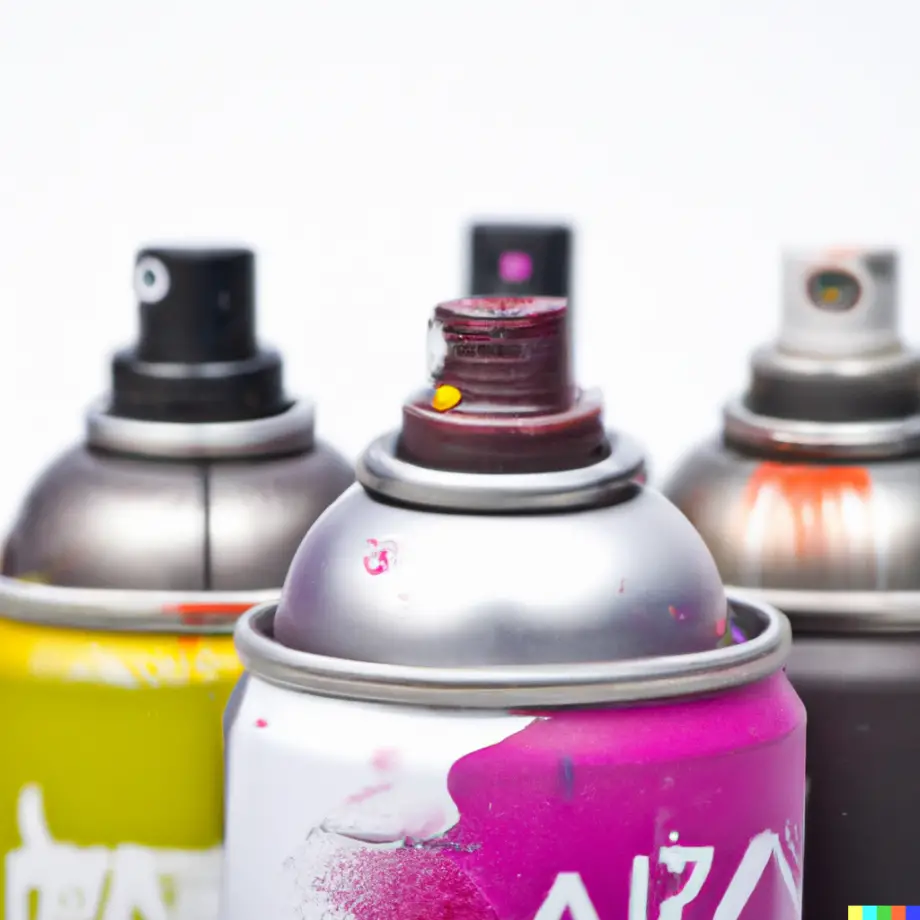
DALL·E 2023 04 03 09.11.31 spray paints Is Spray Paint Toxic – Debunking 5 Steps to Get Rid of Smell

How Toxic is Spray Paint?

Now that we already know that spray paint fumes are toxic, the question arises – how toxic are they? 

The toxicity of spray paints depends on the type and amount of chemicals present in the paint. 

Moreover, it also depends on your exposure to these chemicals. The longer and more frequent your exposure to spray paint fumes, the higher the risk of experiencing adverse health effects. 

The level of toxicity also varies depending on the application method, with spray painting being more likely to release a higher concentration of harmful chemicals into the air than other methods. 

How Long Does Spray Paint Smell Last?

After painting, giving enough time for the paint to dry and the fumes to dissipate is essential to consider the area safe. 

The time required for spray paint to dry and become safe depends on various factors such as humidity, temperature, type of paint, and the surface being painted. 

If you live in a hot climate, you’re more likely to enjoy a quick drying time. 

In general, spray paint can take a few hours to several days to dry and become safe. To speed up the drying process, it’s recommended to apply thin coats of paint, keep the area well-ventilated, and allow ample time for each coat to dry before applying the next. 

Once the spray paint is dry, it’s advisable to wait an additional 24-48 hours before using or occupying the painted surface to ensure maximum safety.

However, as a rule of thumb, you can use the newly painted room after 3 to 5 days of the spray paint application. 

Is Spray Paint Toxic When Dry?

Fortunately, once the paint is dried completely, the toxic fumes dissipate, posing no health risks. 

However, if your paint contains cadmium or lead, it can be toxic even after it has dried, depending on the paint’s condition. 

Dry and undamaged paint is not a concern. But peeled and  cracked paint, and sanding dried paint can release dust particles containing toxic chemicals into the air. 

Lead and cadmium poisoning pose serious issues that can be irreversible in some cases. Some symptoms of heavy metal poisoning include abdominal pain, memory loss, joint and muscle pain, delayed growth in children, fatigue, loss of appetite, nausea, headache, dizziness, etc. 

How Do I Know I Have Spray Paint Toxicity

If you experience any of the following symptoms of spray poisoning, it’s essential to seek fresh air immediately and consult a healthcare professional if the symptoms persist or worsen. 

Here are some of the common spray paint toxicity symptoms:

  • Headaches
  • Dizziness
  • Nausea
  • Vomiting
  • Shortness of breath
  • Chest pain
  • Irritation of the eyes, nose, throat, and lungs
  • Skin irritation or rash
  • Loss of coordination
  • Fatigue
  • Confusion
  • Seizures

It’s important to note that symptoms can vary depending on the type, amount of chemicals in the spray paint and the individual’s sensitivity and exposure level.

How to Get Rid of Spray Paint Smell

Spray paint fumes’ side effects can be serious. To ensure safety, getting rid of the spray paint smell is optimal. You can use the following steps to get rid of the paint smell:

  1. Increase ventilation by opening windows and doors to allow fresh air to circulate.
  2. Use fans or air purifiers to help remove the fumes from the air.
  3. Place bowls of vinegar or activated charcoal in the painted area to absorb the odor.
  4. Use odor-neutralizing sprays or deodorizers specifically designed to eliminate paint smells.
  5. Clean surfaces with a mixture of water and baking soda or vinegar to help neutralize the odor.

Meanwhile, the above steps are crucial; avoid spending time in the painted area until the smell has dissipated entirely. Fumes can take a few hours to several days to dissipate, depending on the extent of the painting and the ventilation.

Precautions to Minimize Exposure to Spray Paint Fumes

  1. Always read and follow the safety instructions on the can of spray paint.
  2. Always use spray paint in a well-ventilated area, preferably outdoors or in a spray booth with adequate ventilation.
  3. Wear protective equipment, such as a mask and gloves, to minimize inhalation and skin contact with the chemicals in spray paint.
  4. Take frequent breaks and avoid prolonged exposure to spray paint fumes.
  5. Dispose of empty spray paint cans properly, following local regulations for hazardous waste.

Choosing Safer Spray Paint Options

  • Look for low-VOC (volatile organic compound) or zero-VOC nontoxic spray paint options. These products contain fewer harmful chemicals and are safer for both human health and the environment.
  • Water-based spray paints are also safer than traditional solvent-based spray paints. Learn our 7 Mind-Blowing Tips to Use Water-Based Paints on Wood

Environmental Impacts of VOCs

VOCs can greatly impact the environment, ultimately harming human health. 

  • VOCs cause air pollution, smog, and respiratory problems in humans.
  • They can damage crops and vegetation and worsen air quality.
  • VOCs create unpleasant odors in consumer products.
  • They contaminate soil and groundwater, affecting wildlife and human health.
  • VOCs contribute to climate change as potent greenhouse gasses.
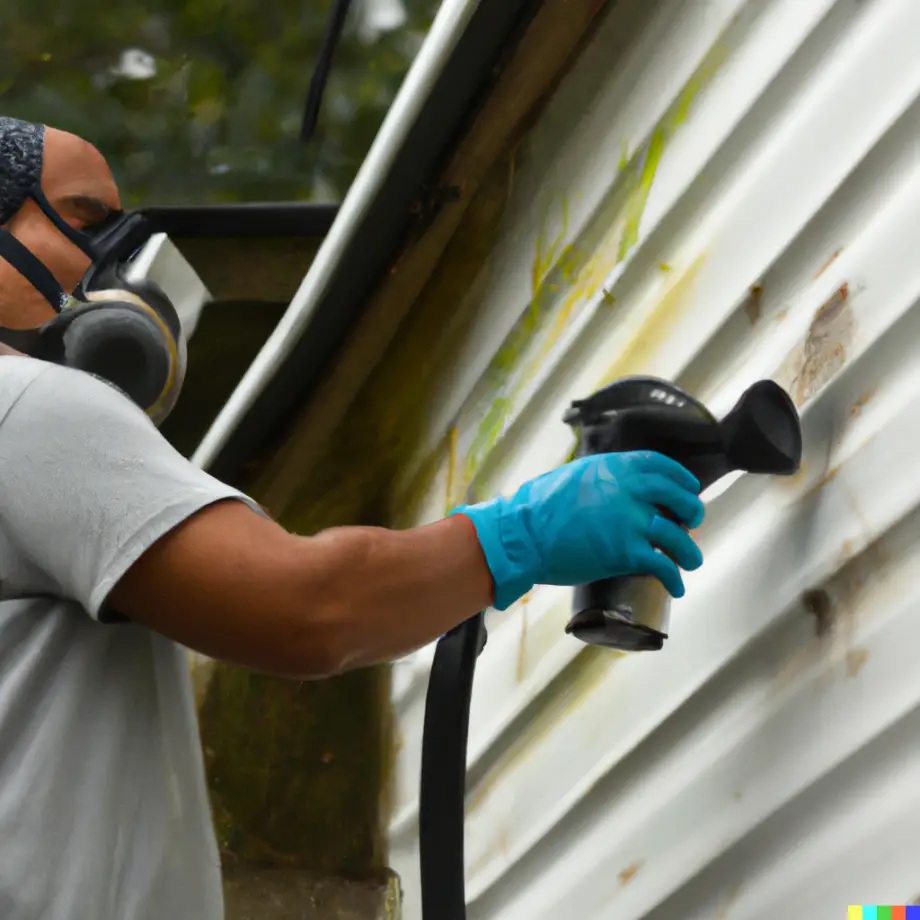
DALL·E 2023 04 03 09.24.23 a person spray painting with protective gear Is Spray Paint Toxic – Debunking 5 Steps to Get Rid of Smell

FAQs 

Is spray paint toxic on the skin?

It’s common for spray paints to cause skin irritation, itching, and rash.

Is it safe to spray paint in the house?

You can safely spray paint your house if you have proper ventilation. Without optimal ventilation, the fumes can cause health issues when inhaled.  

Is spray paint toxic to dogs?

Is spray paint toxic to cats, dogs, and other pets is a common concern for every pet owner. The answer is, yes, if ingested or inhaled, spray paint fumes can result in health problems such as respiratory distress, vomiting, diarrhea, and other symptoms in animals.

Can you die from spray paint fumes?

Yes, exposure to high concentrations of spray paint fumes can lead to death from respiratory failure or other severe health complications.

Conclusion

To summarize, spray paint can be toxic and harmful to human health and the environment. The fumes released during spray painting contain chemicals such as volatile organic compounds (VOCs) and can cause short-term and long-term health problems. 

It is important to use spray paint in a well-ventilated area, wear protective equipment, and follow proper disposal procedures to minimize the risks associated with spray painting. 

Additionally, opting for non-toxic, low-VOC spray paint alternatives and reducing the use of spray paint altogether can help mitigate the negative impacts on our health and environment.

pexels cottonbro studio 7493876 Can Spray Paints Cause Cancer - 5 Ways To Avoid It

Can Spray Paints Cause Cancer – 5 Ways To Avoid It

Easy to use, fast drying, and even finish, isn’t this every DIY painter’s dream?  

And that exactly is the hype about spray paints! 

You press a nozzle; you have a fine mist of paint that coats your surfaces smoothly, and viola! 

The aerosol cans make painting oh-so-easy.  

However, with great convenience comes great responsibility. And that’s when the biggest concern arises: can spray paints cause cancer? 

To answer your question right away, here is what we know about spray paints causing cancer:

Spray paints may and may not cause cancer, depending on the composition of the aerosol paints. Various studies have been conducted to find the effects on the health of occupational painters. However, it is important to note that spray paints do possess health threats in some way or the other way.   

Below is a detailed overview of if spray paints can cause cancer. Read on to learn more before you dive into your next DIY project. 

A Brief Overview of Spray Paints 

Spray paints come in a canister and are applied using a spray nozzle. They are designed to be used on various surfaces, such as metal, wood, plastic, and fabric. 

Whether you need to revamp your old car or revitalize your wardrobe by painting denim, spray paints are a popular choice for both professionals and DIY enthusiasts due to their convenience and versatility.

How Do the Aerosol Cans Work

Spray paints contain liquefied paint and a propellant gas, typically compressed air or liquefied gas. 

When you press the can nozzle, the air pressure in the can changes transforming the gas and paint into tiny droplets. These droplets are sprayed out in fine mist. The mist then settles onto the surface, creating an even and smooth finish. 

But as we all know, this sprayed mist also releases paint fumes, which many people think are carcinogenic. 

Before diving into the conclusion, it is important to know what exactly in the aerosol can is responsible for causing cancer.

The Chemical Composition of Spray Paints 

The chemical composition of spray paints can vary depending on the specific brand and type of paint. However, most spray paints contain the following basic components:

  1. Pigments: These are the particles that provide color to the paint. Pigments can be organic or inorganic.
  2. Resins: These are the binding agents that hold the pigments together and help the paint adhere to surfaces.
  3. Solvents: These liquids help dissolve the resins and pigments and keep the paint in a liquid form. Solvents in spray paints are usually volatile organic compounds (VOCs), which can harm human health.
  4. Propellants: These are the gasses that create pressure to force the paint out of the can. Common propellants in spray paints include butane, propane, and dimethyl ether.
  5. Additives: Additives improve paint’s performance, such as drying time, viscosity, and resistance to weathering.

The Link between Spray Paint and Cancer

The potential carcinogenic effects of spray paint are thought to be due to the presence of volatile organic compounds (VOCs), heavy metals, and isocyanates. These chemicals release into the air when you spray the pain.

When inhaled, spray paint fumes’ side effects can be severe. They can enter the lungs and respiratory system, where they can cause irritation, inflammation, and damage to delicate tissues and cells. Over time, this damage can accumulate, increasing the risk of developing cancer.

Several types of cancer have been associated with spray paint exposure, including lung cancer, bladder cancer, kidney cancer, and leukemia.

Research studies have provided evidence to support the link between spray paint and cancer.

Below are some studies discussed:

  • A study was conducted on a 46-year-old non-smoking bumper spray painter who developed lung cancer after 15 years of work. Experts found high levels of hexavalent chromium in bright yellow paint and consider it a possible suspect in the crime. 
  • Another study found that men who have worked as painters at some point have a higher chance of getting lung cancer than men who have not worked as painters. This increased risk was the highest for painters who worked in construction and repair. They have an increased risk of lung cancer, including small and squamous cells. The risk is higher for men who have smoked and also worked as painters.
  • A case-control study was conducted in Northern Italy to assess the relationship between bladder cancer, occupation, and exposure to occupational agents. The study found that, along with other occupations, people associated with painting/spraying work reported more frequent cases of bladder cancer. 
  • Comprehensive data available online discusses in detail the types of cancer and the chemicals responsible for causing the disease. Some of the cancers mentioned in the data are lung, bladder, and childhood leukemia associated with maternal or paternal paint exposure. There are inconclusive data on cancers of the upper aerodigestive tract (oral cavity, nose, pharynx, nasopharynx, larynx, and esophagus), stomach, pancreas, liver, colon, rectum, kidney, brain, prostate, testis, ovary, and breast, and of melanoma and soft–tissue sarcoma. Some chemicals known or suspected to cause cancer are Benzene, Formaldehyde, Toluene, Xylene, Ethylbenzene, Cadmium, and Lead.

Can Spray Paints Cause Cancer?

Not all spray paints cause cancer, but some may contain harmful substances known as carcinogens. The risk of developing cancer from exposure to these substances depends on the level and duration of exposure, as well as individual factors such as age, health status, and genetic makeup.

Occupational exposures to spray paint are particularly concerning, as workers in industries such as painting, automotive repair, and construction may be exposed to high levels of spray paint fumes regularly. 

However, if you are using spray paint for personal projects at home, you may be safe with proper precautions to protect yourself from exposure.

can spray paints cause cancer

Preventing Exposure to Spray Paint

Let’s be honest – a little DIY project every once in a while won’t cause much harm and will satisfy your painting cravings. 

To minimize exposure to potentially carcinogenic chemicals in spray paint, you MUST take the following precautions.

  • Work in a well-ventilated area to allow fumes to disperse and minimize inhalation of toxic chemicals.
  • Wear appropriate protective gear, such as a respirator mask and gloves, to minimize skin and respiratory exposure to VOCs.
  • Use spray paint that contains low levels of VOCs and follow the manufacturer’s instructions for safe use.
  • Take breaks when working with spray paint to allow the fumes to dissipate.
  • Avoid working in enclosed spaces where fumes can accumulate.

What Happens if You Inhale Spray Paint Fumes

Inhaling spray paint fumes can be dangerous to your health. Symptoms of spray paint poisoning include headaches, dizziness, nausea, coughing, wheezing, and shortness of breath. 

If you have accidentally inhaled spray paint fumes, here are some steps you can take:

  1. Move to a well-ventilated area: If you are indoors, go outside or open windows and doors to get some fresh air. This can help to reduce the concentration of fumes you are breathing in.
  2. Seek medical attention: If you are experiencing any symptoms such as dizziness, nausea, or difficulty breathing, seek medical attention immediately. Call your local emergency number or go to the nearest emergency room.
  3. Drink plenty of water: Drinking water can help to flush out any chemicals that may have entered your system.
  4. Rest: If you feel lightheaded or dizzy, lie down and rest until you feel better.
  5. Take precautions in the future: When working on future projects, make sure to work in a well-ventilated area and wear a mask or respirator to protect yourself from inhaling fumes.

Frequently Asked Questions (FAQs)

Can I get cancer from spray paint? 

Yes, prolonged exposure to spray paint fumes can increase the risk of cancer.

What kind of cancer does paint cause? 

Spray paint exposure can increase the risk of lung, liver, and bladder cancer.

How long is spray paint fumes harmful? 

Spray paint fumes can be harmful for several hours after painting or up to a day after the paint is dried. Proper ventilation and air filtration can help to disperse the fumes quickly.

What are the dangers of spray paint? 

The dangers of spray paint include respiratory problems, liver and kidney damage, and an increased risk of cancer.

How to clear the lungs of spray paints?

The best way to clear your lungs of spray paint is to seek medical attention and follow the advice of a healthcare professional. Also, follow the steps discussed above. 

Can acrylic paint cause cancer? 

Acrylic paint does not contain the same harmful chemicals as spray paint and is generally considered safe to use.

What to do after inhaling paint fumes?

If you think you’ve inhaled spray paint fumes, go in a well-ventilated area, drink plenty of water, take rest, seek medical help if the symptoms feel worse, and make sure to follow precautions next time you spray paint. 

Conclusion

In conclusion to the query Can Spray Paints Cause Cancer, here’s our takeaway: Spray paint can cause health hazards, including the risk of cancer. It is crucial to take appropriate measures to protect yourself from exposure. Understanding the hazards and risks of spray paint is essential for minimizing exposure and controlling the associated risks. By following safety guidelines and taking appropriate precautions, you can enjoy spray paint’s benefits without risking your health.Want to know how you can take your spray painting projects to the next level? We have compiled just the right content for all YOUR needs! Spray paint your cars, renovate your homes and bathrooms, and upscale your wardrobe with everything you need to know.

pexels wallace chuck 5025303 Is Spray Paint Permanent - Will it Last Long or Wear Off

Is Spray Paint Permanent – Will it Last Long or Wear Off

As an artist and a DIY enthusiast, I love creating art that is unique and colorful, and the most convenient and pocket-friendly way is using spray paints. However, one question that often bothers me is: “is spray paint permanent?” It gets me thinking if my artwork made out of love will last. The question is important because I really want my unique creations to stay fresh and last long. 

The permanence of spray paint depends on various factors, such as the type of paint, surface, and environmental conditions. Some spray paints, like Acrylic, Enamel, and, Epoxy are designed to be permanent, while others, like chalk spray paints, may fade or chip over time. Proper preparation and application can improve the longevity of spray paint projects.

There is no definite answer to the question of the permanency of spray paint; however, I will explain to you in detail the different types of paint and the surfaces they are applied on.  We will also examine the environmental conditions and other external factors that can affect the longevity of spray paint. By the end of this blog post, you will have a better understanding of whether spray paint is permanent and how to ensure your spray paint projects last for years to come.

How Long Does Spray Paint Last

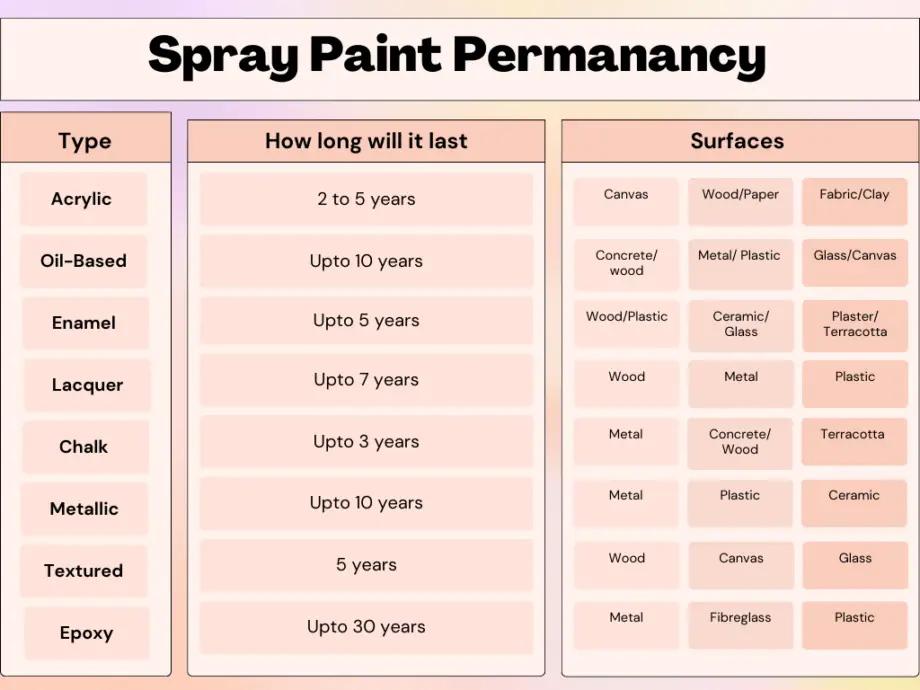
The average life span of spray paint is between two and ten years, depending on the spray paint type and method adopted.

Additionally, the span of spray paints relies on a combination of factors that need to understand efficiently. And the best approach to do so is to familiarize yourself with different types of spray paints coming ahead. 

Types Of Spray Paints

Acrylic Spray Paint

The first type we have on our list is Acrylic spray paint which is known for its quick-drying properties and durability. It can last from 2 to 5 years. Acrylic resin, solvents, and pigments are the main ingredients of acrylic spray which make it super resistant to fading and cracking.

With that said, the acrylic spray is best for customizing car paints using spray guns to get durable finishing on automotive parts like dashboards, leather car seats, car rims or wheels, or even the whole car exterior

Oil-Based Spray Paint

The following type is oil-based spray paint which gives a glossy finish on metal and outdoor wooden surfaces. Unlike acrylic spray paints, oil-based spray paints don’t have water-based solvents and are suspended with turpentine or mineral spirits. Due to these strong solvents, oil-based spray paints provide strong adhesions and longer durability for up to 10 years.

Since oil-based spray paints have a relatively very long life, you can use them on various types of surfaces. It’s great for wood, glass, concrete, metal as well as all kinds of plastic.

Oil-based spray paint is a petroleum-based solvent that eliminates the need for primer. It offers a glossy finish and is suitable for decorating and changing the outlook of your outdoor furniture.

Enamel Spray Paint

The interesting thing about enamel-based spray paint is that it comes in both water and oil-based formulas. This provides an excellent opportunity for a wide range of products. As per durability, enamel spray paints last up to 5 years; however, their water-based formula is less toxic and easier to clean up.

While oil-based enamel spray paint is known for greater durability and resistance against wear and tear, Enamel paint spray is considered ideal for protecting outdoor metal furniture against harsh weather. You can also use it on indoor items of furniture and appliances. 

Lacquer Spray

A quick-drying solvent-based lacquer is known as lacquer spray paint. You will find a great variety of colors in lacquer spray paints. On furniture, musical instruments, and accessories, you can spray lacquer paints for a perfect and factory-like finish. It may be applied to many different surfaces, including wood, metal, and plastic.

Lacquer spray paint dries quickly and offers a tough, long-lasting finish that lasts up to 7 years and is frequently used on furniture and other home furnishings. Although it dries rapidly, the best results take several coats.

Chalk Spray Paint

Chalk spray paints are used for getting a distressed and vintage look. This spray paint is synthesized with solvents, binding agents, and pigments in an aerosol can. Often it is used in craft projects and can be easily applied on ceramic, metal, and wood surfaces, and it will remain good for 3 good years

Chalk spray paint has a matte texture and is water-based. It is frequently employed for do-it-yourself jobs like painting furniture or decorative objects. The drying time of chalk paint is 15 minutes, as you would have already read from our blog about it, and it is not waterproof but water-resistant, even when used on outside furniture

Metallic Spray Paint

Little metallic particles in metallic spray paint give the finished product a reflective appearance. Although it can be used on other materials, it is frequently utilized on metal surfaces.

Metallic spray paint can last for several years, up to 10 years, if taken care of. However, if the weather is unpredictably bad with spells of high humidity and frequent heat spells, the longevity of metallic spray paint can be adversely affected to come down to as low as 1 to 2 years.

Textured Spray Paint

Spray paint with a textured finish can be used to add texture to a range of surfaces, including metal, wood, plastic, and more. When applied, the granules or particles in textured spray paint produce a textured or rough finish.

Textured spray paint gives surfaces a distinctive finish, like sand or stone, and is frequently used for ornamental purposes. Life after the application is about 5 years if maintained well; however, the paint may chip even before in harsh weather conditions. 

Epoxy Spray Paint

Epoxy spray paint type is distinctive from others and can withstand harsh environments efficiently. Epoxy resin is the main component of spray paint which works as an excellent adhesion and sticks to almost any surface, including plastic, concrete, metal, and wood.

A fun fact is when it comes to durability, the lifespan of epoxy coating is not measured in years but in decades, and epoxy spray paints have examples of up to 30 years or more. It’s one of the toughest paint materials used without primers, and once coated, it won’t take off easily.

PS: If you’re wondering how long spray paint takes to dry, have a look at our blog, which tells you details about the drying time of different types of paints.  

Summarized Table

is spray paint permanent

Factors Affecting Spray Paint Permanency

The permanency of spray paints can be affected by various factors, such as the quality of the paint, the surface preparation, and the environmental conditions during application and curing.

The quality of the paint can influence its durability and resistance to fading or chipping over time.

Proper surface preparation, including cleaning and priming, can also affect adhesion and prevent flaking.

The temperature and humidity during application and curing can impact the drying time and overall finish of the paint.

Additionally, exposure to UV light, moisture, and chemicals can cause the paint to degrade or lose its color. Therefore, choosing high-quality spray paints and ensuring proper surface preparation and environmental conditions can help to ensure the permanency of spray paints.

How does the Quality of the Spray Paint affect its Permanency

The quality of the spray paint can have a significant impact on its permanency. High-quality spray paints typically contain more durable and long-lasting pigments and binders, which can resist fading, chipping, and flaking over time. In contrast, lower-quality spray paints may contain lower-quality pigments and binders, which can lead to a less durable finish and a shorter lifespan.

Additionally, high-quality spray paints often have better adhesion properties, which can help to ensure that the paint adheres properly to the surface and does not peel or flake off. Overall, investing in high-quality spray paints can lead to a more permanent and long-lasting finish.

How does Proper Surface Preparation affect Spray Paint’s Permanency

The surface preparation is a critical factor that can affect the permanency of spray paints. Proper surface preparation can ensure that the paint adheres properly to the surface and does not flake or peel off over time.

Surfaces should be cleaned thoroughly to remove dirt, grease, and other contaminants that can interfere with adhesion. Priming the surface can also improve adhesion and provide a smooth and even surface for the paint to adhere to.

Additionally, proper surface preparation can prevent rust and corrosion, which can cause the paint to peel or flake off. Therefore, taking the time to properly prepare the surface before applying spray paint can significantly improve its permanency.

How do Temperature and Humidity affect the permanency of Spray Paints

Temperature and humidity are two factors that can significantly affect the permanency of spray paints. Here’s a breakdown of how each one impacts spray paint:

Temperature:

The ideal temperature for spraying is typically between 50-85°F (10-29°C). Temperatures outside of this range can affect the drying time of the paint, leading to inconsistent finishes and adhesion issues. If the temperature is too low, the paint will take longer to dry, causing it to become tacky or crack. If the temperature is too high, the paint will dry too quickly, leading to a rough and uneven finish.

Humidity

Humidity levels outside of the range of 40-60% can cause issues with spray paint permanency. High humidity can lead to moisture getting trapped between the surface and the paint, which can cause the paint to bubble or blister. On the other hand, low humidity can cause the paint to dry too quickly, leading to cracking or peeling. The ideal humidity level for spraying is below 85%, and it’s important to monitor the humidity level throughout the entire process, including during the curing time.

In summary, the temperature and humidity can have a significant impact on the permanency of spray paints, so it’s essential to consider these factors during the application and curing process.

How Does Exposure to UV light, Moisture, and Chemicals affect the Permanency of Spray Paints

Spray paints have become a popular choice for a wide range of applications, from graffiti to furniture refinishing. However, exposure to UV light, moisture, and chemicals can have a significant impact on their permanency. Here’s a breakdown of how each of these factors can affect the long-term durability of spray paints.

Exposure to UV light:

When exposed to UV light, spray paints can fade or even peel over time. This is because UV light causes the chemical bonds in the paint to break down, leading to the loss of color and adhesion. To combat this, it is recommended to use spray paints that contain UV-resistant additives or to apply a clear protective coating over the paint to shield it from UV rays.

Pro Tip: Spray paint can fade away over time if exposed to UV light; therefore, it is best to use Montana water-based spray paint that has UV inhibitors.

Moisture:

Moisture can cause spray paints to corrode, leading to rust or discoloration. This is particularly problematic for metal surfaces. To prevent moisture damage, it is important to ensure that the surface is completely dry before applying the spray paint. Additionally, using a rust-inhibiting primer before painting can provide an extra layer of protection.

Chemicals:

Spray paints can be vulnerable to damage from chemicals, including cleaners, solvents, and even certain types of paints. When exposed to chemicals, spray paints can dissolve or lose their adhesion, leading to flaking or peeling. To avoid this, it is important to choose spray paints that are resistant to chemicals or to apply a clear protective coating over the paint.

By selecting high-quality spray paints and taking proper precautions, you can help ensure that your painted surfaces remain durable and long-lasting.

The Two Types of Surfaces: Porous and Non-Porous

The permanency of spray paint can vary depending on the type of surface it is applied to. We shall now explore how permanent spray paint is when applied to porous and non-porous surfaces.

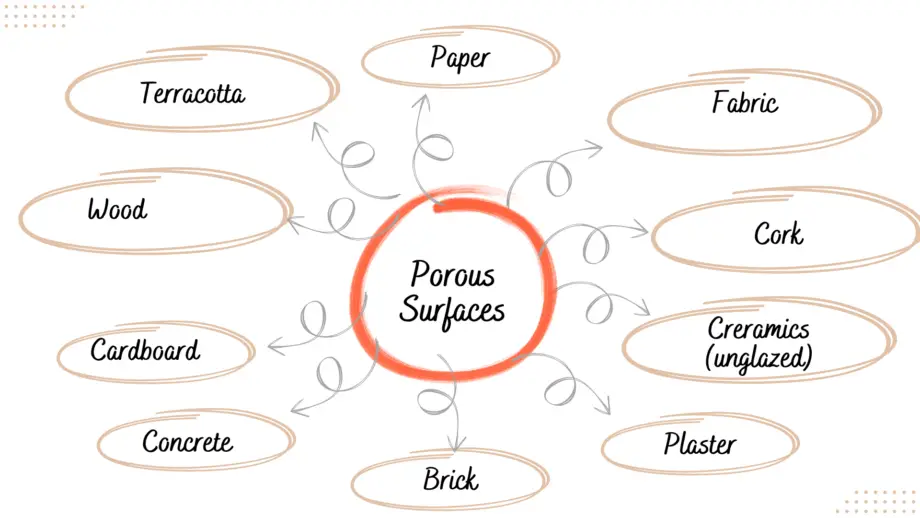
Porous Surfaces

1 Is Spray Paint Permanent - Will it Last Long or Wear Off

Porous surfaces, such as wood or concrete, have small openings or pores that can absorb the paint. When spray paint is applied to a porous surface, it can be more difficult to achieve a smooth, even finish. The paint may also be prone to chipping or flaking over time, especially if the surface is exposed to weather or heavy use.

To improve the permanency of spray paint on porous surfaces, it is recommended to use a primer specifically designed for porous surfaces before applying the paint. This will help the paint adhere better and create a more durable finish.

Non-Porous Surfaces

2 Is Spray Paint Permanent - Will it Last Long or Wear Off

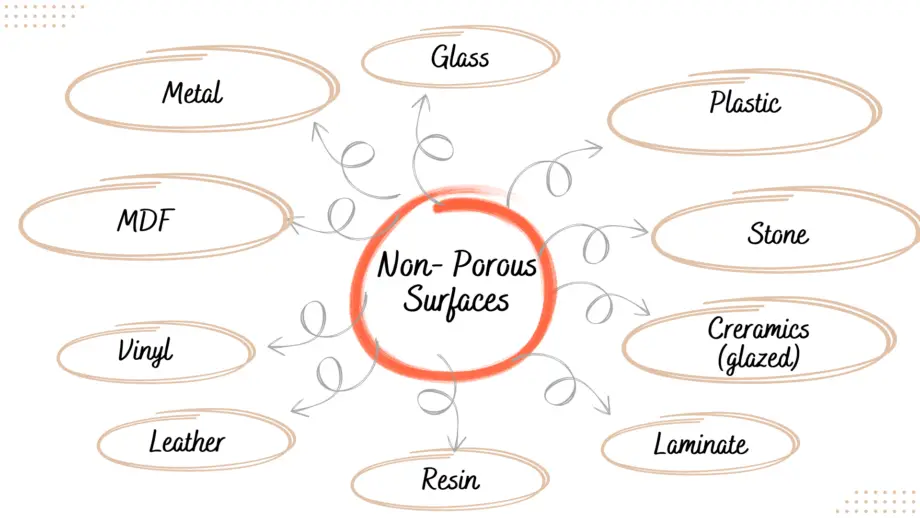
Non-porous surfaces, such as metal or glass, do not have small openings or pores like porous surfaces do. This means that spray paint can adhere better to non-porous surfaces and create a more permanent finish. However, non-porous surfaces can still present challenges for spray paint, as they are often smooth and can make it difficult for the paint to stick.

To improve the permanency of spray paint on non-porous surfaces, it is recommended to use a primer specifically designed for non-porous surfaces before applying the paint. This will help the paint adhere better and create a more durable finish.

What is the Application Technique to Help Increase the Permanency of Spray Paints

Not only the right spray paint but the right application technique plays a crucial role in enhancing the durability of spray paint. Here are certain things to consider while dispensing spray.

Distance:

Keep a consistent distance while applying paint; move it swiftly.

Number of Coats:

To avoid peeling and chipping, apply multiple light coats than applying a single thick coat.

Drying Time:

Give each coat some time to dry before applying the next one, and this trick helps the paint last longer than usual.

Frequently Asked Questions

What to do if Spray Paint sticks to your hand?

Spray painting is fun until it covers your hair, nails, or skin! The best way to remove spray paint from skin is using acetone or nail polish remover.

How Long Does Spray Paint Last?

The paint spray paint, under optimal conditions, can last between two and ten years.

Does Spray Paint Wash Off?

Once you spray the paint and allow it to settle, it will resist water or other cleaning solution.

Are All Spray Paints Permanent?

Not every spray paint is permanent Chalkboard spray paint, and temporary marking spreads can be removed with a damp cloth if the surface is too porous or unclean.

Is Spray Paint Permanent on Metal?

If the surface is prepared well, it will stick.

Can Spray Pain Remove from Rims?

Yes, you can remove spray paint from rims by identifying the material of the rim and using a spray paint remover afterward. Brush it well with a brush and rinse with water

Wrap Up

The answer is that Spray paint has various circumstances, but if I have to sum up, it neither remains forever nor goes off completely. If the spray is applied while considering all the factors mentioned above, it will last between two and ten years which is a fair deal! Because obviously, you don’t want your spray to fade away before the season ends. You can last your Spray paint longer with the right product and technique.

pexels max vakhtbovych 7061065 How To Spray Paint Mirror Frames In 7 Easy Steps

How To Spray Paint Mirror Frames In 7 Easy Steps

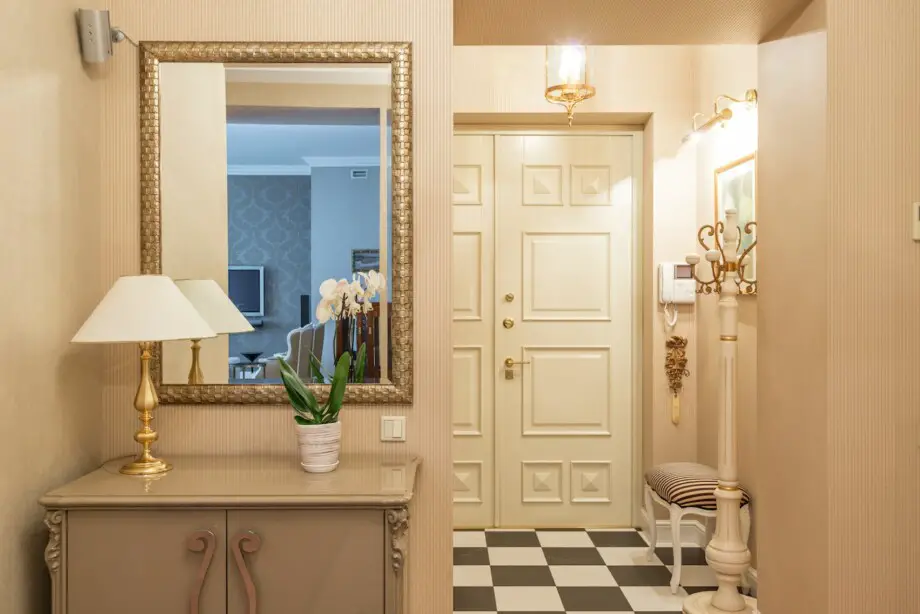
Well-placed mirrors in the living area can make the room appear brighter and more spacious. However, worn-out mirror frames can ruin the aesthetics of your space, regardless of their size.

If you want to spruce up your mirror frames on a budget, spray paints are an excellent alternative to replacing them altogether. All you need are a few supplies and free hours to breathe new life into your mirrors.

Spray painting mirror frames is pretty straightforward. Start by cleaning the surface with a damp cloth and thoroughly sanding it. Next, cover the mirror with paper and tape to avoid stains, and apply two layers of primer. Finally, cover the frame with the color coat of your choice.

Spray painting seems effortless, but you must prepare the mirror frames correctly to ensure the results will last. But don’t worry; I will simplify the process and add a few extra tips to sweeten the deal.

Let’s get painting!

Things you will need

Spray painting mirror frames require different materials and tools, but luckily, you would already have most of them lying around the house. Here are a few things you should keep on standby before you start painting the mirror.

●     Tack cloth

●     Scissors

●     Newspaper

●     Sandpaper

●     Primer

●     Spray paint

●     Painter’s tape

●     And, of course, a mirror that needs some TLC

How to paint mirror frames in 7 quick steps

Step 1: Clean the frame

It’s always best to paint on a clean surface to ensure a smooth finish. Take a tack cloth soaked in warm soapy water and clean the frame thoroughly. Remove all dust and debris before cleaning it again with a dry cloth.

Step 2: Sand the surface

Sanding helps remove any irregularities from the frame’s surface, allowing you to work on an even base. This step is crucial if you’re repainting a frame that has a protective sealant on top.

Using fine-grit paper, sand the frame thoroughly until you’re satisfied with the results.

Pro Tip: When painting a wooden mirror frame, you should fill in any cracks and holes before sanding the surface.

Step 3- Prepare your workstation

Spray painting is undoubtedly fun but can get messy within a few minutes. So unless you want to color your floor along with the mirror frame, spread two to three newspapers or cardboard just to be safe.

Step 4- Cover the mirror

A freshly-painted frame looks spectacular, but if you accidentally get paint on the mirror’s surface, the result can look sloppy! 

Fortunately, this can be easily avoided by covering the entire mirror with paper and painter’s tape. Just make sure not to leave any tape touching the frame itself, or you might miss a spot while painting it.

Step 5- Apply primer

You can skip this step if you’re working with an all-in-one paint.

Start by applying a thin layer of primer on the frame and allow it to dry for at least 15 minutes. Once the first coat becomes dry to the touch, apply another thin layer. The primer creates an ideal base for the paint to adhere completely.

Pro Tip: Opt for white primer if you want to spray paint the mirror frame gold or any other light color, such as silver or gold. But if you prefer to spray paint the mirror frame black or another deep shade, you can use a gray-colored primer.

Step 6- Paint away!

After the final layer of primer is dry, pick up the spray paint can and give it a good shake. Start spraying a thin coat of paint and keep a steady hand to avoid oversaturation at any spot. Make sure you cover the top and the sides of the mirror while painting it.

Allow the first layer to dry before going in with another one. If you achieve your desired shade intensity in 2 coats, your job’s done. But if you prefer a more vibrant color, feel free to apply more layers of paint until you are satisfied.

A bathroom mirror frame requires waterproof paint for lasting results, so make sure to buy waterproof spray paint.

Pro Tip: Allow the primer to dry overnight before your spray on the color coat. But make sure to wipe away any dust the frame collects over time.

Step 7- Peel away the tape

Don’t wait for the paint to dry completely before removing the paper and tape from the mirror. If you wait too long and the paint dries with the tape, parts of the frame’s paint may come off when you pull it away.

Best spray paint for mirror frames

Finding a high-quality and superior finish spray paint is crucial if you want professional results. If you’re wondering how to spray paint wood frames, try the Rust-Oleum Painter’s Touch 2X Ultra Cover. It is an oil-based formula that goes on smoothly and resists chipping and fading. The highlight of this paint is its quick drying time which helps you complete your painting projects quickly.

Black frames look modern and chic, but metallic frames have their own appeal. If you’re a fan of metallic colors, try the Rust-Oleum Pure Gold Spray Paint. This paint is highly versatile and works well on different surfaces. So, whether you are working with a wood frame or want to learn how to paint metal frames, this rust-resistant formula is ideal for both.

FAQs

How do you paint a mirror frame without getting it on the mirror?

The best way to paint a mirror frame without getting it on the mirror is by covering the whole surface with paper and some tape. The only part visible should be the frame.

Can you spray paint a mirror?

Yes, you can spray paint a mirror, but pick a paint compatible with the frame’s material. Before buying one for your project, read more about using water-based paints on wood.

Does spray paint stay on mirrors?

Spray paint lasts if you pick one according to the frame’s surface. You can always add a sealant to the color coat for added protection.

How to spray paint a mirror frame without taking it apart?

Cover the sides of the mirror’s surface entirely if you don’t want to remove the mirror from the frame. The best way to get a secure fit is by measuring the dimensions with a tape measure and carefully cutting the paper according to the mirror’s size.

Conclusion

Spray painting is an inexpensive way of upgrading your home, whether you want to paint a bathtub or a mirror frame. With the correct type of paint and technique, everything is possible!

So, get your painting gear on and grab all the frames that need a makeover. 

Happy painting!

woodwork furniture

Can I Use Water-Based Paint On Wood – 7 Mind-Blowing Tips!

Wood is an outstanding building material that can be used for various projects. However, wooden objects, such as furniture, doors, panels, etc., can lose their shine and color over time. Fortunately, the problem can be quickly fixed with a fresh coat of paint.

The best part about painting wood is the versatility you can achieve in terms of colors and finishes. Whether you want to paint your wooden door a bright yellow or give your table a vintage look in black, paint opens up many options. But what paint to use on wood furniture?

Yes, you can use water-based paint on wood; in fact, it is a popular choice for woodwork as it is effortless to apply and clean. Besides its ease of use, water-based paint dries quickly, allowing you to finish your projects in minimum time.

However, water-based paints are not as durable as oil paints, which makes prepping the wood more important for lasting results. But rest assured, as I will explain how you can achieve a durable finish with water based paint on woodwork without taking the traditional oil-based route.

Types Of Water-Based Paints

There are two types of paints, acrylic, and latex, and each has distinct properties. However, many paint manufacturers use confusing naming conventions, making it challenging to identify which color is acrylic and which is latex.

While both are water-based, it would be best to pick a type according to the surface of your next painting project.

Here’s a quick guide to help you get started:

Acrylic Paint

If you come across a paint label that says ‘acrylic,’ it means the formula contains more acrylic polymers than latex paint. Hence, it will provide better adhesion and superior durability. However, this option is more costly and perhaps not worth buying for interior drywalls. But if you’re looking to color wooden kitchen cabinets and outdoor furniture, acrylic paint is your best bet.

Pro Advice: Water-based acrylic paint is called acrylic latex paint, whereas solvent-based acrylic paint is termed as 100% acrylic. This difference will help you pick the right one from the home store.

Latex Paint

Latex paint is a more affordable, water-based variant with a lower ratio of acrylic polymers. In addition to its reasonable price point, it is also more eco-friendly, making this formula a popular choice among DIY enthusiasts. The only downside to this paint is that it’s not as durable or resilient as acrylic paint.

Regardless of this comparison, latex paint works well on vertical surfaces and indoor wooden surfaces. But applying this water-based paint on outdoor furniture will not deliver the same lasting results as acrylic paint.

Recommended Paint Brands

Krylon COLORmaxx Acrylic Paint

51n3OhokzOL. AC SL1000 Can I Use Water-Based Paint On Wood - 7 Mind-Blowing Tips!

The Krylon acrylic paint is a versatile option that works on various materials, including wood, metal, wicker, plastics, and more. This easy-to-apply paint can be used for indoor and outdoor projects and is available in a wide variety of colors.

Rust-Oleum Acrylic Enamel Spray

Can I Use Water-Based Paint On Wood - 7 Mind-Blowing Tips!

The Rust-Oleum spray is another excellent option for painting wood surfaces. The upside of selecting this variant is that it includes a primer, so you don’t need to buy it separately. Rust-Oleum acrylic paint is available in modern colors such as aluminum, cherry red, ultra matte black, etc., so you have plenty of options to choose from.

Rust-Oleum Imagine Craft & Hobby Spray Paint

71p4rHSSsuL. AC SL1500 Can I Use Water-Based Paint On Wood - 7 Mind-Blowing Tips!

If you’re looking for a quick transformation, the Rust-Oleum Craft paint is perfect, as it dries to the touch in 20 minutes and can be recoated within 1 hour. In addition, it comes in exciting colors like gloss sky blue, azalea pink, satin azure blue, and suede brown.

Krylon Fusion All-in-one Spray Paint

51B2W XR4OL. AC SL1000 Can I Use Water-Based Paint On Wood - 7 Mind-Blowing Tips!

The Krylon Fusion is an ideal option for wood surfaces, whether you’re working on interior or exterior surfaces. The highlight of using this paint is that you don’t need sanding or priming before applying it, which reduces your prep time in half.

Are oil-based paints better for outdoor furniture?

Here’s a question I often get: Should I use oil or water-based paint for exterior wood?

The answer depends on a few factors. First of all, oil-based paints contain high VOCs, which can be harmful to your health. This is why many traditional painters have switched from oil-based paints to water-based alternatives.

However, technology and innovation have made oil-based paints much safer, thanks to lower VOC levels. In addition, if you plan to color an outdoor project, any fumes from the paint will dissipate quickly.

That said, oil-based paints are more difficult to use than water-based paints. They take longer to dry and require significant prep work. So, if you can achieve a similar result with an easy-to-use water-based alternative, why take the harder route?

Pro Tip: Remember to seal water-based paint for wood with a top coat for outdoor projects. It will help increase the surface’s resistance to moisture and avoid wear and tear signs.

Can you use water-based paint on oil-based coatings?

A common problem DIYers face when using water-based paints on wood is that the previous coating is usually oil-based. This makes the application challenging and also affects the final result. So, how can you achieve a flawless finish with water-based paints that doesn’t just peel away?

The answer is Thorough prep work!

The idea is to clear the oil painting from the surface before you apply any type of water-based paint. While removing the base coat completely can be pretty time-consuming, sanding the surface well enough can still provide adequate results.

In addition to sanding and dusting, adding two layers of primer helps build a clean and smooth foundation for the water-based paint to adhere to.

7 Tips for achieving a durable finish on wood with water-based paints

If you’re wondering whether water-based paint is suited for woodwork, the answer is yes, but there are a few conditions you must meet. Here are a few tips to help you get a flawless finish on wooden surfaces.

  • Always sand in the direction of the wood’s grain, or you may create noticeable scratches on the surface.
  • Sanding is crucial for a smooth surface but remember to clean the area with a vacuum cleaner and a bristle brush attachment once you’re done.
  • Using a damp cloth after sanding also does the trick.
  • Do not apply water-based paint directly on a previously painted surface. Instead, remove the coating with a scraper, followed by thorough sanding.
  • If you plan to apply matte or chalk paint on glossy wooden furniture, it will only stick if you sand the glossy coating away.
  • Always apply a water-based primer on the wooden surface before the color coat.
  • If you’re painting a high-traffic area or furniture that is used often, it’s best to seal the paint with a sealer for longevity.

You can learn more about using chalk paint on outdoor furniture if you prefer a matte and vintage look.

FAQs

How do you paint wood with water-based paint?

To paint wood with water-based paint, it’s crucial to prepare the surface for maximum adhesion. This includes sanding, priming, and sealing the surface to ensure lasting results.

Should I use water-based paint on wood?

Water-based paints are a great option for painting wood as they are easy to apply and deliver lasting results. In addition, they don’t contain VOCs, making them ideal for indoor projects.

What kind of paint do you use on wood?

You can use both oil-based and water-based paints on wooden surfaces. If you prefer water-based paints, you can choose acrylic, latex, and chalk paint, depending on the finish you want.

What are the disadvantages of using water-based paint?

Water-based paints are difficult to use in lower temperatures and have poor adhesion on metal and shiny surfaces. Another problem is that water-based paints leave behind more brush strokes if not applied correctly.

What paint can you use on wooden doors?

You can easily use water-based paints to color wooden doors, but it’s essential to use a primer before the application. Moreover, you should seal the deal with a top coat for added protection and longevity. You can find out more about which paint finish is best for interior wooden doors in this blog.

Conclusion

Wooden surfaces are tricky to work with since they are organic. However, the correct technique can make the process easier and provide a lasting finish. Water-based paints are excellent for wooden surfaces since they let you choose between various finishes. So, if you’re about to start a new wooden paint project, don’t hesitate to reach out for water-based paints.

pexels mike b 9735323 How To Paint Car Rims Like A Pro In 10 Easy Steps

How To Paint Car Rims Like A Pro In 10 Easy Steps

Any car, regardless of its age or condition, looks better with a great set of rims. If you take a basic economy car and fix the look of its wheels, you can quickly transform it into a respectable ride.

Old and rusty rims can ruin the appearance of your tires and, ultimately, your car. Fortunately, there are ways to reverse this situation. All you need is a primer, a spray paint of your choice, sandpaper, and soapy water. Sounds simple enough, doesn’t it?

Start by cleaning the rims with soapy water to remove dirt and grease from the surface. Using sandpaper, clear away rust stains and create a smooth base for the primer. Spray on the primer in even layers, followed by a colored coat, and you’re done!

In this article, I will explain in detail how you can achieve a professional-like finish with a DIY paint job. So, let’s jump right in.

Can You Paint Your Rims Yourself?

Yes, absolutely!

Although auto shop owners make painting your rims at home sound like an impossible task, with the right tools and equipment, you can paint your rims yourself at home.

Rims are either made of steel, chrome, or aluminum. So, you must select the primer and color spray according to the material of your wheels. Before buying spray paint, remember to do thorough research and determine what your rims are made of.

I have also included a few suggestions for primers and paints to help you get started.

If you’re struggling with a previous paint job gone wrong, you can remove spray paint from your rims before coloring them again using the step in our blog.

A step-by-step guide for painting your car rims

Now, let’s get down to the real business.

Painting your car rims should take about two hours in total if you have all the equipment and tools ready. Here is a list of things you will need for the project.

Things you will need:

  • Soap and water
  • Wax and grease remover
  • Metal wire brush with angle grinder or sandpaper
  • Protective gear
  • Painter’s tape
  • Primer
  • Color coat

Let’s start the painting process now.

 Step 1: Remove tires from the car

The first step is to remove the tires from your car. You will need a lug wrench to loosen the lugs. Next, jack up the car and use the jack stands to stabilize it. Remove all the lug nuts and pull the wheel away from the vehicle.

Remove all four wheels.

Step 2: Remove the rims from the tires (Optional)

This step is optional because you can paint the rims even if they’re attached to the tires. However, removing them helps reduce your prepping time and the chance of overspraying. Also, this way, you can paint all the way to the edge of the rim without any interference.

So, if you have the specialized equipment necessary for detaching the rims, go ahead and do it. But if you don’t have the right tools, it’s better not to attempt the feat at home as you can damage the wheels.

Step 3: Detach the valve stem (Optional)

Just like the tyres, removing the valve stem gives you a free hand when painting. However, it is up to you to take it out or let it be.

We will discuss how you can cover it up if you keep the valve stem on.

Step 4: Clean the wheels with soap and water

Now the rims are ready to be prepped, so start cleaning the surface thoroughly.

Spray soapy water on the wheels and scrub the surface with a brush. You can also use a washcloth, but a brush does a better job at cleaning. Make sure to remove any dirt on the rims and wipe it dry once you’re done.

Step 5: Use a wax and grease remover

Water washes away dirt and debris but doesn’t work as well on oil and grease. That’s why you need to bring in a solvent to dissolve things that water can’t.

Apply the wax and grease remover to the trims to clear away any oil or grease residue on the wheels.

Try me: You can use rubbing alcohol to wipe the surface of the rims because it works the same way as a grease remover.

Step 6: Sand the surface

We want to make the surface of the rims as smooth as possible, so the primer adheres to it perfectly. The best way to create a solid foundation is by sanding the wheels thoroughly. This will also help remove any rust from the rims and make you achieve a professional finish.

You can start by using 300-grit sandpaper to sand the wheels. Slowly move onto 500 and then 800 grit sandpaper to get a smooth surface. Make sure to get into every crevice and remove any rust on the surface entirely.

A quicker way to achieve better results is using a fine metal wire brush on an angle grinder. If you’re dealing with a lot of rust, you may need to switch to a thicker metal wire brush.

If you’re working on aluminum wheels, sanding them will take less time than steel wheels. So if your car has steel wheels, be prepared to sand for at least 10 minutes.

Pro Tip: Wear protective eyeglasses and a mask if you plan to use an angle grinder for the heavy lifting. The metal wires on the brush tend to shoot, so you need to be careful.

Step 7: Clean the sanding residue

The next step is to clean all the sanding debris to help the primer go on smoothly. You can get the desired effect with an air compressor or a leaf blower. The idea is to blow away all the dust you’ve created from sanding off the wheel.

For good measure, wipe the rims clean with a paper towel soaked in rubbing alcohol. The solvent is perfect for removing any residue and is also highly volatile, which means it dries quickly.

Step 8: Cover the tires

If you haven’t removed the rims from the tires, you must cover the areas you don’t want to paint accidentally.

You can use paper and painter’s tape to mask off the tires. Remember to tape closely around the rim’s edge to get a clean finish.

There’s another trick that you can use for this step, though. Take a bottle of tire shine gel and apply it to the outside of the tires, being careful not to touch the rim at all. If you get some gel on the wheel by chance, wipe it away with rubbing alcohol immediately because the gel will prevent the paint from sticking onto the surface.

And that’s precisely how the layer of tire shine gel will protect your tires. If you get any paint on it, you can simply wipe it off without any hassle.

The second trick is to use good old index cards. Place the cards one by one between the rim’s edge and the tire, creating a circle of index cards around the wheel. Now you don’t have to worry about messing the tire’s surface with overspraying.

If you haven’t removed the valve stem, you can cut the finger of an old glove and place it over the valve to protect it from paint.

Step 9: Apply primer

The primer is crucial to getting a good paint finish. That’s because it helps cover minor surface imperfections and gives the paint a good surface to bond to.

Remember to select a primer that works on the metal surface and is ideal for automotive use. Here are a few options you can consider:

Dupli-Color Scratch Filler & Primer

It has a fast-drying formula that’s good for filling deep scratches while providing a rust-resistant finish.

61j pbOUgAL. AC SX300 SY300 QL70 FMwebp How To Paint Car Rims Like A Pro In 10 Easy Steps

Rust-Oleum Painter’s Touch 2X Ultra Cover

This is an oil-based primer with a comfort spray tip to reduce fatigue from continuous spraying. It delivers a matte finish that’s chip-resistant and durable.

61CJaoPw0lL. AC SX300 SY300 QL70 FMwebp How To Paint Car Rims Like A Pro In 10 Easy Steps

Rust-Oleum Stops Rust Automotive Primer

This special primer has an oil-based formula specially designed for automotive surfaces. It provides a flat finish that is rust-resistant and long-lasting.

71CQkT3kzGL. AC SX300 SY300 QL70 FMwebp How To Paint Car Rims Like A Pro In 10 Easy Steps

Rust-Oleum Automotive Sandable Primer Spray Paint

It is an excellent option if you’re looking for a sandable primer. Formulated for automotive surfaces, the primer has a special Stop-Rust formula that’s ideal for prepping cars.

712bUF2WYKL. AC SL1500 How To Paint Car Rims Like A Pro In 10 Easy Steps

Now let’s move on to spraying the primer. Remember to keep your hand moving steadily and never start or stop spraying when the nozzle is pointed directly at the wheel. Instead, start from the outside, bring the can toward the rim, and keep spraying until you have reached the other end of the tire.

Apply the first coat of primer, ensuring it’s light and even. Don’t worry about coverage at this point because you will need multiple layers of primer to build a solid base.

Allow the first layer to dry for 2-5 minutes before applying the second coat. It would be best if you sprayed from different angles and sides for this coat to get complete coverage. You should not be able to see any bare metal at the end of the second coat. Again, let the wheel dry for 2-5 minutes.

For the final layer of primer, you can slow down the movement of your arm. This means you will get a slightly thicker coat, but we don’t want it too thick.

Pro Tip: If the air temperature is less than 80 degrees Fahrenheit, place the primer in a bucket of hot water before using it. This trick will help improve the spray pattern and reduce the chances of the orange peel effect.

Step 10: Spray the color coat

Allow the final layer of primer to dry for at least 10 minutes before going in with the color coat. If you’re not sure about the best paint for rims, you can check out the following options:

Dupli-Color High Performance Wheel Paint

A paint specially designed for wheels, making them ideal for your rims. Another perk of using this brand is that its colors are tested and approved by vehicle manufacturers so that you can find a perfect match to the original factory finish.

51qpB3mvrEL. AC SL1000 How To Paint Car Rims Like A Pro In 10 Easy Steps

Rust-Oleum High Performance Wheel Spray Paint

It is another option specifically designed for rims. The oil-based formula dries to the touch in under 10 minutes and provides a glossy, high-shine finish. 

71KKJC0NOdL. AC SX300 SY300 QL70 FMwebp How To Paint Car Rims Like A Pro In 10 Easy Steps

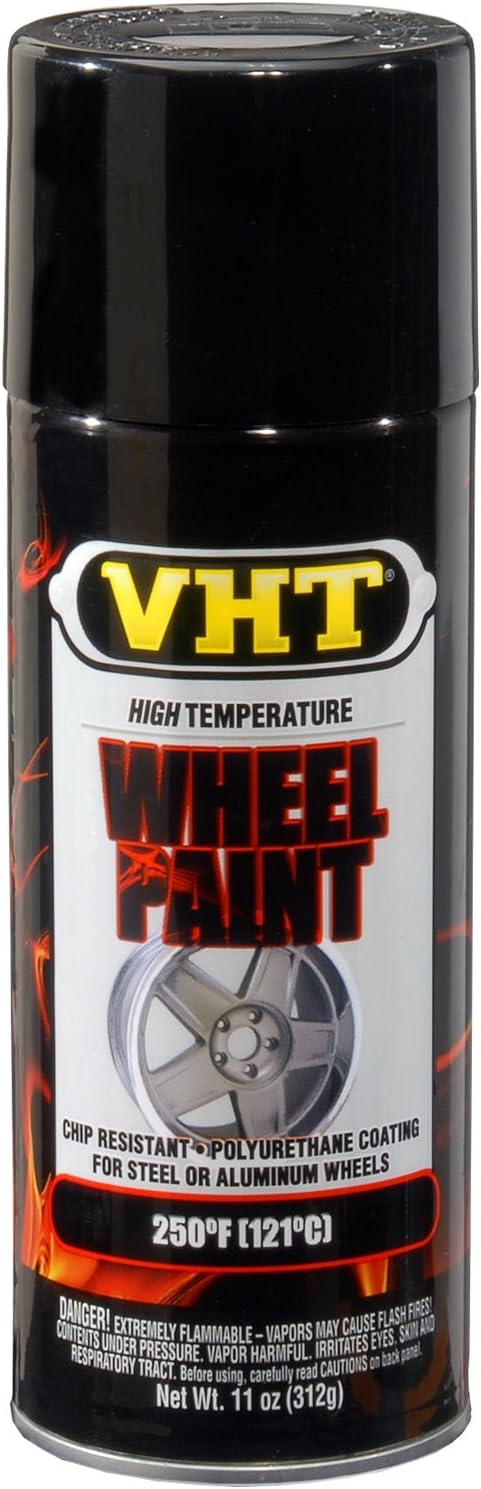
VHT Gloss Black Wheel Paint Can

This one is perfect for aluminum and steel wheels. The paint offers heat and chemical resistance while protecting the rims from the effects of brake dust, salt, sand, and rocks.

61GE0trasUL. AC SL1500 How To Paint Car Rims Like A Pro In 10 Easy Steps

You need to apply the rim spray paint the same way as the primer- in multiple coats. You will need at least 3 coats of color to achieve full coverage. Remember to paint from different angles and sides, so you don’t miss a spot on the rims. Wait 5 minutes between each coat, so the first one dries completely before you paint on the second layer.

When you’re done painting the final layer, remove the index cards you’ve placed around the rims. Allow the wheels to dry for two hours before attaching them to your car.

FAQs

Is spray painting your rims a good idea?

Spray painting your car rims is a great idea if you want to improve their appearance without spending a hefty amount at the auto shop. Remember to buy paint specially designed for automotive surfaces for a lasting finish.

Can you paint alloy wheels?

Yes, you can paint alloy wheels, but there is a high chance of peeling, so you need to buy special paint formulated for alloy automotive surfaces.

How much does rim repaint cost?

While the actual cost may depend on the shop you go to and the size and condition of your wheel, the average price of a professional rim paint job is between $100 and $200 per wheel. So, you’re looking at a total cost of $400 to $800 approximately.

Can you paint over already painted rims?

Yes, it is possible to paint over rims that have been painted previously. Since we sand the surface of the wheels before painting, it helps remove any imperfections in the previous layer and helps create an even base for the new paint.

Can you use Rust Oleum peel coat on rims?

The Rust-Oleum Peel Coat is a rubber coating perfect for customizing different car parts, like rims, hoods, and more. It protects your wheels against rust and road debris and allows you the freedom to peel the paint off once you get bored of the color.

Conclusion

You can easily upgrade your ride’s look with spray paint, whether you want to color the rims or spray paint your leather car seats. As long as you have the right equipment and technique, you can nail any paint project like a pro!

pexels megapixelstock 18296 How Much Does It Cost To Paint Car Rims - Is DIY Cheaper?

How Much Does It Cost To Paint Car Rims – Is DIY Cheaper?

People say that your ride reflects your personality, so if your car is in top shape, it makes you look good. However, worn-out exterior parts, such as car rims, can ruin the appearance of your vehicle. 

Fortunately, you can upgrade your car by painting the rims, which leads you to the question: “Should you go for a DIY or a professional paint job?”

Ultimately, the cost of each option becomes the deciding factor. So, how much does it cost to paint your car rims?

For each wheel, a professional rim painting costs around $100 to $200. This means you must shell out $400 to $800 to have your rims painted professionally. On the other hand, a DIY rim painting costs $30 to $100 per wheel, depending on the products you use.

If you are on a budget but still want your wheels to look as good as new, a DIY paint job will cost you way less than a professional one and also offer good results.

Stay with me to find out how to calculate the actual cost of a DIY rim painting job and the factors that affect your ultimate paint budget.

HOW MUCH DOES IT COST TO GET THE RIMS PAINTED?

Brake dust is the number one enemy when it comes to your car’s rims.

Regular driving can form a coat of dust on your rims, making them look dirty and dull. In addition, off-road drives only make matters worse.

When you repaint your rims, it adds to your ride’s aesthetic appeal and also increases its value.

We have already established that a DIY paint job will cost much less than a professional one. However, it will not deliver perfect results, so how do you select which one is right for you? By comparing its cost with your budget, of course.

What is The Cost of a Professional Rim Paint Job

Whether you opt for painting your wheels or a complete alloy wheel powder coating, the average cost of a professional paint job is about $100 to $200 for each rim. But before you choose one, getting painting estimates from more than one painter is recommended to get high-quality results at fair prices.

Another option is to get your rims painted by the same dealership from where you bought the car. Wheel repair and repaint are usually included in the warranty or through insurance, but you may have to bear the additional cost if your rims are extremely damaged.

What is The Cost of a DIY Rim Paint Job

Painting your rims at home is easier if you know how to paint car rims. With the right tools and techniques, you should be able to achieve lasting results even without professional help.

If you decide to paint your car rims yourself, be prepared to spend around $30 to $100 per wheel. The cost of DIY rim painting will vary depending on the type of paint you use, its quality, and the area coverage you require. Other factors contribute to the difference in price range, but we will discuss them in detail later.

Getting your rims painted professionally means you will be paying for the paint as well as labor cost. However, if you paint the rims yourself, you can straightaway save the labor cost and make it zero.

If you want to paint your car’s rims, pick a day when you can spare around 3 to 4 hours because that’s how long it will take you with all the equipment required for painting.

HOW O DECIDE THE AVERAGE COST TO PAINT 4 RIMS

When calculating the average cost for painting 4 rims, it’s important to understand the breakdown of the costs. This will help you reduce the overall cost if your budget is low.

The following factors will affect the total cost of painting car rims:

  • Cost of paints
  • Cost of labor
  • Variable costs

Cost of Paints

You first need to determine the type of paint you want to use. Different paints have varying costs, so your choice of color will ultimately decide how much you will have to spend on the DIY.

Another thing to remember is that every paint has different variants in terms of quality. So, if you select a high-quality color over a low-quality one, the total cost of paints will be higher too.

Here are a few standard paint options for your rims.

Plasti Dip Paint

Plasti-dip is a form of sprayable rubber that was initially designed for coating tool handles. Over time, it has become a favorite among vehicle owners for rim coating.

This paint is very easy to apply, making it an excellent choice for painting your car rims. If you buy a 22oz bottle of Plasti-Dip, you will need 4 cans to paint all 4 wheels. Since the cost of 1 can is around $15 to $20, 4 cans will amount to up to $60 to $80.

The cost will be even less if you buy it in a pack of 4. For example, 4-pack Plasti-Dip Rubber Coating Spray costs a reasonable amount, which is definitely a smarter investment.

Spray Paint for Rims

Several spray paints are designed especially for rims, such as the Rust-Oleum High Performance Wheel Spray Paint and Dupli-Color High Performance Wheel Paint.

Spray paints cost lesser than Plasti-Dip paints, so if you want to reduce the cost of your project, this is a paint option you can try.                                      

You will need approximately 4 to 5 cans of spray paint to color all 4 rims. So, if one paint can costs about $15, the total should be around $60 to $75.

You can see more details on best spray paints for car exterior including wheels and rims here, discussed in depth.

Truck Bed Liner

This is another paint option for your rims that is cheaper than Plasti-Dip. A truck bed liner paint offers long-lasting results with a textured finish.

You need 2 cans of 32oz paint to coat 4 rims. Since a truck bed liner costs around $20 to $30, the total cost of using this paint will be $40 to $60. If you buy the Rust-Oleum Automotive Truck Bed Coating, it will cost you about $44 to paint all 4 rims.

Powder Coating

The final option, but an excellent one, is powder coating your rims. This delivers the best finish out of all the paint types but applying a powder coat is more complex than spraying regular paint.

When you apply a powder coat, it’s important to do so with industrial tools. The paint has to be sprayed electrostatically and cured under heat. Therefore, if you are an amateur with no experience in powder coating, you may not be able to achieve the desired results.

Powder coating costs $20 per gallon, but you also need a paint gun which can be brought for over $100. Therefore, the total cost of DIY powder coating can amount to $150 to $250.

More details on best automotive spray painting guns can be read here.

Powder coating is a pricier and trickier option, so if you don’t get the job done well, you may end up wasting considerable money.

Cost of labor

When you hire a professional to paint your rims, you have to pay them at an hourly rate. Most of the time, the cost of skilled labor is the same as that of paints. On average, professional labor costs around $500 to $1000 in total for all 4 rims.

You should keep in mind that the cost of professional labor varies in different countries and cities, and it’s pretty normal to pay a high price for the same service in a highly urbanized city.

On the other hand, for a DIY job, you are the laborer and probably working for free. So, all you need to invest is 3 to 4 hours of your time to paint the rims yourself.

Varying costs

Finally, you must decide what you want to achieve by painting the rims. Do you only need to recoat the wheels with a fresh layer of paint, or are your rims completely bare? This will help you determine how much paint you need to complete the project.

If you want to recoat your rims, the cost of paint will be lower compared to a new coat of color on bare wheels.

If you want to remove paint from your rims then you can read a detailed article here and for our review over paint strippers here, for an easy paint removal process. 

WHAT IS THE AVERAGE COST TO PAINT RIMS PER SQUARE FOOT?

If you’re still unsure whether to go for a professional paint job or paint the rims yourself, here is a breakdown of the average cost per square foot of both options.

Average Cost Per Square Foot of DIY

Here is a simple way to calculate the cost per square foot:

  • If you’re working on 16” tires, the area of rims is equal to 1.3963 square feet
  • If you multiply that area with 4 rims, you get a total area of 5.5853 square feet
  • If you use 5 cans of spray paint costing $15 each, you are spending $75 on paint altogether
  • $75 / 5.5853 square feet = $13.43 per square foot

Average Cost Per Square Foot of a Professional Paint Job

Now, let’s look at the average cost per square foot of hiring a pro.

  • If the cost of getting 1 rim painted equals $150, you’d be paying a total of $600 for 4 rims.
  • $600 / 5.5852 = $107.43 per square foot

Hence, there is a considerable difference between painting your rims at home and getting them painted professionally.

FAQS

Is it better to powder coat or paint wheels?

Powder coating creates a stronger bond with the rims and provides better coverage than liquid paints. So, powder coating your car rims is a better option if you are looking for lasting results.

Is rim paint durable?

The key to making your rim paint durable is to use colors specially formulated for automobile rims. In addition, you should also ensure the surface is thoroughly prepped and primed for maximum paint adhesion.

Is it cheaper to paint or powder coat rims?

It is definitely cheaper to paint your rims than powder coat them. While powder coating provides a more durable finish, the process of applying it is too complex for a DIY paint project.

Can alloy wheels be repainted?

Repainting your alloy wheels is an effective way to revamp their appearance and increase your car’s value. With so many colors and finishes available, you can customize your rims effortlessly.

How much does it cost to paint rims matte black?

Getting your rims painted matte black will professionally cost around $100 to $200. However, if you paint the wheels at home using specialized paint like the Rust-Oleum High Performance Wheel Spray Paint Matte Black, the paint will cost around $44 to $55. 

CONCLUSION

As we reach the end of our article, it’s evident that the cost of painting your car rims at home is much lesser than a professional job. However, you should prep and prime your rims correctly to make the paint finish last, or else it will end up costing you more with each repainting session.

Keeping your car in top shape is a great way to maximize its value and enhance its aesthetic appeal. From painting the car’s rims to painting your car’s hood or giving your bumper a facelift– there are many ways to upgrade your car’s outer appearance.   

pexels wangchen tsomu 8436382 Can You Spray Paint Trim- Renovate Your Home In 9 Easy Steps

Can You Spray Paint Trim- Renovate Your Home In 9 Easy Steps

Your home is your haven, but everything can lose its appeal over time. Fortunately, you can spruce up the look of your house by repainting the trims. Whether you choose a bright color or paint it a classic white, freshly painted trims can elevate your home’s interior without costing you an arm and a leg.

You can easily spray-paint trims to make them as good as new! Start by prepping the room with tape and paper. Next, clean the border and fill up any nail holes. Sand the surface so the primer can adhere correctly. Caulk the gaps between the baseboard/ walls and trims. Apply primer, followed by two coats of paint.

Spraying your trim always gives a better finish compared to brush application. However, spray paint means more mess and, therefore, more clean-up. I will tell you how to prepare your trims so there’s minimum clean-up for later. With my tips, you will achieve professional-looking results without spending on a pro-paint job.

Is it better to spray or brush paint trim?

Many homeowners wonder whether it’s better to brush paint or spray their trims. In theory, spray paint will always result in a smoother and even finish. If you are new to painting, brush application will leave ugly brushstrokes that are impossible to cover.

Spray painting is the best option in new construction where trims aren’t attached to the baseboards. But in an existing home, spray painting your trim will cause you a ton of extra work you might not be willing to do.

So, it all comes down to how much time and effort you’re willing to dedicate to the project. Another deciding factor would be the finish you’re after.

If you want to maintain the quality of the paint job regardless of the extra work it would require, spray paint your trims by all means. But if you’re on a tight schedule and don’t mind the look of brush strokes, you can brush paint all your trims.

How to spray paint trims

I have outlined the process in a step-by-step guide to help you spray paint your trims quickly. If you want to brush paint instead of spray, the following steps will remain the same. The only difference is that you will use paint and brush to do the priming and painting.

Let’s begin.

1. Prepare the floor

Spray painting can get messy very quickly, but if you prepare the surrounding areas properly, you should have a much easier time cleaning up. You will tape and paper –lots of it.

Prepping the floor

Place the paper on the floor and tape it so that one end is on the paper while the other is tucked under the trim. Take your time placing the tape in a straight line, so the result looks neat and sharp. If you have carpeted floors, tuck the inside edge of the tape under the trim but over the carpet.

Dragging a drop cloth everywhere you paint can be time-consuming and leave paint smears on the floor. The best way to cover your floors is with a 36″ rosin paper roll. This way, you can paint without fearing the paint getting on the baseboards.

Prepping the wall

Apply tape on the upper side of the trim as well, making a straight line between the edge and the wall.

Prepping for windows

If you’re painting the trims on your windows, apply a strip of tape and paper on the window, glass, or any other surface you don’t want to paint accidentally. You should also remove window coverings and cranks before you start.

Prepping for door trims

For door trims, you can remove the door and hinges or cover the two with tape and paper.

2. Clean the trims

Regardless of the project, cleaning the surface you will paint is crucial. Start by vacuuming the room with a shop vac to remove all dust from the area.

Vacuuming might not be enough if you’re painting the trims in your kitchen or a similar area. You can wash the trims with warm water and soap, cleaning up any oily residue or grease from the surface.

Once the trims are clean, wipe away the soap residue with a clean cloth.

3. Repair holes

If you’re going to paint your trims, any holes or cracks you leave will show up as a contrasting black and ruin the final result. Therefore, fill all the nail holes with spackling paste to achieve a smooth surface.

Refrain from filling the gaps between the walls and the trims because a flexible caulk works better for that surface.

4. Sand the trims

Once all the nail holes are filled, start sanding the trims to smooth down the surface. Sanding the surface also helps the primer bond properly with the trim being painted.

Take a medium grit sanding sponge and start sanding the surface in a back-and-forth motion. The good thing about using a sponge is that it conforms to the trim’s shape and prevents slivers.

After you’ve sanded thoroughly, clean the trims and the surrounding areas with a vacuum cleaner. A clean work area means fewer chances of dust and debris ruining your finish.

5. Apply a primer

When selecting a primer and paint for your project, make sure to choose the same type. For example, if you’re going to use water-based paint, then buy a water-based primer to accompany it. Similarly, you should select a water-based top coat to finish the paint job.

I suggest using water-based paints for residential homes primarily because of the VOCs in oil-based paints that can stink up your house. In addition, cleaning up oil-based paints is challenging because it doesn’t just wash off; you have to use a paint thinner to remove it.

Since painting the trims requires moving around the whole house, the clean-up after using an oil-based paint could be a disaster.

Spray a coat of primer to prepare the surface. The smoother the foundation, the better your final paint application will be. The Rust-Oleum Painter’s Touch 2X Ultra Cover is an excellent flat white primer for this project.

71skbuiHARL. AC SY879 Can You Spray Paint Trim- Renovate Your Home In 9 Easy Steps

6. Sand the surface again

Allow the primer to dry completely before sanding all the trims again. If you’re wondering whether it’s necessary to sand the surface again, you should remember that quality paint jobs require several rounds of sanding.

This time, use a 3M fine-grit sanding sponge, as it helps make the primer extra smooth. Once you’re done, vacuum the trims and the room to remove any dust from your work area.

7. Caulk the trim gaps

You can caulk the gaps before priming the surface, but I prefer to do it later for a few reasons. For starters, primed trims make the cracks even more apparent. It makes your caulking job easier and also saves time from having to caulk areas where it’s not needed.

Secondly, primed and sanded trims significantly reduce the chances of slivers. And finally, your trim is very smooth after all the above processes, allowing you to lay a fine bead of caulk.

To caulk the trims, you need a dripless gun, paintable caulk, and a wet cloth. Snip a small piece off the tube to neatly squeeze the caulk into the gap. Start laying a bead of caulk and pause to go over it with a wet rag. This pushes the caulk into the gap and makes it look neat and smooth.

Try not to overdo the caulking and keep it from coming out or over the gaps. Allow it enough time to dry before painting the surface. You don’t need to sand the surface after caulking.

8. Start painting

Now that your trims are primed, sanded, and caulked, we can finally move on to the color coat. For interior projects, creating an ideal temperature and humidity level is recommended for the best results.

Shake the can for a good five minutes and check for any clogged nozzles. If you’re working with old paint, check its expiry date and spray on a spare cardboard sheet to ensure the spray paint has not expired. Spray one coat of paint and wait for 15 minutes to go in with the second one.

If you’re working on several trims at the same time, finish painting and circle back to where you started for the second coat.

9. Clean up

You’re in the final stretch now. Once your top coat has dried completely but not cured, pull the tape around the trims and remove all the paper you’ve spread on the floor. Don’t wait too long to pull the tape, though, as paint drips on the floor will get very hard to remove later.

Painting trims or walls? Which one to do first

Here’s a question I have heard many times: “Should I paint my trims before I paint the walls?”

The answer is yes! Here’s why.

A painted trim has already been prepped and primed. So when you start painting the walls, you can save time creating a surface for the tape. You simply tape a straight line on the trim and paint the walls.

Secondly, if you paint the trim later, it means you didn’t caulk it to the walls before it was painted. So, when you spray paint the trims at the end, the paint will flow from the trims to the caulk and onto the walls.

Finally, the paint you use on the trims is harder compared to wall paint. For this reason, when you tape the wall to paint the border, there’s always a chance of that wall paint pulling off with the tape. Sometimes, pulling the tape also results in lifting the top layer of paper from your drywall along with the color, which could be a catastrophe.

Hence, it is recommended to paint the trims before moving on to the walls.

FAQs

Can you use can spray paint on the trim?

You can easily spray paint your home’s interior and exterior trims if you sand and prime the surface properly before applying the top coat.

Can you paint wood trim with spray paint?

The best way to paint wood trims is by using spray paint specially designed for wood surfaces. The result will not be long-lasting if you use other variants that are not meant for wood.

Should you spray or hand paint trim?

Spraying your trims will give you a smooth and clean finish, but it’s a time-consuming process. You can hand paint your trims if you are okay with the brush strokes and have limited time for the project.

What kind of paint should be used on trim?

Trims are considered a decorative addition; therefore, the paint you choose should bring out its details. Semi-gloss, satin, gloss or high-gloss paint finishes are best suited to trims.

Conclusion

Repainting your trims helps brighten your home and makes the walls and décor look more attractive. Fortunately, spray painting is a quick way to refresh your living space while staying within a DIY budget. 

pexels inline media 5232618 Can You Spray Paint Car Radiator- Revive It In 8 Easy Steps

Can You Spray Paint Car Radiator- Revive It In 8 Easy Steps

Your car’s radiator helps eliminate heat from the engine while you drive. The constant movement in the radiator causes considerable wear and tear, and you might notice its paint fading and becoming dull. Don’t worry because you can fix this problem at home by spray painting your car’s radiator.

You can spray paint your car’s radiator by draining the coolant first. Next, remove the radiator from the car’s engine bay and scrub it with a wire brush and cleaner. Strip the old paint and clean any residue with mineral spirits. Finally, apply three to four coats of spray paint before reinstalling it.

Painting a car’s radiator is as straightforward as painting a car’s hood. As long as you know all the steps, you should be able to do a good job. I have made it easier by breaking it down into 8 quick steps that you can follow along to repaint your car’s radiator.

Why painting the car radiator black is a good idea

You must have noticed that car radiators are usually painted dull black. The reason is that the black color is a good radiator and absorbs heat. It emits the heat generated by the engine through radiation. This allows the car’s engine to cool down quickly.

If you decide to paint your car radiator, you should stick to the same color as it has a purpose. Just make sure to use high-quality spray paint that can withstand high temperatures. Buying low-quality paint can decrease your radiator’s efficiency and performance.

A step-by-step guide for painting the radiator with black spray paint

Now that we’ve decided on the color for our radiator spray paint let’s discuss the steps you need to follow to get the perfect finish.

Step 1- Drain the Coolant

The first step is to drain the coolant from the radiator. Depending on the model of your car, you may find the drain located at the bottom of the radiator. Open the valve and remove all the coolant. It’s up to you to discard or store it in a suitable container for later use.

Step 2- Disconnect the radiator

If you want to ensure a good paint job, removing the radiator from the engine bay is recommended. You can refer to the car’s manual for instructions on disconnecting the radiator safely. Since every vehicle is different, take your time examining how it is installed to determine how you can remove it.

Apart from bolts, you will also need to detach any coolant hoses connected to the radiator.

Step 3- Clean the radiator

Wash the radiator with water and soap to remove dust and dirt from its exterior. Use a wire brush with the cleaner to scrub away any oil and grease on the radiator. Once you’re done, clean the surface with a dry cloth.

Since you’ve removed the radiator from the engine bay, you can have it pressure-tested for leaks before painting it. Take it to your nearest radiator shop so the professionals can check it and repair any bent cooling fins if necessary.

Step 4- Strip the old paint

If the existing paint on the radiator is chipped or peeling away, painting on top of that surface is not a good idea. Therefore, strip the old paint with a paint stripper.

Apply the paint stripper on the car’s radiator and let it sit for a few minutes. Follow the instructions given on the stripper’s label to determine how long you should wait. When you see the paint bubbling, wipe the paint stripper with a clean rag. You may need to scrub the area to remove the paint completely.

Step 5- Clean the surface with mineral spirits

Take a clean rag and soak it in mineral spirits. Wipe the radiator’s surface with the cloth to remove any oil and residue from the paint stripper.

Step 6- Apply a coat of primer

Primer helps spray paint adhere to any surface it’s applied to. Make sure to select a primer designed for metal surfaces. You also need it to withstand high heat since the radiator is placed inside the engine bay.

The VHT Engine Enamel Primer is a good choice for this job as it easily endures temperatures up to 500 degrees when cured correctly.

You should apply 2 thin coats of primer, allowing drying time between coats. You can check the primer’s label to find out how long you should wait before applying the first color coat.

Step 7- Apply radiator spray paint

Once the primer is dry, spray a light and even layer of radiator paint. Let it dry for a few minutes before applying the second coat. You may need three to four layers of color coat to achieve solid coverage.

Allow the paint to dry completely for a few hours. If you can leave it overnight, that would be even better.

Step 8- Reinstall the Radiator

Once the paint has fully cured, reinstall the radiator into the engine bay and reattach any hoses that were removed. Fill it with coolant and start the motor to check for leaks. If everything is functioning correctly, stand back and feel proud of your achievement!

Can you use normal metal paint on radiators?

The simple answer is no!

Regular paints are designed for metal surfaces but not to withstand high temperatures. The best spray paint for a car radiator is different because it is formulated to block heat from the engine and is usually black in color. Therefore, even the best spray paint for metals will not deliver good results on the car’s radiator.

Best paints for automotive radiators

Here are my top picks that are readily available in the market.

1. VHT Engine Enamel Spray Paint

This is an engine enamel paint formulated especially for your car’s engine. It offers superior durability and finish while withstanding temperatures up to 500°F. The paint works best when used in combination with a primer and top coat.

2. Rust-Oleum Automotive Engine Enamel Spray Paint

Another great option, this paint is formulated for use on automotive engines and other surfaces that are exposed to high temperatures up to 500°F. It is gas and oil-resistant, making it perfect for your car’s radiator. In addition, the formula helps prevent rust, increasing the life of your paint job.

3. Rust-Oleum High Heat Spray Paint

This oil-based paint formula renews and protects metal surfaces against high temperatures of up to 1000°F. It is ideal for painting car engines and radiators as it has excellent color retention even under extreme heat.

Another benefit of using this paint is that you don’t need a primer to improve adhesion. It sticks to metal surfaces delivering a rich satin finish that prevents chipping, rust, and corrosion.

4. Krylon High Heat Spray Paint

This is an enamel spray paint that can be used to paint your car’s radiator. Since the color can endure high temperatures, you can use it on your engine, cooking stove, and other surfaces exposed to extreme heat.

Is it safe to paint your car’s radiator?

Paint is prone to flaking and chipping. If this happens near the radiator’s thermostat, chances are it will malfunction. For this reason, you should be careful applying paint near the thermostat. Moreover, the color should be kept from any sharp edges or corners.

For your paint job to last on the radiator, it’s crucial to use high-quality paint explicitly designed for it. Ordinary paints will not perform the same way and eventually chip off under high heat. If you want long-lasting results, try one of the options listed above to paint your radiator black.

FAQs

Do I need special paint for radiators?

Yes, for your paint results to last, you need to use a specialist radiator paint. That is because it is heat resistant compared to its counterparts.

Can Rustoleum spray paint withstand heat?

Rust-Oleum offers a variety of paints, including high heat and automotive engine enamel paint that can withstand high temperatures up to 1000°F.

Is enamel paint good for radiators?

Enamel paint is an excellent option for radiators as it is more resistant to heat than latex paint. You can also find ‘high-heat’ enamel paints to be used on automotive engines and other parts exposed to extreme temperatures.

Conclusion

The radiator in your car is a crucial part of your motor’s cooling system, but as it gets older, the paint starts fading and chipping from being exposed to continuous high heat. Spray paint can help revive the appearance of your car’s radiator efficiently without a professional paint job. Just follow the steps mentioned above, and you should have an ‘almost new’ radiator ready in no time.