Raheela

Meet Raheela, your friendly neighborhood content wizard, armed with over four years of experience in the realm of writing. An enthusiast of all things tech, lifestyle, chemistry, dyes, paints, spray paints, interior design, and exterior design, Raheela crafts articles that are both informative and engaging. Dive into the world of knowledge and creativity with Raheela's articles, where every piece is thoughtfully curated to bring you insights and a dash of inspiration.

pexels tima miroshnichenko 6474305 What Kind Of Interior Paint Is Washable- Pick The Right One

What Kind Of Interior Paint Is Washable- Pick The Right One

Painting your walls a fresh new color can help breathe life into your home. But apart from its aesthetic appeal, you also want your paint job to last. While some wear and tear is inevitable, choosing a washable interior paint can help keep your walls looking clean and as good as new for a longer time.

As a rule of thumb, high-gloss paints are the easiest to clean, but semi-gloss, satin, and eggshell paints are also washable. Usually, flat paints aren’t washable, but a few water-based variants can be wiped clean. On the other hand, matte finishes cannot be cleaned or washed so easily. 

When selecting paint finishes for your home, you must decide which rooms are more suited to a particular paint. Here, you will find out what interior finishes are washable and which rooms are best for them.

Are all interior paints washable?

There is a basic rule when it comes to choosing paint sheens- the more shiny the paint, the more durable it will be. High-gloss paints have the most brilliance, whereas matte paints have the least. Therefore, the former is more durable, and washability is a major factor contributing to its strength.

Here is a rundown of how each paint type fares in terms of washability.

High-gloss paints

High-gloss paints dry to a hard finish and have light-reflecting properties. It is the most durable and easiest to clean out of all paint sheens. The only downside of the paint is that it highlights imperfections on the wall. However, if you prep the surface correctly, you should get quality results.

Semi-gloss paints

Semi-gloss paints are highly durable and are formulated to reflect light like high-gloss paints. However, its sheen is lesser than its predecessor. Semi-gloss paints are washable and easily cleaned thanks to their hard, shiny surface. Homeowners prefer this paint because it instantly adds luster to any object.

The only problem with the finish is that it also brings out any imperfections of the walls it’s applied to.

Satin paints

Satin finish has a subtle sheen that is often described as velvety. If you don’t prefer a lot of shine on the walls, a satin finish is perfect for your home. The paint is easy to clean and also stands up exceptionally well to scrubbing. However, its glossiness brings out imperfections like cracks or poorly patched areas.

If you plan to use satin paints, prep your walls thoroughly for a perfect finish.

Eggshell paints

The eggshell finish lies right between satin and flat paints, and it has a very subtle sheen that resembles a chicken’s egg hence, the name. These paints are durable but not as sturdy as their shinier counterparts. However, it is washable to an extent, and you can wipe off stains more quickly from an eggshell finish than from flat walls.

The upside to using this paint is that it effectively hides imperfections to give a flawless finish. It’s shinier than flat but not as glossy as satin, so an eggshell is a good option if you’re undecided on the two.

Matte or flat paints

If your walls have a story of wear and tear to tell, matte paints are your best friend. The finish can absorb light; therefore, it hides any flaws underneath. Flat paints also have the most pigment, which is why they deliver excellent coverage. The only downside to this paint is that it’s not easy to clean. So, if you get grime on your walls, chances are you will take the paint off as you attempt to wipe it.

Best washable paint for interior walls- Which finish is better for which room?

Every paint finish has different properties; therefore, one type may suit specific surfaces more than others. For example, you would want washable paint for kitchen walls, but the bedroom can get away with a less durable finish.

Let’s find out which paint type is best for individual rooms in your home.

High-gloss finish

High-gloss paints are the most durable paint for walls and the easiest to clean, making them perfect for high-traffic areas in the house. While you can use them on interior walls, the excessive shine might not be everyone’s cup of tea. But you can always use high-gloss paints in playrooms or the kitchen. In fact, this paint works best on kitchen cabinets, doors, and trims. Just make sure not to skip on prep work before applying high-gloss paint.

Semi-gloss finish

Semi-gloss paint can withstand moisture, drips, and grease stains. Since it provides a hard finish, it is a wall paint that can be wiped clean. Semi-gloss is a good candidate for high-traffic areas in the house. You can apply it on trims, chair rails, and woodwork, and it’s also ideal for rooms like the kitchen and bathroom.

Satin finish

The satin finish is washable, making it ideal for hardworking rooms such as the kitchen and bathroom. You can also apply this durable paint to family rooms, foyers, kids’ bedrooms, and hallways.

As a rule, paints with a sheen are perfect for low-lit areas or rooms that don’t get a lot of sunlight. It helps your home look bright and lively.

Eggshell finish

Eggshell paint is unsuitable for high-traffic areas like the playroom, kitchen, etc. Since it offers low to medium durability, you can use it in hallways, living rooms, and bedrooms. Eggshell paint can camouflage minor imperfections, so if you prepare the surface well, you can expect it to last a long time.

Matte or flat finish

Matte paints offer medium to low durability and should be used in low-traffic areas. Since you cannot easily wash away dirt and grime, it’s not a good candidate for bathrooms, kitchens, living rooms, or other areas more prone to stains.

However, you apply a flat finish in adult bedrooms and other spaces that are not used throughout the day. Compared to other finishes, matte paints are less durable and require high maintenance.

How to clean different types of paints on walls

Regardless of the sheen you select, a freshly-painted wall always looks immaculate. However, the same cannot be said two to three years down the lane. Your walls start showing signs of wear and tear in the form of scuff marks, spots, etc. That’s when you start wondering,’ Can I clean my walls without washing off the paint?’

Fortunately, the answer is yes! Here is a quick guide that tells you how to clean different paint finishes.

Water-based painted walls

Water-based paints are the easiest to clean. All you need is some warm water and a non-abrasive all-purpose cleaner.

  1. Mix the cleaner with warm water in a bucket.
  2. Fill another bucket with clean water.
  3. Now, dip a sponge in the cleaner solution and gently wash the walls using the mixture.
  4. Next, take another sponge and immerse it in clean water.
  5. Gently wipe away the cleaner from the walls with the clean sponge.
  6. Dry your walls with a towel.

This is the best way to wash water-based painted walls. However, some stains are tougher to clean. Try rubbing a paste of baking soda and water with a sponge. The stain should come right off.

Oil-based wall paints

Oil-based paints are not as easy to clean as water-based paints, but it’s not impossible. You will need liquid detergent, white vinegar, and warm water to clean the walls.

  1. Mix 1 teaspoon of liquid detergent, a quarter teaspoon of vinegar, and warm water together in a bucket.
  2. Dip a sponge in the cleaning mixture and gently scrub the walls.
  3. Once the stain is gone, clean the area with a clean wet sponge.
  4. Finally, dry the walls with a towel.

Flat wall paints

Flat finishes are the least durable and the toughest to clean. It’s better not to use any harsh chemicals, or you might strip the paint with it. Instead, wash any dirty spots with just water. You can also use a mixture of white vinegar and water but always test it on a small area to ensure it doesn’t damage the paint.

Best washable paint for interior walls

Keeping your interior paint looking fresh and clean can be challenging, but your job gets more manageable if you know what kinds of paints are washable. As a rule of thumb, premium paints are more lasting and provide truer color. In addition, they are more scrub-resistant than cheaper paints and can be washed easily.

Here are my picks of washable paints that you can try for your home.

Diamond Brite Paint Latex Gloss Enamel

71BSgNWgbWL. AC SX300 SY300 QL70 FMwebp What Kind Of Interior Paint Is Washable- Pick The Right One

The Diamond Brite Paint offers a high-gloss finish that mimics the appearance of enamel or plastic. If you like bold and bright looks, this is an excellent option since you can choose from 8 colors. Make sure to prep your surface correctly before applying paint, as the shiny finish magnifies surface imperfections. 

Montage Signature Eco-Friendly Paint, Low Sheen

81bFa7YNoQL. AC SL1500 What Kind Of Interior Paint Is Washable- Pick The Right One

The Montage Signature is an excellent choice for interior and exterior walls. It is water-based and offers a low-sheen finish which is easy to wash. The paint is perfect for interior walls in your main living areas, such as dining rooms, lounges, and bedrooms.

The ONE Paint & Primer for Interior/ Exterior

616+mwaP4SL. AC SX300 SY300 What Kind Of Interior Paint Is Washable- Pick The Right One

Here is a premium chalk-based paint that delivers excellent coverage. As it is a 2-in-1 paint, you don’t need to prime your walls before applying it. It has a water-based formula; you can choose between gloss, satin, and matte finishes. The ONE paint is highly versatile and can be used on walls, window frames, wood paneling, skirting boards, kitchen cupboards and more.

RECOLOR Paint Recycled Interior Latex Paint Wall Finish

51WJl0Ja9lL. AC SX300 SY300 QL70 FMwebp What Kind Of Interior Paint Is Washable- Pick The Right One

The RECOLOR paint offers a finish that is between flat and eggshell. It’s a durable latex paint process from screened feedstock to ensure the highest quality recycled content paint is produced. If you want a greener alternative to virgin paint, this is an option, as it can be cleaned up easily with soap and water.

Boomerang Eco-Friendly Interior Paint, Eggshell Finish

51cBqAhwfwL. AC SL1001 What Kind Of Interior Paint Is Washable- Pick The Right One

The Boomerang egg-shell finish is a premium, eco-friendly latex paint that can be used on ceilings and walls. Since it is not as shiny as semi-gloss or satin finishes, it has excellent hiding power. It is available in 8 modern colors, so you have plenty of hues to choose from.

Rust-Oleum Painter’s Touch Latex Paint, Gloss

71XlsRulTFL. AC SL1500 What Kind Of Interior Paint Is Washable- Pick The Right One

The Rust-Oleum Painter’s Touch delivers a semi-gloss finish that effectively resists chipping and fading. It is a multi-purpose product that can be applied to masonry, wood, metal, plastic, or unglazed ceramic. The water-based acrylic paint formula is low-odor, so you can easily use it on indoor surfaces. 

FAQs

What does washable interior paint mean?

Many interior paints are described as washable, and what it really means is that you can wash away marks, grime, and other impurities from the wall with water.

What is the difference between wipeable and washable paint?

You can clean washable paint with soap and water, but wipeable paint can be cleaned gently using a damp cloth. Washable finishes are more durable than wipeable paint.

Is it worth buying washable paint?

Theoretically, washable paints are more durable than non-washable paints. So, if you’re buying paints that you can clean easily, you’re investing in a finish that will be lasting and easy to maintain.

How do you know if the walls are washable?

If you want to test whether your walls are washable or not, mix some dishwashing liquid with water and apply some on the corner of the wall with a clean cloth. If you see color transferring onto the cloth, your wall paint isn’t washable.

Conclusion

Buying washable paints for your interior walls is a great idea because they are easier to maintain and remain vibrant and fresh for a longer time. If you have young children at home, then you should definitely go for washable interior paints but if you prefer a matte finish over shiny ones, be prepared for more maintenance and frequent touch-ups.

Also, make sure to know about the use of primer before painting your interiors, and check out the best time of the year to paint your interiors

Painting guides - paintplatform

Interior Vs. Exterior Paint – Differences and Similarities

I painted the outside of the house, and it faded in a couple of months. I also observed there were some places where the paint was chipped. The paint I used was fresh and nowhere close to expiry. However, upon researching and found out that I used the wrong type of paint outside. Different kinds of paints vary in properties. That is when I discovered that labeling the paint cans as interior and exterior paint is not a business strategy but an actual paint classification.

Different kinds of paints are synthesized to cater to different needs. Interior paints are adapted to stain resistance and ease of regular cleaning. Interior paints are different from exterior paints mainly due to their chemical makeup. On the other hand, exterior paints are designed to withstand weather changes. 

Can I use interior and exterior paints interchangeably? Will it save me cost or become a spilled glass of wine on a white dress? Let’s take a deep look at how the two types of paint vary as I answer all questions you may have in mind.

Compositional difference between Interior and Exterior Paints

The four main paint components are binders, pigments, additives, and bases. Variations in these lead to the differences in properties of Interior and Exterior paints.

Binders or Resins

Resins are commonly known as binders. They are the substances that hold the paint pigments with the base and make the paint adhere to the wall. 

Exterior paints are manufactured using soft resins, which can expand or contract based on weather conditions. The flexibility in exterior paints is essential to prevent cracking during the winter season. 

However, the resins used in making interior paints are inflexible and rigid. Since interior paints are not exposed to such drastic temperature changes throughout the day, the resins used here do not possess flexibility.

Exterior paints use acrylic binders, whereas silicon or epoxy binders are found in interior paints.

Additives

Modern paints incorporate various additives in the paint formula to enhance the outlook and improve the efficiency of paint. Additives can be any additional element added to the paint that is not part of the general paint formula and the dye or pigment. 

Interior paints contain leveling agents, antimicrobials, glitters, and conditioners as additives. 

Some examples of additives found in exterior paints are UV blockers and thickening agents to improve the functionality of the paint.

Pigments

Pigments are substances that give the paint its color. 

The nature of pigments in interior paints is purely organic. Due to the smaller size of organic pigments, we notice a much smoother blend in interior paints. Moreover, they are taken from plants and animal extract, thus safe to be used inside.

Exterior paints incorporate pigments derived from earthly minerals. Due to their larger size, these inorganic pigments provide a highly durable finish to the exterior walls.

Bases

The base is the solvent used to dissolve the resins, additives, and pigments. It is the key component that gives the paint its texture and allows mixing all the components to create a blend that can be applied to the walls.

There are two main kinds of bases; water base and oil base. 

Most interior paints are water-based, which allows easy cleaning and stain resistance inside the house. They also dry out more quickly than oil bases.

Exterior paints are oil-based. Oil-based paints provide water and temperature resistance; however, they take much longer to dry.

Learn more details about the composition of interior paint in our blogs.

pexels blue bird 7217999 1 edited Interior Vs. Exterior Paint - Differences and Similarities

Differences in Paint Properties

Due to the differences in composition of the paints, you can notice a difference in their properties as well. These can be measured as differences in weatherproofing abilities, durability, VOC levels etc.

Durability

On the exterior of your house, you experience stress, such as twigs falling off the trees, footballs hitting the walls, often kids running into it with their skateboards, and years of climatic distress. This demands higher durability, which is precisely how exterior paints are manufactured.

Even though interior paints can withstand a specific amount of stress, they are not as tough and durable as exterior paints.

Adhesion

Adhesion is the ability of the paint to stick to the wall surface. Interior paints require adequate priming before painting as they display excellent adherence to the primer.

You can learn about this in detail by reading our blog on the primer requirement before painting your interior

However, exterior paints adhere strongly to walls without primer as well. Most exterior paints will also adhere to brick or wooden surfaces; however, there will be differences in finishing when you’re not using a primer. Read more on this topic and learn whether you need a primer for your exterior walls.

Outgassing

Exterior paints have various additives to keep the paint weatherproof, temperature, moisture, and UV resistant. While exterior paints dry out, they release toxins that one must not inhale. Usually, the wind carries them away, which is not an issue while painting the exteriors.

Since interior paints have lesser additives added to the formula, they do not outgas harmful fumes.

Cleaning

Interior paints are stain resistant to keep up with the aesthetics of a clean house. Nonetheless, there can still be tough stains on the walls, perhaps your kid’s doodles. This may require heavy scrubbing, peeling off that area’s interior paint.

Exterior paints are more rigid and can resist scuffing and scrubbing better without affecting the paint.

VOC levels

Exterior paints have high VOCs compared to interior paints. These are harmful to health, and despite being highly durable, VOC emission is the main reason exterior paints cannot be used indoors.

Fade Resistance

An average house experiences sunlight for almost 12 hours a day. The rays shine bright, hitting your house at least 6 hours daily. That is a lot of saturated energy coming in contact with your house. Exterior paints incorporate additives that can withstand such strong beams of light and contain intense pigments that don’t fade away under the sun.

Temperature Resistance

The interior temperature of the house hardly fluctuates. Thus temperature resistance is not a characteristic we find in interior paints. 

Exterior paints encounter harsh temperatures, fluctuating throughout the day; thus, additional additives are added to exterior paints that make the paint temperature resistant and prevent cracking. The temperature-resistant additives are absent in interior paints, making interior paints unfit to be used on the exterior.

Moisture resistance

Exterior paints contain moisture-resistant additives to protect your house against severely fluctuating humidity, rainfall, hail, and melting snow.

Interior paints hardly undergo washing once or twice a year; therefore, moisture resistance component is absent in interior paints.

Mildew Prevention

Since the interior undergoes cleaning and disinfection regularly, molds and mildew do not build up on interior paints. Additional mildew protection is not required in the formula. Moreover, mildew preventive chemicals fume out for years and thus are unsafe to be used in interior paints. 

On the other hand, mildew is a severe risk on the exterior, and thus exterior paints contain mildew-prevention additives.

UV prevention

The sun carries heat, light, and harmful radiation, known as  UV radiation. UV radiations can bleach out pigments in your paint, causing it to fade and appear dull. Since the outer walls are exposed to the sun directly, exterior paints require UV protection. 

Interior paints do not require UV protection additives as sunlight doesn’t hit the inside walls directly.

Weatherproofing

Every time you purchase an exterior paint bucket, you’ll see a sticker that says weatherproof. Because it is the exterior that faces rain, snow, hail, dust storm, falling leaves, and harsh sunlight, they contain weatherproofing. The exterior secures the interior; thus, it does not require weatherproofing. This is why interior paints are not weatherproof.

Color Scheme

Exterior colors are in contrast to the surroundings. The most common exterior colors are gray, white, blue, autumn red, dull yellow, etc. thus, most exterior paints revolve around these shades. Interior color schemes differ as people choose colors like olive green, pastel pink, lavender, and teal, so you will find interior paints revolving around these shades. 

You can also learn more about interior paint colors and how they affect temperature

Cost

The cost of interior and exterior paints is quite similar; however, the difference still exists. Interior paints are more on the affordable side, whereas exterior paints tend to be a bit expensive due to the additional additives added to them. 

If you want to know the amount of interior paint you need for your house, you can go through this detailed blog. 

Similarities Between Interior And Exterior Paints

Interior paints and exterior paints are both used to paint your house. They are both made up of four essential components; resin, also known as binders, additives, color pigments, and a water- or oil-based base. 

Both these paints are available in various finishes such as matte, gloss, semi-gloss, mild shine, satin, etc., with a vast range of colors to choose from. Whether you’re painting indoors or outdoors, you need paint maintenance every 5 – 7 years.

Are interior and exterior paints interchangeable?

Since the basic makeup of interior and exterior paint is quite similar, the two most obvious questions arise. Can I use interior paint outside? Or can exterior paint be used inside? After all, they are just paints.

No, interior and exterior paints are not interchangeable. Interior paints must strictly be used inside the house, whereas exterior paints should be used on the outer walls. Not only will their efficiency as a paint be affected when used alternatively, but they can also cause serious health hazards. 

For example, interior paints outside will decrease the paint’s lifespan, as interior paints aren’t weather, temperature, or UV resistant. They will fade away faster when exposed to the sun, calling for a yearly touch-up.

Similarly, when exterior paints are used inside the house, they outgas harmful fumes that irritate the eyes, throat, and nose. Headaches, nausea, and fatigue have also been reported after exposure to the volatile compounds in exterior paints.

To avoid surpassing your yearly home maintenance budget, ensure a healthy environment, and guarantee the longevity of paint, interior and exterior paints must not be interchanged.

Frequently Asked Questions 

Is exterior paint thicker than interior paint?

Exterior paint is thicker than interior paint as exterior paints contain rigid binders and additives, increasing the paint’s density. Since exterior paint is supposed to withstand harsh conditions, it requires a thicker coat supported by the thick formula of exterior paints.

Should exterior and interior colors match?

There is no defined rule on whether exterior and interior colors should match. Your exterior color is chosen in contrast to the surroundings, whereas your interior color is chosen following the furniture. However, having similar tones will allow a smoother transition from the house’s exterior to the interior setting.

Can you DIY exterior paint?

Of course, you can! DIY painting is trending all over the world. People are taking up the responsibility to paint their own house with their families, which also leads to quality family time. However, painting requires time, patience, and expert advice to enhance your skill set and achieve a professional finish.

Can I mix interior and exterior paint?

If both the interior and exterior paints are water-based or oil-based, they can be mixed. However, water doesn’t dissolve in oil. If the bases used in the paints are different, they should not be mixed.

Moreover, exterior paints have higher VOCs than interior paints. If paints are chemically compatible for mixing, you must be careful of the ratio while mixing both the paints. 

Summing it up

Exterior and interior paints are not merely labeled on a paint can but are actual representations of the product. Interior paints differ significantly from exterior paints based on their chemical nature and usage. Exterior paints are designed to bear the harsh UV radiation and combat wear and tear due to weather changes. On the other hand, interior paint is meant to give a smooth and aesthetic finish and resist stains. They must not be used interchangeably for optimal finish, durability, and longevity.

If you still have questions, check out our recent blogs about whether you can use interior paints outside or if exterior paints can be used inside!

pexels erik mclean 4940925 8 Best Automotive Paint Guns - Product Review

8 Best Automotive Paint Guns – Product Review

Painting a car seems like a troublesome job for a mechanic to a layman. But for a car enthusiast, the paint finish on his car holds the utmost importance. Even if you are not enthusiastic about auto motives, having a scratched-up vehicle is not ideal for your vehicle’s life span. However, painting a car can be a difficult and tiring job, and there is where spray paint guns enter the conversation.

A spray paint gun is ideal for your automotive exterior (car or motorbike). It provides a professional finish and reduces your time and effort significantly. Most people think spray guns are just for professionals, which is simply not true; there are hundreds of spray guns in the market that are perfect for beginners and DIY projects.

Now the question arises, which paint gun to buy? To address your worry, we have developed a list of the eight best automotive paint guns so you can avoid ending up with a flawed product. All these guns are beginner friendly and very ideal for DIY projects.

OUR TOP 3 PICKS OF BEST spray PAINT FOR cars

Best overall

DeVilbiss 803558 Finishline 4 FLG-67

81aGUrjcVyL. AC SL1500 8 Best Automotive Paint Guns - Product Review
  • High quality and premium product 
  • Highly durable and lasts long
  • Gives a precise paint flow for a perfect end result
  • High quality finish

budget friendly

Astro Pneumatic Tool 4008

81a8c7WLq L. AC SL1500 8 Best Automotive Paint Guns - Product Review
  • Give you great value for your money
  • Comes with an anti-slip feature 
  • Ergonomics design with adjustable wide fan
  • One year warranty to help you make the best buying decision

most versitile

3M Performance Spray Gun

61sJMZr20VL. AC SL1333 8 Best Automotive Paint Guns - Product Review
  • Highly durable and long-lasting
  • Works best on outdoor fabric 
  • Weather resistant- can bear excessive heat and light as well as rain
  • Dries up quickly to give results in minimum time

RATING CRITERIA

As mentioned before, there are hundreds of paint guns out there that are claimed to be user-friendly. But the truth is not all products are up to par, or even if they are high quality, they are not convenient enough to be used by a layman. That is why we came up with strict rating criteria to list the best automotive spray, and only eight products made the cut. Our rating criteria included the following factors.

1. Affordability

Paint guns are costly. They are primarily used for commercial purposes in garages, so finding a spray gun that provides a professional finish and fits an ordinary consumer’s budget takes a lot of work. But we made sure to include paint guns of varying prices to satisfy a diverse audience’s needs. All the spray guns are value to money (some more than others) and will most likely fit under your tight budget.

2. User-Friendly

Most paint guns are meant to be handled by professionals so they can be more friendly to beginners. They include settings that will be of no use to an inexperienced consumer who only wants to give his automotive a few touch-ups. So we scoured the internet to come up with the list of best automotive paint guns, which are the most beginners friendly and do not require a lot of experience.

3. Handling and Convenience

Handling was a big concern in our rating criteria. Many guns are very high quality and reasonably priced, but they could be more user-friendly for a beginner. This is because of their complex handling, which makes them inconvenient. So we made sure to find the best user-friendly spray guns that do not punish your hand for wanting to have a good-looking car.

8 BEST AUTOMOTIVE PAINT GUNS

Once you are assured of our rating criteria, we can finally move to the list. But before that, keep in mind that all these products have their pros and cons. our top pick may not necessarily fit your project the best, so scroll down and read the specs of each product to find out which one is the best for your DIY project and gives your car the best finish.

1. DeVilbiss 803558 Finishline 4 FLG-670 – Best Overall

Key Features

  • Aluminum body makes it light weight
  • Even coverage provides a premium look
  • Highly compatible with most paints
  • Anodized body eases the cleaning process

What do we like best?

This is the ultimate spray paint gun for any automotive lover. The DeVilbiss 803558 Finishline may be a DIY product for any regular consumer, but its premium finish and even coverage are comparable to any paint job with a professional gun. It features dynamic air control, providing even coverage and better results.

The product does not lack in any department (hence it is our number one pic). It has an anodized aluminum body (both interior and exterior) which reduces rust and other chemical reactions and significantly increases the product’s life. The anodized surface also makes it very easy to clean without leaving a lot of stains.

Many latex-based and urethane paints are very thick and can cause problems if used by them. So to get the best result from this product, you will need to use a paint solvent to get the right thickness.

What needs to be improved?

The product is slightly more advanced than other products on our list. It can cause problems for a first-time user. But it will be fine if you have essential experience with a paint gun or even read the instructions carefully.

Pros

  • Air dynamics provide even distribution
  • It provides a high-quality finish
  • The aluminum body makes it convenient to use
  • Anodized coverage is easy to clean
  • Best for a DIY project

Cons

  • Highly-priced
  • Requires a solvent with thick paints

2. Astro Pneumatic Tool 4008 – Budget Friendly

Key Features

  • All-purpose spray gun (works with most paints) 
  • Easy to clean
  • Dripless cup reduces the mess
  • Fully adjustable fan is very convenient

What do we like best?

No one would like to spend a hefty amount on a spray gun if they are a beginner. But if you go for a cheaper product, there is a high chance you will end up with a low-quality product. To save you from the hassle, we present to you the Astro Pneumatic Tool 4008, which fits under your tight budget and does not compromise on quality whatsoever.

The product features special anti-spill features that prevent the paint from spilling at the angle you spray. The product also has an adjustable fan, allowing maximum coverage of up to 11 inches by an 8-inch distance.

The product contains a three-hp compressor which allows it to spray paint at 50 to 60 psi, allowing a quality finish even with dense colors.

What needs to be improved?

The product could be more convenient for professional use because of its small filling size. But this list is about spray guns for beginners, and the filling size is enough to satisfy any DIY project needs for relatively small projects.

Pros

  • Provides great ergonomics
  • Lightweight and convenient to use
  • Does not spill any paint
  • Adjustable fan width
  • Works excellent with dense paints

Cons

  • Small filling size
  • Not ideal for professional use

3. 3M Performance Spray Gun – Most Versatile

Key Features

  • Adjustable fan pattern provides an even flow
  • Highly efficient paint spread
  • Durable and long lasting body
  • Convenient to use due to EZ tip

What do we like best?

As a beginner in automotive paint, you need to gain more knowledge about spray guns and want a product that contains everything you will require for a project; the 3M performance spray kit checks all these boxes. It is a highly durable paint gun that provides a precision spray performance through adjustable fan patterns.

The mantra of 3M, “everything is replaceable,” completely fits this product as it is equipped with five different-sized nozzles. So you save time cleaning the paint and replacing the nozzle to complete your project. The product also supports the full range of automotive colors, including latex, metallic, and primers.

Finally, the product is equipped with PPS 2.0 system, which provides 360-degree coverage and makes the product very easy to use, even for inexperienced painters.

What needs to be improved?

The downside of having a high-quality product is that it is costly. But considering the product’s durability and the fact that you can replace the damaged parts, the higher price is justifiable.

Pros

  • Replaceable nozzles save a lot of time
  • Works with all automotive paints
  • Very convenient to use
  • Impact resistant gun
  • Very paint efficient

Cons

  • Very high price
  • Kit does not include a compressor

Note: If you are looking for a paint sprayer that is easy on your pockets you can opt for number 2 on our list, or on number 4 for two guns in one deal.

4. Campbell Hausfeld DH420000AV Paint Spraying Kit – Two Guns

Key Features

  • Contains two guns of different sizes
  • Convertible siphon speed gun
  • Internal and external speed air caps
  • Provides great value for money

What do we like best?

Everyone is attracted to a good deal, and if you are looking for a spray paint gun getting two for the price of one seems highly unlikely. But the paint gun kit DH42000 by Campbell Hausfeld is precisely that. It includes everything you need to paint your automobile, including two different-sized guns.

One gun has a 1.4 mm tip, and the other contains a 0.8 mm tip. Both guns consume about 2.1 CFM and 1.4 CFM of air, respectively. The smaller gun has a capacity of 120 ml, while the larger one can fill up 550 ml. even with a small air intake and less paint, these guns can produce 40 psi of air pressure.

You can buy each gun separately, but choose the whole kit as it will provide a lot more value for money, and you will get accessories like paint filters, cleaning brushes, PTFE paint thread, and a wrench, among other things.

What needs to be improved?

The paint guns are high quality, but the quality of the kit itself is substandard. It is a plastic casing that is not very long-lasting, so we suggest taking out all the accessories and storing them in a different box.

Pros

  • Provides excellent value for money
  • Includes two guns
  • Produces high pressure with less air intake
  • It comes with extra accessories
  • Minimal wastage

Cons

  • Low-quality casing
  • Accessories require prior experience

5. DEWALT Latex Paint Sprayer – Small Spots Specialist

Key Features

  • Aluminum body makes it lightweight
  • Comes with a three-year warranty
  • 1000 ml paint canister
  • 90 days money back guarantee

What do we like best?

Sometimes you don’t need to paint the whole car or a significant part; instead, you want to cover up minor damages, which require a lot of time and attention to detail. Painting minor damages can be frustrating and complex, but the Dewalt latex paint sprayer throws these issues out of the window.

As the name suggests, it is a high-volume, low-pressure (45psi) gun that helps paint a precise and manageable amount. The coverage is also 6.5 inches which further adds to its precision. The gun has an aluminum body with an excellent grip, making it very user-friendly and easy to use.

The product is not limited to small parts; its lightweight body with a large canister size (1000 ml) comes in handy when painting large automobile parts, like a bumper or a hood.

What needs to be improved?

This product comes with an anti-drip feature which reduces its paint efficiency and can cause a mess. But a few paint stains are not a big ask for small DIY projects.

Pros

  • Long-lasting aluminum body
  • It comes with a three-year warranty
  • Large canister size
  • Provides manageable coverage
  • 90 day money back guarantee

Cons

  • No anti-drip feature
  • Slightly pricy

Note: If you want a budgetted gun which does not drip go bacl

6. DEWALT HVLP Spray Gun – Lightweight

Key Features

  • Atomized paint spraying provides even distribution
  • 30 psi pressure is convenient for small parts
  • 600 ml canister makes it lightweight
  • Comes with a three years warranty

What do we like best?

Any beginner would prefer to work with a lightweight spray paint gun for their automotive instead of a heavier one. If you are working on motorbikes, you would like less air pressure and a small gun. To tend to your needs, Dewalt introduced their HVLP spray paint gun.

The paint gun’s whole body is made of aluminum, making it very lightweight and long-lasting. The compact design and small canister size further add to its convenience. The gun also gives you complete control over the airflow; three different dials on the gun’s body control airflow, spray width, and paint flow, respectively.

Like the other Dewalt product on our list, this one also comes with a three-year warranty and 90-day money-back guarantee without any questions.

What needs to be improved?

The gun is gravity fed, which means you will lose liquid if you tilt it too much. But if you are working on a motorbike that does not require a lot of different angled painting, this is your product to buy.

Pros

  • Small compact size
  • Provides control over airflow
  • Spray atomized paint for better coverage
  • Low pressure makes it convenient for beginners
  • It comes with a three-year warranty

Cons

  • Gravity fed gun
  • Small canister size

7. DeVilbiss 802343 – Paint/Priming Kit

Key Features

  • Contains two guns for painting and priming
  • Include a high quality cleaning kit
  • Multiple tips (each of different size)
  • Best for priming if you are using a gun

What do we like best?

Getting two guns for the price of one may be a good purchase, but it is rare that a kit includes a gun just for the sole purpose of priming or sealing a coat. The Devilbiss 802343 start line kit provides everything an automotive spray painter would ever want. It has two guns, one for priming coats and the other for base coats.

Having a different gun for priming reduces the project’s duration massively, as you do not have to clean your gun after every step of painting. But even if you do, Devilbiss has you covered, and they include a high-quality cleaning kit in the package so you can take care of your guns and work with them long-term.

Each gun also comes with three tips which further reduce your cost and effort. Finally, these guns are diverse and can work with any paint or sealing coat.

What needs to be improved?

Many complaints have that these guns could be much higher quality. But if you are someone who uses paint guns rarely and takes good care of them, quality will be a minor factor.

Pros

  • Works with all types of paint
  • A different gun for priming
  • It contains a storage case
  • It comes with a quality cleaning kit
  • Value for money

Cons

  • Low-quality guns
  • Compromised long-term durability

Note: If you want a high quality gun which lasts for a long time go right to our top pick which is product number 1.

8. NEIKO 31207A HVLP Mini – Easy to use

Key Features

  • Minimal sized gun is convenient
  • Adjustable airflow is very user friendly
  • Stainless steel nozzle lasts very long
  • 125 ml capacity makes it lightweight

What do we like best?

A daily driven car is sure to have its fair share of wear and tear; scratches and chipped bumpers are very common among these cars. No car user wants to buy a big paint gun that will take up a lot of space to tend to these minor scratches. To address these problems, Neiko introduced their 31207A HVLP mini-paint gun.

The product is very small-sized, with a canister capacity of only 125 ml which is more than enough to give the car some minor touch-ups. But the small size of this paint gun does not limit its functionality. The stainless steel nozzle makes it compatible with various paints for a wide range of projects.

The spray gun has a low-pressure nozzle (50 psi) which provides even distribution on the surface, and along with its adjustable paint flow, you can change your car back to its original glory.

What needs to be improved?

The body is made of stainless steel, making it heavy for its size. The size-to-weight ratio can cause a problem with handling. But if you use this gun for minor touch-ups, handling will not be much of an issue.

Pros

  • Small sized gun
  • Low-pressure nozzle provides an even distribution
  • Adjustable paint flow is convenient
  • Works with a variety of paints
  • The stainless steel nozzle is very durable

Cons

  • Weight to size ratio makes it difficult to handle
  • Small canister size

Note: To get an ample sized gun with great handling go right to product number 3.

TIPS TO USE A SPRAY PAINT GUN TO CUSTOMIZE YOUR AUTOMOTIVE

Now that you have gone through the list of the eight best automotive paint guns, you should be able to decide which one suits you the best. Once you decide on the paint and the gun, the next step is painting. To make your process as smooth as possible, we will provide tips to achieve the best results and avoid running into a beginner’s problem.

  • Develop the habit of cleaning your gun every time before you start painting and clean it as soon as you are done painting. This habit will benefit you in countless ways. First, your gun will last much longer; secondly, you will not risk mixing the old paint with the new one and ruining your automotive surface.
  • Change the nozzle regularly. Most guns come with multiple nozzles, and the number of coats per nozzle is mentioned on the box; if not, a good thumb rule is to change the nozzle after 5 to 7 coats of paint.
  • Finally, if you are considering buying or using a second handgun, try tearing it apart as the manufacturer instructed. If it is difficult to take apart, save time and find a better gun

HOW TO CHOOSE A SPRAY GUN TO CUSTOMIZE YOUR AUTOMOTIVE?

The tips mentioned above will only work if you buy the right product. All the products in our list stand out from their competition for one reason or another. But that does not mean each one will provide you with the desired results. Even the best product can save the project if you use it on a suitable surface. To avoid this issue, we will provide you with a buying guide consisting of significant factors you need to consider before buying an automotive spray paint gun.

Type of Feed

There are usually two types of automotive spray guns, siphon guns or gravity-feeding guns. Both perform differently under different circumstances. For example, gravity-feed guns provide a better finish but are more vulnerable to dripping. On the other hand, siphon guns do not splatter or drip paint.

So if you are painting on a bumper or a door that does not require different angles go with the better finish gravity feed gun, and if you are working under the car or hard-to-reach parts, choose a siphon gun.

Spraying Nozzle

A spraying nozzle is solely responsible for providing an evenly painted surface. Most products come with a spray nozzle, while others don’t. If you choose a gun without a spray nozzle, you will have to pay extra to buy one, so it is always better to choose a weapon that comes with its specialized nozzle.

Some automotive spray guns or paint kits have multiple nozzles of different sizes. We recommend getting a kit with numerous nozzles to reduce your time and effort on the project.

Air Compression

Spray guns require an air compressor to force paint out through air pressure. But all guns have a certain level of air pressure. If you already own a compressor, make sure the gun you buy is compatible with it; otherwise, it will lead to uneven spraying and a really ugly surface.

If you use too much pressure than required, the gun can overheat and shut down for good. So always use the recommended pressure to achieve your desired results.

Handling and Convenience

Convenience is the most significant factor in the purchase decision of any beginner. As mentioned, spray guns are usually meant to be used by a professional, but if the product is convenient and easy to handle, any newbie would love to get their hands on it.

Convenience typically comes from a balanced size-to-weight ratio. We recommend getting a small-sized aluminum gun. The aluminum body will reduce the weight of the gun and make it very convenient to use at most angles.

CONCLUSION

We have provided you with a list of the eight best automotive paint guns for beginners, but keep in mind this list is by no means exhaustive. Everyone has their comfort level, and someone may find another gun more convenient than any paint gun on our list.

But by going through our rigid rating criteria and buying guide, you can expertly decipher which automotive paint gun will suit your project the most and give you the best result.

Finally, our tips will help you avoid beginner mistakes and have a smooth painting process. Here you can also check out details about spray painting in detail.

 So what are you waiting for now? Buy a gun and give your car its dream look, with these brands that we selected for you. 

pexels max vakhtbovych 5998120 Does Interior Paint Color Affect Temperature

Does Interior Paint Color Affect Temperature

Have you ever wondered, despite having a broad spectrum, there are limited colors on a paint sheet? Ever since I was a kid, I wanted to paint my room black, and my mom never let me. However, the grown-up me now understands the reason behind it.

Paint color contributes to the amount of energy absorbed or reflected through the walls. Yes! Interior paint color affects the temperature as darker colors absorb more heat, making rooms warmer, while lighter colors generate a cooling effect inside your rooms.

Choosing the right interior paint color can help you regulate temperature. This means establishing an energy-efficient system through the choice of colors can help you cut down on bills. Either you can use my years of experience and save some bucks on bills or continue to spend extra on energy; the choice is yours!

How does color affect temperature?

Interior temperature and the color of your walls are related. It may seem strange to people how color can help regulate temperature as well as help you save on energy costs.

Cool colors, generally the lighter shade colors, reflect the sun’s radiation, producing a cooling effect. On the other hand, warm colors, generally the darker colors, absorb 70 to 90 percent of the sun’s radiation, inducing a heated effect.

Moreover, visualizing certain colors, like the warm shades of red, yellow, and brown, can subconsciously remind us of all the hot objects like the sun and fire. This instills a warm feel, making the insides of our rooms much cozier. 

Similarly, shades of teal and blue, which fall under the cool colors category, remind us of cool things such as the morning sky, water, or tree shades, inducing a cooling effect that we can feel physically.

Can the interior paint color help you save energy?

People in hotter regions tend to use more air conditioning in their houses. Using lighter colors on the walls can reflect up to 35% of the sunlight. Reflection of sunlight means less energy is absorbed, reducing the air conditioning used inside the house. The lesser your air conditioner will be operational, the lesser will be your electricity usage.

The same goes for heating systems. For example, painting your house a darker color absorbs the sun’s energy as heat. This automatically raises the internal temperature, calling to shut off the heating systems installed.

Using appropriate colors based on your environment is a great and highly effective way to reduce energy expenditure.

Colors that make your room cooler

pexels saviesa home 2089696 Does Interior Paint Color Affect Temperature

If you’re wondering what color makes a room feel cooler, I’ve got a little exercise for you. First, close your eyes and take a deep breath. Then, think of all the things that give you a cooling sensation. 

Most people come up with objects like the blue morning sky, water, and mint. Any light shade that appears in your imagination and gives you a cooling sensation is the color you should be going with. 

White is undoubtedly the best color for heat reflection as it reflects 98.1% heat off the surface. If you can maintain the ordinary class of white interior, keeping it clean at all times, there certainly can’t be a better option. 

However, due to a difficult maintenance routine, you can explore mint green, pastel pink, ivory, pastel green, colonial blue, pale blue, or light gray, which tops the best paint to reflect heat.

Colors that make your room warmer

pexels max vakhtbovych 6580222 Does Interior Paint Color Affect Temperature

Now you know that dark colors can absorb heat energy during the day, making the interior feel warmer. A warm and cozy interior is the top choice for people living in high altitudes with harsh winters. Using natural energy to heat your house is smart and energy-efficient. 

Darker colors such as mustard yellow, rich red, tangerine, gold, amber sienna, and shades of brown can absorb maximum solar energy to warm up your space. Even though black is the best absorber of heat, a black interior is unpleasant to many people’s eyes. 

Always ensure that your chosen color matches the furniture style and color. You can always add yellow lighting to make the interior appear much warmer.

Frequently Asked Questions

Should the entire house be painted the same color?

No, you should never paint the house the same color. Instead, you can use shades of the same color to connect the walls. Using the same color throughout the house makes the area look smaller, and your house may appear congested. Using different colors also adds to the aesthetic appeal of your house. 

Also, adding texture to some of your walls creates a fantastic outlook and attracts the eye. 

Are white walls in Style 2022?

White walls are the most classic color scheme inside a house. However, they still seem to trend amongst the most popular interior colors, but the new year has also brought in some textured designed walls. 

Even though the evergreen fashion of a white interior seems one of the chicest looks you can give your house, not all houses can pull off this color since it requires heavy maintenance, therefore, textured walls are trending-in.

Why shouldn’t you paint your house a dark color?

Dark-colored paints absorb more energy from the sun than lighter tones. So even though it helps regulate warmth inside the house and acts as a natural heater in winter, they absorb more UV light and heat from the sun’s radiation, causing the color to fade away quicker than usual.

Is it better to paint a house light or dark color? 

If you’re living in a warm region, light colors should be your choice to paint the house. These colors help induce a cooling effect by reflecting 35% more heat from the sun.

Dark colors, however,  are ideal for your home in cooler areas as they absorb maximum heat to warm up your house. However, dark colors fade more quickly because of the sun’s UV radiation. Thus it would be best if you select the right shade and keep them maintained.

Wrapping it up

Instead of investing money in insulation, air conditioning, and heaters, you can choose an appropriate interior paint to regulate temperature. 

Lighter paints reflect heat and lower the temperature, while dark colors absorb heat and raise the interior temperature significantly. So if you’re living in a region with a high temperature, it’s great to paint your interior light colors. 

In contrast, dark tones would be ideal for your interior if the temperature around you often drops too low.

If you’re thinking of repainting your house with a suitable color based on your region’s climatic conditions, find out about the temperature and humidity levels to paint your interiors and the best time to paint your interior here! Happy painting.

pexels blue bird 7217990 What Is Interior Paint Made Of - Understanding The Basics

What Is Interior Paint Made Of – Understanding The Basics

Everyone loves the look and feel of freshly painted walls but have you ever wondered what’s inside your paint? It’s important to understand what interior paint is really made of since you have to live with it every day inside your home. So, let’s find out.

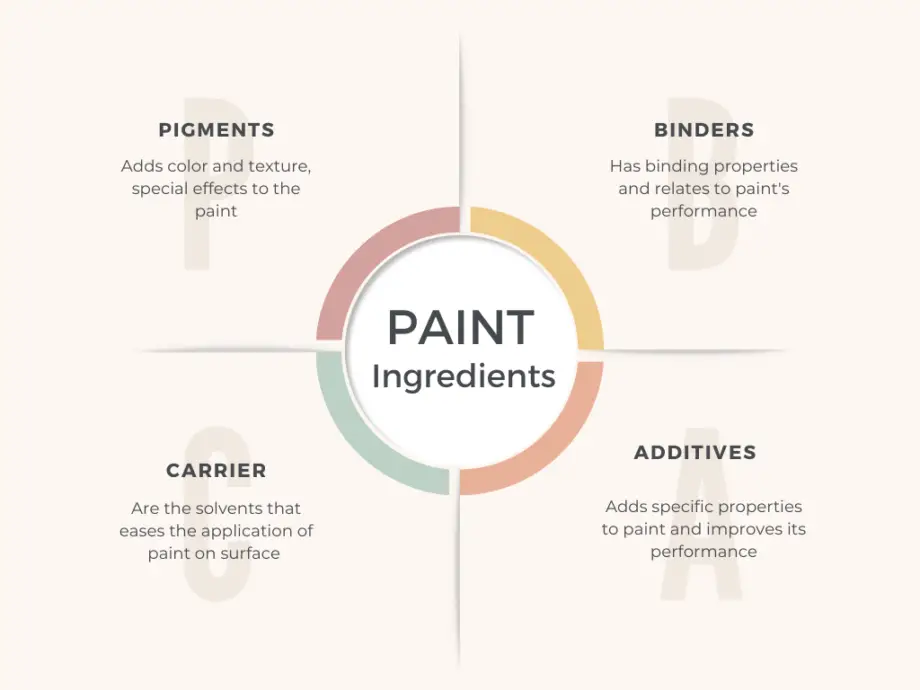
Interior paint comprises four basic ingredients: pigments, binders, carriers, and additives. The pigments give the paint its hiding ability and color, while binders turn liquid paint into solid when applied to the wall. Carrier acts as the solvent, and additives help boost the paint’s performance.

Each element used in interior paints has a purpose to serve that we will explore in this article. I will also discuss different types of interior paints you can buy from the market and what makes them unique.

What are the ingredients of paint?

All paints have four essential ingredients:

  • Pigments
  • Binders
  • Carrier (solvent)
  • Additives
Navy and Broken White Modern Company Organizational Chart Graph 1 What Is Interior Paint Made Of - Understanding The Basics

Here is a detailed look at what each ingredient entails.

Pigments

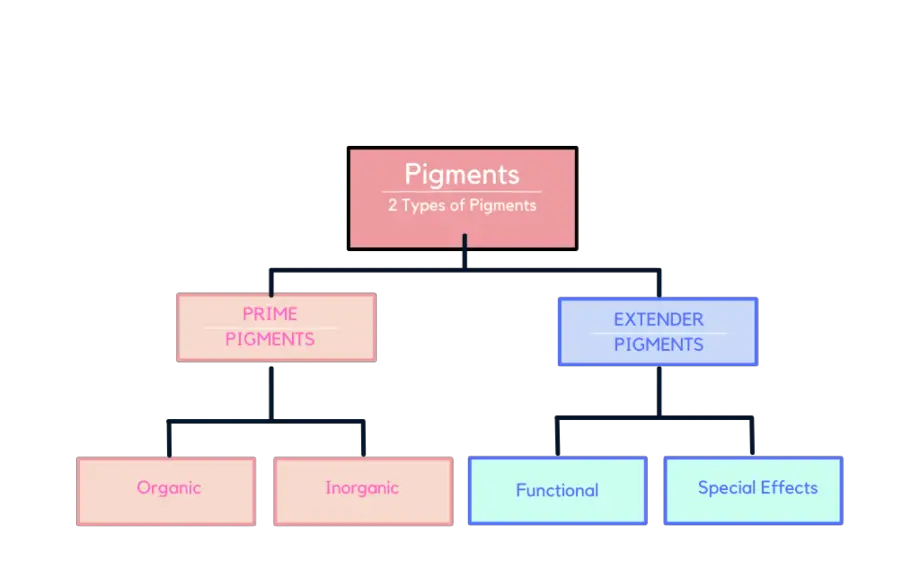
Pigments are finely ground insoluble particles that may be natural or synthetic. They are used in paints to add color, impart bulk, or have physical or chemical properties to the wet or dry film. Pigments comprise two basic variations:

Navy and Broken White Modern Company Organizational Chart Graph edited What Is Interior Paint Made Of - Understanding The Basics

1. Prime pigments

  • Organic
  • Inorganic

Prime pigments affect both wet and dry hide in paint. The whiteness in paint is achieved through the pigment Titanium dioxide, while colorants create the paint’s actual color.

Colorants can be either organic or inorganic. Organic pigments tend to form clumps or pigment particles, while inorganic pigments spread out evenly in the resin. The former is more or less transparent when we look at opacity, but the latter delivers high opacity results.

Organic variants provide brighter colors, such as phthalo blue and hansa yellow, but they aren’t very durable, which is why they’re used in interior paints. Inorganic colorants are mostly duller and earthy, like red oxide, umber, and yellow ochre. They are more resilient than their counterparts and are used in exterior paint.

2. Extender pigments

  • Functional
  • Special effects

Extender pigments add extra weight or bulk to the paint and contribute only to the paint’s dry hide.

Functional pigments add specific properties to the coating, like the corrosion inhibitor, while special effect pigments are responsible for creating optical effects like hammer and metallic finish.

Clay, talc, silica, diatomaceous silica, zinc oxide, and calcium carbonate are all examples of extender pigments.

Binders

The binders used in paints directly relate to its performance, washability, fade resistance, scrub resistance, and gloss retention. Binders are polymers (resins) that bring the pigments together to create the perfect dry coat of paint on a wall.

Alkyd (oil) based binders dry to a hard finish that offers superior adhesion and leveling. The downside is that it will turn yellow in light colors and oxidize on surfaces. Moreover, it contains VOCs that are harmful to human health.

Thanks to modern technology, a newer alternative is alkyd-emulsion paint which gives an oil-like performance but can water and soap solution can clean it up easily. Unfortunately, this, too, can turn yellow and chalk over time.

The following are common binders that are found in paint:

  • Acrylic resins
  • Alkyd resins
  • Latex (PVA)
  • Phenolic resins
  • Urethane resins
  • Epoxy resins
  • Chlorinated rubber

Carrier (solvent)

The carrier is the solvent that allows the paint to be applied from the can to the surfaces. Pigments and binders are considered solids, while the carrier is a liquid. When they are all mixed together, they create the paint you see on the walls.

Carriers can be:

  • Oil-based or alkyd paints that comprise paint thinner or other types of solvent.
  • Water-based or latex that consists primarily of water.

If a paint contains more solids than liquid, it is considered higher in quality. So, if 35-40% of the paint remains on the wall after the solvent has evaporated, the paint will perform better. But that doesn’t mean every paint with high solids content is good. It’s the make-up of the solid elements that make a paint formula better than the others.

Additives

Additives add specific properties to the paint and improve its overall performance. The most commonly used are:

  • Defoamers- to break bubbles formed during manufacturing and when applied onto a surface.
  • Thickening agents- to provide additional thickness and viscosity for improved flow and leveling. It also helps reduce the splatter effect when the paint is applied with a roller.
  • Biocides- to prevent bacteria from growing and to eliminate mildew growth.
  • Co-solvents- to increase the liquid content in the paint. This helps the binders form a solid film when applied at low temperatures.
  • Surfactants- to prevent the paint from separating. They also keep the pigments evenly distributed in the liquid resulting in better color accuracy and hiding power.

Characteristics of interior paint

  1. Interior paints are used for decorative and aesthetic purposes. Since it’s used inside the home, its properties include washability, easy maintenance, and dampness prevention.
  2. Interior paint is formulated to withstand abrasion, but it’s not as hard as exterior paint.
  3. The paint is washable, so you can quickly wipe away roller and brush marks, as well as dirt and grime.
  4. Interior paints don’t have fade-resisting properties as they don’t have to face the sun. It also doesn’t require sunlight to cure.
  5. They contain a low amount of VOCs, reducing health risks and maintaining the air quality inside the home.

6 Types of interior paints and finishes

Many homeowners focus on picking the right color palettes for their homes but often don’t know the difference between various finishes. How the paint color looks on your wall greatly depends on the finish you select.

Some paints reflect light, creating a sheen on the walls, while others absorb light and make the walls look flat. A glossy surface usually highlights cracks and imperfections, whereas matte finishes camouflage flaws. The type of paint plays an integral role in its durability, coverage, and lighting within the space.

1. Matte Finish

Flat or matte paints deliver a diffused and mute color with a minimum to a soft sheen. They usually have a higher ratio of solids: liquid which helps them give deeper coverage. Also known as the concealer of paints, they work well to hide any imperfections on the walls, like nail holes, scratches, etc.

This variant is perfect for painting interior spaces like the bedroom. Since the paint is high-coverage, you don’t need multiple coats. The only downside is that matte walls can be harder to clean compared to glossy surfaces.

If you want to buy flat paint for your home, you can try the Rust-Oleum Painter’s Touch Latex Paint. I love this one because it is available in 28 exciting colors.

2. Textured Finish

If you like to add some character to their walls, textured paints are the right choice for you. These paints make your walls appear rustic and distinct, which is hard to achieve with other paints.

With textured paint, you can add depth and shadows to the walls. Since it doesn’t deliver a flat finish, it effectively masks uneven walls and other imperfections.

3. Satin Finish

Satin is right between matte and shiny; therefore, an all-rounder of wall paint finishes. These satin paints reflect more light than eggshell finishes, but they are not at all glossy. You can compare it to the shine of a pearl- soft and muted.

Satin finish feels soft and velvety to the touch and is ideal for living spaces that don’t receive a lot of sunlight. The only problem is that satin paint brings out application imperfections, unlike matte and textured finishes.

4. Eggshell Finish

As the name suggests, this paint gives a low sheen when applied to walls, just like an eggshell. It’s not entirely lusterless like matte paints and has a pleasing texture and feel. Eggshell paint hides wall imperfections like holes, bumps, etc., and offers a highly durable finish.

The finish is easier to clean than satin, making it ideal for high-traffic living spaces like the dining room, kitchen, living room, and hallways.

5. Semi-Gloss Finish

The semi-gloss is an ideal solution if you like gloss but don’t want ‘high-shine’ walls. Semi-gloss paints are shiny and reflective but not as shiny as high-gloss paints. They are durable, mildew-resistant, and easy to clean, making them perfect for playrooms, dining rooms, etc.

The only drawback is that it highlights the flaws in your walls, like satin finishes. The Montage Signature Interior/ Exterior Eco-Friendly Paint is a good option if you want a low-sheen finish. It comes in two finishes: low-sheen and semi-gloss.

6. High-gloss finish

The high-gloss finish is popular among designers and homeowners because it reflects light to give the highest sheen. Apart from being reflective, this delivers a hard finish that is highly durable. High-gloss surfaces are easy to clean, making them perfect for cabinetry, kitchen work, doors, and other objects prone to dirt and moisture.

The drawback of a high-gloss finish is that it makes any imperfections on the walls more apparent and requires several coats for full coverage.

How to choose the right paint finish for your home’s interior

Before you head out to buy paint for your DIY home paint project, you should decide the finish you want in your space. Consider these factors to help you find the perfect paint for your home.

Traffic

The first crucial thing to consider is the usual traffic in your living space. If an area is busy all the time, like playrooms and kitchens, you must get a durable paint finish and easy to clean. Semi-gloss, high-gloss, or satin finishes are perfect for such areas.

Spaces that remain relatively calmer can get away with flat and eggshell paints.

Sheen

When it comes to paint’s sheen, everyone has a different preference. But regardless of what you like, low-light or dark areas can benefit from higher-gloss finishes. If you want to make a room appear brighter and more open, go for a glossy finish. But if your living space receives plenty of daylight, you can go for any finish you like.

Walls condition

Paint helps bring life into your home, but the wrong finish can ruin a freshly-painted look. Suppose your walls have imperfections; in that case, you should choose a paint that hides them instead of highlighting them.

The more reflective a finish, the more surface imperfections will show. So, if your walls have nail holes or bumps, go with matte or satin finishes, as they help make walls appear smooth.

FAQs

Is all interior paint latex?

Latex-based paints are highly popular for both interior and exterior surfaces. Almost 75% of paint sold is latex, and more homeowners are jumping on the green-paint bandwagon.

Can I use interior paint on the exterior?

Interior paint should not be used on external surfaces as they are not formulated with the required additives. If you use interior paint outside, it will not withstand heat, rain, or any other environmental stressors.

What happens if I accidentally use exterior paint inside?

Exterior paint contains toxic additives, so if you use it inside your home, you will expose your family to long-lasting harmful chemicals. There are several other reasons why you shouldn’t use exterior paint inside.

How long does interior paint last?

A good interior paint job should last 5 to 10 years or even longer, depending on how well you maintain it.

Conclusion

All paints are created using four ingredients: binders, pigments, solvents, and additives. As manufacturers tweak the quantity and quality of these elements, the paint’s formulation and finish change. Knowing the basics about interior paint will help you find the right fit for your home.

pexels wangchen tsomu 8436382 Can You Spray Paint Trim- Renovate Your Home In 9 Easy Steps

Can You Spray Paint Trim- Renovate Your Home In 9 Easy Steps

Your home is your haven, but everything can lose its appeal over time. Fortunately, you can spruce up the look of your house by repainting the trims. Whether you choose a bright color or paint it a classic white, freshly painted trims can elevate your home’s interior without costing you an arm and a leg.

You can easily spray-paint trims to make them as good as new! Start by prepping the room with tape and paper. Next, clean the border and fill up any nail holes. Sand the surface so the primer can adhere correctly. Caulk the gaps between the baseboard/ walls and trims. Apply primer, followed by two coats of paint.

Spraying your trim always gives a better finish compared to brush application. However, spray paint means more mess and, therefore, more clean-up. I will tell you how to prepare your trims so there’s minimum clean-up for later. With my tips, you will achieve professional-looking results without spending on a pro-paint job.

Is it better to spray or brush paint trim?

Many homeowners wonder whether it’s better to brush paint or spray their trims. In theory, spray paint will always result in a smoother and even finish. If you are new to painting, brush application will leave ugly brushstrokes that are impossible to cover.

Spray painting is the best option in new construction where trims aren’t attached to the baseboards. But in an existing home, spray painting your trim will cause you a ton of extra work you might not be willing to do.

So, it all comes down to how much time and effort you’re willing to dedicate to the project. Another deciding factor would be the finish you’re after.

If you want to maintain the quality of the paint job regardless of the extra work it would require, spray paint your trims by all means. But if you’re on a tight schedule and don’t mind the look of brush strokes, you can brush paint all your trims.

How to spray paint trims

I have outlined the process in a step-by-step guide to help you spray paint your trims quickly. If you want to brush paint instead of spray, the following steps will remain the same. The only difference is that you will use paint and brush to do the priming and painting.

Let’s begin.

1. Prepare the floor

Spray painting can get messy very quickly, but if you prepare the surrounding areas properly, you should have a much easier time cleaning up. You will tape and paper –lots of it.

Prepping the floor

Place the paper on the floor and tape it so that one end is on the paper while the other is tucked under the trim. Take your time placing the tape in a straight line, so the result looks neat and sharp. If you have carpeted floors, tuck the inside edge of the tape under the trim but over the carpet.

Dragging a drop cloth everywhere you paint can be time-consuming and leave paint smears on the floor. The best way to cover your floors is with a 36″ rosin paper roll. This way, you can paint without fearing the paint getting on the baseboards.

Prepping the wall

Apply tape on the upper side of the trim as well, making a straight line between the edge and the wall.

Prepping for windows

If you’re painting the trims on your windows, apply a strip of tape and paper on the window, glass, or any other surface you don’t want to paint accidentally. You should also remove window coverings and cranks before you start.

Prepping for door trims

For door trims, you can remove the door and hinges or cover the two with tape and paper.

2. Clean the trims

Regardless of the project, cleaning the surface you will paint is crucial. Start by vacuuming the room with a shop vac to remove all dust from the area.

Vacuuming might not be enough if you’re painting the trims in your kitchen or a similar area. You can wash the trims with warm water and soap, cleaning up any oily residue or grease from the surface.

Once the trims are clean, wipe away the soap residue with a clean cloth.

3. Repair holes

If you’re going to paint your trims, any holes or cracks you leave will show up as a contrasting black and ruin the final result. Therefore, fill all the nail holes with spackling paste to achieve a smooth surface.

Refrain from filling the gaps between the walls and the trims because a flexible caulk works better for that surface.

4. Sand the trims

Once all the nail holes are filled, start sanding the trims to smooth down the surface. Sanding the surface also helps the primer bond properly with the trim being painted.

Take a medium grit sanding sponge and start sanding the surface in a back-and-forth motion. The good thing about using a sponge is that it conforms to the trim’s shape and prevents slivers.

After you’ve sanded thoroughly, clean the trims and the surrounding areas with a vacuum cleaner. A clean work area means fewer chances of dust and debris ruining your finish.

5. Apply a primer

When selecting a primer and paint for your project, make sure to choose the same type. For example, if you’re going to use water-based paint, then buy a water-based primer to accompany it. Similarly, you should select a water-based top coat to finish the paint job.

I suggest using water-based paints for residential homes primarily because of the VOCs in oil-based paints that can stink up your house. In addition, cleaning up oil-based paints is challenging because it doesn’t just wash off; you have to use a paint thinner to remove it.

Since painting the trims requires moving around the whole house, the clean-up after using an oil-based paint could be a disaster.

Spray a coat of primer to prepare the surface. The smoother the foundation, the better your final paint application will be. The Rust-Oleum Painter’s Touch 2X Ultra Cover is an excellent flat white primer for this project.

71skbuiHARL. AC SY879 Can You Spray Paint Trim- Renovate Your Home In 9 Easy Steps

6. Sand the surface again

Allow the primer to dry completely before sanding all the trims again. If you’re wondering whether it’s necessary to sand the surface again, you should remember that quality paint jobs require several rounds of sanding.

This time, use a 3M fine-grit sanding sponge, as it helps make the primer extra smooth. Once you’re done, vacuum the trims and the room to remove any dust from your work area.

7. Caulk the trim gaps

You can caulk the gaps before priming the surface, but I prefer to do it later for a few reasons. For starters, primed trims make the cracks even more apparent. It makes your caulking job easier and also saves time from having to caulk areas where it’s not needed.

Secondly, primed and sanded trims significantly reduce the chances of slivers. And finally, your trim is very smooth after all the above processes, allowing you to lay a fine bead of caulk.

To caulk the trims, you need a dripless gun, paintable caulk, and a wet cloth. Snip a small piece off the tube to neatly squeeze the caulk into the gap. Start laying a bead of caulk and pause to go over it with a wet rag. This pushes the caulk into the gap and makes it look neat and smooth.

Try not to overdo the caulking and keep it from coming out or over the gaps. Allow it enough time to dry before painting the surface. You don’t need to sand the surface after caulking.

8. Start painting

Now that your trims are primed, sanded, and caulked, we can finally move on to the color coat. For interior projects, creating an ideal temperature and humidity level is recommended for the best results.

Shake the can for a good five minutes and check for any clogged nozzles. If you’re working with old paint, check its expiry date and spray on a spare cardboard sheet to ensure the spray paint has not expired. Spray one coat of paint and wait for 15 minutes to go in with the second one.

If you’re working on several trims at the same time, finish painting and circle back to where you started for the second coat.

9. Clean up

You’re in the final stretch now. Once your top coat has dried completely but not cured, pull the tape around the trims and remove all the paper you’ve spread on the floor. Don’t wait too long to pull the tape, though, as paint drips on the floor will get very hard to remove later.

Painting trims or walls? Which one to do first

Here’s a question I have heard many times: “Should I paint my trims before I paint the walls?”

The answer is yes! Here’s why.

A painted trim has already been prepped and primed. So when you start painting the walls, you can save time creating a surface for the tape. You simply tape a straight line on the trim and paint the walls.

Secondly, if you paint the trim later, it means you didn’t caulk it to the walls before it was painted. So, when you spray paint the trims at the end, the paint will flow from the trims to the caulk and onto the walls.

Finally, the paint you use on the trims is harder compared to wall paint. For this reason, when you tape the wall to paint the border, there’s always a chance of that wall paint pulling off with the tape. Sometimes, pulling the tape also results in lifting the top layer of paper from your drywall along with the color, which could be a catastrophe.

Hence, it is recommended to paint the trims before moving on to the walls.

FAQs

Can you use can spray paint on the trim?

You can easily spray paint your home’s interior and exterior trims if you sand and prime the surface properly before applying the top coat.

Can you paint wood trim with spray paint?

The best way to paint wood trims is by using spray paint specially designed for wood surfaces. The result will not be long-lasting if you use other variants that are not meant for wood.

Should you spray or hand paint trim?

Spraying your trims will give you a smooth and clean finish, but it’s a time-consuming process. You can hand paint your trims if you are okay with the brush strokes and have limited time for the project.

What kind of paint should be used on trim?

Trims are considered a decorative addition; therefore, the paint you choose should bring out its details. Semi-gloss, satin, gloss or high-gloss paint finishes are best suited to trims.

Conclusion

Repainting your trims helps brighten your home and makes the walls and décor look more attractive. Fortunately, spray painting is a quick way to refresh your living space while staying within a DIY budget. 

pexels inline media 5232618 Can You Spray Paint Car Radiator- Revive It In 8 Easy Steps

Can You Spray Paint Car Radiator- Revive It In 8 Easy Steps

Your car’s radiator helps eliminate heat from the engine while you drive. The constant movement in the radiator causes considerable wear and tear, and you might notice its paint fading and becoming dull. Don’t worry because you can fix this problem at home by spray painting your car’s radiator.

You can spray paint your car’s radiator by draining the coolant first. Next, remove the radiator from the car’s engine bay and scrub it with a wire brush and cleaner. Strip the old paint and clean any residue with mineral spirits. Finally, apply three to four coats of spray paint before reinstalling it.

Painting a car’s radiator is as straightforward as painting a car’s hood. As long as you know all the steps, you should be able to do a good job. I have made it easier by breaking it down into 8 quick steps that you can follow along to repaint your car’s radiator.

Why painting the car radiator black is a good idea

You must have noticed that car radiators are usually painted dull black. The reason is that the black color is a good radiator and absorbs heat. It emits the heat generated by the engine through radiation. This allows the car’s engine to cool down quickly.

If you decide to paint your car radiator, you should stick to the same color as it has a purpose. Just make sure to use high-quality spray paint that can withstand high temperatures. Buying low-quality paint can decrease your radiator’s efficiency and performance.

A step-by-step guide for painting the radiator with black spray paint

Now that we’ve decided on the color for our radiator spray paint let’s discuss the steps you need to follow to get the perfect finish.

Step 1- Drain the Coolant

The first step is to drain the coolant from the radiator. Depending on the model of your car, you may find the drain located at the bottom of the radiator. Open the valve and remove all the coolant. It’s up to you to discard or store it in a suitable container for later use.

Step 2- Disconnect the radiator

If you want to ensure a good paint job, removing the radiator from the engine bay is recommended. You can refer to the car’s manual for instructions on disconnecting the radiator safely. Since every vehicle is different, take your time examining how it is installed to determine how you can remove it.

Apart from bolts, you will also need to detach any coolant hoses connected to the radiator.

Step 3- Clean the radiator

Wash the radiator with water and soap to remove dust and dirt from its exterior. Use a wire brush with the cleaner to scrub away any oil and grease on the radiator. Once you’re done, clean the surface with a dry cloth.

Since you’ve removed the radiator from the engine bay, you can have it pressure-tested for leaks before painting it. Take it to your nearest radiator shop so the professionals can check it and repair any bent cooling fins if necessary.

Step 4- Strip the old paint

If the existing paint on the radiator is chipped or peeling away, painting on top of that surface is not a good idea. Therefore, strip the old paint with a paint stripper.

Apply the paint stripper on the car’s radiator and let it sit for a few minutes. Follow the instructions given on the stripper’s label to determine how long you should wait. When you see the paint bubbling, wipe the paint stripper with a clean rag. You may need to scrub the area to remove the paint completely.

Step 5- Clean the surface with mineral spirits

Take a clean rag and soak it in mineral spirits. Wipe the radiator’s surface with the cloth to remove any oil and residue from the paint stripper.

Step 6- Apply a coat of primer

Primer helps spray paint adhere to any surface it’s applied to. Make sure to select a primer designed for metal surfaces. You also need it to withstand high heat since the radiator is placed inside the engine bay.

The VHT Engine Enamel Primer is a good choice for this job as it easily endures temperatures up to 500 degrees when cured correctly.

You should apply 2 thin coats of primer, allowing drying time between coats. You can check the primer’s label to find out how long you should wait before applying the first color coat.

Step 7- Apply radiator spray paint

Once the primer is dry, spray a light and even layer of radiator paint. Let it dry for a few minutes before applying the second coat. You may need three to four layers of color coat to achieve solid coverage.

Allow the paint to dry completely for a few hours. If you can leave it overnight, that would be even better.

Step 8- Reinstall the Radiator

Once the paint has fully cured, reinstall the radiator into the engine bay and reattach any hoses that were removed. Fill it with coolant and start the motor to check for leaks. If everything is functioning correctly, stand back and feel proud of your achievement!

Can you use normal metal paint on radiators?

The simple answer is no!

Regular paints are designed for metal surfaces but not to withstand high temperatures. The best spray paint for a car radiator is different because it is formulated to block heat from the engine and is usually black in color. Therefore, even the best spray paint for metals will not deliver good results on the car’s radiator.

Best paints for automotive radiators

Here are my top picks that are readily available in the market.

1. VHT Engine Enamel Spray Paint

This is an engine enamel paint formulated especially for your car’s engine. It offers superior durability and finish while withstanding temperatures up to 500°F. The paint works best when used in combination with a primer and top coat.

2. Rust-Oleum Automotive Engine Enamel Spray Paint

Another great option, this paint is formulated for use on automotive engines and other surfaces that are exposed to high temperatures up to 500°F. It is gas and oil-resistant, making it perfect for your car’s radiator. In addition, the formula helps prevent rust, increasing the life of your paint job.

3. Rust-Oleum High Heat Spray Paint

This oil-based paint formula renews and protects metal surfaces against high temperatures of up to 1000°F. It is ideal for painting car engines and radiators as it has excellent color retention even under extreme heat.

Another benefit of using this paint is that you don’t need a primer to improve adhesion. It sticks to metal surfaces delivering a rich satin finish that prevents chipping, rust, and corrosion.

4. Krylon High Heat Spray Paint

This is an enamel spray paint that can be used to paint your car’s radiator. Since the color can endure high temperatures, you can use it on your engine, cooking stove, and other surfaces exposed to extreme heat.

Is it safe to paint your car’s radiator?

Paint is prone to flaking and chipping. If this happens near the radiator’s thermostat, chances are it will malfunction. For this reason, you should be careful applying paint near the thermostat. Moreover, the color should be kept from any sharp edges or corners.

For your paint job to last on the radiator, it’s crucial to use high-quality paint explicitly designed for it. Ordinary paints will not perform the same way and eventually chip off under high heat. If you want long-lasting results, try one of the options listed above to paint your radiator black.

FAQs

Do I need special paint for radiators?

Yes, for your paint results to last, you need to use a specialist radiator paint. That is because it is heat resistant compared to its counterparts.

Can Rustoleum spray paint withstand heat?

Rust-Oleum offers a variety of paints, including high heat and automotive engine enamel paint that can withstand high temperatures up to 1000°F.

Is enamel paint good for radiators?

Enamel paint is an excellent option for radiators as it is more resistant to heat than latex paint. You can also find ‘high-heat’ enamel paints to be used on automotive engines and other parts exposed to extreme temperatures.

Conclusion

The radiator in your car is a crucial part of your motor’s cooling system, but as it gets older, the paint starts fading and chipping from being exposed to continuous high heat. Spray paint can help revive the appearance of your car’s radiator efficiently without a professional paint job. Just follow the steps mentioned above, and you should have an ‘almost new’ radiator ready in no time.

pexels teona swift 6850541 Does Spray Paint Wash Off Clothes - Paint Removers That Work!

Does Spray Paint Wash Off Clothes – Paint Removers That Work!

Spray paint DIYs are fun as long as you don’t accidentally get some paint on your clothes. Once that happens, your focus shifts from getting the perfect finish to cleaning the stains quickly. Luckily, you can get spray paint off of clothes using items already stored in your cabinets.

Wet paint is easier to remove from clothes than dry paint. If some paint sprays on your clothes, act quickly and place paper towels on the stain to absorb as much of it as possible. For water-based paint, clean the surface with dishwashing liquid and water. For oil-based paint, a solvent like acetone or hairspray will work better.

While your first instinct is to toss the soiled clothes in the washing machine, it is recommended to pre-treat the stain before going down that road. I will explain what gets spray paint out of fabrics and how you should treat wet and dry paint for the best results.

Will spray paint come out of clothes?

Spray paint sticks to clothes differently compared to smooth objects, and this is because paint settles into the fabric and sinks in the weaves. So, while you can quickly strip away paint from metal surfaces and other smooth objects, clothes are not so forgiving.

Water-based paints come off easily from clothes compared to oil-based variants. However, you should keep in mind that some color may stay on your clothes even if you remove the stain completely. And if you try to scrub the surface too much or use a strong chemical paint remover, you will end up ruining your clothes.

Light-colored clothes are easier to treat than darker colors because there are fewer chances of discoloration due to paint removal treatments. Fortunately, small paint stains are less noticeable on dark-colored clothes.

Effective ways to remove spray paint from fabric safely

Before attempting to clean a paint stain, check the label of the spray paint can to find out whether it’s water-based or oil-based. Both types of colors are removed using different products; therefore, it’s important to know what kind of stain you’re dealing with.

Bleach and chemical paint thinner are quick ways of removing stains, but they can damage the fabric for good. Instead, use safe products that remove the paint without ruining your clothes.

For water-based paints like acrylic and latex, washing the soiled area with dish detergent and warm water can do the trick. If the color is oil-based, using an oil-based remover has a better chance of effectively removing the stain.

Before using any paint remover, patch test a small area of the garment to ensure it doesn’t cause any damage to the original color.

Whatever you do, avoid putting the garment through the washing machine until you’ve treated the paint first. It may spread on other items in the load or color the insides of your washing machine.  

How to remove wet paint from clothes

Customizing your fabrics with spray paint is one thing, but accidental splashes can ruin the appearance of your clothes.

Removing wet paint takes less effort, so if you see a stain while you’re spray painting, clean your clothes before it dries completely.

Here are a few steps to get wet paint off your clothes without spoiling them.

1. Blot up the excess paint

When the paint is wet, avoid rubbing it, as that may cause the color to spread to other areas. Rubbing the spot might also cause the paint to sink deeper into the fabric.

Instead, place paper towels on both sides of the material to absorb the excess paint. Keep replacing the soiled paper with a fresh one to remove all the extra color.

2. Apply a stain remover

Once you have cleaned the wet paint from your clothes, it’s time to treat the stain with a paint stain remover.

For water-based paints, you can apply dish soap to the area and gently scrub the stain with a brush. Rinse the clothing with warm water and repeat the process if necessary. If dish soap doesn’t get the paint off, you can use other products to break down the stain a little more.

For oil-based paints, use a product that has solvent in its composition. You can apply turpentine by soaking a rag cloth in its solution. Leave the remover for 10-15 minutes to react with the bonds of the paint and break them down. You can also add some scrubbing action to the equation for better results.

Rub the soaked fabric with a clean cloth, preferably one you can discard later. The paint should start coming off onto the rubbing cloth. When it gets saturated, replace it with a new one and keep scrubbing the stain. Continue the process until you’ve removed as much paint as you reasonably can.

If the paint doesn’t come off with turpentine, you can try WD-40 or even hairspray.

3. Place it in the washing machine

After you have removed as much paint as you can, toss the garment into the laundry to clean the after-effects of the paint remover you’ve used.

How to remove dry spray paint from clothes

Dried spray paint stains can look intimidating, and you may be resigned to throwing your clothes away. Fortunately, you can get rid of dry paint from your garments and save them from the trash.

Here is a step-by-step guide to help you remove dried paint from your clothes.

1.      Scrape off the dried paint

The first step is removing as much dried paint as possible. You can use a paint scraper or a butter knife to scrape the excess paint away from the stain. The more you remove from the surface, the higher chances of the paint remover reaching the paint that has soaked into the fabric.

2.      Clean the stain with an alcohol-based solution

Your best bet for removing acrylic-based spray paint stains is alcohol-based cleaners such as acetone or hairspray. Apply the cleaner so it sinks into the stain, and allow it to soak for 10-15 minutes. These cleaners should break the bond between acrylic plastic.

Since dried paint is difficult to remove, an alcohol-based cleaner might only remove some of the stain. In this case, you may need to use a heavy-duty paint remover.

Please be warned that paint removers contain harsh chemicals that can strip down the fabric’s original color. Therefore, they should be used as the last resort.

3.      Wash the fabric

Whether or not you were able to remove the paint stain completely, put the fabric in the washing machine to clean the paint remover thoroughly.

What gets spray paint out of fabric?

Sometimes one paint-removing method may not get the job done. Therefore, we have listed a few products that can help you remove paint stains from clothes.

Dish soap

If the paint is wet and water-based, dish soap can work on the paint stain. If it does not remove it entirely, it should help get rid of the top layer. You can then use another product for the paint that’s bonded to the fibers.

Rubbing alcohol

Rubbing alcohol is an effective paint stain remover whether you’re using oil-based or water-based paints. It works better on wet paint, but you can always give it a shot for dried stains. Your best bet would be to use rubbing alcohol that’s 90% or stronger.

Just remember to do a patch test to ensure it won’t damage the material.

Vinegar

Vinegar is a good option for removing paint since it’s acidic. While it may not work as well on large stains, you can definitely try it on smaller areas. The good news is that it can be used for both types of paints, water and oil-based. You can also use vinegar on wet and dry stains, which helps take the guesswork out of which surface is better suited to this product.

Check the material with a spot test before applying it liberally over the stain. Do not pour it on top of the paint; instead, saturate a cotton ball with vinegar and apply it to the fabric until the stain is soaked. Allow it to sit for 15-20 minutes before washing it with warm water.

Turpentine

Turpentine is an effective way to remove paint as it is primarily a paint thinner. You can use it on wet and dry oil-based paint, but it doesn’t work as well on water-based paint stains.

The only downside is that turpentine can strip the original color of your clothing. For this reason, you should only use it on white or light-colored fabrics.

Just like vinegar, you shouldn’t pour turpentine directly on the stain but soak the paint with a spare cloth dipped in the solution. Let it sit for 15-20 minutes, and then wash the area with some dish soap and warm water.

Turpentine has a strong smell, so you should make sure your room is adequately ventilated. In addition, you may need to soak the fabric in a solution of water and vinegar for a few hours to get rid of the odor from your clothes.

WD-40

WD-40 works on oil-based paint when it’s still wet. It contains degreasers and solvents that help break down oily substances, but the solution doesn’t work on dry spray paint.

While it is an effective solution, WD-40 is not recommended as it can create an additional stain on the fabric if applied too liberally. If you decide to use it, spray just the paint and not the area around it.

Let it soak for some minutes before rinsing it with warm water and dish soap.

Hairspray

Hairspray contains alcohol that can help break down the paint and remove it from your clothes. You can use it for oil-based spray paint stains, whether dry or wet.

As with other paint removers, hairspray can also leave behind a stain on the fabric. Therefore, it’s best to test on a hidden area of the garment first before spraying it on the paint.

Once the hairspray has passed the patch test, spray it on the stain and gently rub the stain with a clean cloth. The paint remover is working if the paint starts transferring on the dry cloth.

Acetone

Acetone works best with oil-based spray paint, regardless of its state. It is the primary chemical used in nail polish removers, so it should also work the same way on spray paint stains.

While acetone doesn’t leave a stain, it can break down synthetic fibers, so always test it beforehand.

What can you do if nothing works?

There is always a possibility that nothing works to remove the paint stain altogether. In that situation, you can take it to a professional dry cleaner who has had better luck removing spray paint from clothes.

The other option is to cover the stain with a fabric-colored pen designed for masking paint marks. Visit an arts or fabric store to find the shade that best matches your clothes.

FAQs

Does spray paint permanently stain clothes?

Spray paint can be removed from clothes if you act fast and clean the stain while it’s still wet. Things get difficult once the paint dries down and binds with the fabric.

Can thinner remove paint from clothes?

A paint thinner helps loosen the bonds between paint and the fabric; therefore, it is an effective solution for removing paint from clothes. You can wash the garment later to get rid of its smell.

Can alcohol permanently stain clothes?

Using alcohol on clothes can result in permanent stains and discoloration, especially on woolen fabrics.

Can you use baking soda to remove dried spray paint?

Yes, you can apply a paste of baking soda and hot water on your dry spray paint stain. Let it sit for 15 minutes, and scrub the fabric to remove the paint.  

Conclusion

Removing spray paint from your clothes can be tricky, especially when the paint has dried. However, that doesn’t mean that your garments are beyond repair. You can try removing spray paint from your clothes using the products and methods mentioned in the article. Don’t be discouraged if one remover doesn’t work; there’s always hope with the next one!

pexels airam datoon 9408437 How Much Does Exterior Paint Increase Home Value

How Much Does Exterior Paint Increase Home Value

“Outer beauty is inner beauty made visible.” – Paulo Coelho

There, the most celebrated literary figure said it! And his comprehensive words are enough a reason to give your home’s exterior a shiny new look before listing it up. 

Wondering how much exterior paint increases home value? Here’s the answer.

Painting your home’s exterior is not only a showstopper but also increases your property’s value by a whopping 51% to 55% of the investment. If painting the exterior of your one-story, 1800 sq ft house costs you $5,420, it will offer an $8,400 increase in value. I’d definitely go for these extra three grand!

The blog below discusses everything you need to know about how painting the home’s exterior increases its value, the specific paint colors that increase house value, and much more. 

By the way, a secret lies somewhere between the blog that discloses how to increase your home’s value by 5% to 10% while cutting down the investment even more. Ready to find it? 

I am super excited to spill the beans. Be all eyes!

How Much Does Exterior Painting Increase Home Value

We already discussed the ROI you will get on painting your home’s exterior. But how much does it affect your home’s actual value? Let’s dive into that.

HomeGain surveyed in 2012 and interviewed 900 real estate agents. The survey concluded that repainting your house’s exterior will give you a 51% to 55% return on investment (investment means the cost of repainting).

The consumer reports further claim that an enhanced curb appeal will increase 2% to 5% of your property’s original value. 

How Does the Enhanced Home’s Exterior Increase the Value

Recalling the words of Paulo here, the exterior of your home narrates many stories about the inside of the home as well as the people who live in it. It’s your first impression for a buyer and your big chance to make it count. 

Here’s why curb appeal affects the value.

1- Modern Residents

In the era of trendsetting, no one prefers someone who still lives in the 1970s. So why should your homes? A timeless, new look on your curb tells people that you’re living with the age and love to have a modern home. They’re sure to step in. 

2- Well-Maintained Home

If I see chipped corners, I’d sure be suspicious that something fishy is going on behind that wall. Maybe a disaster, a leakage, or whatnot. Save yourself from embarrassment and show the world that you’re well-kept. A spotless house definitely brings in more potential buyers.

Painting the Exterior Has Some Codes Before Listing

If you’re planning to just renovate your home, it’s perfectly alright to go for personal choices. But if you plan to list your home, there’s some code to follow or, in other words, have exterior paint colors that increase home value. 

Below are the dots and dashes of the code you must follow before repainting your house to increase value. 

1- Black Door is the Secret to $6000 Extra 

According to the survey conducted by Zillow, painting the front door of your home black can help you sell your home for an extra $6000 or can increase your home’s value by around 2.9%.

2- Avoid Bright and Bold

You may be a fan of bright and bold colors, and they’re sure to inspire your online fam, but when it comes to reselling, homes painted in bright colors face a hard time selling quickly. Moreover, bright and bold colors like red, blue, orange, or yellow are very personal choices, and not everyone can stand them. 

3- Your Region Matters

People from different regions have different color preferences. Cristina Miguelez, a remodeling specialist at Fixr.com, says, 

“The South likes dark colors, while New England likes coastal hues: white, gray, blue, etc. The Midwest likes neutrals, and the West Coast likes rich tones in green and gray, as well as more vibrant and deep hues in reds and golds.”

4- Play Safe with Neutrals

Not sure which color to pick for your home’s exterior? Neutrals are the best bet in all cases. The timeless colors are sure to impress people from all tastes. Hues like gray, beige, white, taupe, or gray-beige highlight the architectural structure and enhance the curb appeal to attract more buyers. 

5- Solar Panels Can Also Favor You

Though unrelated to the house’s exterior paint, if you have a solar panel installed on your roof, that can do the magic of having more offers on your listings. In fact, it can also increase your home’s value by 4.1%.

6- Compliment the Structure

Living in a Victorian home? The best palette to pick is burgundy, chestnut, maroon, red, brown, or dark green. Have a modern home? Befriend a neutral palette. Every house structure calls for its unique color scheme to complement it the best. 

7- Use Best Quality Paints

Listing your home doesn’t mean you’ll sell it the next day. Make sure when you get your house repainted, never use interior paints for exterior walls. The walls may fade away faster than you think and can start chipping off. Don’t want to put a bad impression on potential buyers, right? 

Did You Just Get Your Home Repainted Recently? 

If you got your home repainted just a couple of years ago, but are now planning to sell it, here’s the secret to increasing its value by 5% to 10% without the hefty investment of repainting it. Get it pressure washed by a reliable company in your hometown. Pressure washing boosts your curb’s apparel and increases the value of your home while ensuring you save time and money at the same time. 

PS: I’ve spilled my secret to a well-kept home without investing big bucks in repainting it and also increasing its value. Comment below if you’re likely to choose this option 🙂

FAQs

What exterior colors increase home value? 

Five paint colors that add value to home are white, gray, beige, taupe, and sage green. You can opt for more from the neutral color scheme to play safe.

What color house has the highest resale value? 

The answer to this question is the very timeless and the most classy color: White. If your house exterior is painted white with a black front door and window sills, you are more likely to cash out the maximum.

How much does new paint add to home value?

This can be answered in two ways:

  • You can get a 51% to 55% return on investment after repainting your home’s exterior.
  • Your house value has a chance to increase by 2% to 5%.

How else can I increase my home value in 2022?

Other than repainting your home, more things that can help upscale your home’s value are:

  • Decluttering
  • Upgrading front door
  • Having energy-efficient home
  • Updating the interior, especially the kitchen
  • Staging your home

Can I paint my home’s exterior myself?

Yes, you can surely enjoy a DIY project of painting your home’s exterior. You can save some tips on having a flawless exterior without outsourcing the job and spend your hard-earned cash. 

Final Word

Finally – Does house color affect the value of your home? The answer is yes, it does. If you’re calculating the return on investment, there’s a 51% to 55% increase in value, and if you calculate the increase in your house’s value, it would be somewhere between 2% to 5%. No matter how you calculate, an extra 3 to 6 grand doesn’t ever hurt anybody.

pexels rodnae productions 10474472 9 Best Spray Paint For Fabrics – Review

9 Best Spray Paint For Fabrics – Review

Whenever a new style emerges, the fashion industry modifies its practices to accommodate it. At this moment, these tendencies are all about using vivid colors and flamboyant patterns. In order to maintain a contemporary demeanor, we need to adopt the prevailing fashions and norms.

Buying a fancy multi-colored shirt from Louis Vuitton sounds all fun until you look at the price. So, would you like to add some colorful glamour to your wardrobe without spending a fortune by relying on your artistic mind alone? Why not!

You can customize your wardrobe by using spray paints. Nowadays, hundreds of specialized fabric spray paints can work well on any fabric without any drippings or overruns.

Plus, these specialized solutions are not confined to clothing only. You can optimize them on your furniture, art canvas, and various DIY projects. For your convenience, we have scoured through the internet and shortlisted the 9 best spray paints for fabrics.

Without any further delay, let’s move to the point of our discussion! 

OUR TOP 3 PICKS OF BEST spray PAINT FOR FABRICS

Best overall

Tulip COLORSHOT Fabric Spray Paint

71+85MP8w6L. AC SY300 SX300 9 Best Spray Paint For Fabrics – Review
  • Comes in a pack of vibrant six colors that stand out on your fabric
  • Does not splatter on cloth, giving it a stable application 
  • Dries up in minutes for you to apply another coat if need be
  • Results are bright

budget friendly

Dupli-Color Vinyl & Fabric Spray Paint

61UcN lz0aL. AC SL1500 9 Best Spray Paint For Fabrics – Review
  • Give you great value for your money
  • Best buy for automotive fabrics 
  • Self-priming formula for saving a bunch of time
  • EZ touch tip for your convenience

long lasting

Rust-Oleum Fabric Spray Paint

71vt8TlgQNL. AC SL1500 9 Best Spray Paint For Fabrics – Review
  • Highly durable and long-lasting
  • Works best on outdoor fabric 
  • Weather resistant- can bear excessive heat and light as well as rain
  • Dries up quickly to give results in minimum time

How Did We Finalize the Products?

Fabric paints are all the rage currently, so manufacturers have responded by releasing hundreds, if not thousands, of different products to fulfill consumer demand.

But not all products are good or even satisfactory. To cast aside the bad ones, we came up with solid rating criteria. From a pool of fifty options, we choose the nine spray paints for fabrics we believe ideal.

Our rating criteria depend upon the following factors:

1. Price

There is no doubt that price is the most significant factor in a consumer’s purchase decision. No matter how good a product is, it is no good to us if it does not fall under our budget. That is why we made sure to list down those products which provide the most value for money in the market. 

2. Vibrancy

Something very unique to fabric colors is their vibrancy. People customize clothes to stand out, so the paints must be as vibrant as possible. If spray paint is not vibrant, using it on a piece of fabric will only do a little for it. For this reason, we relied only on spray paints, which consistently produce brilliant hues regardless of the circumstances.

3. Wash-ability 

Surprisingly, all fabric spray paints are not washable. Some paints are just used to provide quick customization to your outfits. To save you from the trouble of buying temporary paint, we only selected the washable products (machine washable in some cases) that did not fade with washing either.

4. Durability

Every spray paint user is concerned about the paint’s longevity. Some items might appear great right out of the bottle but lose their luster after only one cycle in the washing machine. At the same time, certain paints may begin to chip after just a few months. To save you from all these worries, we shortlisted the products which provide high durability and eliminate the need for frequent repainting.

Best Spray Paint for Fabrics

Your clothes play a big role in shaping your personality. Giving them a little color will not only improve your fashion but will also have a positive impact on your overall image. There is nothing better than spray paint to customize your attire and give them a little more life. 

As we stated above, fabric spray paints are not just limited to your wardrobe. They are very useful in other aspects as well, like painting your patio and upholstery. In this article, we will go through the best spray paints for garments that have been tested and shown to work well with a wide range of materials.

1. Tulip COLORSHOT Fabric Spray Paint- Best Overall

Key Features

  • Works on all fabrics
  • Gets absorbed quickly
  • Variety for vibrant colors
  • Quick drying ability  

What do we like best?

Nobody likes a monotone fabric. A variety of colors is what makes painting on a fabric fun, and no product provides more variety than Tulip ColorShot Maxcolor. The product comes in six 3 ounces bottles, each providing a different yet equally vibrant color.

This product works on virtually all fabrics, including your daily wear. It also gets absorbed quickly, which reduces splattering and dries up soon with a soft finish. So if you want the paint to make your bland, boring white shirts a little more fun, this is your product to buy.

What needs to be improved?

The sizes of the bottles are small, which means they carry a small amount of paint that can be a nuisance. But if you are doing a multi-colored project, the total amount of paint in each bottle would be more than enough to attain desired outcomes.

Pros

  • Contain a variety of colors
  • Each paint color is unique and vibrant
  • Dries up in no time
  • Gets absorbed quickly
  • Works on all types of fabrics

Cons

  • A small amount of paint per bottle
  • Gives out a strong odor

Note: If you want an odorless paint with non-toxic formula jump straight to our product number 6

2. Dupli-Color Vinyl & Fabric Spray Paint – Budget Friendly

Key Features

  • Best Budgeted 
  • Features EZ Touch conical nozzle
  • Paint and primer mix
  • Works on multiple surfaces


What do we like best?

This product is for all car lovers. It’s an excellent fluid if you want to customize your car interior while staying on a tight budget. The Dupli-Color HVP106 is a specialized automotive interior paint that works on your seats, dash, and other interior fabrics. 

It offers a variety of colors from beige, red, and wooden to classic black, which gives your car a premium look; on top of all that, it does not require any primer, which is always suitable for interior paints. Finally, the EZ tip makes it convenient to use on door boards and other hard-to-access areas of your car’s interior.

What needs to be improved?

Like many other products from Dupli Color products, the tip is up to par with their high standards. It can malfunction during painting, leading to dripping.

Pros

  • Highly budget friendly
  • Works best on car interiors
  • Does not require priming
  • Comes with the EZ touch feature
  • Gives your car interior a premium look

Cons

  • Tip can malfunction
  • Does not cover a large surface area

Note:  Details about painting your car leather seats can be read in detail here. Read and find out the step-by-step guide to painting your leather seats.

3. Rust-Oleum Fabric Spray Paint – Long Lasting

Key Features

  • Polyurethane formula 
  • UV resistant
  • Prevents fading
  • Provides softer touch

What do we like best?

This product is a lifesaver for someone who has to paint their patio every few months. The Rust-Oleum 358839 is made to withstand harsh weather and intense UV rays of the sun, so it can provide long-lasting paint and free you from the hassle of repainting frequently.

It has a potent polyurethane formula which prevents the paint from fading. The paint also provides soft touch while being water-repellent, a unique quality. So you don’t have to compromise between a hard surface and a durable paint.

What needs to be improved?

The product carries less amount of paint than expected. The size of the bottle is standard, but the amount of paint seems less because of its thick consistency.

Pros

  • Best for outdoor furniture
  • Provides a long-lasting effect
  • Dries up within an hour
  • Protects the surface from harsh weather
  • Provides the surface with a soft touch finish

Cons

  • The amount of paint is less than expected
  • The thick consistency makes it hard to work with

4. Tulip COLORSHOT Instant Fabric Color – Best for Jeans

Key Features

  • Blends in fabric 
  • Dries up quickly
  • Soft to touch 
  • Even coverage

What do we like best?

Denim jeans are one of the most common pieces of clothing nowadays. Everybody has at least a couple of pairs in their wardrobe, but their color can fade with time (especially the black ones). That is where the Tulip ColorShot Instant Fabric Color comes in handy.

It can do wonders for your denim jeans as it blends right in with the fabric and spreads evenly while making it hard to distinguish from the original color. So, if you want to modify the appearance of your denim or add some personal flair by dying them a different color, Tulip ColorShot Instant Fabric Color is all you need.

What needs to be improved?

The packaging size is too small to cover a large piece of clothing. But if you want to give your jeans a fresh look, a single can will be enough to serve your purpose.

Pros

  • Works best on synthetic fabric like jeans
  • Provides even coverage
  • Does not splatter
  • Blends in well with the fabric
  • Provides a soft touch

Cons

  • Small packaging size
  • Covers a small surface area

Note:  Details about how to paint jeans can also be read on our blog page, where you can know what are the steps to prep jeans for a long-lasting paint art. 

5. Tulip Fabric Spray Paint – Best for T-Shirts

Key Features

  • Comes in a pack of 7 
  • Easy-to-use bottles
  • Permanent fabric paints
  • Dried paint does not spread or fade after washing

What do we like best?

Are you done wearing plain black or white t-shirts? Well, it’s time to give your wardrobe a little fun color. The Tulip Fabric Spray Paint comes in a pack of seven bright colors that can be used individually or in combination.

This solution integrates into the costume and ultimately becomes a part of it. Further, it can’t be scratched off or worn away by detergent or water. The seven varieties of paint are packaged in a variety of child-friendly containers. So, if you’re searching for kid-friendly paint that won’t harm them while they’re having fun, look no further than Tulip Fabric Spray Paint.

What needs to be improved?

The paint can get chipped away if washed with a fabric softener, which can be problematic as some clothes demand softeners. Avoid using this product on those fabrics so you don’t have to face this issue.

Pros

  • Works best on light-colored t-shirts
  • Provides a variety of color
  • Gets enriched in your fabric
  • Don’t fade with washing
  • Children friendly

Cons

  • Chips with fabric softener
  • Small size and less quantity

Note: To get a more durable paint with a long lasting effect go straight to product number 3 of our list

6. Tulip Fabric Spray Sets – Best Neon Shades

Key Features

  • Non-toxic formula
  • Does not contain air
  • EZ touch nozzle
  • Washable and iron-safe

What do we like best?

Neon paints are pretty helpful in fabric painting, especially regarding school projects. However, not all paints are suitable for kids, which is where the Tulip Fabric Spray Sets 29849 excels above its rivals. Its EZ tip makes it convenient for youngsters as well as adults, and its harmless composition is not detrimental to health.

The bright neon paint looks vibrant on any background, including dark surfaces. In contrast to most other neon items, this one can also be washed and ironed.

What needs to be improved?

The color will ultimately become brilliant, but if you are personalizing the entire shirt with a single color, the quantity may be an issue.

Pros

  • It can be washed and iron
  • Provides vibrant colors
  • Comes in a pack of seven
  • The paint does not splatter
  • Does not spray pollutants into the air

Cons

  • Requires multiple coats on a darker surface
  • Less quantity per color

7. Krylon Glitter Spray – Best Glitter Effect

Key Features

  • Works on all fabrics 
  • Best for a DIY project
  • Provides a magical finish
  • Washable

What do we like best?

There are not many things as cool as a glittered shirt or jeans. Magic finish jeans cost a lot, but you can easily do it by using the Krylon 100405. It is painted from Krylon’s line up which is always reliable and works on virtually all kinds of fabrics.

The product comes in sixteen colors and provides your fabric with a 3-D finish. It has strong adhesion and sticks right to the surface, forming a solid permanent layer. Unlike other glitter paints, this one can be washed and cleaned.

What needs to be improved?

Product drying time is long because of the glitter paint’s strong sticky composition. Nevertheless, practically all glittery paints have this issue, so the tradeoff is not that severe.

Pros

  • Washable (by hand)
  • Stick right to the fabric
  • Provides a 3-D finish to the fabric
  • It is perfect for all shimmery DIY projects
  • Glitter does not fade

Cons

  • Takes a lot of time to dry up
  • It can be a little hard to work with due to viscosity

8. Tulip Dimensional Fabric Paint – Best Metallic Effect

Key Features

  • Provides a flawleess metallic finish
  • Does not fade
  • Works on dark surfaces
  • Machine washable

What do we like best?

Sometimes you want to throw your customized cloth in the washing machine without worrying about its color being chipped off. Tulip Dimensional 17372 fabric paint is so long-lasting that it won’t fade or chip, even after being washed in a washing machine.

The product provides a bright metallic finish, providing a glossy look to the surface. The paint is durable because it soaks into the fabric within minutes of application. Once it dries up, the paint becomes a permanent part of the fabric and does not fade for a long time.

What needs to be improved?

The actual colors may somewhat differ from what is
stated. The shade can be a little lighter or darker, depending on the color you
are using. So it is better to always test the paint before buying if you need
more diversity in your color scheme.

Pros

  • Can be washed in the machine
  • Does not fade with time
  • Provides a glossy finish
  • The durability makes the paint long-lasting
  • Variety of colors

Cons

  • Colors can differ slightly
  • The price is a little higher

Note: If you are tight on budget and cannot afford this paint you can always go for our number 2 product which is budget friendly and provides satisfactory results

9. Tulip Color Shot Instant Fabric Spray Paint – Best for Upholstery

Key Features

  • Works on multiple surfaces
  • Does not splatter
  • Dries up quickly
  • Permanent on the surface

What do we like best?

Upholstery is a hard job, but it can be a fun hobby for anyone with a knack for painting. However, it’s not advisable to do massive undertakings and purchase huge quantities of paint just for fun; this is where Tulip ColorShot Instant Fabric Color Interior Upholstery comes in.

The spray paint is very convenient for a small DIY project and works on absorbent and non-absorbent surfaces. It is specialized to perform indoor upholstery projects. Further, the solution also dries up quickly; once it has fully settled in, it will not crack or peel for a very long time.

What needs to be improved?

Its use is restricted by the fact that each can covers just one yard. But you won’t find a better fabric spray paint at this pricing point if your project is on the smaller side.

Pros

  • Best for small DIY upholstery projects
  • Does not crack or peel after settling in
  • Dries up in thirty minutes
  • Works on both natural and synthetic surfaces
  • Specialized in indoor painting projects

Cons

  • Covers a small surface area
  • Compared to the size, it is a bit high-priced

Tips to Use Spray Paint on Fabrics

We have provided you with the best list of spray paints for fabrics. But even the best product will not perform well if you don’t know how to use it. To make things go more smoothly, we will also provide you with some tips for maximizing your productivity and avoiding common rookie errors.

  • The first and most important thing to do is to read the directions. Without the proper surface, even the finest paint will fail. If you want to be sure you’re getting the most out of a product, read the directions first.
  • Try to use the product on fabric that has a lighter shade than the paint itself. That way, you will use considerably less amount of the product.
  • Wash the fabric before spraying the paint to remove any other stains, but avoid using any fabric softener.
  • Iron the fabric to get an even surface for painting. In this way, you will clear out all the wrinkles, which can be a hurdle.
  • If you are a beginner, go for simpler styles. Instead of trying to paint a complex character or image, just randomly use a mixture of colors and paint them in a circular motion or a consistent pattern.
  • Test the paint with a small spray on the inner side of the fabric; this will give you an idea of how the color will look, and you can change or keep that shade based on that.
  • If you are painting a design that covers a specific part of the fabric, it is wise to cover the rest so the paint does not splatter on the rest of the surface.

  • Place the fabric on cardboard or wood so in case the paint bleeds through, it won’t damage the other side.

  • Choose a robust and durable formula for painting on outdoor furniture fabric and use multiple coats. Once you are done, give it ample time to dry up, so the paint completely soaks in the surface.
  • Finally, when the paint is all dried up, turn the fabric upside down and iron it lightly, making it permanent.

How to Choose a Spray Paint to Customize Your Attire?

To put it simply, not all items are made equally. There are situations in which one product excels over another. Do not waste your time or money by trying to use the appropriate product in the incorrect setting.

Below, we will mention some crucial considerations that will aid you in selecting the best product based on your situation.

Type of the Surface

There are countless fabric types, and all spray paints perform differently on each one. Go through the product’s specifications (including the color and formula) to get the right product for your project.

Some products work well on softer fabrics like shirts or jeans, while others are specialized in outdoor furniture padding. So make sure the product you buy is in line with the type of project you are doing.

Viscosity

Viscosity is a significant factor when it comes to spray paints for fabrics. Usually, fabric paints are somewhat fluid, so their viscosity is relatively low. But in case you are using glitter or metallic paint, you will encounter a totally different type of composition. Further, the viscosity of the paint also hugely affects its drying time.

 A viscous paint takes more time to dry up compared to water-based paint. So for soft fabrics like clothing, thinned paint works better, but for magic finishes, go for viscous paint.

Opacity

Opacity refers to the ability to hide the surface underneath. The more opaque the paint is, the less you will have to use it. In the case of light-colored fabrics like white, opacity is not an issue, but if the fabric is dark-colored, we recommend going with opaque paint.

 Using opaque paint will not only make your job a lot easier but will also reduce the cost of your project because you will not have to paint as many coats.

Type of Applicator

Spray paints push out the paint in a narrow stream. There are two ways to achieve the pressure required to push out the paint, either by a pump sprayer or an aerosol can. In the case of an aerosol can, the paint is mixed with a propellant and is packaged under pressure to come out as a fine mist. The propellant is not very environmentally friendly and causes problems for asthmatic patients.

That is why we recommend using a pump sprayer. A pump sprayer does not contain any toxic chemicals and provides you with excellent control over the paint stream. Its dribbling effect can also be used to create unique designs, which makes it fun to use.

Conclusion

We have provided you with the list of the 9 best spray paints for fabrics which covers almost all types of fabrics and most finishes of paints. Our strict rating criteria ensure that no flawed product seeps through, and you only get the best.

But remember, this list is not exhaustive. These products may be the best, but you need to know how to use them to get maximum results. That’s why we laid down some guidelines for a painless application process—so you can skip right over the learning curve.

Finally, our buying guide will help you select the paint best suits your project. So go grab that brush, start customizing your jeans and t-shirts and become an instant sensation among your peers!