
How to Store Paint in Cold Weather: 4 Rules That Save It
This post contains affiliate links. As an Amazon Associate, we earn from qualifying purchases.
To store paint in cold weather, keep it above freezing and below the label’s ceiling, Hempel caps storage at 104F (40C), Dunn-Edwards warns above 110F, and Sherwin-Williams recommends 35-95F indoors for Kem Aqua 8710. Hempel states that waterborne coatings exposed to frost are irreversibly destroyed, while solvent-borne paints resist heavy frost and recover when re-warmed slowly. Check the forecast before cans sit in a garage or job-site trailer overnight.
Waterborne and solvent-borne paint fail in opposite directions, and that split runs through every decision below, including how to store paint in cold weather. Latex holds pigment and resin particles suspended in water. Freeze that water and the particles can get pushed into clusters: Hempel says the damage is irreversible, while Dunn-Edwards says gelling gets worse with each freeze/thaw cycle and may not finish a can after one cold night.
What follows: the four rules, the temperature ceilings three manufacturers disagree about, and the how to store paint in cold weather shake-feel-look check that tells you whether a can is already gone.
Key Takeaways
- Sources disagree on waterborne paint and frost. Hempel calls freeze damage to waterborne coatings irreversible; Dunn-Edwards says gelling gets worse with each freeze/thaw cycle.
- Storage ceilings vary by source. Hempel caps storage at 104F (40C), Dunn-Edwards warns above 110F, and Sherwin-Williams puts Kem Aqua 8710 at 35-95F indoors.
- Turn cans every 3 months per Hempel, or monthly per the Bureau of Reclamation, to slow pigment settling.
- Hard settling is the end. Pigment that can’t be stirred back in leaves paint different in gloss, viscosity, and performance.
- Low-VOC products fail first, per Sherwin-Williams. Sherwin-Williams states low-VOC paint can’t take a freeze/thaw cycle at all, while Dunn-Edwards says water-based paint damage depends on the number of freeze/thaw cycles.
What Happens to Paint Below 32F
Water is the whole problem. Latex paint is pigment and resin particles floating in water, and freezing can drive those particles into tight clusters: Hempel says they won’t separate again, while Dunn-Edwards says gelling worsens with each freeze/thaw cycle.
Waterborne coatings should never be exposed to frost. Below the freezing point of water, the paint becomes irreversibly destroyed. Solvent-borne paints resist even heavy frost, becoming more viscous, and slow re-heating restores original consistency in most cases. Two-component high-solids epoxy and polyurethane binders may form crystals at sub-zero temperatures and require special heating and re-mixing.
That comes from Hempel’s storage of paint guideline, and it’s the strictest version you’ll find. Dunn-Edwards is softer. Its paint storage best practices bulletin says water-based paint stored below 32F can gel, especially after numerous freeze/thaw cycles.
That wording leaves room for one cold night. Hempel leaves none. The two positions aren’t reconcilable, so plan for the stricter one and you’re covered either way.
Dunn-Edwards lists syneresis, or phase separation, among the effects of cold/heat stress on latex paint. Dunn-Edwards calls it syneresis, or phase separation.
| Paint type | What cold does to it | Comeback |
|---|---|---|
| Waterborne latex | Gels below 32F, worse with each cycle | Hempel: none. Dunn-Edwards: maybe |
| Solvent-borne alkyd | Thickens, survives heavy frost | Slow re-warming restores it |
| 2K high-solids epoxy or PU | Crystals form at sub-zero | Special heating plus re-mixing |
| Low-VOC waterborne | Fails a single freeze/thaw cycle | None |
Dunn-Edwards singles out its reactive-pigment coatings as the hardest to keep stable: ARISTOSHIELD, BLOC-RUST Premium, ENDURA-COAT, ENDURAPRIME Metal Primer, EZ-PRIME Wood Primer, and ULTRASHIELD Galvanized Metal Primer. Those are the cans I’d carry indoors first.
Why Does the Temperature Ceiling Keep Moving?
Because it’s a product spec, not a law of nature. Hempel caps storage at 40C (104F), Dunn-Edwards warns above 110F, and the Kem Aqua 8710 product data sheet recommends 35-95F indoors.
| Source | Upper limit | Lower limit |
|---|---|---|
| Hempel | 40C / 104F | No frost for waterborne |
| Dunn-Edwards | 110F | 32F, max 24 hours outside |
| Sherwin-Williams Kem Aqua 8710 | 95F indoors | 35F indoors |
The how to store paint in cold weather spread between 95F and 110F isn’t sloppiness. A general architectural latex and a water-reducible industrial enamel age at different rates, and the product data sheet beats the general guidance every time.
Above 40C, Hempel says ageing speeds up. Alkyds and oil paints start to cross-link until the paint gels, and epoxies can lose reactivity. In hot climates Hempel recommends air-conditioned storage and pulling the can out only just before you apply it.
Heat damage is quieter than cold damage. A gelled can looks normal until the brush drags through it.
Kem Aqua 8710 shows the mild version. Sherwin-Williams notes water-reducible alkyds commonly rise up to 25% in viscosity over time, and you thin them back with water. Past 25%, the sheet says to call a rep.
If viscosity rises, reduce with water to the desired viscosity.
The same numbers govern cold weather painting on the wall, and bringing a chilled can indoors to warm slowly is standard practice for indoor winter painting.
The 4 Rules That Actually Save a Can
Four rules, in the order they save you money.
Before you start: Solvents and thinners need storing apart from coatings because their flashpoints are lower. Keep both away from pilot lights, space heaters, and anything with a motor that sparks, and ventilate the room before you open a can.
- Keep waterborne paint above freezing. Hempel says one frost can end a latex can permanently, while Dunn-Edwards says gelling worsens with each freeze/thaw cycle. Move it indoors before the first hard freeze, not after.
- Cap heat at 104F, or the label’s number if it’s lower. Above that ceiling, alkyds cross-link and gel, and no amount of stirring brings them back.
- Turn the can upside down every 3 months. That’s Hempel’s interval. The Bureau of Reclamation says monthly for multi-month storage. Either beats leaving it upright for a year.
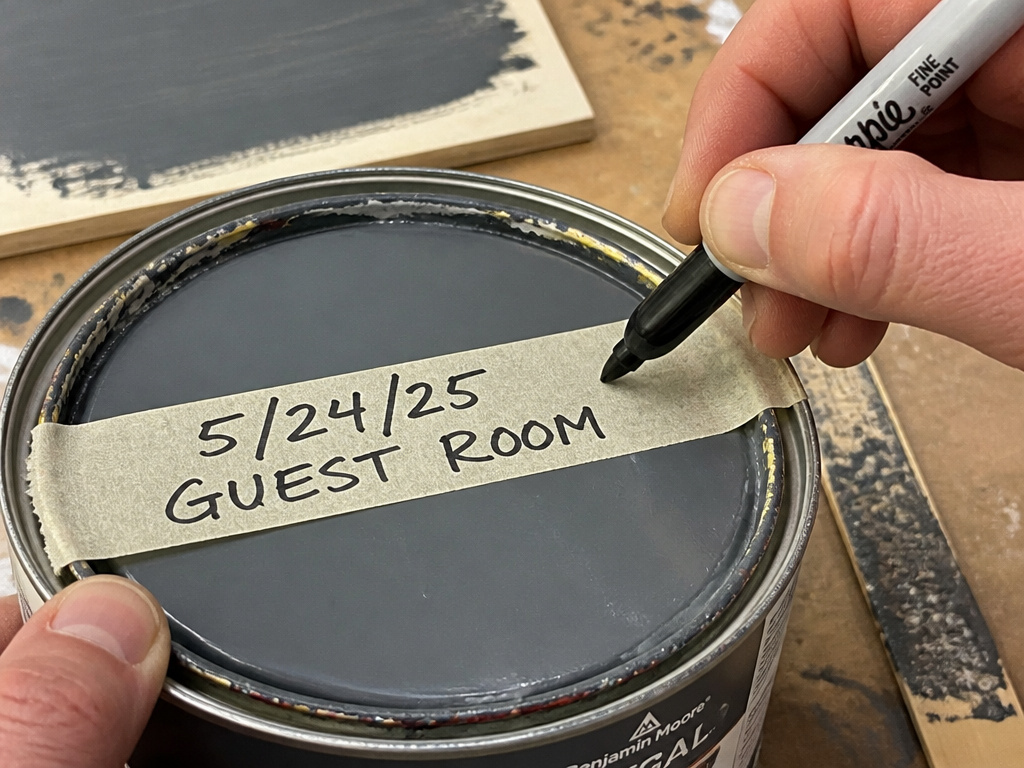
- Date the lid and use the oldest first. USBR stores coatings by batch and lot for exactly this reason, and a marker costs nothing.
None of these rules help if the lid is loose, so storing paint cans properly starts with the seal. A tight lid and a date on the side are the core of keeping opened paint usable through a whole winter.
If a can has been open and half-used for a season, treat it as a sample, not a supply. Test it on scrap before it touches a wall.
How Do You Tell If a Can Has Already Frozen?
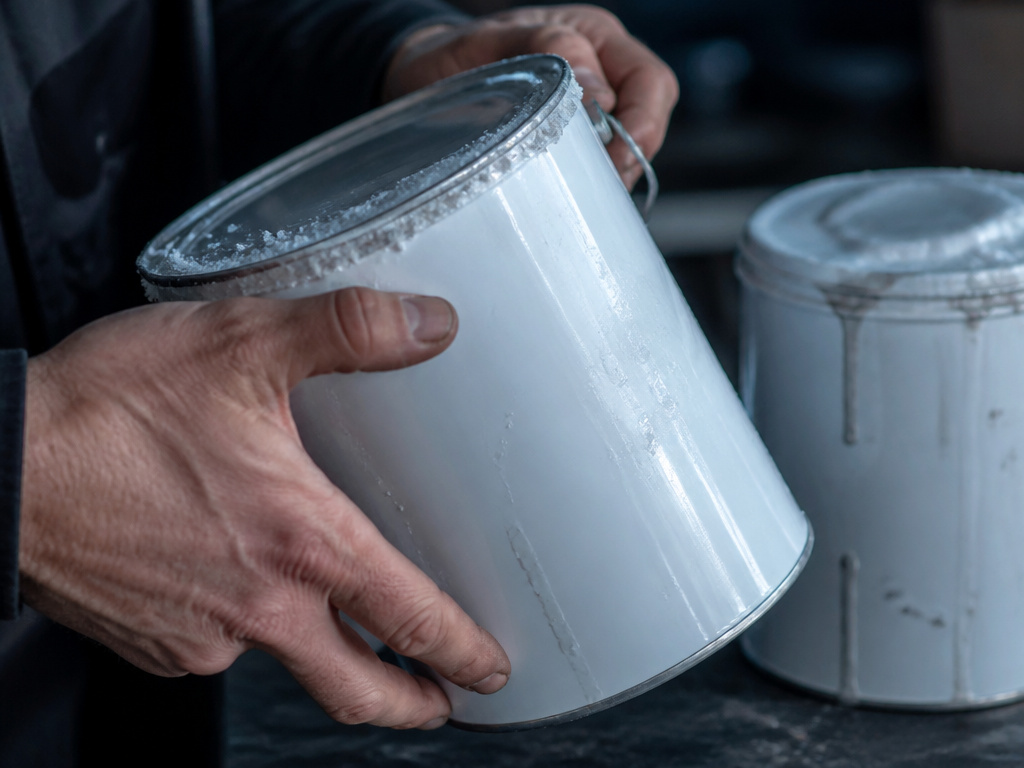
Use your hands before your eyes.
Where this goes sideways: Judging a cold can by the label alone. Waterborne paint can look normal on the surface and still be gelled at the bottom, and you’ll find out when the roller starts shedding clots across the wall.
The check is three steps, and it takes about a minute per pail:
- Shake the first few pails by hand. You want to hear liquid move, not a dull thud.
- Feel the side of the pail to gauge temperature. Feel the side of the pail to gauge temperature.
- Look for bulging lids or bowed sides. Look for bulging pails.
If any of the three feels wrong, open the can and look. Lowe’s frozen material process is blunt about the stakes: product that has been through a freeze/thaw cycle can’t be sold, and Sherwin-Williams says low-VOC formulations won’t survive it, while Dunn-Edwards says damage depends on the number of freeze/thaw cycles.
Spotting bad paint early is cheaper than discovering it mid-wall.
Where Cold-Weather Storage Goes Wrong
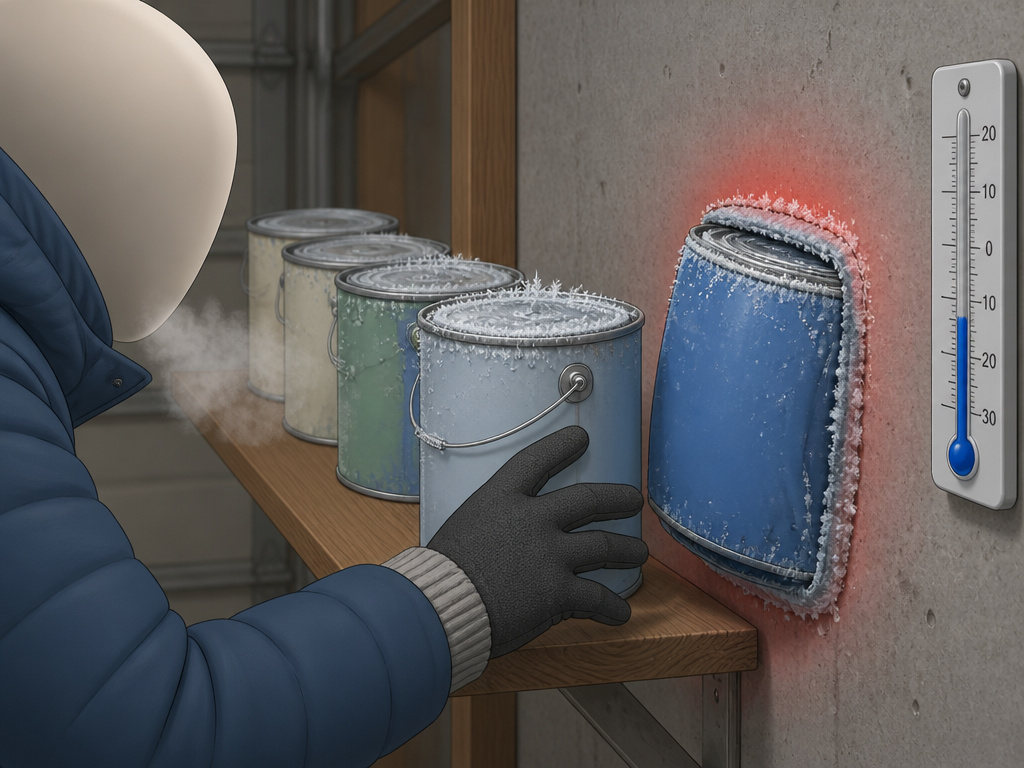
The most common storage spot for leftover paint is also the worst one: a garage that freezes.
The Unheated Trailer Problem
The Bureau of Reclamation coatings guide notes that contractors commonly store coatings in unheated trailers and calls that practice unsuitable. If a job-site trailer is your storage, your cans are riding the same temperature curve as the outdoors.
Low-VOC Paint Fails First
The “safer” formulation is the more fragile one in cold. Sherwin-Williams’ frozen material process states that low-VOC products cannot withstand a freeze/thaw cycle because of their low VOC levels. Sherwin-Williams says a low-VOC can may not survive a freeze/thaw cycle, while Dunn-Edwards says water-based paint damage depends on the number of freeze/thaw cycles rather than simply low VOC levels.
Solvents Don’t Belong Next to Cans
USBR requires solvents stored apart from coatings because of lower flashpoints. That’s a fire rule, not a stability rule, and it’s the one people skip when they’re in a hurry.
Aerosol cans live in that same cold garage, and spray paint storage has separate rules again.
Easy to miss: The can pressed flat against an uninsulated garage wall. It sits colder than the cans on the shelf, and it’s the one that freezes first.
What to Do With Paint That Froze in Transit
I’ve skipped the scrap test before. I mixed a color, liked it in the can, and brushed it straight onto a nearly finished piece. Now I test on scrap first, including with paint that’s been sitting in storage through a cold snap.
If a delivery shows up after a hard freeze, don’t refuse it. Lowe’s frozen material process is specific about that, and the steps run in order:
- Inspect the shipment immediately and contact Sherwin-Williams customer service if you suspect freezing. Refusing the shipment is the one thing the process tells you not to do.
- Set the order aside until the field team inspects it and confirms whether the paint is still sellable.
- Expect a return for non-sellable product above 10 gallons, and Haz-Mat handling for anything under 20 gallons.
For your own cans, the test is simpler. Stir it, look for lumps or a skin, and brush a patch on scrap. Hard settling of pigments cannot be stirred or shaken back in, resulting in paint different in gloss, viscosity, and performance.
That’s the failure Dunn-Edwards warns about: hard settling of pigments cannot be stirred or shaken back in, resulting in paint different in gloss, viscosity, and performance.
Dunn-Edwards also notes gelling is worse after numerous freeze/thaw cycles, which is why paint freeze-thaw damage tends to show up on the second or third thaw rather than the first freeze.
Try this: tape a strip to the lid with the date and the room it came from.
Frequently Asked Questions
Can you store paint in an unheated garage?
Only if the garage stays above 32F all winter, and most don’t. Hempel states that waterborne coatings exposed to frost are irreversibly destroyed, while Dunn-Edwards says gelling worsens with each freeze/thaw cycle, so a garage that dips below freezing is a bad home for latex. Solvent-borne paint handles it better, but it still thickens and needs slow re-warming.
Does latex paint really die after one freeze?
The sources disagree. Hempel says frost destroys waterborne paint irreversibly, full stop. Dunn-Edwards says water-based paint below 32F can gel, especially after numerous freeze/thaw cycles, which suggests one cold night might not finish a can. Plan for the stricter reading and you won’t be surprised.
What temperature is too cold for paint storage?
Below 32F is the hard floor, since that’s where the water in waterborne paint freezes. Sherwin-Williams recommends 35-95F indoors for Kem Aqua 8710, which is a tighter window than the general 32F line. Dunn-Edwards says avoid holding product more than 24 hours outside 32-110F.
Can frozen paint be saved?
Sometimes, but not reliably. Solvent-borne paint that thickened in the cold usually comes back with slow re-warming, per Hempel. Two-component high-solids epoxy or polyurethane may form crystals at sub-zero and need special heating and re-mixing. Waterborne paint that gelled is gone per Hempel, while Dunn-Edwards says damage depends on the number of freeze/thaw cycles.
Should I store paint cans upside down?
Yes, if you can. Hempel suggests turning the can upside down every 3 months to reduce settlement, and the Bureau of Reclamation recommends inverting containers monthly for multi-month storage. The point is to stop pigment from packing hard on the bottom, which is the damage you can’t undo.
The Bottom Line
Here’s the trigger to remember: the night before the forecast drops below 32F, every waterborne can comes indoors. That’s the whole decision, and it takes one trip.
If you can’t move them all, save the low-VOC cans and the reactive-pigment primers first. Sherwin-Williams flags low-VOC cans as unable to withstand a freeze/thaw cycle, and Dunn-Edwards flags reactive-pigment coatings as hardest to stabilize.
One concession, because it matters: none of this helps if the can was already half-empty and skinned over before the cold arrived.
Fewer cans, better stored, is the whole game.
