
How to Safely Paint Indoors in Winter: Step-by-Step
This post contains affiliate links. As an Amazon Associate, we earn from qualifying purchases.
To safely paint indoors in winter, keep both the air and the surface at or above 50 degrees F, hold relative humidity under 85 percent, and stay at least 5 degrees F above the dew point. Those conditions have to hold through the cure, not just the first hour.
Get the dew point wrong and the damage shows up the next morning, not the same afternoon. Condensation runs down a film that hasn’t set yet and leaves a dull band straight through the sheen. Dunn-Edwards’ cold-weather bulletin names that exact mechanism, and it’s why their advice includes a stop time as well as a temperature.
What follows walks the field conditions in order: the temperature window and where the published specs split, the dew-point margin, a ventilation method that doesn’t freeze the room, the cure hold, and the rag rules that actually prevent fires.
Key Takeaways
- 50 degrees F is the floor, not a suggestion. Both the air and the surface have to hold it.
- Stay 5 degrees F above the dew point. The Houston spec and PPG agree on the number; PPG adds a 24-hour hold above 50 degrees F afterward.
- Open windows on two sides rather than leaving one cracked all day.
- Full cure takes 7 days on PPG Break-Through! V62-510C, even though it’s dry to the touch in 15 to 20 minutes.
- Oily rags leave the room daily and go into a lidded metal can outdoors.
What Temperature Can You Actually Paint At in Winter?
Fifty degrees Fahrenheit is the floor in many spec sheets, though Dunn-Edwards states latex is formulated for low-temperature coalescence down to 40 degrees F, and some products to 35 degrees F. The University of Houston master spec 09 91 23 sets the window at 50 to 95 degrees F for both surface and ambient air. APCA’s cold-weather note lands in the same place: most interior products are formulated to be applied above 50 degrees F (10 degrees C).
Interior painting specifications set a field-condition window that governs surface and ambient air temperature together. Application is restricted below 50 degrees F and above 95 degrees F, at relative humidity above 85 percent, and at less than 5 degrees F above the dew point. Damp or wet substrates are excluded at any air temperature.
That’s the tidy version. Real products don’t all agree, and the spread matters when the room is cold.
Where the Specs Actually Disagree
| Source | Minimum | Maximum | Extra condition |
|---|---|---|---|
| University of Houston 09 91 23 | 50 degrees F | 95 degrees F | No work under 5 degrees F above dew point |
| PPG Break-Through! V62-510C | 50 degrees F | 90 degrees F | Hold above 50 degrees F for 24 hours |
| APCA cold-weather note | Above 50 degrees F | Not stated | Heat the space first if the system is off |
| Dunn-Edwards bulletin | 40 degrees F, some 35 | Not stated | Air and substrate above 35 degrees F during cure |
The gap between 35 and 50 degrees F is the one that catches people. Dunn-Edwards states that latex is formulated for low-temperature coalescence down to 40 degrees F, and some products to 35 degrees F. A university spec written for institutional work won’t sign off on that, and PPG’s Break-Through! Won’t either.
So which number do you use? Follow the TDS for the product in your hand, and if you can’t find one, use 50 degrees F. That’s the conservative floor, and it’s where APCA, PPG, and the Houston spec all sit, while Dunn-Edwards states latex is formulated for low-temperature coalescence down to 40 degrees F, and some products to 35 degrees F.
Pick the product before you pick the day. A good indoor paint for a cold room is a water-borne acrylic with a stated low-temperature limit printed on the technical sheet, not whatever is left in the garage, and that is the first step in how to safely paint indoors in winter.
Surface temperature is the part that gets skipped. APCA flags dense substrates like structural steel and concrete because they take longer to heat up than the air around them. Put your palm on a concrete floor in an unheated room and it reads colder than the air at head height. Check the surface, not the thermostat.
Common mistake: Heating the room and calling it done. A 70-degree room with a 48-degree concrete floor still fails, because the film forms at the substrate temperature, not at eye level.
Why Dew Point Beats Room Temperature Every Time
Dew point is the number that ruins winter paint jobs.
Condensation forms on any surface at or below the dew point. In a cold room the wall, the window frame, and the floor all sit colder than the air, so the film can be condensing water while the thermostat reads a comfortable 68 degrees F. Water-borne acrylic can’t knit into a continuous film while water keeps landing on it.
Dunn-Edwards explains the mechanism in plain terms. Latex particles have to touch and merge as the water leaves. Below the formulation’s minimum, they stay separate and the film dries chalky and weak instead of clear and hard.
You’ll see the failure as a dull band with a faint water line at its top edge. It doesn’t sand out evenly.
If the dew point is within 5 degrees F of your wall temperature, you’re done for the day. Extra drying time won’t rescue a film that formed in the wrong conditions.
The margin itself is settled. The Houston spec says 5 degrees F above dew point, and the PPG Break-Through! V62-510C technical data sheet says 3 degrees C, which is the same 5 degrees F. PPG adds a condition the Houston spec leaves out: air and surface have to stay above 10 degrees C (50 degrees F) for the next 24 hours.
How Do You Ventilate Without Freezing the Room?
It’s 28 degrees outside, the window is open, and you’re standing there in a coat watching a wall dry. Nobody enjoys this part.
Before you start: Solvent vapors build in a closed room, so open two windows on opposite walls before you pour anything. Oily rags go into a lidded metal can outdoors, never into a pile on the floor or the household trash. Open-flame and propane heaters add moisture to the air, which is the last thing a water-borne film needs.
Here’s where the sources pull against each other. The CPSC healthy indoor painting practices guide says to open all doors and windows to the outside, not to hallways, and to keep windows wide open with exhaust fans during painting and for 2 to 3 days afterwards. APCA says the opposite instinct is the problem: closing windows to stay warm causes a sudden humidity spike, and that spike stops waterborne coatings from curing.
Both are describing the same physics from different ends. A sealed room traps the water the paint is trying to release. An open window in January drops the surface temperature below the film’s minimum.
The workaround I use is burst ventilation. Open windows on two sides, close them, and repeat. The room loses less heat than leaving one window cracked all day, and the air actually changes. Fan placement does most of the work, and the details of how to ventilate a room properly are worth ten minutes before you start, especially when you are learning how to safely paint indoors in winter.
The CPSC guide is specific about the fan itself. Place a box fan securely in the window blowing out, and don’t point it at someone else’s space. If it rains or snows, turn the fan off and pull it out of the window. An air conditioning unit is not a substitute, and bathroom or kitchen exhaust fans don’t always vent outdoors.
How to Safely Paint Indoors in Winter Without Breaking the Cure
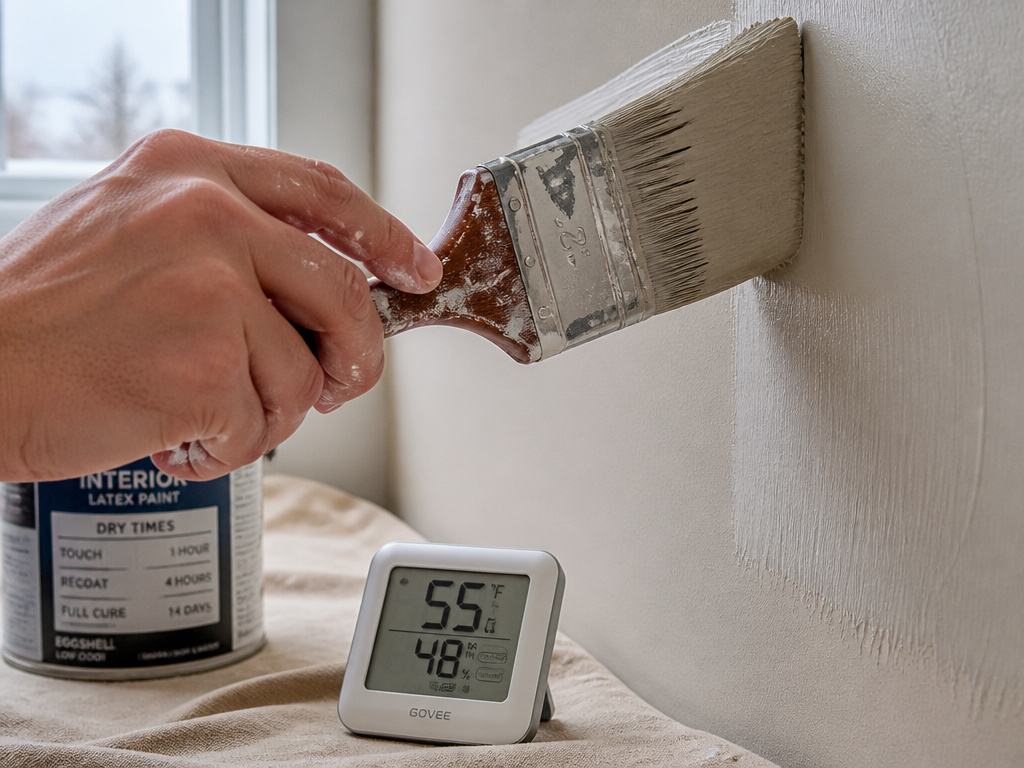
Recoat time is not cure time, and winter is where that gap bites.
PPG publishes drying times for Break-Through! V62-510C at 25 degrees C (77 degrees F) and 50 percent relative humidity: 15 to 20 minutes to touch, 1 hour to handle, 1 hour to recoat, 12 hours for foot traffic, and 7 days to full cure. The same sheet notes those times vary with temperature, humidity, colour, film build, and air movement.
At 55 degrees F in a spare room, you’re near the bottom of that range, not the middle.
What “Cure” Means on a Cold Day
Cure is the film reaching full hardness and adhesion, and it keeps going long after the surface feels dry. PPG states full cure at 7 days and says to wait at least 7 days before cleaning the surface with a non-abrasive mild cleaner or letting water pond on it. Dunn-Edwards calls the first 48 hours the most critical cure window.
- Check the spread before you open a can. Compare the dew point forecast to the wall temperature. Under 5 degrees F of margin and you stop.
- Heat the room to 50 degrees F and hold it. APCA’s note covers the case where the building’s heating system isn’t running yet: bring the space up with space heaters before any paint goes on.
- Start early and stop early. Dunn-Edwards recommends working between 10 am and 2 pm and stopping mid-afternoon. Sherwin-Williams frames the same rule differently, asking for 3 to 4 hours of drying time at recommended temperatures before dark.
- Recoat inside the stated window. PPG gives 1 hour at 77 degrees F and 50 percent relative humidity. Miss it and you’re sanding.
- Keep the heat on overnight. PPG requires air and surface above 50 degrees F for the next 24 hours. Drop below it and the film may never fully harden.
- Wait 7 days before you clean it. That’s the PPG interval before a mild non-abrasive cleaner or standing water.
Storage is its own winter problem. PPG’s label states PROTECT FROM FREEZING, and the Houston spec requires materials not in use to sit in tightly covered containers in well-ventilated areas at not less than 45 degrees F. Storing paint in winter is a separate job from applying it, and a can that froze in transit is already a problem before temperature ever matters.
When a Winter Coat Fails, Read the Streak Pattern
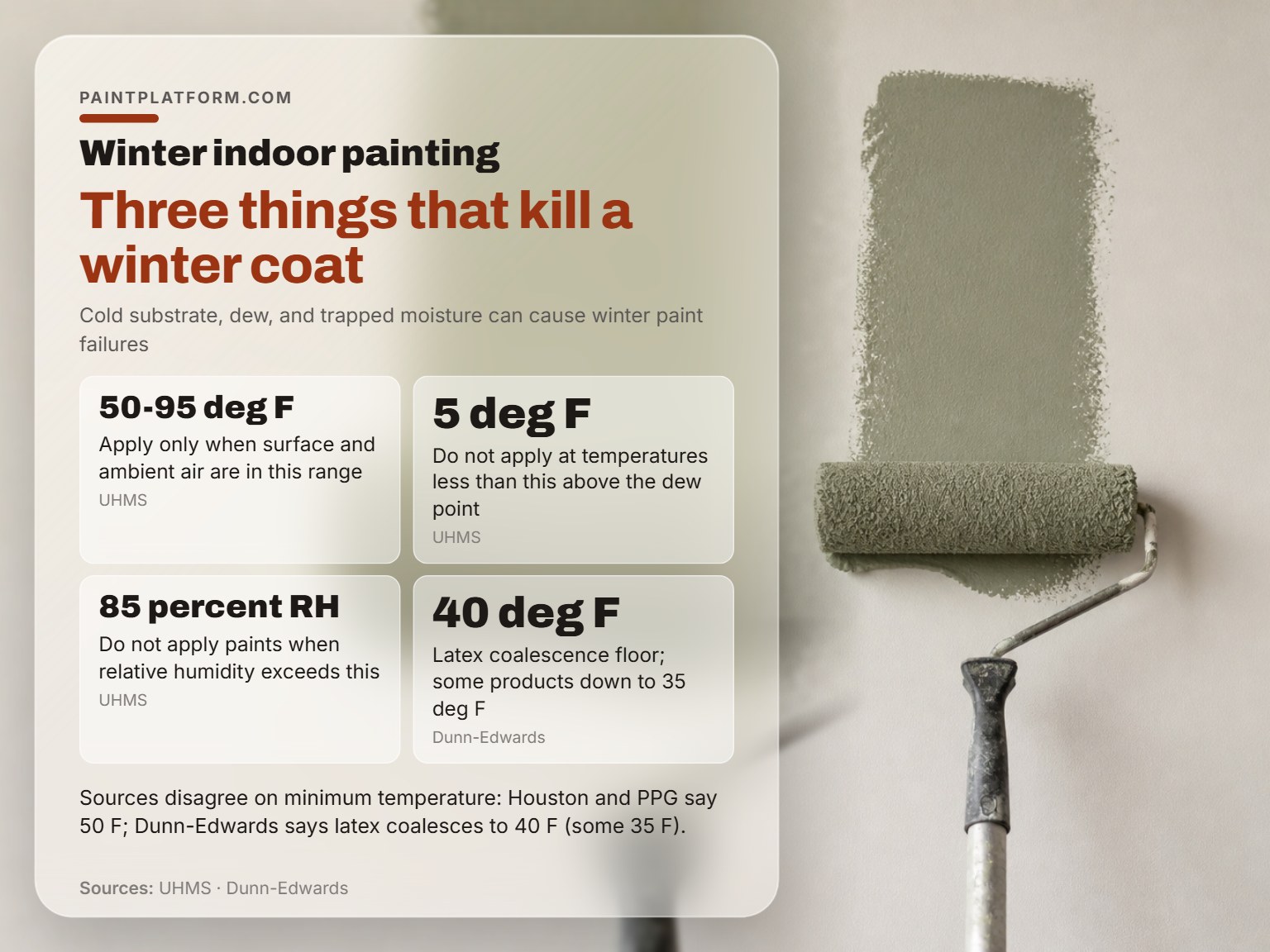
Three things kill a winter coat: cold substrate, dew, and trapped moisture.
| What you see | Likely cause | What to do |
|---|---|---|
| Dull band with a faint water line | Condensation ran down a wet film | Sand back, repaint earlier in the day |
| Chalky finish that wipes off | Film formed below the coalescence floor | Strip and repaint above 50 degrees F |
| Peeling at edges and corners | Substrate was damp or too cold | Let it dry, sand, recoat |
| Still soft after a week | Room dropped below 50 degrees F during cure | Restore heat, extend the cure window |
The streak is the tell. Condensation runs downhill, so the band starts at a horizontal edge and widens as it falls. A chalky finish that wipes off on your hand is a different failure, and it points at the coalescence floor rather than at water running down the wall.
Sherwin-Williams adds one more failure at the other end of the thermometer. Extremely high temperatures over 100 degrees F can dry a film before it adheres, and that shows up as peeling later. Winter work rarely gets there, but a space heater pointed at one wall can.
Rags, Solvents, and the Fire Risk Sitting in the Corner
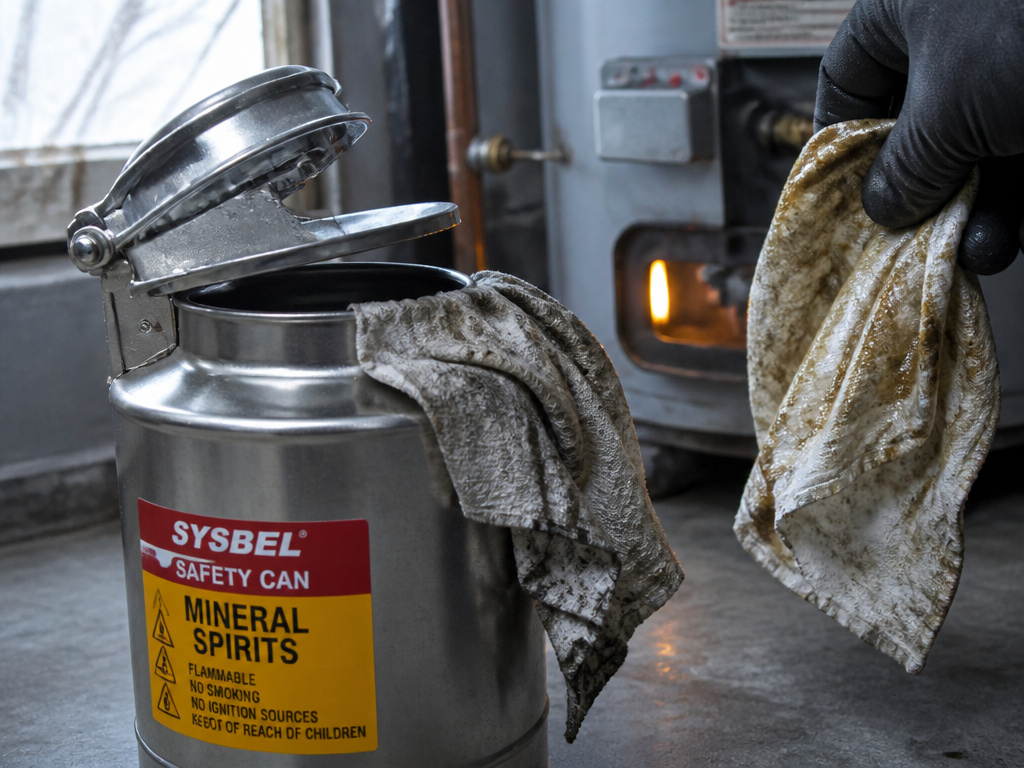
Oily rags are the one part of a paint job that can burn your studio down after you’ve gone to bed.
One January I cleaned a set of brushes with mineral spirits in a closed studio because it was freezing outside and I didn’t want to lose the heat. About 30 minutes in I had a dull headache and felt weirdly goofy. That was the last time I worked that way.
The smell is the tell. Mineral spirits has a heavy, sweetish edge, and if you can still smell it from the next room, the air isn’t moving.
What changed: I switched to a low-odor option, I crack a window even in January, and I cap the jar every time I set a brush down. None of that is dramatic. All of it is routine now.
The sources back the routine. The CPSC guide notes that short-term solvent exposure from alkyd paints can be significantly higher than from latex, and that flammable products should be used away from ignition sources such as water heaters, furnaces, electric motors, and fans. It also states flatly that gasoline should never be used to clean brushes.
Headache and that floaty feeling are among the early symptoms the same guide lists, alongside eye and throat irritation, dizziness, and vision problems. The broader paint fumes picture is worth reading once before you commit to a solvent job.
For alkyd work in a closed room, a cartridge respirator earns its place. For alkyd work in a closed room, a cartridge respirator earns its place. For water-based paint it’s overkill. Choosing a paint respirator comes down to cartridge type and fit, and solvent work is the case where it matters.
The Rag Rule That Prevents a Fire
Houston’s spec is blunt about it: remove rags and waste from storage areas daily. That’s the whole rule.
- Lidded metal can, outdoors. A steel can with a self-closing lid keeps vapor from collecting in the room.
- Out of the house the same day. Not the garage, not the porch, not the bin under the sink.
- Never balled up in a trash bag. A pile of rags is where the heat builds.
- Away from the water heater. The CPSC guide lists water heaters, furnaces, electric motors, and fans as ignition sources.
Where this goes sideways: Capping the jar but leaving the lid loose. The vapor escapes anyway, and you’ve told yourself you handled it.
Who Should Not Be in the Room
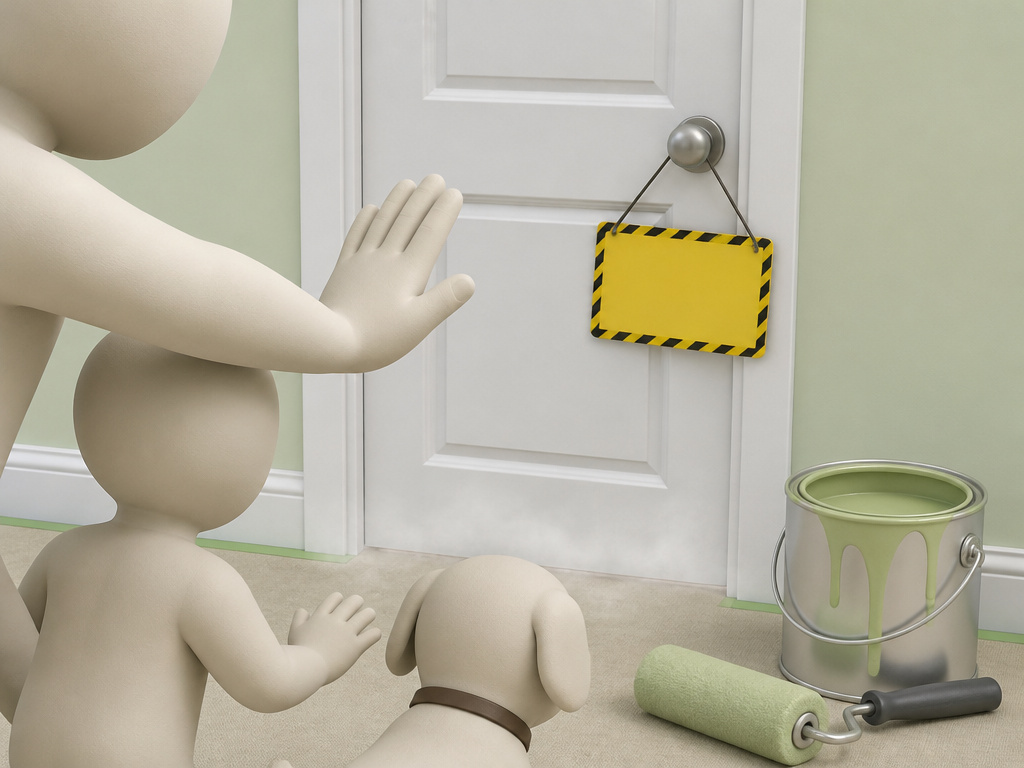
The EPA’s lead-paint rule kicks in at 1978, and it changes who should be in the room.
The CPSC guide names two groups directly. Pregnant women should avoid undertaking painting projects and should limit time in freshly painted rooms, especially when oil-based paints are used. Young children and people with breathing problems should avoid paint vapors altogether.
That’s not a liability disclaimer. Solvent exposure from alkyds is significantly higher than from latex, and the same guide notes that professional painters exposed to high vapor levels over long periods have shown nervous system, liver, and kidney damage.
Lead Paint in Anything Built Before 1978
APCA cites EPA guidance on this one. Test a home or building for lead-based paint if it was built before 1978, because more than half the homes built before 1978 contain lead paints. Sanding a window frame in a 1950s house is a different job from sanding one built in 1995.
If you’re choosing products for a room with kids or pets in it, low-VOC paint is the starting point, not the whole answer. The CPSC guide notes that water-based paints generally emit fewer chemicals and lower levels of chemical vapors than oil-based ones. Ventilation still does most of the work.
- Pregnant: stay out during application and limit time in the room afterward, especially with alkyds.
- Young children and anyone with breathing problems: keep them out of freshly painted rooms until the air clears.
- Pets: same rule as kids, and the paint safety for kids and pets checklist covers where they shouldn’t be.
- Homes built before 1978: test for lead before you sand anything.
The specifics of painting while pregnant go further than this section can, and it’s worth the read if that’s your situation.
Frequently Asked Questions
Can I paint indoors in winter with the heat off?
Not at the temperatures the specs require. APCA’s note addresses this directly: if the building’s heating system isn’t running, bring the ambient temperature up with space heaters before painting starts. Below 50 degrees F, most interior products won’t form a proper film.
What is the lowest temperature I can paint at?
It depends on the product, and the published numbers disagree. The Houston spec and PPG both set 50 degrees F. Dunn-Edwards states that latex is formulated for low-temperature coalescence down to 40 degrees F, and some products to 35 degrees F, with air and substrate above 35 degrees F during cure. Use the technical sheet for your specific product.
Do I have to keep the windows open the whole time?
The CPSC guide says windows wide open with exhaust fans during painting and for 2 to 3 days afterwards, while APCA warns that closing windows to stay warm causes a humidity spike that stops waterborne coatings from curing. APCA warns that sealing the room causes a humidity spike that stops waterborne coatings from curing.
How long before I can walk on a painted floor in winter?
PPG lists 12 hours for foot traffic on Break-Through! V62-510C, measured at 25 degrees C (77 degrees F) and 50 percent relative humidity. Colder rooms take longer, and the same sheet notes drying times vary with temperature, humidity, and air movement.
Is it safe to sleep in a room painted the same day?
The CPSC guide recommends continuing ventilation for 2 to 3 days after painting to return the air to acceptable quality. Pregnant women should limit time in freshly painted rooms, especially with oil-based paints. Give the room air before you give it occupants.
Why did my paint dry chalky?
Chalky, powdery finish points at the product’s coalescence floor. Latex particles need to merge as the water leaves, and cold stops that from happening. Sand it back and repaint when the surface holds at least 50 degrees F through the cure.
Before You Go
Here’s the threshold that matters most: if the spread between your dew point and your wall temperature is under 5 degrees F, no amount of heat in the room fixes it. Wait for a better day. Winter hands you plenty of bad ones and a few good ones, and the good ones are obvious once you start checking.
The first step takes five minutes. Tonight, put a thermometer against the wall you plan to paint and leave it there overnight. Tomorrow morning, compare that reading to the dew point in the forecast. If it’s under 50 degrees F, you already have your answer.
Fair warning: this is the least satisfying part of the hobby. Nobody posts a photo of a correctly disposed rag can.
