
Paint Safety for Children and Pets: Lead and Ventilation
This post contains affiliate links. As an Amazon Associate, we earn from qualifying purchases.
Paint safety for children and pets rests on two rules: use paint that meets the federal lead limit of 0.009% (90 ppm), and keep kids and animals out of a freshly painted room for 2 to 3 days. Water-based low-VOC paint cuts the fume load, but ventilation timing still matters.
The 0.009% figure has a history behind it. Before August 14, 2009, the federal limit sat at 0.06%, and CPSIA section 101(f) dropped it to 0.009% effective August 14, 2009. That history matters.
What follows walks the actual regulations, the ventilation guidance where CPSC recommends 2 to 3 days and EPA sets no numeric interval, and the storage and disposal habits that keep a messy studio from becoming a hazard for a toddler or a curious cat.
Key Takeaways
- 0.009% (90 ppm) is the current US lead limit for paint on children’s products, certain furniture, and household paint, down from 0.06% before August 14, 2009.
- CPSC recommends 2 to 3 days of open windows and box-fan ventilation after painting; the EPA sets no numeric interval at all.
- Canada’s 90 mg/kg limit has five named exemptions the US rule does not, including agricultural anti-corrosive and adult art/craft coatings.
- A Safety Data Sheet is not proof of compliance for a children’s product; third-party CPSC-accepted lab testing is.
- Paint thinner recalls turn on packaging, not lead, as the July 16, 2026 Liizousuda recall shows.
Paint Safety for Children and Pets: What the Lead Limits Actually Say
The current US limit is 0.009% lead by weight of the dried film, which equals 90 parts per million. That number comes from the 16 CFR Part 1303 lead paint ban, the federal rule that bans lead-containing paint on household surfaces, children’s products, and certain furniture.
The rule didn’t always read that way. The original limit was 0.06%, and it stayed there until CPSIA section 101(f) dropped it to 0.009% effective August 14, 2009. That history matters for paint safety for children and pets if you’re working around paint from an older renovation, because the older limit isn’t the one that applies today.
The 0.009% threshold applies to the weight of total nonvolatile content or the dried paint film.
The CPSC lead in paint FAQ restates the same number for children’s products, certain furniture articles, and household paint. It also draws the scope lines: motor vehicles and boats sit outside the ban, and so do printing inks that become part of the substrate, electroplating, and ceramic glazing.
Before you buy, check three things on the can:
- The lead limit statement (0.009% or 90 ppm for US consumer paint)
- The VOC rating, which indicates the product’s volatile organic compound content
- The storage temperature range, such as the 40°F to 90°F range in the Florida Paints SDS
I keep the 0.009% number in my head when I’m standing in the paint aisle. It’s small enough that a casual label skim will miss it.
The US and Canada Split on Exemptions
Both countries land on 90 ppm for the headline number. Canada expresses it as 90 mg/kg under SOR/2016-193, and the scope is where the two rules part ways. The US rule is a flat ban above the limit for consumer paints, toys, and furniture, with narrow carve-outs for the categories above.
Canada’s regulation lists five named exceptions: agricultural anti-corrosive coatings, coatings for non-building agricultural or public structures, metal touch-up, outdoor billboard art, and adult art or craft use. Some of those can legally exceed 90 mg/kg if the container carries the mandated bilingual DANGER panel.
| Jurisdiction | Lead limit | Notable exemptions |
|---|---|---|
| US (16 CFR 1303) | 0.009% (90 ppm) | Motor vehicles, boats, printing inks, electroplating, ceramic glazing |
| Canada (SOR/2016-193) | 90 mg/kg | Agricultural anti-corrosive, metal touch-up, billboard art, adult art/craft |
| US pre-2009 | 0.06% | Superseded August 14, 2009 by CPSIA section 101(f) |
The adult art/craft exemption has a catch. It voids the moment a child uses the coating, which is worth knowing if you keep oil paints or specialty mediums in a shared studio. A curious toddler doesn’t read the label.
Why Pica Makes Lead Paint a Different Risk for Toddlers
The CPSC’s own findings put a number on the risk. Pica, the repetitive ingestion of nonfood substances, occurs in 50% of children between the ages of one and three. The behavior is episodic, showing up 2 to 3 times a week rather than as a steady habit.
That timing is what makes lead paint a different problem from most home hazards. A toddler doesn’t need to eat a chip of paint every day to accumulate exposure. A few episodes a week is enough, and children in that age band absorb lead faster than adults do.
The health outcomes listed in the regulation are the reason the limit sits so low: hyperactivity, slowed learning ability, withdrawal, blindness, and in the worst cases death. Former Surgeon-General Jesse L. Steinfeld estimated in 1971 that 400,000 pre-school American children had elevated body lead burdens. The National Bureau of Standards put the figure at 600,000 in 1972.
Rule of thumb: If a painted surface is within a toddler’s reach and the paint predates 1978, assume it contains lead until a test kit says otherwise. A swab test is cheaper than a blood test.
How Long Should Kids and Pets Stay Out of a Freshly Painted Room?
The CPSC’s Healthy Indoor Painting Practices guide recommends keeping windows wide open for about 2 to 3 days after painting, and avoiding freshly painted rooms for the same window whenever possible. That guidance covers young children and anyone with breathing problems, not just pets.
The EPA’s EPA volatile organic compounds indoor air guidance takes a different approach. It recommends increasing ventilation but doesn’t set a numeric post-paint interval. The 2-to-3-day figure is a CPSC recommendation. The EPA does not set a numeric interval of its own.
The practical checklist from CPSC looks like this:
- Schedule for a dry period in fall or spring, when windows can stay open.
- Mount a box fan in the window to exhaust vapors, and make sure it can’t fall out.
- If no fan is available, open a second window for cross-ventilation.
- Keep kids and pets out for the full 2 to 3 days, not just until the smell fades.
- Take fresh air breaks while painting, and leave the area if you feel dizzy or get a headache.
I used to go by smell. When I repainted the hallway a few years back, I let the dog back in once the sharp edge was gone, usually about a day with a box fan propped in the window. Then I read the CPSC guidance and realized I had been cutting the window short by half. Now the dog stays out the full 2 to 3 days, and the fan runs the whole time.
The fan matters more than people give it credit for. A window-mounted box fan pulls air out of the room, and you can feel the difference on the back of your hand when you hold it near the doorway. If the fan can’t be used, CPSC says the room needs adequate cross-ventilation instead.
The Apartment Problem: Shared Air
Vapors don’t respect unit boundaries. CPSC’s guidance notes that harmful gases can move through common walls via gaps around pipes and electrical outlets, which the agency calls shared air. A paint job in one unit can reach the unit next door through the same channels.
The practical fix is to vent both the painted unit and the neighboring ones to the outdoors with box fans. CPSC also suggests apartment managers give advance notice to adjacent units and consider loaning fans to residents doing their own painting.
A water-based paint that feels dry to the touch can still be off-gassing well before the 2-to-3-day CPSC ventilation window ends. That gap is the whole reason the 2-to-3-day window exists.
For the broader fume picture, the paint fumes safety guide covers solvent-based products and the symptoms to watch for.
Paint Thinners, Strippers, and the Packaging Rule Most People Miss
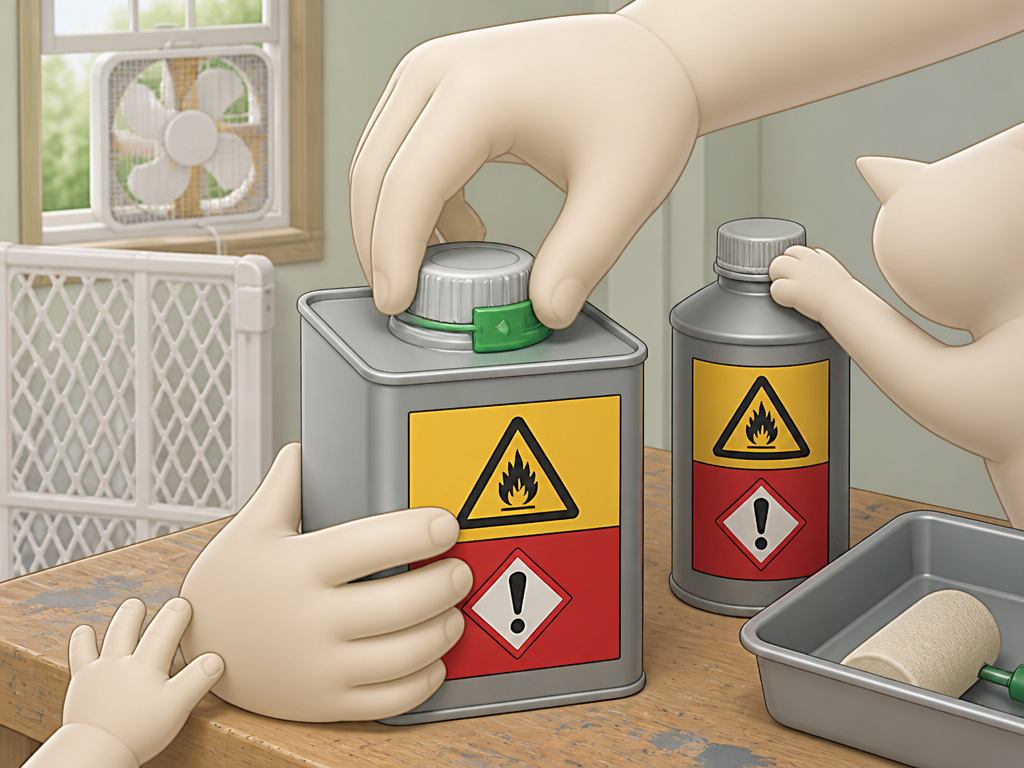
On July 16, 2026, the CPSC recalled about 4,200 bottles of Liizousuda Paint Thinner, sold on Amazon between March 2025 and February 2026. The recall had nothing to do with lead content. The bottles violated the PPPA child-resistant packaging standard for low-viscosity petroleum distillates, and no injuries were reported.
That distinction matters because it’s easy to fixate on lead and miss the packaging layer. A paint thinner can be chemically unremarkable and still be a serious hazard to a toddler if the cap is not child-resistant.
Methylene chloride strippers are a separate category. CPSC advises against using them in enclosed spaces like bathrooms and around children. CPSC advises against using methylene chloride strippers in enclosed spaces and around children.
Where this goes sideways: Using a methylene chloride stripper in a bathroom with the door closed and the exhaust fan on. CPSC advises against using these strippers in enclosed spaces such as bathrooms and around children.
Before you start: Solvent-based strippers and thinners give off vapors, and the Florida Paints SDS lists possible symptoms including dizziness, nausea, and headache. Work outdoors or with a box fan pulling air out of the room, and keep children and pets out of the space entirely. Oil-based rags and steel wool can self-heat and ignite if wadded up; spread them flat to dry outside or seal them in a metal can with a lid.
What the SDS Does and Does Not Tell You
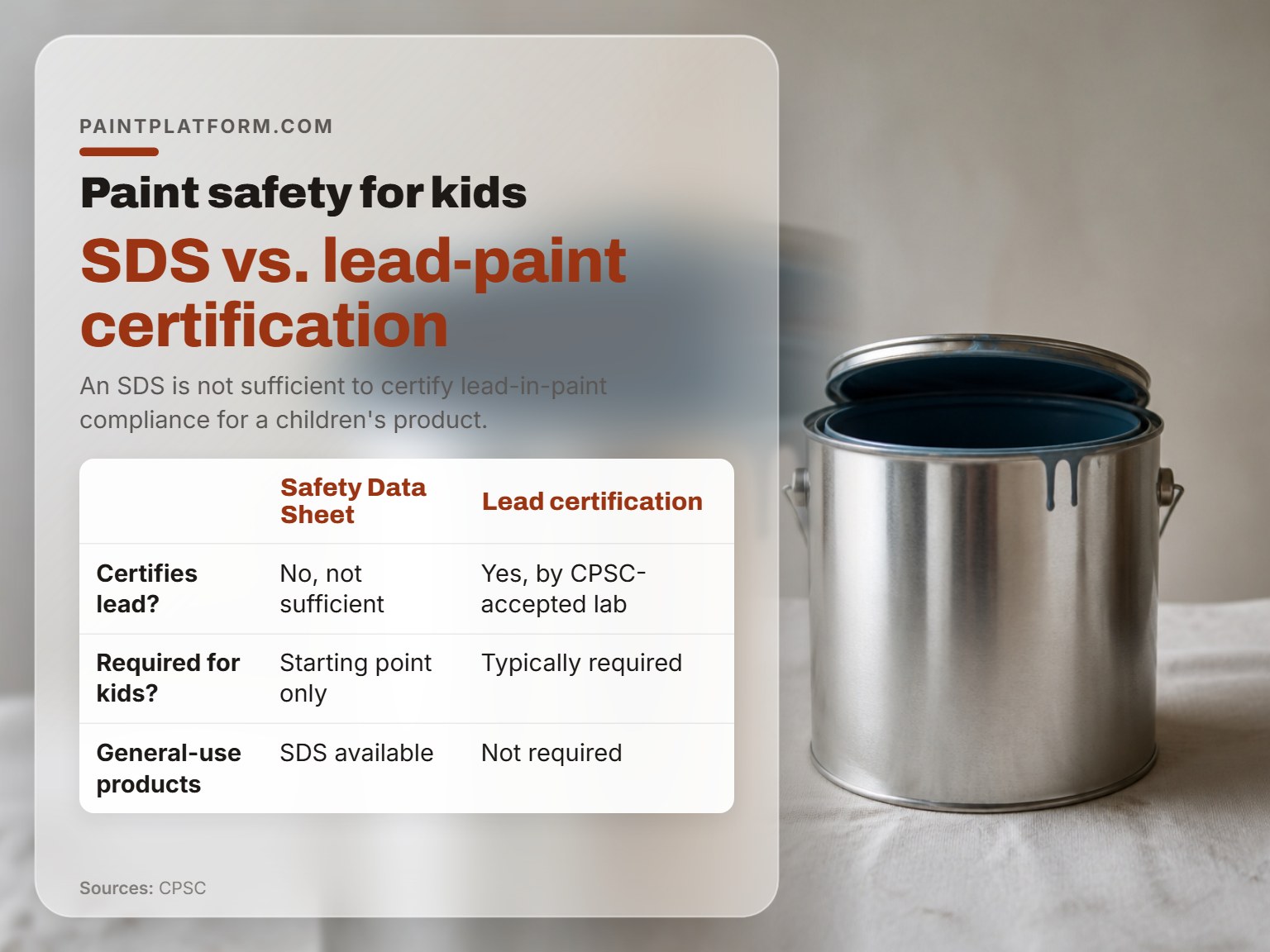
A Safety Data Sheet is a starting point, and the CPSC treats it as separate from a compliance certificate. The agency states plainly that an SDS isn’t sufficient to certify lead-in-paint compliance for a children’s product. For those, third-party testing at a CPSC-accepted laboratory is typically required. General-use products don’t carry the same testing requirement.
The Florida Paints interior paint SDS (form 2305-1) is a useful example of how far an SDS goes. It declares the product exempt from OSHA GHS-HCS labeling requirements, with no signal word, hazard statement, or pictogram required. It still lists precautionary statements: do not ingest, use only with adequate ventilation, avoid breathing spray mist, keep out of reach of children.
| Parameter | Value |
|---|---|
| Storage temperature | 40F to 90F |
| Maximum stack height | 3 containers |
| Eye exposure first aid | Flush with fresh water for 15 minutes |
| Ingestion first aid | Drink fresh water to ensure dilution |
| Inhalation first aid | Move to fresh air |
The SDS also notes that dried films can support combustion when in contact with open flames, and that closed containers can develop internal pressure and rupture under extreme heat. That’s worth knowing if you store paint near a water heater or in a garage that gets summer sun.
Easy to miss: An SDS that says “no reportable hazardous ingredients” isn’t the same as a lead-free certification. The CPSC treats the two as different documents with different legal weight.
I’ve been guilty of treating an SDS as a gold star. It isn’t one. For the buying side, the non-toxic paint guide walks through what certifications to look for on the can.
Storage, Rag Disposal, and the Habits That Actually Prevent Accidents
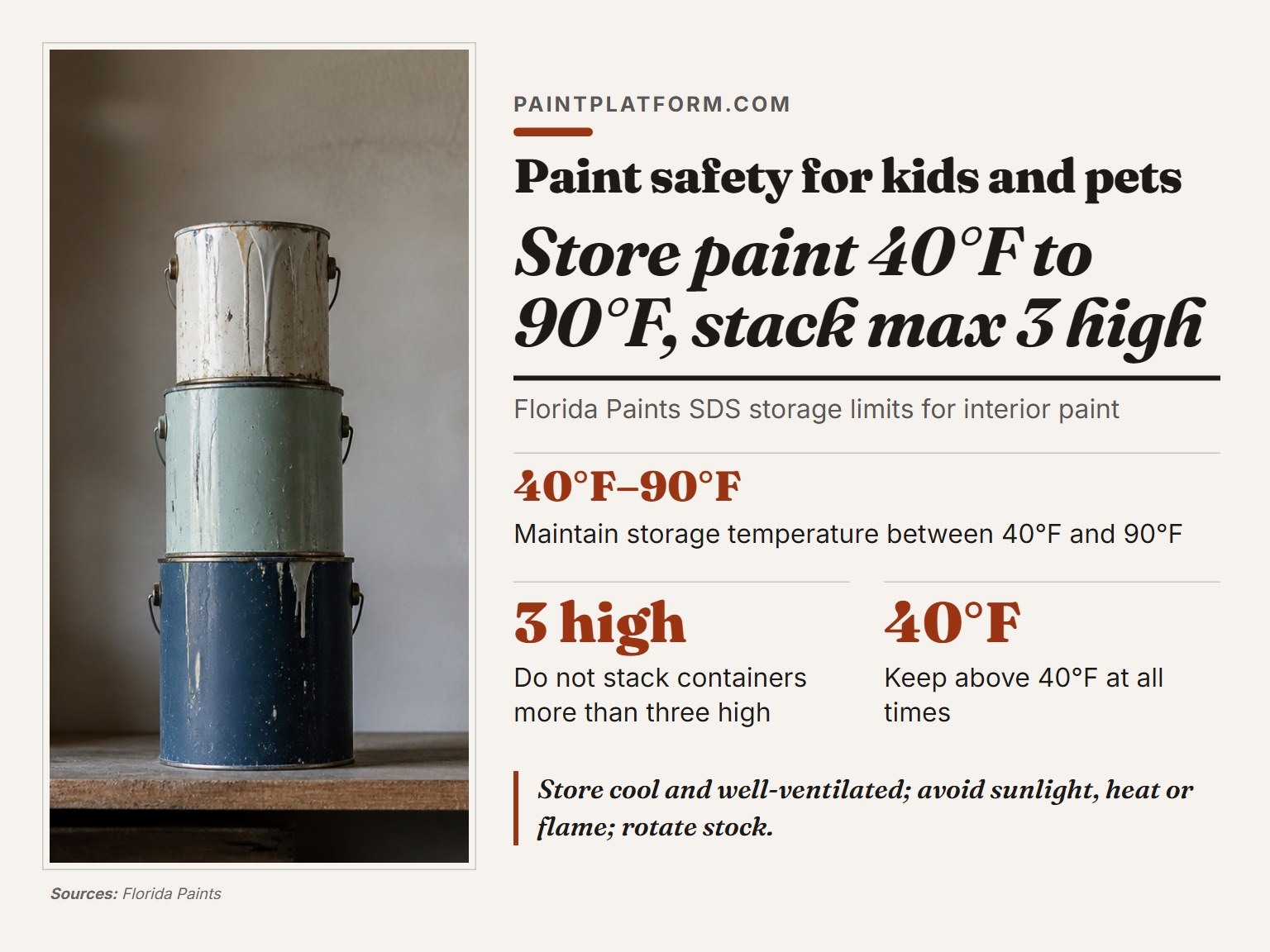
The Florida Paints SDS gives a storage window of 40F to 90F, and it says not to stack containers more than three high. It also calls for a cool, well-ventilated area, no direct sunlight or flame, periodic leak checks, and stock rotation so older material gets used first.
Those numbers matter in a studio or a garage. A stack of four cans exceeds the SDS maximum of three high and is one nudge away from a spill that a toddler or a cat will find before you do.
- Store between 40F and 90F, per the Florida Paints SDS.
- Stack no more than three high, and keep the stack away from a shelf edge.
- Rotate older cans to the front so you use them before they separate.
My tubes and jars live on a high shelf for exactly this reason. A curious cat can clear a low shelf quickly, and a toddler isn’t far behind.
Oil-Based Rags: The Fire Risk Nobody Warns You About
Oil-based paints, stains, and varnishes leave rags that can self-heat as they dry. The heat comes from the curing oil oxidizing, and a wadded rag traps that heat in the middle. Left in a pile, it can reach ignition temperature without a flame ever touching it.
A wadded rag that’s been sitting in a bucket can feel warm to the touch, and that warmth is the tell. Spread them flat.
The fix is simple. Spread the rags flat on a non-combustible surface outdoors to dry, or drop them in a metal can with a tight lid and a little water. Never ball them up and leave them in a plastic bucket overnight.
The paint disposal safety guide covers the local rules for what to do with the leftovers.
When Should You Skip the Project and Hand It to Someone Else?
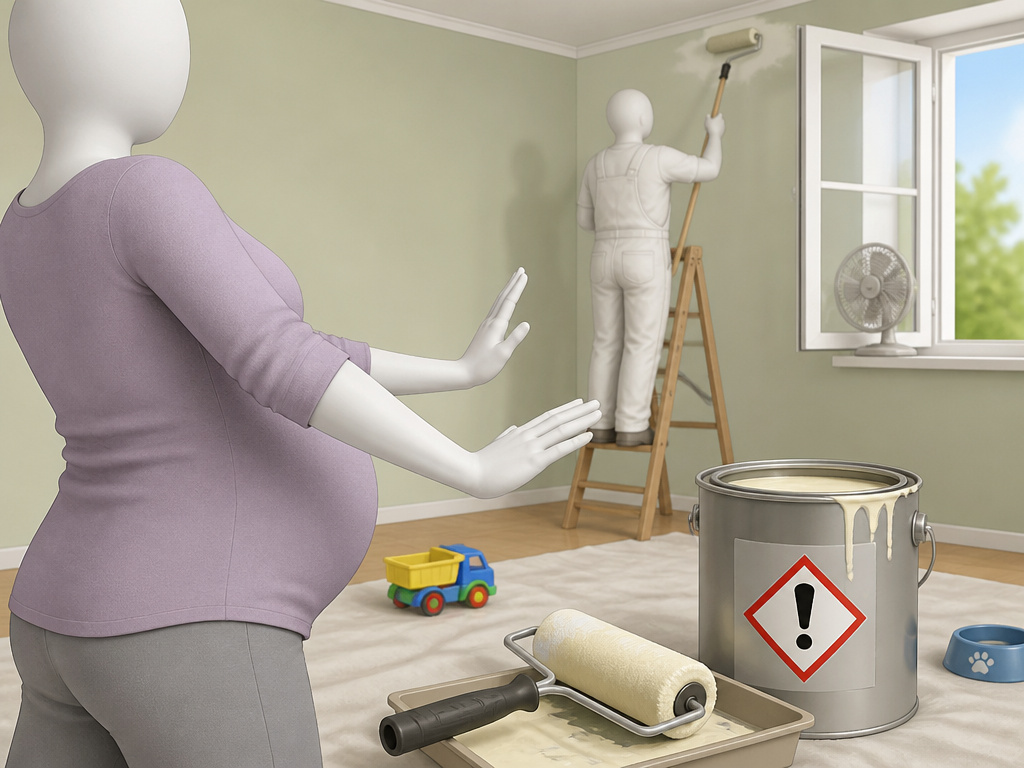
If you’re pregnant, the calculation changes. My own rule is to skip solvent-based products and spray paint entirely, choose water-based paint, ventilate hard, and let someone else handle the ceiling and the cleanup. That last part is the one people skip, and it’s often the most exposed part of the job.
The paint exposure pregnancy and children reference is one place to start if you want to read further before deciding.
For small water-based jobs, an open window and a fan help address the vapors. For solvent-based work, spray application, or anything involving a methylene chloride stripper, the honest answer is that the setup belongs in professional hands.
- Solvent-based paint or stripper: hand it off.
- Spray application: hand it off.
- Ceiling work or cleanup while pregnant: hand it off.
If you want a simpler on-ramp, the toddler paint guide covers the low-VOC options that make cleanup easier. The paint for kids rooms guide goes deeper on color and finish choices.
For the skin side of the job, skin protection covers gloves and barrier creams for the solvents that don’t wash off with soap alone.
Frequently Asked Questions
Is all modern paint lead-free?
No. The US limit is 0.009% (90 ppm), which is a ceiling rather than a zero. Imported or specialty paints can still exceed it, and older paint from before 1978 is a separate risk entirely. The CPSC’s guidance covers household paint, children’s products, and certain furniture, not to every coating on the market.
How long after painting is it safe for a dog or cat?
CPSC recommends 2 to 3 days of open windows and box-fan ventilation before reoccupying a room, and that window covers pets as well as children. The EPA gives no numeric interval, so the 2-to-3-day figure is a CPSC recommendation rather than a joint rule.
Does low-VOC paint mean no ventilation is needed?
No. Low-VOC paint reduces the fume load, but it doesn’t eliminate off-gassing. The CPSC guidance on ventilation timing applies regardless of the VOC rating on the can.
Can I rely on the Safety Data Sheet for lead compliance?
Not for a children’s product. The CPSC states that an SDS isn’t sufficient to certify lead-in-paint compliance, and third-party testing at a CPSC-accepted laboratory is typically required. For general-use products, the testing requirement is lighter.
What is the most common packaging mistake with paint thinners?
Child-resistant caps. The July 16, 2026 Liizousuda recall turned on the PPPA child-resistant packaging standard for low-viscosity petroleum distillates, not on the chemistry of the product. A cap that is not child-resistant is the hazard.
The Bottom Line
The two numbers that matter most are 0.009% and 2 to 3 days. The first is the US lead limit for paint on household surfaces, children’s products, and certain furniture. The second is the CPSC ventilation window before kids and pets come back in.
If you take one action this week, read the label and the SDS on the next can of paint you buy before you open it. Check the lead limit, check the VOC rating, check the storage temperature, and check whether the product is exempt from GHS labeling. That five-minute read is the difference between a routine paint job and a story you tell later with a wince.
Start messy. Refine later. But read the label first.
