
How to Choose a Paint Respirator: Air-Fed vs Cartridge
This post contains affiliate links. As an Amazon Associate, we earn from qualifying purchases.
To choose a paint respirator, match the device to the paint. Isocyanate (2K) sprays need air-fed breathing apparatus under UK rules, while NIOSH-approved 23C cartridges are cleared for paint mists and organic vapors in the US. The two systems disagree, and that gap decides your setup.
Isocyanate levels in a spray room can climb into the thousands of micrograms per cubic metre, according to HSE. At that concentration, the cartridge question carries real weight. The device you pick decides what you breathe.
What follows: the UK and US split, the air-fed versus cartridge decision, the beard and fit rules, the test intervals, and what the shop studies actually found. By the end you’ll know which standard your booth has to meet.
Key Takeaways
- Air-fed breathing apparatus is the UK requirement for isocyanate paints, per HSE. Filtering respirators don’t meet it.
- NIOSH 23C cartridges are approved for paint mists and organic vapors in the US, a narrower claim than “suitable for 2K isocyanate spraying.”
- Test the breathing air at least every three months, or monthly in a spray booth, depending on which HSE document you follow.
- A beard breaks a face seal, though loose-fitting hoods skip the fit test and work with facial hair. Loose-fitting hoods skip the fit test and work with facial hair.
- Five of six auto body shops in a NIOSH study used respirators inappropriately. The hardware was fine. The program was missing.
Why the UK and US Disagree on Paint Respirators
The HSE and NIOSH answer the same question differently, and the difference matters more than any spec sheet.
Filtering respirators are not suitable for spraying isocyanate paints, according to the UK Health and Safety Executive. Respiratory protective equipment for this work must be air-fed breathing apparatus. The US NIOSH approval for 23C chemical cartridges covers paint mists and organic vapors, a narrower claim that does not address isocyanate spray rooms.
The HSE position is blunt: filtering respirators don’t cut it for isocyanate paints, and the gear has to be air-fed. That’s a UK enforcement stance. It reflects what isocyanate does in a spray room, where levels can rise into the thousands of micrograms per cubic metre.
Paint mist hangs in the booth light long after the gun stops. The exposure doesn’t end when the noise does.
The split between respirator types matters here because the two rulebooks answer different questions. NIOSH’s 23C approval clears chemical cartridges for paint mists and organic vapors. It does not say those cartridges are suitable for isocyanate spray work, and treating the two claims as the same thing is a common error.
The HSE bodyshop respiratory protection guidance is the primary source for the UK position. If your shop sprays 2K products, that page is the one an inspector will point to.
Where this goes sideways: Reading “NIOSH-approved” as “fine for 2K isocyanate spraying.” The approval covers paint mist and organic vapor, not the isocyanate exposure a spray room generates.
How to Choose a Paint Respirator: Air-Fed vs Cartridge
HSE says air-fed breathing apparatus is required for 2K isocyanate work, while NIOSH 23C cartridges are approved for paint mists and organic vapors.
When you’re working out how to choose a paint respirator, the paint data sheet comes first. Everything else follows from what’s printed there.
| Device | What it supplies | US position | UK position |
|---|---|---|---|
| 23C chemical cartridge (half or full face) | Filtered room air | NIOSH-approved for paint mists and organic vapors | HSE: not suitable for isocyanates |
| Air-fed half-mask (EN 14594:2018) | Supplied clean air | Not addressed | Only if visor vision is inadequate; adequacy unclear |
| Loose-fitting supplied-air hood | Supplied clean air | No fit test; beard and glasses OK | Air-fed breathing apparatus |
| Tight-fitting supplied-air full facepiece | Supplied clean air | Highest protection; fit test, no beard | Air-fed breathing apparatus |
The Cartridge Case (US)
The cartridge setup has one real job: paint mist and organic vapor. The respirator vs mask distinction matters because a dust mask and a cartridge respirator are not the same tool, and only one is approved for solvent vapor.
The NIOSH respirator cautions and limitations page spells out the limits. A powered air-purifying respirator needs at least four cfm (115 lpm) of airflow for a tight-fitting facepiece, or six cfm (170 lpm) for a hood or helmet. Below that, the unit doesn’t count.
The Air-Fed Case (UK)
Air-fed gear sidesteps the filter question entirely. It delivers clean air from a remote supply, so the facepiece never has to strip contaminants out of the room.
The catch is the supply itself. Air has to be fit to breathe, free of oil, water, carbon monoxide, and other fumes, per HSE. Air-line respirators can only be used when supplied with respirable air meeting CGA G-7.1 Grade D or higher, per NIOSH. A compressor pulling exhaust fumes delivers contamination straight to your face.
For a cartridge setup that actually seals, choose a half-face respirator that takes the 23C cartridges the approval covers. If you’re going air-fed, loose-fitting hood supplied-air respirators skip the fit test. I’d rather you spend on the air supply than the visor trim. The full spray painting safety gear list covers the rest of the kit.
Before you start: Keep the visor down until the overspray has cleared.
Here’s the four-step check before you buy:
- Identify the paint. If the data sheet names an isocyanate, treat it as air-fed territory. Skipping this step is how people end up with a cartridge that doesn’t match the job.
- Check the standard your shop answers to. UK shops follow HSE. US shops follow OSHA 29 CFR 1910.134, which requires NIOSH-certified respirators only.
- Match the device to the paint, not the brochure. A loose-fitting hood supplied-air unit skips the fit test. A tight-fitting full-facepiece gives the highest protection but needs a clean-shaven seal.
- Verify the air supply before the first spray. Oil, water, carbon monoxide, or fumes in the line invalidate the whole system.
The EPA auto refinishing respirator options report puts the choice in plain terms: supplied-air is the recommendation for isocyanate paints.
Is a Half-Mask Air-Fed Unit Good Enough in a Spray Room?
HSE allows it in one breath and doubts it in the next.
If vision through a visor is inadequate, HSE says a half-mask breathing apparatus with constant airflow to EN 14594:2018 may be suitable, with a separate splash visor. That’s the permission.
The doubt follows immediately. HSE states it is not clear a half-mask air-fed unit provides adequate protection in a spray room, given the isocyanate levels encountered during spraying.
I’d rather see a painter in a loose-fitting hood than a half-mask they keep lifting to check their work. The hood is clumsier, but it keeps the seal question off the table.
A lifted visor looks like a quick check. In a live booth it’s an open door. The paint fumes don’t wait for you to finish inspecting the finish.
The EPA isocyanate respiratory protection chapter adds the exposure context: potential occupational exposures can exceed OSHA PELs during spray painting, so respiratory protection is normally required.
What the Rules Say About Beards, Fit, and Face Seals
No beard, no face seal, though loose-fitting hoods skip the fit test and work with facial hair.
Why a Beard Breaks the Seal
HSE is direct: face-seal RPE won’t work if the worker has facial hair or stubble. The hair lifts the mask edge off the skin, and contaminated air takes the gap.
The EPA takes a different angle on the same problem. Loose-fitting hood supplied-air respirators don’t require a fit test and can be used with a beard and eyeglasses. A loose-fitting facepiece with a flip-up visor also skips the fit test and accommodates some facial hair.
If you’re choosing around a beard, the options narrow fast:
- Loose-fitting hood supplied-air: no fit test, works with a beard and glasses, and often the coolest option.
- Loose-fitting facepiece with flip-up visor: no fit test, some facial hair OK, but the visor rule applies.
- Tight-fitting full-facepiece: highest protection, needs a fit test, and no beard allowed.
- Half-mask with a face seal: fails with stubble, full stop.
A splash visor handles the rest of the exposure. The ventilation in the booth does the rest of the work.
The COSHH Essentials RPE guidance R2 is the document behind the fit rules. It also says users should check the fit every time they put the gear on.
Common mistake: Shaving the morning of a fit test and skipping it the rest of the week. Stubble grows back in a day, and the seal goes with it.
How Often Should You Test the Breathing Air?
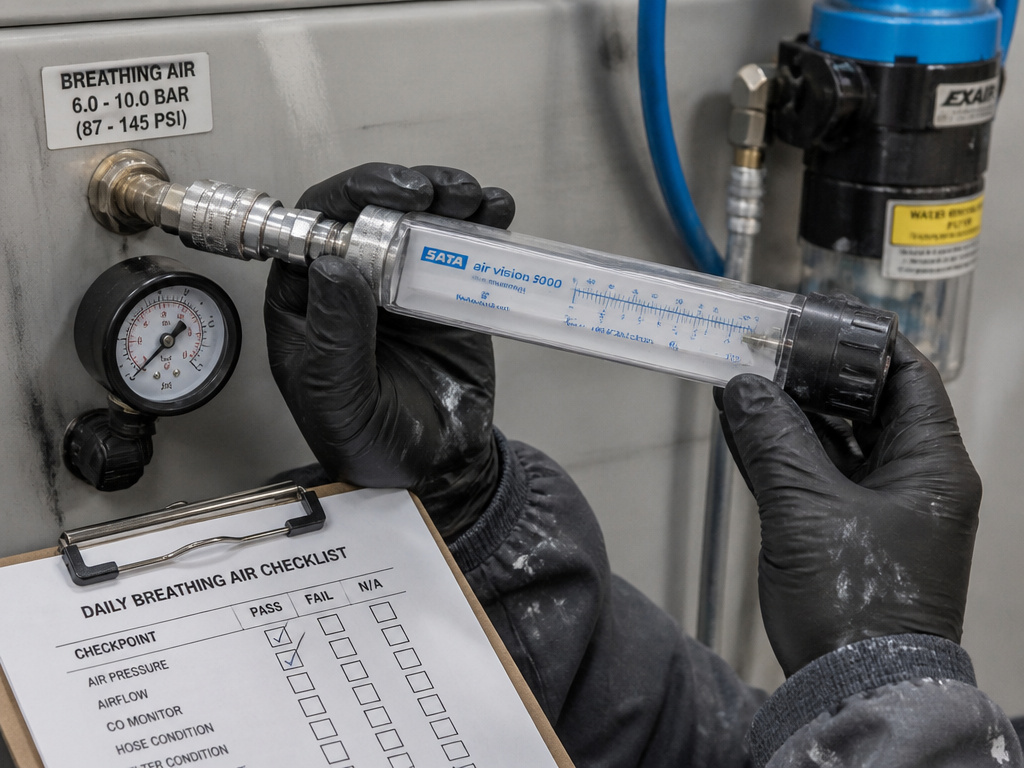
Two HSE documents give two different answers, and both are current.
| Task | Interval | Source |
|---|---|---|
| Breathing line check (spray booth) | Monthly | HSE COSHH Essentials MR02 |
| Air quality to air-fed RPE | At least every three months, or before use | HSE COSHH R2 |
| Air flow check | Every use | HSE COSHH R2 |
| RPE maintenance | At least every three months | HSE COSHH R2 |
| Disposable RPE | One use only | HSE COSHH R2 |
| Filter and expiry check | Per supplier advice; check dates | HSE COSHH R2 |
The Monthly vs Three-Month Split
COSHH R2 sets the default at least every three months, or before use. COSHH Essentials MR02 advises monthly breathing line checks for spray booths and rooms.
COSHH R2 sets the default at least every three months or before use, while COSHH Essentials MR02 advises monthly line checks for spray booths and rooms.
Check the airflow every time, per HSE. Check the airflow every time, per HSE.
A paint fume extractor reduces the airborne load, but it doesn’t replace the respirator. The two work together.
COSHH R2 sets the default at least every three months or before use, while COSHH Essentials MR02 advises monthly line checks for spray booths and rooms.
What the Shop Studies Found About Real-World Use
Five of six auto body shops in one NIOSH study used respirators inappropriately.
That’s the number from the EPA isocyanate profile. Here’s what the studies found:
- Five of six shops used respirators inappropriately, with poor maintenance and no written program.
- Only 32% of Australian workers had half-facepiece air-purifying respirators that did not leak.
- Most shops had no written program, no training, and no fit testing, according to a manufacturer’s representative.
The hardware was fine. The program was missing.
The paint poisoning risk climbs when the program is missing, because nobody is checking the seal, the cartridges, or the air line.
The part nobody mentions: A perfectly spec’d respirator with no written program, no training, and no fit test is decoration. The studies measured the program, not the hardware.
Frequently Asked Questions
Are NIOSH-approved cartridges safe for isocyanate paints?
NIOSH 23C cartridges are approved for paint mists and organic vapors. That approval doesn’t cover isocyanate spray rooms, and HSE states filtering respirators are not suitable for isocyanate paints. Treat the two claims as separate.
Can I wear a respirator if I have a beard?
Not a face-seal respirator. HSE says face-seal RPE won’t work with facial hair or stubble. Loose-fitting hoods and loose-fitting facepieces with a flip-up visor skip the fit test and can be used with a beard.
How often should I check the breathing air?
COSHH R2 says at least every three months, or before use. COSHH Essentials MR02 advises monthly line checks for spray booths and rooms.
What airflow does a powered respirator need?
NIOSH says at least four cfm (115 lpm) for a tight-fitting facepiece, or six cfm (170 lpm) for a hood or helmet. Below that, don’t use the unit.
Do supplied-air respirators need a fit test?
Loose-fitting hoods and loose-fitting facepieces don’t need a fit test. Tight-fitting full-facepiece respirators do, and the wearer can’t have a beard.
What happens if the visor is lifted during spraying?
HSE says lifting the visor to inspect work while still in paint mist increases exposure and must be prohibited. The EPA allows lifting only after the ventilation system has exhausted all overspray.
The Bottom Line
How to choose a paint respirator comes back to one question: what’s in the paint? If the data sheet names an isocyanate, HSE requires air-fed breathing apparatus, while NIOSH 23C cartridges are approved for paint mists and organic vapors.
The concession: none of this matters if the air supply is dirty. A supplied-air system fed by a compressor pulling exhaust fumes delivers contamination straight to the facepiece.
The gear you buy is the easy part. The written program, the fit test, the monthly line check, and the training are what the shop studies actually measured, and what they found was missing. Start there.
