
10 Best Paint Fume Extractors in 2026
This post contains affiliate links. As an Amazon Associate, we earn from qualifying purchases.
For cleaner studio air, the Paasche Airbrush Spray Booth is the best overall choice, thanks to its dual 235 CFM fans and durable galvanized steel build. The Master Airbrush Portable Spray Booth earns our Best Budget Pick, while the Colima Professional Airbrush Spray Booth leads with its water curtain system for solvent-based paints.
Paint fumes and airborne particles are a real concern for anyone spraying indoors, whether with an airbrush or a spray gun. The right extractor removes vapors and particulates before they settle on surfaces or enter your lungs, making your workspace safer and more comfortable.
This guide is based on manufacturer specifications, expert round-ups, and patterns in owner feedback across dozens of models. We focused on airflow strength, filtration quality, portability, and workspace fit to help you find the right extractor for your setup.
Top 10 Paint Fume Extractors in the Market
Certain content that appears on this site comes from Amazon. This content is provided "as is" and is subject to change or removal at any time.
The Best Paint Fume Extractors, Reviewed
Paasche Airbrush Spray Booth
What We Like
- Dual 235 CFM fans for strong airflow
- Galvanized metal panels for easy cleaning
- Includes two 4" dryer duct adapters
- Made in the USA
Trade-offs
- 16" height limits tall objects like large model kits
- No built-in light included
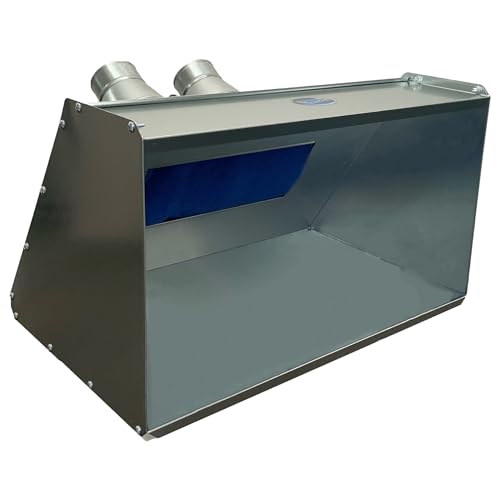
Two fans pushing 235 CFM each give this booth serious pulling power for hobby airbrushing, clearing fumes fast enough to keep your workspace breathable during long sessions. The galvanized metal panels wipe down easily after paint buildup, so you are not fighting sticky residue between projects. This booth suits anyone who airbrushes regularly and wants a sturdy, no-nonsense setup that prioritizes airflow and durability over frills.
The trade-off is the 16-inch height, which means larger items like tall model kits or small sculptures may not fit inside without angling. The FumeClear FC-2002 offers H13 filtration and works without ducting, but its 153 CFM is significantly lower, so the Paasche wins on raw air movement for paint fumes.
Product photos
FumeClear FC-2002 Fume Extractor
What We Like
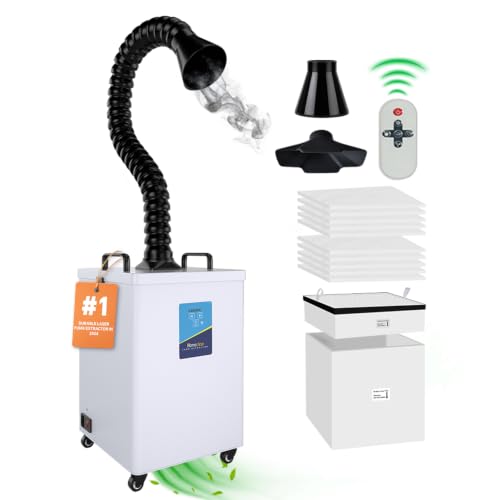
- 260-300 m³/h suction for heavy fume loads
- 99.97% purification with 3-stage HEPA filtration
- Aerospace-grade noise reduction keeps it under 55 dB
- Carbon filter lasts up to 4000 hours
Trade-offs
- Focused on 15 cm³ area near the hood head
- Designed for 0-40W laser engravers, not large spray booths
The trade-off is that this machine is built for concentrated extraction near the source, not for ventilating an entire spray booth or room. If you are painting large surfaces or using a wide airbrush booth, a larger exhaust fan may move more air across a bigger area. But for anyone running a desktop laser cutter, 3D printer, or soldering station who wants serious suction without the roar of a workshop fan, the FC-2002 delivers focused power with low noise.
FUMEGO Laser Fume Extractor
What We Like
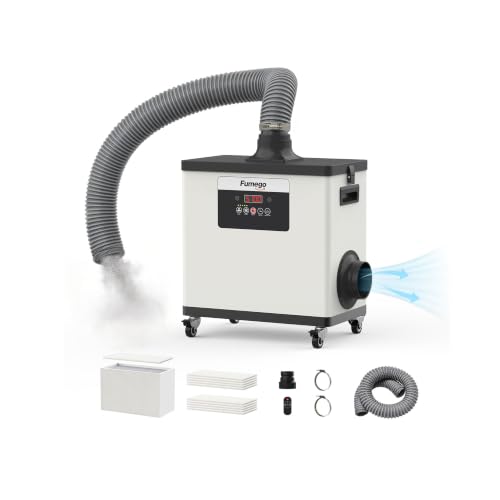
- 200W motor for high suction
- 177 CFM airflow with 10 levels
- HEPA filter captures 0.3μm particles
- Smart clogging alarm alerts replacement
Trade-offs
- 31 lb weight limits portability
- 4-inch outlet needs hose for outdoor venting
- Designed for under-60W laser engravers only
The trade-off is weight: at 31 pounds, it’s not something you toss in a shelf between sessions, it stays put on its braked castors. And while the 4-inch outlet can vent filtered air back into the room, the included 1.5-meter hose makes outdoor venting easy if you prefer zero odor.
Product photos
Fenjidrop 16 Inch Paint Booth Fan
What We Like
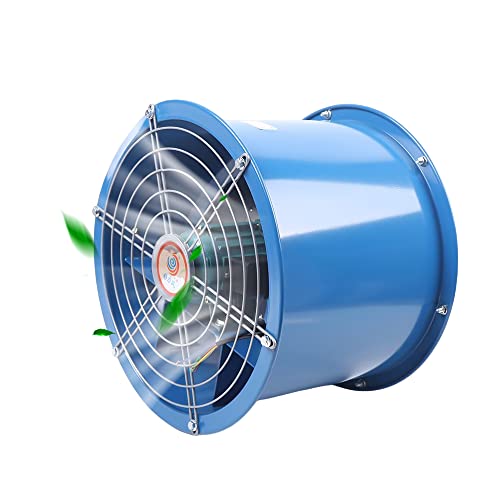
- Explosion-proof design with protective grids
- High airflow 5400 m³/h for large spaces
- Corrosion-resistant carbon steel and stainless blades
- Compact cylindrical shape fits walls or ducts
Trade-offs
- No integrated filter for capturing paint particles
- Heavy reliance on ductwork for safe exhaust routing
A 5400 m³/h airflow and 370W explosion-proof motor make this fan a serious tool for clearing fumes from paint booths, factories, or workshops where flammable vapors are a real concern. The carbon steel housing and stainless steel blades resist corrosion from solvents, and the protective grids at both ends keep debris and fingers out. This is the fan to reach for when you need raw, safe ventilation in hazardous environments, not a quiet desktop unit for hobby work.
This fan moves air without any filtration, so overspray and particles will not be trapped. At 71 dB, it is loud enough that some users may prefer hearing protection during extended use. Compared to the FumeClear FC-2002, which uses H13 filtration to capture fumes, the Fenjidrop focuses on high-volume airflow and explosion safety. If your priority is removing fumes from a spray booth in a hazardous environment, this fan is a strong option. If you need to capture particulates from laser engraving or soldering, a filtered unit would be more appropriate.
Product photos
Colima Professional Airbrush Spray Booth
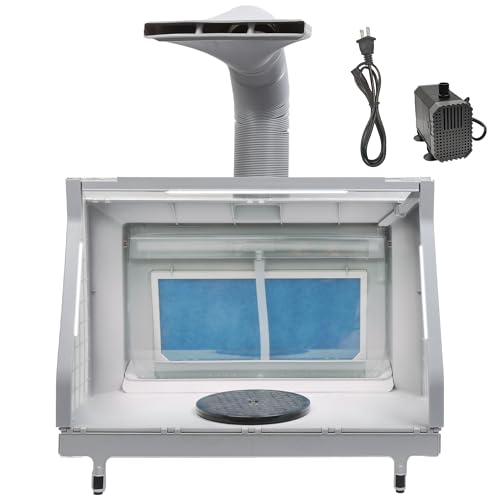
What We Like
- Three 45W fans with adjustable speed
- Ultra-bright 2430 LUX shadow-free LED lighting
- Includes 67" exhaust hose for window venting
Trade-offs
- At 26.4" wide, needs dedicated bench space
- Blue filters need replacement every 3 months with frequent use
- Water sink adds setup and cleaning steps
The blue filters require replacement every three months under frequent use to maintain peak performance, and the 10-liter water sink adds a cleaning step that simpler fan-only booths skip entirely. While that extra maintenance ensures the system captures 99% of particles and fumes, it does mean a bit more routine effort compared to models like the Master Airbrush Portable Spray Booth with dual exhaust fans. Reviewers note the trade-off is worthwhile for safer indoor airbrushing with solvent-based paints or heavy acrylics.
Product photos
Master Airbrush Portable Spray Booth
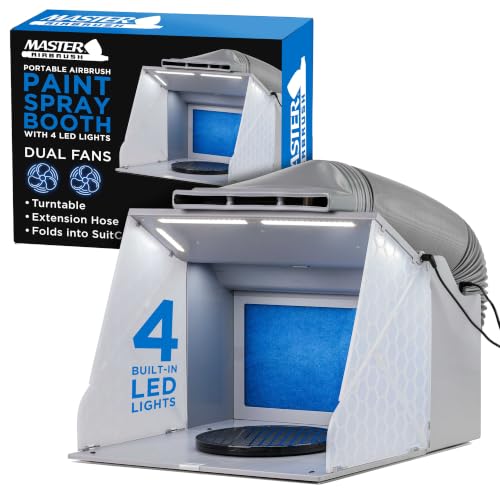
What We Like
- Dual fans pull 5.2 m³/min airflow
- Built-in LED lights illuminate workspace
- Includes 7.5-inch revolving turntable
- Exhaust hose extends up to 6 feet
Trade-offs
- Fiberglass filter captures particles only
- Hose extends to 6 feet maximum
Dual exhaust fans pulling 5.2 cubic meters of air per minute give this portable booth real pulling power for its size. The four built-in LED lights keep your work area bright, and the 7.5-inch turntable lets you rotate a model or cake without touching it. It suits hobbyists who paint small projects like miniatures, crafts, or ceramics and need something that folds down quickly for storage between sessions.
The dual exhaust fans pull 5.2 cubic meters of air per minute, which is enough suction to keep paint particles and vapor from lingering in your workspace. That high-density fiberglass filter traps the particles, but you’ll still want the room ventilated for any strong fumes. Compared to the Paasche model’s 30-inch width, this one keeps a smaller footprint so it fits on a desk or bench without taking over the room.
Product photos
JFLLAJNF Airbrush Spray Booth

What We Like
- Folds with woven handle for easy carry
- Dual fans with independent stepless speed control
- Dual ring LED with adjustable color and brightness
- Includes 6 filter pads and dedicated storage pockets
Trade-offs
- Oxford fabric walls flex under heavy items
- 16.5-inch depth won't fit large diorama bases
At 6.3 pounds and folding flat with a woven handle, this booth is built to move, you can tuck it under an arm or into a closet between sessions. The dual fans offer stepless speed adjustment up to 2800 RPM with independent control, so you can match the airflow to your painting needs. The Oxford fabric and aluminum foil lining are waterproof and easy to clean, and the dual ring LED lets you switch between three color temperatures and ten brightness levels to match your lighting needs. For the hobbyist who paints in a shared space or likes to work at different tables, this is a genuinely portable setup that doesn’t skimp on ventilation or visibility.
VEVOR Inflatable Paint Booth
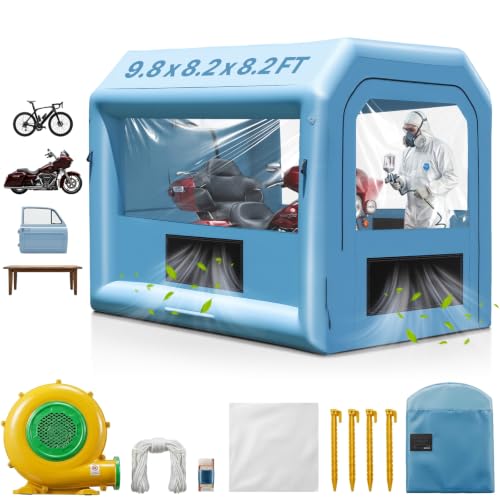
What We Like
- 550W blower keeps booth inflated
- Primary + activated carbon filters
- Includes repair kit, sandbags, stakes
Trade-offs
- Blower must run continuously to stay inflated
- Recommended for clear weather only
- Filters need regular replacement to avoid clogging
A 9.8-foot inflatable booth with a 550W blower creates a workspace big enough for a motorcycle, bicycle, or small furniture. The Oxford cloth and double stitching are built for durability, and the primary plus activated carbon filters block dust and harmful gases, helping keep your work area cleaner. This is for anyone who needs a portable, temporary spray enclosure that packs down into a storage bag when not in use, rather than a permanent fixture in the garage.
An inflatable spray booth requires the blower to run continuously while you paint. It is also designed for calm weather only, since wind or rain can compromise stability even with the included sandbags and ground stakes. If your work is mostly small models or hobby pieces, a compact booth makes more sense; if you need to spray a full bike or furniture, this inflatable design is the most practical portable option.
Product photos
OMTech XF-180 Fume Extractor
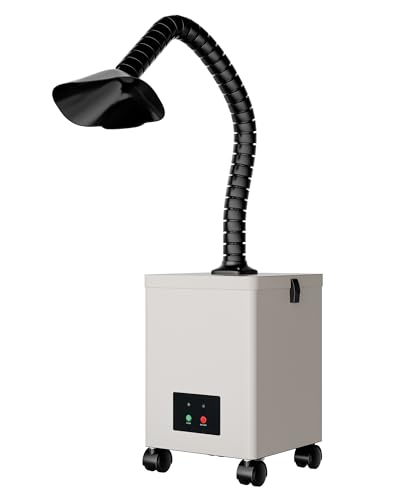
What We Like
- Locking caster wheels for easy mobility
- 106 CFM airflow for fume capture
- 3-stage air filter system
- Adjustable 3-speed airflow control
Trade-offs
- 80W motor limits airflow for heavy paint spraying
- No HEPA filter for fine particulate capture
A 106 CFM airflow from an 80W motor means this extractor can pull fumes from laser engraving, soldering, or small-scale paint work without taking over your workspace. The four locking caster wheels let you roll it between stations and lock it in place, so you can move from a soldering bench to a laser cutter without lifting.
That same 80W motor and 106 CFM airflow are best suited for small-scale tasks rather than heavy-duty paint spraying. For large paint jobs or big booths, a dedicated high-airflow unit would be more appropriate. But for a small studio where you switch between soldering, engraving, and light painting, the wheels and compact footprint make it the most convenient extractor to have nearby.
Product photos
Wathai 4 Inch Duct Fan
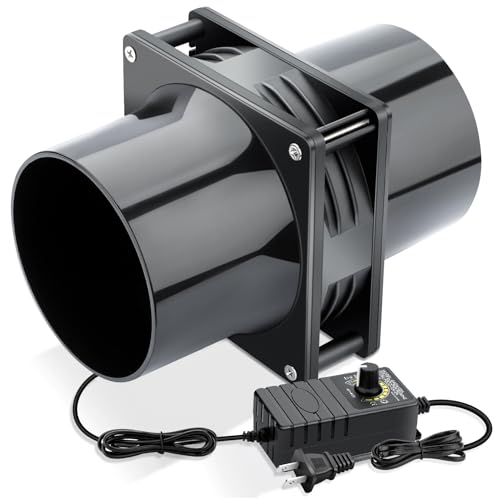
What We Like
- Compact size fits tight spaces
- Adjustable speed for quiet or max airflow
- Double ball bearings for durability
- Includes flanges, guards, and screws
Trade-offs
- Small 4-inch duct limits total airflow
- No built-in filter or filtration system
A 4-inch duct fan with adjustable speed and a compact 4.7-inch length means it can slide into spots where larger fume extractors simply won’t fit. That makes it a practical choice for hobbyists who need a lightweight, easy-to-mount fan for a small paint booth, soldering station, or laser engraver enclosure. The double ball bearings support reliable operation, and the included flanges, guards, and screws simplify installation.
A 4-inch duct fan moves less air than larger models or enclosed spray booths, so it suits small-scale fume extraction rather than full-size painting projects. Compared to the Paasche Airbrush Spray Booth with its two fans, this fan is a component that requires you to provide your own enclosure. For cramped spaces with light fume loads, it offers an affordable way to add ventilation.
Product photos
How We Evaluated Paint Fume Extractors
Our evaluation combined manufacturer data on airflow ratings and filter efficiency with expert recommendations from art and workshop safety publications. We also analyzed hundreds of owner reviews to understand real-world performance, noise levels, and durability over time.
The four criteria that mattered most were airflow capacity (CFM or m³/h), filtration type (HEPA, carbon, or basic particulate), build quality and materials, and size relative to typical workspaces. For hobbyists, portability and ease of setup also played a major role in rankings.
This is a research-led evaluation, not a hands-on test. We prioritized products with clear, verifiable specifications and consistent feedback from owners. If a product lacked reliable data or had conflicting reviews, we excluded it from consideration.
What To Look For In Paint Fume Extractors
Choosing the right fume extractor means balancing airflow, filtration, and workspace fit. Here is what matters most.
Prioritize a unit with at least 100 CFM for airbrush work and HEPA or activated carbon filtration if you use solvent-based paints. Measure your workspace before buying.
Airflow and Suction Power
Airflow is measured in CFM (cubic feet per minute) or m³/h. For small airbrush booths, 100-200 CFM is sufficient. Larger spray booths or whole-room ventilation may require more airflow. Dual-fan setups like the Paasche offer redundancy and stronger overall suction. For laser engravers and soldering stations, look for suction ratings around 260-300 m³/h.
Filtration Type
Basic fiberglass filters catch dry particles but do nothing for fumes. Activated carbon filters absorb volatile organic compounds (VOCs) from solvent-based paints. HEPA filters capture 0.3-micron particles at 99.97% efficiency. A 3-stage system combining pre-filter, carbon, and HEPA offers the best protection for indoor use. Water curtain systems add an extra layer of fume capture for solvent-heavy work.
Size and Workspace Fit
Measure your bench or table depth before choosing. Compact booths like the Paasche are 16 inches tall, which limits tall models but fits small workspaces. Larger units like the Colima need 26.4 inches of width. Foldable models save storage space but can be less rigid. Inflatable booths work for large projects but require continuous blower operation.
- Check the exhaust hose diameter (usually 4 inches) and whether adapters are included
- Confirm the unit has a light if you work in dim conditions
- Look for replaceable filters and check their estimated lifespan
- Consider noise levels if you work in a shared space
A good rule of thumb: buy an extractor rated for at least double your typical spray volume to allow headroom.
Paint Fume Extractors Compared
The table below compares the key specs of our top picks so you can see at a glance how airflow, filtration, and size differ across models.
| Product | Dimensions | Airflow | Filtration |
|---|---|---|---|
| Paasche Airbrush Spray Booth | 30"W x 16"H | 235 CFM each | Paint and carbon filter per fan |
| FumeClear FC-2002 Fume Extractor | N/A | 260-300 m³/h | 3-stage (pre, HEPA, carbon) |
| FUMEGO Laser Fume Extractor | L 18.1 inches, W 10.2 inches, H 20.3 inches | 177 CFM | HEPA + 11 pre-filters |
| Fenjidrop 16 Inch Paint Booth Fan | L 16.0 inches, W 16.0 inches, H 11.8 inches | 5400 m³/h | N/A |
| Colima Professional Airbrush Spray Booth | L 26.4 inches, W 13.4 inches, H 20.7 inches | N/A | Triple: water curtain + dual filters + activated carbon |
| Master Airbrush Portable Spray Booth | 16"x18"x13" | 5.2 m³/min | High-density fiberglass |
| JFLLAJNF Airbrush Spray Booth | 16.5 x 16.5 x 24.4 inches | N/A | 6 filter pads |
| VEVOR Inflatable Paint Booth | 9.8 x 8.2 x 8.2 ft | N/A | Primary + activated carbon |
| OMTech XF-180 Fume Extractor | N/A | 106 CFM | 3-Stage |
| Wathai 4 Inch Duct Fan | L 4.7 inches, W 1.5 inches, H 1.5 inches | N/A | N/A |
Frequently Asked Questions
Can I use a paint fume extractor for laser engraving?
Yes, models like the FumeClear FC-2002 and FUMEGO Laser Fume Extractor are designed specifically for laser engravers and soldering stations. They offer high suction and HEPA filtration for fine particulates. However, most spray booths are not optimized for laser fumes.
How often do I need to replace the filters?
It depends on usage. For frequent painting, carbon filters may last 3-6 months, while HEPA filters can last 6-12 months. The Colima Professional booth recommends replacing blue filters every three months with heavy use. Some units have smart alarms that alert you when replacement is needed.
Do I need to vent the extractor outside?
Many extractors can be used indoors with carbon and HEPA filtration, but venting outside is always more effective for removing fumes. Units like the Paasche include dryer duct adapters for window venting. The Master Airbrush comes with a 6-foot exhaust hose. Always check local fire codes for spray booth ventilation requirements.
What is the difference between a spray booth and a fume extractor?
A spray booth is an enclosure that contains overspray and fumes, while a fume extractor pulls air through filters to clean it. Many spray booths include built-in fans and filters, functioning as both. Standalone fume extractors like the OMTech XF-180 are designed to be placed near the fume source without a full enclosure.
How much space do I need for a paint fume extractor?
Compact models like the Paasche need about 16 inches of height and 30 inches of width. Larger booths like the Colima require 26.4 inches of bench width. Foldable options like the JFLLAJNF store flat but need 16.5 inches of depth when set up. Measure your workspace before buying.
The Bottom Line
For most hobbyists and model painters, the Paasche Airbrush Spray Booth delivers the best balance of power, build quality, and value. Its dual 235 CFM fans and galvanized steel body make it a long-lasting choice for indoor airbrushing. If you work with solvent-based paints on larger items, the Colima Professional with its water curtain system is worth the extra investment.
Budget-conscious buyers should look at the Master Airbrush Portable Spray Booth, which includes a turntable and LED lights at an affordable price point. For laser engravers, the FumeClear FC-2002 offers hospital-grade HEPA filtration in a quiet, compact package.
The single most important factor is matching the extractor’s airflow and filtration to your specific materials and workspace size. A unit that is too small will not protect you, while one that is too large may be overkill for your needs.
