
How to Prevent Paint Poisoning: Step-by-Step
This post contains affiliate links. As an Amazon Associate, we earn from qualifying purchases.
To prevent paint poisoning, ventilate the room with open windows and a window-mounted box fan during painting and for about 2 to 3 days afterward, keep young children and anyone with breathing problems out of freshly painted rooms, and test or presume lead paint in any home built before 1978.
Presuming is the half people skip. A surface counts as painted even when it hides under wallpaper, shellac, varnish, or stain, so a room that looks like bare wood can still be a lead room. Knowing how to prevent paint poisoning starts with testing those hidden layers.
What follows is the order I’d actually work in: read the label, get the air moving, settle the lead question before any sanding, and know the three spots where good sources don’t quite agree.
Key Takeaways
- Two to three days of open windows after the last coat.
- Oil-based paint carries the VOC load. OSHA ties the most significant health effects of these products to polluted air, inhalation, and poisoning.
- Pre-1978 homes get tested or presumed. Every affected surface, including the ones under wallpaper and varnish.
- Methylene chloride strippers get converted into carbon monoxide inside your body. Dizziness and shortness of breath are the tell.
- A box fan in a window helps exhaust vapors from the work area. Point it out, not in.
What Actually Causes Paint Poisoning?
Volatile organic compounds, lead dust, and carbon monoxide are the three routes into the body, and each one gets in a different way.
VOCs are the solvent coming off oil-based paint as it cures. The OSHA chemicals in painting materials training document states that the most significant health effects of oil-based paint come from polluted air, inhalation, and poisoning. Those products can also catch fire if they sit at high temperatures for a long stretch.
Lead runs a different route. Poison Control’s poison-safe home remodeling guide explains that leaded paint releases lead into the air when it’s sanded or heated, and the body absorbs it by inhaling or swallowing the dust and fumes.
Oil-based paints release volatile organic compounds as the film cures, and OSHA identifies that polluted air as the source of the most significant health effects from these products. Leaded paint behaves differently: sanding or heating releases lead into the air as dust and fume, which the body absorbs by inhaling or swallowing.
The third route is the one nobody expects, and it comes from a stripper rather than a can of paint. More on that below.
| Source of exposure | What it releases | What you’d notice first |
|---|---|---|
| Oil-based paint | VOCs as the film cures | Eye, nose, and lung irritation |
| Sanded or heated lead paint | Lead dust and fume | Often nothing at all |
| Methylene chloride stripper | Carbon monoxide inside the body | Dizziness, shortness of breath |
| Portable generator | Carbon monoxide | Headache, upset stomach, drowsiness |
If you want the fuller picture of what’s actually in the can, the paint ingredients breakdown covers pigments, binders, extenders, and the additives that don’t make the front label.
The Ventilation Window Is Longer Than You Think
Two to three days. That’s the figure in the CPSC healthy indoor painting guide, and it applies to the room, not just the wet wall.
The guidance on how to prevent paint poisoning says to keep windows wide open, as weather permits, for about 2 to 3 days after painting to avoid unwanted exposure to paint vapors. The same document says to avoid freshly painted rooms for 2 to 3 days whenever possible.
A box fan mounted in a window, exhausting air out of the work area, moves more vapor than anything passive. The CPSC guide is specific that the fan can’t be able to fall out of the window. If fans aren’t an option, the room needs genuine cross-ventilation: air entering on one side and leaving on the other.
Before you start: Oil-based paint and its solvents can catch fire when exposed to high temperatures for a long time, so keep cans away from heaters and pilot lights. Methylene chloride strippers get converted into carbon monoxide inside your body, and the effects run from dizziness and shortness of breath to a heart attack. A generator should be placed outside, not in a garage or under an open window.
Here’s the order I’d set a room up in.
- Open windows on opposite walls before you open the can. Skip this and the fan just stirs the same air in a circle.
- Seat a box fan in one window, blowing outward, and block it so it can’t tip. A fan that falls out of a second-floor window is its own emergency.
- Close the door to the rest of the house. Vapor doesn’t respect a hallway.
- Keep windows wide open for the full 2 to 3 days, not just while the brush is wet.
If it goes wrong, it usually goes wrong at step 4. The smell fades by evening and everyone shuts the windows.
Where this goes sideways: Closing up at night because the house gets cold. Vapor doesn’t clock out, and the room reloads by morning.
The CPSC guidance is blunt about who should be kept from freshly painted rooms: young children and anyone with breathing problems. If that’s your household, keeping kids and pets safe from paint covers the room-by-room version. For the vapor side specifically, there’s a longer paint fumes walkthrough worth reading before you start a whole-house job.
Why Low Odor Tells You Almost Nothing
A can smell mild and still load a room with solvent. Odor is a poor meter, and it’s the one most of us reach for.
Low-VOC and zero-VOC indoor paints do exist, and Poison Control’s advice on how to prevent paint poisoning is to raise the question with the retailer when you buy. That’s a real improvement. It’s also a label on a can, not a reading of the air in your spare bedroom.
A can that smells mild can still be loading the room. Judge the air by the fan and the window, not by your nose.
What the label actually covers
Indoor and outdoor paints aren’t interchangeable. OSHA notes that paint contains fungicides and algaecides added to protect exterior paint from mold, algae, and lichen, and Poison Control warns that those additives may not be safe to breathe indoors. Use indoor paint inside. That’s the whole rule.
Old stock deserves its own caution. Some paints in the past used mercury as a fungicide, and young children developed mercury poisoning from breathing the fumes. That’s a decent argument for disposing of old construction products safely according to community guidelines.
Clear coats are a separate chemistry. The EPA’s paint mixing room guidance describes isocyanates as the hardening component in most clear coats, strong skin and lung irritants, and the leading cause of occupational asthma. The same document notes that recent studies indicate skin contact may trigger an allergic reaction in the lungs.
If you’re picking a can and want the label decoded properly, the guide to low-VOC paint goes through what the certifications actually mean. I’m not the person to ask which pigment is lightfast. I mix by feel and by whatever’s already on the palette. What I can tell you is that a headache at hour two is information, not a coincidence.
Lead Paint: The 1978 Line and What It Changes
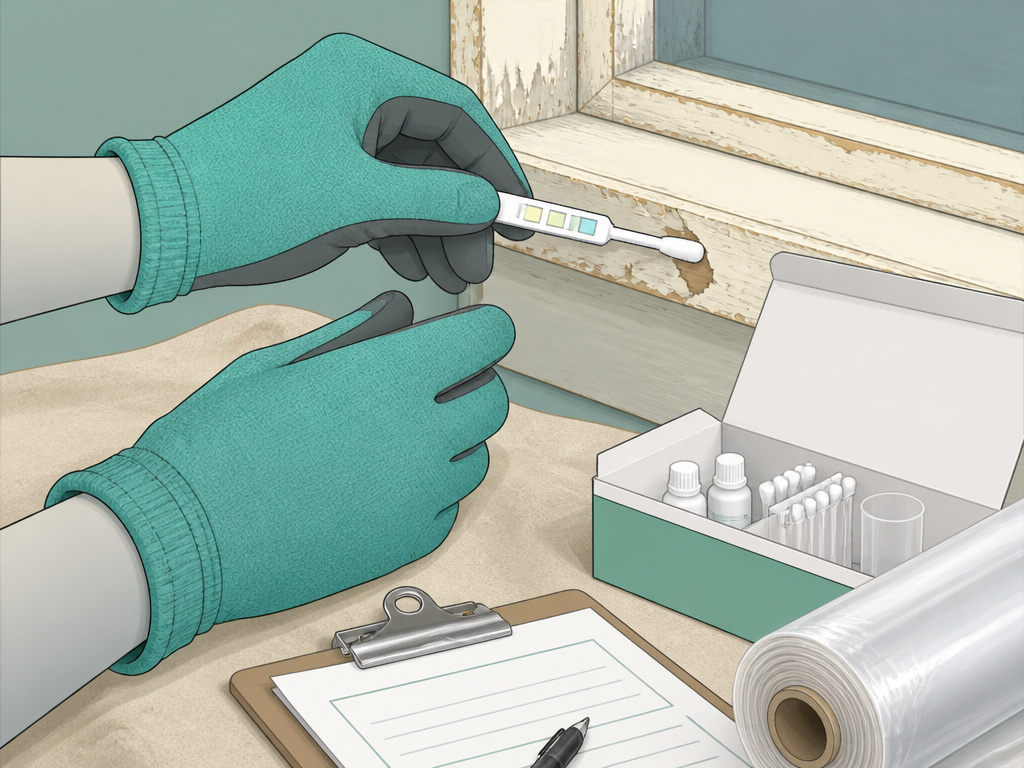
1978 is the dividing line. Homes built before it are likely to contain lead-based paint, per Poison Control, and that single date decides how the entire job runs.
Before an older home gets renovated, the paint should be tested for lead content. EPA-approved test kits are sold at hardware stores. For a major renovation, Poison Control suggests having a certified contractor run the tests instead of doing it yourself.
Since April 2010, contractors who remove lead-based paint have been required to be certified, and homeowners should ask for a copy of that certification. It’s a document you can request. Request it.
If the paint is intact, Poison Control’s usual recommendation is to cover it up so it can’t flake or deteriorate, while the EPA focuses on containment and cleaning verification when paint is disturbed. If it has to come off, Poison Control says that’s a certified contractor’s job, while the CPSC/EPA resident guidance offers ventilation advice for residents doing the work themselves, and the EPA lead-safe renovation steps document covers the containment and cleanup verification that goes with disturbing it.
The 1987 farmhouse case
In 1987, a family in a Victorian farmhouse renovated it without sealing off the work areas. Thick dust spread through the house. The family’s dog died of kidney failure.
Blood tests explained the rest. The mother, who worked from home, and the children all had high blood lead levels. The father, who worked outside the home five days a week, was not elevated.
The babysitter’s children were poisoned too. So the lesson isn’t about the people holding the sander. It’s about everyone downstream of the dust, including the ones who never entered the room. If you want the full handling picture, lead paint safety covers testing, encapsulation, and what a certified crew actually does.
Three Questions Where the Good Sources Split
Good guidance can still disagree, and papering over the disagreement is how people get hurt.
| Question | Position A | Position B |
|---|---|---|
| Intact lead paint | Poison Control: cover it so it can’t flake | EPA RRP: contain the dust and verify cleanup |
| Who removes it | Poison Control: a certified contractor | CPSC/EPA: ventilation guidance for residents |
| Ventilation length | CPSC/EPA: about 2 to 3 days, windows open | Same figure repeated elsewhere, text unverified |
On intact paint, both positions are reasonable for different situations. Covering works while the paint is sound. Containment and cleaning verification is what you do once it’s disturbed, which is why the EPA framing exists at all.
On who removes it, the split is starker. Poison Control says a certified contractor should remove lead paint from a renovation. The CPSC and EPA resident guidance assumes you’re the one painting and hands you ventilation advice instead. If you’re sanding lead paint rather than painting over it, Poison Control says a certified contractor should remove it, while the CPSC/EPA resident guidance offers ventilation advice for residents doing the work themselves.
On ventilation length, the 2 to 3 day figure is consistent across the CPSC/EPA guidance. The same number gets repeated in secondary write-ups, but the primary text behind those repeats wasn’t retrievable, so treat 2 to 3 days as the anchor and don’t shorten it on the strength of a blog post.
Pregnancy raises the stakes on all three. The paint exposure during pregnancy fact sheet on the NCBI Bookshelf addresses the exposure question directly, and the painting while pregnant guide covers the practical version.
Solvents, Strippers, and the Carbon Monoxide Trap
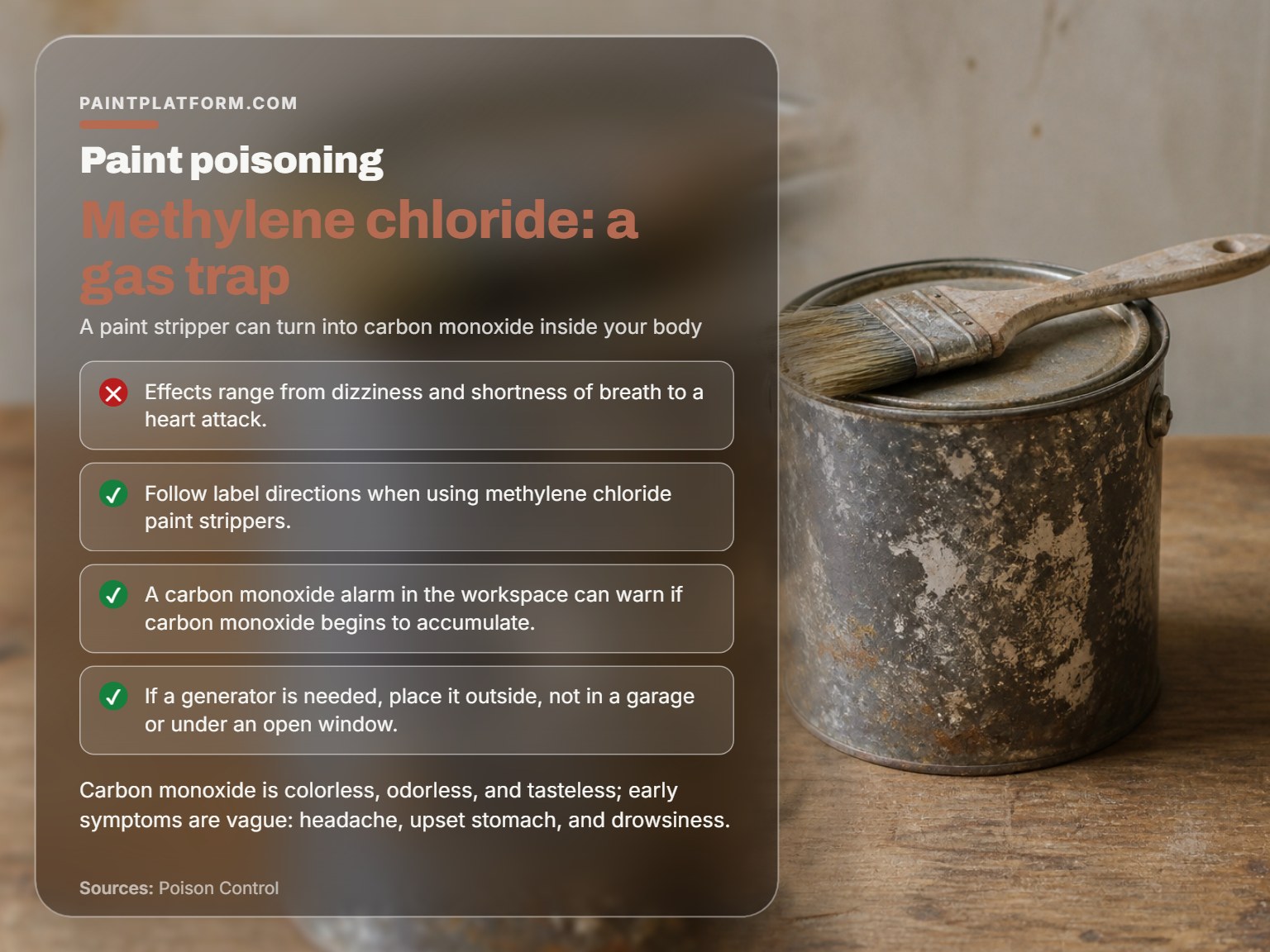
Methylene chloride is the one that surprises people, because nothing about a stripper suggests a gas.
It’s a common paint stripper, absorbed by inhaling the fumes or by getting it on your skin. The body converts some of it into carbon monoxide. Effects range from dizziness and shortness of breath to a heart attack. That’s the reason the label directions matter more than the label warnings. It’s the reason the label directions matter more than the label warnings.
Why a paint stripper can act like a generator
A generator makes carbon monoxide outside your body. Methylene chloride makes it inside. Same gas, same vague early symptoms: headache, upset stomach, drowsiness.
Carbon monoxide is colorless, odorless, and tasteless, so there’s nothing to notice and nothing to warn you. Keep breathing it and you can become unconscious, develop seizures, and die.
Generators have one rule and it’s absolute. Outside, not in a garage, not under an open window. A carbon monoxide alarm in the workspace gives you a warning if it starts accumulating anyway.
Skin and eyes get overlooked in all of this. The EPA’s mixing room guidance is specific that a full face piece respirator covers the eyes, but a half-mask needs goggles or a face shield alongside it. If you’re still choosing, the paint respirator guide covers fit and cartridge selection. And protecting skin from paint contact matters more with strippers than with latex, because skin is a real absorption route, not just a splatter target.
How Do You Set Up a Room So the Air Actually Moves?
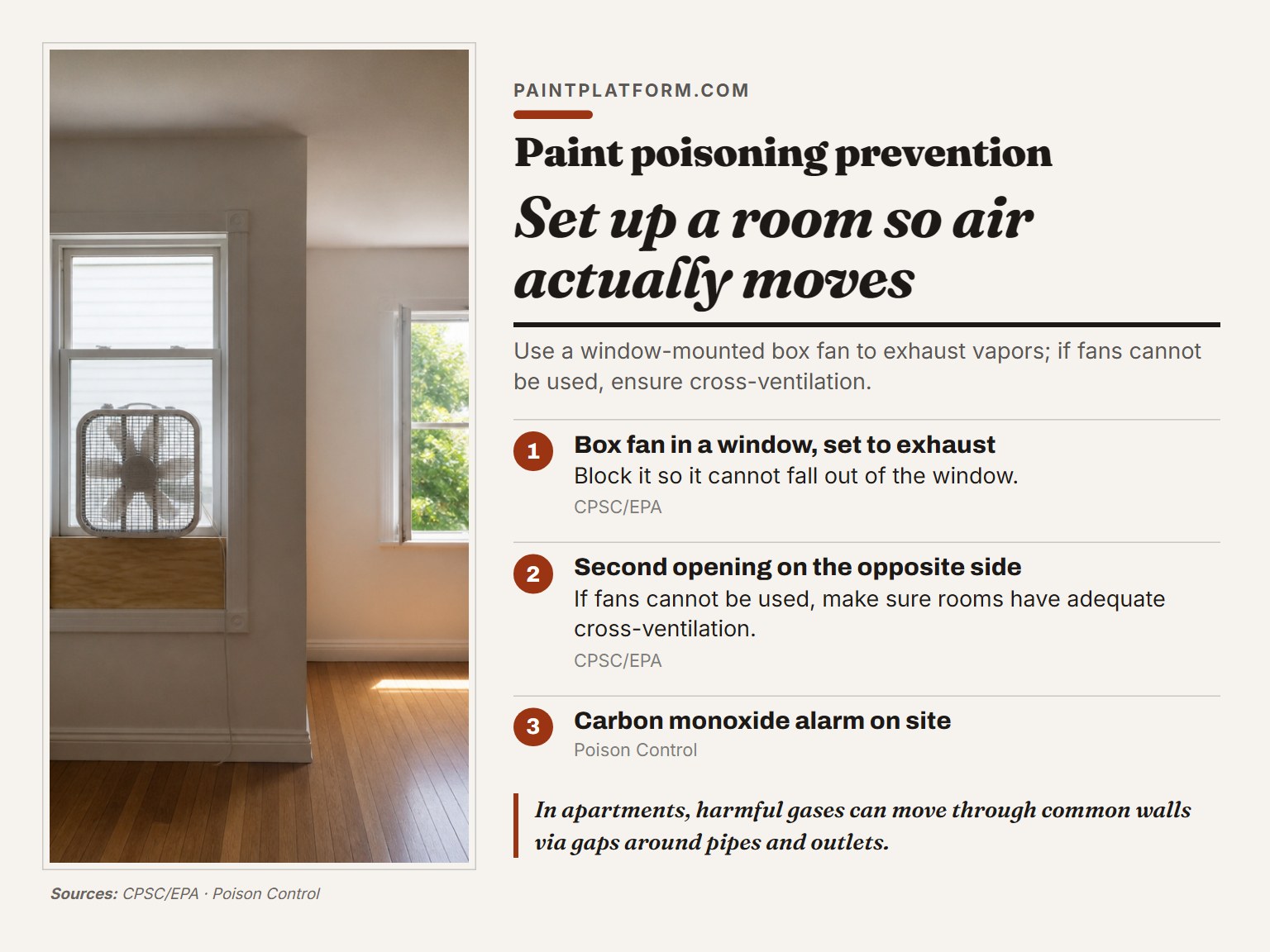
Where does the air come in, and where does it leave? If you can’t answer both, you don’t have ventilation.
A fan in a sealed room just pushes the same vapor around the walls. You want a path: one opening feeding the room, one fan pulling air out.
- A box fan in a window, set to exhaust, blocked so it can’t fall
- A second window or door open on the opposite side, even a few inches
- The room door closed to the rest of the house
- A carbon monoxide alarm if any fuel-burning equipment is on site
Apartment buildings break this setup in a way that isn’t obvious. Vapor travels as shared air. The CPSC guidance notes that harmful gases can move through common walls via gaps around pipes and electrical outlets, which means painting 3B can put vapor in 3A.
The same document suggests advance notice to neighbors in adjacent units, and venting the neighboring apartments with box fans too, not just the one being painted. Property managers get a version of the same advice: make sure ventilation is maintained during painting and, as a rule of thumb, for at least 2 to 3 days afterward.
A dedicated box fan that lives with the drop cloths is the difference between a habit and a good intention. A dedicated box fan that lives with the drop cloths is the difference between a habit and a good intention.
When Should You Stop Painting and Get Help?
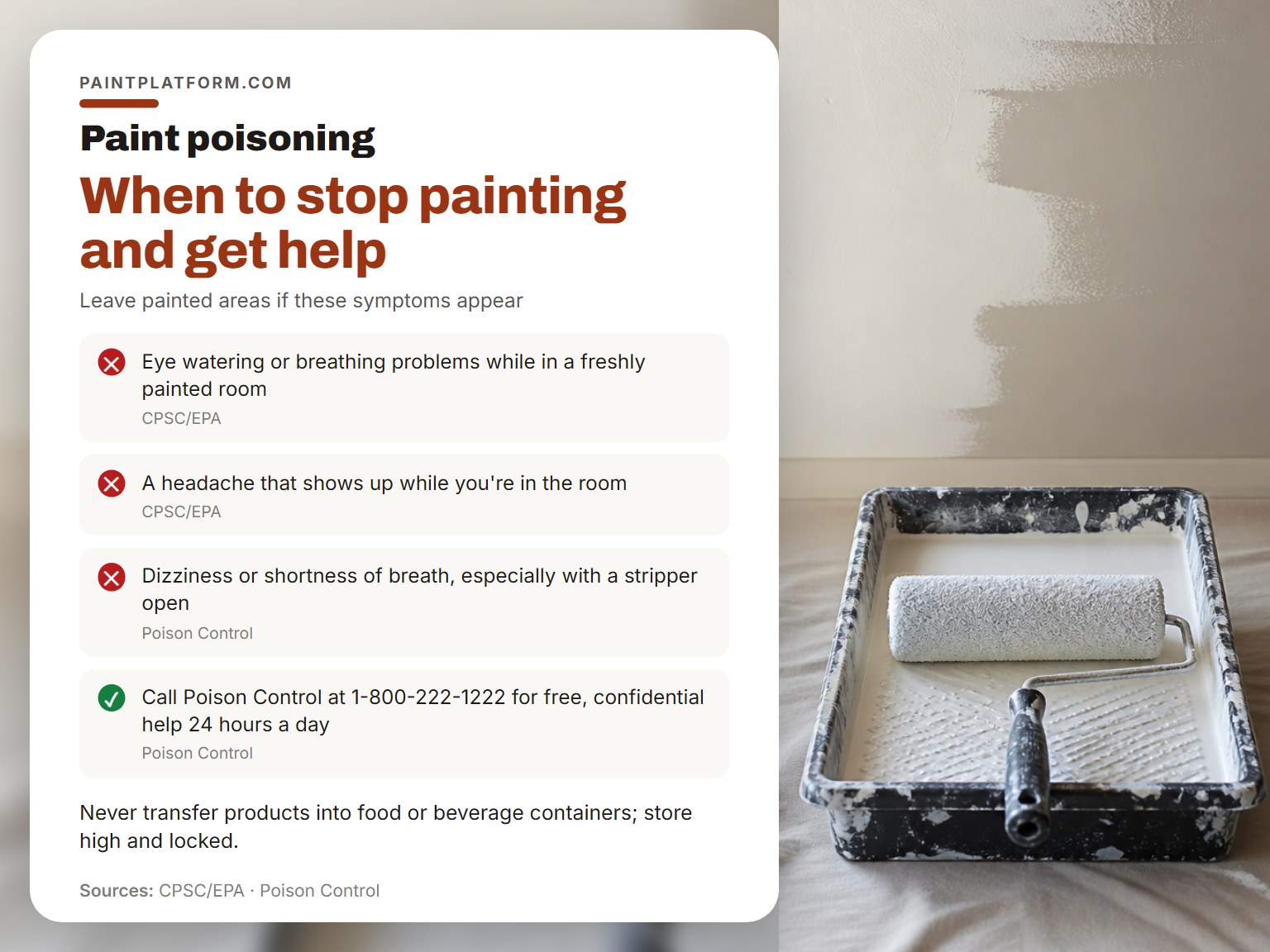
You’re partway through, the ceiling is half done, and your head has started to ache. That’s the exact moment the guidance is written for.
The CPSC advice is to leave painted areas if you experience eye watering, headaches, dizziness, or breathing problems.
- Eye watering or a scratchy throat that shows up an hour into the room
- A headache that shows up while you’re in the room
- Dizziness or shortness of breath, especially with a stripper open
- Drowsiness that doesn’t match how hard you’ve actually been working
For a suspected poisoning, Poison Control is 1-800-222-1222, free and confidential, 24 hours a day.
One storage rule gets broken more than any other. Never transfer a product out of its original container into a food or beverage container. An adult died after drinking from a soda bottle that someone had filled with a strong cleaning product. Store products high and locked rather than on the floor, a chair, or a low table, and keep children and pets elsewhere while the work is happening.
Frequently Asked Questions
Does opening a window for a day clear paint fumes?
Not according to the federal guidance. The CPSC and EPA recommend keeping windows wide open, as weather permits, for about 2 to 3 days after painting, and avoiding freshly painted rooms for that same window whenever possible. One day gets rid of the smell. It doesn’t get rid of the vapor.
Is lead paint dangerous if it isn’t peeling?
Intact lead paint is the safer version of a bad situation, which is why Poison Control’s usual recommendation is to cover it so it can’t flake or deteriorate, while the EPA focuses on containment and cleaning verification when paint is disturbed. The danger arrives when it’s disturbed. Sanding or heating leaded paint releases lead into the air, and the body absorbs it by inhaling or swallowing the dust.
Can I paint my apartment if I’m pregnant?
That’s a conversation to have with your own clinician rather than a blog. What the guidance does say is that vapor moves between units as shared air, through gaps around pipes and outlets, so the neighbors’ painting matters as much as yours. Hand the job off where you can, and don’t use smell as your exposure meter.
Do low-VOC paints still need ventilation?
Yes. Low-VOC and zero-VOC indoor paints are a genuine improvement and worth asking your retailer about, but they’re a label on a can rather than a measurement of the room. The 2 to 3 day ventilation window doesn’t change because the can says zero.
What should I do if I feel dizzy while painting?
Leave the painted area first, then get fresh air. The CPSC guidance says to leave painted areas if you experience eye watering, headaches, dizziness, or breathing problems. If a stripper or generator was involved, call Poison Control at 1-800-222-1222.
The Bottom Line
Here’s the one thing I’d change about how most people approach this job: buy the box fan before you buy the paint. It’s the cheapest part of the project and it’s the part that actually does something.
The threshold that matters is 1978. If the house predates it and you’re planning to sand, scrape, or strip anything, stop and test first. That’s the line where this stops being a weekend project and becomes a job for someone with a certification you can ask to see.
Everything else here is habit. Windows open, fan running, kids out of the room, label read before the lid comes off. None of it is hard. None of it is hard.
Start with one window and one fan. That’s the whole first step, and you can do it right now, before the can is even open.
