
How to Tell If Paint Is Still Good: 5 Checks to Run First
This post contains affiliate links. As an Amazon Associate, we earn from qualifying purchases.
To tell if paint is still good, run five checks: can integrity, homogeneity after mixing, in-can viscosity, a film at the specified thickness, and drying time. Hempel’s storage guideline lists those five steps and advises verifying rather than discarding on the date alone, though common consumer practice is to discard any can past its printed date.
Those five checks come from a coatings manufacturer’s technical guideline on how to tell if paint is still good, and they exist because paint ages in the can even when the lid never comes off.
What follows covers the temperature limits that actually matter, the five checks in the order I run them, what frost does to different binders, and the spots where the published standards don’t quite agree with each other.
Key Takeaways
- 40 °C / 104 °F is the storage ceiling for most paint. Above it, alkyds gel and epoxies lose reactivity.
- Shelf life at 35 °C / 95 °F is roughly half the shelf life at 25 °C / 77 °F, per Hempel’s rule of thumb.
- Hempel states waterborne paint exposed to frost is irreversibly destroyed, while conventional solvent-borne paint generally resists heavy frost and usually recovers with slow reheating.
- A printed best-before date is guidance, not a verdict. Hempel states paint is often usable well beyond it.
- Turn cans upside down every 3 months to slow pigment settlement at the bottom.
Why 40 °C Is the Line Paint Can’t Cross
Hempel puts a hard ceiling on storage temperature at 40 °C (104 °F), and some products carry a lower limit printed on the label. Above that line, the ageing process speeds up in ways you can’t undo.
Liquid paint ages in the can through the same chemistry that cures a film on a wall. Above 40 °C, alkyd and oil binders begin to cross-link and gel, while epoxy systems may lose reactivity entirely. Higher temperatures also thin the vehicle, so pigments and fillers settle faster and redisperse with more difficulty.
The number that matters most for planning is the halving rule. Shelf life at 35 °C is half the shelf life at 25 °C, which means a hot garage in August burns through your margin at double speed. Hempel’s default maximums, absent a product-specific limit, look like this:
| Paint Type | Max at 25 °C / 77 °F | Max at 35 °C / 95 °F |
|---|---|---|
| One-component | 5 years | 3 years |
| Two-component | 3 years | 2 years |
Those figures run from the date of production, not the date you bought the can. If you don’t know when it was made, you’re already working from a guess. This is the same reason how long paint lasts depends so heavily on where the can sat before it reached you.
I keep a cheap thermometer on my studio shelf now, mostly because I got tired of guessing. It reads close to the line on a bad afternoon, which is close enough that I move the two-component stuff to the cool closet.
How to Tell If Paint Is Still Good Without Trusting the Date
Open the can and look before you decide anything. Hempel’s guideline is explicit that paint will often be usable well beyond the printed date, and that suitability should be verified rather than assumed in either direction.
I once painted over an acrylic layer that felt dry on top and was still damp underneath. The new coat lifted in patches the next morning, which is how I learned that a dry surface and a cured film are two different things. That lesson is why I now test the film, not the surface.
Before you start: Solvent-borne paint gives off flammable vapor, so open the can outdoors or in a cross-draft. A can that has bulged may be holding pressure from gas evolution, so point the lid away from your face when you pry it. Wear nitrile gloves when handling two-component hardeners.
The Five Checks in Order
- Can integrity. Look for corrosion, a failing seam, or a lid that no longer seals. A damaged can lets moisture in and lets solvent out, and the paint inside suffers from both.
- Homogeneity after mixing. Stir from the bottom up. If pigment won’t redisperse, or the film stays streaky no matter how long you work it, the dispersion has broken.
- In-can viscosity. Compare against what the product should feel like fresh. A sudden thickening or thinning is a signal, not a diagnosis on its own.
- Film at the specified thickness. Brush a patch on a test surface at the thickness the label calls for. Skinning, lumps, or a gritty drag under the brush all show up here.
- Drying time. If the patch stays tacky well past the stated window, the cure chemistry has drifted. Skip this and you’ll find out on the real surface, which is the expensive place to learn.
ASTM D1849-95(2019) covers the same territory from a different angle. It specifies observing stored samples for skinning, corrosion, odor of putrefaction or souring, lower-layer rigidity, consistency change, and lumps or streaks in brushed films. Notice how much of that list you can catch with your eyes and nose before you ever touch a viscometer.
Where this goes sideways: Judging a can by viscosity alone. Hempel notes that temperature-sensitive additives can seed out into small lumps, and those lumps wreck anti-sagging properties without moving the viscosity number at all. A paint that measures fine and brushes badly is telling you two different things.
If the can passes all five, seal it properly and put it back. Getting opened paint to survive another season is mostly about the seal and the shelf, not the chemistry.
Frost Kills Waterborne Paint and Spares Solvent-Borne
Two cans sitting side by side in the same frozen garage can have completely different outcomes, and the binder decides which. This is where most generic advice collapses into a single wrong answer.
| Paint Type | Below 0 °C | Recovery |
|---|---|---|
| Waterborne (latex, acrylic) | Irreversibly destroyed | None |
| Conventional solvent-borne | Thickens, unusable | Slow reheat restores |
| High-solids 2K epoxy / PU | Crystals may form | Special heat and remix |
Waterborne: No Rescue Possible
Hempel states waterborne coatings should never be exposed to frost, and below the freezing point of water the paint is irreversibly destroyed, whereas conventional solvent-borne paint generally resists heavy frost and recovers with slow reheating. There’s no stirring technique, no warm room, no overnight rescue that brings it back.
The mechanism is straightforward once you see it. Water expands as it freezes, and the polymer dispersion that carries the pigment gets pushed apart at a scale you can’t fix by hand. What’s left in the can may look like paint. It won’t form a film.
Solvent-Borne: Slow Reheat Usually Works
Conventional solvent-borne paint behaves almost oppositely. Hempel states these products resist even heavy frost, becoming more viscous and unsuitable for application, and that slow reheating in most cases restores the original consistency.
Slow is the operative word. A radiator or a warm room overnight does the job. A heat gun does not, because you’ll cook the binder at the edges before the middle thaws.
Common mistake: Assuming a frozen can is fine because it looks fine after thawing. Waterborne paint destroyed by frost can still pour. The failure shows up in the film, days later, as cracking or a chalky rub-off that won’t sand smooth.
The high-solids corner is the exception that catches people. Some solvent-free two-component epoxy and polyurethane binders may form crystals at sub-zero temperatures and need special heating and re-mixing. Standard warm-and-stir isn’t enough for those. If you want the fuller picture on storing paint in cold weather, the binder type is the first thing to check.
And yes, freezing paint on purpose is a real technique for some products and a disaster for others. The base is the deciding factor, every time.
What Does a Bulging Can Actually Tell You?
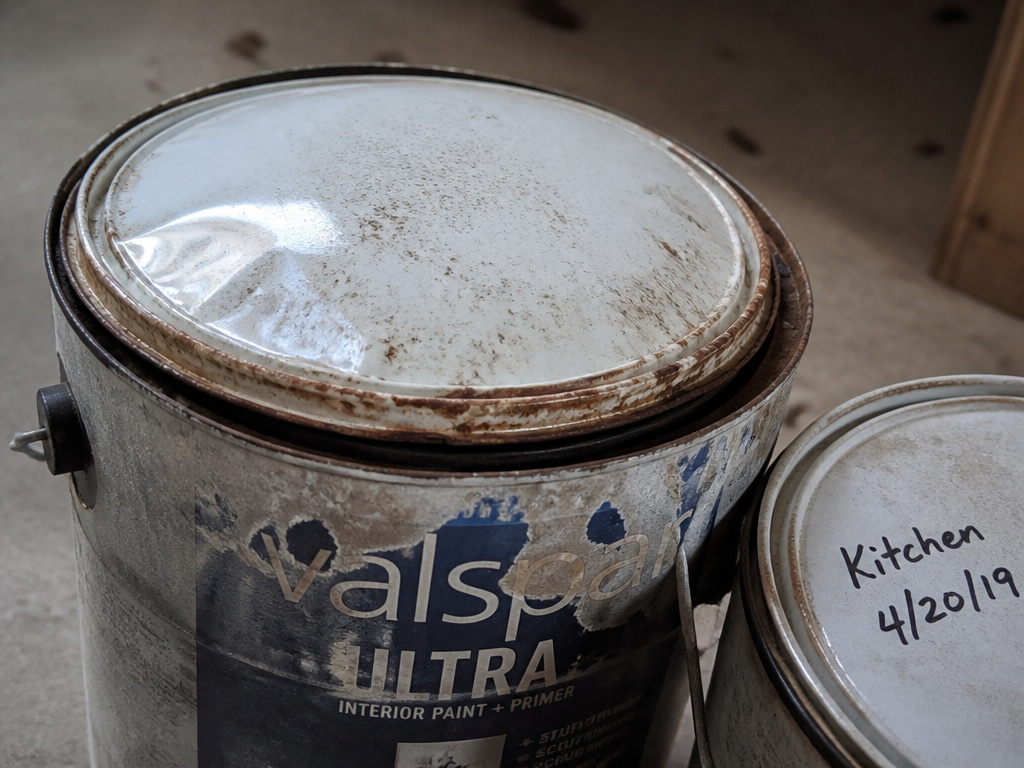
A can that has swollen at the lid is telling you something specific, and it isn’t always “throw it out.” Hempel flags a bulged can as possible gas evolution in aged product, which means handle it carefully rather than shake it and hope.
Here’s what a swollen or damaged can mean:
- Gas evolution from slow reaction inside. Treat it as a pressure vessel and open it outdoors.
- Corrosion at the seam. Prolonged humidity degrades labels and eventually corrodes the can, which affects integrity over the longer term.
- A failed seal letting solvent escape. The paint thickens and skins at the surface while the bulk stays soft.
- Nothing at all. Some cans dent and stay dented. A dent isn’t a bulge.
The one that surprises people is discoloration. A darkened epoxy hardener gets binned constantly by people who assume it’s spoiled.
Hempel states that epoxy curing agents may darken over time with no negative impact on corrosion protection, so color alone is not grounds for the bin, though the widespread assumption is that discoloured hardener means the product is spoiled.
That distinction runs along the same line as water based vs oil based paint generally. Different binders fail in different ways, and the failure signature that matters for one is meaningless for the other.
I’ve thrown out cans that were probably fine, and I’ve kept cans I should have binned. Writing the color and the date on the lid with a Sharpie is what would have saved me both times, and it costs nothing.
Where the Standards Don’t Agree
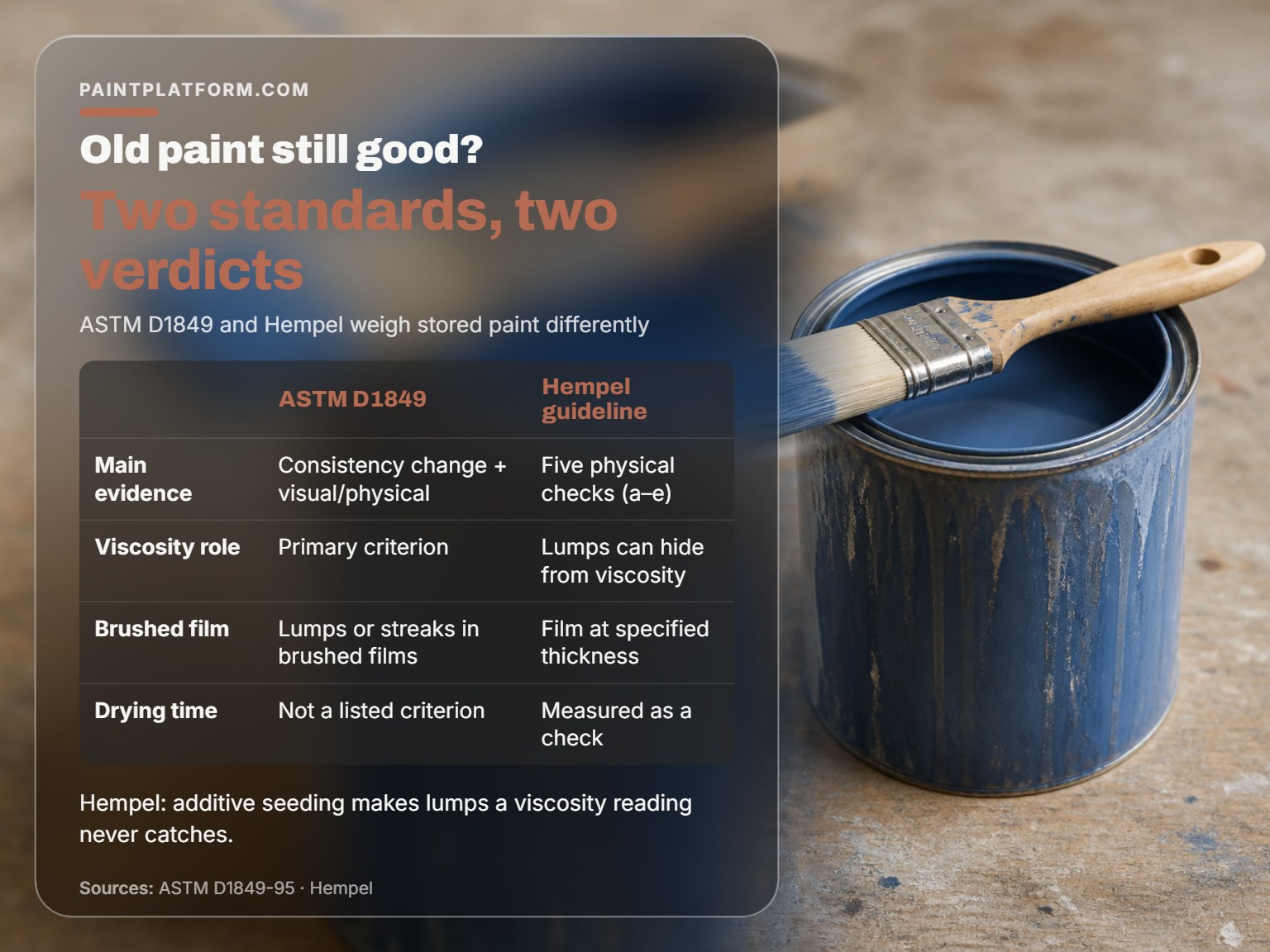
ASTM D1849 and Hempel’s guideline both assess stored paint, and they weight different evidence. Neither is wrong. They’re answering slightly different questions.
The ASTM D1849 package stability test leans on change in consistency plus visual and physical observation. Hempel’s five checks lean on the same physical territory but add a brushed film at specified thickness and a drying-time measurement. Where they diverge is on how much a viscosity number can tell you: ASTM treats consistency change as a primary criterion, while Hempel points out that additive seeding produces lumps that a viscosity reading never catches.
There’s a similar gap on the application side. ISO 9514:2019 covers determining coating pot life for multicomponent systems, and the standard is explicitly a lab method rather than an in-situ control. Hempel’s guideline notes that paint is designed for application at a paint temperature of 15-30 °C, and that exceeding that range may affect film forming. A pot-life figure measured in the lab tells you less than you’d like on a hot afternoon.
For visual inspection itself, the ISO 13076 visual assessment standard sets lighting and procedure for judging coating defects. It’s the reference to reach for when two people look at the same patch and disagree about whether it’s streaked. And if you want the long view on how coatings degrade over years rather than months, the NIST coating service life report lays out the failure-mode framework behind all of this.
I’d rather see a brushed test patch than a perfect viscosity reading. The patch shows you what the paint will actually do on a surface, and that’s the question you’re trying to answer.
When a can finally fails every check, dispose of old paint through your local household hazardous waste program rather than the bin. If your area requires it, dry out old paint first with an absorbent before it goes out.
Frequently Asked Questions
Can I use paint that’s past its best-before date?
Often, yes. Hempel states that paint will frequently be usable well beyond the printed date, and recommends verifying with the five checks rather than discarding on the date alone. Run the checks before you commit a whole wall to it.
Does freezing ruin all paint?
No. Conventional solvent-borne paint generally resists heavy frost and recovers its original consistency with slow reheating, though some high-solids or solvent-free two-component epoxy and polyurethane binders may form crystals at sub-zero temperatures and require special heating and re-mixing. Waterborne coatings are the opposite case: below the freezing point of water they are irreversibly destroyed, with no recovery path.
What’s the highest temperature paint can be stored at?
Hempel sets 40 °C / 104 °F as the ceiling for most products, with some requiring a lower limit stated on the label. Above that, alkyds and oils begin to cross-link and gel, and epoxies may lose reactivity.
Is a dark epoxy hardener still usable?
Hempel describes darkened epoxy curing agents as a cosmetic change with no negative impact on corrosion protection, though the widespread assumption is that discoloured hardener means the product is spoiled; color alone doesn’t condemn the product, so check the other signs before you toss it.
How often should I turn stored cans?
Every 3 months, if you can manage it. Turning the can upside down reduces settlement at the bottom, which makes redispersing easier when you finally open it.
Why does my paint have lumps even though it stirs smooth?
Temperature-sensitive additives can seed out into small lumps as the product ages. Those lumps affect application properties and final appearance, and they don’t register on a simple viscosity check.
The Bottom Line
Here’s the trigger I’d give you: if a can has been stored above 40 °C at any point, or if it’s waterborne and froze, stop running checks and treat it as compromised. Everything else is worth testing.
Start this week with one can. Pick the oldest one on your shelf, open it, stir from the bottom, and brush a patch on a scrap board. Write the result on the lid with the date.
That single habit answers how to tell if paint is still good far more reliably than any label ever will. And when a can does pass, you’ve saved yourself a trip to the art store for something you already owned.
