
How to Dry Out Paint for Disposal: Step-by-Step
This post contains affiliate links. As an Amazon Associate, we earn from qualifying purchases.
To dry out paint for disposal, harden it first: stir in a waste paint hardener (one packet per gallon of latex), let it sit 30 minutes until it goes tacky, then leave the lid off in a ventilated outdoor spot until the solids won’t spill. Wet paint gets left at the curb.
Collection crews check. A can that still sloshes when they tilt it gets tagged and left behind, and Montgomery County writes the rule out plainly: wet or soft paint that could spill will be left as unacceptable. That turns drying into the whole job, not the last chore before the bin, which is why knowing how to dry out paint for disposal matters.
What follows is the full sequence: the hardener dose, the in-can thresholds that county documents flatly disagree about, the layer method for a can that’s mostly full, and the paints that skip your trash can entirely.
Key Takeaways
- Wet paint gets left at the curb. Collection crews won’t take a can that could still spill, so hardening is a hard gate, not a suggestion.
- One packet of waste paint hardener treats up to a gallon of latex, and 30 minutes of set time gets it to a tacky, oatmeal-like consistency.
- County documents disagree on the threshold. Henry County, Ohio says less than one cup or one inch; Alexandria, Louisiana says less than one-fourth of the container.
- Oil-based paint splits the sources. Wisconsin Extension routes it to household hazardous waste; Henry County and Alexandria say dry small amounts and trash them.
- Lead paint, marine paint, and listed artist pigments skip the trash entirely, even after they harden.
Why a Sloshing Can Gets Left at the Curb
A can that still sloshes gets left behind. That’s the whole reason this chore exists.
Latex and water-based paint are accepted in regular trash only after the material has hardened or dried completely. Residual liquid is the disqualifying condition, because fluid paint can spill before, during, and after collection. Hardening locks the remaining chemicals into a solid mass that crews can handle without a spill risk.
Montgomery County’s disposal page states it without hedging: any wet or soft paint that could spill will be left as unacceptable by collection crews. Henry County’s document adds a second reason to take it seriously, noting that many trash collectors won’t pick up cans of paint at all.
The rest of the paint disposal sequence, including how to dry out paint for disposal, only matters once this gate is passed. Skip the drying and you’ve done nothing.
There’s also the mess angle. Fluid paint spills in the truck, on the driveway, and on the guy lifting the can. That’s why the rule exists.
The 4 Ways to Dry Out a Can of Latex Paint
Four methods cover almost every can: chemical hardener, absorbent bulk, thin layers, and plain air.
Before you start: Solvent-based paint gives off flammable vapor, so keep every open can away from pilot lights, grills, and space heaters. Set cans where children and pets can’t reach them, and bring them in before rain. A locked screen porch or balcony is the standard spot for this.
Two more things about how to dry out paint for disposal before you open anything. Basic paint disposal safety comes down to ventilation, distance from flame, and keeping the can out of the weather. And read your own county’s page first, because the numbers below vary by jurisdiction.
| Method | Best for | Rough timing | Watch out |
|---|---|---|---|
| Waste paint hardener | Cans more than half full | Tacky in 30 minutes | One packet per gallon of latex |
| Clay cat litter | Partial cans, separated paint | Slower than hardener | Needs enough absorbent to take all the liquid |
| Thin layers in a lined box | Full cans, large volume | One layer at a time | Layer depth varies by county |
| Lid off, stirred occasionally | Small residue in the can | Days to months | Won’t work if the can is mostly full |
Here’s the sequence that works for a typical can of latex:
- Match the method to how full the can is. A can under the local cutoff (Henry County, Ohio says less than one cup or one inch; City of Alexandria, LA says less than one-fourth of the container) dries in place. A can that’s half full needs hardener or a lined box, and skipping that step leaves it wet for weeks.
- Dose the hardener by volume, not by eye. One packet of waste paint hardener treats up to one gallon of latex. Underdosing leaves a sloshy layer under a set skin that splits the moment you lift the can.
- Stir thoroughly, then wait 30 minutes. Montgomery County’s instructions call for a full stir and a half-hour set, after which the paint reaches a tacky, oatmeal-like consistency that won’t pour. Skip the stir and the hardener clumps while the paint below stays liquid.
- Move the can somewhere sheltered and ventilated. Away from flames, children, pets, and rain. Alexandria notes that some latex paint contains mercury, which is the reason the outdoor step matters.
- Leave the lid off until the surface is solid. Montgomery County gives a few days in a well-ventilated area. Alexandria warns the range runs from several hours to several months depending on type and quantity.
- Bag the can and its lid, then set it out. Lids come off so collectors can see the paint is dry. Both lid and can go into a plastic bag with your regular trash, and the bag goes into a rigid can.
The tell is tactile. A properly hardened can feels solid when you press a thumb into the surface, and nothing comes away on your skin.
Once the can is solid, paint cans go out with the regular trash in a rigid bin. No bags on the curb by themselves.
How Much Paint Can Stay in the Can?
How much paint is too much to dry in place? Every agency answers it differently, and the answer changes what you do next.
| Source | Cutoff for drying in the can | What it means in practice |
|---|---|---|
| Henry County, Ohio | Less than one cup or one inch | Works for a shallow residue |
| City of Alexandria, LA | Less than one-fourth of the container | Scales with can size, not depth |
| Montgomery County, MD | No cutoff; harden or dry all of it | Hardener dose covers up to a gallon |
The practical difference is real. A quarter of a tall narrow can is a different volume than a quarter of a wide one, and the wide one skins over first. Henry County’s depth-based rule sidesteps that problem by ignoring can shape entirely.
Measure depth, not fractions. A quarter of a tall can is a different volume than a quarter of a wide one, and the wide one will skin over first. If a thumb pressed into the surface still sinks, it isn’t done.
Local documents phrase this differently, and it’s worth comparing two or three before you commit. The Cape Cod paint disposal document sits alongside the county pages above as another example of how local wording shifts.
The Layer Method: One Inch or Half an Inch?
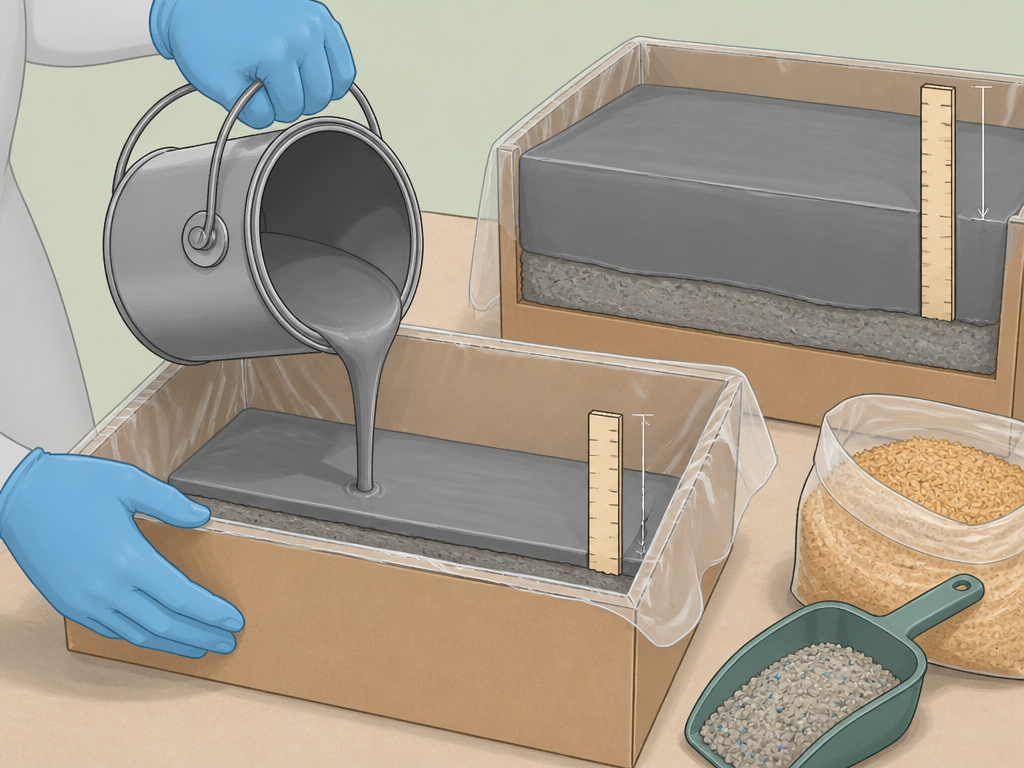
Two county documents, two different numbers, same job.
Henry County says to pour one-inch layers into a plastic-lined cardboard box and let each one dry before adding the next. Alexandria says half-inch layers, same method, same box. Neither document cites the other, and both are county government guidance.
Both agree on the underlying principle: thin layers dry faster than thick ones, and stirring or adding absorbent speeds it further. So if you’re working in humid weather or a cool garage, note that Henry County, Ohio calls for one-inch layers while City of Alexandria, LA calls for half-inch layers.
Here’s the sequence:
- Line a cardboard box with plastic. A trash bag works. Skip this and the paint bonds to the cardboard and you’ve made a permanent sculpture.
- Pour the first layer thin. Henry County, Ohio calls for one-inch layers, while City of Alexandria, LA calls for half-inch layers.
- Let it dry completely before the next pour. Adding a second layer onto a soft one traps solvent underneath and the whole slab stays tacky for days.
- Add absorbent to speed it up. Henry County lists cat litter, sawdust, concrete mix, oil dry, or sand. Alexandria names kitty litter and sawdust.
- Bag the solid slab when it’s set. Then it goes out with the trash, lid off.
A half-inch layer in July goes leathery faster than in a humid basement. That same layer in a humid basement can sit soft much longer.
Easy to miss: Separated latex paint needs a different first move. Pour the clear liquid off the top into a lined box, mix it with an equal amount of kitty litter, and let that dry separately while the solids in the can dry in place.
Oil-Based Paint, Solvents, and the Trip to Hazardous Waste
Oil-based paint is where the advice splits down the middle.
Wisconsin Extension’s publication G3454 treats oil-based and solvent paint as hazardous and routes it to household hazardous waste collection, not curbside trash. Henry County and Alexandria both say to dry out small amounts of oil-based paint and put the dried material in household garbage.
Both positions are in writing, from government sources, and they contradict each other. The oil-based paint disposal rule in your own county decides which one applies to you.
If you can’t find your county’s position, note that Wisconsin Extension routes oil-based paint to household hazardous waste, while Henry County and Alexandria say to dry small amounts and trash them. It’s the more conservative route, and it’s the one the university extension takes.
Solvents and thinners
Paint thinner, turpentine, and mineral spirits are classified as solvents, and they’re flammable. Wisconsin Extension is blunt: don’t put them in the trash and don’t pour them down the drain.
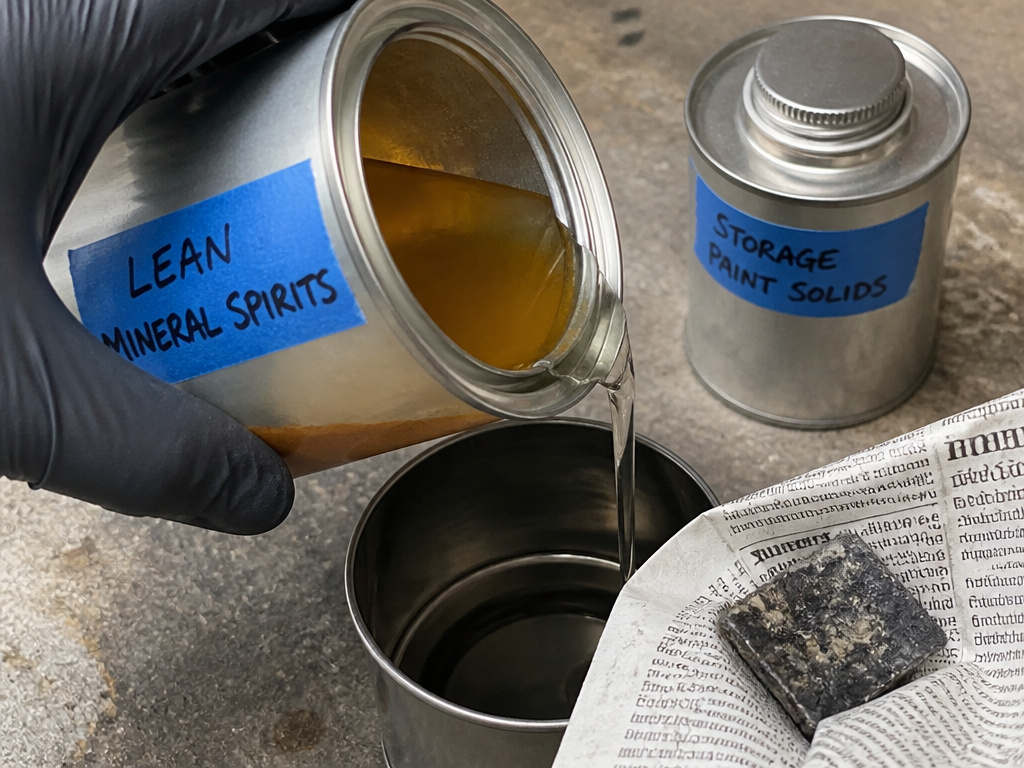
The reuse move is to let particles settle in a closed container, pour the clear thinner into a labeled storage can, and solidify the sludge left behind before wrapping it in newspaper and binning it.
Varnishes, shellac, and wood oils
Same flammable warning, same routing. Solidify very small quantities and keep them out of both the trash and the drain. The word “small” is doing real work in that sentence.
One more rule from the same publication: never store household chemicals in old food containers. Old coffee cans are the single exception, and only for soaking brushes in thinner.
Artist paints and the named pigments
This is the part that matters most if your leftover paint is tubes, not gallons. Wisconsin Extension keeps a named list of pigments that should go to hazardous waste collection rather than the bin: cadmium yellow, orange, and red; chrome yellow, orange, and green; lead white and flake white; vermillion; zinc yellow; cobalt violet; manganese blue and violet; emerald green and Paris green.
The list continues with Naples yellow, molybdate orange, strontium yellow, antimony white, barium yellow, raw and burnt umber, Thalo blue and green, lemon yellow, and Scheele’s green. Paints not on that list can be hardened and thrown away.
I keep a labeled coffee can of mineral spirits on the shelf and let the solids settle before pouring the clear part back into the working can. It’s the one disposal habit that pays for itself, because you’re reusing thinner instead of buying another quart.
What Never Goes in the Trash, Even Dried
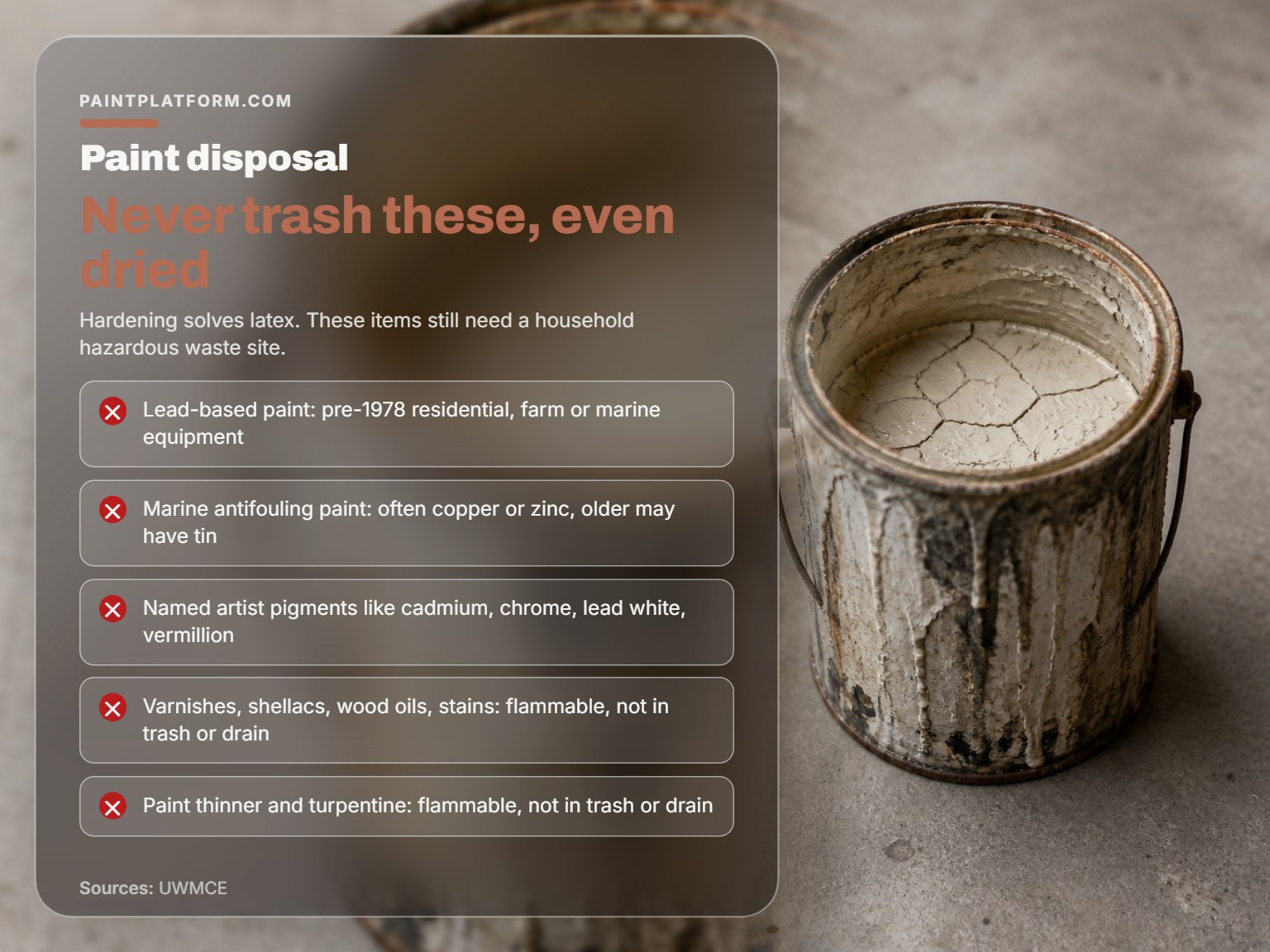
Hardening solves latex. Everything else on this page needs a different route.
These items go to a household hazardous waste site regardless of how solid they get:
- Lead-based paint. Wisconsin Extension flags pre-1978 residential paint and any paint used on farm or marine equipment today. Look for the word “lead” on the can label.
- Marine antifouling paint. Often contains copper or zinc, and older formulations may carry tributyl tin.
- Artist pigments from the named list above.
- Solvent-based strippers containing methylene chloride, unless you’re solidifying a very small quantity.
- Varnishes, shellacs, wood oils, and stains, which are flammable.
- Paint thinner and turpentine.
Where this goes sideways: Rinsing brushes in the sink and letting the water run. Henry County notes that improper disposal down a drain can contaminate the environment, and the residue coats the trap long before anyone notices a problem.
Rinse water counts too. Paint water from brush cleaning shouldn’t hit a storm drain or a gutter, and a jar left to settle does most of the work for you.
Oily rags are their own category. Linseed and oil-based rags generate heat as they cure, so they get spread flat to dry or sealed in a metal can, never balled up in a bucket.
Can You Reuse It Instead of Drying It?
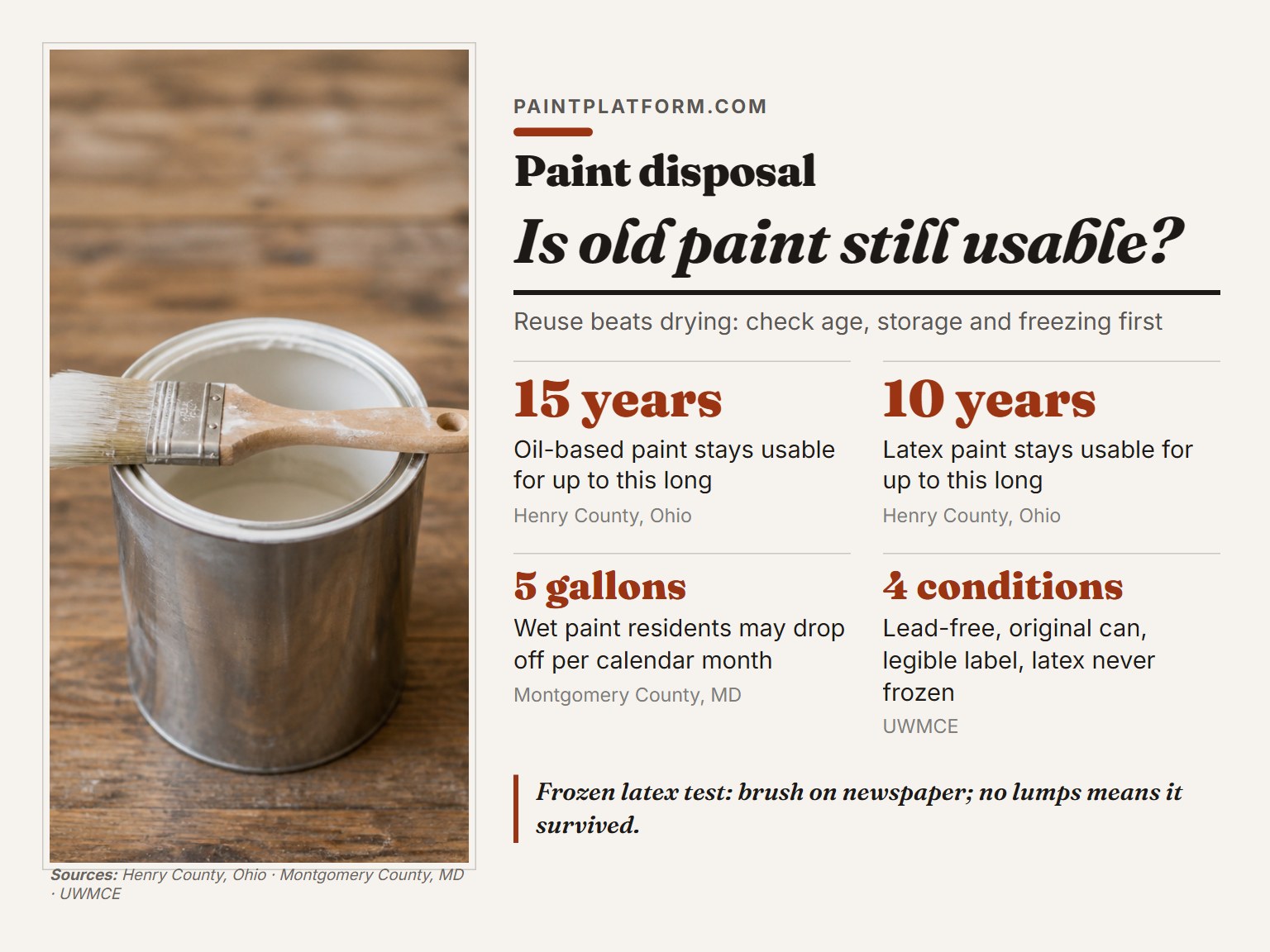
What if the paint is still good? That question is worth ten minutes before you commit to the drying routine.
Wisconsin Extension sets four conditions for sharing paint: it’s lead-free, it’s in the original can, the label is legible, and latex paint has never been frozen. Miss any one of those and it goes down the drying path instead.
Whether old paint is worth saving comes down to age and storage. Henry County and Alexandria agree on the numbers: oil-based paint stays usable for up to 15 years and latex for 10, assuming it was never exposed to freezing and thawing.
The frozen-latex test is simple. Brush a little on newspaper. If there are no lumps, it survived.
Montgomery County runs a Paint Giveaway out of the Shady Grove Household Hazardous Waste facility, where usable, unfrozen paint goes back out to residents for free. Residents can drop off up to five gallons of wet paint per calendar month.
You can recycle paint through a swap program in plenty of towns too. Alexandria’s document lists theatre groups, school art classes, house rehabilitation organizations, and local painters as takers.
This is where I’ll admit my own bias. I gave up on the big multi-tube sets years ago because I could never remember which tube to reach for, and a small chosen palette made me faster. It also meant fewer half-used tubes going dry in a drawer.
Fewer tubes bought means less paint to dry. That’s the cheapest disposal method there is.
Frequently Asked Questions
Can I use cat litter or sawdust instead of a commercial hardener?
Yes. Equal parts absorbent material and paint, stirred thoroughly, will thicken latex over a day or two. Stir again after the first hour so the absorbent reaches the paint at the bottom of the can. Commercial hardeners work faster, but bulk absorbents are fine when you have several cans to process.
How long does a mostly full can take to harden without a hardener?
Expect one to three weeks, depending on humidity, temperature, and how deep the paint sits. Shallow cans dry in days; a nearly full gallon can take much longer because air only reaches the surface. Stirring every day or two and adding absorbent shortens the wait considerably.
What do I do if the paint is already partly dried and chunky?
Break up the skin with a stir stick and mix the chunks into the remaining liquid. If the can is more solid than liquid, skip the hardener and just leave the lid off outdoors until it is fully firm. A can that is stiff but still soft in the middle needs more time, not more additive.
Can I dry out paint indoors to speed things up?
No. Keep the open can outside in a ventilated spot, away from children, pets, and ignition sources. Indoor drying releases fumes and invites spills on floors and carpets. A covered porch or a shaded spot outdoors is the right place, even though it takes longer.
Before You Go
Find your county’s solid waste page and read the paint entry before you open another can. A little reading beats a rejected can on collection day, and the thresholds really do differ from one jurisdiction to the next.
If your can is more than a quarter full and you’re not sure it’s worth saving, use it up. Paint a closet shelf, a garage wall, a scrap board. Henry County’s advice is the same as mine: buy only the amount you need next time.
And the small thing to try today: go count the cans in your garage and write the date on the lid of each one. That’s it. Next spring you’ll know exactly which ones are worth saving and which ones are getting the hardener.
