
How to Store Paint Cans: Step-by-Step
This post contains affiliate links. As an Amazon Associate, we earn from qualifying purchases.
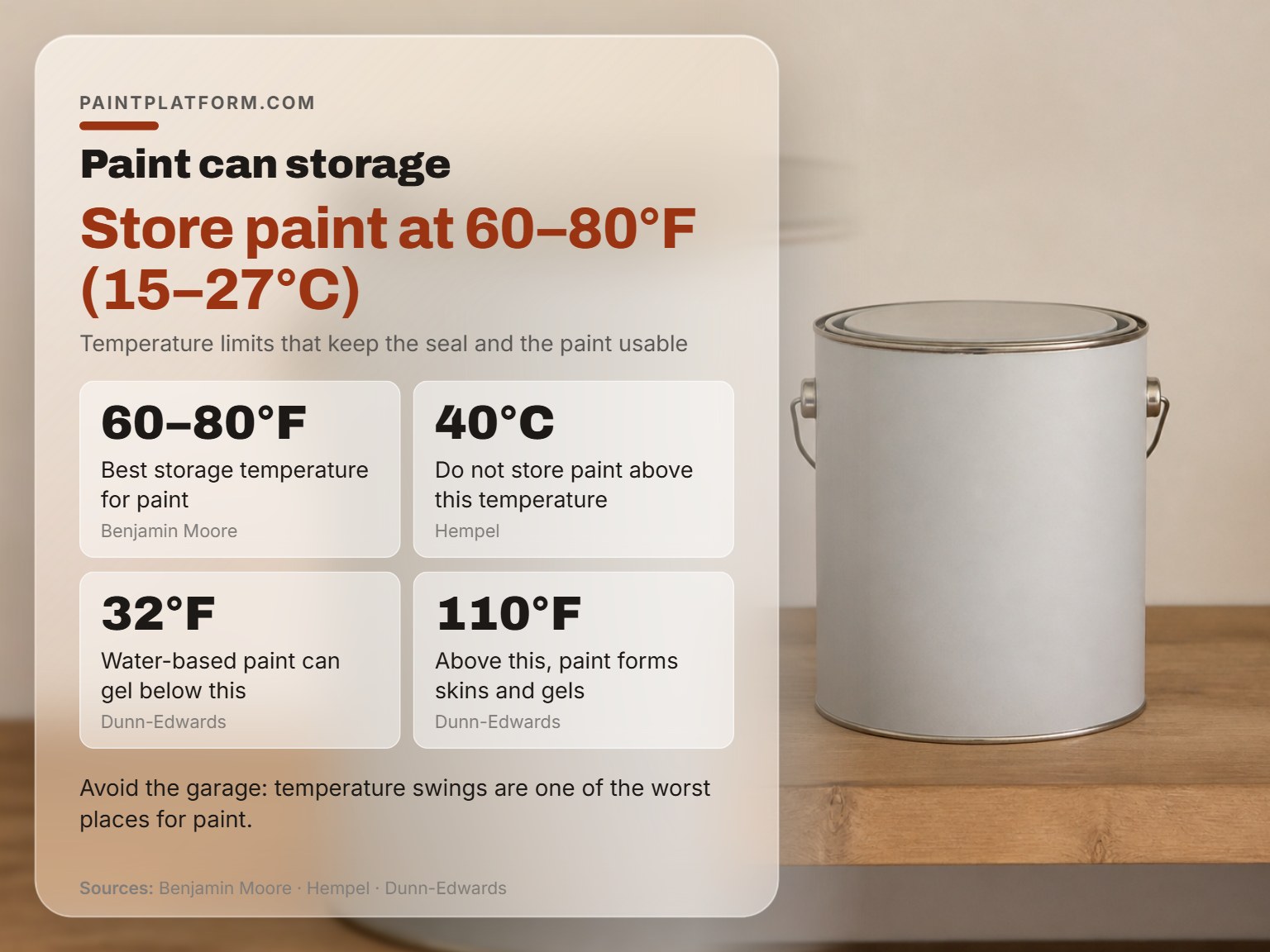
To store paint cans, keep them sealed; Benjamin Moore and Sherwin-Williams recommend 60-80°F (15-27°C), while Hempel sets a 40°C/104°F ceiling. Heat above 40°C/104°F speeds up aging, and frost irreversibly destroys water-based paint. Benjamin Moore puts opened shelf life at two years, so a clean rim and a stable shelf are what actually buy you that time.
That 60-to-80 band from Benjamin Moore and Sherwin-Williams sounds easy until you check where the cans actually live and confront the how to store paint cans question. Dunn-Edwards warns that temperatures above 110°F can cause paint to skin, settle, or gel, and that water-based paint stored below 32°F can gel, especially after numerous freeze/thaw cycles. A can that opens clean and one that opens with a skin on top were separated by a shelf and a thermometer.
What follows covers the temperature limits the manufacturers publish (they don’t agree with each other), how cold tolerance splits between water-based and oil-based paint, the sealing routine that keeps air out, and how to tell when a can is past saving.
Key Takeaways
- 60-80°F (15-27°C) is the range both Benjamin Moore and Sherwin-Williams publish for stored paint, while Hempel sets a 40°C/104°F ceiling and Dunn-Edwards warns above 110°F.
- Frost destroys water-based paint irreversibly according to Hempel, while solvent-borne paint resists heavy frost and recovers on slow re-heating.
- Two years is the common opened-shelf-life figure for latex, though B&Q claims up to 10 years for water-based and 15 for oil-based.
- Aerosol cans must stay upright. Westerbeke traced dead spray cans to blocked internal discharge tubes in a 2008 parts bulletin.
- Label the lid with color, room, and date so you’re not buying a duplicate can in two years.
What Temperature Should Paint Cans Be Stored At?
40°C. That’s 104°F, and it’s the hard ceiling Hempel puts on paint storage in its technical guideline, though Dunn-Edwards warns above 110°F and Benjamin Moore and Sherwin-Williams recommend 60-80°F.
Temperature is the single most important factor in paint storage stability. Higher temperatures lower viscosity, accelerate settling of pigments and fillers, and speed the natural ageing of the binder. Hempel’s guideline sets 40°C (104°F) as the ceiling, with some products requiring a lower limit printed on the label.
Four sources, four different numbers. That’s the first thing worth knowing about Hempel’s storage guideline and every other document on this subject: there’s no single industry figure.
| Source | Storage temperature | Notes |
|---|---|---|
| Hempel | Max 40°C / 104°F | Some products lower per label |
| Dunn-Edwards | Avoid above 110°F / 43°C | Skinning, settling, gelling |
| Benjamin Moore | 60-80°F (15-27°C) | Check the product data sheet |
| Sherwin-Williams | 60-80°F; spray 50-80°F | Garage called worst location |
Hempel’s 104°F and the 110°F in the Dunn-Edwards storage bulletin differ, and the gap comes from what each one measures. Hempel tracks the rate of chemical aging. Above 40°C, alkyds and oil paints start to cross-link and gel inside the can, and epoxies lose reactivity.
Dunn-Edwards tracks visible failure. Above 110°F, paint forms a skin on the top layer, settles, and eventually gels over time.
Benjamin Moore and Sherwin-Williams skip the ceiling argument and give a target instead: 60-80°F (15-27°C). Aim for the middle of that band. Treat Hempel’s 104°F as its ceiling, while Dunn-Edwards warns above 110°F and Benjamin Moore and Sherwin-Williams recommend 60-80°F.
Why the Ceiling Matters More Than the Floor
Hot storage does its damage slowly and quietly. Hempel’s rule of thumb is blunt: shelf life at 35°C/95°F is half the shelf life at 25°C/77°F. Its published limits run five years at 25°C and three years at 35°C for one-component products.
Additive seeding is the quiet one. Temperature-sensitive additives seed out and fill the paint with small lumps that affect how it applies and how the finish looks. You won’t see it until the can is open.
In hot climates, Hempel recommends air-conditioned storage or containers, with the can taken out only just before you apply.
Why the Garage Is the Worst Place for Paint Cans
Sherwin-Williams calls the garage one of the worst places to store paint. Benjamin Moore says a garage is fine if you know your climate and make sure it doesn’t freeze.
Both are describing the same problem from different climates. A garage swings hard in both seasons, freezing in winter and overheating in summer, which is the pattern that pushes paint past both limits in a single year. B&Q takes the harder line and says garages and sheds aren’t ideal at all.
Better spots, roughly in order of how well they hold a steady temperature:
- A closet or utility room. These stay closest to 60-80°F year round with no effort on your part.
- A basement shelf, not the floor. Sherwin-Williams points out that moisture from a basement floor causes cans to rust, and rust is the start of a failed seal.
- Under-stairs cupboards, as long as they’re away from radiators and direct sunlight.
- Anywhere that stays above freezing. That rules out most sheds.
Humidity is the second problem with outdoor storage when you compare a how to store paint cans approach indoors. Hempel notes that prolonged damp degrades labels and eventually corrodes cans, which makes identification harder and eats into the can’s integrity. A garage that passes the temperature test can still fail on moisture.
Does Freezing Ruin Paint?
Hempel draws a hard line between waterborne and solvent-borne coatings, and it’s the most useful distinction in this whole topic.
Waterborne coatings should never be exposed to frost. Below the freezing point of water, Hempel says the paint becomes irreversibly destroyed. That’s the strongest statement in any of the six sources.
Dunn-Edwards is softer on the same question. It says water-based paint stored below 32°F can gel, especially after numerous freeze/thaw cycles, which leaves room for a single cold night being survivable. Freezing paint is where the two documents split hardest.
Repeated cycles are what drive freeze-thaw damage, so one cold night is a different risk from a whole winter. If your storage spot dips below freezing more than once a season, the water-based cans need to move.
Water-based paint that has frozen solid is a write-off. Solvent-based paint that has frozen just needs time and gentle warmth to come back. Treat them as two different materials, because that’s what they are.
Solvent-Borne Paint Handles Cold Differently
Hempel says solvent-borne paints generally resist even heavy frost. They get more viscous and unsuitable for application, and slow re-heating brings back the original consistency in most cases.
That contrasts with the keep-it-above-freezing advice from B&Q and Benjamin Moore, neither of which separates solvent- from water-based products, while Hempel says solvent-borne paints resist even heavy frost. If you’re storing oil paint, Hempel’s position is the more specific one.
High-solids two-component epoxies and polyurethanes are the exception. Some binder ingredients form crystals at sub-zero temperatures, and those need special heating and re-mixing rather than a slow warm-up.
What most people get wrong: Assuming a frozen can is finished before checking what’s in it. A solvent-borne can that went through a hard frost often comes back with slow warming. A water-based one doesn’t.
How Long Does Opened Paint Actually Last?
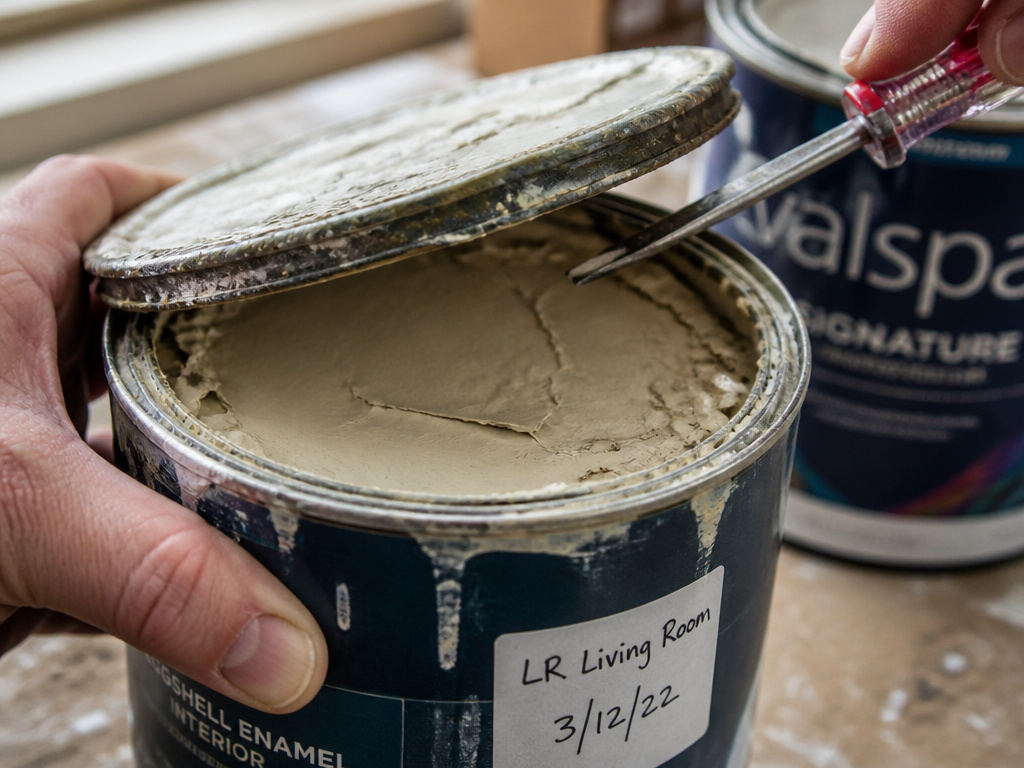
Two years. That’s the figure Benjamin Moore and Sherwin-Williams both give for opened latex paint, though B&Q claims up to 10 years for water-based paint.
Both add the same caveat: environment and temperature swings move that number. Benjamin Moore’s leftover paint guide points you to the product’s Technical Data Sheet for specific storage temperatures.
B&Q publishes a very different pair of numbers: up to 10 years for water-based paint and up to 15 for oil-based, provided the can is tightly sealed and stored correctly. Sherwin-Williams lands near B&Q on oil, at up to 15 years if properly stored, and stays at about two for latex.
Why the Numbers Diverge So Much
Three things explain the spread. Opened versus unopened is the biggest. Hempel’s five-year figure for one-component products is measured from the date of production in a sealed container, while Benjamin Moore’s two years starts the day you crack the lid.
Temperature is the second. Hempel’s own limits drop from five years at 25°C/77°F to three years at 35°C/95°F for one-component products, and from three years to two for two-component products.
Product chemistry is the third. Oil-based paint is less susceptible to going bad, which is why both Sherwin-Williams and B&Q put it at up to 15 years.
My working rule: treat two years as the figure Benjamin Moore and Sherwin-Williams give for any latex can you’ve opened, while B&Q claims up to 10 years for water-based paint, and treat anything past five as a bonus you verify before you commit a wall to it. Opened paint ages on the calendar, not on how full the can looks.
How to Store Paint Cans So the Seal Holds
Five steps, in this order, and the first one is the one everybody skips.
Before you start: Solvent-based paint and aerosol cans give off flammable vapor, so do your lid work away from pilot lights and space heaters. A bulging can may hold gas from aged product, so carry it outside before you open it. Wear gloves when you wipe a rim with solvent.
- Clean the rim before the lid goes back on. Wipe the wet paint away with a damp cloth, then scrape the dried ring off with something metal, like a straightened wire hanger. Skip it and the lid sits on a ridge of dried paint and never seals.
- Lay plastic over the opening. Cling film or a circle cut from a plastic bag, pulled slightly tight. Benjamin Moore and Sherwin-Williams both recommend it, and B&Q notes that a torn film lets air straight in.
- Tap the lid down with a rubber mallet, working around the edges until it’s firmly closed.
- Label the lid with a marker. Brand, color, product name, sheen, and where you painted. Add the month and year you opened it, which is Sherwin-Williams’ way of tracking age without relying on memory.
- Put the can on a shelf, not the floor. B&Q recommends a shelf to keep the can off damp concrete, and Sherwin-Williams makes the same point about basement floors causing rust.
Fair warning: step one is the whole job. Everything after it is just closing a can.
If There’s Only a Little Paint Left
Air is the enemy, and a nearly empty can is mostly air. Benjamin Moore’s guidance is to size the container to the amount of paint left. B&Q says the same thing more bluntly: transfer the remainder to a smaller clean glass jar or plastic container with an airtight lid.
A wide-mouth glass jar is about the right shape for this, and you can see the color through the glass without opening anything. If you’d rather not use glass, a plastic container with an airtight lid seals hard and stacks.
Benjamin Moore adds a detail worth copying: most leftover latex, including AURA, REGAL and ben, should go into a lined metal can to prevent rust, or a glass or plastic container.
This is the pantry principle. You don’t need many jars to cook well, you need a few good ones and a label so you know where the salt is.
The 3-Month Flip
Hempel suggests turning liquid paint cans upside down every three months to reduce settlement, so pigment doesn’t pack hard on the bottom. Never do this with an aerosol can, which has to stay upright for reasons covered below.
How Do You Store Spray Paint and Aerosol Cans?
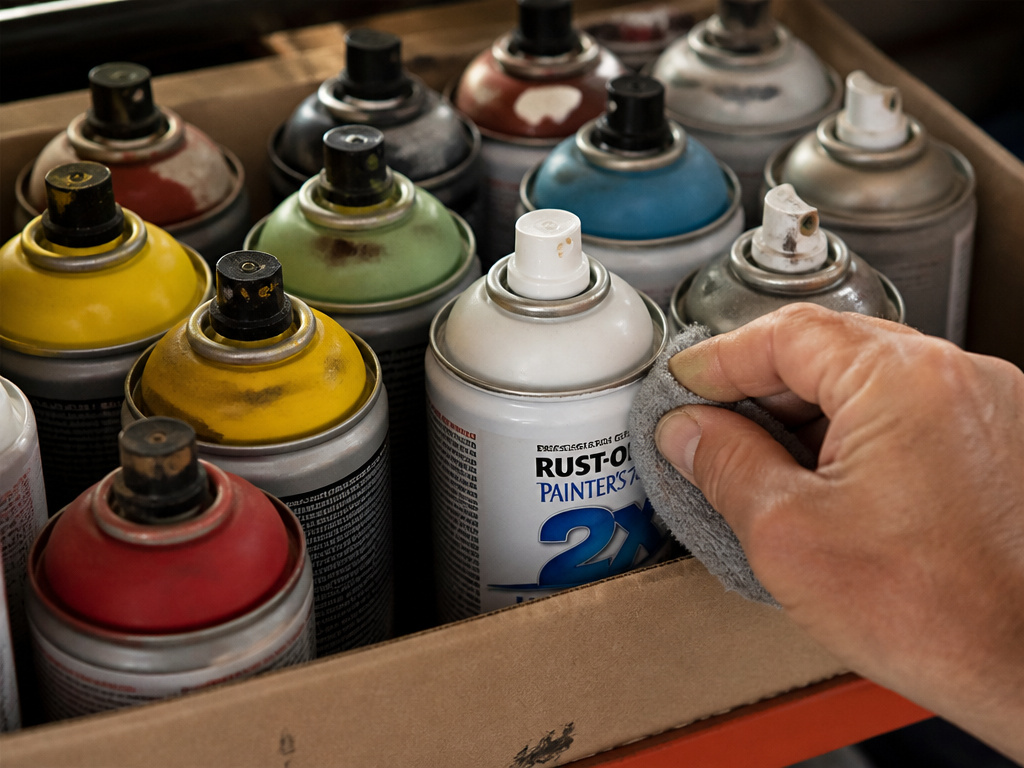
You shake it, press the nozzle, and get a weak spit of propellant and nothing else. The can still feels full.
That failure showed up in the field badly enough that Westerbeke issued a parts bulletin about it on 24 November 2008. Customers were returning aerosol paint spray cans that would not spray any paint.
The supplier examined the returns and traced the cause to storage. The internal discharge tube had become blocked because the cans weren’t stored upright. Westerbeke told dealers to check the storage position of every can in stock and announced a label revision. You can read the whole thing in Westerbeke bulletin 2008-4.
Sherwin-Williams gives the same instruction for spray paint cans: upright, in a well-ventilated area, away from direct sunlight, at 50-80°F. Stored that way, spray paint lasts two to five years.
I keep my aerosol cans in a shallow box lid so they physically cannot lie down. It looks silly on a shelf, and it’s the only reason my nozzles have stayed clear.
When Is a Can Past Saving?

Hard settling is the one failure you can’t stir your way out of.
Dunn-Edwards explains why. With soft settling, pigment can be stirred or shaken back into the system. With hard settling, it can’t, and the result is paint that differs in gloss, viscosity, and performance from what the label promises.
Hempel’s reuse check runs five items: no leakage or internal corrosion, a homogeneous appearance after thorough mixing, a viscosity that isn’t gelatinous, a uniform defect-free film at the specified thickness, and a drying time that isn’t significantly longer than normal.
| What you see | What it means | What to do |
|---|---|---|
| Skin on top, smooth below | Normal for oil-based | Cut it out, stir well |
| Jelly-like clumps after stirring | Past its prime | Recycle it |
| Strong sour or rotten-egg smell | Spoiled | Recycle it |
| Bulging lid or can | Possible gas evolution | Carry outdoors, handle with care |
| Pigment hard-packed on the bottom | Hard settling | Recycle it |
Bulging cans are the one to handle carefully. Hempel flags bulging as a possible sign of gas evolution in aged product and says to handle those cans with care, which is a polite way of saying carry it outside before you open it.
Never pour paint down a septic system, per Sherwin-Williams. PaintCare runs drop-off sites around the country, and Earth911 keeps a searchable database by ZIP code. Both are covered in more detail in this guide to paint can disposal.
Frequently Asked Questions
Can you store paint cans in a shed?
Not if you have another option. Sherwin-Williams calls the garage one of the worst places to store paint because of temperature swings, and B&Q says sheds aren’t ideal either. A shed that freezes in winter will destroy water-based paint, and one that bakes in summer pushes it past Hempel’s 104°F ceiling, while Dunn-Edwards warns above 110°F.
Does paint go bad if it freezes once?
It depends entirely on the base. Hempel says waterborne coatings are irreversibly destroyed below the freezing point of water, while Dunn-Edwards says water-based paint can gel especially after numerous freeze/thaw cycles, and solvent-borne paints resist even heavy frost and recover their original consistency on slow re-heating. Dunn-Edwards is slightly softer on water-based paint, noting gelling especially after numerous freeze/thaw cycles rather than after a single cold night.
Should paint cans be stored upside down?
Liquid paint, yes, every three months, per Hempel’s recommendation to reduce settlement, though Westerbeke and Sherwin-Williams require aerosol cans to stay upright. Aerosol cans, never. Westerbeke traced a run of dead spray cans to blocked discharge tubes caused by non-upright storage, and Sherwin-Williams gives the same upright instruction.
How do you know if old paint is still usable?
Smell and consistency do most of the work. Benjamin Moore and Sherwin-Williams both describe a sour or rotten-egg smell and jelly-like clumps that survive stirring as the end of the line. Hempel’s fuller check adds leakage, internal corrosion, gelatinous viscosity, poor film formation, and unusually slow drying.
How long can paint sit in a tray between coats?
Sherwin-Williams says no longer than 24 hours if you cover the tray with plastic wrap and seal it in a bag with the air squeezed out. Benjamin Moore allows up to two days for an uncleaned brush or roller wrapped in clear plastic. Past that, clean the tools.
The Bottom Line
Here’s the threshold that matters most: if your storage spot drops below freezing even once a season, move the water-based cans this week. That’s the only failure on this list with no recovery path, and it’s the one nobody notices until spring.
The garage debate is genuinely unresolved. Benjamin Moore allows it if your climate is mild and the cans never freeze, while Sherwin-Williams calls the garage one of the worst places to store paint and B&Q says garages and sheds aren’t ideal. I’d split the difference and keep latex inside, oil in the garage if you have to choose.
Try this today: go write the color and the month on the lid of every can you own. A few minutes and a marker, and you’ll never buy a duplicate quart of the same off-white again.
