
How to Paint Exterior Walls in Cold Weather: Read the Can
This post contains affiliate links. As an Amazon Associate, we earn from qualifying purchases.
To paint exterior walls in cold weather, read the can first: general exterior latex floors range from 40F to 50F depending on the maker, while cold-formulated products such as Sherwin-Williams Duration and Diamond Vogel Palisade go down to 35F. The lower number only holds if the surface stays above it through the cure window.
Those two numbers come with two different hold times, and the hold time is where cold-weather jobs fail. Diamond Vogel wants 8 hours above 50F for standard latex, and 24 hours above 35F for its cold-formulated products. Dunn-Edwards calls the first 48 hours the critical stretch. Sherwin-Williams wants the temperature in range and above the dew point for 48 hours, which is central to how to paint exterior walls in cold weather.
Below: the temperature floors as four sources state them, the prep steps that decide whether a cold-weather coat holds, and the timing that gets you off the wall before dew lands.
Key Takeaways
- 50F is Diamond Vogel’s and Sherwin-Williams’ standard floor. Air and surface both, and Diamond Vogel wants it held for at least 8 hours after the last stroke, while Dunn-Edwards formulates all its latex down to 40F and the University of Houston spec requires 50F to 95F.
- 35F products are real. Sherwin-Williams Duration, Resilience, SuperPaint, and A-100 Exterior are labeled for it, as are Diamond Vogel Palisade, Durango, and EverCryl.
- The hold window is the part that bites, and the sources disagree. Diamond Vogel wants 24 hours at 35F for its low-temp products, Dunn-Edwards calls the first 48 hours critical, and Sherwin-Williams wants 48 hours above dew point.
- Diamond Vogel and the University of Houston spec both draw a 5F dew-point line. Dunn-Edwards and Sherwin-Williams discuss dew point only qualitatively, and Sherwin-Williams notes dew forms the moment the sun sets.
- Wet wood fails at any temperature. Keep wood under 15% moisture and masonry under 12% before the first coat.
What Temperature Is Too Cold to Paint Exterior Walls?
Diamond Vogel’s technical bulletin sets the general exterior latex floor at 50F, air and surface both. Sherwin-Williams uses the same number for standard latex and calls it the normal recommendation.
Exterior latex paint carries two separate temperature numbers: a general application floor of 50F for air and surface, and a lower floor of 35F on products formulated for cold application. The second number holds only when air and surface stay at or above 35F through the full cure window, and that window runs longer than the first one.
The exception is a group of cold-formulated products, and the list is short enough to memorize. Diamond Vogel names Palisade Ultra Premium Exterior Acrylic Latex, Durango Acrylic Latex Exterior Finish, and EverCryl Exterior Acrylic Latex Finish at 35F.
Sherwin-Williams names Duration, Resilience, SuperPaint, and A-100 Exterior at the same 35F. Dunn-Edwards formulates all of its latex for coalescence down to 40F, with some paints reaching 35F.
Four sources, four answers.
| Source | General latex floor | Low-temp product floor | Hold window |
|---|---|---|---|
| Diamond Vogel | 50F, air and surface | 35F on Palisade, Durango, EverCryl | 8 hours at 50F; 24 hours at 35F |
| Dunn-Edwards | 40F coalescence | 35F on some products | First 48 hours most critical |
| Sherwin-Williams | 50F | 35F on Duration, Resilience, SuperPaint, A-100 | In range and above dew point 48 hours |
| University of Houston spec | 50F to 95F | None written in | Not stated |
Where the Four Sources Split
Section 099113 of the University of Houston exterior painting spec allows application only when surface and ambient air sit between 50F and 95F. It writes in no low-temperature exception at all. On an institutional job that clause is enforceable, which is why a contractor painting a school in November wants the product label and the spec to agree before the ladder leaves the truck.
Temperature is one input, and honestly it’s the easiest one to check when you compare a how to paint exterior walls in cold weather. The full weather conditions for exterior painting include wind, sun exposure, and how fast the number is falling.
It’s easier to choose exterior paint by its labeled temperature range than by sheen or color, which is central to how to paint exterior walls in cold weather. In fall, that range decides whether you work at all.
The Cure-Hold Window: 8 Hours, 24 Hours, or 48?
Eight hours, 24 hours, 48 hours. Three manufacturers, three different hold windows, and only one of them matches the can in your hand.
Diamond Vogel asks for 50F or better for at least 8 hours after application on general exterior latex. Its three cold-formulated products get a lower floor and a longer leash: 35F at application and for the next 24 hours.
Dunn-Edwards goes further. Its bulletin calls the first 48 hours of the drying schedule the most critical stretch, and notes that cold-weather paints may take up to two days to dry with the minimum temperature held the whole time. Sherwin-Williams lands in the same place, asking for the temperature to stay in range and above the dew point for at least 48 hours after the last stroke.
Here is where the sources genuinely part company. Diamond Vogel’s general rule covers 8 hours after application and does not extend to the overnight low, while Dunn-Edwards says to suspend painting if a dip below the minimum is forecast and Sherwin-Williams calls the warm-day, cold-night pattern a common mistake. Dunn-Edwards says to suspend painting entirely if the temperature will dip below the minimum during the drying phase. Sherwin-Williams calls the warm-day, cold-night pattern a common mistake outright.
Common mistake: Painting into a 50F afternoon with a 34F night behind it. Sherwin-Williams flags that exact spread: the coating can stop coalescing when the temperature drops, and the dew that forms at sunset seeps into a film that hasn’t finished knitting together.
I plan around 48 hours, because it’s the longest window any of the three names, though Diamond Vogel asks for only 8 hours on standard latex and 24 hours on its low-temp products. If the forecast can’t give me that, I move the job or move it inside.
Moving inside is its own project. Painting indoors in winter runs on different rules about ventilation and dry time, and a garage wall is not a living room wall.
If the can doesn’t name a temperature below 50F, the can means 50F. Treat that number as a hard edge, not a suggestion.
Why Latex Stops Forming a Film Below the Floor
Latex paint dries by coalescence, and coalescence is a physical process with a temperature floor built into it.
The mechanism is straightforward. Latex is dispersed pigment and resin particles suspended in water. As the water evaporates, the particles pack together and fuse into a continuous film. The resin particles are thermoplastic, so they soften when warm and harden when cold. Below the floor they harden past the point where they’ll fuse.
That’s the mechanism.
Dunn-Edwards describes the outcome in two tiers. In severe cases the film cracks. In milder ones it shows poor touch-up, weak holdout, uneven color, or a sheen that won’t sit flat.
A coat that failed to coalesce doesn’t look wet or runny. It dries to a flat, chalky surface that powders onto your fingertip when you drag it across.
Diamond Vogel frames the same failure in performance terms. Film formation that isn’t optimal compromises adhesion, toughness, and longevity, and it can show up as sub-standard gloss, off color, or visible cracks. Those problems don’t announce themselves on day one.
The acrylic vs oil-based exterior paint question comes up every fall for reasons that run past temperature, but the film-formation difference is the one that matters in October.
The same logic runs in reverse at the other end of the year. That’s why painting in hot weather has its own rules about direct sun and hot surfaces, and why Diamond Vogel caps the drying accelerants you can stack at once.
Moisture Trapped Under the Film Ruins More Jobs Than Cold
Cold gets blamed for failures that moisture caused.
The University of Houston spec puts hard numbers on substrate moisture before any coating goes on: 15% maximum for wood, and 12% for concrete, masonry, and gypsum board, measured with an electronic moisture meter. Those limits don’t loosen in winter. If anything, wet substrates are more common in cold months because everything dries slower.
The Plastic Sheet Test for Concrete
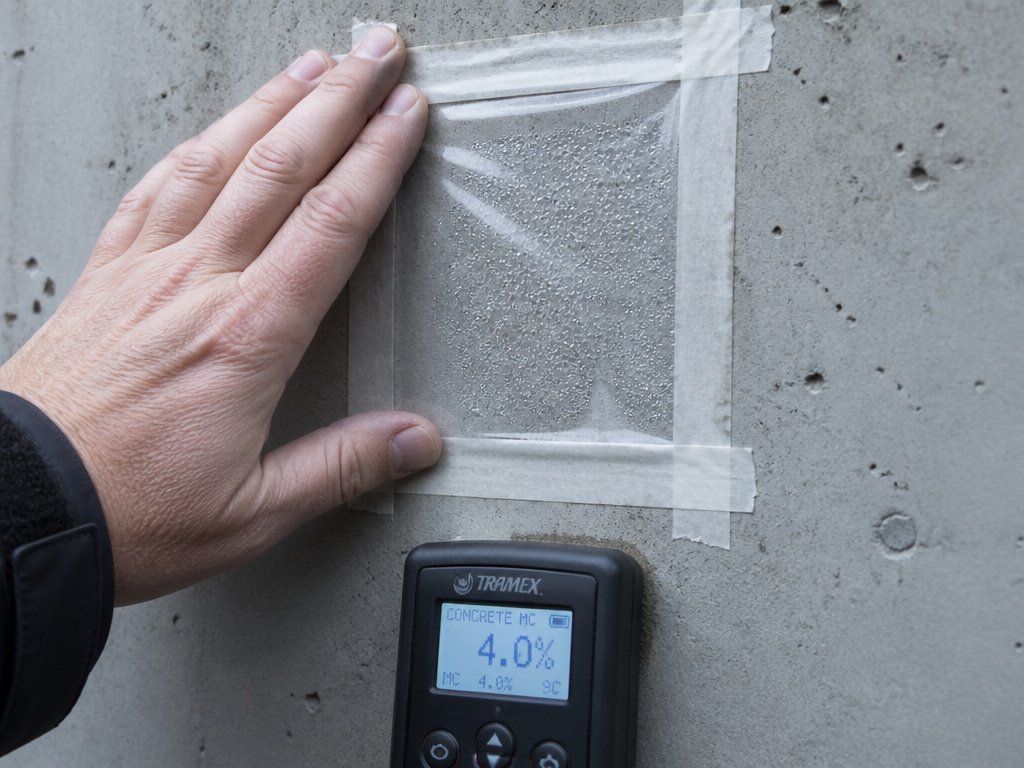
Concrete is the sneaky one. Sherwin-Williams notes that concrete moisture seldom drops below 15%, then gives a field test you can run with a scrap of plastic.
Tape all four edges of an 18 inch by 18 inch sheet of 4 mil plastic to the bare surface and seal every edge. Inspect after at least 16 hours. Moisture, discoloration, or condensation on the concrete or the underside of the sheet means the source needs fixing before paint goes anywhere near it.
Other substrates have their own waiting periods:
- Brick: weather at least one year, then wire brush the efflorescence off.
- Galvanized metal: weather a minimum of 6 months before coating.
- Plaster: dry thoroughly for at least 30 days.
- Stucco: 30 days if the recommended procedures were followed and drying conditions are normal.
- Hardboard siding: clean it thoroughly and prime with an alkyd primer, factory primed or not.
Bare patches after scraping want a spot primer. Joints that keep opening want a flexible exterior sealant. Good caulk at a joint stops more water than an extra coat of paint ever will.
The mildew conversation comes up a lot on shaded trim and fences. On painted wood, the green-gray film I keep finding turns out to be surface mildew that scrubs off with a stiff brush and soapy water. Soft, crumbly wood underneath is a different problem, so I poke it with a screwdriver before deciding anything. North-facing spots grow it fastest, and cutting back a bush did more for one fence than repainting did.
Wood needs to dry completely before primer, and in cold weather that can take longer than a warm-weather job. Preparing exterior walls properly is the step that decides how the whole job ages.
The part nobody mentions: A 35F-rated coating over wet wood still fails. The rating covers the paint’s ability to coalesce. It says nothing about moisture trying to leave the substrate underneath.
That’s the short version of why prevent paint from peeling is mostly a prep article with a painting section bolted on the end.
How Do You Time a Cold-Weather Paint Day?
Ever watched the forecast all week and then painted straight into a sunset?
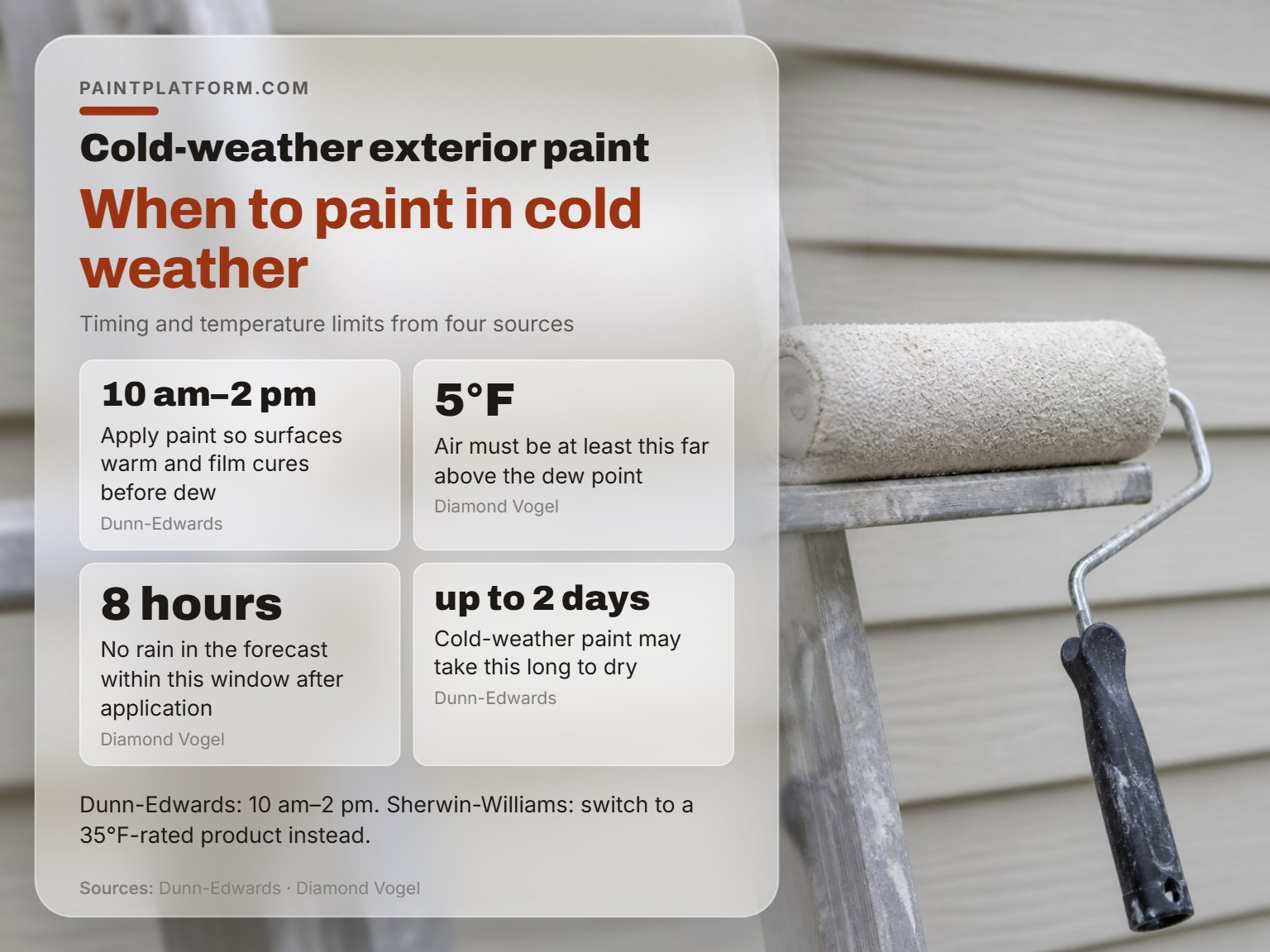
Dunn-Edwards has the most specific timing advice of the four sources, recommending 10 am to 2 pm, while Sherwin-Williams instead recommends switching to a 35F-rated product rather than a time window. Apply paint between 10 am and 2 pm, so surfaces have time to warm and the film has time to cure before dew falls. In cold weather, follow the sun around the house instead of the shade, and stop around mid-afternoon or when the temperature starts dropping.
Before you start: Frost on ladder rungs and deck boards is slick before the sun reaches it, so set the ladder once the sun has warmed it or sweep and salt the footing. Cold makes extension cords stiff and their insulation brittle, so uncoil them fully and check for cracks before plugging in. Primer and solvent vapors build up faster in a closed garage, so keep the door open even when it’s cold out.
- Write the floor on your hand. Read the can before you open it. Applying a 50F product below its floor is how a wall ends up chalky by spring.
- Check the dew point, not just the temperature. Diamond Vogel and the UH spec both want air at least 5F above the dew point. A smaller gap means wait.
- Check the rain window. Diamond Vogel says no application if rain is in the forecast within 8 hours. Sherwin-Williams says wait at least one day after a heavy rain, and the surface must be dry.
- Check humidity against the trend. Diamond Vogel says skip it at 90% relative humidity or above if the temperature is predicted to drop.
- Start on the wall the sun hits first. That surface warms earliest and gives you the longest safe stretch before the shadow line moves.
- Stop early. Losing an hour of daylight beats losing the whole coat.
The Drying Accelerants That Stack Against You
Diamond Vogel warns against combining more than two to three drying accelerants at once: above 95F, direct sun, a hot surface, a hot and porous surface, wind, and relative humidity below 20%. Cold-weather work usually has the opposite problem, but a windy October afternoon on a dark south-facing wall can stack several of those without anyone noticing.
A coat that tacks quickly in July can stay soft for up to two days in October. Dunn-Edwards puts cold-weather dry time at up to two days, and the minimum temperature has to hold for the whole stretch.
It’s also worth knowing how to store paint in cold weather before the leftovers sit in an unheated garage all winter.
What a Cold-Weather Failure Actually Looks Like
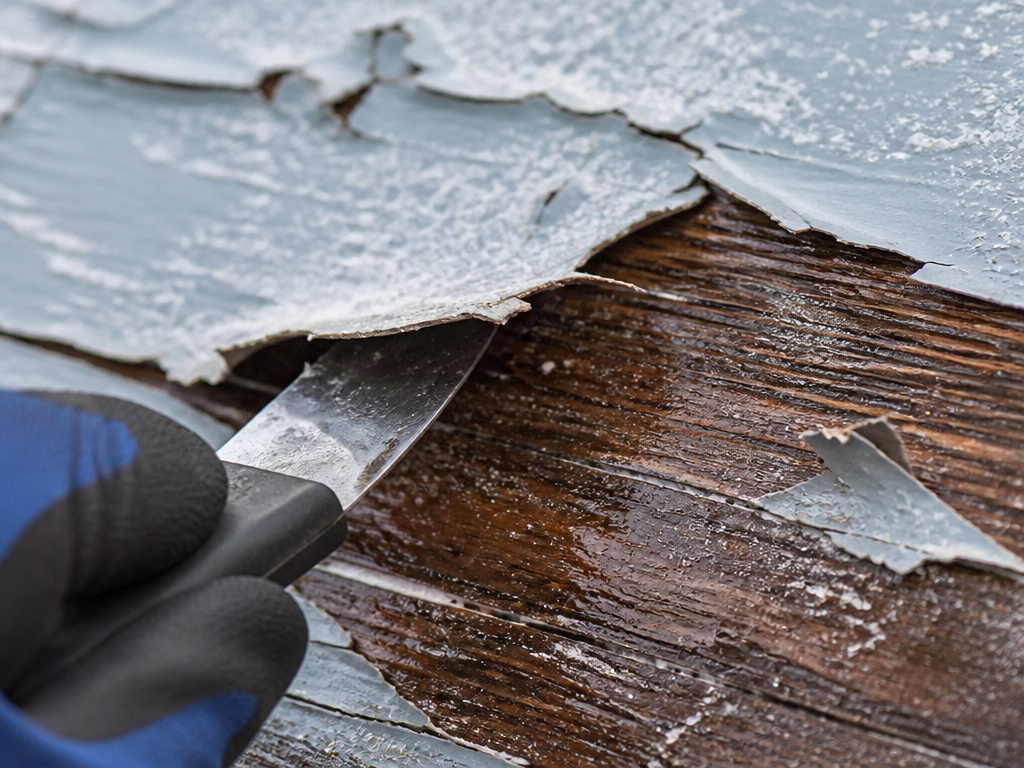
A college investigated why a paint job was already coming off in sheets. The NPS exterior woodwork painting note documents what the investigation found.
Three factors stacked. A burst steam pipe had saturated a gymnasium wall, and moisture readings hit 43% before the wall was closed up and painted. The coating chosen was a fire-retardant marine-grade pigmented polyamide epoxy, picked partly for its fire-retardant content and partly to seal troublesome joints. It turned out to be hygroscopic, absorbing moisture through the fire-retardant salts, swelling, and blistering off because the bond underneath was poor.
Records also showed the work happened in weather below 40F. Paint applied in 1980 started peeling within a year, and by 1984 the failure was extensive. The remedy was total paint removal, proper surface prep, and a repaint. The college had wanted the new work to last in excess of 7 years.
Three factors stacked.
| What you see | Likely cause | What to do |
|---|---|---|
| Chalky, powdery film | Poor coalescence after a cold night | Strip and repaint above the floor |
| Peeling within a year | Moisture trapped under the film | Find the water source first |
| Blisters that swell and pop | Hygroscopic or impervious coating over damp wood | Strip, dry, recoat with something breathable |
| Streaks running down the wall | Condensation landing on a wet film | Repaint, and stop before dew |
| Uneven sheen or color | Film formed below its rated floor | Repaint inside a stable window |
The chalky film is the one that fools people, because it looks like a paint that’s simply aged. It isn’t. It’s a film that failed to coalesce.
Frequently Asked Questions
Can you paint exterior walls at 40F?
Only with a product labeled for it. Dunn-Edwards formulates all of its latex for coalescence down to 40F, and some of its paints reach 35F. A standard exterior latex with a 50F label is out of range at 40F, and the film may form poorly even if it feels dry to the touch.
What happens if the temperature drops below the minimum overnight?
Coalescence can stop. Sherwin-Williams describes exactly this pattern, a daytime high above 50F with a nighttime low below 35F, and notes the paint can stop melting together when the temperature falls. The result can be a chalky, powdery film with weak adhesion rather than an obvious run.
Is 35F paint as good as 50F paint?
Not automatically. Dunn-Edwards makes the point directly: a paint that cures at low temperature doesn’t guarantee a job without issues, because substrate temperature, humidity, dew point, and sudden swings all still apply. The 35F label widens the window, and the first 48 hours still decide the outcome.
How soon can it rain after painting?
Diamond Vogel says no application if rain is in the forecast within 8 hours. Sherwin-Williams says to wait a minimum of one day after a heavy rain before painting, and the surface must be dry before the brush touches it.
Does cold-weather painting work on masonry?
Only when the masonry is dry. The University of Houston spec caps moisture at 12% for concrete, masonry, and gypsum board, and Sherwin-Williams notes that concrete moisture seldom drops below 15%. Brick should weather at least one year before it gets a coat.
The Bottom Line
Here’s the threshold I’d hand anyone: if the overnight low is forecast below the floor printed on your can, don’t start. Not because the paint will obviously fail, but because you won’t know for a year, and by then the fix is a strip and repaint instead of a second coat.
The first step costs nothing. Go read the can you already own, or the spec sheet for the product you’re about to buy, and write the temperature floor and the hold window on a scrap of paper. A can that gives you 50F and a short hold is a narrow job. A can that gives you 35F and a longer hold buys you a longer season and a longer checklist.
Fair warning: the wider window comes with more moving parts, not fewer. Dew point, substrate moisture, and the cure-hold window all still apply, and none of them care which brand is on the lid.
One small exercise for this week: pick the wall you want to paint, take its surface temperature in the morning and again in the afternoon, and write both numbers down. That gap tells you more about your real window than any forecast does.
