
How to Choose Exterior Paint: What Actually Decides It
This post contains affiliate links. As an Amazon Associate, we earn from qualifying purchases.
How to choose exterior paint comes down to matching three things: the surface (wood, masonry, or metal), the weather window (above 50°F and below 90°F), and the paint chemistry (acrylic latex for wood, cement-water for damp masonry). Brand matters less than a dry, clean, primed surface.
Water trapped behind the paint film is the most common cause of blistering, per the National Bureau of Standards, and it ruins the best paint on the shelf. The prep and the weather window decide the job’s lifespan before the first coat goes on.
What follows: the surface-to-paint match, the temperature rules the sources actually disagree on, and the coverage numbers that will save you a trip back to the store.
Key Takeaways
- Match paint to surface, not to brand. Cement-water for damp masonry, acrylic latex for wood, vinyl-safe paint for vinyl siding.
- Below 50°F, stop. NBS says urgent cases can go to 40°F, but a forecast 10-degree drop disqualifies the job either way.
- Spot-prime bare patches. Apply exterior primer on bare wood, brick, or stucco to improve adhesion.
- Two coats, 4-6 hours apart. Sherwin-Williams puts the recoat window at 4-6 hours depending on climate.
- Coverage varies wildly. NBS white lead paint ran 500-700 sq ft/gal. Modern exterior paint runs 250-400.
How to Choose Exterior Paint: What the Test Data Says
Five years of exposure data from the National Bureau of Standards tell a blunt story: one paint started peeling under the eaves in less than two years, another held nearly four, and four showed next to nothing. Same primer. Same buildings. Same climate.
The NBS field test applied six white exterior paints over a single TT-P-25a primer on previously painted yellow pine, then applied the same six paints tinted to light brown over primed redwood siding. Undereave peeling separated the six formulations within two years of exposure, and the gap widened through the fifth year.
The peeling tracked the chemistry. Paint No. 5 was a water-thinned oil, solubilized. Paint No. 4 was water-thinned oil, emulsified. Neither is sold today, which the NBS report itself notes is probably significant. The broader point holds: chemistry and moisture movement under the film decide which paint peels first.
I keep coming back to one line in the NBS report: the two water-thinned oil paints in the test are no longer commercially available. The paint that peeled at two years is off the market. The lesson about moisture behind the film isn’t.
The full NIST field test of exterior paints is worth reading if you want the raw ratings. If you want the short version of paint chemistry, our guide to exterior paint types covers the categories in plain language.
How Do You Match Paint to the Surface?
Roll acrylic latex onto a damp cinder-block wall and the paint blisters before the second coat goes on. Masonry that holds water needs a paint class that cures with moisture, not one that fights it.
| Surface | Paint class | Why |
|---|---|---|
| Open-texture masonry (cinder, lightweight block) | Cement-water paint | Cures with moisture in the wall |
| Close-texture dry masonry (cast concrete, tile) | Resin emulsion or rubber-vehicle | Film-forming, needs a dry-ish surface |
| Damp or structurally wet masonry | Cement-water paint only | Only class rated for walls that stay damp |
| Bare wood | Acrylic latex over exterior primer | Flexes with the wood, resists UV |
| Vinyl siding | Vinyl-safe acrylic (Sherwin-Williams VinylSafe) | Standard paint can warp or craze vinyl |
| Metal doors and trim | High-gloss acrylic or alkyd | Weather resistance and clean release |
Two rules from the NBS masonry circular do most of the work. Open-textured block takes cement-water paint. Close-textured, relatively dry surfaces take resin emulsion or rubber-vehicle paint. The painting exterior masonry walls guide spells out the full selection logic.
Open-Texture vs Close-Texture Masonry
Texture isn’t cosmetic on masonry. Cinder block, concrete block, and lightweight aggregate block are open-textured: they drink water and hold it. Cast concrete, asbestos-cement siding, and tile are close-textured and relatively dry.
Resin emulsion paints can go on damp walls but not wet ones. That’s a narrower window than it sounds. Damp means the surface is darker than dry but not shiny or weeping.
Where this goes sideways: Sealing a damp masonry wall with oil paint. Oil needs walls dry at application and built to stay dry. Trap moisture behind the film and the paint blisters within one wet season.
If you’re painting in a place where the wall never fully dries, the exterior paint for humidity question deserves its own answer.
The Temperature Window That Ruins Paint Jobs
Fifty degrees Fahrenheit is the line both the NBS and Sherwin-Williams draw for exterior application. The two sources agree on the floor and disagree on almost everything else about it.
| Source | Minimum | Extra rule |
|---|---|---|
| NBS Letter Circular 810 | 50°F, 40°F urgent | Disqualify if a 10°F drop is forecast |
| Sherwin-Williams | 50°F | Avoid above 90°F |
The NBS rule is stricter than the manufacturer’s in one direction and looser in another. NBS allows a 40°F urgent-case exception; Sherwin-Williams doesn’t mention one. Sherwin-Williams adds a 90°F ceiling; NBS doesn’t state one. Neither is wrong. They answer slightly different questions.
The full text of the Letter Circular 810 exterior wood painting covers the reasoning.
If the forecast shows a 10-degree drop, don’t paint. NBS Letter Circular 810 treats that forecast as a disqualifier on its own, independent of the current reading.
One more weather rule sits in the masonry circular: when conditions cause paint to dry too fast, work in the shade. The surface skins over before the film underneath has set, and the finish can look uneven.
Temperature isn’t the only decision the weather forces. Color choice interacts with sun exposure, and tinted paints in the NBS test showed uneven color retention (mottling) by year three. The how to choose exterior paint color process is worth running before you buy, especially on a south- or west-facing wall.
Why Cedar Holds Paint and Southern Yellow Pine Doesn’t
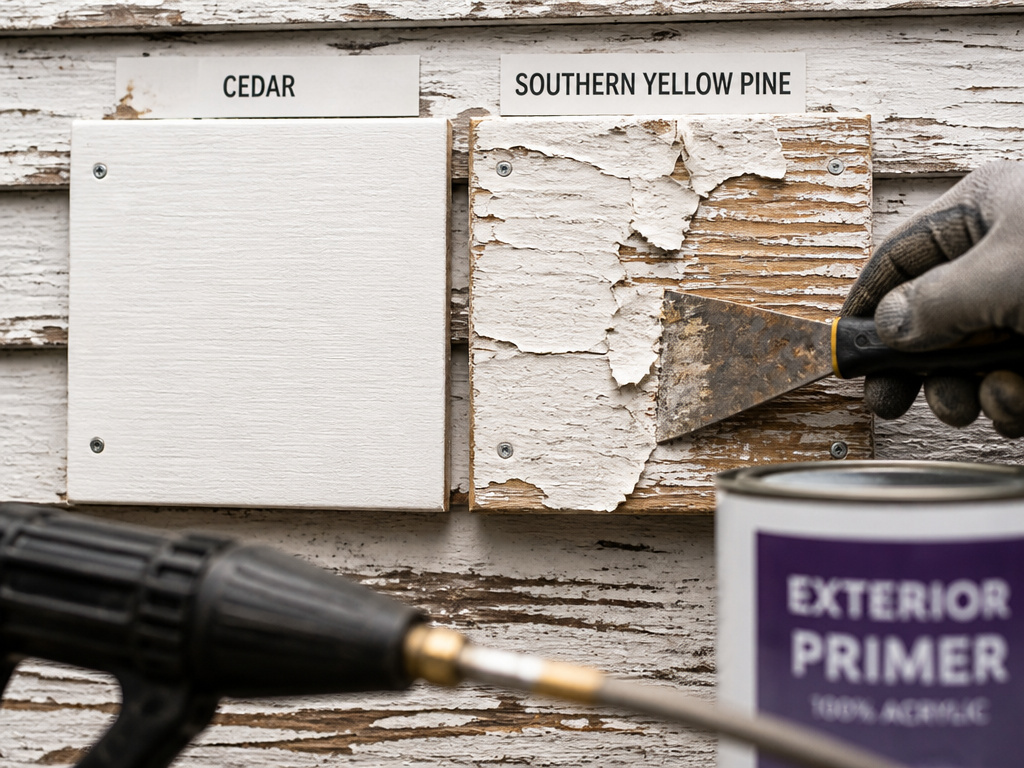
Southern yellow pine sits in the bottom group of paint-holding woods in the NBS ranking, alongside Douglas fir and western larch. Cedar, redwood, and cypress sit at the top.
The NBS ranking, best to worst:
- Cedar, redwood, cypress hold paint longest and suffer least when you skip a repaint cycle.
- Northern white pine, western white pine, sugar pine come next.
- Ponderosa pine, spruce, hemlock land in the third group.
- Douglas fir, western larch, and southern yellow pine bring up the rear.
Prep is where the job is won. Pressure-wash, then wait at least 24-48 hours for the house to dry before paint touches it. Apply exterior primer on bare wood, brick, or stucco.
Before you start: Exterior painting involves ladders and pressure washers. Wood needs at least 24-48 hours to dry before paint.
It came off. Surface mildew, not paint failure. The wood underneath was sound, so I trimmed back the bush that was keeping the boards wet and waited a few sunny days before priming the bare spots.
The primer does the adhesion work. The topcoat just has to look good on top of it.
Which Paint Chemistry Should You Buy?
Sherwin-Williams recommends Duration Exterior Acrylic Latex for long-lasting results and says Emerald Exterior Acrylic Latex can extend paint lifespan. Both are acrylic latex. The oil-base paints in the NBS field test tell you how chemistry behaves over time, not what to buy at the counter today.
Acrylic Latex vs Oil-Based
Acrylic latex flexes with wood movement and resists UV fade better than oil in most exterior uses. Oil penetrates deeper and holds a harder film, which is why it still shows up on metal doors and some trim. The acrylic vs oil-based exterior paint breakdown goes deeper on the trade-offs.
If fade resistance is the deciding factor for you, the UV resistance question is worth its own read.
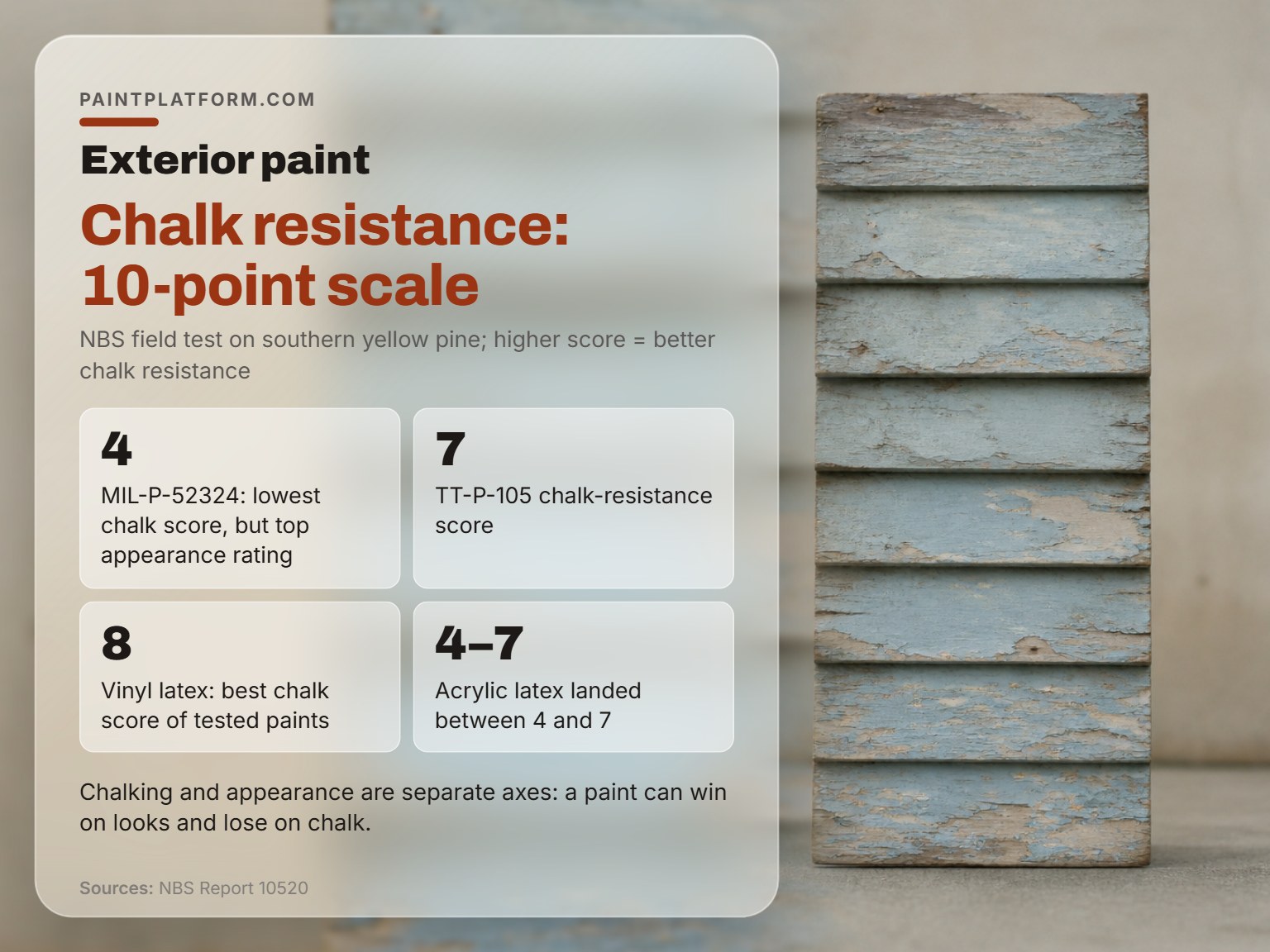
Chalking splits the sources. Sherwin-Williams treats chalk resistance as a quality marker in its exterior paint comparison chart. The NBS field test found the opposite trade-off: the highest-appearance paint, MIL-P-52324, got its top rating at the expense of moderately heavy chalking. Chalking and appearance are separate axes. A paint can win on looks and lose on chalk.
On the NBS 10-point chalk-resistance scale, tested on southern yellow pine:
- MIL-P-52324 scored 4, the lowest of the group, despite its top appearance rating.
- TT-P-105 scored 7.
- Vinyl latex scored 8, the best of the tested paints.
- Acrylic latex landed between 4 and 7.
If you want a starting point on brands, our best exterior paint roundup covers what’s actually on shelves now.
The Coverage Math That Saves You a Second Trip
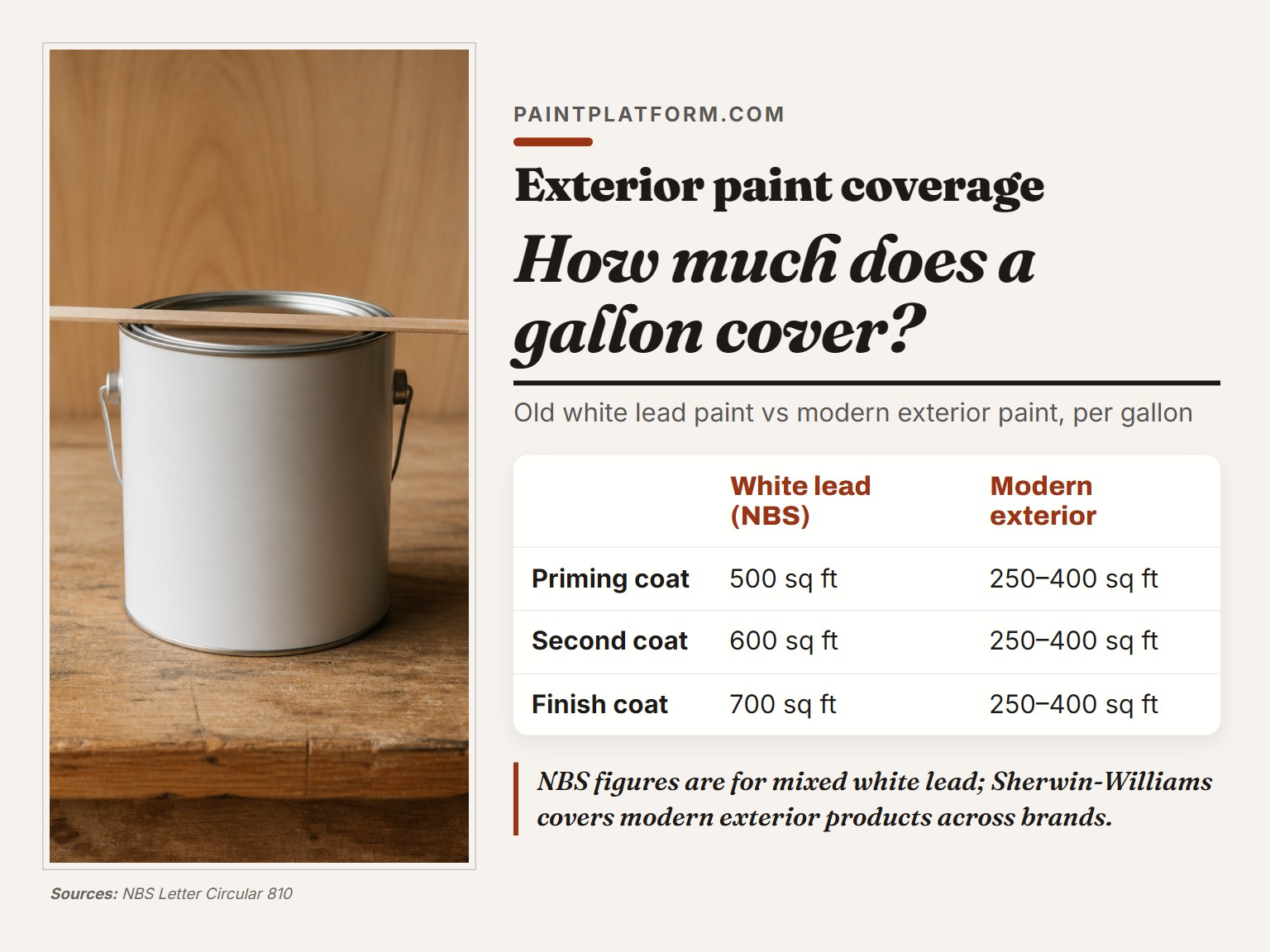
A gallon of modern exterior paint covers 250-400 square feet, per Sherwin-Williams. The NBS figure for mixed white lead paint was 500-700 square feet per gallon, depending on the coat. The gap is real and it matters when you’re buying.
| Paint | Coverage per gallon | Source |
|---|---|---|
| Mixed white lead, priming coat | 500 sq ft | NBS LC 810 |
| Mixed white lead, second coat | 600 sq ft | NBS LC 810 |
| Mixed white lead, finish coat | 700 sq ft | NBS LC 810 |
| Modern exterior paint | 250-400 sq ft | Sherwin-Williams |
The NBS numbers come from a specific white lead formula mixed on the job. The Sherwin-Williams number covers modern exterior products across brands. Neither is wrong. They describe different paint.
Two coats is the standard. Sherwin-Williams asks for two coats with the first fully dry before the second, and gives 4-6 hours between coats depending on climate. The sequence that actually works:
- Wash and dry. Pressure-wash, then wait at least 24-48 hours for the house to dry before paint touches it.
- Scrape and fill. Remove loose and cracked paint. Fill cracks with exterior-grade filler. Sand rough spots.
- Prime bare patches. Exterior primer on bare wood, brick, or stucco. This is the step that extends the job.
- Paint trim, shutters, and doors first. Drips land on unpainted walls instead of fresh paint. Our best paint for outdoor trim guide covers the high-gloss products that hold up.
- Roll the walls in two coats. First coat fully dry, then 4-6 hours before the second.
- Pull tape at the one-hour mark. Once the paint is dry to the touch, usually about an hour.
How Many Gallons Do You Actually Need?
Measure the wall square footage, divide by the coverage number on the can, and round up. Measure the wall square footage, divide by the coverage number on the can, and round up. Buy one extra gallon for touch-ups.
How Long Should Exterior Paint Last?
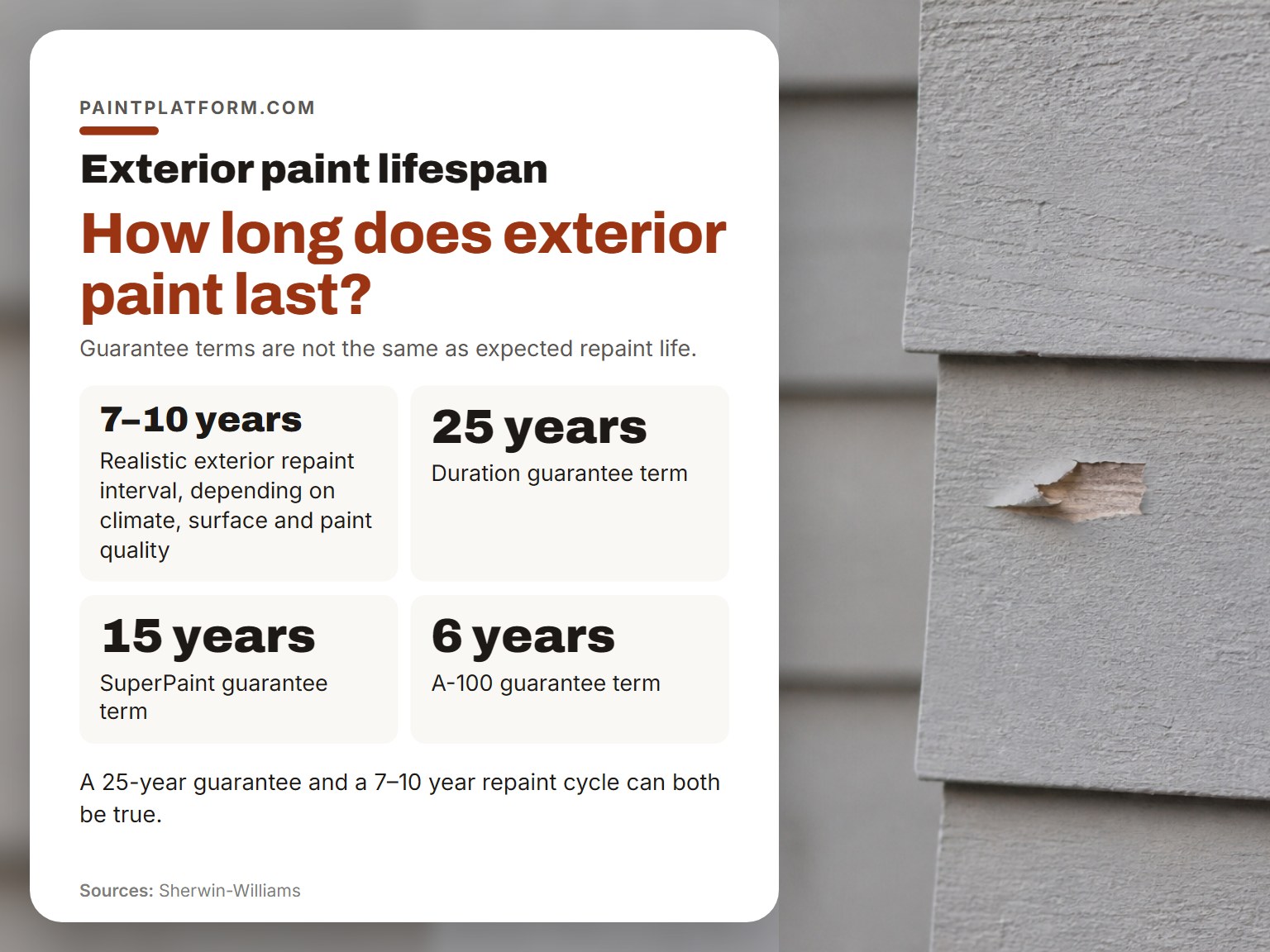
Ever peeled a paint chip off a wall at year four and wondered where the ten-year guarantee went? Seven to ten years is the Sherwin-Williams figure for exterior paint life, depending on climate, surface material, and paint quality. The NBS field test gives you a useful counterpoint: several paints showed negligible or no undereave peeling over the five-year test, while Paint No. 5 peeled in less than two years.
Sherwin-Williams lists guarantee terms by product: Duration at 25 years, SuperPaint at 15, A-100 at 6, and Exterior Accents under a Lifetime Homeowner’s Warranty. Those numbers describe the guarantee, not the expected life. The 7-10 year figure is the realistic repaint interval.
The part nobody mentions: A 25-year guarantee and a 7-10 year repaint cycle can both be true. The guarantee covers product failure, not normal weathering. Read what triggers a claim before you treat the number as a lifespan.
ASTM D1006/D1006M-21 is the standard that governs how exterior paint exposure tests are run. Two of its provisions matter for reading any durability claim you see on a can. First, at least three replicates of each material should be tested. Second, results from one location can’t be assumed to apply in a different location; multi-location exposures are recommended.
The ASTM D1006 exterior exposure testing standard is worth a skim if you want to see how the claims get made.
Location transferability is where consumer guidance and the standards diverge. ASTM says single-location results can’t be assumed useful elsewhere. NBS Letter Circular 810 says the same paint will fail sooner in Southern Florida than in Maine. Sherwin-Williams consumer pages carry no location caveat at all. If you live somewhere with hard sun or long wet seasons, treat every durability number as a ceiling rather than a promise.
Frequently Asked Questions
Can I paint exterior wood below 50°F?
NBS Letter Circular 810 allows painting down to 40°F in urgent cases, but disqualifies the job if a 10-degree drop is forecast. Sherwin-Williams states a flat 50°F floor with no urgent exception. Below 40°F, neither source supports painting.
Do I need to prime the whole house or just bare spots?
Bare wood, brick, and stucco need exterior primer, per Sherwin-Williams. Spot priming bare patches is the highest-value step in the job. Priming the whole wall is optional on previously painted surfaces that are sound and clean.
How long between coats of exterior paint?
Sherwin-Williams gives 4-6 hours between coats, depending on climate, with the first coat fully dry before the second goes on.
What’s the best paint for damp masonry?
Cement-water paint is the only class NBS Letter Circular 747 rates for walls that are damp at application or may become damp afterward from structural defects. Resin emulsion paints can go on damp walls but not wet ones. Oil paint requires dry walls that stay dry.
Does exterior paint really last 7-10 years?
Sherwin-Williams gives 7-10 years as the typical repaint interval, varying with climate, surface material, and paint quality. The NBS field test found a wide gap between the best and worst paints on the same buildings. Treat any single number as a starting point, not a guarantee.
Is chalk resistance the same as fade resistance?
No. The NBS field test found the highest-appearance paint (MIL-P-52324) scored a 4 out of 10 on chalk resistance. Vinyl latex scored 8. Chalking and appearance are separate axes, and Sherwin-Williams frames chalk resistance as a quality marker while the NBS data shows the trade-off.
The Bottom Line
One rule overrides everything above: if the forecast shows a 10-degree drop overnight, or the surface is damp, or the wood is soft under a screwdriver, stop. No paint on the shelf survives a bad window or a wet substrate. The NBS report puts water behind the film as the most common cause of blistering, and one paint in the study peeled in less than two years when the conditions were wrong.
The short version of how to choose exterior paint: match the class to the surface, check the forecast, and prep like the paint depends on it. Because it does.
The prep and the weather window will do more for the job than the label on the can.
Try this today: pick one exterior wall, run your hand over it, and note where the paint feels chalky or where the wood gives under a thumbnail. That quick survey tells you more about what the wall needs than any paint can label.
