
How to Freeze Paint for Storage: Why the Labels Say No
This post contains affiliate links. As an Amazon Associate, we earn from qualifying purchases.
Freezing paint for storage is not a method any manufacturer in the sources recommends. Water-based paint freezes at or below 32°F, and Dunn-Edwards warns that repeated freeze/thaw cycles can gel it into hard pigment settling that stirring cannot fix. KBS Coatings is the exception: its products are formulated to survive freezing, then thaw and stir.
That 32°F line is where the argument starts, not where it ends. Dunn-Edwards asks for special measures once a can sits more than 24 hours above 110°F or below 32°F. Family Handyman points out that a paint’s ingredient blend can push its own freezing point lower, the way salt lowers water’s freezing point, which is why knowing how to freeze paint for storage matters.
What follows is what the standards and data sheets actually say about cold, the three storage bands that don’t agree with each other, the thaw-and-stir test, and how to seal a can so the question never comes up.
Key Takeaways
- No data sheet recommends freezing paint on purpose. ASTM D2243 exists to test whether a coating survives freezing it never asked for.
- 32°F is the working line for water-based paint, though ingredient blends can push the real freezing point a little lower.
- Dunn-Edwards and IPC treat freeze damage as permanent, while Family Handyman says frozen paint may be salvageable if warmed slowly and stirred. KBS Coatings says its own products thaw and stir back fine.
- KBS Coatings recommends 50°F to 80°F for its products, and 60°F to 70°F when a product sheet names that band.
- Cottage-cheese texture means the can is done for most latex paints. Thaw slowly, stir, then judge by how it comes off the stick, though KBS Coatings says its own products thaw and stir back fine.
ASTM D2243 Measures Cycling, and Cycling Is What Breaks Paint
ASTM D2243 is the only formal standard covering how to freeze paint for storage, and its scope is narrow on purpose. It evaluates how freeze/thaw cycling affects viscosity and the visual properties of the dried film.
Freeze-thaw cycling damages water-borne coatings more than steady freezing does. The ASTM D2243 method subjects a coating to repeated cycles and then measures two things: viscosity and the visual properties of the dried film. A coating that survives one freeze may still fail after several cycles, because the damage accumulates instead of resetting.
That distinction is the whole ballgame. A can that freezes once and stays frozen is in less trouble than a can that thaws and refreezes all winter.
Dunn-Edwards lists what that stress looks like in the can: a jump or drop in viscosity, skinning or seeding on the surface, syneresis, and pigment settling. Syneresis is the easy one to spot. A thin, semi-clear layer of liquid sits on top of a thicker body of paint, and the two have started to part company.
Settling is the one that ends the argument. Soft settling stirs back in without much fight. Hard settling doesn’t, and Dunn-Edwards calls the result bad paint, different in gloss, viscosity, and performance.
| Source | Position on freezing | Practical read |
|---|---|---|
| Dunn-Edwards | Cycling below 32°F can gel paint; hard settling is irreversible | Treat freeze damage as permanent |
| IPC test report | Unprotected can froze 4 times under winter profile | Shipping needs insulation, not luck |
| KBS Coatings | Products formulated to withstand freezing | Thaw to room temperature, then stir |
| Franklin Paint | Data sheet says “KEEP FROM FREEZING” | No salvage claim offered |
| Family Handyman | Usually ruined; cottage-cheese texture means dispose | Judge by texture after thawing |
Those positions don’t reconcile, and pretending otherwise would be dishonest. Read them as chemistry-specific rather than contradictory: KBS is describing its own coatings, not latex wall paint.
Does Paint Freeze at Exactly 32°F?
Water-based paint freezes at or below 32°F, and that’s the number Dunn-Edwards builds its how to freeze paint for storage bulletin around. It’s a threshold, not a guarantee.
Family Handyman notes that a paint’s blend of ingredients can lower its freezing point somewhat, the same way salt lowers water’s freezing point. That buys a little leeway in a mild cold snap. It buys nothing in a hard freeze.
Oil-based paint is a different animal. Oil-based craft paint with a linseed oil base freezes around -4°F, while oil-based house paints can withstand almost any recorded temperature in the continental US. Retail advice tends to collapse those two into one category, and that’s how people lose a can of craft paint they assumed was safe.
Common mistake: Leaving cans on a job site without checking the forecast. Dunn-Edwards asks for special measures once a can sits more than 24 hours above 110°F or below 32°F.
A cold snap is its own problem, and cold weather storage asks different questions than long-term shelf storage does.
Three Storage Bands, and None of Them Say Freezer
Three manufacturers publish three different storage bands for nominally similar products. Here they are, side by side.
The Dunn-Edwards Window: 32°F to 110°F
Dunn-Edwards sets the outer boundary. Don’t store product where temperature will rise above 110°F or fall below 32°F for extended periods. Above 110°F, paint forms skins, settles, and eventually gels.
The KBS Window: 50°F to 80°F
KBS Coatings gives a narrower target and a reason. Coatings belong in a cool, dry area with a relatively consistent temperature, out of direct sunlight, ideally between 50°F and 80°F.
The Franklin Window: 60°F to 70°F
Franklin Paint’s Premium Hydrophast data sheet asks for 60°F to 70°F indoors, out of direct sunlight, and states a minimum 12 months of shelf life unopened at those conditions.
The bands differ because the products differ: KBS Coatings gives 50°F to 80°F, Franklin Paint gives 60°F to 70°F, and Dunn-Edwards sets outer limits of 32°F to 110°F, so follow the band printed for your specific product. My own shelf sits in a closet with a fairly consistent temperature, and that’s luck rather than planning.
One more number worth keeping: Franklin notes that cold paint may be heated to 110°F for flow properties, and that heating won’t speed up dry time. Warming a can before use is not the same as storing it warm.
Most Frozen Latex Is a Loss, and the Texture Tells You
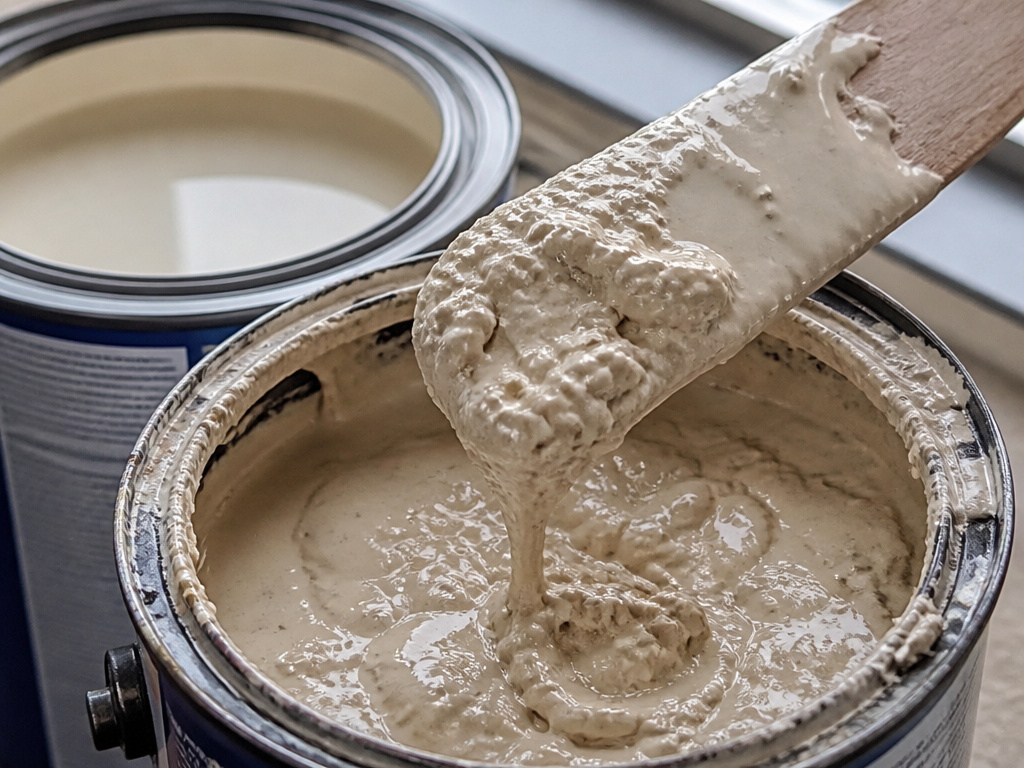
Thaw it slowly first, because that’s the only step that costs nothing. Family Handyman’s sequence is to let the paint warm to room temperature on its own, then stir it well and look at what the stick brings up.
Thawed latex that’s gone bad doesn’t just look wrong. It comes off the stir stick in lumps and ropes, and it looks like cottage cheese left out overnight.
If it looks like that, Family Handyman advises disposing of it properly, though KBS Coatings says its own products thaw and stir back fine. If the color and consistency read normal, test it somewhere inconspicuous before it goes on a wall.
The KBS Exception
KBS Coatings tells customers something quite different: freezing poses no problems for its products, which are formulated to withstand it. Bring the coating to room temperature naturally, stir, and performance is unaffected.
That exception has a boundary. KBS #1 Thinner can freeze, and it needs to thaw and reach room temperature before use, so the “freezing is fine” line doesn’t cover every bottle on the shelf.
If a thawed can pours in a smooth ribbon off the stir stick, test it on scrap. If it comes off in lumps, no amount of stirring brings it back.
Sealing the Can So Cold Never Gets In
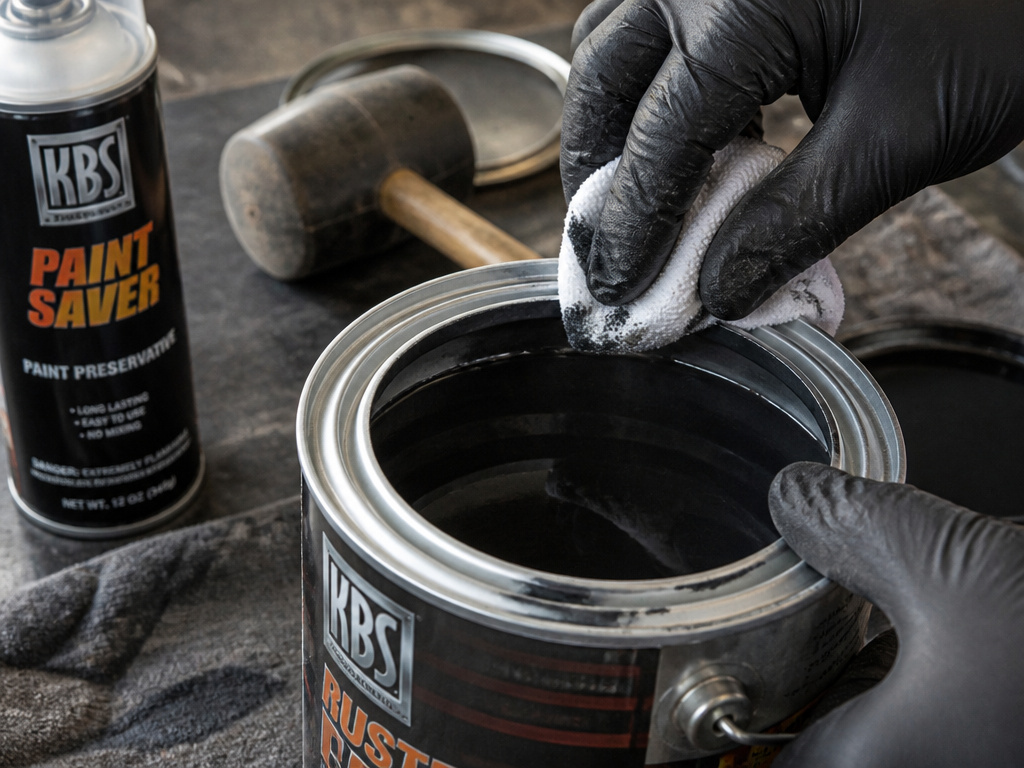
Four things decide whether a stored can survives a winter: how clean the rim is, how much air sits on top of the paint, how tightly the lid seats, and where the can lives.
- Wipe the rim clean before the lid goes back on. Residue on the rim interferes with the seal, and a lid that doesn’t seal lets the paint skin over from the top down.
- Displace the air with KBS Paint Saver. The spray uses argon and nitrogen, which are heavier than air and lay a blanket over the surface. Spray 2 seconds for a quart can or less and 4 seconds for a gallon can. Skip it and the top layer hardens into a skin you’ll be fishing out later.
- Seat the lid with a rubber mallet. Gentle taps around the rim give you an airtight seal. Prying at it with a screwdriver bends the channel and the can never seals again.
- Move the paint to steel or glass if the can is damaged. A bent rim or a lid that won’t seat means a new container with a tight-fitting lid, or the paint dries out from the top.
I decant leftovers into small glass jars instead of fighting a bent lid. You can see the color through the glass, the jar seals flat, and there’s less air sitting on top of the paint.
A storage tote keeps dust off the shelf and catches drips, though it won’t hold temperature on its own. For the full routine on sealing paint cans, the rim and the lid seat do most of the work. Getting the air out is how you keep paint fresh across a whole season.
Aerosol cans follow different rules entirely, and spray paint storage is mostly about keeping the can upright and the valve clear.
Reactive-Pigment Coatings Play by Different Rules
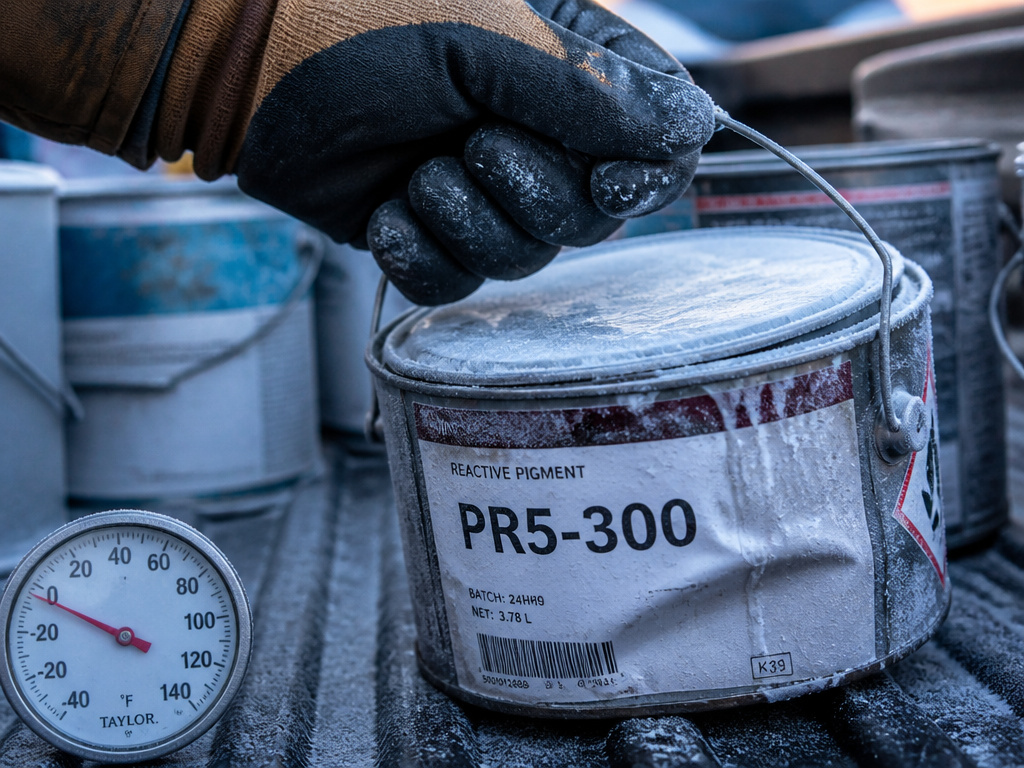
The standard advice assumes ordinary architectural latex. Dunn-Edwards flags a whole category where that advice underperforms.
Coatings with reactive pigments, including direct-to-metal products, specialty primers, corrosion-resistant topcoats, and stain blockers, are much more difficult to stabilize than typical architectural pigments. Dunn-Edwards lists them by product code so they get extra care:
- ARISTOSHIELD ASHL30, ASHL40, ASHL50, ASHL70
- BLOC-RUST BRPR00
- ENDURA-COAT ENCT30 and ENCT50
- ENDURAPRIME ENPR00
- EZ-PRIME EZPR00
- ULTRASHIELD ULGM00
These are the cans that should never spend a night in the truck bed. If a reactive-pigment product has been through a hard freeze, treat it as suspect even if the texture looks fine.
When to Stop Trying and Dispose of It
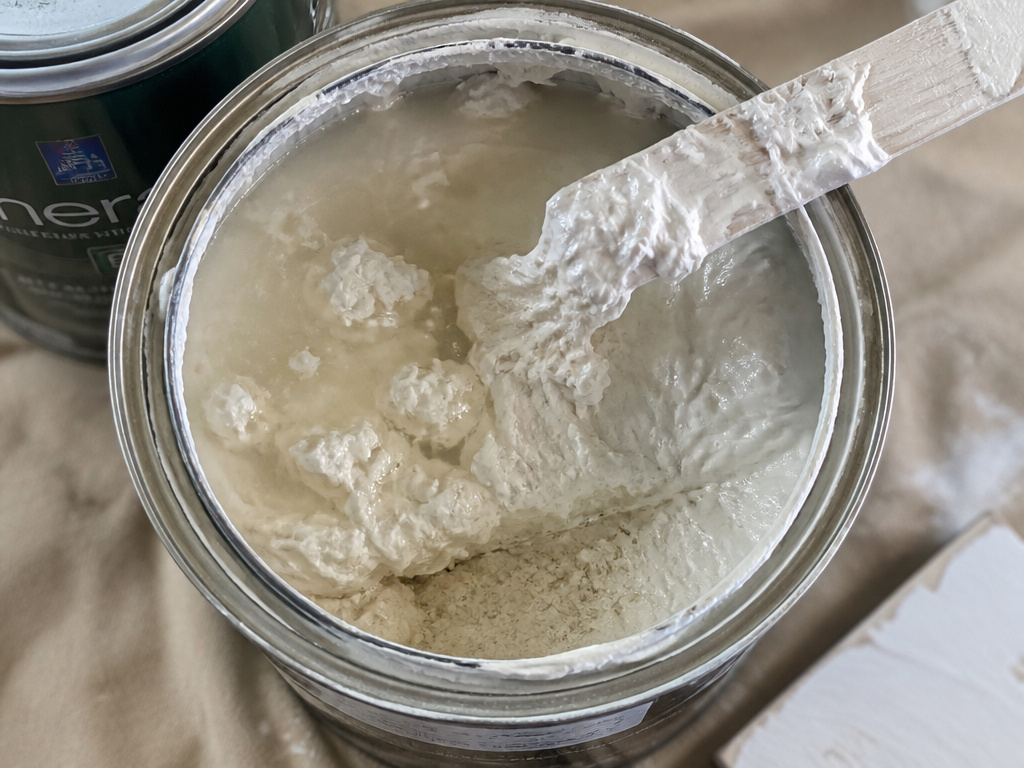
You open the can in April. The lid pops, and instead of paint you get a cloudy liquid layer over a lumpy body.
Work through the symptoms before you decide.
| What you see | What it means | What to do |
|---|---|---|
| Semi-clear liquid on top | Syneresis, phase separation | Stir from the bottom up |
| Skin or seeds on the surface | Skinning from heat or air | Strain it and use the rest |
| Hard pigment packed at the bottom | Hard settling, irreversible | Retire the can |
| Lumps and ropes after stirring | Freeze damage | Dispose of it |
| Smooth, even color | Still usable | Test on scrap first |
When you’ve decided the can is finished, work through it in order:
- Check that it’s actually finished using the signs above, since paint still good is a texture question more than an age question.
- Dry it out before it leaves the house, because liquid paint in a bin is a spill waiting to happen. The process for dry out paint takes time and open air.
- Follow your local household hazardous waste rules for the rest, since paint disposal varies by municipality.
Frequently Asked Questions
Can you put paint in the freezer to keep it from drying out?
No. None of the sources reviewed recommend deliberate freezing, and Dunn-Edwards specifically warns that water-based paint stored below 32°F can gel, especially after repeated freeze/thaw cycles. The freezer doesn’t preserve paint; it stresses the resin and pigment system.
At what temperature does water-based paint freeze?
At or below 32°F, according to both Dunn-Edwards and Family Handyman. Family Handyman adds that a paint’s ingredient blend can lower that point somewhat, similar to how salt lowers the freezing point of water, so a mild cold snap may not be fatal.
Is frozen paint ruined for good?
Usually, yes. Family Handyman reports that thawed paint turns clumpy and compares the texture to cottage cheese, and the IPC test report states that the freeze-thaw cycle makes paint unusable. KBS Coatings is the documented exception for its own products, which it says are formulated to withstand freezing.
What is the best temperature to store paint?
KBS Coatings gives 50°F to 80°F as the best storage range, while Franklin Paint specifies 60°F to 70°F for its Premium Hydrophast. Dunn-Edwards sets the outer limits at 32°F and 110°F. When two bands conflict, follow the narrower one printed for your product.
Can I store paint in an unheated garage?
KBS Coatings advises against it, noting that temperature swings in an uninsulated garage can cause paint and coatings to deteriorate or separate well before their time. Family Handyman agrees, recommending a heated or temperature-controlled space instead.
Before You Go
Here’s the threshold that decides most of these cases. Dunn-Edwards says special measures should be taken to avoid storing product for more than 24 hours above 110°F or below 32°F. If a can crossed that line, don’t trust it for a finish coat. Use it on scrap, under a primer, or not at all.
The rest is boring and it works. Write the color and the date on the lid with a marker, stand the cans upright in a closet that stays between 50°F and 80°F, and stop buying duplicates because you couldn’t read the label.
Start messy, refine later, and try one thing today: go find every can you own, check the lid, and move the ones living in the garage onto a shelf indoors. That single trip solves more paint problems than any storage gadget you can buy.
