
How to Choose Non Toxic Paint: Step-by-Step
This post contains affiliate links. As an Amazon Associate, we earn from qualifying purchases.
To choose non toxic paint, check three things: base VOC content (target 10 g/L or less), whether the colorant adds VOCs back after tinting, and a certification that limits VOC content, not just emissions. Most labels only report the first.
The certification point is where most buying decisions stall. A label can carry a logo that limits what off-gasses while saying nothing about what went into the base, and those two things get measured separately.
I used to buy paint by the gallon because the bigger can looked like the better deal. I ended up with three half-used cans in my basement, which is roughly the opposite of green. What follows is the buying sequence that would have saved me the storage.
Key Takeaways
- Target 10 g/L or less in the base — that’s the Healthy Building Network / HomeFree ceiling, and it’s stricter than most “low-VOC” labels imply.
- Colorants add VOCs back after tinting, so a zero-VOC base can fail the test once it’s tinted to the color you actually want.
- Green Seal GS-11 covers VOC content, emissions, chemical restrictions, and performance. Cradle to Cradle Silver+ covers only two of those four.
- Skip antimicrobial paint. Both Habitable and Building Clean flag it, and the EPA pesticide registration is the tell.
- Buy less paint. Every extra coat adds to total emissions, and the greenest can is the one you didn’t need.
How to Choose Non Toxic Paint When the Label Won’t Tell You
The front label is a marketing surface. The back label carries the EPA-required VOC number, and that number is worth reading for exactly one reason: it’s the only figure the manufacturer has to print when you’re learning how to choose non toxic paint.
Federal rules require manufacturers to list a paint’s VOC content, but only VOCs that contribute to smog formation are actually tested. Many other volatile compounds in a freshly opened can go unmeasured by that printed figure, so the number on the side of the can understates total exposure in a newly painted room.
The EPA greener paints and coatings guide names ammonia, formaldehyde, odor masking agents, and fungicides as specific toxics to reduce or eliminate. None of those show up in the VOC number the same way, and some don’t show up at all. The question of VOCs in paint is bigger than the number on the can.
A freshly opened can of low-VOC paint smells like almost nothing. That’s the point. A can that still smells sharp has something in it the number didn’t catch.
I’ve learned to ask for the technical data sheet before I ask for a color chip. The TDS has the number the front label doesn’t.
What Does “Low-VOC” Actually Mean on a Paint Can?
It means the base paint meets a threshold the manufacturer chose to certify against, not a universal standard. The most common reference point is the California Department of Public Health Section 0130 emissions standard, which third-party low-VOC certifications must meet, and it’s central to how to choose non toxic paint.
| Source | VOC target | Applies to |
|---|---|---|
| Healthy Building Network / HomeFree | 10 g/L or less | Base paints |
| NY OGS GreenNY | 6 NYCRR § 205.3 limits | Interior latex wall/ceiling |
| NY OGS GreenNY | 100 g/L or SCAQMD limit | Specialty paints |
| NY OGS GreenNY (encouraged) | SCAQMD 50 g/L | Paints other than interior flats |
The low-VOC paint label is genuinely useful. It tells you the base cleared a bar. Which bar is a separate question.
Where this goes sideways: Buying the base on its VOC number and forgetting the tint. The colorant can push total VOCs back above the low-VOC threshold, and the can’s printed number won’t reflect the change.
Try this: next time you’re at the paint desk, ask for the technical data sheet, not the color chip. The TDS lists the base VOC. The chip doesn’t.
The Certification Stack, Ranked by What It Actually Covers
The certification stack is where buying decisions get made or lost. New York State’s GreenNY specification accepts six certifications for interior paint: Cradle to Cradle Silver+, Green Seal GS-11, Green Wise Gold, MPI Extreme Green, MPI GPS-2, and MPI GPS-1. For spray paint only, EPA Safer Choice is the accepted mark.
The list looks like a level playing field. It isn’t.
NY OGS’s own comparison table shows Cradle to Cradle Silver+ restricts chemicals of concern and limits emissions but carries no VOC-content limit and no performance standard. Green Seal GS-11 covers all four columns.
GS-11 vs Cradle to Cradle: The Four-Column Test
| Certification | VOC content limit | VOC emissions | Chemical restrictions | Performance |
|---|---|---|---|---|
| Green Seal GS-11 | Yes | Yes | Yes | Yes |
| Cradle to Cradle Silver+ | No | Yes | Yes | No |
The New York GreenNY paint specifications page is worth bookmarking if you buy paint for a school, office, or any building that answers to a procurement rule. The question of toxic paint is more than a VOC number, and the certification stack is where that shows up.
Before you pick a can, run four checks:
- Does the certification limit VOC content, or only emissions?
- Does it cover the colorant, or just the base?
- Does it include a performance standard?
- Is it listed for the product type you’re actually buying?
I’d rather see GS-11 on a can than C2C Silver+, and it’s not close.
Why Does Tinted Paint Break the Zero-VOC Promise?
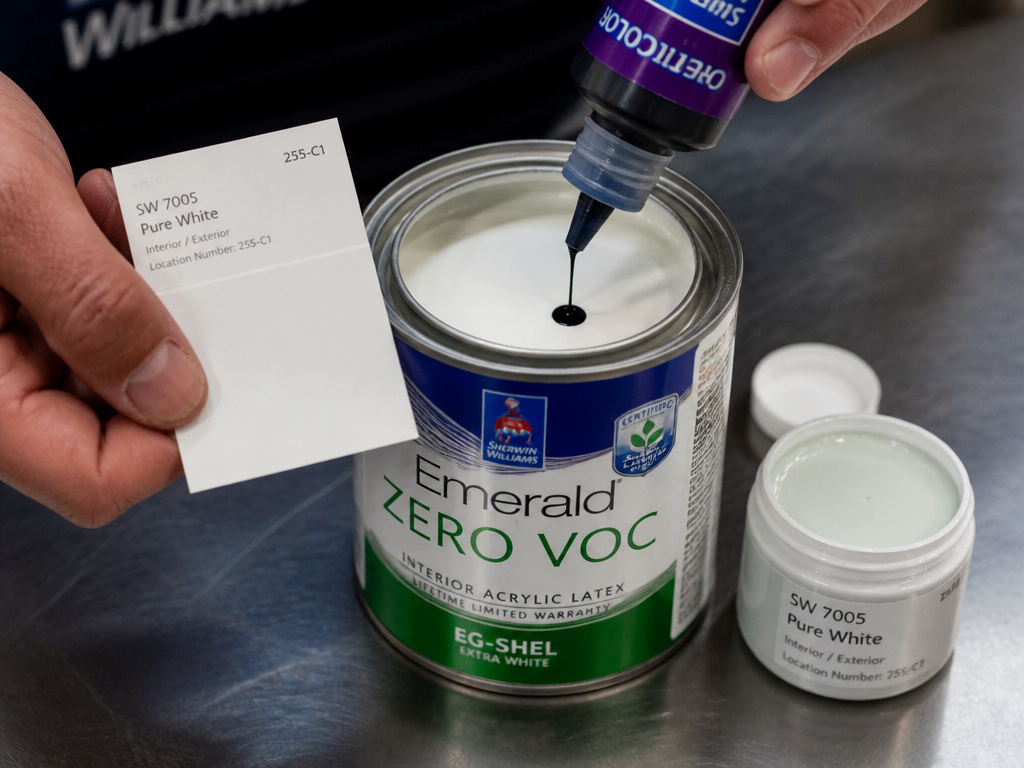
Because the colorant is added after the base is certified. A base can test at zero VOCs and still end up above the low-VOC threshold once the tint goes in, and the label on the can won’t reflect the change.
Habitable’s guidance is explicit: choose colorants that don’t increase the VOC content of the base paint when tinted. Building Clean makes the same point from a different angle: tints contain VOCs and should be counted when you’re selecting a low-VOC product.
This is the single most under-reported issue in the category. A zero-VOC paint claim is a real thing, but it’s a claim about the base, not about the color you walk out with.
A tinted can smell different from the base. The colorant carries its own VOCs, and that’s the gap the base label doesn’t cover.
I won’t buy a zero-VOC base without asking about the tint. The base is the part the manufacturer controls. The color is the part you control, and it’s the part that decides whether the can actually lives up to the label.
The part nobody mentions: The VOC number on the can is measured before tinting. Ask the paint desk for the tinted VOC figure, or pick from a line whose colorants are certified not to add VOCs.
Try this: bring your color chip to the desk and ask, “What’s the VOC of this base plus this tint?” If the answer is “the base is zero,” ask again.
Recycled Paint: Where the Experts Disagree
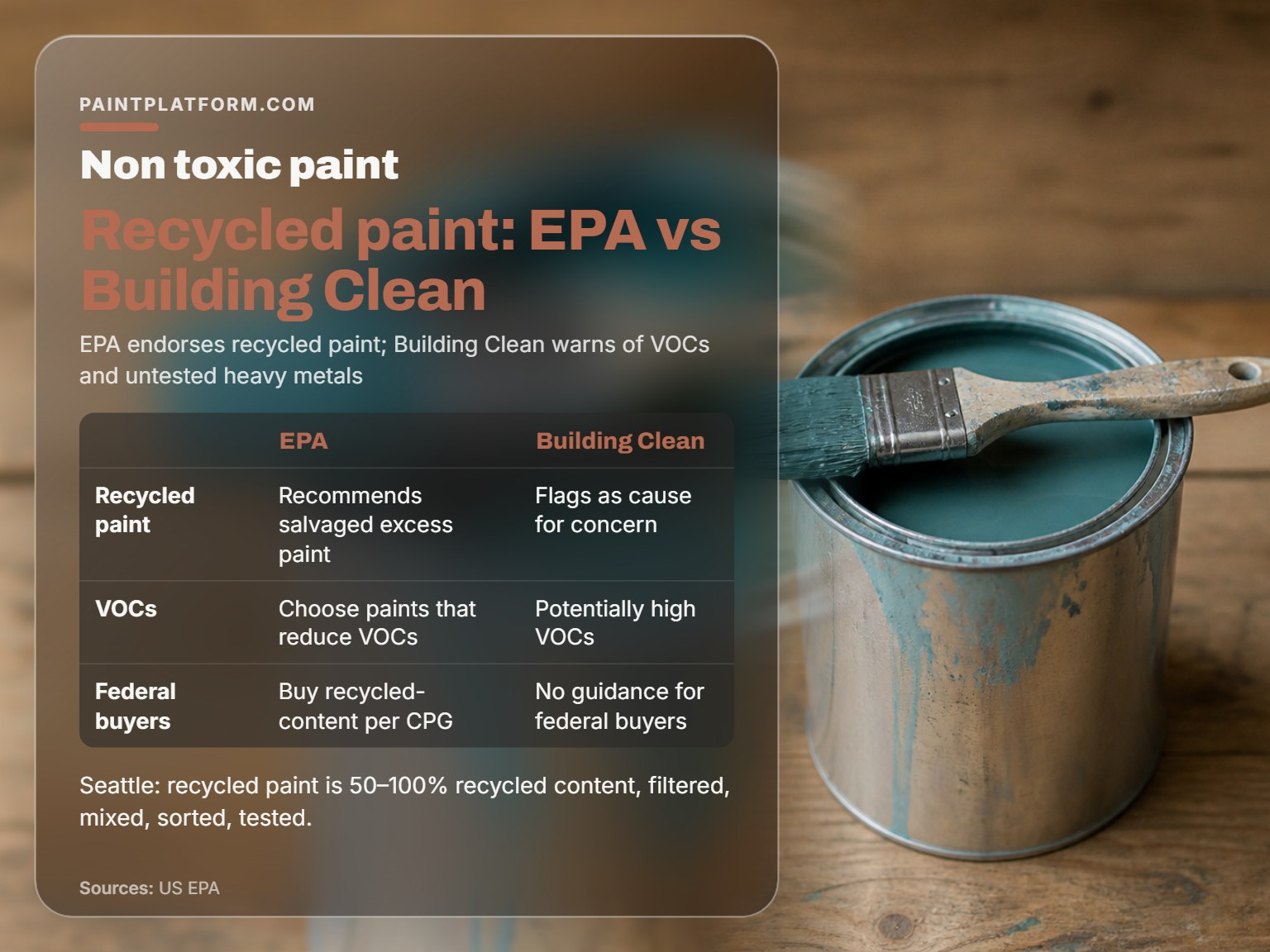
Recycled paint is the one place where the EPA and a health-focused NGO disagree outright.
- EPA: recommends salvaged excess paint, notes that some vendors can remix it into almost any color, and directs federal purchasers to buy recycled-content consolidated and latex paint under its Procurement Guidelines.
- Building Clean: flags recycled-content paints as a cause for concern due to potentially high VOCs and the lack of standard practices for testing heavy metals.
- Seattle’s guide: describes commercially produced recycled paint as 50 to 100 percent recycled content, filtered, mixed, sorted, and tested for consistent quality.
What the EPA Says vs What Building Clean Warns
The Building Clean paints and wallcoverings guidance is the caution here. The honest read is that the EPA endorses recycled paint as a good environmental choice, while Building Clean flags it as a mixed health choice due to potentially high VOCs and the lack of standard heavy-metal testing.
If you’re buying it for a shed or a garage, the tradeoff is easy. If you’re buying it for a nursery, the question of paint safety for children and pets should pull you toward a certified virgin-content line instead.
Antimicrobial and Specialty Paints: What Most People Get Wrong
Habitable and Building Clean both flag antimicrobial paint, saying these paints often carry EPA pesticide registrations and lack evidence of health benefit when built into a coating, though Seattle’s guide implies mildew resistance is a desirable paint property.
Specialty paints are a separate caution. Chalkboard, whiteboard, and magnetic paints may introduce hazards not covered by standard interior-paint guidance, per Habitable. NY OGS routes them to a different rule: the applicable SCAQMD limit or 100 g/L, instead of the 6 NYCRR § 205.3 limits that apply to interior latex.
Skip this if: You’re buying “mold-resistant” paint for a bathroom. Latex and acrylic paints are already more mildew-resistant than oil-based, per Seattle’s guide. You don’t need the pesticide additive to get the mildew resistance.
I’ve stopped buying antimicrobial paint entirely. The question of types of natural paint gets the same treatment: lime, milk protein, clay, and plant oils all have their own hazard profiles, and “natural” doesn’t automatically mean safer.
Try this: read the back of the can for an EPA registration number. If it’s there, the product is registered as a pesticide, and that’s your cue to put it back.
Primers, Coats, and the Math Nobody Runs
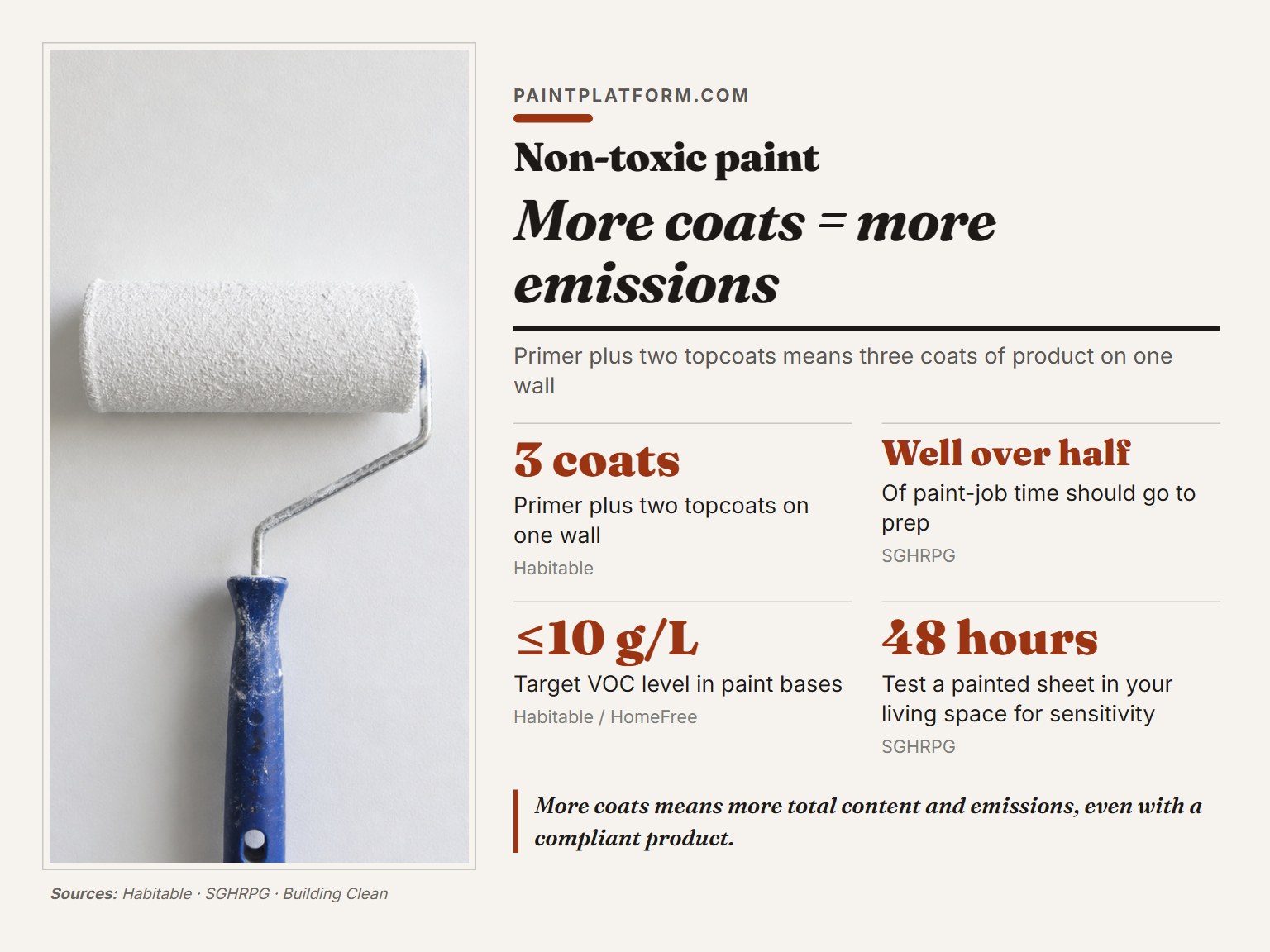
The number of coats you apply matters as much as the product you pick. Building Clean’s guidance is direct: more coats means more total content and more emissions.
A compliant product applied in more coats carries more total content and emissions than the same product in fewer coats. The math is simple and almost nobody runs it.
Primers count too. Building Clean explicitly extends low-VOC certification requirements to primers, not just topcoats. Most buyers skip that step.
The Coat-Count Math
If your walls need a primer plus two topcoats, you’re applying three coats of product, and more coats means more total content and more emissions than a single coat. The greenest can in the aisle can’t beat that arithmetic if you’re applying it three times.
You can tell a wall was prepped by how the first coat sits. On a clean, primed surface, the paint pulls tight and even. On a wall that skipped prep, the first coat beads and skips, and you’re back at the store for another gallon.
The Seattle Green Home Remodel paint guide puts prep at well over half the total time on a paint job. That’s not a coincidence. Good prep reduces the number of coats you need, which reduces total emissions.
If your walls need a primer plus two topcoats, you’re applying more coats and therefore more total content and emissions to cover one wall. Good prep can reduce the number of coats you need.
The question of paint fumes is really a coat-count question in disguise.
What Should You Actually Buy?
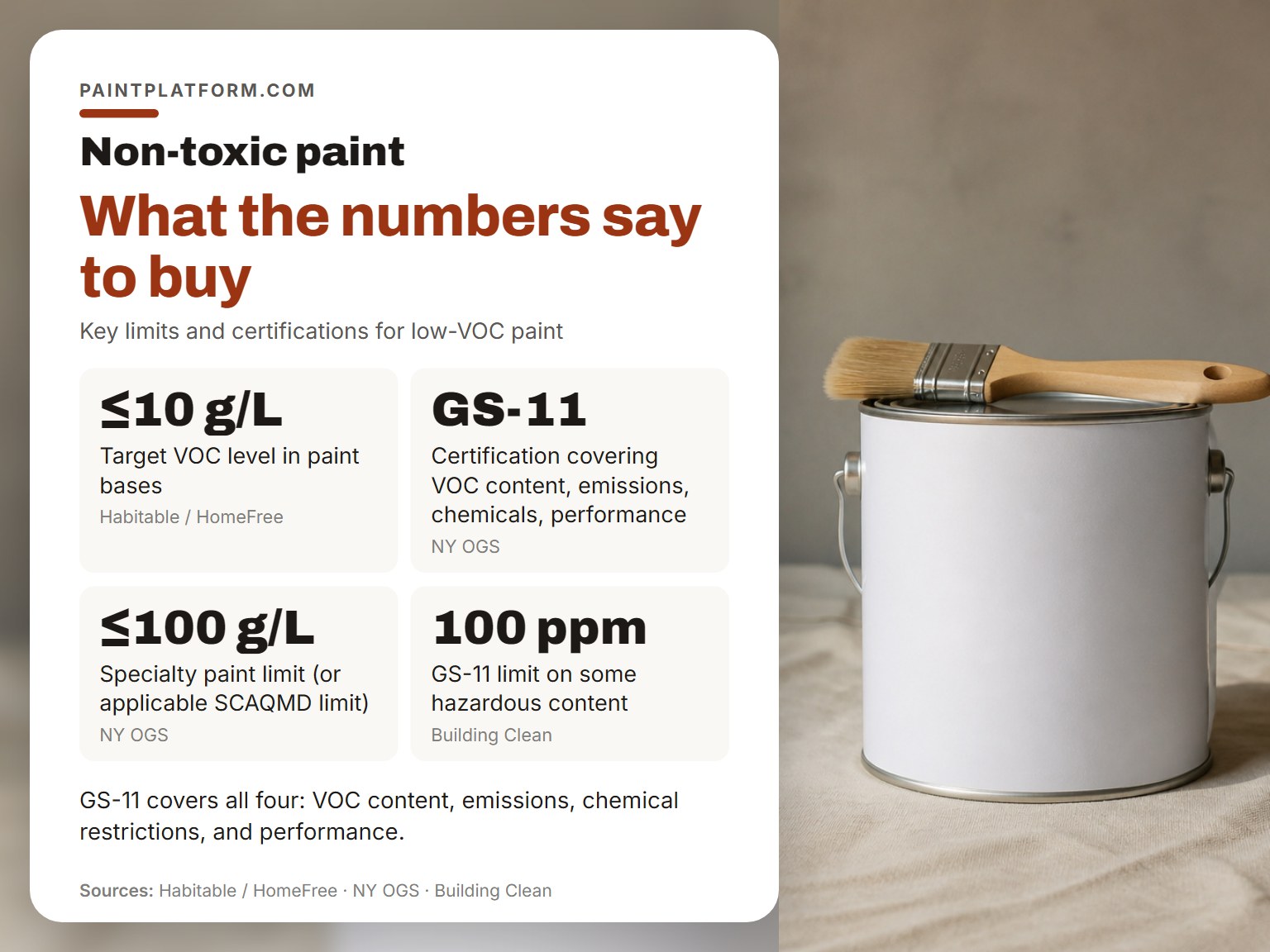
Start with a brand that publishes its technical data sheets and certifies its colorants, and puts the base VOC number where you can actually find it.
For a bathroom or a kid’s room, the GS-11 mark is the one to look for. It covers VOC content, emissions, chemical restrictions, and performance in a single certification.
For a garage or a shed, recycled paint is a defensible choice: the EPA’s Identifying greener paints and coatings page endorses it, while Building Clean warns that recycled-content paints may have high VOCs and lack standard heavy-metal testing.
Here’s the buying sequence that works:
- Pull the technical data sheet for the exact product.
- Check the base VOC number against the 10 g/L target.
- Ask how the colorant affects total VOC after tinting.
- Confirm the certification covers content, not just emissions.
- Buy the smallest can that covers the job.
The Default Pick
If you want one answer: a GS-11 certified interior latex from a line that certifies its colorants, bought in the smallest quantity that covers your walls. That covers the large majority of household jobs.
The exception is a pre-1960 home with lead paint. That’s not a paint-choice problem. Seattle’s guide is direct: only licensed professionals should attempt lead paint removal, and do-it-yourself removal is likely to increase health risks.
The question of choosing a paint respirator matters here too. If you’re sanding or scraping an old surface, the respirator is the tool that decides whether the dust reaches your lungs.
The water-based vs oil-based paint tradeoff is not settled: Habitable prefers water-based paints with both low VOC content and low VOC emissions, Seattle’s guide notes latex/acrylic paints are more mildew-resistant than oil-based, and Building Clean notes VOCs are higher in oil-based paint.
Frequently Asked Questions
Is zero-VOC paint actually zero?
No. Zero-VOC is a claim about the base paint, measured before tinting. Once a colorant is added, the total VOC content can rise above zero. Ask for the tinted figure, or pick a line whose colorants are certified not to add VOCs.
Does low-VOC paint still need ventilation?
Yes. Low-VOC means lower, not none. Adequate ventilation is recommended for any paint job, and the smell test is a rough guide: a can that still smells sharp has something in it the number didn’t catch.
Are natural paints like lime and milk paint safer?
Not automatically. The EPA lists lime, milk protein, clay, and earth-based pigments as alternatives worth considering. Seattle’s guide adds the caveats: lime is heated to about 900 degrees Fahrenheit, slaked lime is caustic and can burn skin, eyes, and lungs, and plant-based oil paints are usually high in VOCs.
Should I avoid antimicrobial paint?
Habitable and Building Clean recommend avoiding it, saying these paints often carry EPA pesticide registrations and lack evidence of health benefit when built into a coating, though Seattle’s guide implies mildew resistance is a desirable paint property.
How much paint should I buy?
The smallest amount that covers the job. Building Clean notes that more coats means more total emissions, and every extra gallon is a can you’ll need to store or dispose of. Use the manufacturer’s paint calculator to estimate the smallest amount that covers the job.
What about paint for a pre-1960 home?
Seattle’s guide is direct: if your home was built before 1960, it almost certainly contains some lead-based paint, and only licensed professionals should attempt removal. Do-it-yourself removal is likely to increase health risks, not decrease them.
The Bottom Line
The single most useful number in this whole category is 10 g/L. That’s the Healthy Building Network’s ceiling for VOCs in the base, and it’s stricter than most “low-VOC” labels will advertise. If a can doesn’t publish that number, ask for the technical data sheet before you buy.
Keep it simple: pick a GS-11 certified line, buy the smallest can that covers the job, and ventilate like the label doesn’t exist.
One concession: this framework assumes interior paint for a home you live in. For a rental, a shed, or a piece of furniture headed outside, the calculus shifts. Recycled paint gets more attractive, and the certification stack matters less.
The wall doesn’t care what the can says. It cares what’s in it.
