
Low VOC Paint Pros and Cons: What Labels Hide
This post contains affiliate links. As an Amazon Associate, we earn from qualifying purchases.
Low VOC paint pros and cons start with one measurement: EPA Method 24 testing found five commercial low-VOC paints below 0.2% VOC by weight, against 2 to 10% for conventional latex flat paint. The catch is that a low VOC number does not guarantee low emissions once the can is open.
Content and emission are two different tests. A can scores near zero on VOC content and still puts formaldehyde into a room. The EPA found exactly that when it chamber-tested one manufacturer’s low-odor paint, and how that happened is the most useful thing on this page.
What follows is the honest ledger: what low VOC paint genuinely fixes, where the label oversells, which standard measures what, and the test patch I would run before letting any can near a whole wall.
Key Takeaways
- Below 0.2% by weight is where EPA Method 24 stops resolving, so a low-VOC result under that line is a detection floor, not a precise figure.
- ASTM D6886 puts the low VOC line at under 150 g/L, and it is the better method below that threshold.
- In a peer-reviewed chamber test, adding sealer SB raised one paint’s TVOC emission rate from 360 to 4750 µg m⁻² h⁻¹, while another pairing (PA+SA) lowered it to 96 µg m⁻² h⁻¹.
- “Air purifying” paints did not reduce indoor pollutants in Schieweck and Bock’s chamber work.
- Ventilation still decides the outcome. The EPA’s worst formaldehyde peak was measured at 0.5 air changes per hour.
What Low VOC Actually Measures on a Paint Label
ASTM D6886 draws the low VOC line at less than 150 grams per liter of coating. That threshold decides which test method applies, and it is the closest thing the industry has to a shared definition.
VOC content is measured in grams per liter of coating. ASTM D6886 defines low VOC as less than 150 grams per liter and is the more precise method below that threshold. Emission rate is a separate measurement, reported in micrograms per square meter per hour, and depends on the substrate, the sealer, and the ventilation rate.
The EPA used a different method. Its Method 24 testing of five commercial low-VOC paints returned results below 0.2% VOC by weight. That figure is the method’s minimum detection limit, so it tells you the paints sat under the floor, not where they landed.
Conventional latex flat paint runs 2 to 10% VOC by weight in the same report. That gap is real, and it is the whole reason low VOC paint exists.
Method 24 has poor precision and accuracy at low VOC levels, per the ASTM D6886 low VOC coatings method. Below 150 g/L, D6886 is the more suitable test, and it measures individual compounds directly by gas chromatography rather than inferring a total. Direct measurement gives better precision in waterborne coatings under 5% VOC.
There is a third framework. The ISO 17895:2024 VOC determination standard covers 0.01% to 0.1% by mass with a boiling point cutoff of 250 °C at 101,325 kPa, and it excludes SVOCs, which fall under ISO 11890-2. A paint can pass one framework and still emit under another.
If you want the difference between a can that says zero and one that says low, it is worth ten minutes to read how zero-VOC differs from low-VOC before you buy. The chemistry behind both labels is also worth knowing: VOCs in paint are not one substance but a family that includes glycols, Texanol, and biocides.
The 150 g/L Line and the 50 g Rule
Here is where the sources split, and you should know it before you trust any number printed on a can.
ASTM defines low VOC as under 150 g/L. A painting contractor says on his channel that he treats “less than 50 g” as the low VOC line and reaches for zero VOC most days. Neither is wrong about what he sees. They are answering different questions, one about a test method and one about a shelf habit.
| Label claim | What it is usually based on | What it does not tell you |
|---|---|---|
| Zero VOC | A result below the test’s reporting floor | Whether SVOCs or biocides are present |
| Low VOC | Under 150 g/L by ASTM D6886 | The emission rate once applied |
| Low odor | Human noses, not instruments | Anything about formaldehyde or acetic acid |
That table is the reason I stopped reading the front of the can. The number that matters is usually on the technical data sheet, not the label, though a painting contractor advises choosing by the VOC number on the label.
The Low VOC Paint Pros and Cons That Hold Up Under Testing
Low VOC paint does the thing it promises on the content side. One bulk-paint GC/MS comparison in the EPA report found 0.59 mg/g of ethylene glycol in a low-VOC paint against 24 mg/g in a conventional paint from an earlier project.
At the national level, the EPA architectural coatings rule is estimated to cut VOC emissions by 103,000 megagrams per year, or 113,500 tons, by limiting what manufacturers can put in the can.
Performance is the older objection, and it is getting weaker. A waterborne alkyd dispersion technical paper published through the American Coatings Association describes a coating formulated at under 5 g/L VOC against 560 g/L for the solventborne version. After 200 hours of salt spray at 1 mil dry film thickness on cold rolled steel, the low-VOC waterborne film showed better corrosion resistance.
That paper also notes that as of 2012, less than 10% of the alkyd market had converted to waterborne. The good results exist. The market has been slow to adopt them.
- Lower measured VOC content by a wide margin, in both the EPA and ASTM frameworks.
- A better odor experience for most people, though the next section explains why “most” is doing real work in that sentence.
- Waterborne alkyds now match or beat solventborne corrosion resistance in the published test data.
- Regulatory tailwind. The federal rule keeps pushing formulators toward lower content, which means better products keep arriving.
Most interior wall paint in North America is latex paint, which is water-based, and that is where the low-VOC reformulation work has concentrated. If you are choosing a finish, start there.
Why Does Low VOC Paint Still Smell?
A low-VOC room does not smell like nothing. It smells faintly of wet chalk, and in some cans it smells like vinegar as the film cures.
Schieweck and Bock tested low-VOC and zero-VOC paints in an environmental chamber and found acetic acid emitted in high concentrations. That is your vinegar note. The binder chemistry that replaces solvent can generate organic acids as the film cures.
The 2018 Springer chamber study found the main TVOC species were Texanol and glycerol ethers, with glycol ether and 2-ethyl-1-hexanol showing high in some samples. Those are coalescents and additives, not solvents in the old sense, and they behave differently in a room.
| What you notice | Likely source | What to do |
|---|---|---|
| Sharp vinegar smell, days 1 to 3 | Acetic acid from the binder | Ventilate hard and wait it out |
| Sweet solvent smell that lingers | Texanol, frequently from the sealer | Check the sealer, not just the paint |
| Odor that returns after a week | Slow off-gassing or biocide | Keep air moving, extend the wait |
| No smell at all, still symptomatic | Compounds below your odor threshold | Trust symptoms, not your nose |
Judge a paint by day three, not by hour one. The solvent note leaves first. The acetic acid and the Texanol are what you are still breathing when the room feels finished.
The practical version of that: read the paint fumes safety guidance before you start a whole-house job, and treat ventilating a room while painting as part of the work rather than an afterthought.
The Formaldehyde Problem in a Low-Odor Can
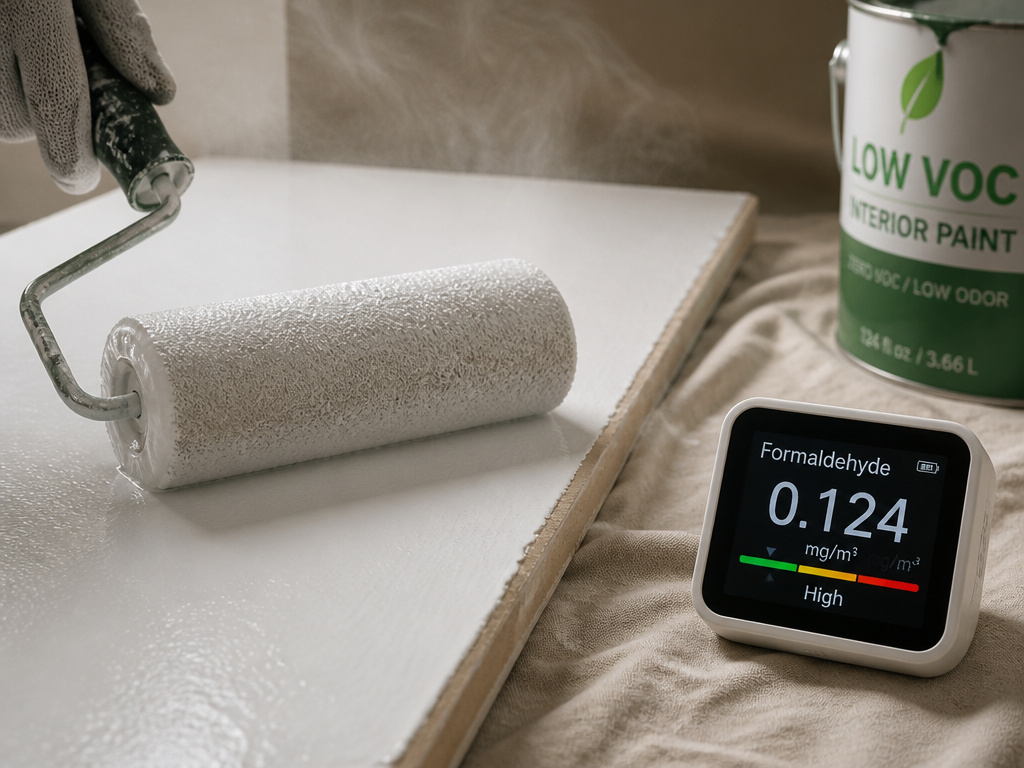
5.5 mg/m³ is the number that should end any assumption that low-odor means clean air. That was the formaldehyde peak the EPA measured from one manufacturer’s low-VOC paint on gypsum board, at 0.5 air changes per hour.
The same paint emitted 0.18 mg/g of formaldehyde over the first 50 hours and 0.47 mg/g over 14 days. On glass it emitted 0.51 mg/g over 50 hours, which matters because gypsum absorbs some of what glass does not.
The source was the biocide. After the EPA raised the finding with the manufacturer, the paint was reformulated with a different biocide. The reformulated version still emitted formaldehyde at 0.15 mg/g over 50 hours and 0.27 mg/g over 14 days on gypsum.
A second manufacturer’s paint, labeled LVD in the report, emitted 0.06 mg/g over 50 hours and 0.15 mg/g over 14 days, with an acetaldehyde peak of 0.34 mg/m³. Acetaldehyde is the other one to watch: one paint peaked at 0.52 mg/m³ while three of the five stayed below 0.05 mg/m³.
What most people get wrong: Reading “low odor” as an air-quality claim. The EPA found elevated formaldehyde in paints marketed as low-VOC and low-odor, and the biocide was the source.
The 14-day figure changed how I plan a job. A room can smell finished on day two and still be emitting on day fourteen. That gap is where the headaches live.
Does Adding a Sealer Make Emissions Better or Worse?
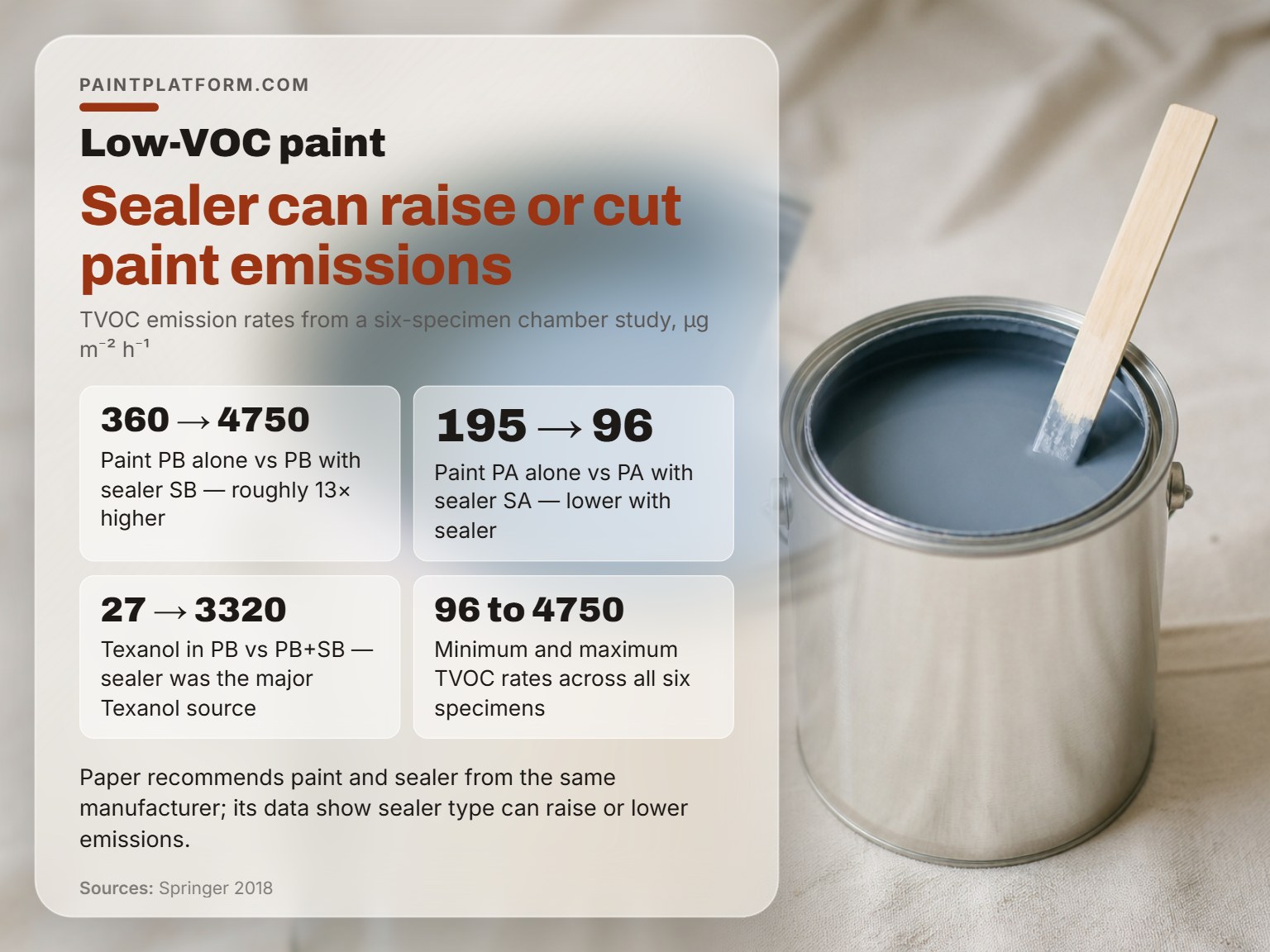
Sealer choice can outweigh the paint choice. In a low-VOC paint emission rates study published in the International Journal of Environmental Science and Technology, adding sealer SB to paint PB pushed the TVOC emission rate from 360 to 4750 µg m⁻² h⁻¹, roughly thirteen times higher, while adding sealer SA to paint PA lowered it from 195 to 96 µg m⁻² h⁻¹.
The same study found the opposite in another pairing. Paint PA alone emitted 195 µg m⁻² h⁻¹, and PA with sealer SA dropped to 96.
Texanol tracked the sealers. It measured 27 µg m⁻² h⁻¹ in paint PB alone, 3320 with sealer SB, 555 in paint PC, and 1750 with sealer SC. The authors concluded the major Texanol source was the sealer rather than the paint.
Across all six specimens, the minimum and maximum TVOC rates were 96 and 4750 µg m⁻² h⁻¹. The paper recommends buying paint and sealer from the same manufacturer, though its own data show sealer type can raise or lower emissions, so the pairing still matters.
I would not buy a low-VOC paint and then pair it with whatever sealer is already in the garage. The chamber data says that combination can define the result more than the paint does. Same manufacturer, or no sealer at all.
Where this goes sideways: Assuming a sealer locks emissions in. In one chamber test it multiplied them by thirteen, while another sealer pairing cut them, and the Texanol came from the sealer itself.
How to Test a Low VOC Paint Before It Touches a Wall
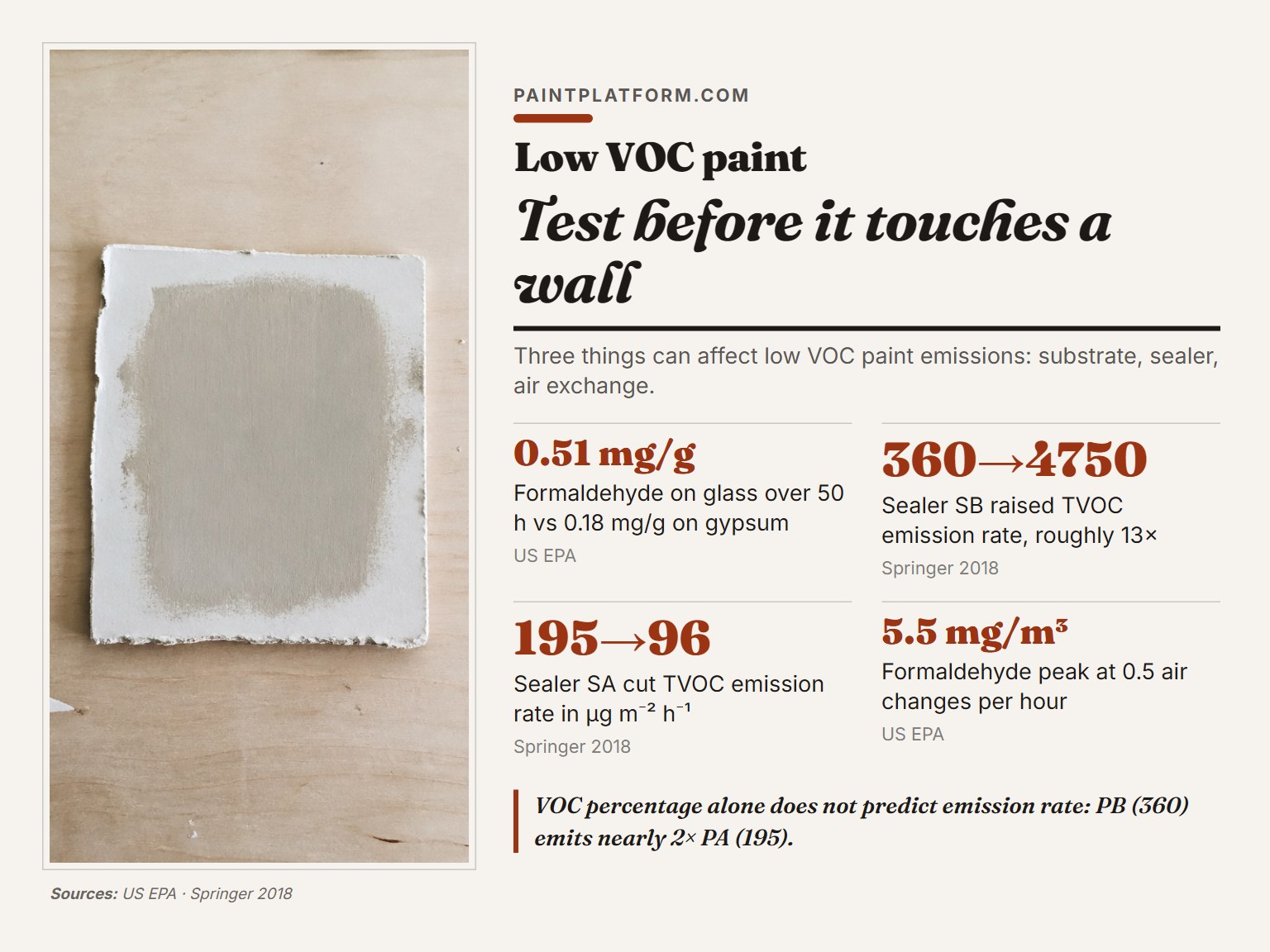
Three things decide whether a low VOC paint works in your room: the substrate, the sealer, and the air exchange rate. You can test all three for the cost of a quart.
Before you start: Treat every can as a chemical until the room has aired, whatever the label says. Keep children and pets out of a freshly painted room until the film is dry and the smell has cleared. Run mechanical ventilation rather than relying on an open window, because the EPA’s worst formaldehyde peak came from a chamber running at 0.5 air changes per hour.
The Test Patch, Step by Step
- Buy a test quart, not a gallon. Skipping this means you discover the smell on a whole wall, at which point your only fix is more paint.
- Paint a scrap of the actual substrate. The EPA measured 0.51 mg/g of formaldehyde on glass and 0.18 mg/g on gypsum over the same 50 hours. A scrap of drywall tells you more than a paint stick.
- Smell it at 24 hours and again at day three. A smell that clears by day two is the solvent note leaving. A smell that returns at day three is the sealer or a slower compound.
- Decide the sealer before you buy either product. In the Springer data, one pairing cut emissions from 195 to 96 µg m⁻² h⁻¹, while another raised them thirteenfold, so the sealer type decides the result.
- Buy only the amount you need. A smaller volume of a certified product beats a gallon you will never finish, and leftover cans are where bad storage habits start.
A low-VOC wall paint can drag under the brush and flash at the edges, and that is where lap marks come from. Keep a wet edge and work in smaller sections than you would with a solvent-heavy paint.
If children or pets share the room, read the low-VOC paint for children and pets guidance first. And check third-party certifications rather than trusting a leaf on the label.
The Brands I Reach For, and What I’d Skip
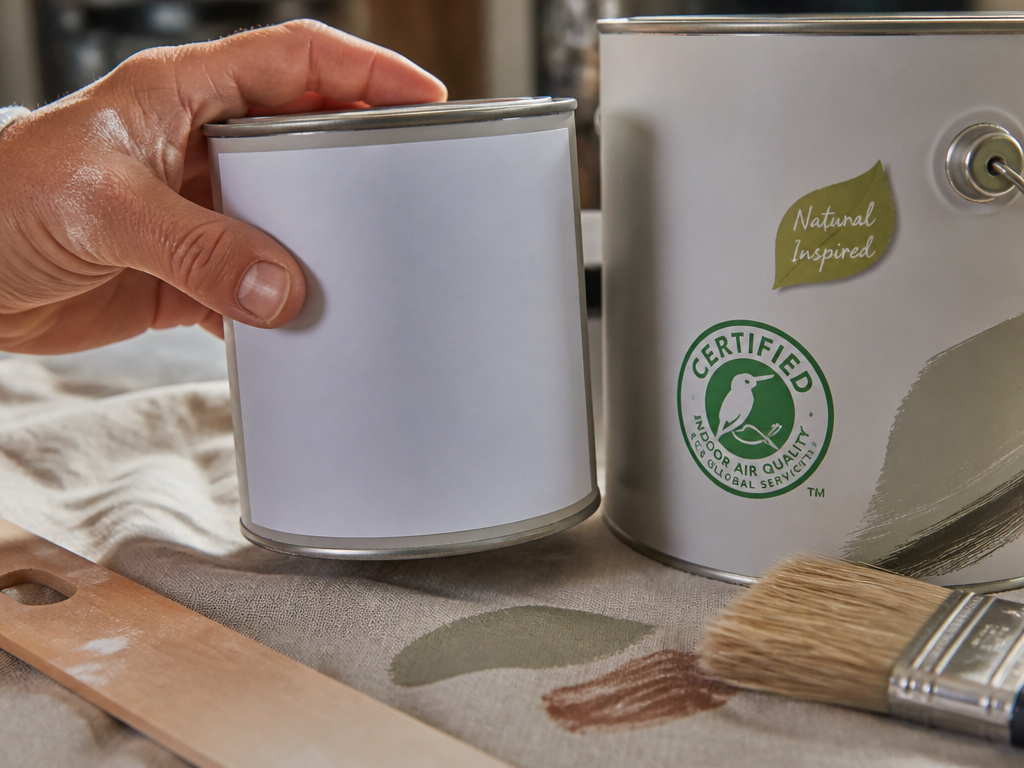
It is a real product line with a real data sheet, which is more than most green-labeled cans offer.
It sits at the low-toxicity end of the market rather than being a conventional formula with a new sticker.
Check the certification on the specific can, because product lines change.
What I would skip is anything labeled natural or green with no third-party certification printed anywhere on the container.
Where “Natural” Fails
I have been sold a label before. I rolled a paint-and-primer-in-one over a brown water ring and the stain bled back through. On a sound, previously painted wall the same product is fine, and I still use it there. Combo paints are thicker paint, not a blocking primer.
The natural aisle works the same way. A leaf on the front is not a test result, and the EPA’s formaldehyde finding came from a can marketed as low-odor.
The underrated move is buying only the amount you need. That beats any certification, because a product you use up and air out properly is not left sitting in a garage.
Try one test quart this weekend.
Frequently Asked Questions
Is low VOC paint better for you than regular paint?
It is better on VOC content, and that is a narrower claim than most people hear. EPA Method 24 put five commercial low-VOC paints below 0.2% by weight against 2 to 10% for conventional latex flat. Whether it is better for you depends on the biocide and the sealer, because the EPA found elevated formaldehyde in a paint marketed as low-odor.
Does low VOC paint still need ventilation?
Yes. The EPA’s worst formaldehyde peak from a low-VOC paint was measured at 0.5 air changes per hour, far below what a normal room sees. Low VOC lowers the total load. It does not remove the need to move air through the space.
Why does low VOC paint smell like vinegar?
Schieweck and Bock found acetic acid emitted in high concentrations from low-VOC and zero-VOC paints. The note usually fades over the first few days as the film cures. A smell that returns after a week points at the sealer or a slower off-gassing compound.
Is zero VOC the same as low VOC?
No. ASTM D6886 sets the low VOC line at under 150 g/L, and zero VOC is a separate claim that usually rests on a result below the test’s reporting floor. ISO 17895:2024 covers a much lower range, 0.01% to 0.1% by mass, and excludes SVOCs entirely.
Can I use low VOC paint in a nursery?
You can, and ventilation still decides the outcome. Keep the room empty and aired for longer than the label suggests, and do not assume a low-odor claim means the air is clean. The EPA’s 14-day emission figures are the reason I wait.
Before You Go
Here is the threshold I would actually use. If a can does not name a certification or a test method, treat the VOC number as decoration and buy a quart to test before you commit to a wall, though a painting contractor advises choosing by the VOC number on the label.
That single habit beats every label claim on the shelf. A test quart is cheaper than a gallon, and it tells you how the paint behaves on your substrate, in your room, at your air exchange rate.
One concession: none of this makes low VOC paint a bad buy. The EPA figures show a genuine drop in content, and the waterborne alkyd data shows the performance gap closing. The low VOC paint pros and cons question has a real answer, and it lands on the side of buying it.
What I would push back on is the assumption that the label finished the job. It did not. Open a window, buy the smaller can, and paint a scrap of drywall first.
