
Lead Paint Safety Guide: Test First, Never Dry-Sand
This post contains affiliate links. As an Amazon Associate, we earn from qualifying purchases.
A lead paint safety guide that works rests on three rules: assume any home built before 1978 has lead paint, test before you disturb it, and never dry-sand or heat-strip. About 29 million U.S. Housing units carry lead paint hazards, and 2.6 million of those house young children.
That word “disturb” covers more ground than a scraper. Sanding a sill, cutting a door to fit, pulling trim, replacing a window sash, and running a heat gun over old baseboard all count.
What follows walks the numbers that decide whether a home passes, the difference between an inspection and a risk assessment, and the point where the job stops being yours.
Key Takeaways
- Pre-1978 means candidate, not confirmed. The residential sale ban took effect in 1978, so older homes need testing before any surface gets cut, scraped or sanded.
- Dust is the number that matters, not paint chips. Floor clearance is 40 ug/ft2, and window troughs only have a standard at clearance.
- A composite sample gets judged against a stricter number than the table shows. Half the subsample count becomes the divisor.
- Dry sanding and heat guns are the two worst tools for old trim. Both spread lead dust through a house.
- Encapsulation beats removal on intact paint, while removal wins on failing paint. Encapsulation also carries an ongoing maintenance obligation under federal rules.
What the 1978 Cutoff Actually Tells You
1978 is the only date that matters at the start. The federal ban on selling lead-based paint for homes, childcare facilities and preschools took effect that year, so anything built before it is a candidate.
Federal law banned the sale of lead-based paint for homes, childcare facilities and preschools in 1978. Any structure built before that year is likely to contain some lead paint. Paint in good condition is generally not a hazard, while peeling, chipping, chalking or cracking paint is. Paint testing on deteriorated surfaces requires a certified inspector or risk assessor.
A pre-1978 build date tells you the house is a candidate, not that every wall is coated. Trim, sills, doors and stair rails are the usual suspects because those are the friction and chew surfaces.
New paint sold today is capped at 0.009% lead by weight. The CPSC treats anything at or above that line as a banned hazardous product, and the same cap covers children’s products and furniture. The CPSC Protect Your Family From Lead In Your Home pamphlet spells out the household version of that rule.
Run a finger across a chalky sill and it comes away white. That smear is the paint telling you it’s failing.
Guessing from the build year only tells you where to look.
Inspection or Risk Assessment: Which One Answers Your Question?
CDC steers toward the risk assessment if you want to know whether the house is safe right now, while EPA presents inspection and risk assessment as neutral options; if you want to know where the lead sits, the answer is the inspection.
CDC draws the line cleanly. A lead paint inspection reports the lead content of every painted structural part, doors, walls and windows included, but it won’t tell you whether that paint is a hazard or what to do about it. A risk assessment identifies serious hazards like peeling paint and lead dust, then names the actions to take.
The two agencies weight this differently, and it’s worth knowing before you hire anyone. EPA presents inspection and risk assessment as neutral options on its EPA lead abatement and inspection page. CDC steers homeowners toward the risk assessment as the step that produces next actions. Same science, different emphasis.
What a risk assessment actually covers
- Deteriorated paint on friction and impact surfaces
- Dust wipe samples from floors, sills and troughs
- Soil sampling where bare dirt meets the foundation
- A written list of hazard reduction actions and who should perform them
Consumer lead paint test kits are a screening tool. They tell you whether a spot reacts, which is useful for triage and useless as a clearance result.
Chips lie. Surfaces don’t.
Lead testing has the same trap. One swab on one windowsill tells you about that windowsill.
The Dust Numbers That Decide Whether a Home Passes
24 CFR 35.1320(b)(2)(i) sets four different dust-lead thresholds, and which one applies depends entirely on why the sample was taken.
| Sample purpose | Floors | Interior sills | Window troughs |
|---|---|---|---|
| Risk assessment | 40 ug/ft2 | 250 ug/ft2 | Not applicable |
| Lead hazard screen | 25 ug/ft2 | 125 ug/ft2 | Not applicable |
| Reevaluation | 40 ug/ft2 | 250 ug/ft2 | Not applicable |
| Clearance | 40 ug/ft2 | 250 ug/ft2 | 400 ug/ft2 |
The federal lead-paint hazard standards live in that one table, and it’s shorter than people expect.
Two things trip readers up here. The first is the window trough column. A trough only has a standard at clearance, at 400 ug/ft2. There is no risk assessment threshold and no reevaluation threshold for troughs, so nobody can cite a trough hazard level from this table. The 400 figure belongs to clearance alone.
The second is carpet. The floor standard covers carpeted interior floors, which contradicts the common assumption that wall-to-wall carpet is exempt.
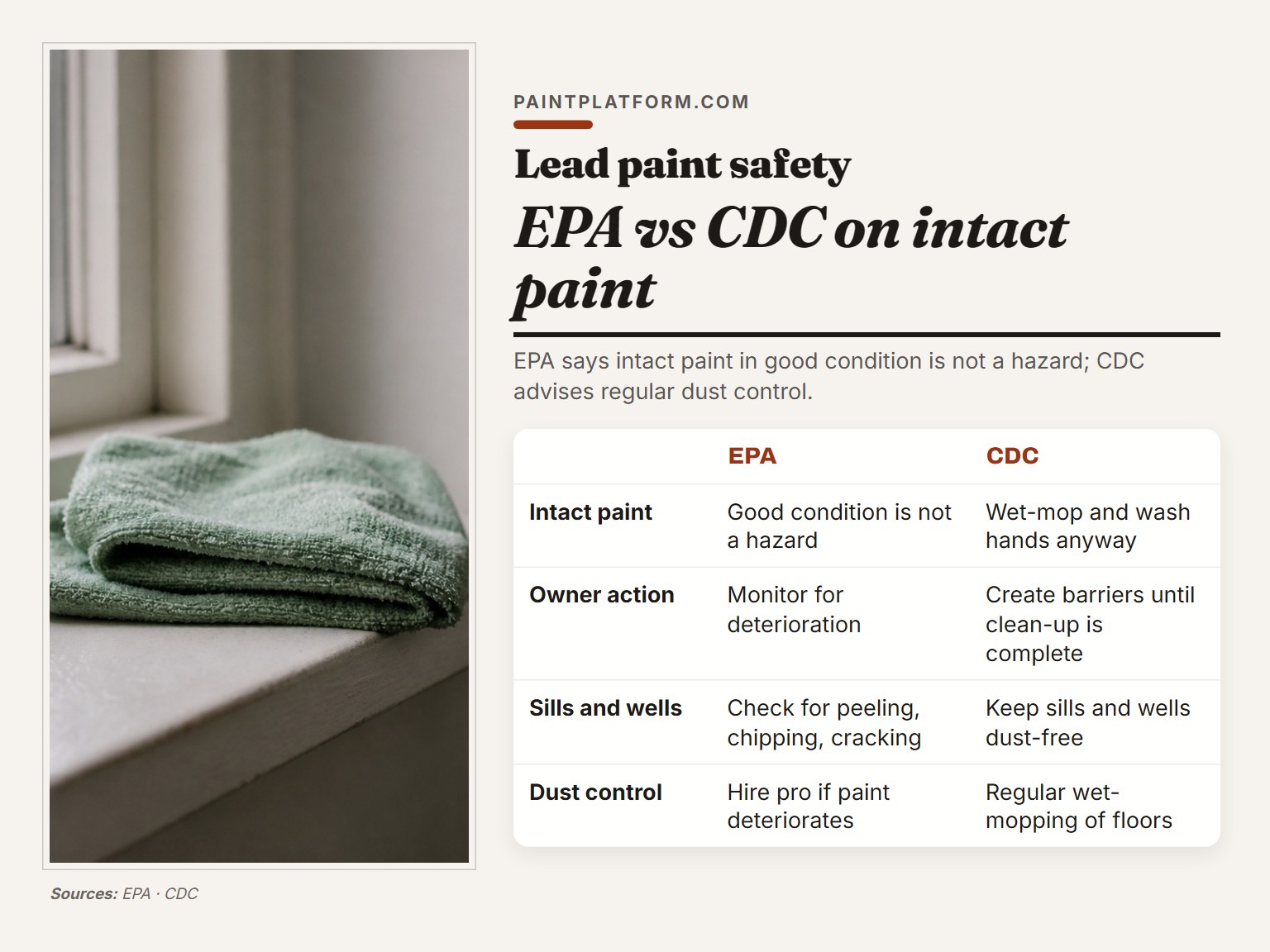
CDC recommends regular lead dust cleanup regardless of paint condition, while EPA says lead-based paint in good condition is not a hazard and should be monitored for deterioration. Household dust is a major exposure route, and wet-mopping floors and horizontal surfaces is the habit that keeps it down.
Common mistake: Treating the 400 ug/ft2 trough figure as a general hazard level. It applies to clearance testing only, so a risk assessor citing it for a trough hazard is reading the wrong column.
The Composite Sample Rule That Trips Up Everyone
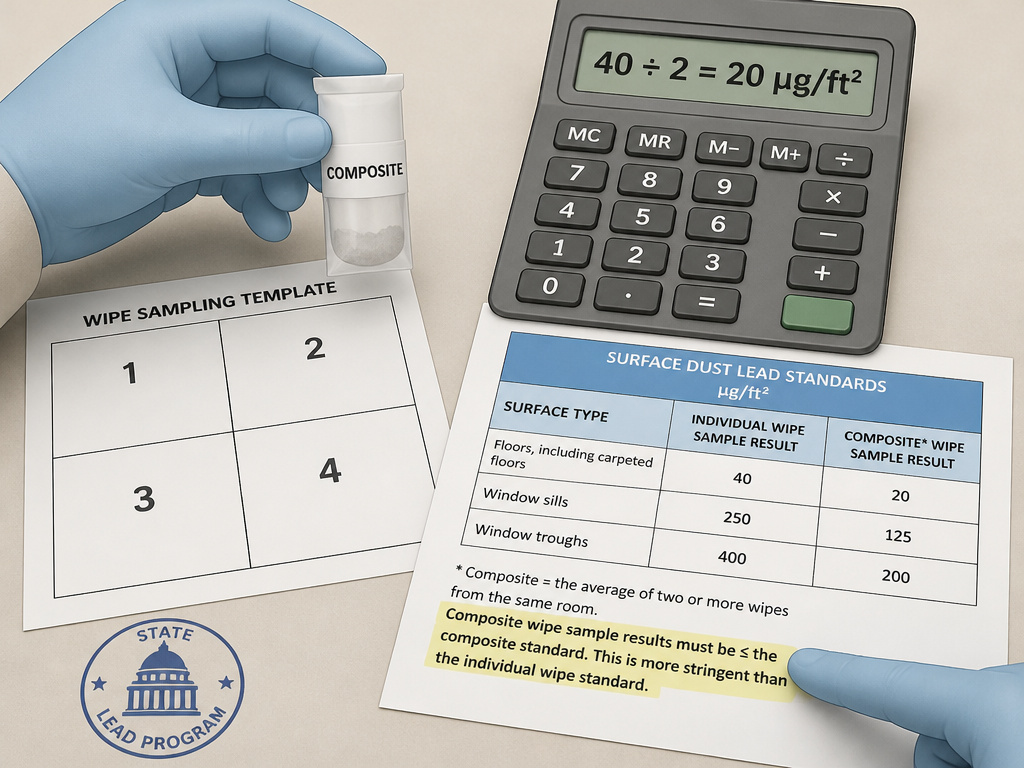
A composite dust sample is judged against a stricter number than the table shows, and the footnote is where people stop reading.
Under 40 CFR 745.63 and 745.227(h)(3)(i), a composite of two to four subsamples gets the applicable standard divided by half the number of subsamples. Four subsamples means half the count is two, so the 40 ug/ft2 floor standard becomes 20 ug/ft2 for that composite. Two subsamples means a divisor of one, and the table value stands.
If you can’t state the divisor out loud, don’t argue with the lab report. Half the subsample count, applied to the table value, is the whole rule.
There’s a second layer most homeowners never hear about. Federal law allows the EPA to authorize states to run their own lead programs, and those state rules can differ or be stricter. The federal table applies where no state or tribal standard is in effect.
Why Dry Sanding Is the Wrong First Move
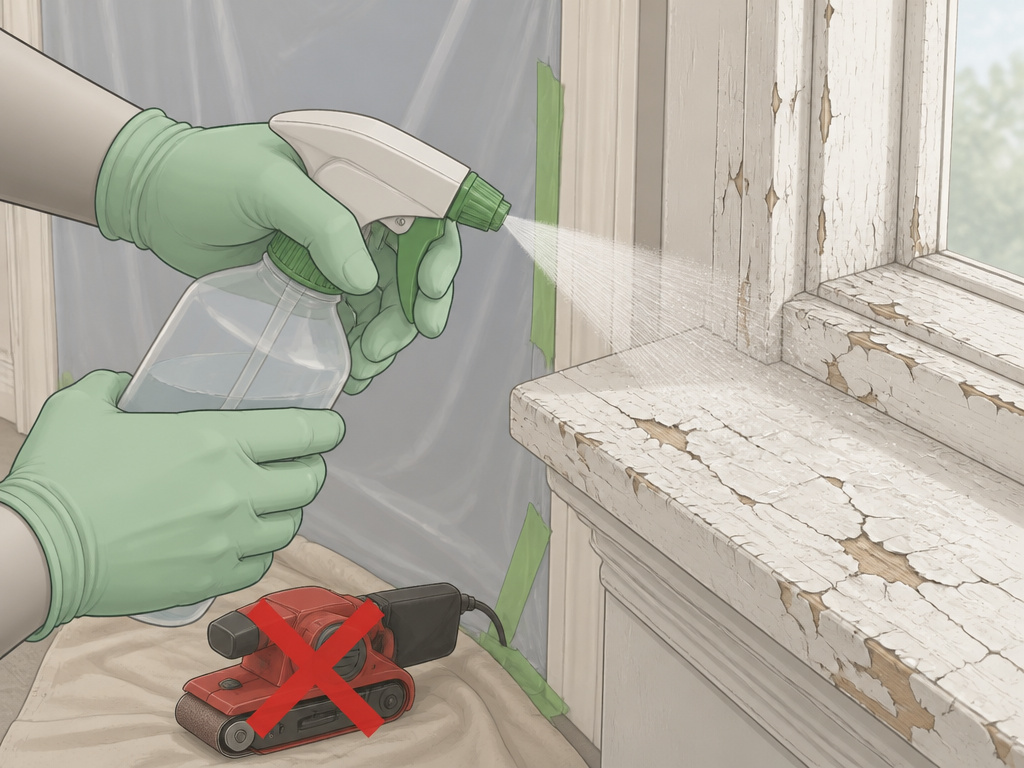
Dry sanding is the fastest way to move lead dust from one room to the whole house. The dust drifts into the next room before you notice it’s there.
Before you start: Sanding, scraping or heat-stripping old paint generates lead dust that settles on surfaces a child reaches. Seal the work area with plastic and tape before any tool comes out, and keep anyone pregnant or under six out of the room until cleanup is finished. A heat gun on lead paint can also produce lead fumes, so leave it in the box.
The wet-prep sequence
- Test the surface first. Skipping this means you’re guessing about every downstream decision, including whether the job is yours to do at all.
- Seal the work area with plastic sheeting and tape at every doorway. An unsealed doorway turns a one-room job into a whole-floor cleanup.
- Mist the paint before touching it. Water holds the dust down. Dry scraping sends it up.
- Work wet, wipe wet, bag wet. Dry sweeping or a shop vac without HEPA filtration just redistributes what you were trying to contain.
- Clean the whole path, not just the room. Dust travels on shoes and clothing, so the hallway and the entry mat need the same wet wipe.
If the paint genuinely has to come off, removing lead paint safely means wet methods and HEPA filtration, not a belt sander and a shop vac.
It’s the cheapest tool on the job and the one that does the most work.
Encapsulation vs Removal: Which One Wins Where
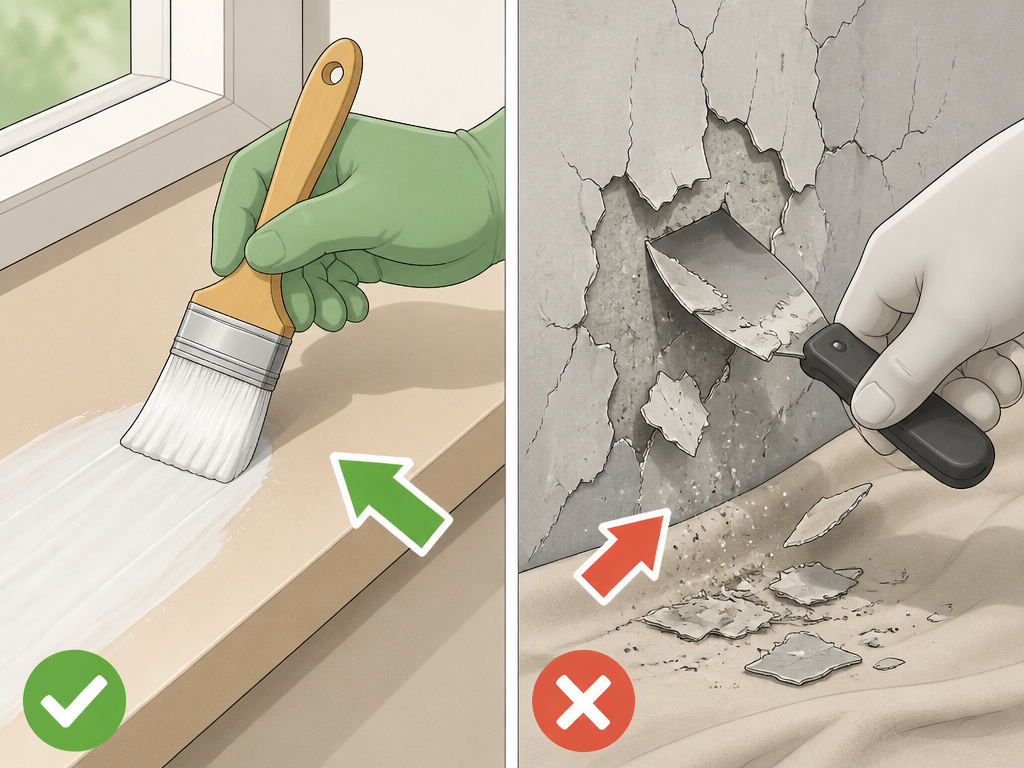
Encapsulation wins on intact paint. Removal wins on paint that’s already failing.
| Approach | Best when | Watch out for |
|---|---|---|
| Encapsulation | Paint is intact and bonded | Ongoing maintenance required |
| Enclosure | You can build over the surface | Blocks access and reduces clearance |
| Removal | Paint is peeling or chipping | Highest dust risk of the three |
| Paint over | Cosmetic refresh on sound paint | Leaves the hazard in place |
Lead paint encapsulation uses a coating that bonds to the old film and seals it off. Federal rules require ongoing lead-based paint maintenance after encapsulation or enclosure, so it’s a commitment rather than a one-time fix.
Painting over lead paint is legitimate when the surface underneath is sound and clean. Ordinary latex over failing paint does not fix the underlying problem. The failure shows up as blistering and lifting at the edges.
A dedicated encapsulating paint product is formulated for this job specifically. Standard wall paint isn’t.
When removal is the only honest answer
Peeling, chipping and chalking paint is the case where sealing it up just traps a failing substrate. EPA’s position is direct on this: deteriorating paint may create a hazard that needs immediate attention from a certified lead professional.
What the RRP Rule Requires Before Anyone Picks Up a Scraper
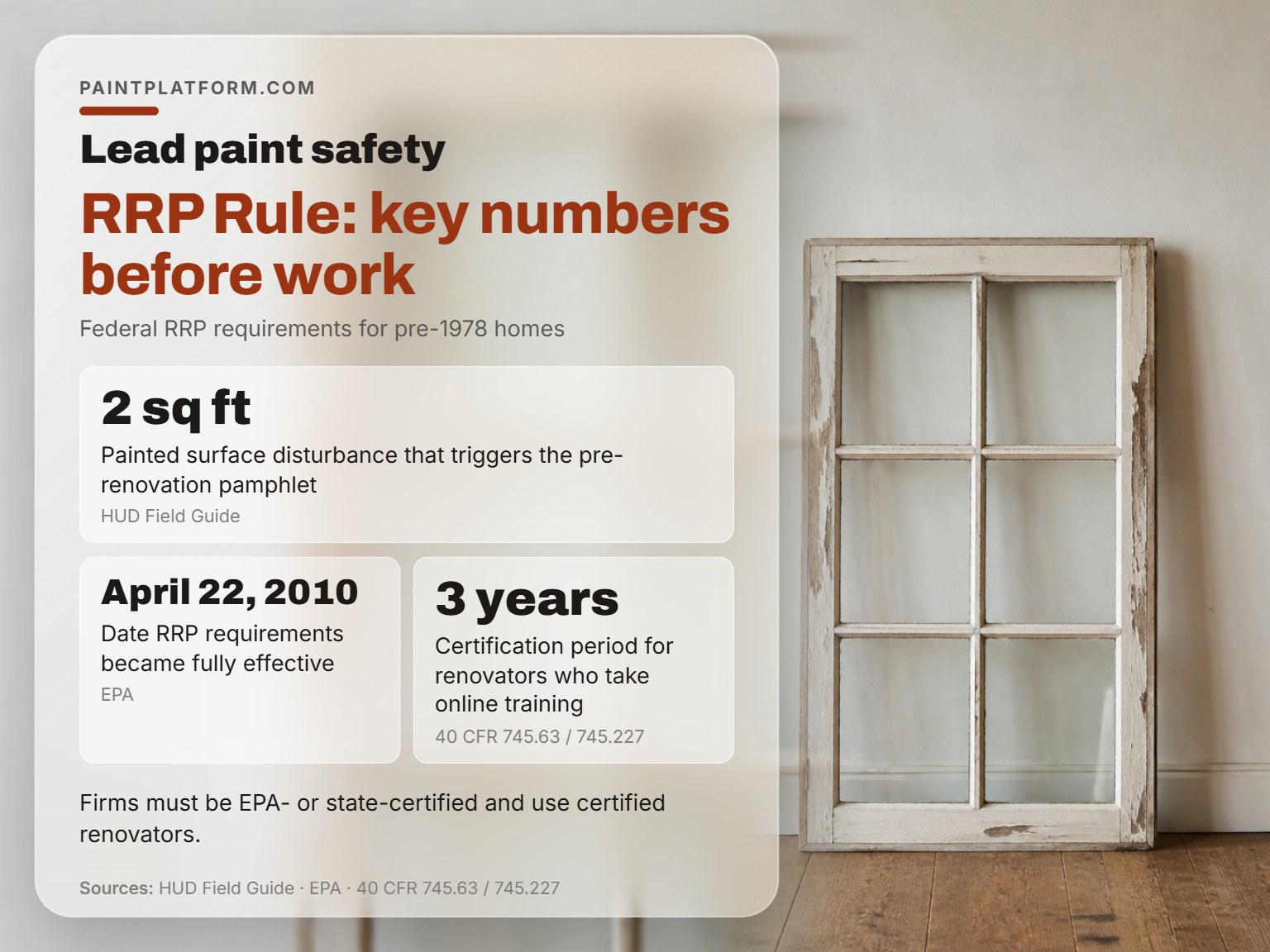
A crew shows up to replace six windows in a 1962 colonial. Before the first sash comes out, someone should be handing over a pamphlet.
Federal law requires owners and occupants of a pre-1978 house or apartment to receive “Protect Your Family From Lead In Your Home” before renovation work starts. The trigger is any work that disturbs a painted surface larger than 2 square feet.
The EPA renovation repair painting rules apply to firms, not just individuals. EPA’s 2008 RRP Rule, amended in 2010 and 2011, became fully effective on April 22, 2010. Since then, firms disturbing lead-based paint in pre-1978 homes, child care facilities and kindergartens must be EPA- or state-certified and must use certified renovators.
Who counts as a certified renovator
Renovators who take the online training are certified for three years. Renovators who take the hands-on training are certified for five. The final rule allows online training for every other recertification.
EPA administers the program directly in eleven states: Alaska, Arizona, Florida, Idaho, Montana, Nevada, New Mexico, New York, South Carolina, South Dakota and Wyoming, plus most Tribal lands and several territories. Everywhere else, a state program runs it, and those rules can be stricter. That’s why lead paint regulations aren’t identical from one ZIP code to the next.
Where this goes sideways: Hiring a firm that’s certified but sending in an uncertified sub. The certification attaches to the firm and to the individual renovator, and a crew member who hasn’t taken the course can’t perform the regulated work.
Where This Lead Paint Safety Guide Draws the Line
Some jobs belong to a certified professional, full stop.
Call one when paint is peeling, chipping, chalking or cracking on a surface a child can reach. Call one before any abatement, which by definition has to finish by achieving clearance. Call one if the work goes past what a field guide covers, which is HUD’s own guidance for owners who hit something bigger than expected.
- Deteriorated paint on windows, doors or stair rails
- Any abatement project, since clearance testing is part of the definition
- A child under six chewing or mouthing a painted surface
- Dust wipe results above the table values
- Anything you’d need a ladder and a scraper to reach
Here’s where the two agencies part company, and it’s worth holding both views. EPA states plainly that lead-based paint in good condition is not a hazard, and that owners should monitor for deterioration. CDC’s CDC lead paint prevention guidance is blunter about daily habits, calling for regular wet-mopping, hand-washing and physical barriers regardless of paint condition.
Both are right about the science. They differ on how much precaution a sound surface deserves.
My read: treat intact paint as low risk and still wipe the sills. The cost of a wet cloth is nothing.
The best way to know whether anyone has been exposed is a blood lead test. Most exposed children and adults show no symptoms at all, which is exactly why the test matters more than watching for signs.
For the habits that keep exposure down day to day, prevent paint poisoning covers hand-washing, barriers and the state health department testing resources.
Frequently Asked Questions
Does a house built in 1979 or later still need testing?
The federal ban on residential lead paint sales took effect in 1978, so a later build date lowers the odds considerably. It doesn’t eliminate them, because older stock and salvaged materials turn up in renovations. Testing a specific surface is cheap compared to assuming.
Can I just paint over lead paint and be done?
Only when the paint underneath is intact and bonded. Encapsulation and ordinary paint-over both leave the lead in place, and encapsulation specifically triggers ongoing maintenance obligations under federal rules. Peeling or chalking paint has to be addressed first.
What’s the difference between a lead hazard screen and a risk assessment?
Screen uses stricter dust thresholds, 25 ug/ft2 on floors and 125 ug/ft2 on sills. If the screen exceeds those levels, a full risk assessment follows. If it doesn’t, no further risk assessment is required.
Do I need a certified firm for a small repair?
The pamphlet requirement kicks in when work disturbs more than 2 square feet of painted surface in a pre-1978 home. Below that, the de minimis limits in the regulation apply. Small jobs still generate dust, so wet methods and cleanup remain the right call.
Are window troughs held to the same standard as sills?
No. Troughs have a clearance standard of 400 ug/ft2 and no applicable standard for risk assessment or reevaluation. That asymmetry is written into the regulation and catches people who read the table too quickly.
The Bottom Line
Here’s the threshold I’d hand anyone with a pre-1978 house: if the paint on a friction surface is peeling, chipping, chalking or cracking, stop and get a certified risk assessment before you touch it. Sound paint on the same surface can wait while you save up for encapsulation.
That single rule sorts most of the decisions in this lead paint safety guide. Failing paint means a professional. Intact paint means monitoring, wet wiping and a plan.
Fair warning: the test is the part people skip. A swab answers the question everything else hangs on.
Try this today. Pick one windowsill in the oldest room in your house, run a damp paper towel along it, and look at what comes off.
