
How to Clean Lead Paint Dust: Step-by-Step
This post contains affiliate links. As an Amazon Associate, we earn from qualifying purchases.
To clean lead paint dust, dust surfaces dry with a microfiber cloth, HEPA-vacuum everything, then wet-wipe with an all-purpose cleaner like 409. Work from clean areas toward dirty ones and use a fresh cloth on every surface. Dry sweeping and ordinary vacuums put the dust back in the air.
That last sentence is the whole how to clean lead paint dust job in miniature. Settled lead dust goes airborne again the moment a broom, a fan, or a footstep disturbs it, so a room that looks finished can be dirtier than it was an hour earlier. Every step below is built backward from that one behavior.
What follows is the order of operations: dry capture, HEPA vacuum, wet clean, then bagging. It also covers the three places where the official guidance genuinely disagrees, and the 2026 numbers that decide whether you keep cleaning or call someone in.
Key Takeaways
- Dry first, then HEPA, then wet. Reverse that order and you’ll turn loose dust into paste that bonds to the paint.
- Brooms and ordinary vacuums are out. Both push settled lead dust back into the air you’re breathing.
- One cloth per surface. The Maine DEP manual calls for a fresh disposable cloth or sponge after every single surface.
- Carpet is the weak point. It traps dust that even HEPA and wet cleaning struggle to pull out.
- Check your pamphlet date. Dust-lead action levels changed on January 12, 2026, and older EPA pamphlets carry the old thresholds.
Why an Ordinary Vacuum Makes Lead Dust Worse
Your everyday vacuum is the wrong tool.
An ordinary household vacuum pushes lead dust through the work area instead of capturing it. The holes between the filter aren’t small enough to trap particles that fine, so the exhaust sends them back into the room. A HEPA vacuum carries a special filter that pulls those particles out of the exhaust stream before the air leaves the machine.
Lead dust particles are small enough to pass straight through the filter of an ordinary household vacuum and return to the room through the exhaust. A HEPA vacuum carries a special filter that captures those particles before the air leaves the machine, which is why the equipment matters more than the effort.
Lead dust is too small to see. That single fact makes this job different from ordinary cleaning, because you can’t judge your work by looking at it.
More children become lead poisoned from leaded dust than from any other form of exposure, according to the Maine DEP’s dust removal manual. If a child in your home has already tested high, the lead poisoning prevention basics are worth reading alongside the cleaning steps.
Common mistake: Sweeping or dry-dusting a room first to “get the bulk of it.” A broom lifts settled dust into the air, and it settles again on surfaces you already finished.
Dust the Ledges Dry Before Anything Gets Wet
A wet sponge touches the top of a door frame and the dust sitting there turns into gray paste. Now it’s smeared into the paint instead of lifted off it.
I learned the how to clean lead paint dust lesson the slow way. For years I skipped the dry pass and went straight to a wet sponge, then couldn’t work out why every wall looked worse when I finished than when I started. A dry microfiber cloth on a long handle takes dust off walls and the top of door trim. Ten minutes. That’s the whole fix.
The cloth comes away with a gray film you can see clearly against the white. That film is what you’re chasing for the rest of the job.
The mechanism is simple. Dust on a ledge is loose. Water turns it into a paste that grips the surface, and now you need abrasion to get it off, which is the last thing you want on painted trim. Dry first, then damp. Always that order.
The lead paint safety guide covers gloves and respirators in detail; the short version is gloves on, hands away from your face.
Step-by-Step: How to Clean Lead Paint Dust in One Day
Three things happen in this order: dry capture, HEPA vacuum, wet clean. Get the sequence wrong and you’ll redo the room.
The Maine DEP manual is blunt about scheduling. Dust removal should be organized so it happens in one day, to limit how long residents are displaced and to stop dust migrating back into rooms you’ve already finished.
Before you start: Lead dust is invisible, so assume it’s on every surface until you’ve cleaned it. Wear nitrile gloves and eye protection, keep young children and pregnant people out of the work area until the final pass is done, and never eat, drink, or smoke in the room you’re cleaning.
Set Up the Room First
- Store loose belongings in boxes, closets, or drawers so floors and surfaces are actually reachable.
- Take down drapes and curtains, and collect washable area rugs for cleaning. Bag them sealed once they’re clean.
- Wash blankets that were unprotected during a renovation that disturbed lead-based paint.
- Wash cleanable toys with an all-purpose cleaner.
- Change the HVAC filter, unless your landlord handles that on a set schedule.
The basic kit is shorter than people expect: all-purpose cleaner (Ajax or 409), rags, sponges, baby wipes, mops, a bucket with a ringer, and a plastic spray bottle. Add disposable latex or vinyl gloves, 2-inch paint brushes, 2-inch clear tape, and 1-inch masking tape. That’s the Maine DEP list, and nothing on it is exotic.
The Cleaning Sequence
- Dry-dust the high surfaces first. Skip this and the wet pass turns loose dust into paste you’ll scrub at for twice as long.
- HEPA-vacuum everything, working from the top of the room down to the floor. Do it last and you’ll drag fresh dust back over clean surfaces.
- Wet-clean with an all-purpose cleaner such as 409, using a new disposable cloth or sponge for every surface. Reusing one cloth moves dust from a dirty surface onto a clean one.
- Work from the areas you’ve already cleaned toward the areas you haven’t. Going the other direction spreads dust back into finished rooms.
- Wipe electrical equipment instead of wetting it down. Water near outlets is its own hazard, and you don’t need a second one.
- Bag cloths, sponges, and vacuum contents as you go rather than at the end.
I keep a roll of 2-inch clear tape in the kit and tape used cloths into a bundle as I finish with them. It sounds fussy. It stops a wet rag full of lead dust from sitting open on the floor while you work the next wall.
Does the Cleaner Actually Matter?
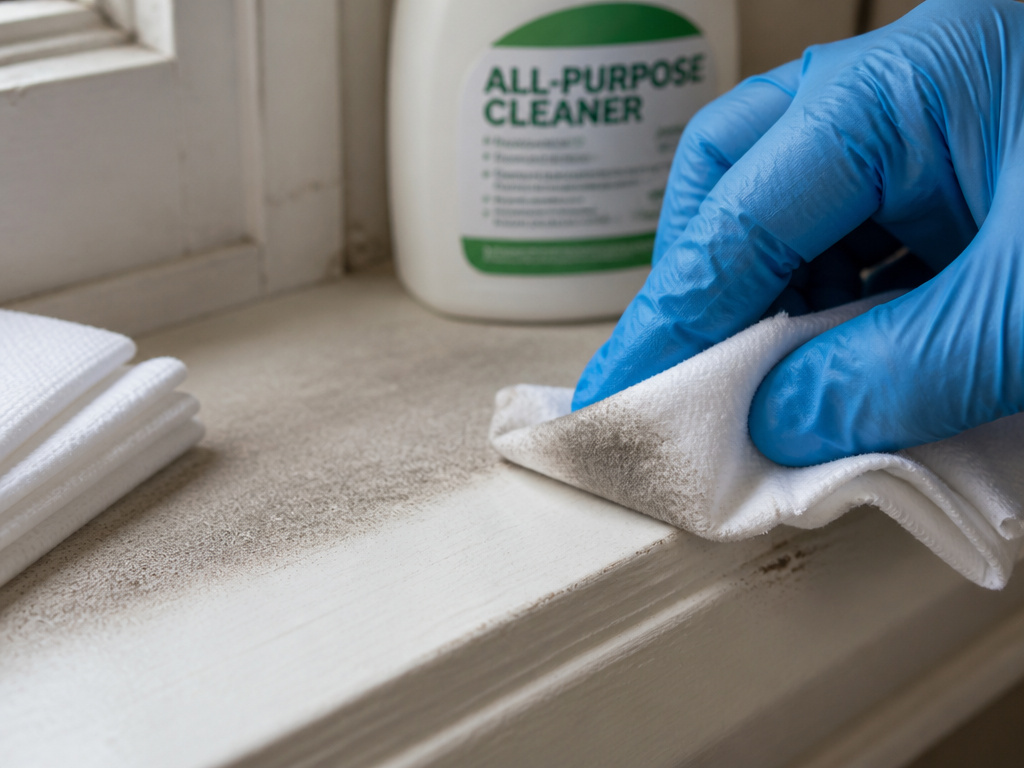
Does the cleaner even matter? The agencies don’t fully agree, which tells you something useful about how much of this job is chemistry and how much is technique.
HUD’s Chapter 14 calls for a lead-specific detergent, a high-phosphate detergent, or another suitable cleaning agent. Maine’s program names a plain all-purpose cleaner such as 409, and lists Ajax alongside it. Australia’s guidance requires a high-phosphate solution specifically. Three agencies, three levels of specificity for the same step.
The Maine DEP lead dust removal manual is the source for the all-purpose cleaner recommendation, and it’s worth reading in full if you’re cleaning a rental rather than a home you own.
Dust on a trim ledge turns into paste the second a wet sponge touches it. The fix is order: dry first, then damp; sources disagree on the cleaner, with Maine naming an all-purpose cleaner such as 409, HUD allowing a lead-specific or high-phosphate detergent, and Australia requiring a high-phosphate solution.
Here’s the mechanism, though, because it explains why a cheap bottle works. Lead dust isn’t chemically bonded to your trim. It sits on top of the paint as a fine powder, and the surfactant in a water-based cleaner lifts it into the cloth. High-phosphate detergents do the same job with more aggressive chemistry, which is why some agencies still specify them for heavy contamination.
Match the cleaner to the surface, not to the label. A plain all-purpose cleaner and a fresh cloth do more than a specialty product applied with a dirty rag.
My own call: 409 and a stack of disposable cloths, changed constantly. If a surface is visibly contaminated or the dust is heavy, step up to a phosphate detergent instead of scrubbing harder with a mild one.
Can the Carpet Be Saved, or Does It Have to Go?
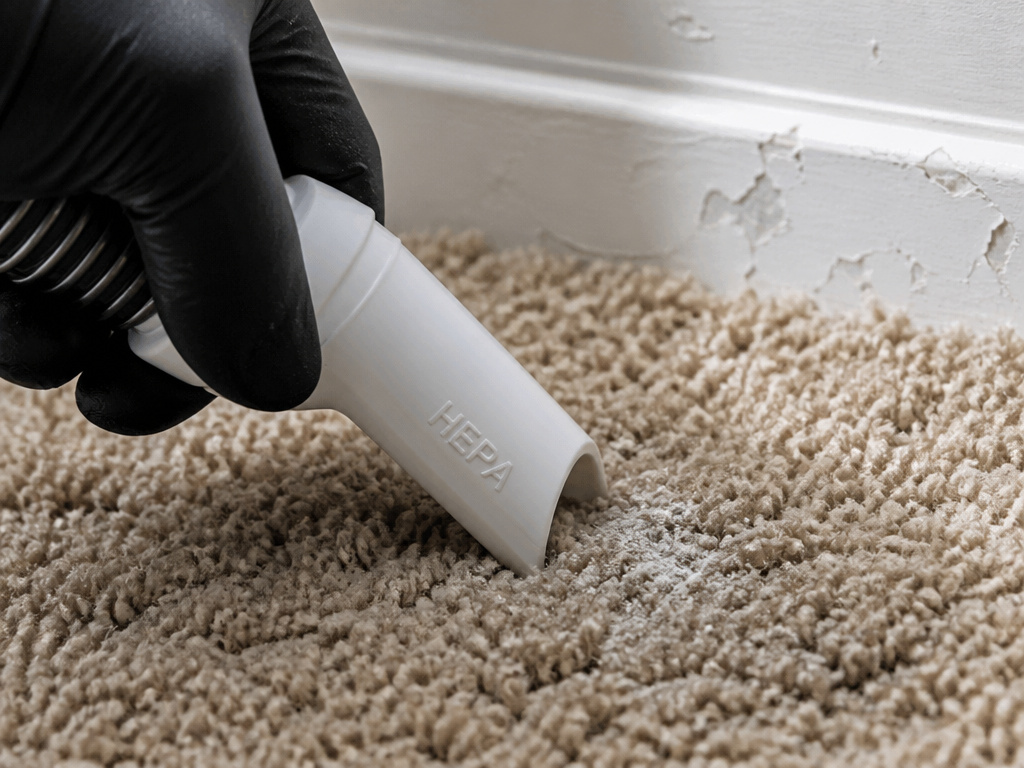
Everyone says clean the carpet. Sometimes the carpet has to go.
This is the one place where the guidance genuinely splits, and the split is worth understanding before you spend a Saturday on a rug.
| Source | Position on carpet | Practical read |
|---|---|---|
| Nebraska DHHS | Some carpet can only be fully decontaminated by removal and replacement | Removal is the ceiling, not the first move |
| HUD Chapter 14 | Carpet is cleanable within the standard HEPA and wet cycle | Cleaning is expected to work |
| EPA 2026 supplement | Action levels cover floors, including carpeted floors | Carpet is expected to pass clearance |
| Maine DEP manual | Carpets are dust traps that resist even special cleaning | Expect to repeat the pass |
Nebraska’s guidance points to removal and replacement as the only full fix for some carpet, with HEPA vacuuming plus a sodium hexametaphosphate steam cleaning as the fallback when disposal isn’t an option. The Maine DEP manual takes the gloomier view: even with special equipment and procedures, lead dust is hard to pull out of dust traps like carpets and rough surfaces.
My read sits between them. Try cleaning first, expect to repeat it, and accept that a thick-pile carpet in a room where paint has been failing for years may never come clean.
Easy to miss: A carpet that passes a visual check can still fail a dust wipe test. The dust you’re chasing is smaller than the eye can resolve, so “it looks clean” tells you nothing at all.
The 2026 Action Levels That Decide Clean Versus Abate
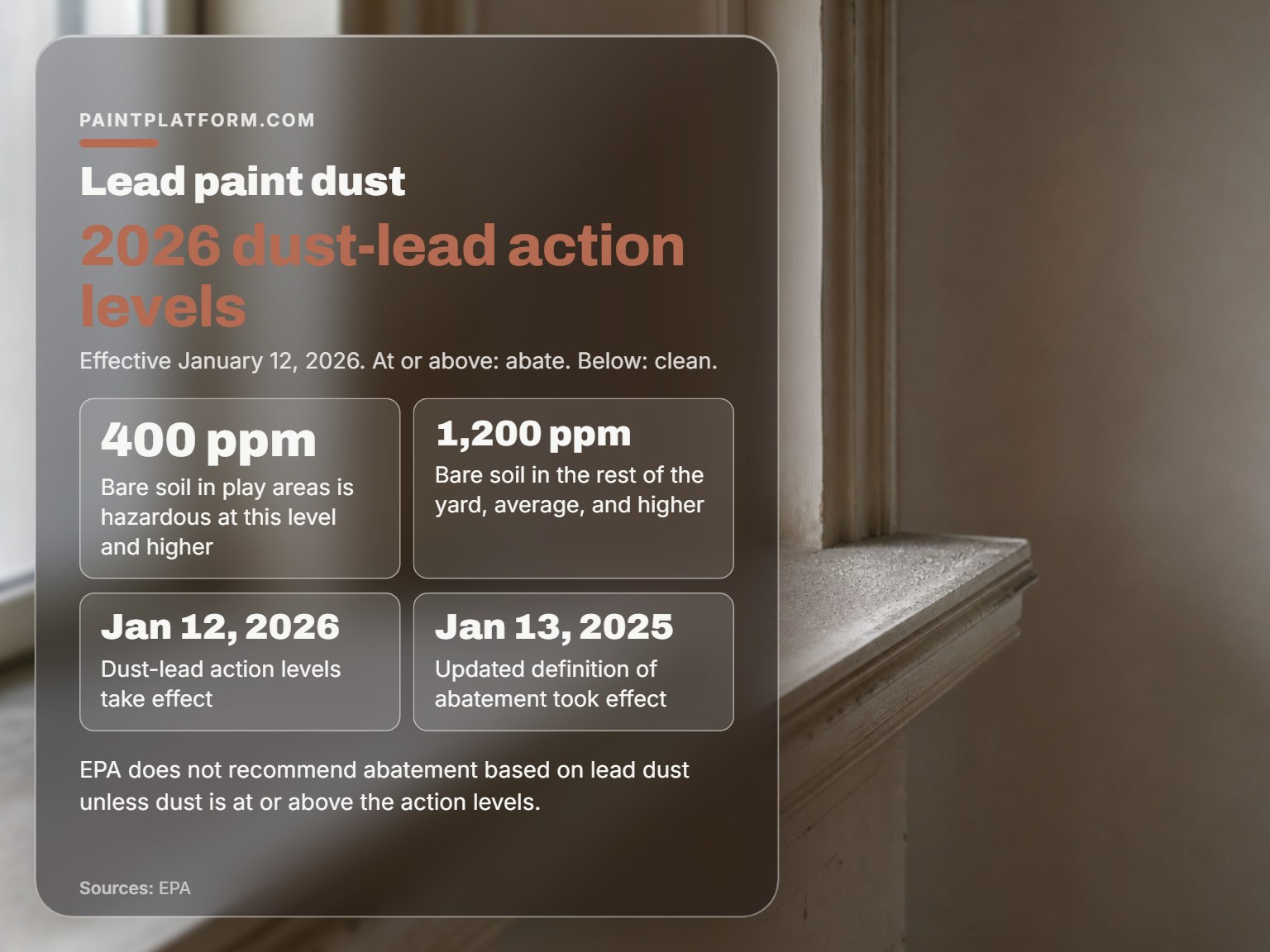
That’s the number that decides whether a floor counts as a hazard in 2026.
EPA’s dust-lead action levels took effect on January 12, 2026. If you’re working from an older copy of the pamphlet, the EPA 2026 supplement carries the numbers.
| Surface | Action level | Note |
|---|---|---|
| Floors, including carpeted floors | Action level | The lowest of the three |
| Interior window sills | Action level | Sills collect dust fast |
| Window troughs | Action level | Highest threshold |
| Bare soil, play areas | 400 ppm and higher | Different unit, same idea |
| Bare soil, rest of yard | 1,200 ppm average and higher | Applies to the whole yard |
EPA currently defines any reportable level of lead dust measured by an EPA-recognized laboratory as hazardous. That’s a low bar, and it’s deliberate.
EPA does not recommend abatement based on lead dust unless the dust is at or above those action levels. Below that line, cleaning is the response.
The only way to find out whether you have a problem is to test. Paint, dust, and soil each need their own test, and a visual inspection tells you nothing. Start with a lead paint test on the painted surfaces themselves before you disturb anything.
Intact paint on a surface nobody touches is usually not a hazard. Paint that’s peeling, chipping, chalking, cracking, or damaged is a hazard and needs immediate attention, and that’s a different job from dust cleaning. If the paint is intact and the problem is friction, painting over lead paint with an encapsulant is often the safer route than removal.
Removal is the bigger job, and its rules changed too: the updated definition of abatement took effect on January 13, 2025. The lead paint removal methods that apply depend on which definition you’re working under, and the lead paint regulations govern who is allowed to do that work.
What Goes in the Bag, and Why You’ll Reclean Anyway
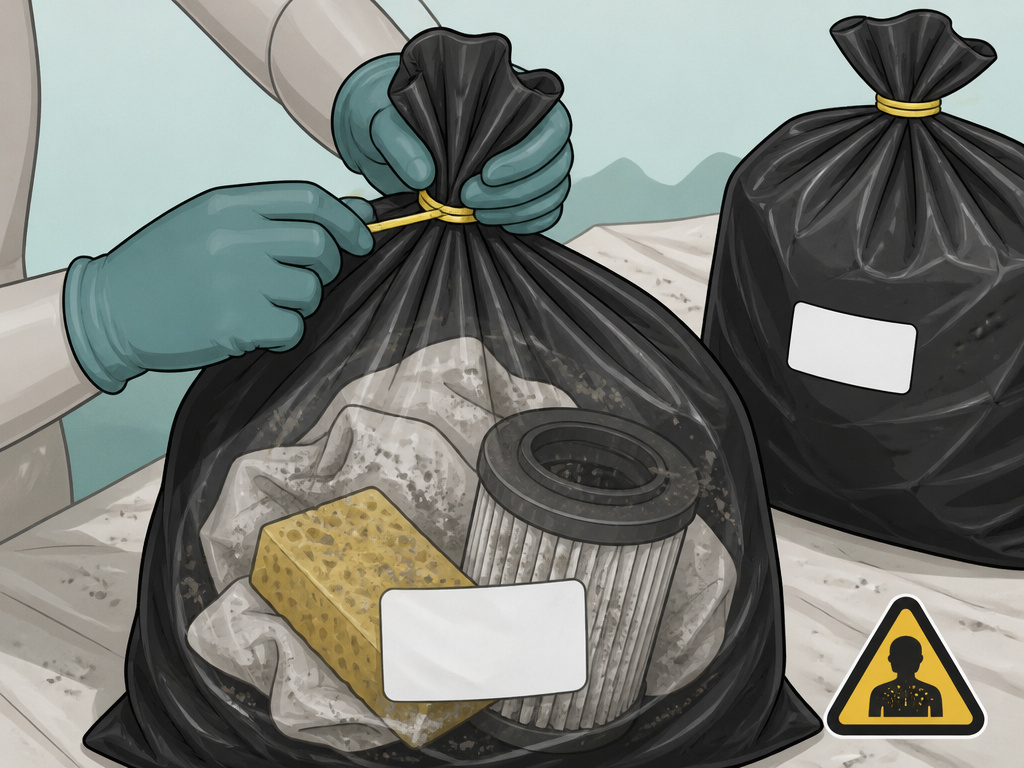
Waste handling is where a HEPA vacuum and wet cleaning agents get undone.
Every cloth, sponge, and vacuum bag you used is now contaminated. Bag them sealed as you finish each surface rather than piling them in a corner until the end.
- Disposable cloths and sponges, one per surface, bagged as you go
- Vacuum bag contents and the filter
- Drapes, curtains, and washable rugs after cleaning
- Anything used to wipe down electrical equipment
How you label and store it matters too, and the lead paint waste disposal rules cover what your local pickup will and won’t take.
Dust removal is interim control, not a permanent fix. The Maine DEP manual defines it as an initial cleaning followed by periodic checking and recleaning as needed. That’s the honest framing. You’re resetting the room, not sealing it.
EPA’s guidance says the same thing from a different angle: settled lead dust goes back into the air whenever the room is vacuumed, swept, or walked through. So the recleaning cycle isn’t proof you failed. It’s the method.
And if you’re working from an older copy of Protect Your Family From Lead in Your Home, EPA doesn’t require you to discard it. It asks that the supplement travel with it, because the thresholds printed inside the old pamphlet are out of date.
Frequently Asked Questions
Can I just use a regular vacuum with a HEPA bag?
HEPA bag in an ordinary vacuum does less than a sealed HEPA machine. The Maine DEP manual’s concern is the exhaust stream: if dust escapes around the housing, the bag hasn’t helped the room. Rent or borrow a real HEPA vacuum for the day.
How often should I reclean?
There’s no fixed schedule in the source material. Dust removal is defined as an initial cleaning followed by periodic checking and recleaning as needed. Check high-traffic floors and window sills first, since those are the surfaces the action levels cover.
Does one cleaning pass get rid of lead dust?
Not reliably, especially on carpet. The Maine DEP manual notes that even with special equipment, lead dust is hard to pull out of dust traps like carpets and rough surfaces. Plan on a second pass rather than assuming one is enough.
What cleaner should I use if I can’t find 409?
Maine’s program names an all-purpose cleaner such as 409 or Ajax. HUD’s Chapter 14 allows a lead-specific or high-phosphate detergent, or another suitable cleaning agent. Plain all-purpose cleaner plus a fresh cloth per surface is the practical default.
Is it safe to stay in the house while I clean?
Keep young children and pregnant people out of the work area until you’ve finished and bagged the waste. EPA’s guidance is to clean regularly to minimize dust when young children live in the home, which implies the cleaning happens while they’re somewhere else.
Do I need to test before cleaning?
Testing tells you whether a hazard exists, not whether to clean. EPA’s position is that the only way to find out if paint, dust, or soil hazards exist is to test for them. In a pre-1978 home, test the painted surfaces before you disturb anything.
The Bottom Line
Here’s the limitation nobody puts in the first paragraph: this whole method is interim control. It resets a room, and the dust comes back if the paint above it keeps breaking down.
So there’s a trigger worth writing down. If a dust wipe still comes back at or above the action level after recleaning, stop cleaning. At that point you’re polishing a surface that keeps regenerating, and the next call is to an EPA-certified risk assessor, not another bucket of 409.
For this week, one small thing. Buy a pack of disposable microfiber cloths and a bottle of 409, pick the room with the oldest trim, and do the dry pass only. Ten minutes. Look at what comes off the top of the door frame and decide from there.
