
Casein Paint for Artists Guide: Mix It Fresh
This post contains affiliate links. As an Amazon Associate, we earn from qualifying purchases.
This casein paint for artists guide starts with the mix: 8 to 10 pounds of powder to 4 quarts of water at 70 F, stirred for 30 minutes. Mix it the day you plan to paint. It sets to touch within 2 hours and dries within 12; Langridge says use it on non-flexible supports, while International Artist allows thin layers on flexible paper or gessoed canvas.
Casein sets as the water leaves and the protein packs into a closed film, so a batch that sat in a jar overnight is already partway down that road, though the casein paint for artists guide notes NBS says to use it the same day while Langridge allows biocide-preserved binder to keep for days or weeks. That closed film resists rewetting, which is what makes it useful over a pencil sketch and what makes an old jar useless.
What follows: the two mixing routes, the storage argument nobody has settled, the support question, and the gloss numbers from a 2023 conservation study that surprised the people who ran it.
Key Takeaways
- Mix fresh and use it the same day. NBS Letter Circular 386 says so even though the mixed paint passes an 18-hour remix test.
- 8 to 10 pounds of powder per 4 quarts of 70 F water, stirred over 30 minutes with no undissolved casein left in the bowl.
- Thick paint needs a rigid panel. International Artist says thin layers are fine on flexible paper or gessoed canvas, but impasto on stretched canvas cracks and crumbles as the film finishes losing water.
- Borax is the easier route. The ammonia version works too, and it wants a window exhaust fan plus eye protection.
- Test on your actual surface first. Langridge recommends it, and a failed sample board stings less than a failed painting.
Is Casein Paint the Same as Gouache?
Both are opaque water-based paints that dry matte, and the resemblance mostly stops there.
Casein films form as water leaves the paint. The protein particles pack tightly and the surface closes, so a dried film resists rewetting far better than gouache does. That closed surface takes varnish, holds a matte finish, and cracks if it is laid on thick over a support that flexes.
Gouache lifts the moment you drag a wet brush across it, a point the casein paint for artists guide makes clear. Casein mostly holds, because that closed film has already formed. International Artist describes the film as resisting reactivation, which is why you can glaze a dried passage without smearing the color underneath.
The trade is real. If you love gouache because you can re-wet and push paint around for an hour, casein will frustrate you for a week.
International Artist warns that sable and Kolinsky brushes are damaged over time by casein, so inexpensive synthetic flats, rounds and filberts are preferred. It dries matte, and a varnish layer brings the luster back when you want depth in a dark passage. Dark casein paintings can be framed without glass once varnished.
Here is the timing that catches people. A stroke dries to the touch in a few minutes to ten minutes on a fair weather day, but the film keeps bonding overnight to a couple weeks. Dry to the touch is not cured.
One more thing your nose will notice: NBS requires casein paint to have no offensive odor, and Princeton EHS notes that certain preservatives in water-based paints may cause allergic reactions in some people.
Casein is the binder in what most people call milk paint, and the two names get used interchangeably. It also sits in the older family of natural paint types alongside egg tempera and distemper, and it is the most forgiving of the three for a beginner.
Try it.
How Do You Mix Casein Paint From Powder?
Two routes get you from powder to paint: borax and ammonia. Both work. Only one is pleasant in a small room.
Before you start: Ammonium hydroxide is moderately irritating on skin and highly irritating to the eyes, lungs, and gut. Mix the ammonia route under a window exhaust fan, wear gloves, goggles, and an apron, and find the eyewash before you open the bottle.
The Borax Route
- Soak 40 g of casein in 125 ml of cold water in a non-metallic bowl. Langridge’s recipe page says about 12 hours; their product page says at least one hour. Skip the soak and you get hard granules that never fully hydrolyse.
- Cover the bowl with a thick, wet cloth. Left open, a skin forms on the surface and you end up fishing it out of the binder with a spoon.
- Dissolve 16 g of crystalline borax in 125 ml of hot water, stir it into the casein, then stir again after a few minutes. Too little borax and the binder stays grainy on the slab.
- Let it stand. Hydrolysis is complete within 2 hours, once no recognizable casein granules remain. A full day of standing gives you a thicker binder.
- Add pigment last. Earth colours take roughly 1:3 pigment to binder by volume. Rushing this step leaves streaks that only show up after the paint dries.
The Ammonia Route
Mix 40 g of casein with a very small amount of cold water, then add 250 ml of warm water. Separately dissolve 10 g of ammonium carbonate in a few drops of water to a smooth paste, pour it into the casein, and the solution effervesces immediately. Keep stirring until the foam subsides.
Ammonia-casein is not particularly stable and goes fluid relatively quickly even with a preservative added. Mix what you’ll use this week.
The 1933 NBS Letter Circular 386 approaches the same job from the other end of the scale: 8 to 10 pounds of powder into 4 quarts of water at 70 F, stirred several times over 30 minutes, with no undissolved casein particles allowed. It also sets a floor on what belongs in the can. At least 10.0 percent commercial casein on total solids, and at least 15.0 percent combined zinc sulphide and titanium dioxide.
If you’ve made homemade natural paint before, the rhythm will feel familiar. Weigh, soak, stir, test.
| Route | What goes in | Good for | Watch for |
|---|---|---|---|
| Borax-casein | 40 g casein, 16 g borax, 250 ml water total | Binder you keep for days | Grainy if the soak is skipped |
| Ammonia-casein | 40 g casein, 10 g ammonium carbonate, 250 ml warm water | Small batches | Fumes; goes fluid quickly |
| Tubed casein | Pre-mixed paste from a supplier | Sketchbook studies | Matte film; varnish for depth |
Same Day or Six Months? The Storage Rules Don’t Agree
Three reputable sources give three different answers on how long mixed casein keeps, and none of them is wrong.
- NBS Letter Circular 386: use the paint the same day it is mixed, full stop, even though the mixed paint passes an 18-hour remix test with no offensive odor.
- Langridge, biocide route: binder kept for several days or weeks needs a biocide, and they advise preparing only small amounts.
- Langridge, borax route: binder made with boiled water and clean containers stores half a year, sometimes longer, with no preservative at all.
Read those together and the sources still disagree: NBS says use it the same day, Langridge says biocide-preserved binder keeps for days or weeks, and Langridge also says clean boiled-water borax binder stores half a year or longer without preservative.
The preservative question runs alongside it. Princeton EHS notes that all water-based paints contain a preservative to prevent mold and bacterial growth, and that certain preservatives cause allergic reactions in some people. If you add your own, avoid sodium fluoride, phenol, and mercury compounds.
Mix what you’ll use this week. A jar in the fridge is a science experiment with a lid on it.
My rule is boring and it works: small batches, dated lids, and a sniff test before every session. Storage is the first thing people ask about with any milk-based paint, and it comes up in every honest milk paint pros and cons discussion.
The 1933 spec also gives you a rejection list worth borrowing. Liquid separation, caking, granulation, hardening in the container, or an offensive odor, either on receipt or within six months after, is cause for rejection. Powder in hard lumps that won’t crumble, or with a putrid smell, gets rejected without further testing.
Write the date on the lid.
Which Support Holds Up: Rigid Board or Flexible Canvas?
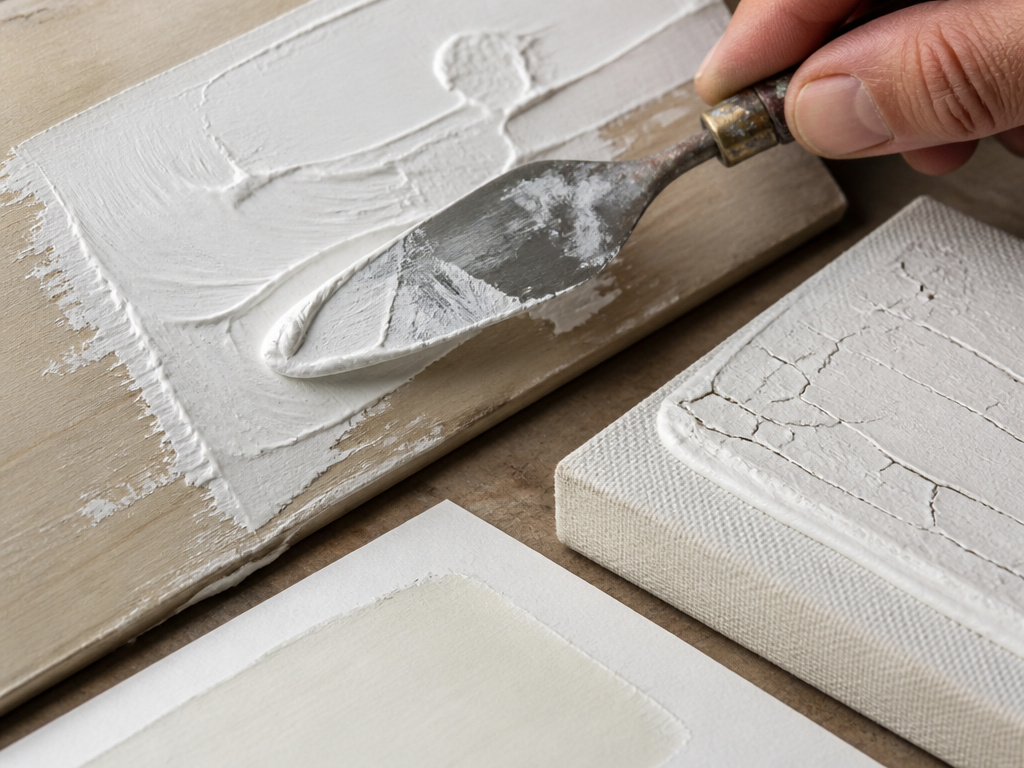
Rigid wins for thick paint: Langridge says casein should be used on non-flexible supports, while International Artist allows thin layers on flexible paper or gessoed canvas.
Langridge states plainly that casein paints are relatively inflexible and should be used on non-flexible supports. International Artist takes a wider view: thin layers on flexible paper or gessoed canvas are fine, and only a thick, textural impasto needs a rigid substrate. The two sources genuinely disagree on flexible supports.
Where this goes sideways: A thick casein impasto on stretched canvas looks wonderful for a week. As the film finishes losing water, the weave flexes underneath and the ridges crack and crumble.
| Support | Thin layers | Thick impasto | Source |
|---|---|---|---|
| Rigid panel or board | Works | Works | Both sources agree |
| Gessoed canvas | Works | Cracks or crumbles | International Artist |
| Watercolor paper | Works | Skip it | International Artist |
When Thin Layers Are Fine
Thin is the key word. A wash or a thin opaque passage on watercolor paper will hold fine. Build in layers and let each one dry before the next.
For anything you plan to build up, a rigid panel gives you a firm support without a trip to the lumber yard. I paint on panel for anything I actually care about, and keep paper for the studies I’ll never frame.
Brushes matter less than you’d think. International Artist recommends inexpensive synthetic flats, rounds, and filberts, and warns that sable and Kolinsky fibers get damaged over time by the paint. That’s a rare case where the cheap tool is the correct tool. Inexpensive synthetic flats handle casein without guilt. The paint brushes you already own for acrylic will mostly do the job.
One limit worth knowing before you commit a wall. NBS says casein cold water paints, especially for exterior use, are not intended to be as durable as good oil paints, and where extreme dampness and poor lighting combine, cement water paint may be the better call. If you’re finishing furniture instead of paper, start with the milk paint vs chalk paint comparison before you commit a whole dresser to either one.
Pigment to Binder: Ratios and Mulling
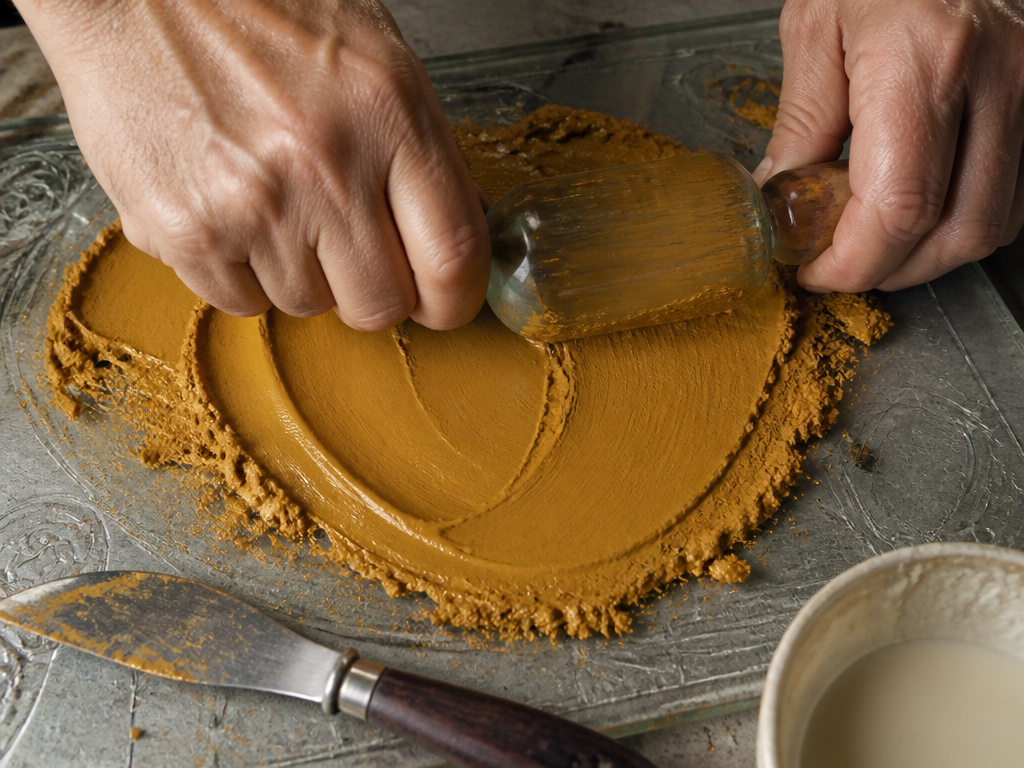
A glass muller on an etched slab does what a shaker bottle can’t.
Place a tablespoon of pigment paste on an etched-face glass slab and rotate the muller in a figure-eight, working the paste across the surface. Scrape it back to the center periodically. The paste gets smoother and glossier as you go, and when it’s properly ground, no grains should be visible and no grittiness should be heard or felt.
Then combine. By volume, mix pigment-paste and casein binder 1:1, adding more binder for a thinner consistency. For natural or prepared earth colours, go closer to 1:3 pigment to binder.
Langridge’s own product page adds the caveat that matters most: the exact ratio varies by pigment, so test a small amount on your substrate and let it dry before you commit.
This is the one step where quality art supplies pay you back, because gritty pigment cannot be mulled smooth no matter how long you lean on the slab.
Mull it longer.
A coverage figure to plan around: Langridge puts 1 litre of casein paint at about 10 square meters of a smooth, non-absorptive ground.
Casein Paint for Artists: What the Gloss Numbers Actually Show
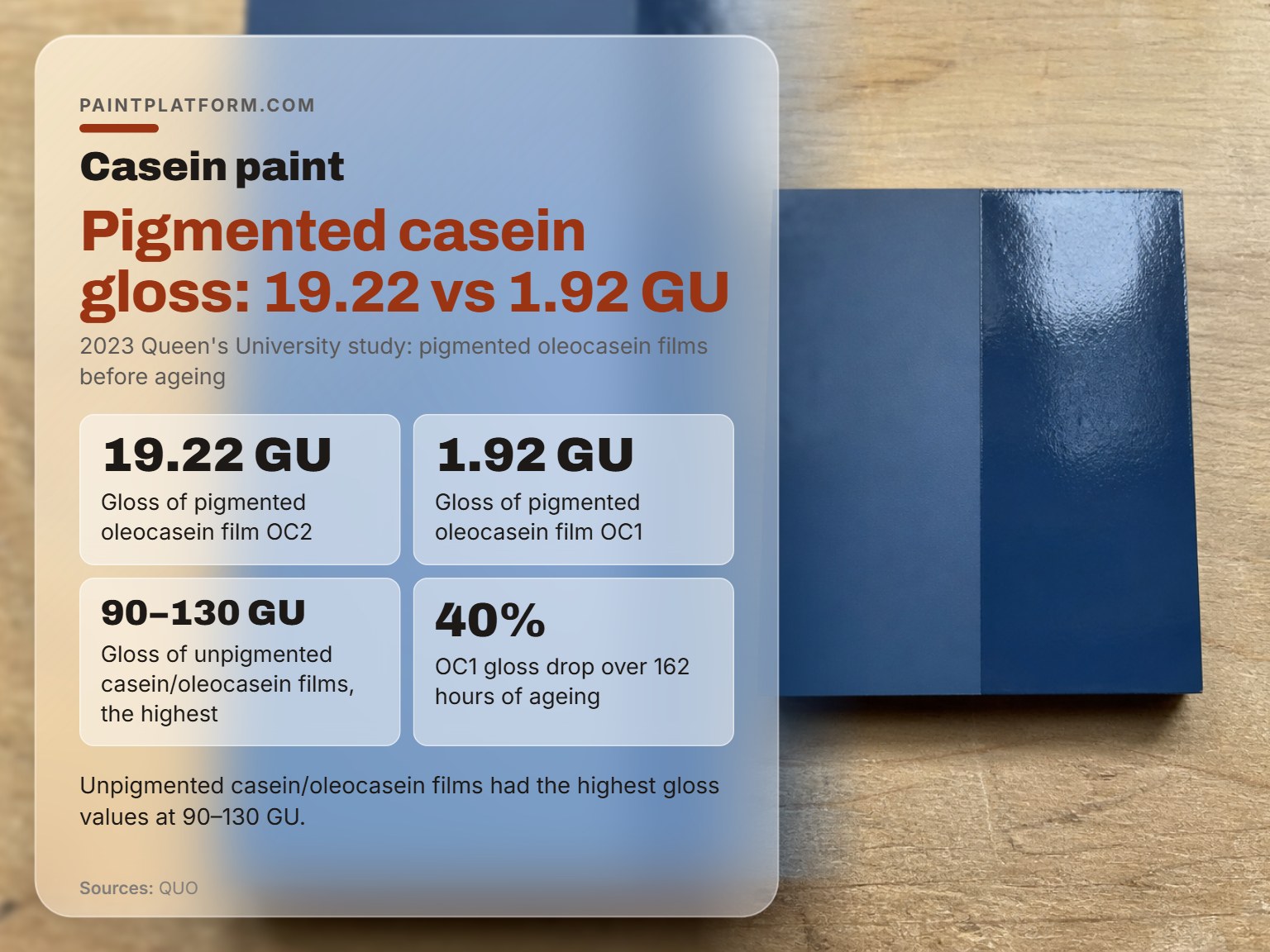
A pigmented oleocasein film measured 19.22 gloss units in a 2023 Queen’s University conservation study. Its sibling measured 1.92.
The study compared casein and oleocasein films, pigmented and unpigmented, with drying speed measured by a scribe test based on ASTM D5895-20. Gloss was measured in gloss units.
Among the pigmented films, OC2 came out glossiest at 19.22 GU while OC1 sat at 1.92 GU. The unpigmented films topped everything at 90 to 130 GU, which makes sense because pigment mattes a film down.
The drying result is the one that should change how you plan a session. Unpigmented oleocasein films never reached the final drying stage during the test window, and pigmented oleocasein reached the final stage after pigmented casein did, contradicting the artists’-manual hypothesis.
Ageing ran 162 hours at 34 C and 1.1 W/m2/m at 420 nm. OC1’s gloss dropped 40 percent over that window, though the overall change was called negligible, under 5 percent.
Matte and glossy shift as a film ages, so judging them wet tells you nothing.
I picked a satin finish off a tiny chip once and it looked soft and pretty. On a full wall with a window across from it, it turned into a mirror for every roller mark. Now I paint a sample board and look at it morning and evening before I commit.
Do the same with casein. Paint a board, varnish half of it, and look at both halves in daylight before you decide the finish is right.
If you want the longer version of how protein binders hold up in a film, there’s a 2025 protein binder stability analysis in Analytical Methods.
Safety, Preservatives, and the Ammonia Route
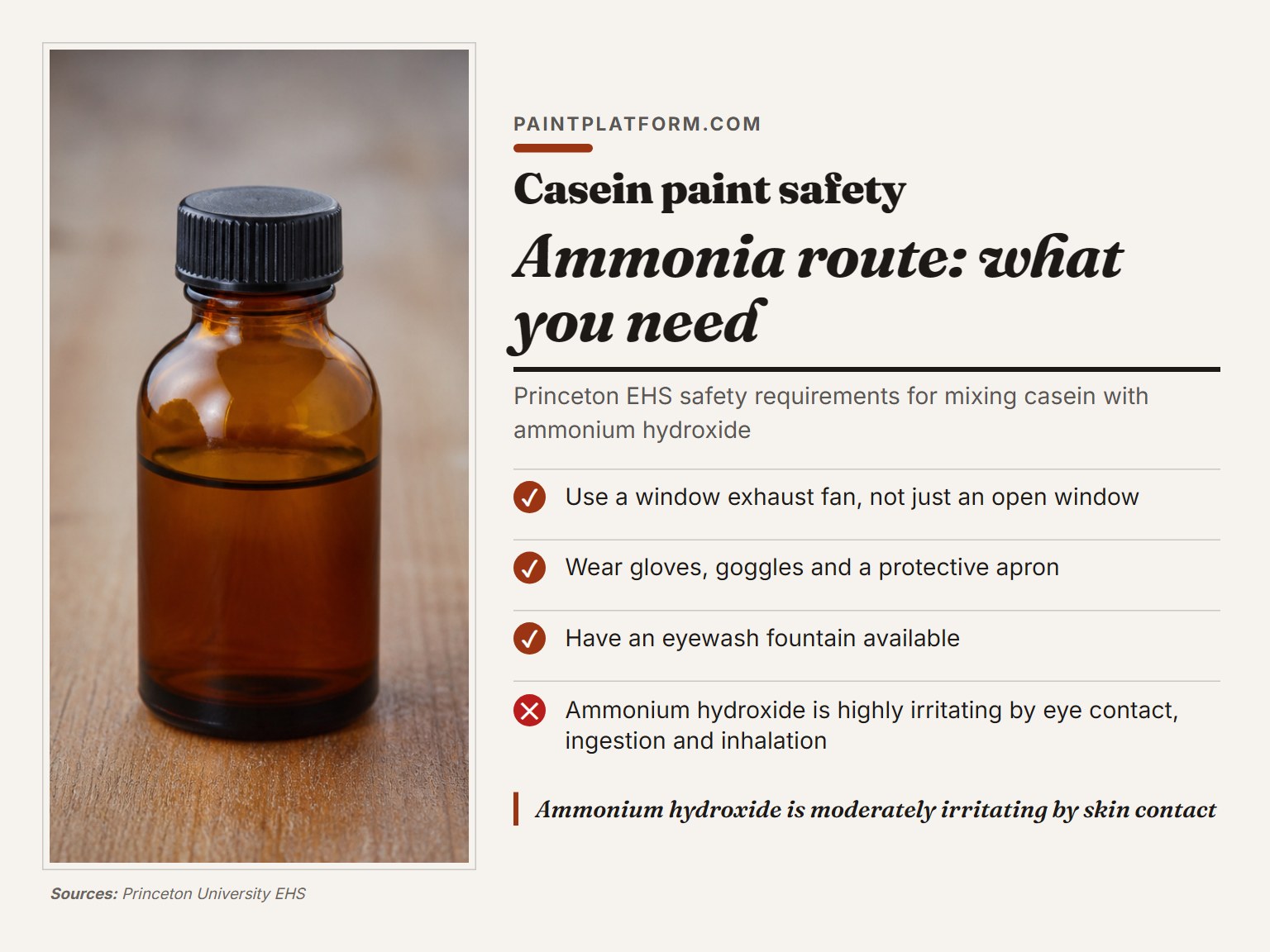
You unscrew the cap on the ammonium hydroxide and your eyes answer before your nose does.
Princeton’s painting and drawing safety page is blunt about the mechanism. Casein can be dissolved in ammonium hydroxide, which is moderately irritating by skin contact and highly irritating by eye contact, ingestion, and inhalation.
- Ventilation: a window exhaust fan, not just an open window, when you mix with ammonium hydroxide.
- Skin and eyes: gloves, goggles, and a protective apron, with an eyewash fountain available.
- Preservatives: all water-based paints carry one, and some cause allergic reactions. Skip sodium fluoride, phenol, and mercury compounds if you mix your own.
- Short-term option: a small amount of pine oil works for short periods in tempera.
Ventilate first.
The borax route is the calm one for a kitchen table, and it’s why I mix it in a small apartment without drama. The ammonia route earns its place when you need fast wetting, and it earns a fan and a pair of goggles along with it.
Frequently Asked Questions
Can you use casein paint on canvas?
International Artist says thin layers on flexible paper and gessoed canvas are fine, with only thick impasto needing a rigid substrate, while Langridge says casein should be used on non-flexible supports only; the sources disagree on flexible supports.
How long does mixed casein paint last?
It depends which product you made. NBS Letter Circular 386 says to use the paint the same day it is mixed, even though it passes an 18-hour remix test. Langridge says binder kept for days or weeks needs a biocide, while borax-casein made with boiled water in clean containers stores half a year or longer without one.
Is casein paint the same thing as milk paint?
Practically, yes. Casein is the milk protein that acts as the binder in what most people call milk paint, and the two names are used interchangeably. The difference is usually in formulation and pigment load rather than in the chemistry.
Do you need a preservative in casein paint?
Princeton EHS notes that all water-based paints contain a preservative to prevent mold and bacterial growth, and that some preservatives cause allergic reactions. Langridge requires a biocide for binder kept days or weeks, but reports that clean borax-casein stores half a year without one. Avoid sodium fluoride, phenol, and mercury compounds.
What brushes should you use with casein paint?
Inexpensive synthetic flats, rounds, and filberts are the recommendation from International Artist, which warns that sable and Kolinsky fibers are damaged over time by the paint. The weaker binding strength compared with acrylic also makes casein gentler on brushes generally.
How long does casein paint take to dry?
Stroke dries to the touch in a few minutes to ten minutes on a fair weather day, per International Artist. NBS set a slower standard for mixed cold water paint: set to touch within 2 hours and dry within 12. Neither number means cured, since the protein keeps bonding overnight to a couple weeks.
Before You Go
Here’s the threshold that decides most of this. If you’re painting anything thicker than a thin opaque passage, the support decides whether the painting survives, and no recipe rescues a thick film on a flexing ground.
So this week: mix one small borax batch, paint a board, varnish half of it, and look at both halves tomorrow morning in daylight. That single board will teach you more about gloss, opacity, and cracking than another hour of reading.
Everything above assumes you want to mix from powder. You don’t have to start there. Tubed casein from a supplier, still made in about 40 colors by the company that acquired Shiva, is a legitimate first step before buying a bag of casein powder and a jar of borax.
Start messy. The board doesn’t care.
