
Milk Paint Pros and Cons: When It Actually Works
This post contains affiliate links. As an Amazon Associate, we earn from qualifying purchases.
Milk paint pros and cons balance a breathable, zero-VOC finish with a 15-50 year interior life against a porous film that stays water-vulnerable for roughly 30 days after application. It suits furniture and dry interior trim. It fails on floors and in wet kitchens.
That 30-day window is where the milk paint pros and cons question really bites, because casein and lime are still reacting with air and moisture. A splash in week two can leave a spot that never fully evens out. The chemistry that makes milk paint breathe is the chemistry that makes it fragile early on.
What follows is the honest split: where milk paint outperforms a modern acrylic, where it fails, and how the manufacturers themselves disagree on the basics.
Key Takeaways
- The first month is the danger zone. Milk paint takes about 30 days to fully cure and can spot if splashed before then.
- Floors are out. Porter’s Milk Paint is not rated for floor surfaces.
- Mix only what you’ll use today. Porter’s says to mix only what you need right away, and the Endeavour Centre gives a 20-60 minute reaction window with refrigerated leftovers lasting 7-10 days, while BHG says mixed solution is storable up to a week.
- Zero VOC does not mean zero ventilation. Dry powder contains silica dust, and the lime content is mildly caustic to skin.
What Milk Paint Is Made Of (and Why the Powder Matters)
Casein is the milk protein that does the work. It opens up in the presence of lime or borax, becomes soluble, and dries into a glue-like film that bonds with porous surfaces rather than sitting on top of them, a behavior covered in more depth in our casein paint guide.
Milk paint is a dry powder of casein, lime, clay fillers, and pigment that is mixed with water before use. Casein reacts with the lime once water is added, and the mixture must stand for at least twenty minutes before brushing. The resulting film bonds into porous substrates and cures over roughly thirty days.
The U.S. Bureau of Standards started testing paste casein cold-water paints in June 1929 and dry-powder samples in September 1931. By the time it published its suggested specification in 1933, it had tested roughly 100 samples. One brand stayed stable in the can for 32 months. Many others went putrid within one or two months.
That smell is the tell. A can of milk paint powder that has gone off has a pronounced disagreeable (putrid) odor, and the 1933 spec says to reject the shipment on the odor alone.
The same document set a mixing test: 100 grams of powder, 100 milliliters of water at 70°F, stirred and left to stand 20 minutes. That 20-minute wait still shows up in modern guidance, which tells you the chemistry hasn’t changed much in ninety years.
| Source | Mix ratio | Wait before use | Notable rule |
|---|---|---|---|
| Porter’s Milk Paint | 600 ml water per 1 kg | Stir 3-4 minutes | Mix only what you need |
| Rust-Oleum Milk Paint | Follow the can label | Stir well | Interior only |
| NBS LC-386 (1933) | 100 ml water per 100 g | 20 minutes | Reject on putrid odor |
| Endeavour Centre | Until creamy | 20 minutes minimum | 20-60 minute reaction window |
The Honest Advantages of Milk Paint
Fifteen to fifty years is the interior lifespan the Endeavour Centre gives milk paint in dry areas, and it is the strongest entry on the milk paint pros and cons ledger. That’s the number to hold onto when someone calls it a primitive finish.
Here’s what actually holds up:
- Zero VOC at the can. Porter’s Milk Paint is listed at 0 g/L VOC on its specification sheet.
- Five naturally occurring ingredients. A 2014 CSB/SJU environmental studies capstone found both Miss Mustard Seed’s Milk Paint and Real Milk Paint are made with five naturally occurring ingredients.
- Fewest hazards of ten paints tested. That same capstone ranked those two milk paints as the lowest human and environmental health hazards in its comparison.
- Breathable film. The Endeavour Centre describes milk paint as reasonably permeable, though it also notes there’s no published standard to measure that.
- Compostable leftovers. Leftover paint can go on the compost pile or down the drain.
The zero-VOC claim deserves a caveat, because labels in this category get loose. Porter’s lists 0 g/L on its own spec sheet, and that’s a real number. A can that just says “natural” on the front is telling you nothing you can verify, so it helps to know the types of natural paint before you buy.
Where Milk Paint Falls Short: Water, Wear, and the Curing Month
Water is the enemy, and the first month is when it wins.
Where this goes sideways: A splash in week two. Milk paint takes about thirty days to fully cure, and the Endeavour Centre warns the film can show spotting within the first month if water hits it. A wet rag on day 12 leaves a mark that a second coat may not hide.
The failure modes cluster:
- Too many coats. The Endeavour Centre notes that adding more coats makes milk paint more vulnerable to cracking and peeling over time. The film stops soaking in and starts behaving like a coating.
- Kitchen cupboards. Porter’s warns that oil and cooking stains will inevitably appear on milk-painted kitchen cupboards and are hard to remove from the porous film.
- Floors. Porter’s Milk Paint is not suitable for floor surfaces.
- Cold or hot application. Rust-Oleum Milk Paint is rated for 50°F to 85°F (10°C to 32°C) and below 85% humidity.
A milk-painted cabinet door that has been splashed near the sink has a dull, chalky ring where the water sat. It doesn’t look wet. It looks faded.
The durability picture is also less clean than the marketing suggests. The Endeavour Centre rates milk paint’s durability as “low to moderate.” Porter’s markets its product as a traditional furniture finish without assigning a durability grade at all. A 2014 CSB/SJU capstone went further and found milk-based paints had the worst performance of the categories it analyzed.
Which Surfaces Should You Never Put Milk Paint On?
Floors and wet kitchens are the two hard nos. Exterior is contested, and I’ll get to that.
| Surface | Verdict | Why |
|---|---|---|
| Furniture, dry interior trim | Good fit | Bonds into porous wood, 15-50 year interior life |
| Kitchen cupboards | Use with caution | Oil and cooking stains will inevitably appear |
| Floors | No | Porter’s Milk Paint is not suitable for floors |
| Exterior wood | Contested | NPS says far more commonly interior; Endeavour says ~10 years colorfast |
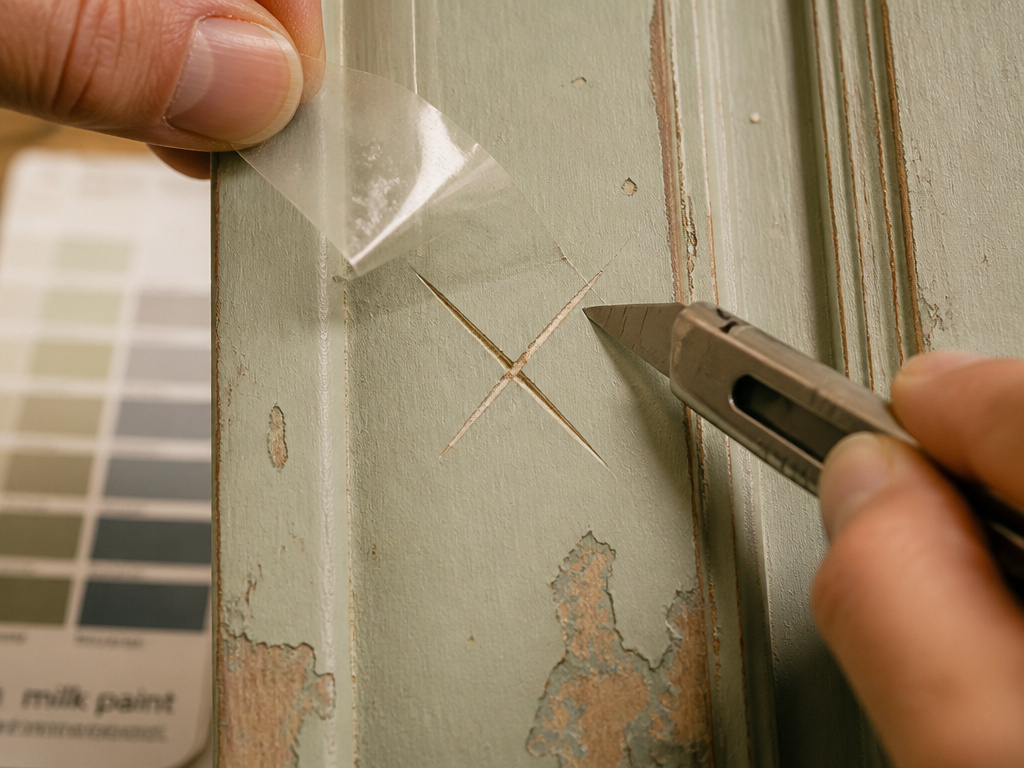
| Previously painted | Test first | X-cut tape test; do not paint over failing paint |
| Metal or plastic | Needs binder | Acrylic binder required per Endeavour Centre |
Porter’s gives a specific test for previously painted surfaces. Cut an X about 3 cm across with a sharp blade, press adhesive tape over it, and pull fast. If the old paint lifts with the tape, do not paint over it.
I once tried a paint-and-primer-in-one over a brown water ring, and the stain bled back through. On a sound, previously painted wall, that same combo paint works fine. Milk paint isn’t a blocker either, so treat any tannin or water stain as a separate problem with a separate product.
How Do You Mix and Apply Milk Paint Correctly?
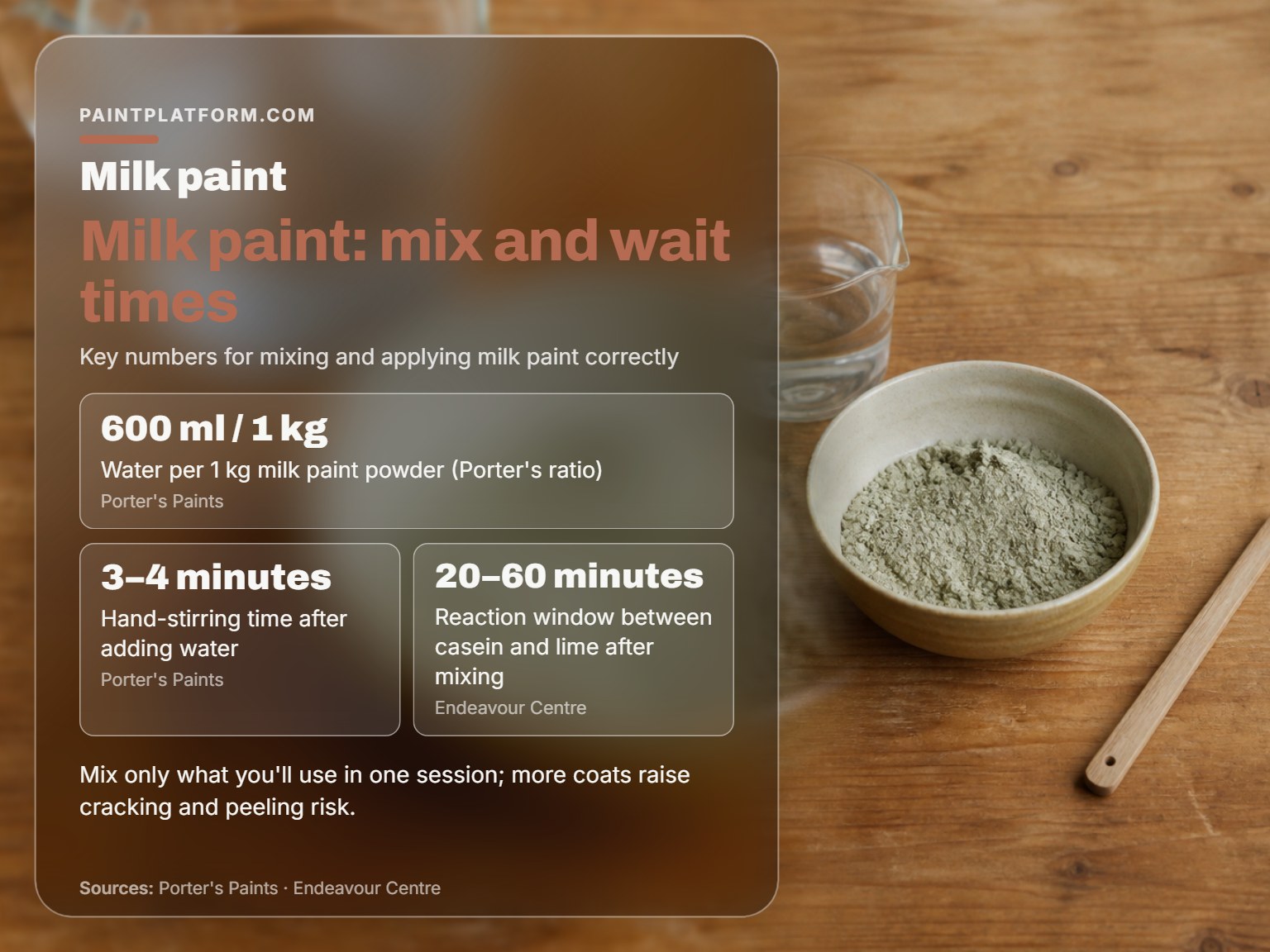
Mix only what you’ll use in one session, stir longer than feels necessary, and give the paint 20 minutes to react before the first brush stroke.
Before you start: Dry milk paint powder contains silica dust, so wear a respirator while handling it. The lime content is mildly caustic, so gloves and eye protection are worth the two minutes.
- Measure the powder first. Porter’s suggests about 600 ml of water per 1 kg of milk paint, though the ratio shifts batch to batch.
- Add water slowly and stir by hand for 3-4 minutes. You’re aiming for a smooth pancake-batter consistency, not a thin wash.
- Let it stand 20 minutes minimum. The Endeavour Centre gives a 20-60 minute window for the casein-lime reaction to finish.
- Brush in a V pattern with a synthetic brush. Rust-Oleum’s label recommends this, and it helps the thin film level out.
- Plan on two or three coats for full opacity. The Endeavour Centre gives this as the typical range.
- Skip the extra coat if you can. More coats raise cracking and peeling risk over time.
The first coat looks terrible. It streaks, it grabs the brush, and it shows every sanding mark you thought you had removed. That’s normal.
One thing I’ve watched again and again is paint drying darker than it looked wet. Milk paint is no exception, and the chalky finish makes the shift feel bigger than it is. Mix a shade lighter than you want, and let the first coat dry before you judge it.
Small confession: I have mixed a batch, wandered off, and come back to a tub of paint that had already started to set. The 20-60 minute reaction window is real, and it does not wait for you.
Milk Paint vs Chalk Paint vs Mineral Paint
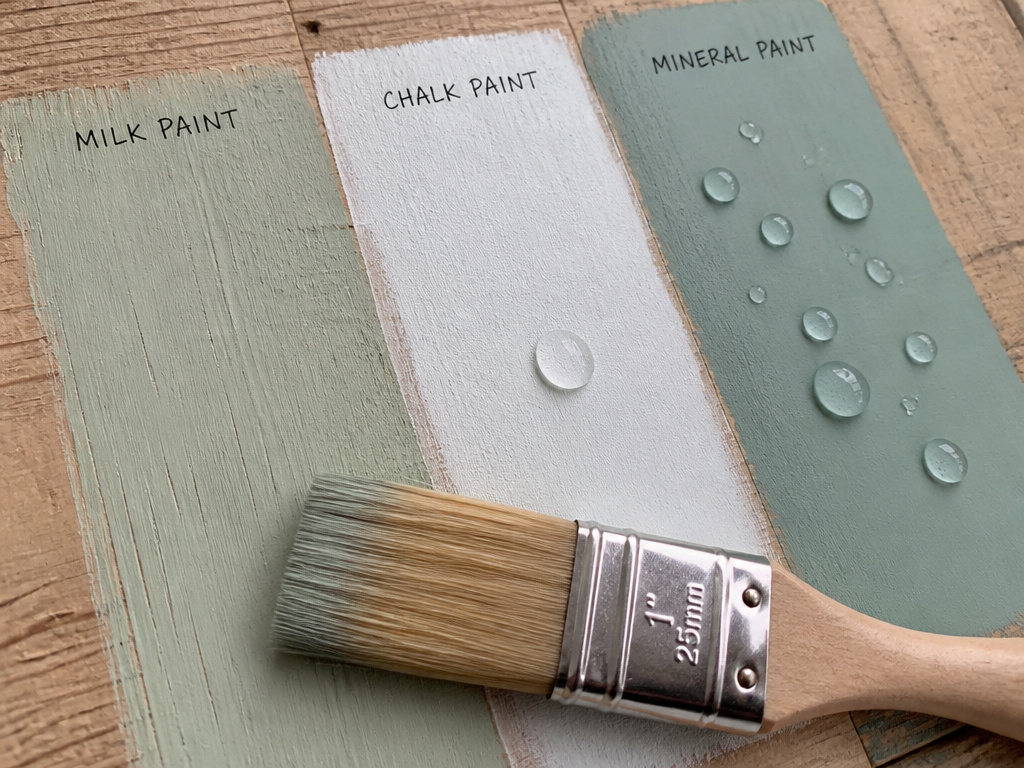
Three finishes get grouped together because they all look matte and old. They behave differently once water and wear show up.
Chalk paint is easier to apply over almost anything, because it’s designed to bond without sanding, which is one of the key differences in our milk paint vs chalk paint comparison. Milk paint is fussier about the surface but gives you a breathable film that ages into the wood instead of sitting on top of it.
Mineral paint is a different chemistry altogether, and I wouldn’t lump it in with milk paint for a furniture project, so see our mineral paint pros and cons before choosing it.
Here’s the winner-per-use-case version:
- Raw wood furniture, dry room: milk paint. It bonds into the substrate and the 15-50 year interior life is real.
- Previously painted furniture, unknown layers: chalk paint. It’s the forgiving option when you don’t want to strip.
- Anything near water: neither. Use a modern acrylic, or note that BHG says milk paint needs a top coat to properly seal while the Endeavour Centre treats oil or wax as optional.
- Decorative trim: milk paint with a Porter’s wax over it (Bee’s Wax, Black Antique Wax, Lime Wax, or Stucco Wax).
Where the Sources Disagree
Four disagreements show up across the manufacturer sheets and the federal guidance, and they matter more than the marketing copy suggests.
| Question | Position A | Position B |
|---|---|---|
| Exterior use | NPS: sometimes exterior, far more commonly interior | Endeavour Centre: protects wood, colorfast ~10 years |
| Topcoat | BHG: needs a top coat to properly seal | Endeavour Centre: oil or wax optional, reduces permeability |
| Pot life of mixed paint | BHG: storable up to a week | Endeavour: 20-60 min reaction window; 7-10 days refrigerated |
| Durability | Endeavour: low to moderate | Porter’s: no durability grade, markets as traditional finish |
The topcoat question is the one that matters most for a buyer. A topcoat reduces permeability while increasing water repellency, per the Endeavour Centre. So if you sealed the paint to protect it, you also traded away the breathability that made you pick milk paint in the first place. That’s a real trade, and the “needs a topcoat” advice glosses over it.
The part nobody mentions: No published standard exists to measure milk paint permeability. The Endeavour Centre says so directly. So when a brand claims a specific breathability number, ask what test it used, because there’s no industry test to point to.
On exterior use, the NPS preservation guidance is the more cautious read. It says milk paints with drying oils or hydrated lime were “sometimes” used exterior in the U.S. But “far more commonly” interior. If you go exterior anyway, sand or replace weathered wood to fresh wood first, which is the NPS best practice.
The Endeavour Centre milk paint entry is the source for most of the lifespan and cure numbers here. The NPS traditional paint preservation guide covers the exterior case in more depth. The NIST casein cold water paint specification is the 1933 document itself, and it’s worth a skim if you want to see what a real paint spec looked like before acrylics. The CSB/SJU green paint study is the source for the hazard ranking and the performance finding.
Frequently Asked Questions
Is milk paint actually more eco-friendly than regular paint?
The 2014 CSB/SJU capstone ranked Miss Mustard Seed’s Milk Paint and Real Milk Paint as the two lowest-hazard paints in a ten-product comparison. Both are made with five naturally occurring ingredients. Porter’s lists 0 g/L VOC. That said, the same study found milk paints had the worst performance of the categories tested, so “eco-friendly” and “durable” are pulling in different directions here.
Does milk paint need a topcoat?
Sources disagree. BHG says milk paint needs a top coat to properly seal. The Endeavour Centre treats oil or wax as optional and notes that a topcoat reduces permeability, which is the opposite of what a breathability claim suggests. Porter’s recommends wax on decorative trim specifically.
Can you use milk paint on kitchen cabinets?
You can, but Porter’s warns that oil and cooking stains will inevitably appear and are hard to remove from the porous film. Use it only if you want the aged, worn look that comes with that.
How long does mixed milk paint last?
The Endeavour Centre gives 7-10 days refrigerated. Porter’s says mix only what you need right away. The 20-60 minute reaction window is about when the paint is ready to apply, not how long it keeps.
Can milk paint go outside?
This is contested. The NPS preservation guidance says milk paints with drying oils or hydrated lime were sometimes used exterior in the U.S. But far more commonly interior. The Endeavour Centre says exterior use protects wood and stays colorfast about 10 years. If you go exterior, sand or replace weathered wood to fresh wood first, per NPS.
Is milk paint safe to breathe?
Dry powder contains silica dust, so wear a respirator while handling it. Once mixed, the main risk is the lime content, which is mildly caustic to skin. Gloves and eye protection are worth it.
The Bottom Line
If you’re painting a piece of furniture that lives indoors and stays dry, milk paint is a real choice with a long track record. Buy a small bag of powder, mix only what you need for one session, and test it on the back of the piece before you commit.
One rule that will save you a repaint: if the piece lives where it will get splashed, skip milk paint. A bathroom vanity, a kitchen sink run, a floor. Those are jobs for a different finish.
Everything above assumes dry interior conditions, and that assumption is doing a lot of work. Step outside that envelope and the 15-50 year number stops applying.
