
How to Spray Paint Glass: Step-by-Step (No Drips)
This post contains affiliate links. As an Amazon Associate, we earn from qualifying purchases.
To spray paint glass, scrub the pane with 70/30 isopropyl alcohol and #000 steel wool until it squeaks, then spray 3 to 4 thin coats, waiting at least 5 minutes between passes. Glass offers no tooth for paint to grip, so adhesion comes from a clean surface. Skip the scrub and the film lifts at the first wipe.
That coat count is where the how to spray paint glass datasheets split. Glassprimer’s FAQ says 3 to 4 coats at 5 minutes apart. PPG’s Selemix process asks for 2 to 3 with 5 to 10 minutes of flash-off. Asia Paint’s APM GF 8220 calls for 4 to 6 until you hit the effect you want. Same job, three answers.
The rest walks the full how to spray paint glass sequence: prep, mix, gun setup, coat schedule, cure, and cleanup. Where the three brands genuinely contradict each other, I’ll say so and name who holds which position, so you can match the advice to the can in your hand.
Key Takeaways
- Prep decides adhesion. Glass has no grain or pores, so 70/30 alcohol plus #000 steel wool does the job sandpaper does on wood.
- Thin coats, always. Glassprimer’s FAQ says 3 to 4 coats at least 5 minutes apart; PPG Selemix says 2 to 3 with 5 to 10 minutes flash-off; Asia Paint goes 4 to 6.
- Cure is the long part. GPPP083 reaches full cure in 24 to 72 hours at best, and up to 15 days when conditions slip.
- Watch the dew point. Glassprimer wants glass at least 5 F (3 C) above dew point and air above 40 F (4 C).
- Removal has a deadline. Glassprimer paint comes off cleanly only within 2 weeks of application.
Why Paint Slides Off Glass (and What Actually Holds It)
Glass is the least forgiving surface in the shop. Wood has grain and plaster has pits, so a coating has somewhere to bite. A float-glass pane arrives flatter and smoother than nearly anything else you’ll handle, and nothing mechanical holds paint there.
Adhesion to glass is chemical rather than mechanical, because the surface offers no pores or grain for a coating to grip. A film bonds only where the pane is free of oils, dust, and residue. Contamination left behind acts as a release layer, and the coating lifts or blisters wherever that layer sits.
That’s why every datasheet covered here spends more space on cleaning than on spraying. Glassprimer’s GPPP083 page and Asia Paint’s APM GF 8220 sheet both open their prep sections with the same alcohol-and-steel-wool routine. PPG’s Selemix sheet goes the other way and asks only for a solvent or alcohol wipe.
The steel wool isn’t there to scratch the glass. It lifts bonded contamination that a wet wipe alone just slides around the pane: fingerprints, silicone haze, kitchen grease.
Wipe a pane with alcohol only and it feels clean. Scrub it with #000 wool and you’ll hear the difference. A dull drag means something is still on the glass. A clean pane squeaks.
Plastic is a different animal, and it needs a bonding primer rather than a scrub. I skipped a plastic-bonding primer once and the paint scratched off with a thumbnail. Glass skips the primer entirely. What it needs is a scrub.
How to Spray Paint Glass: The Prep Both Brands Demand
Two of the three datasheets here open their prep section with the same instruction, almost word for word. Saturate the glass with 70/30 isopropyl rubbing alcohol, scrub with #000 or #0000 steel wool, then wipe dry with new paper towels until the surface squeaks.
Before you start: Solvent vapor pools low and ignites easily, so shut off pilot lights and open a window before you crack the acetone. Wear nitrile gloves and goggles; Asia Paint’s APM GF 8220 sheet calls for overalls, goggles, dust mask, and gloves, and warns against breathing vapor or spray mist. Keep a wet rag within reach for drips.
- Strip or mask the hardware. Pull gaskets, handles, and vents, or tape them with low-tack tape. Paint that bridges a gasket anchors to it, and the bond tears the film the first time the part moves.
- Flood the pane with alcohol. Saturate rather than mist. A light mist flashes off before it can dissolve the oils you’re trying to lift.
- Scrub with #000 or #0000 steel wool. Keep the wool wet the whole time. Dry wool drags and leaves a haze that shows through a dark coat.
- Wipe dry with new paper towels. Glassprimer specifies paper towels, not lint-free cloth. A reused rag puts the oil straight back on the glass.
- Re-wipe the perimeter last. Handling marks collect at the edges, and that’s where lifting starts.
PPG’s Selemix sheet skips the steel wool entirely. It asks for a clean, dry surface degreased with solvent or an alcohol-based glass cleaner, applied above the dew point.
I’d still scrub. Two of three manufacturers call for it, and the one that doesn’t is describing fresh glass in a spray booth. If you’re working on a backsplash that’s been up for years, the wool is doing the real work.
Mixing Ratios: 7:1, 4:1, and 1000:200:85:85
Glassprimer’s GPPP083 mixes 7 parts paint to 1 part GPUC083 catalyst. The waterborne GPWB128 runs 4 parts paint to 1 part GPWBC128 catalyst. Asia Paint’s APM GF 8220 is 4:1 as well. PPG’s Selemix goes by weight instead.
| Product | Mix Ratio | Pot Life | Dry Film Thickness |
|---|---|---|---|
| Glassprimer GPPP083 | 7:1 paint to GPUC083 catalyst | 2-3 hours | 2.5-5.5 mil |
| PPG Selemix 7-536/7 | 1000:200:85:85 by weight | 3 hours, or 1-2 hours with 1-490 thinner | 50-100 um |
| Asia Paint APM GF 8220 | 4:1 | 5 hours at 30 C | 30 um |
Look at the last column. Asia Paint specifies 30 um. Selemix specifies 50 to 100 um. Glassprimer’s 2.5 mil minimum works out to about 63.5 um. That’s a wide spread for products all sold as glass paint, so follow the sheet for the can you bought rather than the average.
Pot life matters more than it looks. GPPP083 gives you 2 to 3 hours once the catalyst is in. Selemix gives 3 hours, or 1 to 2 with the 1-490 thinner. APM GF 8220 runs 5 hours at 30 C.
Mix only what you can spray inside the pot life. A half batch sprayed at the right consistency beats a full batch that turns to jelly in the cup.
Mixing a batch is like seasoning a soup. You add a little, stir, and check. Nobody rescues an over-thinned batch by dumping in more paint and hoping.
Easy to miss: Selemix’s datasheet warns against combining 1-490 Thinner with 6-550 Accelerator. Both speed drying, and using them together is a shortcut the sheet explicitly rules out.
Glassprimer asks for a 5-minute digest after mixing, and a pass through a paint strainer before the gun. Both are cheap. Both show up later if you skip them.
The Heavy Coat That Ran Down the Jar
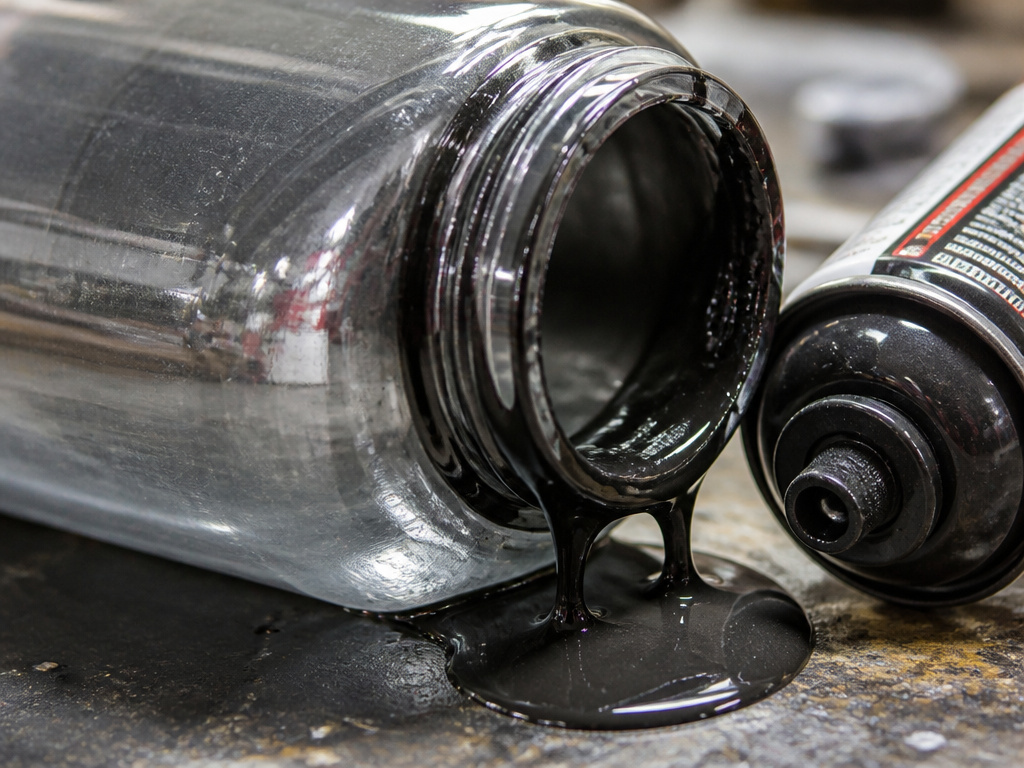
The first jar I ever sprayed got one heavy coat, because thin coats looked like they’d take all afternoon. The paint ran down the side in a slow bead and pooled at the base. It looked like a sad candle.
That’s exactly what the coat counts on the datasheets exist to prevent.
| Source | Coats | Interval Between Coats |
|---|---|---|
| Glassprimer FAQ | 3-4 | At least 5 minutes |
| PPG Selemix 7-536/7 | 2-3 | 5-10 minutes flash-off |
| Asia Paint APM GF 8220 | 4-6 | Minimum 2 hours overcoat |
The spread is real, and it comes from the products rather than from sloppy writing. APM GF 8220 has a 30 um dry film. Selemix has a dry film thickness of 50 to 100 um. Glassprimer’s GPPP083 is a different chemistry again, with a 2.5 mil minimum.
Coats build film thickness, and film thickness is what those numbers are really about. Too thin and the color goes translucent and uneven. Too thick and the cure stretches out. Glassprimer says outright that film above the recommendation makes cure substantially longer.
A coat that’s too heavy shows up as a wet gloss line that keeps moving after you stop spraying. If the sheen is still sliding, stop and let it flash.
The fix is the same one behind a smooth spray finish technique on any surface: keep the gun moving and overlap each pass by half.
I spray glass in 3 or 4 very light mist coats at least 5 minutes apart, and I stop while the color still looks a shade too light. It darkens as it flashes. Every time I’ve chased the final color wet, I’ve flooded it.
Which Glass Paint Should You Buy?
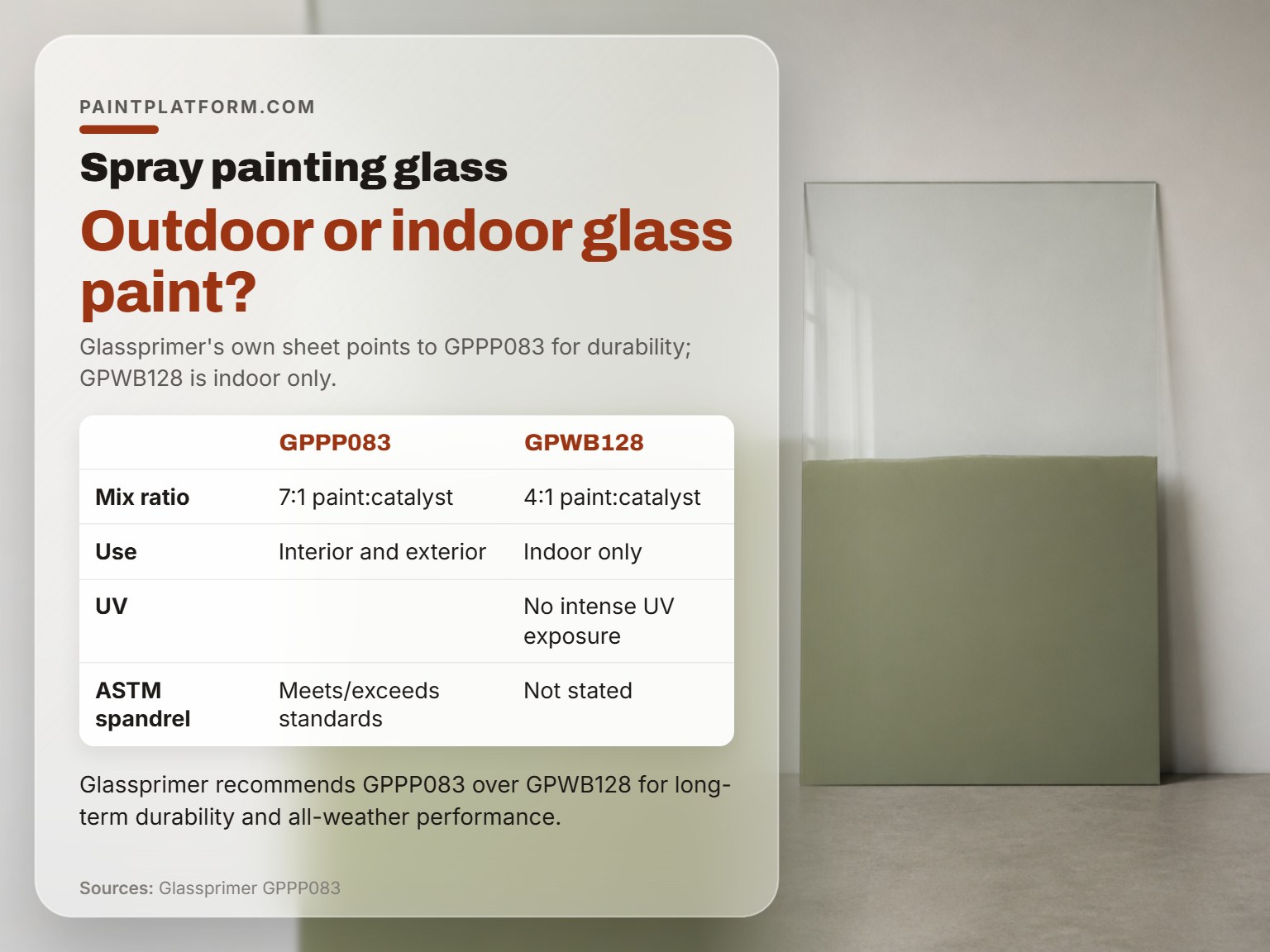
Four products cover nearly every back-painted glass job, and the choice comes down to whether the glass faces weather.
GPPP083 vs GPWB128
Glassprimer makes both, and the company’s own sheet points at GPPP083 for durability. GPPP083 is rated for interior and exterior architectural glass and meets or exceeds ASTM standards for spandrel glass coatings. GPWB128 is indoor only, and the sheet warns against intense UV exposure.
For a kitchen backsplash, either works. For a door panel, a signage face, or anything that sees sun, GPPP083 is the one. Glassprimer says as much in the GPWB128 warning box.
Selemix vs APM GF 8220
Selemix 7-536/7 is built for spray shops, with a bake schedule of 60 C for 45 minutes and a nozzle chart split by feed type. It also handles glitter effects: 0.5 to 2.5% glitter in the 7-110 binder, recoated after at least 10 minutes with 7-536/7.
APM GF 8220 has a 30-minute touch dry and a 4-hour hard dry. That fast window suits anyone working without a booth.
- Glassprimer GPPP083 for anything outdoors or long-term. Interior and exterior rated, ASTM spandrel standard.
- Glassprimer GPWB128 for indoor panels where low odor matters. Indoor only, no intense UV.
- PPG Selemix 7-536/7 for a shop with a bake oven and proper ventilation.
- Asia Paint APM GF 8220 for brush or spray work that needs a fast touch dry.
For a first back-painted backsplash, GPPP083 is the safe pick. It’s the product Glassprimer itself points to when durability is the question, and the 7:1 mix is forgiving.
If you’d rather work from a rattle can than a gun, the options narrow fast. Spray paint for glass covers which aerosol products actually bond.
Gun Setup: Tip Size, Pressure, and the Thinning Argument
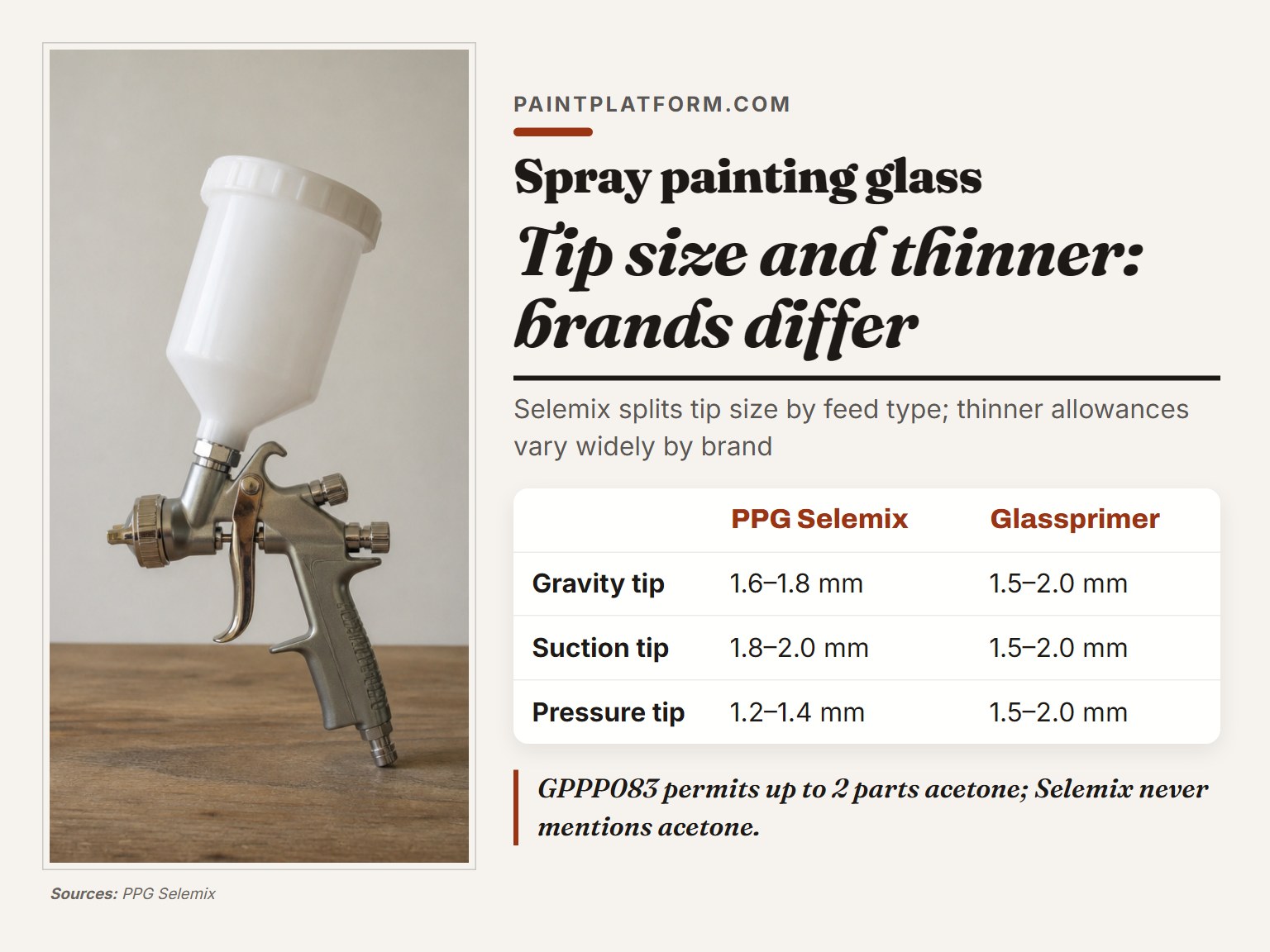
Selemix’s datasheet splits nozzle size by feed type, which tells you how much the gun matters. Gravity feed takes 1.6 to 1.8 mm. Suction feed takes 1.8 to 2.0 mm. Pressure feed takes 1.2 to 1.4 mm.
Glassprimer’s FAQ gives one number for all of them: an HVLP gun with a 1.5 to 2.0 mm tip, spraying at 40 to 120 psi, while PPG Selemix splits tip size by feed type. Both ranges overlap, so a 1.6 to 1.8 mm gravity gun sits inside both recommendations. Start there.
Thinning is where the brands really separate. Glassprimer’s FAQ recommends 15%, about 1 part acetone, while the GPPP083 sheet permits up to 2 parts acetone and Asia Paint allows up to 100% by volume. The GPPP083 product sheet permits up to 2 parts acetone, which is a much wider allowance. Asia Paint allows up to 100% by volume with APM Lacquer Thinner AAA. Selemix wants its own 1-470, 1-480, or 1-490 thinners and never mentions acetone.
None of the three sheets says its thinner works in another brand’s product. Treat them as brand-specific and don’t improvise across brands.
Start at the low end of your product’s allowance, Glassprimer’s FAQ suggests 15% (about 1 part acetone), though the GPPP083 sheet permits up to 2 parts and Asia Paint up to 100% by volume, spray a test pass on scrap, and add more only if the gun is spitting or the film looks pebbled. Acetone hits your nose the second the lid comes off, and it lingers on the rag afterward.
Gun distance and booth setup matter as much as the mix. Avoid overspray covers masking and airflow before you load the cup.
Why Does Glass Paint Take 15 Days to Cure?
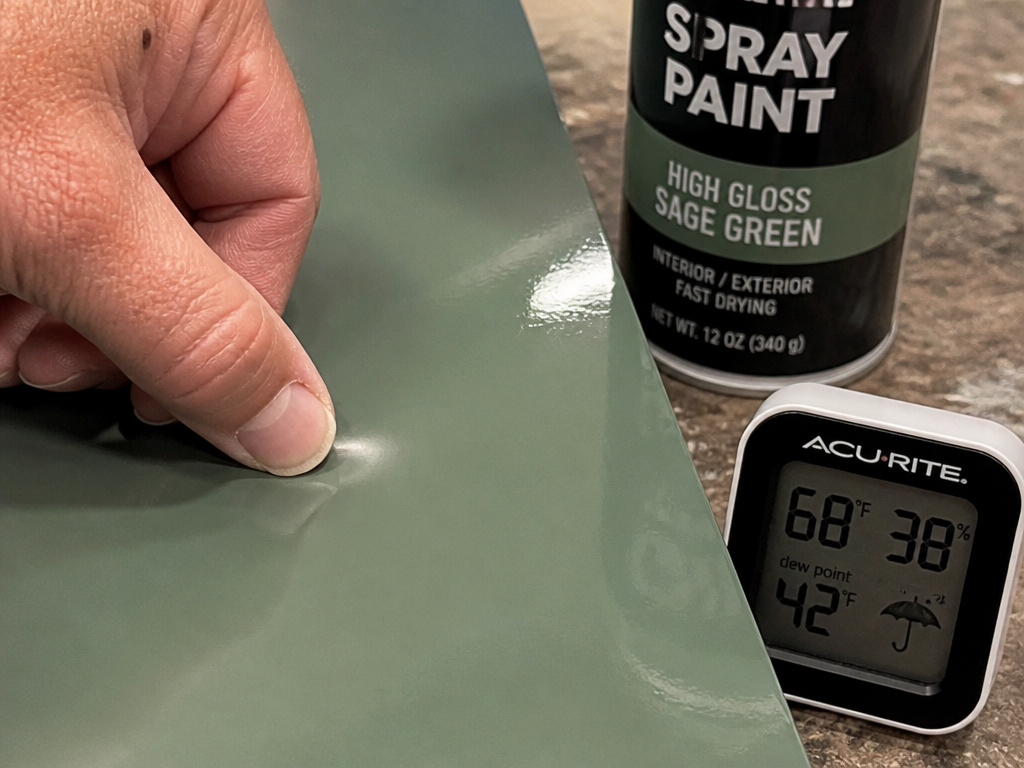
Because cure time tracks film thickness and conditions, not a fixed clock. Glassprimer puts GPPP083 full cure at 24 to 72 hours in optimal conditions. Push the conditions and it stretches to 15 days. GPWB128 goes to 20 days under the same caveat.
The company’s own field test is a fingernail. Press a nail into the painted surface with force. Any visible indentation means it needs more time. No indent, and it’s ready to install.
Temperature and dew point set the floor. Glassprimer requires air above 40 F (4 C) and glass surface at least 5 F (3 C) above the dew point. Selemix says only that the surface must sit above the dew point, with no numeric margin.
I’d take the Glassprimer number even when I’m spraying Selemix, though Selemix itself specifies only that the surface sit above the dew point with no numeric margin. That 5 F margin is cheap insurance against condensation forming on the glass while the film is still open.
Film thickness is the other lever. Glassprimer says outright that cure becomes substantially longer if the paint goes on thicker than recommended. That’s the trap: chasing opacity with a wet coat turns a 3-day cure into a 15-day one.
Chasing opacity also causes spray paint runs, which is a separate problem with its own fix.
Fixing Runs, Overspray, and Paint You Want Gone
The run is easier to prevent than to fix. If you catch one wet, stop spraying and let it flash. Sanding a run while the film is still soft smears it across the panel and doubles the area you have to repair.
Once it’s cured, Glassprimer’s FAQ gives a repair path: sand the area with 220 to 320 grit, clean with rubbing alcohol, then repaint. The color can look lighter while wet, but the sheet says it blends once dry.
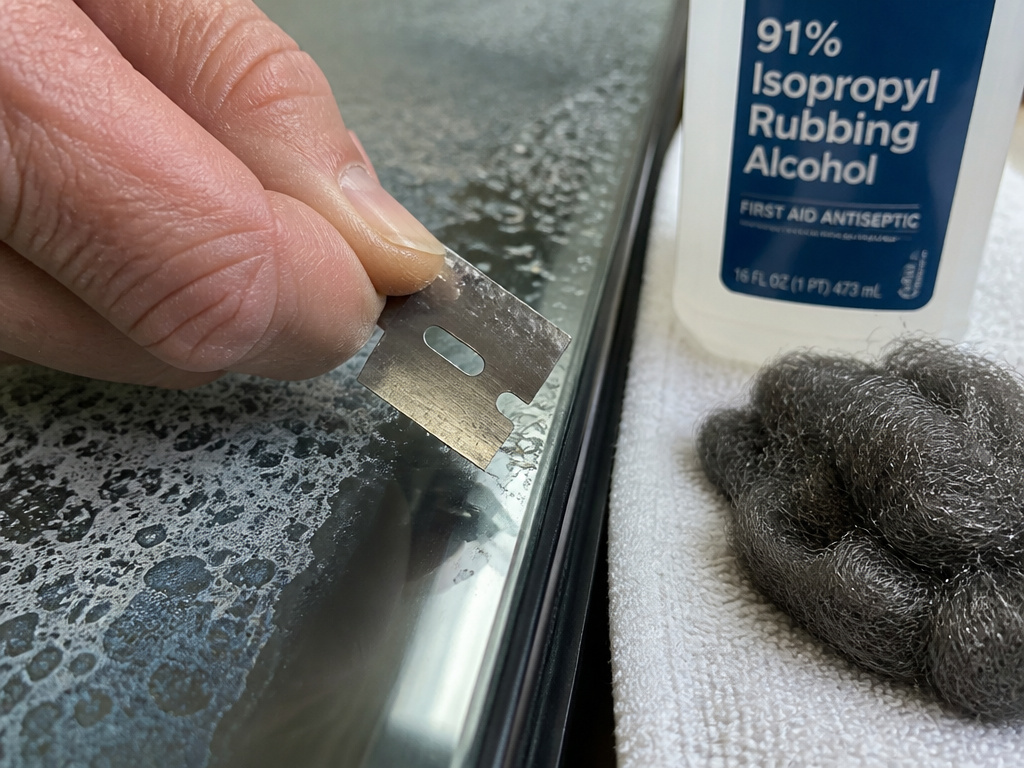
Overspray on the glaze side or the edges polishes off with #000 steel wool once the paint is dry. Larger areas take acetone and paper towels first. Thick layers come off with a single-edge razor blade, then a polish with #000 wool.
For dried latex or overspray on glass and tile, I use a fresh single-edge blade held at a low angle with a little soapy water. The water stops the blade skating and scratching. Skip the blade on plastic: warm soapy water and a fingernail or plastic scraper first. I clouded a plastic light cover with a solvent once trying to save time, and the dull patch never came back.
Glassprimer paint comes off cleanly only within 2 weeks of application. After that the bond is set and stripping is the only route. Cover the pane with conventional polyurethane stripper, let it stand about 15 minutes, then wash the loose paint off with water.
Clean the gun the same day. Spray acetone through it for 30 to 60 seconds until the stream runs clean, then break it down and soak the parts.
Where this goes sideways: Letting paint cure in the gun. Acetone cuts wet Glassprimer in under a minute and does almost nothing to a cured film, so a gun left overnight becomes a rebuild.
More detail on paint overspray and on how to remove paint from glass once it has fully hardened.
Small glass items are where coat count matters most. Spray painting small objects covers how to prop a jar or a votive so you can reach every side without touching wet film.
Frequently Asked Questions
Can you spray paint glass without sanding?
Yes. None of the three datasheets covered here calls for sandpaper. Glassprimer and Asia Paint both specify a steel wool scrub with 70/30 isopropyl alcohol instead, while PPG Selemix asks only for a solvent or alcohol-based glass cleaner wipe. The wool removes bonded contamination without leaving the visible scratch pattern sandpaper would.
Do you need a primer on glass?
No. Glassprimer describes GPPP083 as a self-priming, permanent-bonding coating. The prep step replaces the primer. On plastic you do need a bonding primer, which is where most people get the two substrates confused.
How long does spray paint take to cure on glass?
Glassprimer puts GPPP083 full cure at 24 to 72 hours in optimal conditions, and up to 15 days when temperature, humidity, or film thickness are off. GPWB128 runs to 20 days under the same caveat. Test with a fingernail before you install anything.
Can you spray paint tempered glass?
Tempered back-painted glass is only recommended when the glass will see fast temperature swings, like behind a stove or in front of a fireplace. If your project needs tempered glass, it has to be tempered before painting, not after.
What happens if you spray glass below 40 F?
Glassprimer requires air above 40 F (4 C) and glass at least 5 F (3 C) above the dew point, while Selemix says only that the surface must sit above the dew point with no numeric margin. Below that, condensation forms on the pane while the film is open, and the coating bonds to water instead of glass.
The Bottom Line
One number decides most of this: dry film thickness. Stay inside the range printed on the sheet for the product in your hand, and the coat count, the cure time, and the adhesion all fall into place. Blow past it chasing opacity and every other number covered here gets worse at once.
If you’re spraying a small jar or a votive, the shop-grade advice mostly doesn’t apply. Work in 3 or 4 light mist coats, stop while the color still looks a shade light, and give it the full cure time before you handle it.
And if the glass is already installed behind a stove, stop and confirm it’s tempered before you touch a gun. Tempering happens before painting or not at all.
Start small and stay curious.
