
How to Remove Paint Overspray: Step-by-Step
This post contains affiliate links. As an Amazon Associate, we earn from qualifying purchases.
To remove paint overspray, start with the least aggressive method and work up: wash the panel, clay it with lubricant, then polish, then wet sand. Chrysler caps polishing at 0.2 mils of clearcoat removal against a 1.5 mil film, which is why the mild steps come first.
That 0.2-mil ceiling sits against a film that runs about 1.5 mils on most vehicles, and it turns a vague “be gentle” warning into a number you can actually measure. Chrysler’s bulletin 31-001-13 pairs the limit with a gauge reading taken before and after the repair. Skip the gauge and you’re polishing blind. Knowing how to remove paint overspray without thinning the film is the same kind of measurable limit.
What follows is the order the manuals prescribe, the places where three manufacturers split, and the two situations that break the standard procedure: hot panels and character lines.
Key Takeaways
- Least aggressive first is written into Chrysler’s bulletin as a rule, not a suggestion.
- 0.2 mils is the polishing ceiling; 0.5 mils covers wet sanding plus polish combined.
- Clay moves in straight lines. Chrysler states that circular motion will create scratches.
- Subaru prohibits claying in direct sunlight or on a hot surface. Chrysler is silent on it.
- Tesla cuts body-line work from 15 seconds to 5 and drops buffer speed by 40-50%.
The 1.5-Mil Budget That Decides Everything
Chrysler’s overspray bulletin caps polishing at 0.2 mils of clearcoat removal, measured against a film that runs about 1.5 mils on most vehicles.
Clearcoat on most vehicles measures about 1.5 mils. Chrysler’s bulletin allows no more than 0.2 mils to come off during polishing, and no more than 0.5 mils across wet sanding plus polishing combined. Thickness is checked with a gauge before and after the repair. The specified gauge is PR-ETG-2X or an equivalent.
Read that again and notice what it implies. You get only a small fraction of the film before you’re into the color layer, and there’s no product that puts clearcoat back.
The gauge matters more than the compound. Chrysler names the PR-ETG-2X or an equivalent, and requires a reading before and after the work. If you don’t own one, the honest move is to stop at clay and let a shop handle anything deeper. You can read the full Chrysler overspray removal bulletin yourself.
Tesla’s manual takes a completely different approach to the same risk, which I’ll get to. First, the order of operations.
Which Method Comes First: Clay, Polish, or Wet Sand?
Which tool comes first when the panel is covered in a fine grit of somebody else’s paint?
I once rushed a second coat onto a piece that wasn’t dry. The underlayer lifted into streaks and I lost work scraping it back. Overspray removal punishes the same impatience, just with a clearcoat budget instead of a canvas.
So the how to remove paint overspray order matters more than the product. Chrysler’s bulletin says it plainly: always begin with the least aggressive method. Here’s the ladder, and what happens when you skip a rung.
Before you start: A rotary buffer can permanently damage painted surfaces if it isn’t used correctly, which is why Chrysler restricts it to trained technicians. Wet sanding removes film you cannot put back, so measure with a gauge before and after. Polishing compound mist needs ventilation and eye protection.
Start with soap, water, and a wash mitt
- Wash the affected area with soap and water before anything else. Dirt trapped under a clay bar turns the bar into sandpaper.
- Work a 12″ x 12″ (305 mm x 305 mm) area at a time and mist it with detail spray. Chrysler names Meguiars Final Inspection; Subaru specifies 3M Body Shop Clean-Up Car Wash Soap P/N 38377 as its clay lubricant.
- Clay as your chosen manual directs. Chrysler’s note is blunt about circular motion creating scratches and calls for unidirectional passes, while Subaru gives no directional instruction and a masking supplier’s guide describes a rubbing motion with no directional restriction.
- Wipe the residue with a microfiber cloth, then move to the next section.
- If clay won’t lift it, step up to a DA polisher with a foam finishing pad and Meguiars So1o Cut & Polish Cream (M8632) or an equivalent compound.
- A rotary buffer comes next, and only in trained hands. Skip the training and you can permanently damage the painted surface.
- Wet sand with Meguiars Unigrit 2500 in a unidirectional pattern, then polish again to clear the sand scratches.
Wipe the residue with a microfiber cloth, then move to the next section.
The how to remove paint overspray order is the same logic that governs general spray paint removal: the mildest tool that works, applied to the smallest area you can manage.
Why Chrysler, Subaru, and Tesla Give Different Instructions
Three manufacturers, three different answers, and the disagreement is real enough that you should pick one manual and follow it rather than blending them.
Chrysler controls the job by thickness. Subaru controls it by conditions, banning clay on hot or sunlit panels. Tesla controls it by time, speed, and pressure, with no mil limit anywhere in the procedure.
| Step | Chrysler 31-001-13 | Subaru 00-17-06 | Tesla Model Y |
|---|---|---|---|
| Decontamination tool | Mild clay bar, straight passes | 3M Perfect-It III clay | Decontamination mitt |
| Lubricant | Meguiars Final Inspection spray | 3M Car Wash Soap P/N 38377 | Detail spray |
| Removal limit | 0.2 mils polish, 0.5 mils sand | None stated | Time, speed, pressure |
| Escalation trigger | After all mechanical steps fail | Not addressed | Under 50% after 3 cycles |
None of these is wrong. They’re three ways of solving the same problem, and the differences tell you what each manufacturer worries about.
Chrysler worries about film loss, so it gives you a gauge and a number. Subaru worries about heat and contamination, so it gives you a prohibition and a disposal rule. Tesla worries about technician technique, so it gives you seconds and percentages.
I’d rather see someone clay a panel twice than jump to a polisher once. Clay is slow and boring and it almost never costs you clearcoat. A polisher is fast and it can cost you a repaint.
Where Overspray Comes From and Why Waiting Makes It Worse
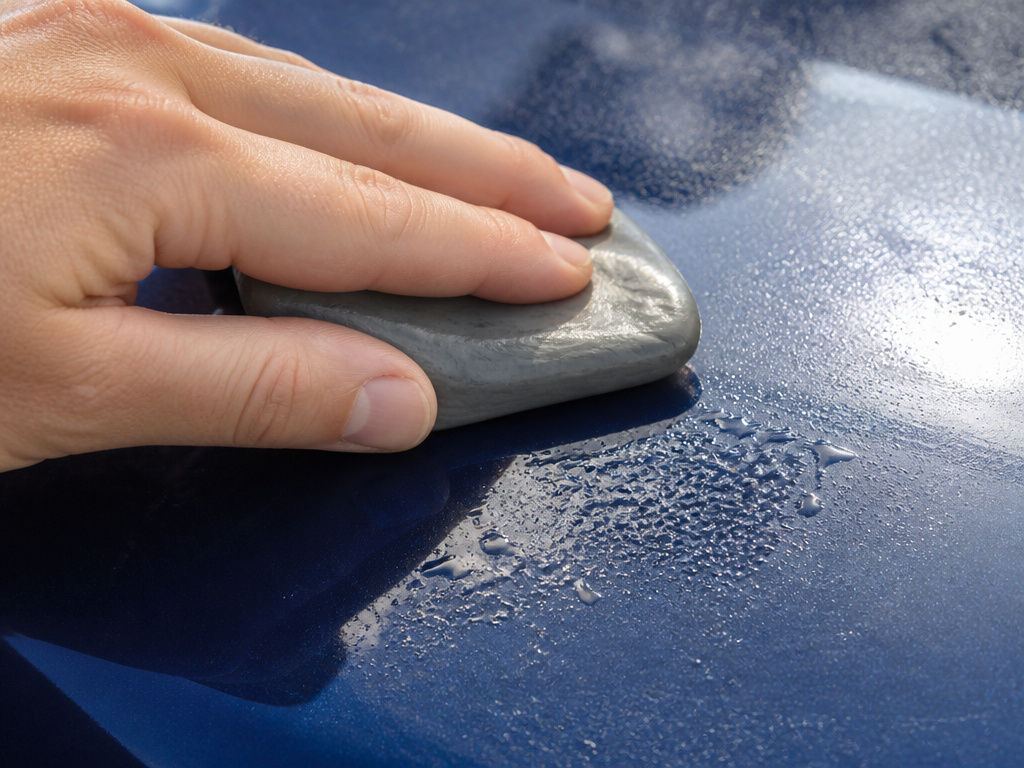
A car parks near a rail line for a week. Nothing visible lands on it, and then the hood feels like sandpaper under a fingertip.
Subaru’s bulletin explains the mechanism: industrial fallout is in most cases rail dust, small airborne metal particles thrown up by trains or by brake linings. Chrysler lists two causes, industrial fallout and a poor refinishing process. Both settle, then bond.
A masking supplier’s own guide makes the practical point that removal should happen as quickly as possible, because the longer overspray sits, the harder it comes off. That matches what the manuals imply by putting clay before everything abrasive.
The best fix is still to prevent overspray in the first place, but that’s a conversation for before the spray gun comes out.
Here’s the part that catches people. Subaru’s bulletin says do not use the clay procedure in direct sunlight or on a hot surface. If the panel is hot to the touch, stop and wait. Chrysler doesn’t address heat at all, so a detailer following only that document could work a panel Subaru forbids.
Common mistake: Claying a hot panel in the sun. Subaru prohibits it outright, and the lubricant flashes off before the bar finishes a single pass.
What Changes on Body Lines and Character Lines?
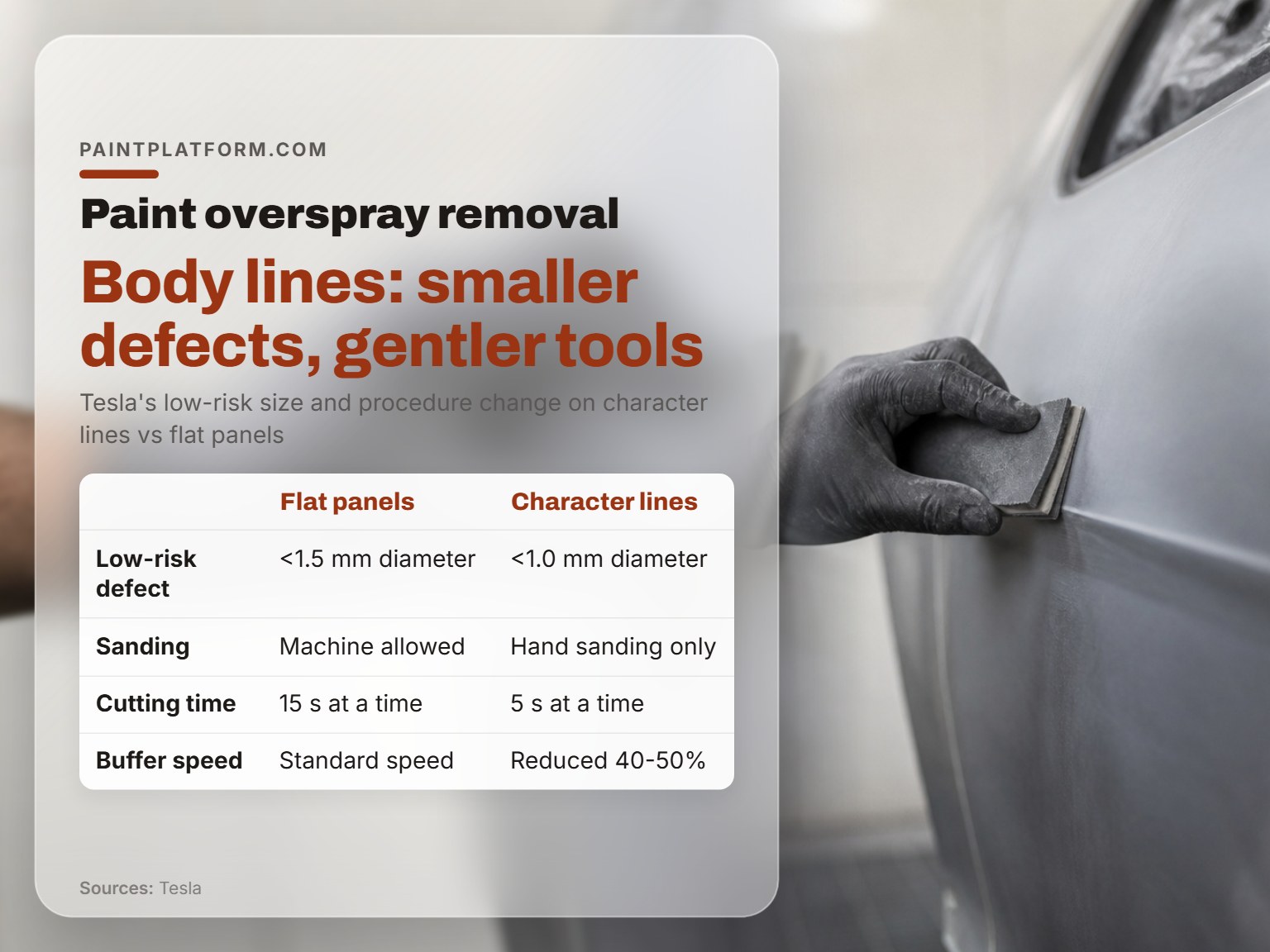
A defect under 1.0 mm on a character line counts as low risk in Tesla’s manual. On flat or near-flat panels, low risk runs to less than 1.5 mm.
Tesla’s manual sets a smaller low-risk size on character lines than on flat panels. Tesla’s procedure is built for flat or near-flat panels with original factory paint, and the manual states that any deviation can alter cutting times, tool speeds, and the ideal pressure.
On body lines, Tesla requires these changes:
- Sand by hand only. No machine sanding on an inclusion sitting on a crease.
- Cut for 5 seconds instead of 15. Same tool, a shorter dwell.
- Drop buffer speed by 40-50% and ease off the pressure.
- Avoid excessive heat buildup and don’t let the compound dissipate.
The rest of Tesla’s numbers are just as specific. Move the buffer side to side at 1 inch per second across a 6 inch area centered on the defect. Turn it off after 15 seconds or when the compound starts to dissipate. Apply pressure until the buffer begins to stall, then back off until it spins normally again.
That stall point is a feel-based instruction worth learning. Apply pressure until the buffer begins to stall, then reduce pressure until it rotates normally.
Where this goes sideways: Chasing a defect past the 0.5-mil sanding limit. The clearcoat doesn’t come back, and the panel needs refinishing anyway.
The Tools the Manuals Actually Name
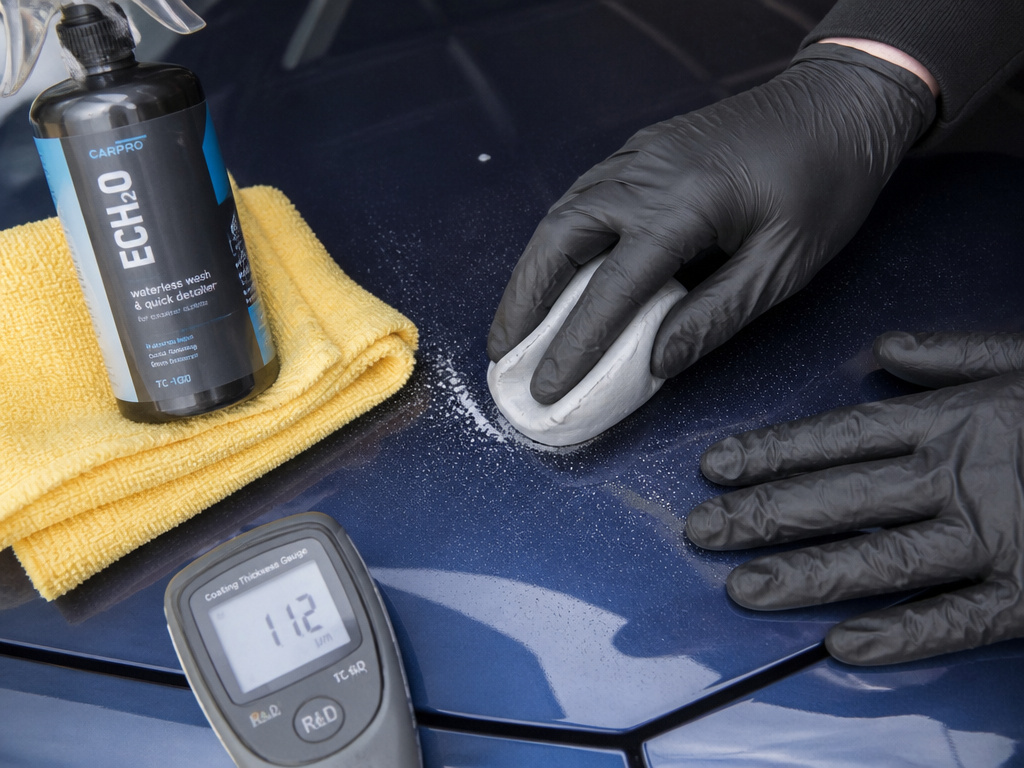
Three things do most of the work: a clay bar, a compound, and a paint thickness gauge.
| Product | Spec | Named by |
|---|---|---|
| Meguiars Mild Detailing Clay | C2000, or equivalent | Chrysler |
| Meguiars So1o Cut & Polish Cream | M8632 | Chrysler |
| Meguiars Unigrit 2500 wet sandpaper | 2500 grit, or equivalent | Chrysler |
| 3M Perfect-It III Cleaner Clay | P/N 38070, 200 g | Subaru |
| 3M Body Shop Clean-Up Car Wash Soap | P/N 38377, 1 gal | Subaru |
| Paint thickness gauge | PR-ETG-2X or equivalent | Chrysler |
For clay, the Meguiars Mild Detailing Clay C2000 is the one Chrysler specifies, and it’s mild enough that you can lean on it without stripping anything. Subaru’s pick, the 3M Perfect-It III Cleaner Clay P/N 38070, comes in a 200 g bar and behaves similarly.
For the polishing step, Meguiars So1o Cut & Polish Cream M8632 does compound and finish work in one bottle, which is why both Chrysler’s DA step and its rotary step name the same product.
If you’re weighing bottled spray paint removers against a clay bar for light overspray, the manuals have already answered it. Chrysler and Subaru put clay first, while Tesla uses a decontamination mitt with detail spray rather than clay.
Two housekeeping rules from Subaru that people skip. Knead the clay periodically so you’re always working with a clean face, and throw the bar out when contamination becomes excessive. Dispose of the clay bar when contamination becomes excessive.
Once the overspray is off, blending spray paint at the panel edge is a separate skill with its own learning curve.
Overspray on Glass, Trim, and Plastic
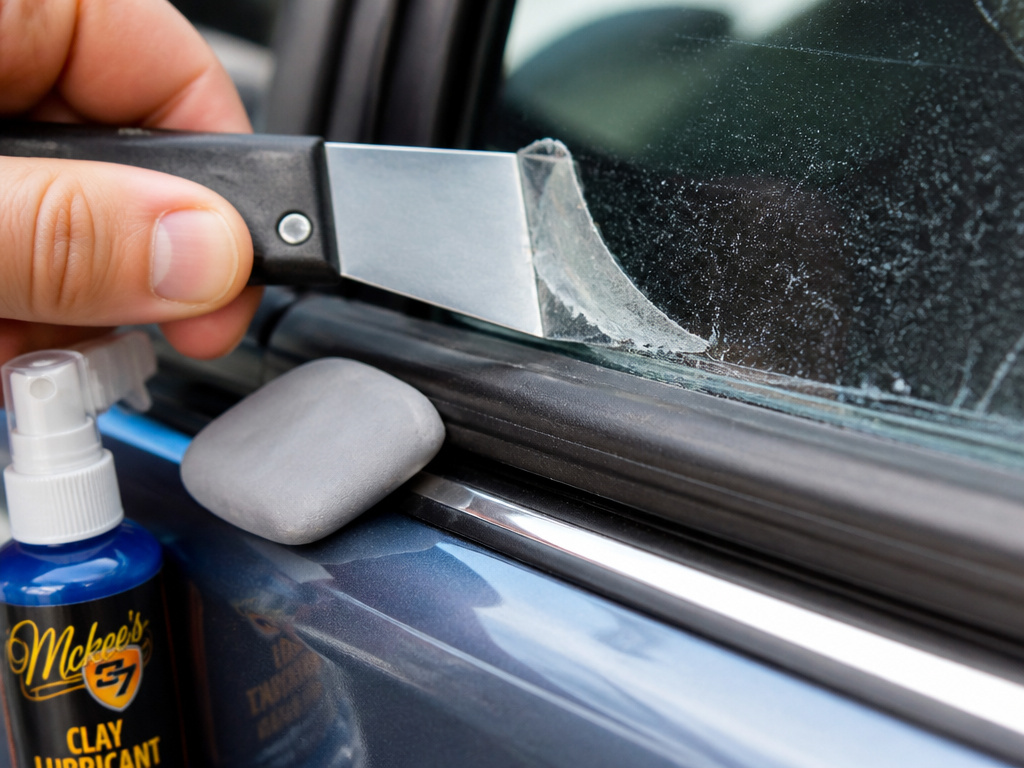
Glass is the easy one, and it’s where you should practice before touching a painted panel.
Glass and trim
Clay works on glass, but a putty scraper is suggested as an alternative for large quantities of overspray and for glass and plastic areas. A masking supplier’s guide suggests a putty scraper for large quantities of overspray and for glass and plastic areas specifically. A putty scraper is suggested for large quantities of overspray and for glass and plastic areas.
I learned the pull-toward-you part on a door frame, where pushing across left chatter marks. Same motion, same lesson. Paint on glass comes off cleanly once the blade angle is right.
Plastic and rubber trim
A putty scraper is suggested as an alternative for large quantities of overspray and for glass and plastic areas. Light pressure, plenty of lubricant, straight passes. Paint on plastic is a patience job, not a force job.
Metal is the opposite case. The clearcoat budget still applies to anything with factory paint on it. Paint on metal covers the bare-metal situation where there’s no film to protect.
When to Stop and Hand It to a Body Shop
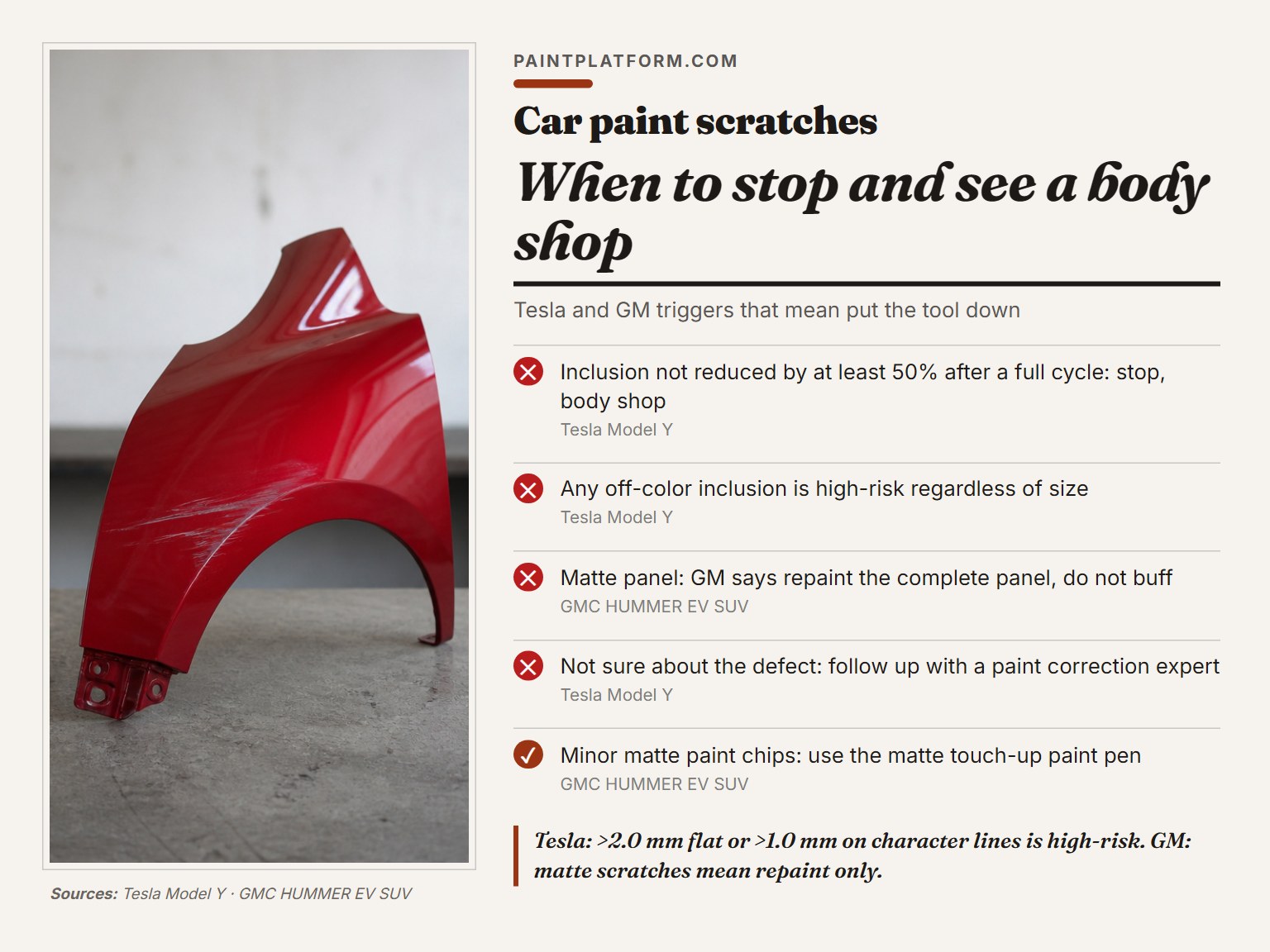
Set your stop point before you touch the panel, because the manuals disagree on where it is and you’ll want a rule you chose in advance.
Tesla’s trigger is measurable. If the inclusion hasn’t been reduced by at least 50% after up to 3 sanding cycles, discontinue and take the vehicle to a body shop. If it’s been reduced by around 90%, restart from step one. Tesla also escalates any off-color inclusion regardless of size, which is a color test rather than a size test.
Chrysler’s trigger is sequential. Refinish becomes the answer only after clay, DA polishing, rotary polishing, wet sanding, and rotary polishing have all failed to remove the overspray.
- Stop if the gauge shows you’re near the limit. Another pass costs more than a shop visit.
- Stop on an off-color inclusion. Tesla escalates these regardless of size.
- Stop if the panel isn’t factory paint or isn’t flat. Tesla’s procedure is designed for flat, factory-painted metal.
- Stop if you’re guessing. Tesla’s manual says to follow up with a paint correction expert when uncertain.
That last one is the honest one. I’d rather hand over a panel with its clearcoat intact than one I polished through trying to prove something.
Frequently Asked Questions
Can I just use a clay bar and skip the polishing?
Often yes. Chrysler’s bulletin moves to polishing only if the clay bar and detail spray fail to remove the overspray. If clay clears it, stop there.
How much clearcoat am I allowed to remove?
Chrysler caps polishing at 0.2 mils and wet sanding plus polishing at 0.5 mils combined, against a film that typically measures about 1.5 mils. Tesla’s manual sets no mil limit at all and controls the work through time, speed, and pressure instead.
Why does Chrysler say not to move the clay in circles?
The bulletin states that circular motion will create scratches. Subaru’s document gives no directional instruction, and Tesla uses a decontamination mitt with light, straight passes rather than clay. Chrysler calls for straight passes, while Subaru and a masking supplier’s guide impose no directional restriction.
Can I clay my car in the sun?
Subaru’s bulletin says not to use the clay procedure in direct sunlight or on a hot surface. Chrysler doesn’t address temperature. If the panel is hot to the touch, do not clay it.
What if the overspray still won’t come off after wet sanding?
Chrysler’s final step says that if wet sanding and polishing don’t remove it, the suspect area will require refinishing. Tesla’s version is to stop once a defect hasn’t improved by at least 50% after three sanding cycles.
The Bottom Line
Here’s the threshold I’d hand anyone before they pick up a polisher: if you don’t own a paint thickness gauge, your job ends at the clay bar. Everything past that step spends film you can’t measure and can’t replace.
Start with one panel and one wash mitt. Wash it, clay a single 12″ x 12″ section with straight passes, and wipe it down. That’s the whole first session, and it’ll tell you whether the overspray is sitting on top of the clearcoat or bonded into it.
One concession worth stating plainly: all of this assumes flat, factory-painted metal. Tesla’s manual says so outright, and the numbers change on curves, on repaints, and on plastic trim. If your panel doesn’t match that description, the percentages and dwell times above stop being reliable.
And if you take one thing from three manufacturer documents that rarely agree on anything, take the one they all share. The mildest method comes first, every time.
