
How to Remove Paint From Glass: Step-by-Step
This post contains affiliate links. As an Amazon Associate, we earn from qualifying purchases.
Learning how to remove paint from glass starts with softening the film first, then lifting it with the least aggressive tool the glass allows. Water-based paint comes off with warm water and a little dish soap; cured oil or spray paint needs a solvent wipe, followed by a detergent wash. Pilkington prohibits blades on heat-strengthened, fully tempered and coated glass, while the NGA and Cardinal steer away from blades on any glass product.
The glass type decides what “allows” means when you compare a how to remove paint from glass. Pilkington permits a new razor blade laid flat on plain, non-coated, annealed glass, while the NGA and Cardinal steer away from blades on any glass product. The same blade on tempered glass leaves scratches you won’t notice until the sun hits the pane at the right angle.
What follows walks the three glass types, the solvents each source will and won’t permit, and the order of operations that keeps a scraping job from turning into a polishing job.
Key Takeaways
- Match the tool to the glass before anything else. Annealed glass tolerates a new razor blade held flat; tempered, heat-strengthened and coated glass do not.
- Soften, then lift. A solvent wipe followed by a detergent wash moves dried paint without force.
- The dish soap dose is tiny. Pilkington lists 10 to 15 drops per 3 to 4 gallons of water.
- Flush grit off first. A water spray before any cloth or blade prevents the scratches nobody sees until full sun.
- Sources disagree on blades and acids. Both conflicts are real, and both change what you should reach for.
What Actually Removes Paint from Glass?
Two stages do the work. A solvent softens the film, then a detergent wash carries the softened residue away. Skip the second stage and the solvent spreads pigment into a thin haze that dries back onto the pane.
Dried paint bonds to glass through the same film-forming resins that make it durable on wood. A solvent softens those resins so the film releases in sheets instead of shearing into particles. Particles are the problem: grit trapped under a cloth or a blade is what produces the fine scratches that appear only in direct sunlight.
That mechanism explains why patience beats force here. A soft film lifts in one pass. A hard film pushed too early breaks into crumbs, and every crumb becomes an abrasive under your cloth.
Pilkington’s manual washing bulletin treats paint as a spot-cleaning problem, not a scraping problem. Their procedure is a paint solvent first, then detergent and water washing, with care taken that the solvent doesn’t damage glazing materials or the frame.
Test the film before you commit to a how to remove paint from glass method. Press a fingernail into an edge of the paint. If it dents and slides, it’s soft enough for warm water and a cloth. If it chips and powders, you’re into solvent territory.
Match the Method to the Glass, Not the Paint
Cardinal notes heat-treated glass is heated to approximately 1,150°F (621°C) in the tempering furnace and then rapidly quenched. That quench leaves the surfaces in compression, which is what makes the glass strong. It also changes how the surface behaves under a blade.
The cleaning procedure doesn’t change. Cardinal states plainly that recommended cleaning for heat-treated glass is the same as for annealed glass. What changes is the risk, because heat-treated surfaces carry microscopic particles fused in during the roller-hearth trip through the oven.
| Glass type | Blade allowed? | Safe approach |
|---|---|---|
| Annealed, uncoated | Yes, new blade, flat edge | Solvent wipe, then detergent wash |
| Heat-strengthened or tempered | No | Solvent and water only |
| Coated or self-cleaning | No | Solvent on a pad, no rubbing |
Run your fingertips across a tempered pane and you’ll feel a faint grit from the roller contact and airborne fines Cardinal describes, and it doesn’t threaten the glass. It does tempt a cleaner into scraping.
Before you pick up anything, check three things:
- The glass type. Look for a tempering stamp in a corner, usually a small etched mark.
- Whether there’s a coating. Low-E and self-cleaning surfaces read slightly different in reflected light.
- What’s around the pane. Sealant, frame paint and adjacent trim all react to solvents.
Where this goes sideways: Scraping a felt-but-unseen particle across tempered glass. Cardinal’s bulletin describes exactly this, a cleaner trying to remove something they can feel but can’t see, and ending up with a scratch or a chip instead.
The Razor Blade Split Nobody Settles
I cleared a flaking window sill with a sharp carbide scraper, after gooey stripper and a plastic putty knife had gotten me nowhere on a similar job. The scraper did the wood. The glass got a solvent wipe and a cloth, because a carbide edge dragged across a pane is a scratch waiting to happen. Keep that scraper sharp, too. A dull one gouges instead of lifting, and you’ll swear at it.
That division of labour matters, because most of the paint around a window sits on the sill, the frame and the trim, and those take a scraper happily.
The glass itself is where the sources stop agreeing.
Pilkington permits a razor blade on plain, non-coated, annealed glass, using the flat edge rather than the corner of a new safety razor blade, and prohibits blades entirely on heat-strengthened, fully tempered or coated glass. The NGA’s 2023 technical paper takes a broader line: avoid metal contact during routine cleaning, and keep razor blades and metal scrapers out of routine work altogether. Cardinal goes furthest, stating that scrapers, abrasives and harsh chemical agents aren’t recommended for any glass product because they can cause irreparable damage.
I keep a razor blade in the toolbox and reach for it on old single-pane annealed glass with a stubborn paint drop. On anything modern, anything double-glazed, anything with a coating, the blade stays in the box. The downside of a scratch is permanent and the upside is a quick job.
So which wins? For a modern sealed unit or anything coated, solvent wins and the blade never comes out. For an old single pane of plain annealed glass with one stubborn drop, a new blade held flat is defensible under Pilkington’s guidance and nobody else’s.
The NGA does leave a door open. Its paper acknowledges that window cleaners may choose more aggressive techniques, including razor blades, in non-routine cleaning, while declining to recommend scraping for routine work. That’s a standards body hedging, and it tells you the field practice exists even where the document won’t bless it.
Which Solvent for Which Paint?
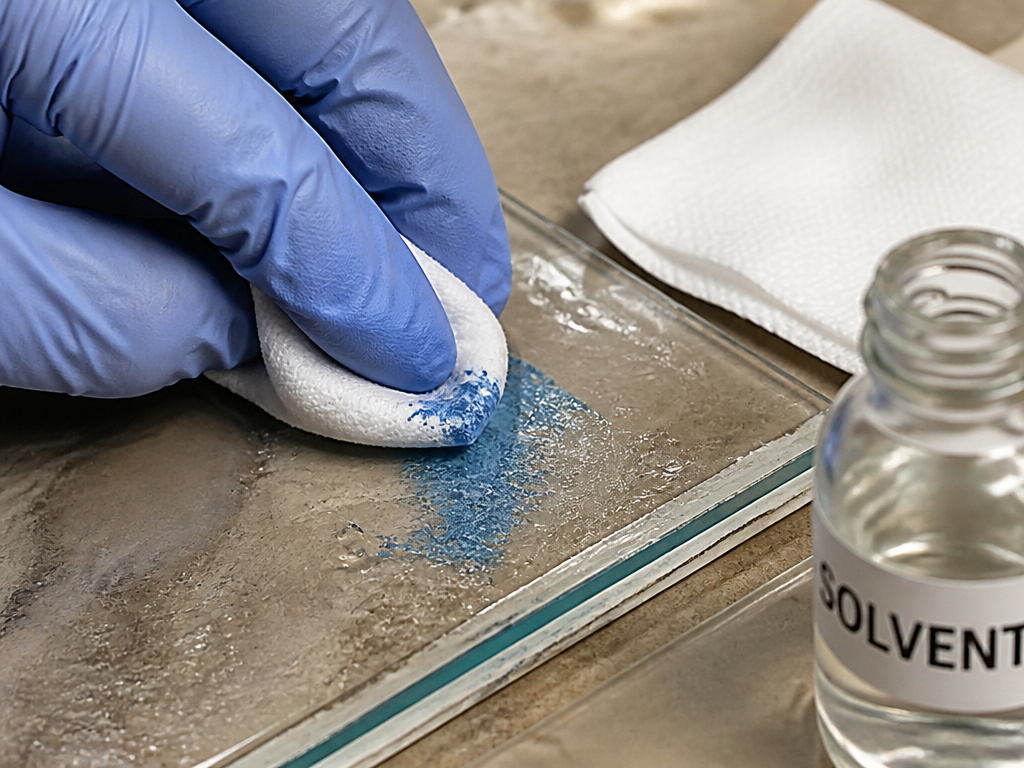
Three variables decide it: how old the film is, what resin it’s built on, and whether the glass underneath carries a coating. Get those three right and the solvent choice almost makes itself.
| Paint type | First move | Avoid |
|---|---|---|
| Fresh latex | Warm water and a little dish soap | Solvent, which smears the film |
| Cured latex | Solvent on a wet cloth, then wash | Dry scraping |
| Oil-based enamel | Acetone or denatured alcohol | Rubbing hard at the mark |
| Spray paint overspray | Solvent, one small area at a time | Wiping across clean glass |
Fresh Latex Versus Cured Latex
Fresh latex paint is the easy case. It hasn’t cross-linked yet, so warm water and a drop of dish soap will lift a smear before it sets. Wipe it now and you’re done quickly.
Cured latex is a different animal. Once the film has hardened, water stops touching it and you’re into solvent territory, followed by the detergent wash Pilkington describes. The longer it sits, the more passes it takes.
Oil-Based Paint and Enamel
Oil paint and enamel cure harder and resist water completely. Pilkington’s spot list covers this ground with denatured alcohol, methyl ethyl ketone and acetone, all available from a hardware store.
Apply a small quantity to a clean, wet cloth, then work the area that needs it. Keep the cloth wet. A dry cloth with solvent on it drags pigment around instead of lifting it.
Spray paint behaves differently again, because it arrives as a fine mist that lands as thousands of tiny dots rather than one film. If you’re dealing with spray paint on glass, work in small squares and change the cloth face often.
Paint overspray on a window is usually the thinnest version of the problem, a faint haze rather than a skin. Solvent on a wet cloth takes it if you catch it early.
How Do You Clean Coated or Self-Cleaning Glass?
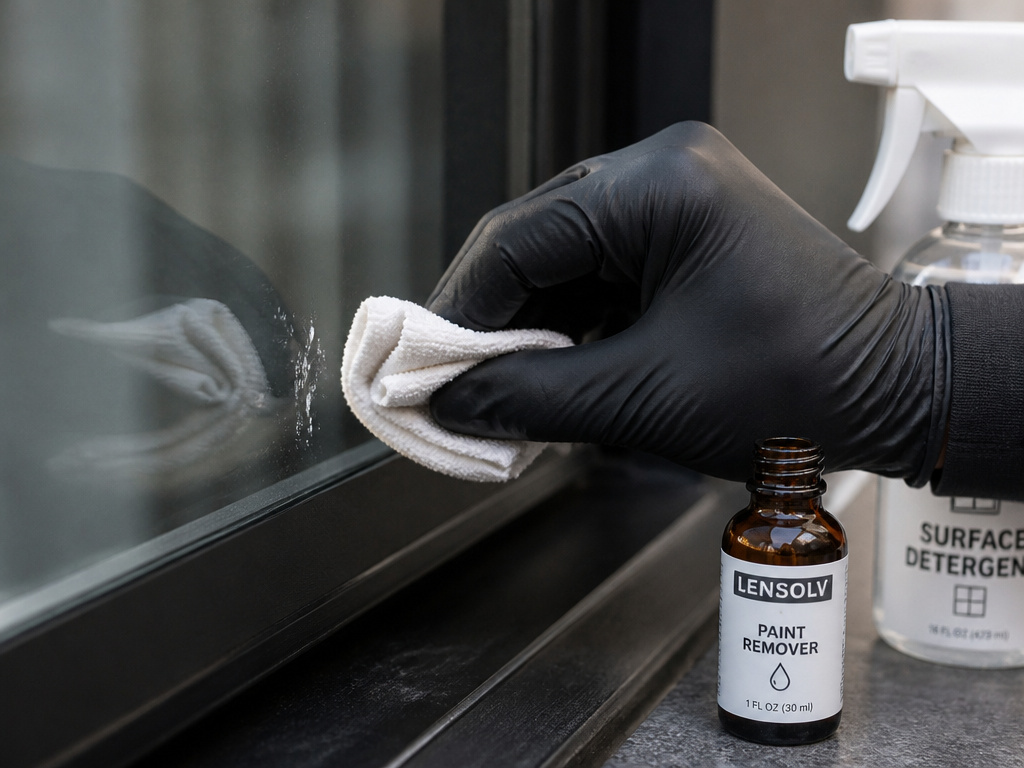
Coated glass needs a different set of rules, and self-cleaning glass needs the strictest ones. Pilkington’s technical tips for its Activ coating list acetone, isopropyl alcohol, methylated spirits and white spirits as suitable solvents for fresh paint or sealant splash.
Speed matters more than technique here. Fresh paint or sealant overspray should come off immediately with a solvent wipe, before it sets or cures. Once it’s cured, you’re into a slower process of wetting the mark with a solvent-soaked pad until it dissolves.
The Coating Caveat
Pilkington is unusually specific about technique on Activ glass, and the instructions read almost opposite to the general advice. Don’t spread the solvent mix over clean areas. Don’t let the solvent run over unaffected areas. Keep reapplying with a fresh area of cloth until the marks are gone, and don’t rub the mark to remove it.
That last one catches people. Rubbing feels productive. On a coating, it just pushes the contaminant sideways and thins the coating while you’re at it.
After the solvent treatment, follow with a detergent wash and a water rinse. The coating in the cleaned area reactivates after 5 to 7 days. Give it a week.
Silicone is its own case. Pilkington’s instruction is to let it dry and then peel it off, with no knife and no abrasive action, then clean the area with methylated spirits without spreading the solvent. Contaminated areas may need ongoing treatment with silicone eaters.
Easy to miss: Solvent on a frame or a sealant bead. Pilkington warns specifically about preventing solvents from contacting glass sealants, framing and adjacent paintwork, because the damage shows up on the frame, not the glass, and by then it’s a repainting job.
The Order That Keeps You Out of Trouble
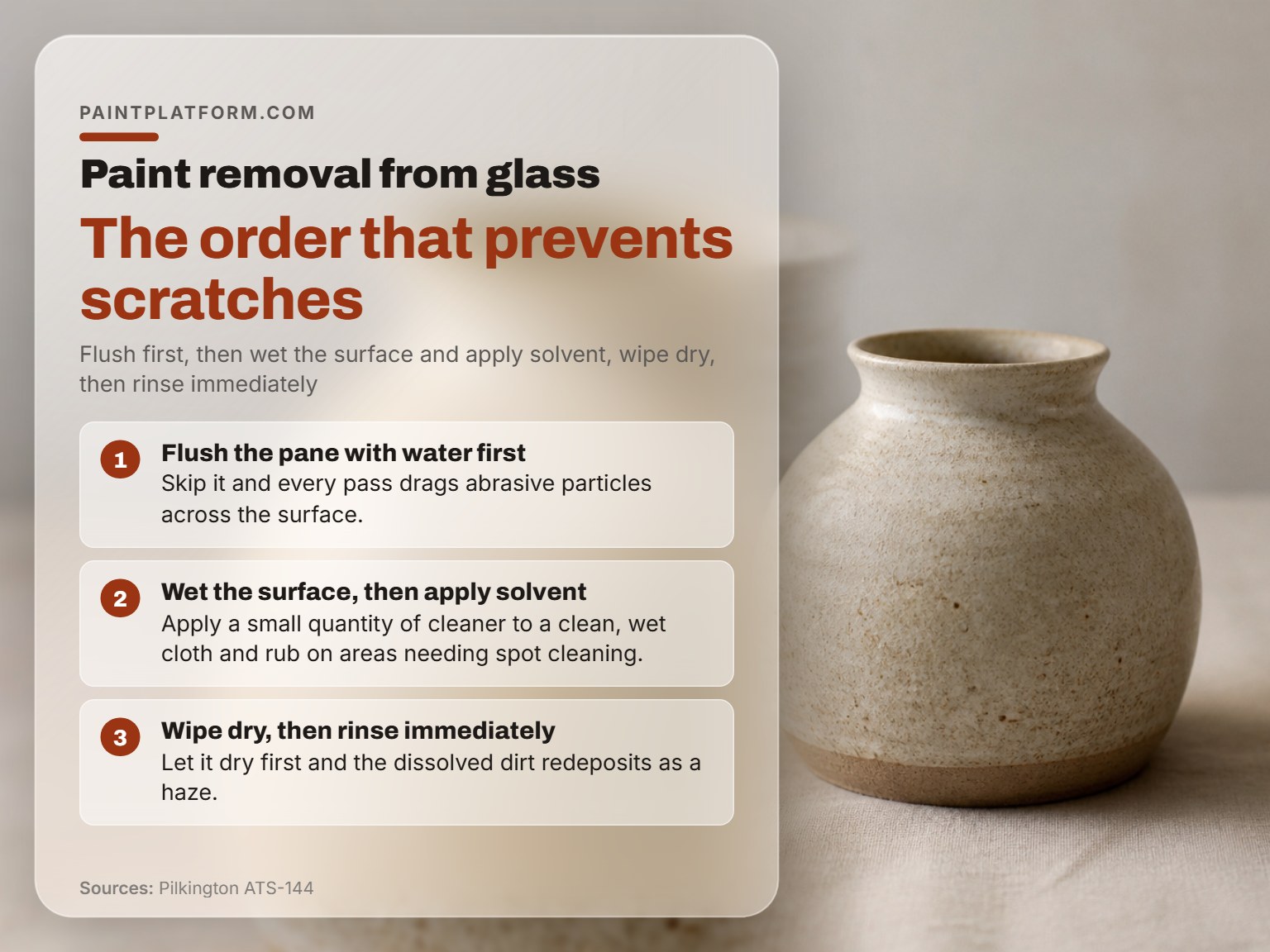
The architectural glass cleaning best practices published by the NGA open with soaking the surface in clean water and a mild, non-abrasive solution before anything else happens. That order is deliberate, the step that stops grit from becoming sandpaper.
Before you start: Follow all recommended safety procedures associated with the products used to clean the glass. Take particular care to prevent solvents from contacting glass sealants, framing and adjacent paintwork. Follow all recommended safety procedures associated with the products used to clean the glass.
- Flush the pane with water first. Skip it and every pass after this drags abrasive particles across the surface.
- Identify the glass type.
- Test one patch at the bottom corner. A small test square tells you whether the solvent works. Skip it and you commit the whole window to a method that might not budge the film.
- Wet the surface, then apply solvent to a clean wet cloth. Pilkington’s procedure applies a small quantity of cleaner to a clean, wet cloth and rubs on areas needing spot cleaning. Solvent on a dry cloth just moves pigment around.
- Wipe dry with a lint-free towel, then rinse immediately. Let it dry first and the dissolved dirt redeposits as a haze.
- Stop wiping while the glass is almost dry. This is the anti-streak rule, and it feels wrong the first time. A thin uniform film of moisture should still be on the pane when you put the towel down.
- Do the frame, sill and trim last. Solvent drips downward. Anything you clean above the frame gets a second pass anyway.
Step 6 deserves the extra sentence, because streaking gets blamed on the product when it’s a technique problem. Pilkington defines streaking as the re-deposition of non-uniform dirt and detergent, left behind when there was too much dirt and too little solution. More liquid, fewer passes, stop early.
Common mistake: Flooding the glass with solvent to speed things up. Pilkington’s own note says abrasive surface dust scratches glass when too much pressure meets too little cleaning solution. Volume helps. Pressure doesn’t.
What Shows Up Only in Full Sunlight
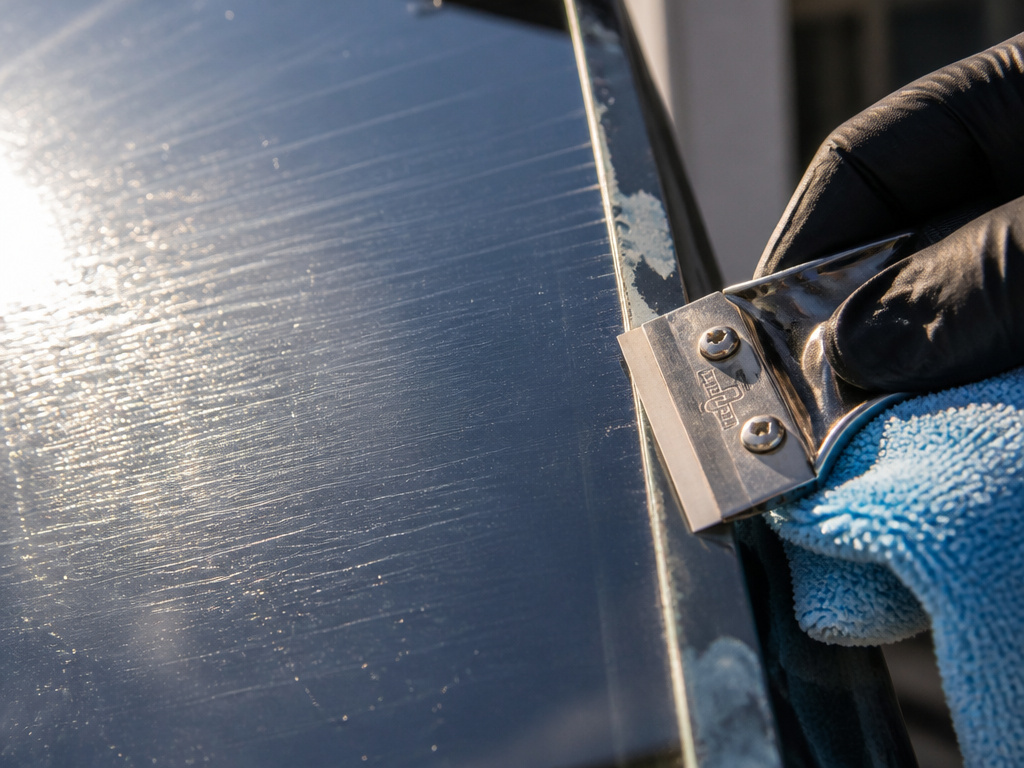
Fine scratches from improper scraping are visible only in full sunlight, according to Pilkington’s bulletin. That’s the cruel part. You finish the job, the pane looks clean, and the damage doesn’t announce itself until the light comes through at the right angle.
Cardinal’s paper describes the same trap from the other direction, where cleaners try to remove particles they can feel but not see and end up scratching or chipping the surface. The scratch is the removal attempt, not the paint.
Worth knowing before you start: A chemical paint stripper earns its keep on a door frame or a bannister. On glass it’s usually overkill, and the run-off is the real hazard, because it takes sealant and frame paint with it. Save the heavy chemistry for the surfaces that need it.
Two conditions make a scratch far more likely, and both are avoidable. The first is dry scraping, which is why every source here pushes liquid onto the pane before anything touches it. The second is a dirty cloth, because a cloth that’s already picked up grit is a sanding block with a soft face.
If you do end up with a scratch, stop. Continuing on the same pane adds more, and the only fix at that point is professional polishing, which the NGA lists among the restoration techniques for glass that can no longer be cleaned routinely.
Frequently Asked Questions
Can you use a razor blade to remove paint from glass?
Only on plain, non-coated, annealed glass, and only with a new safety razor blade held flat rather than by the corner. Pilkington permits it there and prohibits it on heat-strengthened, fully tempered and coated glass. The NGA and Cardinal both steer away from blades on any glass product.
What removes dried paint from glass without scratching it?
Solvent wipe followed by a detergent wash. Wet the pane first to flush grit, apply a small quantity of solvent to a clean wet cloth, wipe dry with a lint-free towel, then rinse with distilled water before the solution evaporates. Pressure is what causes scratches, not the solvent.
Is vinegar safe for removing paint from glass?
Pilkington lists a mixture of one part clear vinegar to one to ten parts clean water as a routine cleaning solution, and vinegar-based cleaners generally give a streak-free finish. It’s a light-duty option. Cured oil paint needs a solvent.
Why do my windows streak after cleaning?
Streaking is re-deposited dirt and detergent, left when there was too much soil and too little solution. Use more liquid, fewer passes, and stop wiping while a thin uniform film of moisture still sits on the glass. That film evaporates clean.
How long does self-cleaning glass take to recover after solvent cleaning?
Can I use the same method on a car window?
That rules out blades and abrasives and leaves solvent, water and cloth. Keep solvents off glazing materials and the frame for the same reason Pilkington warns about them.
The Bottom Line
One rule covers most of this: if you can’t identify the glass, assume it’s the fragile kind and use solvent only. Temper stamps hide in corners, coatings are nearly invisible, and the difference between a five-minute job and a permanently scratched pane is which one you’re standing in front of.
Here’s the concession, though. On an old single-pane window with one blob of cured oil paint, all this caution is overkill, and a new blade held flat will save you time. Pilkington says so explicitly. The catch is that you have to actually know it’s annealed, not guess.
My honest suggestion for this week: go look at the glass you’re planning to clean and find the temper stamp before you buy anything. If there’s no stamp and the unit is sealed double glazing, the IWCA window cleaning field guide approach applies, which means treating the job as non-routine restoration rather than a Saturday wipe-down.
Start with one mark. The smallest one, in the corner, with a wet cloth and a drop of soap. You’ll learn more from that small test area than from any guide, including this one.
