
Zero VOC Paint Guide: What 0 g/L Really Means
This post contains affiliate links. As an Amazon Associate, we earn from qualifying purchases.
This zero VOC paint guide starts with the number that matters: 0 g/L is a bulk calculation taken before tinting; PPG labels Speedhide Zero 6-5510 as VOC 0 g/L while conceding tinting colorants may raise VOC significantly, whereas the FTC treats a zero claim as deceptive unless post-tint VOC is literally zero or trace-level evidence backs it.
The number comes from a bake-off test. A sample is heated under set conditions, the material that leaves is weighed, and water plus exempt compounds get subtracted from the total. Whatever survives the arithmetic is what gets printed on the can.
What follows walks the measurement, the tinting loophole, the two standards that disagree about what zero means, and the test patch I run before any gallon touches a wall, all covered in this zero voc paint guide.
Key Takeaways
- 0 g/L is a pre-tint bulk number. PPG’s own sheet for Speedhide Zero 6-5510 concedes that colorants may raise VOC significantly.
- The FTC wants post-tint zero or trace-level evidence, even though PPG’s own sheet still labels 6-5510 as VOC 0 g/L. It issued orders against PPG and Sherwin-Williams in March 2013 over zero VOC advertising.
- Bulk content and chamber emissions are different quantities. A paint can pass one and fail the other.
- Recoat windows aren’t interchangeable: 2 to 4 hours on PPG 6-5510, 4 hours minimum and 8 for best results on AFM Safecoat.
- Test a sample board in the room itself before you commit a wall to a finish.
What Does 0 g/L Actually Measure on a Paint Label?
Two different quantities get called VOC content, and the label prints only one of them. The printed figure is a bulk content number.
ASTM D3960 derives VOC content from the mass of material released from a coating sample under specified bake conditions, then subtracts water and exempt volatile compounds. The result is expressed three ways: per unit volume of coating less water and exempt compounds, per unit volume of coating solids, and per unit mass of coating solids.
Only the volume-of-solids version gives a linear comparison. The other two expressions don’t, and ASTM says so directly. A coating at 3 lb of VOC per gallon of solids releases half the VOC of one at 6 lb per gallon of solids. Run the same two paints through the expression that ignores volume solids and the gap reads as roughly 85% less, which overstates the difference.
That matters because two cans can print the same number using different expressions. If the chemistry is new to you, start with VOC levels in paint before the arithmetic here makes sense.
The ASTM D3960 VOC content practice is the reference method behind most of these labels. It measures what comes off a sample in a bake oven, not what comes off your wall.
| Method | What It Measures | What It Leaves Out |
|---|---|---|
| ASTM D3960 | Bulk VOC from a baked sample | What the cured film emits |
| ASTM D6803 | Chamber emissions, formaldehyde and carbonyls | The bulk number on the can |
| ISO 17895:2024 | Headspace GC, 0.01% to 0.1% by mass | Anything below 0.01% |
Notice the third row. The ISO 17895:2024 headspace method is scoped to VOC contents between 0.01% and 0.1% by mass, with a boiling point cutoff of 250 °C at 101,325 kPa. It cannot resolve below 0.01%. So on that instrument, zero is below the floor of the test, not a measured value.
The Tinting Loophole That Cost PPG and Sherwin-Williams an FTC Order
A gallon of base sits on the shaker and the color you picked goes in at the counter. Everything the can promised happened before that moment.
In March 2013 the Federal Trade Commission issued final decisions and orders resolving allegations that Sherwin-Williams and PPG Architectural Finishes had deceptively advertised paint as zero VOC. The orders prohibit representing a paint’s VOC level as zero unless, after tinting, the level is zero grams per liter, or the company holds and relies on competent scientific evidence of a trace level.
What the 2013 Orders Actually Require
The orders define trace level of VOCs as all three of these holding at once:
- VOCs were not intentionally added to the product.
- The level present does not cause material harm consumers associate with VOCs, including harm to the environment or human health.
- Ambient air concentrations do not rise above background levels.
The Commission also stated it is aware of no scientific or regulatory body that has recognized a specific trace contaminant level of VOCs in paint or any other architectural coating.
For the FTC, a zero VOC claim either survives the tinting question or it does not survive at all, while PPG’s own sheet still labels 6-5510 as VOC 0 g/L. No regulator has handed anyone a trace level they can point to on a spec sheet.
The FTC enforcement policy on VOC-free claims applies that tailored definition to all VOC-free claims for architectural coatings. It also lists the phrasings it covers: zero VOCs, 0 VOCs, no VOCs, and free of VOCs. Four ways of saying it, one standard to meet.
PPG Speedhide Zero vs AFM Safecoat: Two Data Sheets, Two Different Stories
Both cans carry a zero. The sheets underneath them disagree on coverage, recoat, and the coldest temperature either one will tolerate.
| Spec | PPG Speedhide Zero 6-5510 | AFM Safecoat Zero VOC Flat |
|---|---|---|
| Labeled VOC | 0 g/L | Zero VOC material, zero HAPs |
| Coverage | About 400 sq ft/gal | About 350 sq ft/gal |
| Recoat | 2 to 4 hours | 4 hours minimum, 8 preferred |
| Minimum temperature | 50°F (10°C) | 55°F |
| Full cure | 30 days | Not listed on the sheet |
PPG lists volume solids at 37% ±2% and weight solids at 46% ±2%, with a sheen of 45 to 65 at 60°. The film goes on at 4 mil wet and dries to 1.5 mil. Those are the numbers that decide how the wall looks at a glance, and none of them appear on the front of the can.
AFM’s sheet has the more interesting contradiction. It lists 66.7% volatile by volume and 47.05% by weight, then states VOC material as zero. Both are true at once because the paint is water based and dilutable, and ASTM D3960 subtracts water before VOC gets calculated. Volatile and VOC are not synonyms, and that single distinction trips up more buyers than any other.
AFM also certifies what is absent: no formaldehyde, ammonia, aromatic hydrocarbon compounds, exempt solvents, or hazardous air pollutants.
Where this goes sideways: Picking a can by its VOC number and nothing else. Coverage and recoat windows decide how many gallons and how many days the job eats, and those two figures differ by roughly 12% and up to 4 hours between these products.
If you want the wider filter for what belongs on an interior wall, the non-toxic paint breakdown covers the labels beyond VOC.
Zero VOC Paint Guide: The Three Standards That Decide the Claim
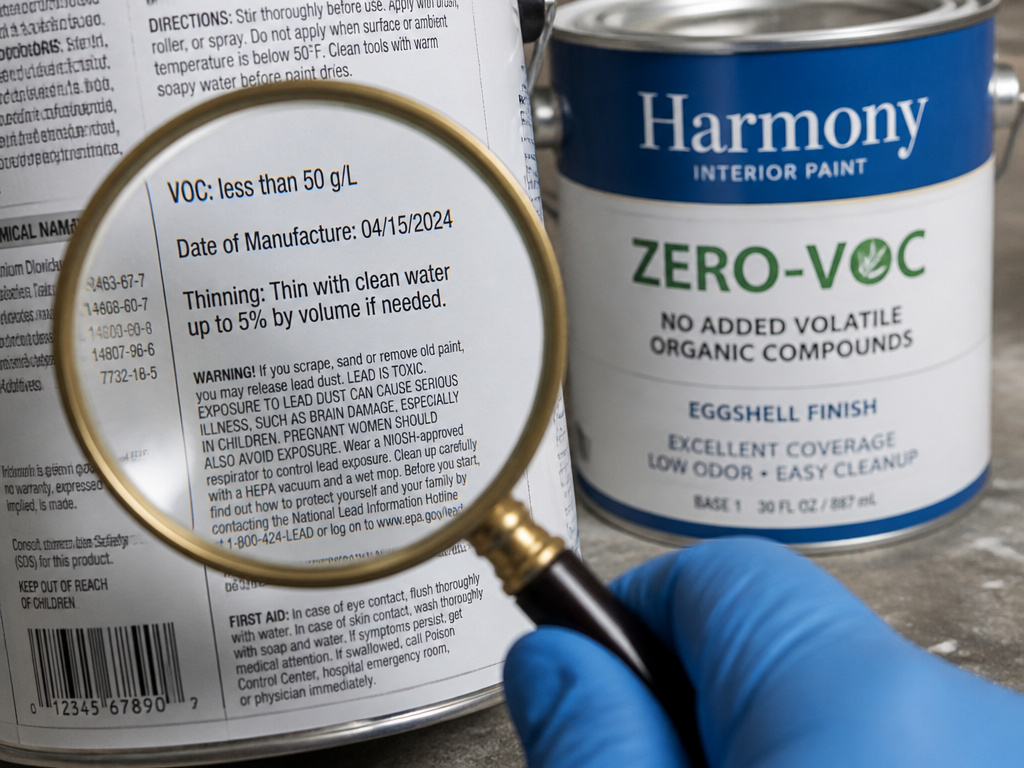
Sixty-one coating categories carry federal VOC limits, and the rule that sets them took effect on September 13, 1999.
The EPA architectural coatings rule rests on a finding that VOC emissions from these products can push ozone levels past the national ambient air quality standards. EPA estimates the rule cuts VOC emissions by 103,000 megagrams per year, or 113,500 tons per year.
Compliance runs through EPA Method 24, with results expressed in grams of VOC per liter of coating. No initial compliance test is required if a coating already meets the limits; the manufacturer submits an initial report and meets labeling requirements. EPA can still demand a Method 24 test at any time, inspect production records, or pull samples from the marketplace. Label review covers the date of manufacture, thinning instructions, and VOC content.
That is the regulatory floor. It is not a statement about your living room. For where the floor sits relative to actual performance, the low-VOC paint pros and cons comparison is the honest read.
Does Zero VOC Mean No Odor and No Ventilation?
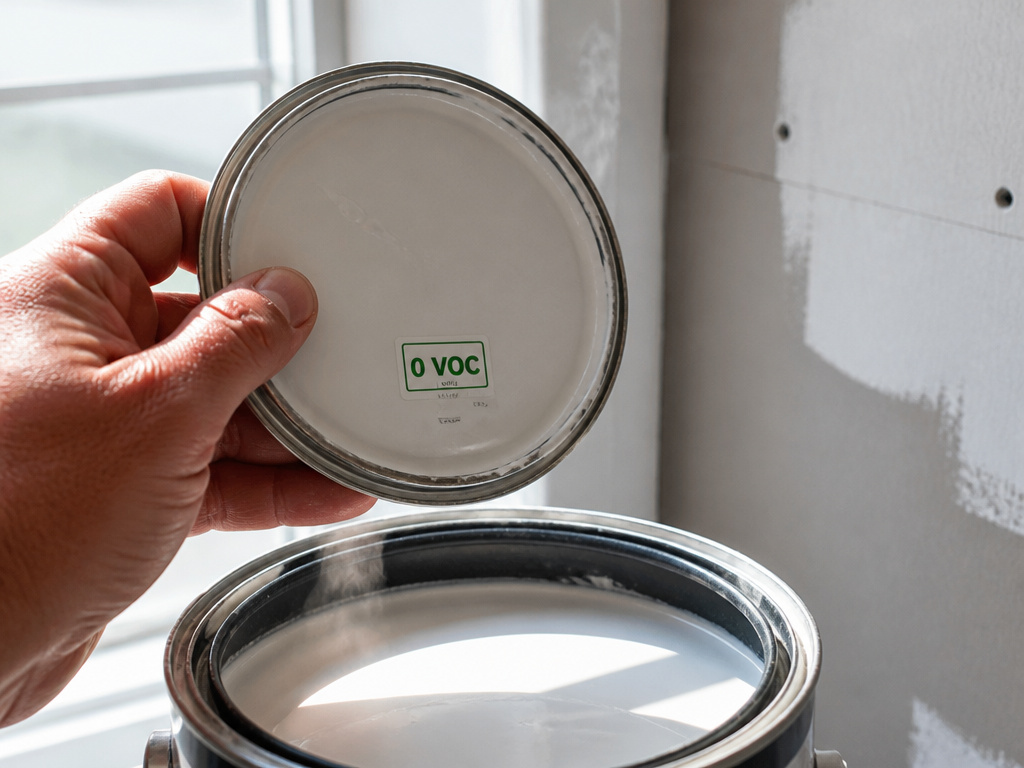
No. A zero VOC figure accounts for one class of compounds and says nothing about the rest of the can.
Schieweck and Bock, publishing in Building and Environment in 2015, tested low-VOC and zero-VOC paints in chambers and found semivolatile organic compounds added to get around solvent classifications. Single substances were emitted in high concentrations, acetic acid most of all. The same study found air-purifying paints were not effective. Acetic acid reads as vinegar on the nose, and it turns up in products carrying a zero on the front.
An EPA chamber study recorded a formaldehyde peak of 2.2 mg/m³ from one paint applied to gypsum wallboard in a small chamber. Two other paints in the same work produced total estimated emissions of 0.47 mg/g and 0.15 mg/g across 14-day tests. Formaldehyde isn’t a VOC by the regulatory definition, so it never shows up in the number you’re reading.
I ventilate every interior job no matter what the front of the can says. The label tells me what got counted. It cannot tell me what got added to stay under the count.
The ASTM small-scale chamber VOC testing practice is the method behind those numbers, and it draws a line worth knowing: estimating exposure for the person applying the paint is a different procedure from estimating the impact of the cured film on indoor air. Two questions, two tests.
Practical fallout lands on the people in the room. Read the paint fumes safety guidance before you plan a two-day job in a closed bedroom, and if small people or animals share the space, the paint safety for children and pets checklist covers the timing.
Apply It Cold and the Label Stops Meaning Anything
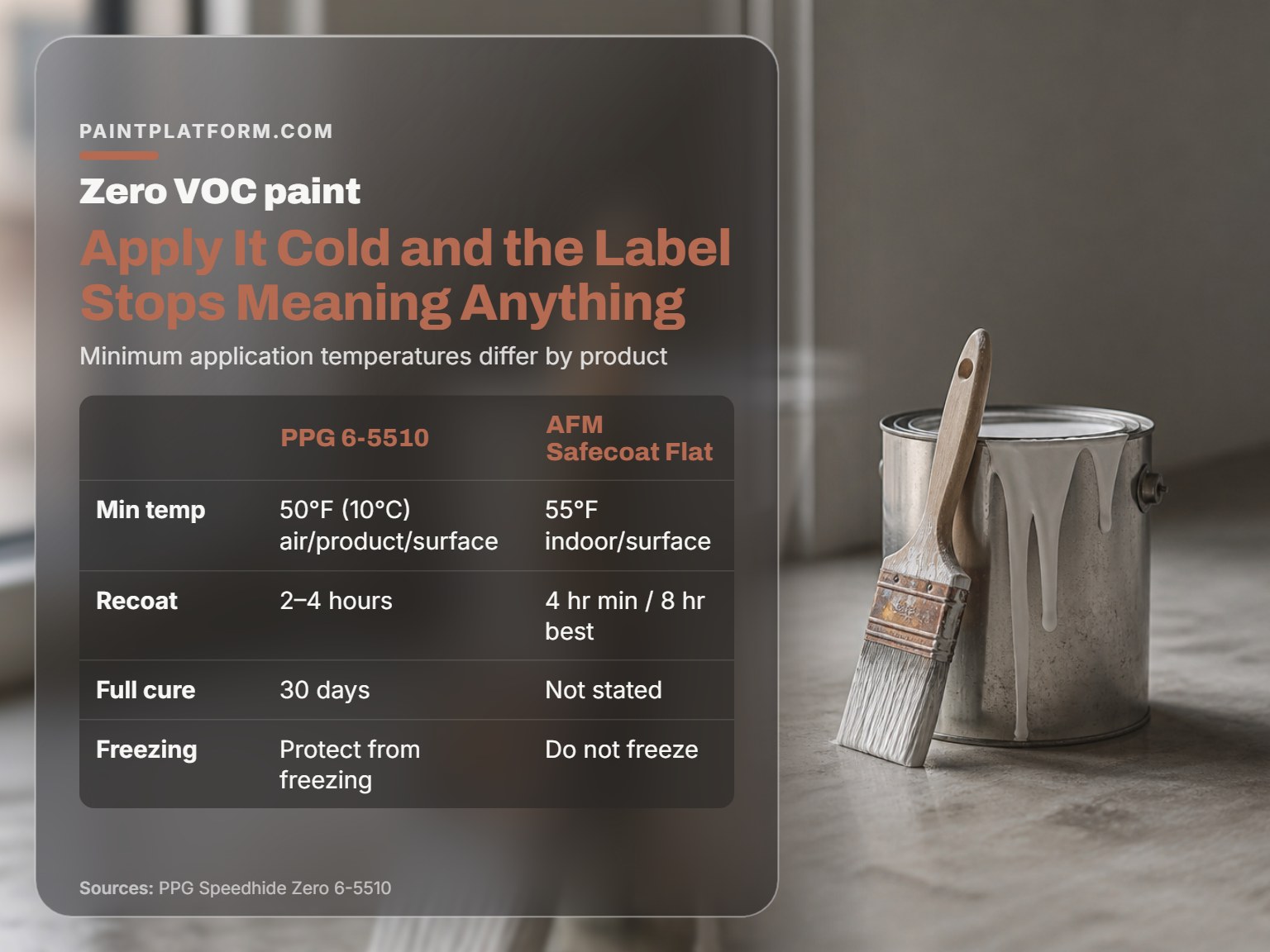
Cold rooms void the claim, though the sources disagree on the floor: PPG 6-5510 wants air, product, and surface all between 50°F (10°C) and 90°F (32°C), while AFM Safecoat Zero VOC Flat refuses anything below 55°F indoors or at the surface. Neither tolerates freezing.
Temperature, Recoat, and Cure Windows
- PPG 6-5510 recoats in 2 to 4 hours and reaches full cure in 30 days.
- AFM Safecoat recoats at 4 hours minimum, with 8 hours giving the better result.
- Both must be protected from freezing, and neither is rated for floors.
- PPG wants new concrete and masonry cured at least 30 days and preferably 90, with substrate pH below 10 before priming.
That 30-day cure number is the one nobody plans around. A wall feels dry in an afternoon and stays soft for a month. Deep colors may run longer.
Before you start: Scraping or sanding old paint can release lead dust, and the PPG sheet spells out the kit: a properly fitted NIOSH-approved respirator, no skin contact, and cleanup with a HEPA vacuum plus a wet mop. Skip the HEPA step and you spread that dust through the whole room instead of removing it.
Cold application is where the recoat promise quietly fails. Paint that never coalesced properly below the minimum application temperature will still feel tacky at the recoat mark, and a second coat over it lifts the first. If the room is running cold, the painting while pregnant guidance on timing and ventilation is worth reading before you push the schedule. So is the paint respirator selection guide, since a cartridge rated for solvents is the wrong choice for a water-based film.
The Sample Board That Saved Me a Repaint
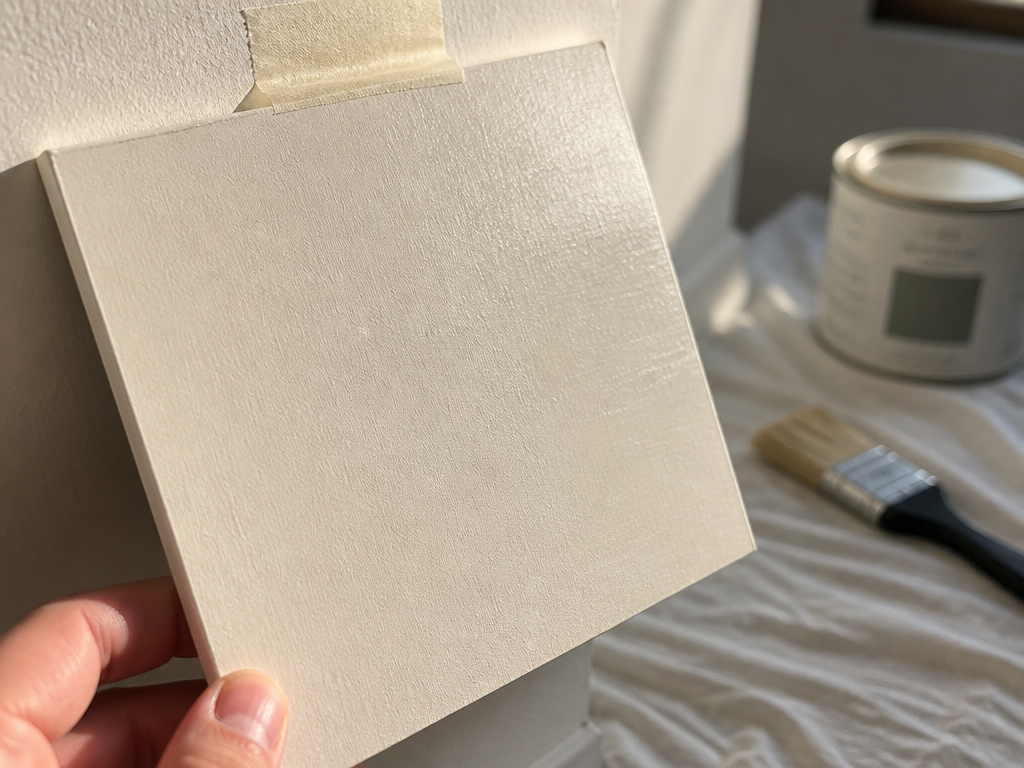
I picked satin off a chip the size of a postage stamp once and thought it looked soft and pretty. On a twelve-foot wall with a window across from it, that same satin turned into a mirror for every roller mark. Now I paint a sample board and live with it before I commit.
Chips lie about sheen because they’re small and you look at them head-on. A wall gets looked at from the side, in raking light, at seven in the morning and again at dusk. Sheen shows up at angles. A chip never shows you that.
How to Run the Test Patch
- Cut a sample board and prime it the way the actual wall is primed. Skip the primer and the sheen reads differently from the finished surface.
- Apply two finish coats, not one. AFM’s own sheet says the best finish comes from a primer plus two finish coats.
- Tape the dry board to the wall you’re painting and walk past it a few times. A board judged in the garage tells you nothing about that room.
- Look at it in morning light and again in the evening. If the sheen bothers you at either hour, it will bother you for years.
- Wait the full cure window before judging hardness. PPG lists 30 days, and a thumbnail dent at day three means nothing.
Easy to miss: Judging the board under the same overhead light every time. Raking daylight from a side window is what exposes roller marks, and that’s the condition the wall actually lives in.
If the room belongs to a kid, the kid-friendly paint shortlist narrows the field before you ever get to a sample board.
Frequently Asked Questions
Is zero VOC paint actually zero?
Sometimes, and the label alone won’t tell you. A base paint can measure 0 g/L before tinting and rise after colorant is added, which is exactly the gap the FTC orders addressed. Ask for the post-tint VOC figure in writing.
Does zero VOC paint still smell?
It can. VOC content covers one class of compounds, and chamber studies have measured acetic acid and formaldehyde coming off low-VOC paints. Odor and VOC content are related but not the same measurement.
Can I paint with zero VOC paint while pregnant?
Talk to your clinician first, and ventilate regardless of the number on the can. A zero VOC figure says nothing about formaldehyde, carbonyls, or semivolatile compounds, and chamber testing measures those separately from bulk content.
Why does my zero VOC paint say 66.7% volatile by volume?
Because water counts as volatile and does not count as a VOC. ASTM D3960 subtracts water and exempt compounds before calculating VOC content, so a water-based paint can carry a high volatile percentage and a zero VOC figure at the same time.
How long before I can wash a zero VOC wall?
PPG lists full cure at 30 days for Speedhide Zero 6-5510, and deep colors may take longer. Wiping a wall before that window can burnish the film and leave a permanent shiny patch.
The Bottom Line
One rule to carry out of this: if the color you picked is deeper than a mid-tone, treat the tinted can as low-VOC until someone shows you a post-tint number. Ask the counter for it before the shaker runs. If they can’t produce one, that answers the question too.
None of this makes zero VOC paint pointless. A base that starts at 0 g/L is a better starting point than one that doesn’t, and the difference shows up fastest in a small room with the windows shut.
Where the advice changes is a nursery, or any room without cross-ventilation. There, the bulk number on the can matters less than what the film emits after application, and no label on that shelf will tell you.
