
How to Use Gouache Paint: Step-by-Step (Without Mud)
This post contains affiliate links. As an Amazon Associate, we earn from qualifying purchases.
To use gouache paint, thin it with water to a double-cream consistency, load a brush, and paint flat shapes on 250 g/m2 mixed media paper. Strathmore describes the working mix as similar to double cream: it drops slowly from the brush and covers the palette without showing white underneath.
The 250 g figure is the one that gets skipped. Caran d’Ache notes that paper lighter than that curls once the water in diluted gouache soaks in, so a thin sketchbook page buckles before the first wash dries.
The paint forgives a lot. The surface and the water decide how to use gouache paint and whether the page stays flat.
What follows is the order I actually work in: mix to consistency, layer without mud, choose a surface, then keep the brushes alive. Four habits, in the order they come up.
Key Takeaways
- Mix to double cream. Gouache should drop slowly off the brush and cover the palette with no white showing through.
- Water causes mud. Strathmore warns that more water in the mix makes it more likely to reactivate the layer below.
- Paper under 250 g curls once diluted paint hits it. Caran d’Ache recommends 250 g/m2 mixed media stock.
- Thick layers split the sources. Caran d’Ache says its gouache never cracks; Strathmore says thick paint can crack and flake on a flexible surface.
- Varnish ends the conversation. Once gouache varnish goes on, Caran d’Ache states the painting cannot be reworked.
What Consistency Should Gouache Be Before It Touches Paper?
Strathmore’s test needs no tools: lift the brush and watch how the paint leaves it.
A working mix holds shape on the palette and drops from a loaded brush in a slow, even bead. Strathmore’s lesson sheet calls the target consistency double cream. A mix that flows and shows the white of the palette is too thin; a mix that clumps on the brush is too thick to layer smoothly.
That is the whole diagnostic. Strathmore’s basic gouache techniques lesson sets it out as three checks: similar to double cream, drops from the brush slowly, and covers the palette evenly without revealing white underneath.
Too thin is the more common failure, and it looks like watercolor because it is behaving like watercolor. Strathmore says a mix that flows on the palette and shows white when you move it around is too thin to use opaquely.
| What you see | What it means | What to do |
|---|---|---|
| Flows and shows palette white | Too thin for opaque work | Add paint from the tube |
| Clumps and drags on the brush | Too thick to layer smoothly | Stir in a few drops of water |
| Drops slowly, covers evenly | Double-cream working mix | Paint with it |
| Thin and watery | Reads like watercolor | Fine for underlayers only |
Some of what looks like a how to use gouache paint consistency problem is really a loading problem. A brush picked up with too much paint makes a mix look thick, so check loading a brush before you add a single drop of water.
If the mix keeps sliding back toward watery, thinning gouache paint covers how much water to add and how to hold onto the opacity you started with.
Try it.
How to Use Gouache Paint in Layers Without Mud
A layer that looks dry is often still live. Strathmore states gouache reactivates very easily when any amount of water is applied, and that is the mechanism behind most muddy second layers.
Let the Base Layer Dry First
Illustrator Pooja Shah, writing for Skillshare, puts the practical rule on it: let the base layer dry completely before starting the next one, because a wet layer bleeds into the base and turns the colour muddy. She also notes that a gouache layer dries in a few minutes, so the wait is short.
Common mistake: Layering onto a base that is still damp. The wet layer bleeds upward into the new colour and the whole area goes muddy, usually right where you wanted a clean edge.
Blending has its own window. Strathmore’s technique is to wait until the paint is not fully wet but still a little shiny, then smooth the transition with a clean, slightly damp brush. Wipe the excess off that brush on a paper towel as you go, or you drag mud across the blend.
Where the Sources Disagree on Reactivation
Here is where the documents part company, and it matters.
- Reeves states the colour cannot be reactivated once it has become hard.
- Caran d’Ache states gouache can be reactivated with water and reworked.
- Strathmore states it reactivates very easily with any amount of water.
- Canson goes furthest: because gouache is permeable, it can be reworked indefinitely, even several years later.
Four documents, two positions. Reeves is describing paint that has fully hardened. The other three are describing a dry film that has not cured to that point. The practical read: Caran d’Ache, Strathmore and Canson expect yesterday’s layer to wake up under a wet brush, while Reeves holds that once the colour has become hard it cannot be reactivated.
Tube, Bottle, or Dry Tablet?
Format changes coverage. Caran d’Ache notes that dry tablets offer slightly less coverage than gouache in tube or bottle form, which is the trade you make for portability.
| Format | Best for | Trade-off |
|---|---|---|
| Tube or bottle | Opaque blocks and full coverage | Needs firm capping and airtight storage |
| Dry tablet | Classes, outdoor painting, travel | Slightly less coverage than tube or bottle |
| Caran d’Ache 18-colour range | A bright range with fluorescents | Four of the 18 colours are fluorescent |
| AK Interactive AKG26 set | Dust, mud, and moss on models | Six tones: five earth, one green |
Caran d’Ache’s own range runs to 18 colours, four of them fluorescent, made with more than 80% natural ingredients. It is also economical at a ratio of 500 ML yielding 2.5 L, which is the figure that surprises people who assume tubes are the costly route.
If you want a single starting point, best gouache paint is where I would look first.
Water is the dial. Add enough and the paint behaves like watercolor. Leave it out and it sits opaque on top. That is the practical version of the gouache vs watercolor question.
On acrylic, AK Interactive’s AKG26 how-to calls gouache a water-based paint that could be considered an acrylic. Caran d’Ache and Reeves both treat it as its own medium, closer to watercolor in behaviour and easier to handle than acrylic. The classification is genuinely contested, and the gouache vs acrylic comparison is worth a look before you commit to a full set of either.
Caran d’Ache Says Its Gouache Never Cracks. Strathmore Says It Can.
Both statements sit in manufacturer documents, and they describe the same failure mode.
Caran d’Ache states its gouache will never crack, and uses that to justify thick, cumulative layers. Strathmore’s lesson sheet warns that gouache can crack and flake off if applied too thickly on a flexible surface. Reeves’ gouache instruction sheet goes further and states gouache is not suitable for applying very thickly to create texture at all.
Three positions, and the surface underneath explains most of the gap. On rigid board, thick paint sits still; on anything that flexes, Strathmore’s warning applies; and Reeves holds that gouache is not suitable for applying very thickly to create texture at all, while Caran d’Ache’s claim is about its own formulation rather than every gouache on the shelf.
I keep thick gouache for highlights and small accents, and I keep those accents on board rather than on anything that flexes. Strathmore’s warning about flexible surfaces is the one I plan around, and following it costs nothing.
Water cuts both ways. Shah notes that too little water can lead to cracking on the paint surface after it dries, so a mix that is dry enough to feel stiff is not automatically a safe one.
Colour mixing has its own traps. Reeves advises against reaching for black to darken a colour, since it can make colours look dirty, and suggests browns and blues instead. Lighten with yellow or white, or a combination of the two. Reeves also notes it may take 3 or even 4 colours to land on a result, which is normal and not a sign you are doing it wrong.
Two additions worth knowing. Caran d’Ache suggests keeping a tube of white gouache on hand for brightening accents, and Strathmore points out that adding Titanium White makes a colour more opaque and layer better. The full method for how to mix paint colors is worth working through once with a scrap sheet.
Paper Under 250 g Curls Once Water Hits It
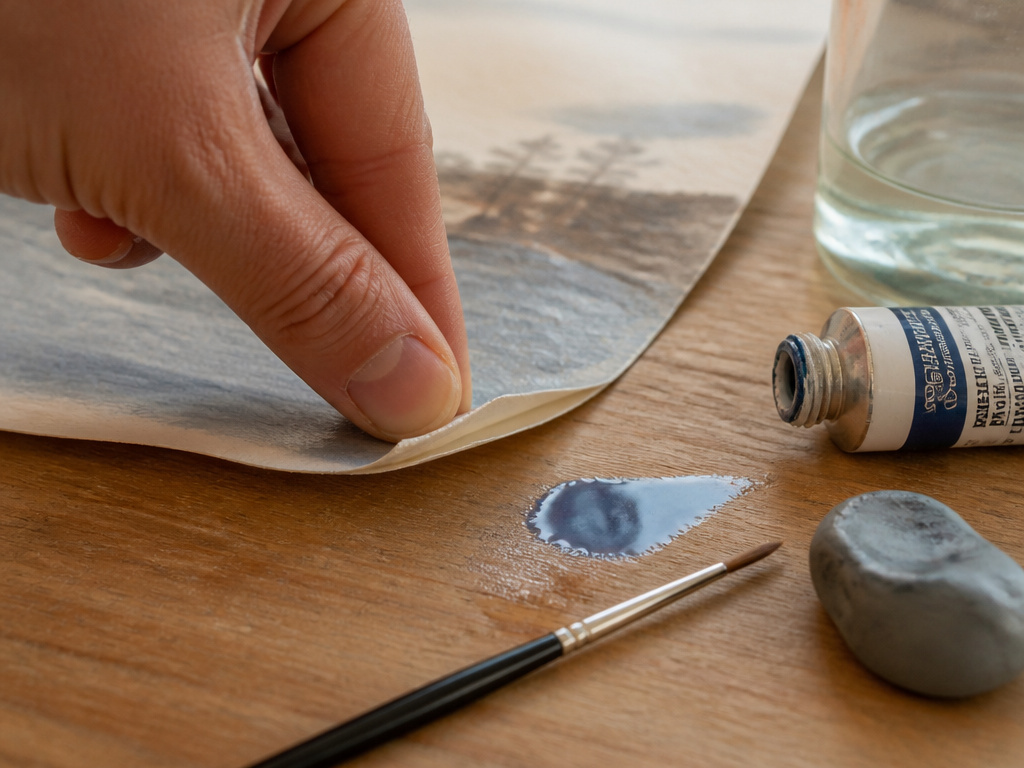
Caran d’Ache’s threshold is worth taking literally: paper under 250 g tends to curl from the water you use to dilute the gouache.
Their recommendation is a 250 g/m2 mixed media paper. Mixed media stock handles wet and dry media, which matters if you sketch in pencil first and paint over it.
Wood, Gesso, and Anything That Isn’t Paper
Non-paper surfaces need their own prep. Caran d’Ache says gouache on wood should be protected once dry with a thin layer of linseed oil.
Working flat is the method, not a preference. Caran d’Ache notes gouache is very fluid, so it is typically applied on a flat, horizontal work surface rather than a vertical one.
Where this goes sideways: Clamping a wet gouache panel to a vertical easel. The paint is fluid enough to run, and the runs dry in place before you notice them.
Here is the order that keeps a painting readable:
- Sketch lightly in pencil first. Reeves recommends a soft putty eraser, and warns never to use an eraser on wet paper because it tears the surface.
- Paint the washes and blocks of colour next.
- Add detail last with a thin brush that is only lightly loaded. Load it heavily here and you put down more paint than a small shape can carry.
- Leave the finished piece flat while it dries. Canson warns that stored rolled, gouache can easily crack.
Canson adds one planning note that saves real trouble: work out the amounts you need, including for blending, because recreating a shade later is always risky.
The Five Minutes at the Sink That Decide Your Brushes
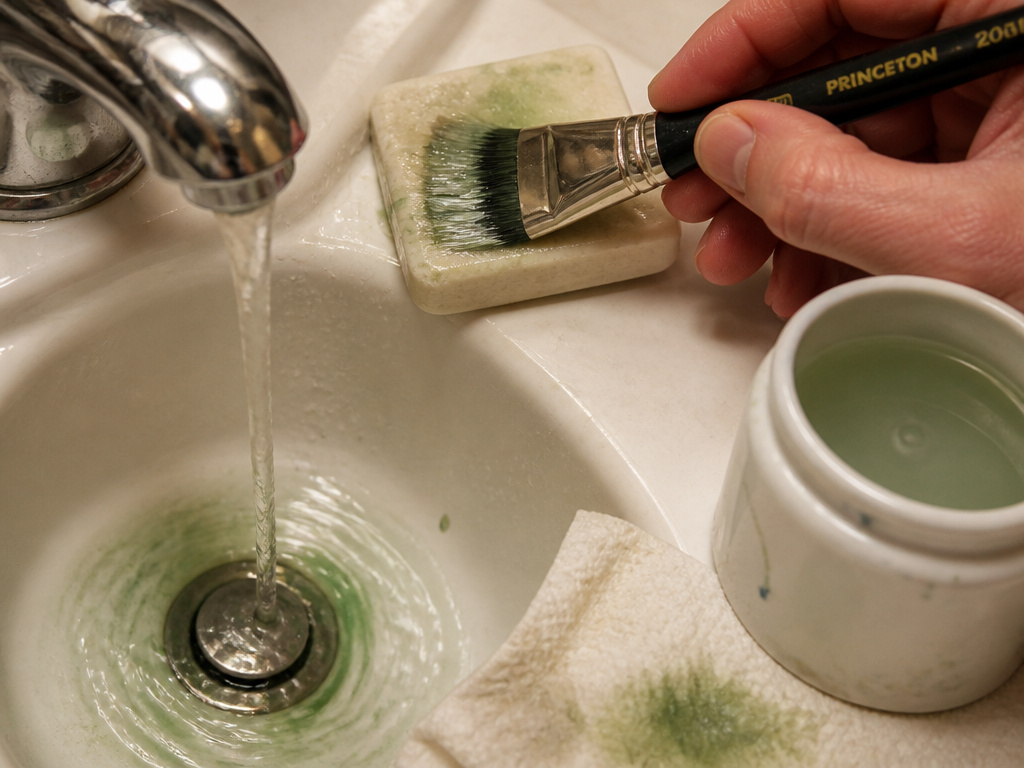
There is a brush in my jar right now with a ferrule packed solid with dried green, and it is there because I told myself I would rinse it later.
I got burned enough by hardened bristles that I now rinse the moment I stop painting. Not at the end of the session, not after I tidy the palette. Right then.
Canson’s guide to preparing and maintaining gouache materials lays out the routine I follow: rinse with clear water and rub a sponge over dry residue, add a little household soap for very strong pigments, then rinse the bristles in warm or hot water and shake them out over absorbent paper to check no colour remains.
- Rinse before the paint dries. Dried gouache in the heel of the brush is what ruins the point.
- Use household soap for strong pigments. Canson notes some very strong pigments leave traces without it.
- Shake the brush hard, then wipe the metal ferrule. Canson says the ferrule rusts if you leave it wet.
- Cap the tubes firmly and store them airtight. Canson recommends the original packaging or a sealed case.
Paint left to dry in the heel of a brush sets hard and pushes the bristles out of shape. Rinse while it is wet and the point survives.
A brush with a splayed tip makes brush control harder than it needs to be, and the routine for cleaning art brushes takes about five minutes.
Do it now, not later.
Varnish, Glass, and the Point of No Return
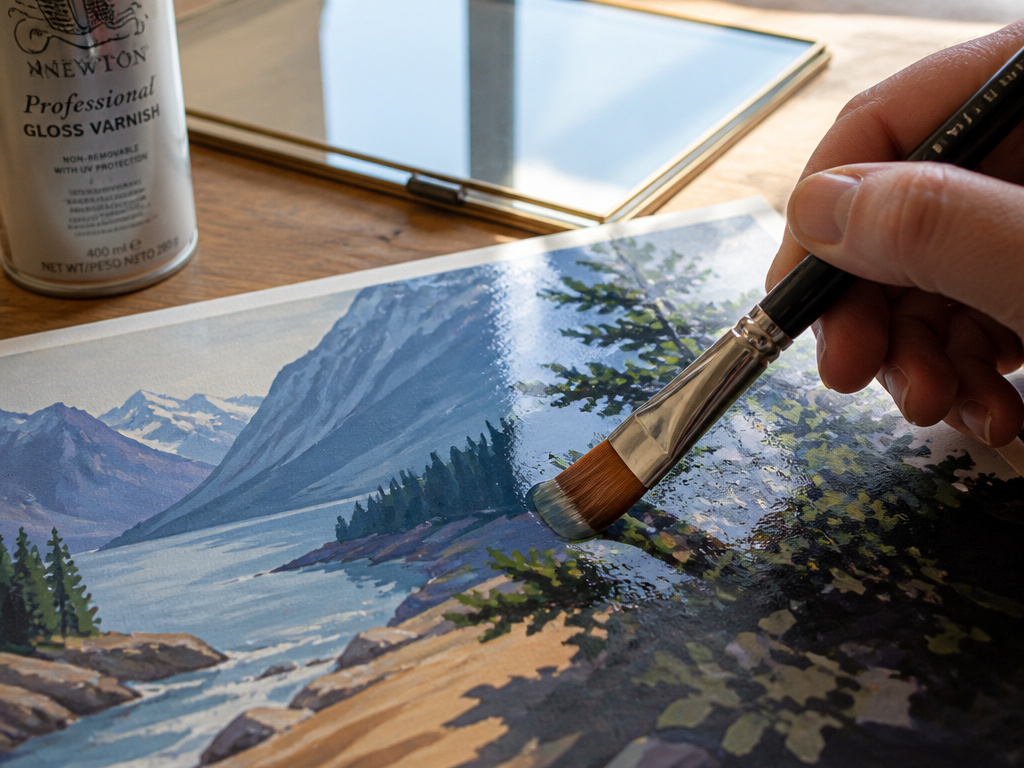
Caran d’Ache’s finishing advice contains a one-way door: once the varnish is applied the painting cannot be reworked.
That is a bigger deal for a medium whose main selling point is that mistakes stay fixable. Varnish when you are done, and mean it.
Framing behind glass adds protection, and Caran d’Ache advises keeping the piece out of direct sunlight. I once photographed a finished painting under a desk lamp at night and the colours came back warm and wrong; near a window in daylight they read correctly. Light changes what you see, so check a piece in daylight before you seal it.
Skillshare’s Kate Joy Stetson offers the other route: a spray fixative gives some protection, though nothing keeps gouache absolutely safe without ruining some of its qualities. That is a real disagreement: Caran d’Ache advises varnish with a special gouache varnish and framing behind glass, while Skillshare’s Kate Joy Stetson suggests a spray fixative for some protection, though nothing keeps gouache absolutely safe without ruining some of its qualities.
The part nobody mentions: Rolling a finished gouache for transport. Canson’s warning is blunt: stored rolled, it can easily crack.
Canson also recommends storing finished pieces flat and keeping tubes firmly capped, which is the least glamorous advice in this whole guide and the advice I ignore most often.
Frequently Asked Questions
Do you have to add water to gouache?
Not always. You add water when you want to reduce coverage and opacity, and the amount you add is the whole dial.
Can you use gouache on regular paper?
You can, but expect curl. Caran d’Ache states that paper under 250 g tends to curl in reaction to the water used to dilute the paint, and recommends a 250 g/m2 mixed media stock instead. A thin sketchbook page will buckle before the first wash is dry.
Why does my second layer look muddy?
Almost always water. Strathmore warns that the more water in the paint, the more likely it is to reactivate the previous layer and muddy the piece. Let the base layer dry completely, then lay the next colour down with a mix that is closer to double cream than to a wash.
Can you paint gouache on canvas or wood?
Caran d’Ache gives wood its own step: protect the dry gouache with a thin layer of linseed oil. On flexible surfaces, Strathmore warns that thickly applied gouache can crack and flake, so keep the paint thinner there than you would on board.
Do you have to varnish a gouache painting?
No rule forces it, but the choice is one-way. Caran d’Ache notes that once gouache varnish is applied, the painting cannot be reworked. If you want to keep correcting a piece, leave it unvarnished and frame it behind glass instead.
The Bottom Line
Mix one colour to double-cream consistency on a scrap of 250 g paper this week and paint three flat squares with it. That single exercise teaches you more about water than any guide, including this one.
If you work on canvas or anything that flexes, Strathmore warns that thickly applied gouache can crack and flake, while Caran d’Ache states its gouache will never crack and allows thick, cumulative layers.
And if the first page looks rough, good. A rough page in a cheap pad teaches you more than a perfect one you were too nervous to start.
