
Gouache vs Watercolor: Which One Fits How You Paint?
This post contains affiliate links. As an Amazon Associate, we earn from qualifying purchases.
In gouache vs watercolor, both paints share the same pigments and usually the same gum arabic. The split is formulation: gouache packs in more pigment with larger particles plus chalk or titanium white for opacity, while watercolor stays transparent so light bounces off the paper. That difference sets your layering order, your paper, and how you repair a mistake.
Repair is where the two really separate. Traditional gouache re-wets with a damp brush, so a dried passage lifts and you paint straight over it. Watercolor sinks into the paper, and once a glaze dries you’re glazing on top or living with what you’ve got.
What follows covers the formulation, the layering order each medium demands, the drying shift that wrecks color matching, and the paper question that the sources genuinely disagree about.
Key Takeaways
- Both paints share the same pigments and usually gum arabic. The split is how they’re built: gouache adds pigment load, larger particles, and chalk or titanium white for opacity.
- Opacity varies by color, not just the medium. Blick’s own technical PDF notes many dark gouache colors are quite transparent, and white and Naples Yellow watercolors are opaque.
- Gouache re-wets; watercolor mostly stains. Blick says gouache is often considered more forgiving because you can rework as you go, while tinyworkshops argues gouache is less forgiving when making changes.
- Expect a shift on drying. Blick describes a value-dependent shift: gouache lights dry darker, darks dry lighter. Swatch on scrap and wait before you commit.
- Skip the giant set. Five tubes and one decent brush teach you more than forty pans you never open.
What Actually Separates Gouache From Watercolor?
Blick’s product profile states it plainly: the two paints have practically the same pigments, binders, and formulation. The design goal is where they part. Gouache is formulated for opacity, watercolor for transparency.
Gouache and watercolor share the same pigment families and usually the same gum arabic binder. Gouache carries a higher pigment-to-binder ratio, larger and more tightly packed particles, and often added chalk or titanium white. Watercolor relies on heavily sized, gelatin-impregnated paper to reflect light back through thin, transparent glazes. The result is a matte, flat film versus a luminous one.
That reads like a small difference in the gouache vs watercolor debate. It reshapes everything downstream.
| Property | Gouache | Watercolor |
|---|---|---|
| Opacity | Formulated opaque; many dark colors still run transparent | Formulated transparent; white and Naples Yellow are opaque |
| Layering | Opaque layers can cover dried ones | Light to dark, paper reserved for highlights |
| Drying shift | Lights dry darker, darks dry lighter | Dries lighter than it looks wet |
| Best uses | Design work, posters, illustration, flat color | Landscapes, botanicals, portraiture, urban sketching |
Read that table as a chain of consequences. The layering row follows straight from the opacity row. If a dried layer can be covered, you can work dark to light and change your mind halfway. If it can’t, the paper’s white is your only highlight, and you plan the whole painting around leaving it alone.
Most beginners get further with gouache paint when they block flat shapes first and add detail later. Watercolor rewards the opposite instinct: a light pencil plan and a lot of patience while things dry.
The Opacity Claim Is Only Half True
Every comparison page leads with gouache is opaque, watercolor is transparent. Blick’s own technical PDF undercuts that in the same document.
Here’s the admission, near-verbatim: many dark colors in gouache tend to be quite transparent, and white and Naples Yellow are both commonly available in watercolors. So the label describes the intent of the formulation, not a guarantee about the tube in your hand.
| Color or grade | What it does | What to do |
|---|---|---|
| Titanium white (gouache) | Full opacity, strong covering power | Use it for tints and final highlights |
| White or Naples Yellow (watercolor) | Opaque even inside a transparent medium | Stop reserving paper for those areas |
| Dark gouache colors | Many are quite transparent | Lay them over a light base, not bare paper |
| Student-grade lines | Extenders lower color strength | Test opacity on scrap before you commit |
The History of Art comparison makes the same argument from the other direction. It holds that opacity varies by pigment and formulation, and that the category label is a useful starting distinction only. That’s a fair read of the evidence, and it’s the position I’d trust over any flat either-or claim.
Test the tube, not the label. A swatch of the exact paint on the exact paper tells you more about opacity than any category name on the box.
This matters most when you’re covering a mistake. A transparent dark won’t hide the passage underneath it, no matter how confidently you load the brush. Reach for titanium white first, let it dry, then glaze the dark over that.
Why Gouache Lets You Paint Light Over Dark
You can lay a dark background first and drop a light shape on top of it. Skillshare describes exactly that workflow, and H&B Art calls it dark-to-light layering, where a new opaque layer sits on a dried layer and covers it, though Blick’s PDF warns that gouache re-wets and darker colors can show through lighter ones.
Now the complication. Blick’s PDF warns that the same re-wetting causes gouache layers to intermix, and darker colors show through lighter ones. Some artists plan for that and let underdrawing bleed into the top coat. Others work light to dark so nothing bleeds at all.
Both are correct in the gouache vs watercolor layering argument. It depends on how much water is still in your brush.
Here’s the physical tell. A thin gouache layer dragged over cold press paper catches the raised tooth and skips the low spots, so you get a broken, speckled pass instead of a flat one. Load more paint and the same stroke goes solid. The paper is telling you how much body you’re carrying.
If your layers keep lifting, the fix is thinning gouache less, not painting faster. Less water means less reactivation underneath.
I keep a scrap sheet beside every painting and test each light-over-dark move there first. Half the time the layer underneath lifts into the new color. I’d rather learn that on the scrap than on the sky.
Where this goes sideways: Applying gouache thick enough to cover in one pass. Skillshare notes that thick gouache can crack as it dries, and the cracks surface days later, not while you’re painting.
Why Does Gouache Dry a Different Color Than It Looks Wet?
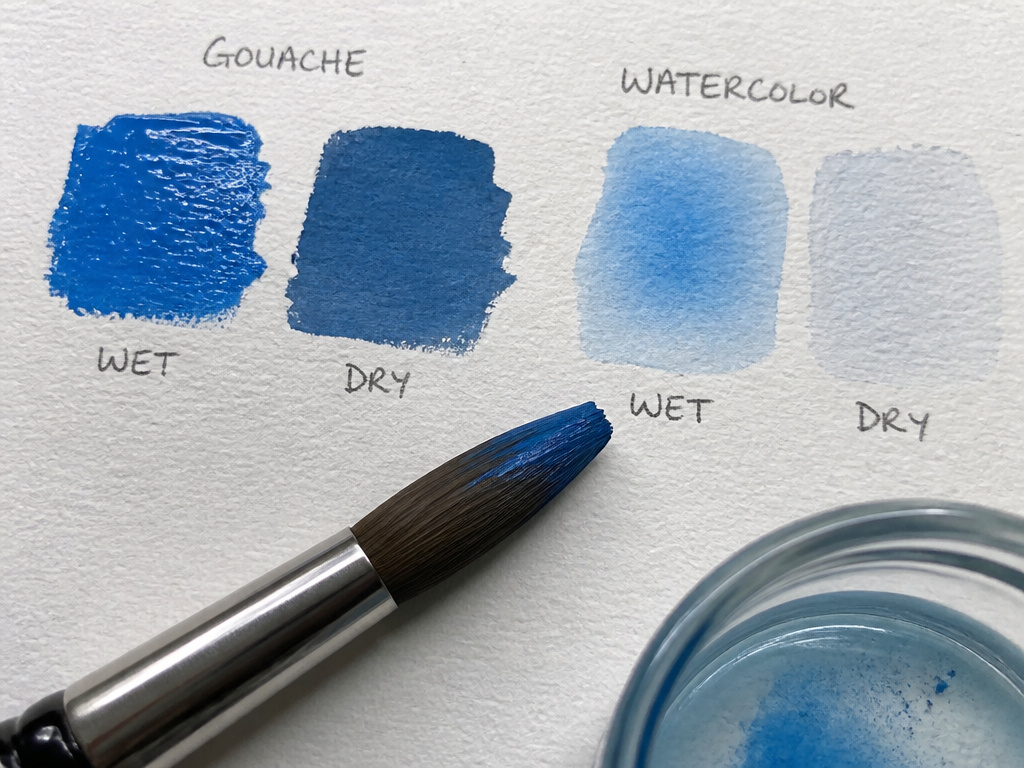
Blick’s comparison table gives a value-dependent answer: gouache lights dry darker and darks dry lighter, while American Watercolor says gouache dries uniformly darker than watercolor and H&B Art says it dries a little darker and flatter than it looks wet. Watercolor, by contrast, dries lighter than it looks wet.
Not every source agrees. American Watercolor states flatly that gouache dries quicker and darker than watercolor, which implies uniform darkening. H&B Art lands somewhere in the middle, saying gouache tends to dry a little darker and flatter than it looks wet.
I’d treat the value-dependent version as the more useful working rule, since it comes from Blick’s technical comparison rather than a passing line in a trade piece. But the honest answer is that this is contested, and the shift depends on the pigment.
In practice I swatch on scrap paper and wait for it to dry before trusting a mix. That wait is the whole trick. Ten minutes of patience beats repainting a sky because your blue went two shades deep on drying.
Watercolor has its own version of this problem. A wash looks bright and wet, then settles lighter and slightly duller. If you’re fighting that, the mechanics of water control in watercolor explain most of it.
Paper, Water, and the Buckling Argument
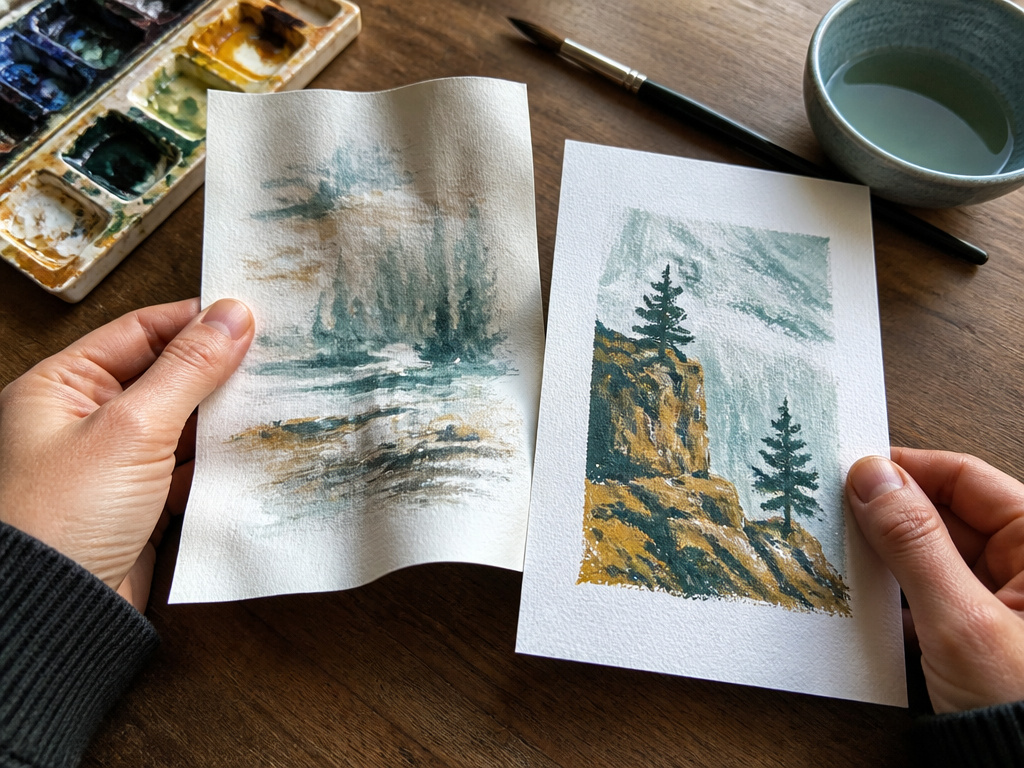
Strathmore’s lesson PDF puts a number on it: use paper 300gsm (140lb) or thicker to minimise buckling and warping, though Skillshare argues gouache’s lower water needs make thinner sketchbook or mixed media paper workable.
Skillshare takes the other side: because gouache needs less water than watercolor, it says gouache can go on thinner stock like sketchbook or mixed media paper, and on colored paper too, while Strathmore recommends 300gsm (140lb) or thicker.
Both are right, and the variable is water. A dry-brush gouache study on thin sketchbook paper is fine. A flooded wet-into-wet background on the same sheet will ripple like a potato chip.
Cold Press or Hot Press for Gouache?
Strathmore recommends cold press first, because the tooth helps the paint grab the surface and makes even coverage easier to reach. Hot press also works and is much smoother, which suits lettering and tight flat shapes.
My preference runs to cold press for studies and hot press for anything with a hard edge. The cold press texture does half the work of making a flat shape look intentional.
When Thin Paper Is Fine
Thin paper earns its place in a sketchbook, where the point is volume of practice rather than archival permanence. Colored paper is underrated for gouache too, since an opaque paint reads clearly on a toned ground.
If you’re still learning how much water your brush holds, the wet-on-wet versus wet-on-dry distinction explains why one pass buckles a page and the next doesn’t.
Where Each One Falls Apart
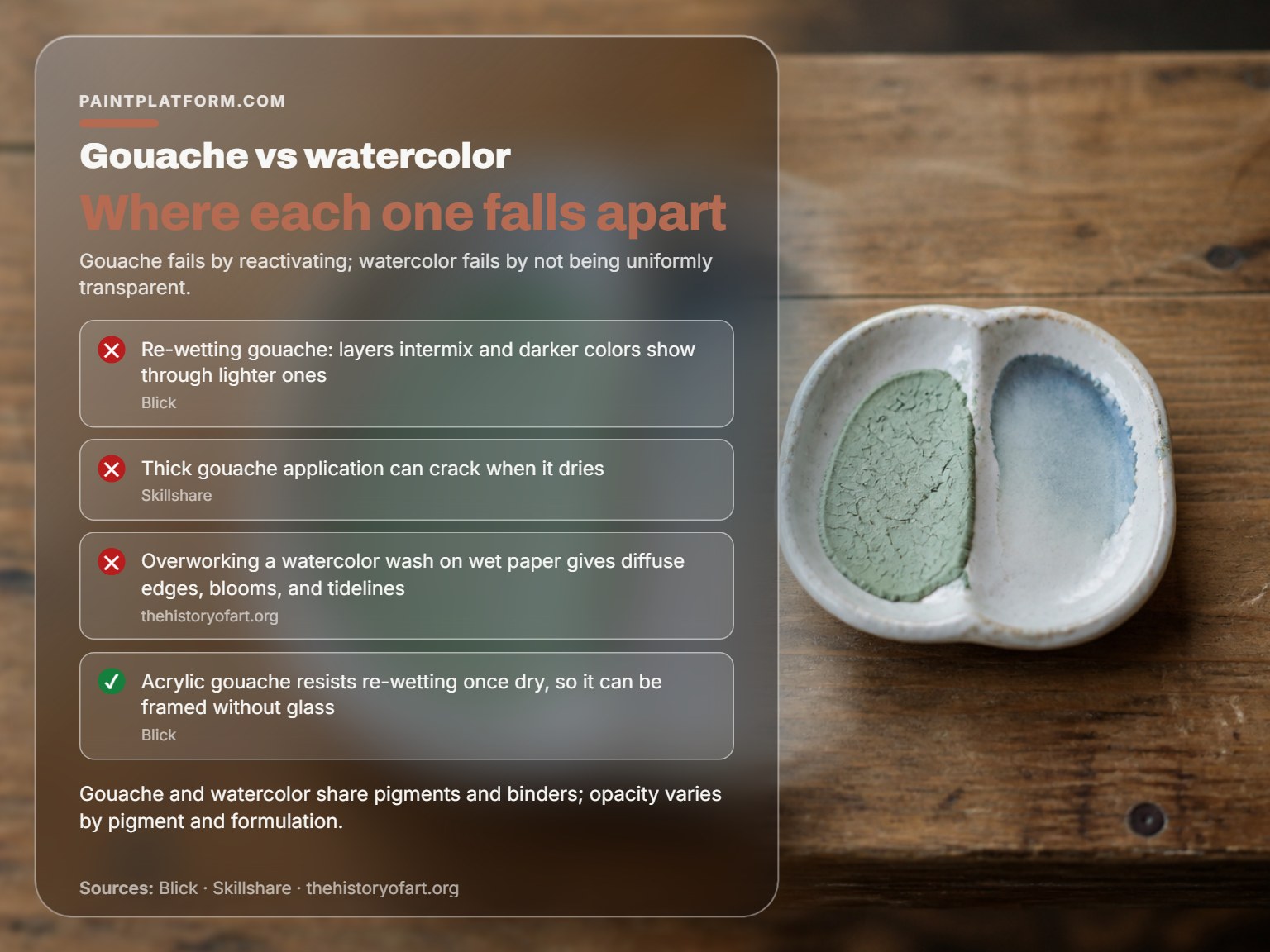
Gouache fails by reactivating. Watercolor fails by refusing to.
Here’s what that looks like in order of how often it bites people:
- Muddying from re-wetting. Blick’s PDF is explicit: layers intermix and darker colors show through lighter ones. This is the single most common gouache complaint.
- Cracking from thick application. Skillshare flags it, and it shows up after the painting is finished and framed.
- Framing without glass. Traditional gouache stays water-soluble forever, so a humid room will eventually find it.
- Overworking a watercolor wash. The History of Art comparison notes that wet paper gives diffuse edges, blooms, and tidelines, while the same paint on dry paper holds a defined edge.
That framing problem has a clean answer. Blick’s product profile points anyone who wants a non-intermixing paint or a glass-free finish toward acrylic gouache, which resists re-wetting once dry. Acrylic gouache behaves closer to gouache compared to acrylic paint than to traditional gouache.
The part nobody mentions: Lightfastness claims for gouache over watercolor don’t hold up. Since the two share pigments and binders, fading tracks the pigment, not the medium. One instructor blog claims gouache is more lightfast and watercolor fades, but no manufacturer test data backs that, and it contradicts the shared-chemistry position.
A Five-Tube Kit Beats the Big Boxed Set
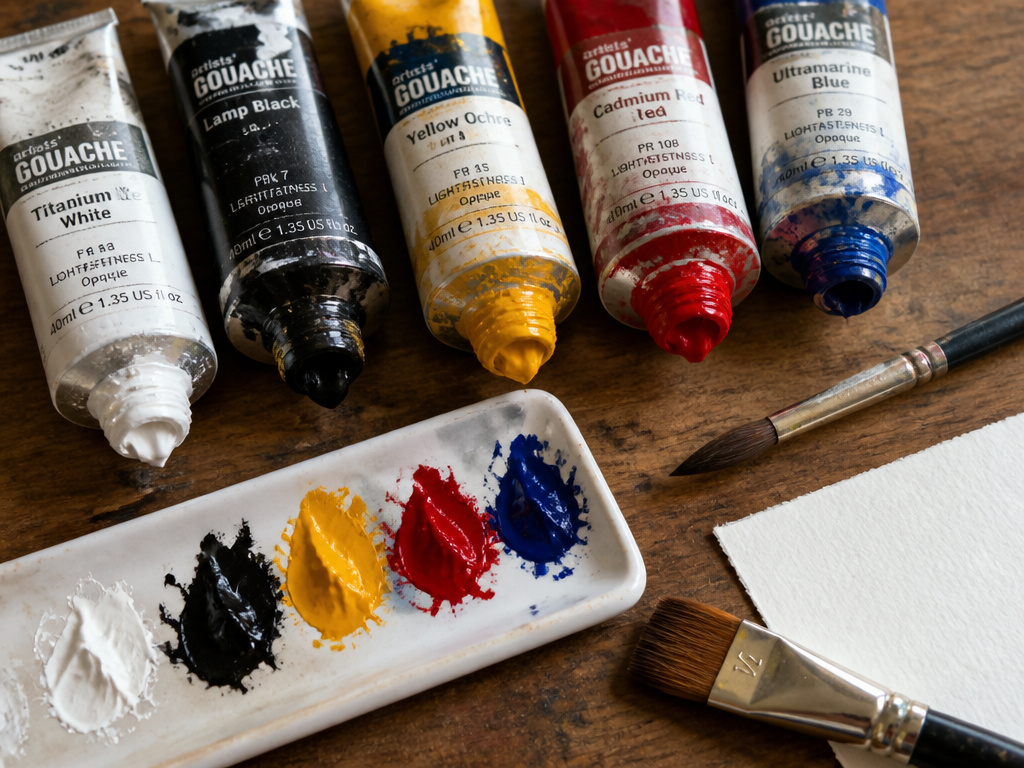
Strathmore’s lesson recommends a limited palette: titanium white, black, yellow, red, and blue, with Payne’s gray, raw sienna, raw umber, and burnt sienna as useful additions.
That’s the whole list. A big boxed set won’t teach you color mixing. Five tubes will, because you have to mix everything you need.
Here’s the order I’d buy in:
- Titanium white and a black. Skip this and you can’t make tints, which is most of what gouache does well. You’ll end up buying a second white anyway.
- One warm and one cool of each primary. A yellow, a red, a blue, chosen so they mix cleanly. Buying six yellows before you can mix a green is procrastination with a receipt.
- A single decent brush. Strathmore’s supply list runs flat and round shapes, which covers most of what you’ll paint.
- 300gsm cold press paper. One good block beats a stack of thin pads, and it survives the flooded washes you’ll attempt in week one.
Which Tubes to Buy First
For watercolor, the equivalent starting point is covered in this rundown of the best watercolor paints.
What to Skip
Skip the 24-pan travel set with the plastic brush. Skip the student-grade gouache that lists extenders on the label if you plan to sell the work. And skip stocking up before you’ve finished one painting.
One honest caveat on cost: gouache generally runs more expensive than watercolor for the same volume. That’s a real reason to start with five tubes rather than a full range.
Frequently Asked Questions
Is gouache just opaque watercolor?
Close, but the framing is loose. Blick’s product profile says the two share practically the same pigments, binders, and formulation, with gouache formulated for opacity. The History of Art comparison argues opacity varies by pigment and formulation, so treat the label as a starting point rather than a rule.
Can you mix gouache and watercolor on the same painting?
Yes. Blick confirms the two can be intermixed, and watercolor can be used like gouache by adding white on the palette, though the surface won’t be as matte. Plenty of painters use transparent watercolor for the base and gouache for the opaque passages on top.
Which one is more forgiving for a beginner?
It depends which mistake you make more often. Blick notes gouache is often considered more forgiving because you can rework as you go. Tiny Workshops argues the reverse, that gouache is less forgiving when making changes. If your errors are color choices, gouache wins. If they’re overworking a wash, watercolor’s ability to be revived helps.
Do you need special paper for gouache?
Strathmore recommends 300gsm (140lb) or thicker to minimise buckling. Skillshare counters that gouache uses less water than watercolor, so thinner sketchbook or mixed media paper works. The deciding factor is how wet you paint, not the medium itself.
Does gouache dry darker than watercolor?
Sources disagree on the direction. Blick describes a value-dependent shift where lights dry darker and darks dry lighter. American Watercolor says gouache dries uniformly darker than watercolor. Swatch your own paint on your own paper and wait ten minutes before trusting the wet color.
The Bottom Line
If you want one rule for choosing: pick gouache when you need to cover, correct, and repaint, and pick watercolor when the paper’s white is doing real work in the image.
The threshold that flips the advice is water. Above roughly the point where your brush drips, gouache starts behaving like watercolor and loses its opacity advantage. Below it, watercolor starts behaving like a thin gouache and you lose the glow. Neither medium is misbehaving. You’ve just crossed into the other one’s territory.
Here’s the concession, though. None of this matters as much as the swatch sheet. Every claim here, including the ones the sources argue about, resolves on your own paper.
So buy five tubes. Make one flat, ugly study. Try it on a scrap first.
