
Coveralls for Painting Guide: Which Type Actually Fits
This post contains affiliate links. As an Amazon Associate, we earn from qualifying purchases.
The coveralls for painting guide question has one hard number behind it: breakthrough time. DuPont Tyvek measured under 0.25 hours against polymeric MDI in industry testing, while Tychem QC held past 8.0 hours. A Type 6 splash rating covers overspray, not a soaked sleeve.
Breakthrough time is measured in a lab cell, with the chemical on one face of a flat swatch and a sensor on the other. Seams, zippers, and cuffs don’t get that test. DuPont’s own spray painting bulletin warns that seams and closures often have shorter breakthrough times and higher permeation rates than the fabric itself, which is why a taped seam costs more than a sewn one.
What follows covers the ratings that actually matter, the fabric rule US and UK regulators can’t agree on, and the donning order that keeps paint off your neck. Two tables, one decision.
Key Takeaways
- Breakthrough time beats the label. Type 6 covers light splashes only. Tyvek measured under 0.25 hours against polymeric MDI; Tychem QC held past 8.0 hours.
- Cotton is a legal requirement for highly volatile paints under 29 CFR 1915.35, though 3M markets its synthetic 51850 laminate for paint shop use with an anti-static coating and DuPont says Tyvek can be considered for paint aerosols with appropriate respirators.
- Discard single-use gloves every time you take them off. HSE guidance is blunt about it, and barrier creams don’t count as a substitute.
- Store coveralls between -20 C and +25 C at under 80% humidity. A hot van cooks the 5-year shelf life out of a 3M 51850.
- A paper dust mask won’t stop solvent vapour. The EPA checklist calls for loose-fitting SAR or better with an assigned protection factor of at least 25 when spray painting, while HSE sets APF 10 for poor ventilation or small spillages and APF 20 for larger hardener spills.
What Breakthrough Time Actually Measures
Breakthrough time is the clock that starts when a chemical touches the outside of a fabric and stops when it’s detectable on the inside.
Standard test methods mount a flat swatch of material in a permeation cell, apply the challenge chemical to one face, and monitor the opposite face with a sensor. The reported value is the elapsed time before detectable permeation. Flat-swatch results describe fabric performance only, not the finished garment.
OSHA’s Technical Manual treats anything above one hour as a rough sign of acceptable performance, and that threshold is worth holding in your head. It also points out that similar materials from different manufacturers give widely different results, so a generic “buy butyl” recommendation is close to useless. You need the data for the specific garment.
A laminate coverall crackles when you bend at the waist. That noise is the film flexing against itself, and flex cracking is what eventually opens a pinhole. The 3M 51850 is certified Type 6 for light liquid splashes and Type 5 for hazardous dusts, and it is explicitly not rated for EN 863 puncture resistance.
I’d rather have a taped seam and a plain cuff than a hood and a knee pad. The seam is the part that fails first.
Coveralls for Painting Guide: What Type 5 and Type 6 Ratings Cover
Two numbers sit on almost every paint-shop coverall, and neither one is a permeation rating.
Type 6 (EN 13034) means the garment resists light liquid splashes. Type 5 (EN ISO 13982-1) means it keeps hazardous dust out. The 3M Paintshop Coverall 51850 carries both, plus EN 1149-5 for anti-static performance and EN 1073-2 Class 1 for radioactive particulates.
The suit material is a polypropylene and polyethylene laminate at 60 gsm in white. The back panel is SMMMS polypropylene at 43 gsm in green, which is the breathable section. It’s also explicitly not rated for EN 863 puncture resistance, so it will not save you from a sharp corner on a substrate.
Easy to miss: The 3M 51850 anti-static treatment works on the white material only, and the garment has to be grounded for the coating to do anything. A coloured variant loses the EN 1149-5 protection entirely.
Repellency and liquid penetration resistance to 30% sulphuric acid and 10% sodium hydroxide both rate Class 3 of 3 under EN ISO 6530. That’s a genuinely strong result for a disposable. It still doesn’t tell you how the suit behaves against the solvent in your gun.
DuPont draws the same line from the other direction. Its bulletin says Tyvek coveralls can be considered for use with appropriate respirators to minimise contact with paint aerosols. Aerosols. Not pools, not drips, not a saturated sleeve.
I’d pay for the certification before I’d pay for the hood. The certification is the part you can look up.
Which Coverall Fabric Matches Your Paint?
Which coverall fabric actually matches the paint you’re spraying? Start with the chemistry, then work backwards to the garment.
The American Chemistry Council ran polymeric MDI against a range of garments, and the spread is enormous. DuPont Tyvek, a 5.0 mil nonwoven, showed a breakthrough time under 0.25 hours with low mechanical durability. Tychem QC, a 6.0 mil nonwoven, held past 8.0 hours.
| Garment | PMDI Breakthrough | Durability | Best For |
|---|---|---|---|
| DuPont Tyvek (5.0 mil) | under 0.25 hours | Low | Dry overspray, dust |
| DuPont Tychem QC (6.0 mil) | over 8.0 hours | Low | Splash risk, smooth substrate |
| DuPont Tychem SL (7.0 mil) | over 8.0 hours | Medium | Splash plus rough surfaces |
| Neese Universal 35 PVC (10.0 mil) | 7.5 to over 8.0 hours | High | Wash-down, repeated use |
| 3M Paintshop Coverall 51850 | No published PMDI data | Not rated to EN 863 | Overspray, dust, static control |
Tyvek vs Tychem: The 8-Hour Gap
Tyvek is made from ultra fine continuous high density polyethylene fibres, compressed under heat and pressure into a non-woven with no fillers, additives, or silicone. It breathes, it’s abrasion resistant, and it sheds very few particles. Independent lab tests to BS 6909 showed it releases considerably fewer particles than SMS or microporous film materials.
That makes Tyvek a strong choice for keeping a spray booth clean and a poor choice for a wet sleeve. DuPont says plainly that Tyvek garments aren’t appropriate if they’re getting wet, if paint is dripping or running on them, or if spotting shows up on the skin underneath.
Tychem with taped seams gives a much higher liquid barrier and a significantly higher risk of heat stress. DuPont positions it for prolonged exposure to un-reacted activator or solvents: large-scale equipment maintenance, spill cleanup, big mixing jobs.
When Cotton Is the Right Answer
Here’s where the rulebook and the catalogue part company. Under 29 CFR 1915.35(b)(9), for highly volatile paints, coveralls or other outer clothing shall be of cotton, though 3M’s 51850 is a polypropylene/polyethylene laminate marketed for paint shops and DuPont says Tyvek can be considered for paint aerosols with appropriate respirators. US rule text says rubber rather than plastic gloves shall be used because of static sparks, while HSE guidance recommends chemical-resistant gloves such as nitrile, with single-use preferred. Footwear has to be non-sparking, such as rubbers, rubber boots, or rubber-soled shoes without nails.
The 29 CFR 1915.35 painting regulation is written for shipyard compartments, where solvent vapour pools and a static spark is a genuine ignition source. In that setting, a polypropylene laminate is the wrong fabric no matter how good its splash rating is.
The synthetic coveralls answer static a different way. 3M’s anti-static treatment is effective on white material only and the garment must be suitably grounded for it to work, and the 51850 carries EN 1149-5:2008 anti-static certification. That’s a coating doing a job cotton does by existing.
Where the Regulations Disagree With the Product Labels
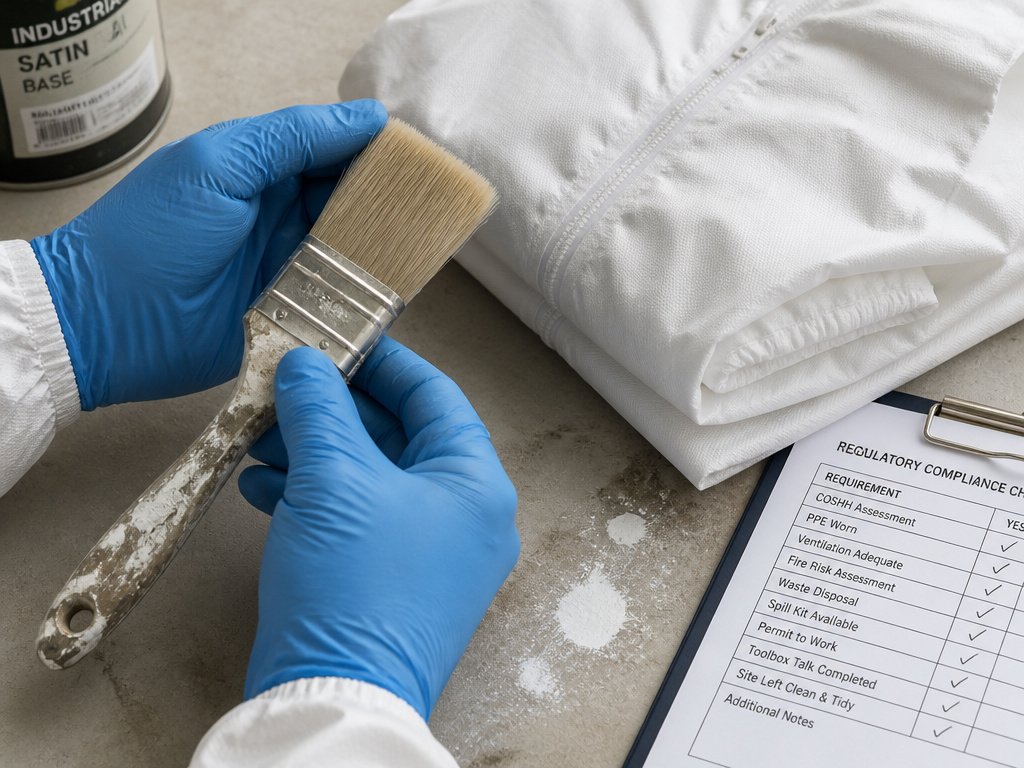
Two regulators can look at the same paint job and hand you opposite instructions. Neither one is wrong for its own jurisdiction, and the gap matters if you’re buying gear that has to work in both worlds.
Gloves are the clearest example. US rule text says rubber rather than plastic, because of static sparks. UK HSE painting by brush guidance says provide chemical-resistant gloves, for example nitrile, with single-use preferred. Nitrile is a synthetic rubber, but most people file it under plastic, and neither document reconciles the two positions.
Reuse is the second gap. HSE says provide disposable coveralls and discard them at the end of the shift. The 3M 51850 technical data sheet permits reuse, tells you to replace it if damaged or heavily contaminated, and gives a 5-year shelf life from manufacture.
Respiratory protection is the third. The EPA spray painting best practices checklist says consistently use loose-fitting SAR or better, with an assigned protection factor of at least 25, when spray painting. HSE puts RPE at APF 10 where ventilation is poor or for small spillages, and air-fed RPE at APF 20 for cleaning up larger spills of hardener. The federal rule text splits it by time: air-line respirators for workers continuously in the compartment, filter cartridge respirators for limited entries.
When two regulators disagree on glove material, buy the one that satisfies the stricter reading of your task. Rubber gloves clear the static-spark rule and the chemical-resistance rule at the same time.
The Gloves, Hood, and Footwear Most Painters Forget
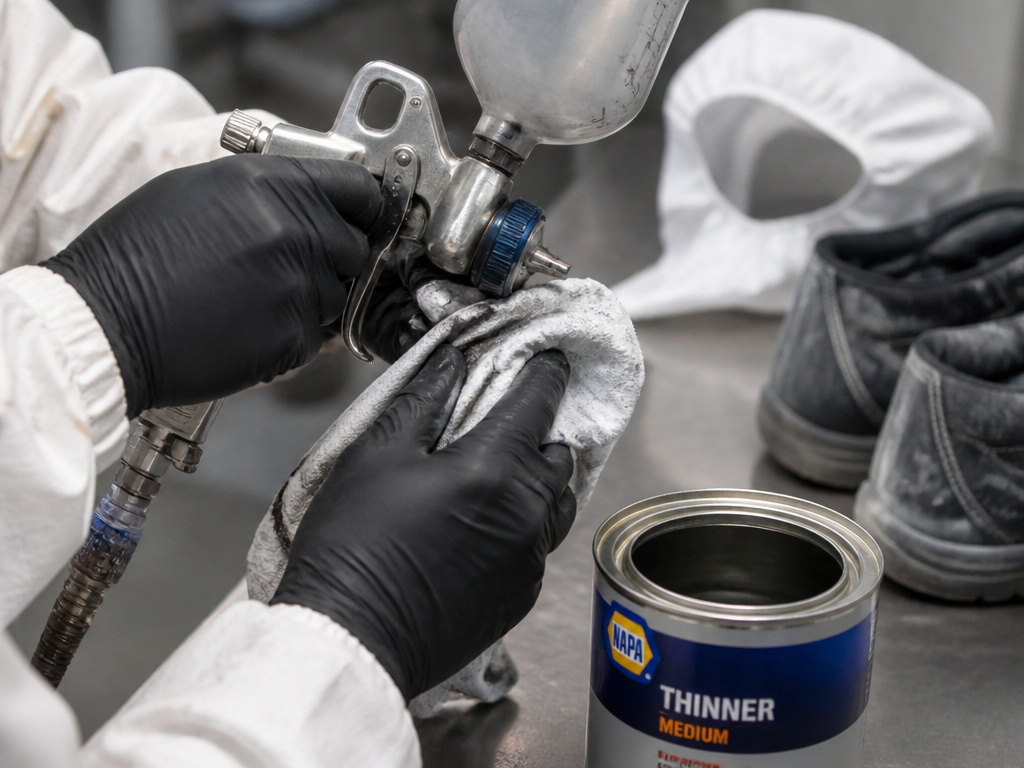
The coverall is the easy part. Everything at the edges is where paint gets in.
Gloves: Nitrile, Rubber, or Neither
Discard single-use gloves every time you take them off. That’s HSE’s instruction, not a suggestion, and it’s the one rule painters break most. The same guidance says barrier creams and liquid gloves don’t provide a full barrier and shouldn’t stand in for properly selected gloves.
The EPA checklist adds two hard facts. Latex gloves don’t protect against most solvents used in auto refinishing shops. And gloves have to be in good condition, free of tears or punctures, because a pinhole at the thumb web is where a solvent burn starts.
- Single-use nitrile for mixing, wiping, and short touch-up work.
- Heavier rubber or butyl where you’re handling volatile paint by the can.
- Never thinners on skin. HSE is explicit, and the drying agents in gun wash strip oils fast.
The painting gloves you pick should match the solvent, not the paint colour. Check the manufacturer’s chart for the actual chemical.
Hoods, Cuffs, and the Neck Gap
The EPA checklist pairs coveralls with a headsock unless you’re wearing a hooded respirator. The reason is take-home contamination: paint dust and residue ride home on hair and collars and end up on your kids’ laundry.
Cuffs have their own trap. On the 3M 4510, the cuffs are not flame resistant and must be worn under gloves, and the garment has to sit over a primary FR layer rather than next to skin when flame resistance is required. The 51850 carries EN 1149-5:2008 anti-static certification and EN 1073-2:2002 Class 1 for radioactive particulates.
Footwear and Static
Non-sparking footwear is the forgotten item on the list. Rubber boots or rubber-soled shoes without nails, per the federal rule text. Steel toe caps with exposed metal studs are the wrong call in a compartment full of solvent vapour.
The safety glasses matter here too. Overspray drifts, and a full-face respirator doesn’t cover the sides of your eyes the way a wrap-around pair does.
Pull a Tychem suit off in a warm booth and the inside can be slick with condensation. That’s the heat stress DuPont warns about, and it’s why the taped-seam suits get worn in short bursts rather than full shifts.
How Do You Put a Coverall On Without Contaminating Yourself?
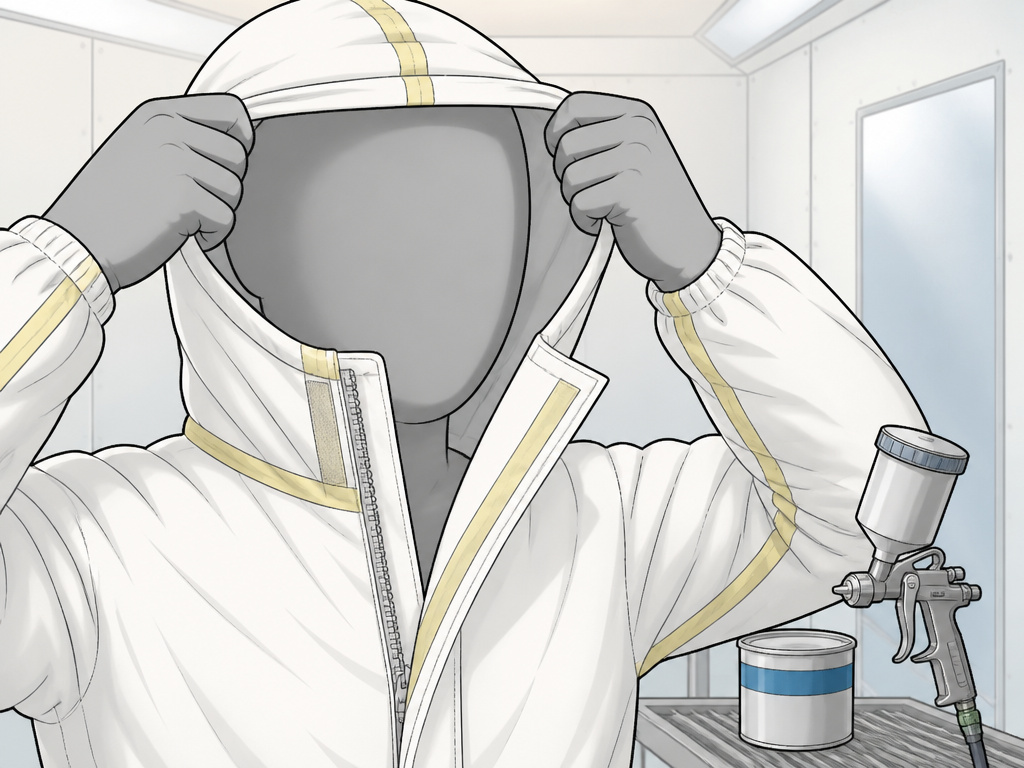
How do you put a coverall on without dragging paint into your hair, your car, or your kitchen? Order of operations, mostly.
Before you start: Solvent vapour at or above 10 percent of the lower explosive limit means stop painting and evacuate the compartment, per 29 CFR 1915.35. Spray work needs respiratory protection at an assigned protection factor of 25 or better, not a paper dust mask. And a laminate coverall is only flame resistant if the label says so; DuPont states plainly that Tyvek, ProShield, and Tychem are not flame resistant and shouldn’t be used near heat, flame, or sparks.
- Empty your pockets and take off jewellery. A watch strap holds solvent against skin for the whole shift, and you won’t feel it until the end.
- Sit down to get your legs in. Standing on one leg on a slick booth floor is how ankles get rolled, and a torn knee on the way in is a wasted suit.
- Pull the hood up before you touch the zipper. Zipping first and fighting the hood afterwards stretches the storm flap until it stops sealing.
- Seal the storm flap over the zipper. An open flap funnels overspray straight down your chest, and you’ll find the stripe when you take the coverall off.
- Tape the cuffs over your gloves, never under. Paint runs down the sleeve and pools at the wrist if the glove sits on top of the fabric.
- Check the neck in a mirror. That’s the gap painters miss, and it’s where the red line shows up by evening.
I’d take a plain white coverall with a taped seam over a hooded one with a sewn seam every time. The seam is the part that fails first, and DuPont says as much in its own bulletin.
Reuse, Storage, and When to Throw It Away
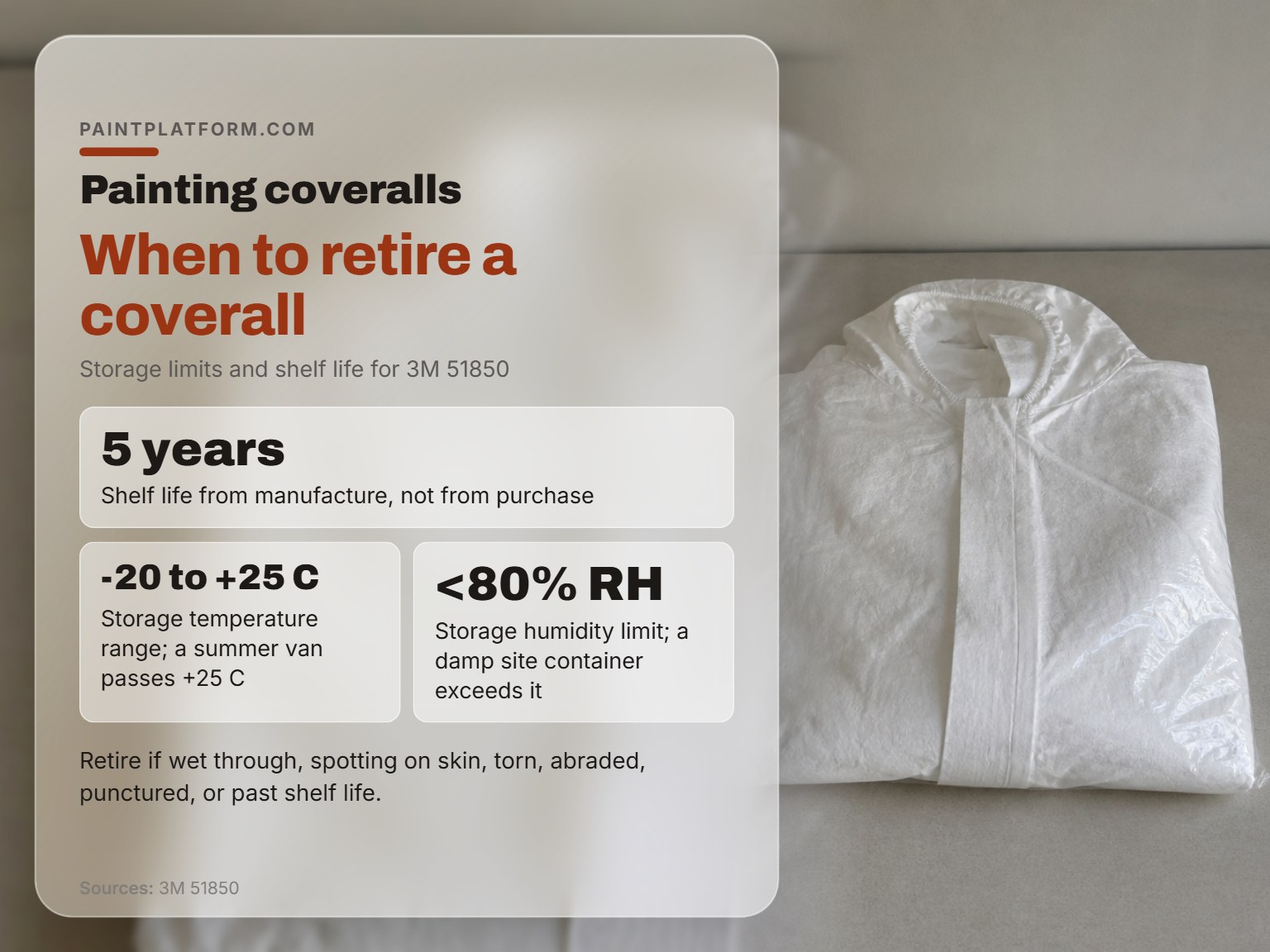
A coverall comes out of the van in July, still folded, and the film has gone tacky where it pressed against the window. That garment is done, even though it looks new.
The Storage Envelope Nobody Reads
The 3M 51850 stores between -20 C and +25 C at relative humidity below 80%, with a shelf life of 5 years from manufacture. A van in summer passes +25 C by mid-morning. A damp site container passes 80% humidity overnight.
Retire a coverall when any of these show up:
- Wet through or dripping. DuPont says Tyvek isn’t appropriate once paint is running on it or it’s wet to the touch.
- Spotting on skin or under-garments. That’s liquid that got through, and the barrier is already compromised.
- Torn, abraded, or punctured. DuPont tells end users to discontinue use rather than risk the barrier.
- Past the shelf life. Five years from manufacture, not from purchase.
- Any job with sharp edges.
Where this goes sideways: Reusing a coverall that got soaked at the knee. The film doesn’t visibly fail, but the seam wicks, and you find out at the end of the shift when the paint line appears.
| What you see | What it means | What to do |
|---|---|---|
| Paint spotting under the suit | Liquid passed the fabric or a seam | Stop, discard the garment, wash skin |
| Tacky or stiff film after storage | Storage envelope exceeded | Retire it, don’t trust the barrier |
| Grey smear at the knees | Abrasion, not a stain | Check for pinholes, replace if torn |
| Fogging inside a Tychem suit | Heat stress building | Shorten the wear period |
| Redness at the collar line | Neck gap | Retape, or switch to a hooded respirator |
The protect skin side of this is where most painters spend the least thought. A coverall is the outer layer, and it works only if the layer under it stays dry.
Frequently Asked Questions
Do I need a coverall for brush and roller work?
Usually not for the paint itself. HSE guidance says RPE isn’t normally needed for brush and roller application where ventilation is working, and the exposure is far lower than spraying. A disposable coverall still earns its place if you’re working overhead, mixing epoxy, or handling isocyanate hardener.
What’s the difference between Type 5 and Type 6?
Type 6 (EN 13034) covers light liquid splashes. Type 5 (EN ISO 13982-1) covers hazardous dusts. Neither is a permeation rating, so neither tells you how long the fabric holds out against a specific solvent. For that you need breakthrough data from the manufacturer.
Can I reuse a painting coverall?
It depends which document you follow. HSE says discard disposable coveralls at the end of the shift. The 3M 51850 data sheet permits reuse and gives a 5-year shelf life. If you reuse, retire the garment the moment it’s wet, torn, abraded, or past its shelf life.
Are latex gloves okay for oil-based paint?
No. The EPA checklist states that latex gloves don’t provide protection against most solvents used in auto refinishing shops. Nitrile, butyl, or PVA are the usual alternatives, and the glove maker’s chemical chart is the only reliable source for your specific solvent.
How often should a respirator be examined?
HSE says examine and test RPE thoroughly at least monthly, and infrequently used RPE at least three-monthly. Records of all examinations and tests should be kept for at least five years. Replace worn parts rather than working around them.
The Bottom Line
If you take one thing from this coveralls for painting guide, make it the breakthrough number. Ask the supplier for the permeation data against your actual chemical before you buy a box of suits. If they can’t produce it, that’s your answer.
Here’s the trigger to act on: any time a coverall gets wet enough that you can see a sheen, the barrier is finished. Not degraded. Finished. Change it at the next break rather than at the end of the shift, because the seam wicks long before the fabric looks compromised.
One concession worth stating plainly. Everything above assumes you’re spraying or handling liquid coatings. If you’re brushing water-based paint onto a wall in a ventilated room, most of this is overkill, and a cotton shirt you don’t mind ruining will do the job.
The spray painting PPE side of the kit is where the money belongs. A properly fitted paint respirator and a suit with a taped seam will do more for you than a hood, knee pads, and a second zipper combined. Skip the extras. Buy the barrier.
