
Painting Gloves Guide: What Actually Protects You
This post contains affiliate links. As an Amazon Associate, we earn from qualifying purchases.
A painting gloves guide worth reading starts with one rule: match the glove to the chemical, not to the color of the box. Nitrile is the default for paint and solvent work, butyl rubber is the stronger barrier against MEK, and most spray painters’ 4-5 mil latex gloves are not effective against isocyanate paints. Check the manufacturer’s chart for your exact product.
Blue used to mean nitrile. Now latex ships in the same blue, so the box tells you nothing reliable about what’s inside. That color swap is the reason so many painters think they’re protected when they aren’t.
What follows covers the three materials that actually get tested, the markings that prove a glove was rated, the numbers behind the thin-latex habit, and the painting gloves guide fit checks most people skip entirely.
Key Takeaways
- Match the material to the solvent, not the thickness. Nitrile handles general paint work, butyl rubber is the named barrier for MEK; the EPA says latex degrades fast against paint chemicals and offers little or no protection, though it also lists latex among glove types for auto refinishing, while HSE says choose non-latex unless no alternative gives the needed protection.
- A study of spray painters found most wore 4-5 mil latex, which was not effective at preventing dermal exposures when spraying isocyanate paints. Medium-to-thick nitrile runs 6-8 mil.
- A chart from one brand does not transfer to another brand’s glove, even in the same material.
- Glove length must exceed immersion depth. Short cuffs are for splashes only.
- Flammable solvents require non-static-discharge gloves under OSHA 29 CFR 1915.35(b)(9), a rule no chemical-resistance chart mentions.
Which Glove Material Actually Stops Paint Solvents?
Four materials get named for paint work: nitrile, butyl rubber, PVA, and latex. Three of them earn their place. The fourth is the one everyone reaches for.
Chemical-protective gloves are rated on three manufacturer metrics: breakthrough time, permeation rate, and degradation. Breakthrough time measures how long a chemical takes to cross the material, permeation rate measures how fast it crosses once through, and degradation describes the physical damage the material suffers on contact. No single glove material protects against all substances, and no glove protects forever.
| Material | Where it fits | What the sources say |
|---|---|---|
| Nitrile | General paint and solvent work | MEK passes through; avoid direct immersion longer than a few minutes |
| Butyl rubber | MEK and similar ketones | Named as the stronger MEK barrier |
| PVA | Listed for auto refinishing | EPA lists it alongside nitrile |
| Latex | Limited, and often misused | Degrades fast; most spray painters’ 4-5 mil latex was not effective against isocyanate paints |
The EPA’s spray painting checklist names all four as options for auto refinishing shops, while also stating that latex gloves do not provide protection against most solvents used in auto refinishing shops. That contradiction is worth sitting with for a second, because it’s the same contradiction you’ll hit in any supplier catalogue.
Degradation is the sneaky metric. HSE lists degradation as one of the three key performance terms and tells buyers to pick gloves with an excellent or good degradation rating. A glove that has swollen is no longer the glove that was tested.
Nitrile earns its reputation for general paint and solvent work in short contact. The limit is specific and documented. The EPA states that MEK passes through nitrile gloves, that nitrile should not be used where direct immersion in MEK lasts longer than a few minutes, and that butyl rubber is the stronger barrier for that solvent.
ISO 374-1:2024 Is the Second Edition, Dated July 2024, and It Changed the Letters
The markings on a glove cuff tell you what the glove was tested against and how it scored, a point any painting gloves guide should stress. Most painters never read them.
ISO 374-1:2024 sets the terminology and performance requirements for chemical risks, and it requires three separate resistances: penetration, degradation, and permeation. Those three get tested under different standards, and ISO 374-1 references each one by number: ISO 374-2:2019 for penetration, ISO 374-4:2019 for degradation, ISO 6529:2013 for permeation, and ISO 21420:2020 for general requirements.
For wet work specifically, HSE points buyers to EN374-2, the European standard that shows a glove is waterproof. Same idea, parallel system.
Type A, Type B, and Type C: What the Letters Mean
The standard defines three glove types for protection against dangerous chemicals. The standard defines three glove types for protection against dangerous chemicals, and the marking requirements differ for each type.
The Extra Letters: EN388 and EN407
Chemical protection is only one hazard. HSE notes that chemical-protective gloves also carry mechanical protection marking under EN388 and thermal protection marking under EN407. If you’re handling sharp scrapers or hot equipment alongside solvents, look for both.
Here’s what to check on the cuff before you buy a box:
- The type letter (A, B, or C) for chemical performance
- EN374-2 if the work is wet rather than splash-only
- EN388 if there’s any cut or abrasion risk
- EN407 for heat
- The manufacturer’s information sheet, which ISO 374-1:2024 requires them to supply
That last item is the one people throw away with the packaging.
Why 4-5 Mil Latex Keeps Turning Up in Paint Shops
I bought a box of blue gloves assuming blue meant nitrile. They went tacky and soft halfway through a solvent session, and I spent the next hour trying to figure out whether I’d imagined it. I hadn’t. A study of automotive spray painters found that latex is now sold in blue, the color that traditionally signaled nitrile, so painters genuinely cannot tell the two apart by looking.
The thickness numbers explain the rest. That same study measured thin latex gloves at 4-5 mil, thick latex at 14 mil, and medium-to-thick nitrile at 6-8 mil. Most spray painters were wearing the 4-5 mil latex, and the researchers concluded those gloves were not effective at preventing dermal exposure when spraying isocyanate paints.
Sit with that gap. The 4-5 mil latex most spray painters wear is thinner than the 6-8 mil medium-to-thick nitrile.
What most people get wrong: Assuming a thicker glove of the wrong material beats a thinner glove of the right one. Latex at 14 mil is still latex. Generally thicker, robust gloves offer greater protection than thinner gloves, but thinner gloves offer better dexterity.
There’s a second finding from the same study that matters more than the mil numbers. Most painters were not always aware that dermal exposure to isocyanates could contribute to occupational asthma. They knew isocyanates were bad to breathe. They didn’t know skin was a route.
The comfort trade-off is real, and the study says so directly. Medium-to-thick nitrile was not always perceived as comfortable and was expected to cost more than thin latex. Workers chose the thin glove on comfort grounds even when the thicker one protected better.
Your Glove Chart Was Tested on a Pure Chemical, Not Your Paint
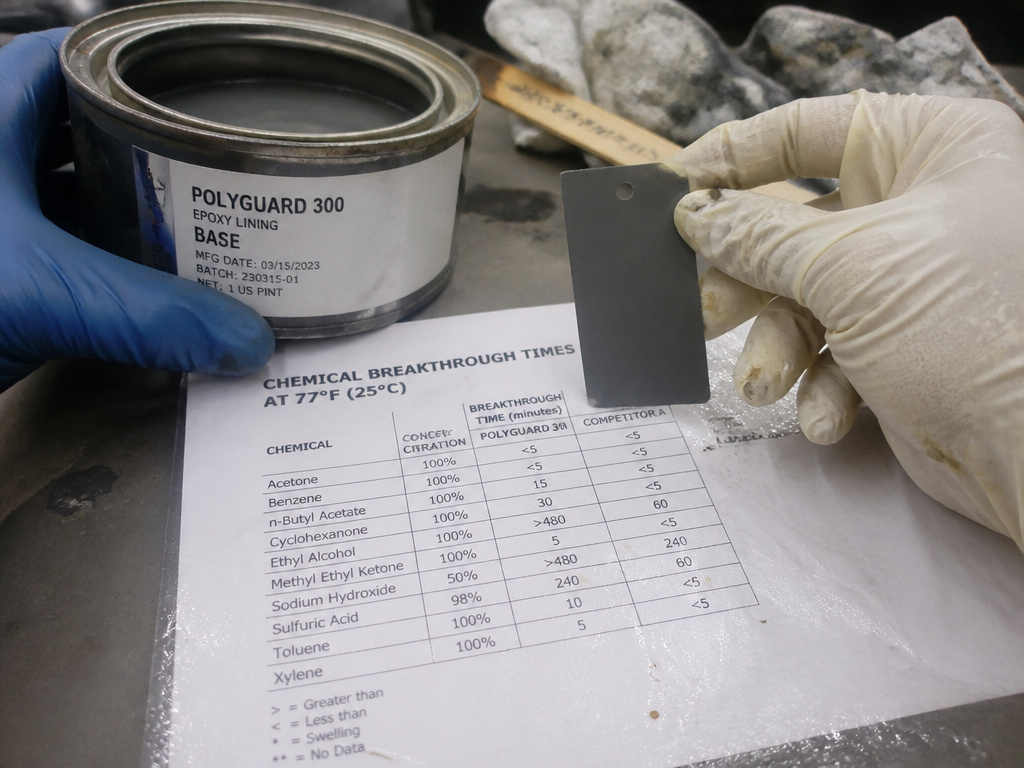
Manufacturer charts are the right place to start. They are not the answer to the question you’re actually asking.
HSE is explicit that manufacturer performance data covers pure chemicals, not mixtures. The only sure way to know how a glove behaves against a mixture is to test that mixture. Short of that, the rule is to select on the component with the shortest breakthrough time.
That rule alone disqualifies most chart-reading. A two-part paint with several solvents has several breakthrough times, and the glove you need is the one that survives the worst of them.
The Surrogate Problem
A published study on paint-stripper formulations found that surrogate test data did not always accurately predict resistance to the commercial formulations themselves. In other words, the lab cocktail and the product in the tin behave differently against the same glove.
That finding sits awkwardly next to the standard advice to trust manufacturer charts. Both things are true. Charts are the best available starting point, and they are not a guarantee, particularly with formulated products like chemical paint stripper.
One counterintuitive detail from that same study: decreased contact time caused relatively little change in permeation resistance.
Brand-to-Brand Variance Is Real
HSE notes that glove performance varies slightly from manufacturer to manufacturer, which means a chart from one brand does not transfer to another brand’s glove. If you switch suppliers, you start over on the chart.
If you want a symptom-to-fix version of this, here’s the short table:
| What you notice | Likely cause | What to change |
|---|---|---|
| Hands sting after a session | Wrong material for that solvent | Check the chart for that chemical |
| Glove goes tacky or swells | Degradation, not breakthrough | Switch material, not thickness |
| Rash on the back of the hand | Latex sensitization or trapped sweat | Non-latex glove, cotton liner |
| Tears at the cuff | Wrong size | Use the sizing chart |
HSE’s Immersion Rule and the Fit Checks Nobody Does
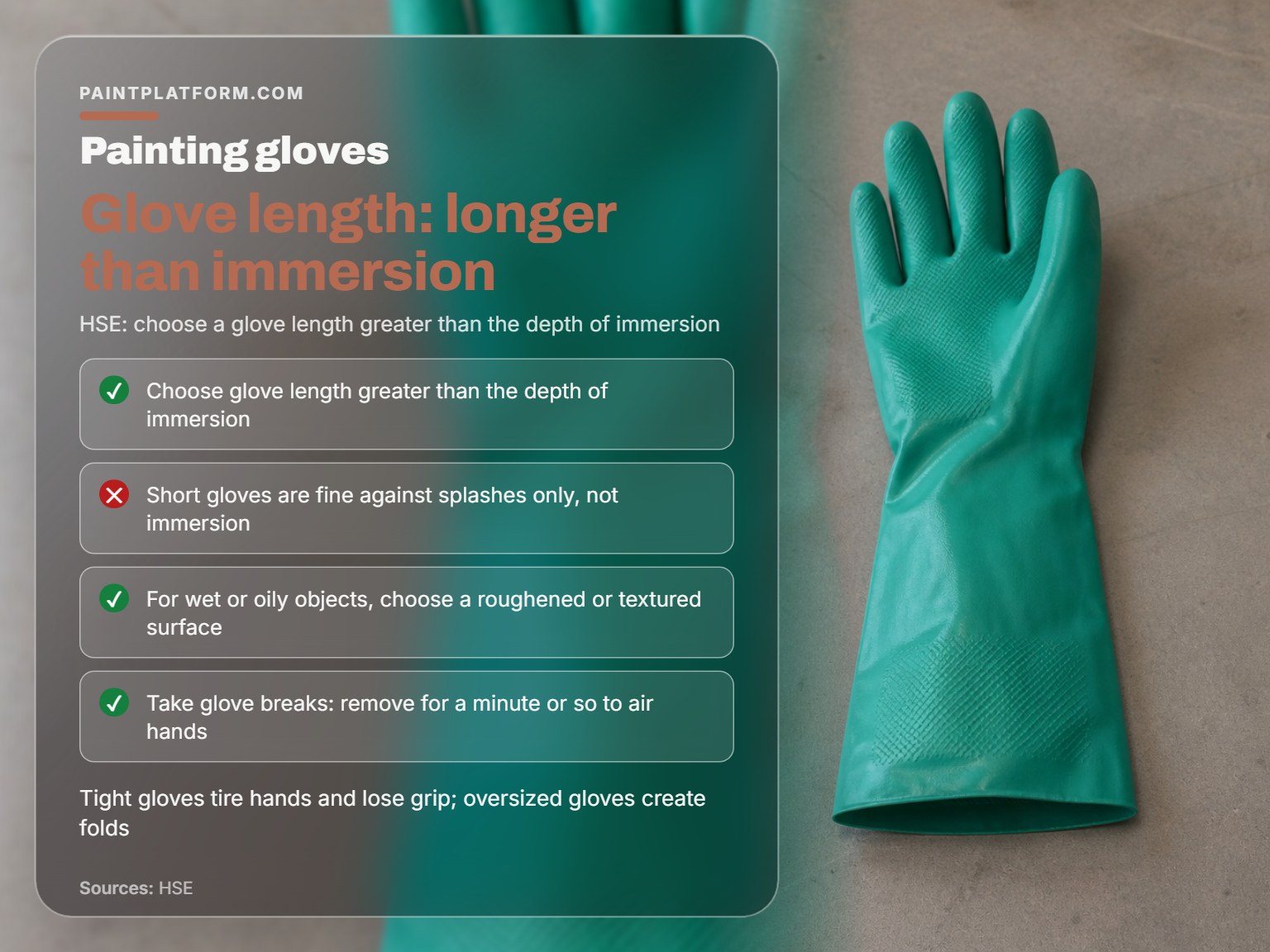
HSE’s guidance on glove length is one sentence long and almost nobody follows it: choose a length greater than the depth of immersion.
Short gloves are fine against splashes. The moment your hand goes into a bucket, a parts washer, or a dip tank, the cuff becomes the weak point, and liquid finds its way over the top. Measure the depth you’ll actually reach into, then buy longer than that.
Fit matters for a different reason. HSE notes that tight gloves make hands feel tired and lose their grip, while oversized gloves create folds that impair the work. Neither is a safety feature.
Here’s a fitting routine that takes under five minutes:
- Check the size chart, not the shelf. Buying a bigger box “to be safe” creates the folds HSE warns about, and folds catch on edges.
- Curl your fingers into a loose fist. If the glove pulls tight across the knuckles, it’s a size down from what you need.
- Test the grip surface. For wet or oily objects, HSE calls for a roughened or textured surface for good grip.
- Take a glove break. HSE recommends removing gloves for a minute or so before hands get too hot and sweaty, to air them out.
- Add a cotton liner if you sweat heavily. HSE suggests separate cotton gloves underneath, which absorb sweat and can be laundered and reused.
That last one solves a problem most people don’t connect to safety. A sweaty hand inside a glove gets uncomfortable, and uncomfortable gear gets taken off at exactly the wrong moment.
Where Gloves Stop Being Enough
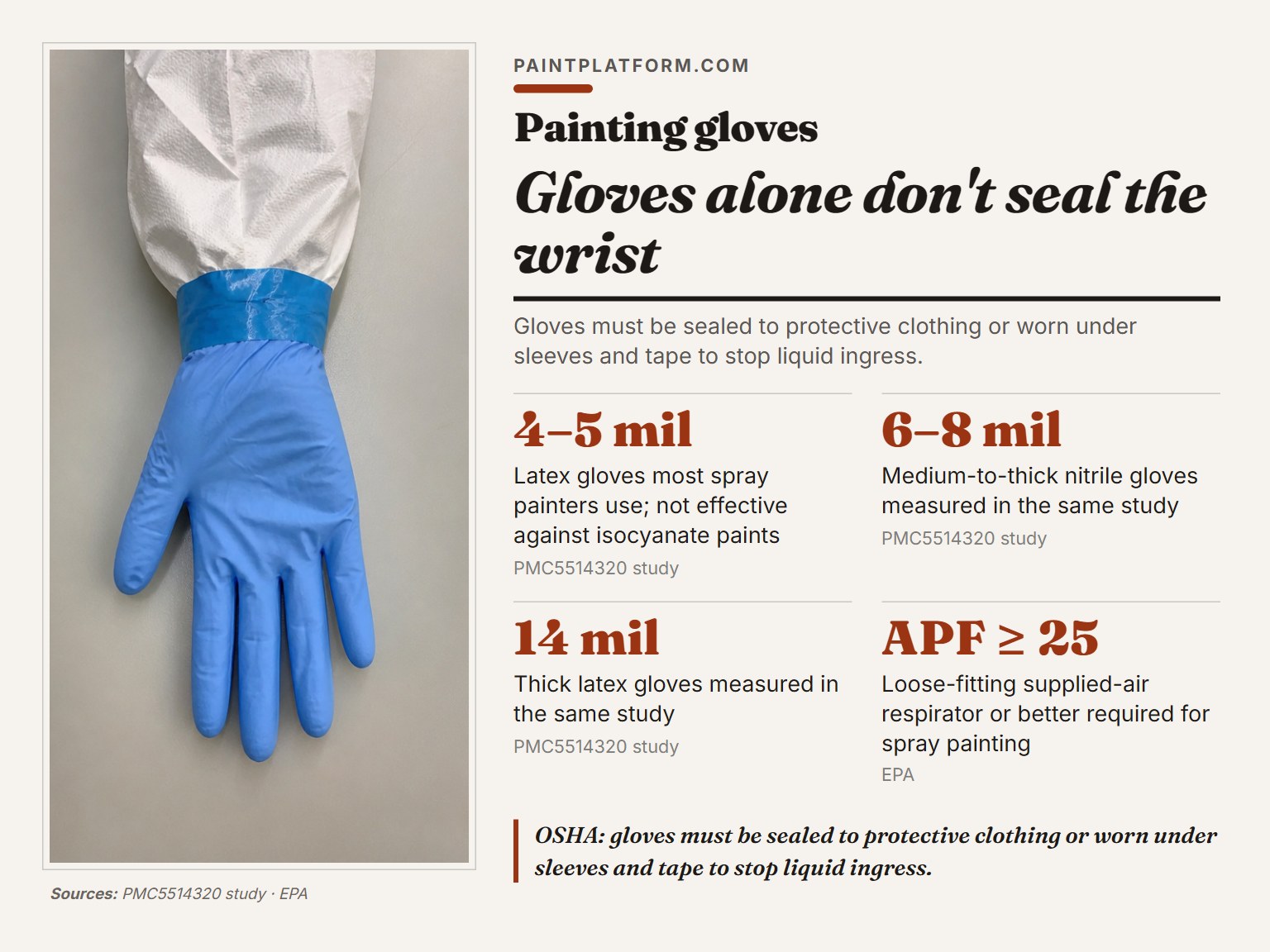
A sealed glove on a bare wrist is a funnel. Liquid runs down the forearm, pools at the cuff, and works its way in.
OSHA’s requirement is that gloves be sealed to protective clothing or worn under sleeves and tape to stop liquid ingress, with inner gloves required for some operations. That’s why coveralls for painting matter as much as the glove itself: the seal is the point where protection either holds or fails.
Before you start: Flammable solvents require non-static-discharge gloves under OSHA 29 CFR 1915.35(b)(9), and a standard nitrile box doesn’t tell you whether it qualifies. Solvent vapors also travel past a glove cuff, so pair hand protection with the right respirator types rather than a paper dust mask.
The rest of the kit follows the same logic. The EPA’s checklist calls for coveralls and a headsock, unless a hooded respirator is worn, specifically to stop painters carrying contaminants home to their families. It also calls for proper eye protection when working with paints and solvents, and for a loose-fitting supplied-air respirator or better, with an assigned protection factor of at least 25, during spray painting.
Chemical-protective gloves and the rest of that clothing are a required element of OSHA’s PPE standard at 29 CFR 1910.132, not a suggestion.
I’ll be honest about my own gap here. I’m an easel painter, not a shop painter, and the first time I read the sealing requirement I realized I’d been treating gloves as a standalone item for years. They’re one layer in a system, and the spray painting safety gear side of that system is where the layering actually gets specified.
How Often Should You Change Painting Gloves?
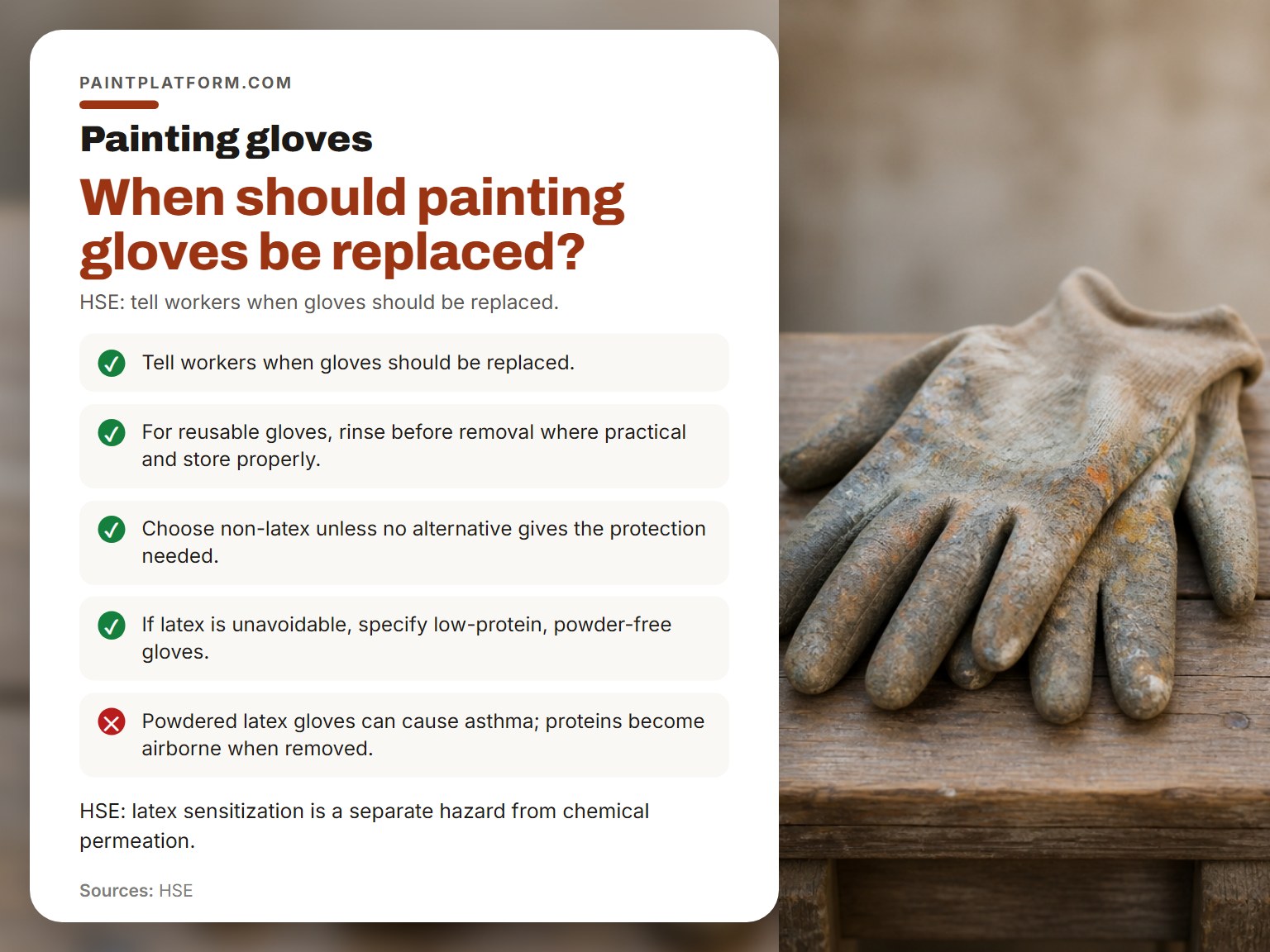
Sooner than feels necessary, and the trigger should be written down rather than guessed at.
HSE’s guidance is to tell workers when gloves should be replaced, and for reusable gloves to rinse them before removal where practical and store them properly. If you can’t answer that question about your own bench, you don’t have a replacement schedule.
The latex question deserves its own paragraph. HSE flags natural-rubber-latex sensitization as a separate hazard from chemical permeation, and notes that powdered latex gloves cause asthma because latex proteins leach into the powder and become airborne when the gloves come off. That’s a risk to everyone in the room, not just the wearer. HSE’s position is to choose non-latex unless no alternative gives the protection needed, and if latex is unavoidable, to specify low-protein, powder-free.
Anyone painting through pregnancy has a second layer of decisions on top of this, which is why painting while pregnant deserves its own read rather than a paragraph here.
And if a glove does fail, deal with the skin promptly. Knowing how to remove paint from skin without scrubbing it raw is part of the same job.
Frequently Asked Questions
Are nitrile gloves good for oil-based paint?
Nitrile is one of the four materials the EPA lists for auto refinishing work, though the EPA notes MEK passes through nitrile gloves. The documented exception is MEK, which the EPA says passes through nitrile, with butyl rubber named as the stronger barrier.
Can I use latex gloves for painting?
The EPA states that latex gloves offer little or no protection because they degrade rapidly against many chemicals found in paint materials, and that they don’t protect against most solvents used in auto refinishing shops. HSE’s position is to choose non-latex unless no alternative gives the protection needed.
How do I know if my gloves are actually rated for chemicals?
Look for a type letter (A, B, or C) under ISO 374-1:2024, plus the EN374-2 marking if the work is wet rather than splash-only. Gloves with no type letter weren’t rated for chemical protection. The manufacturer is required to supply information with the gloves, so keep that sheet.
How thick should painting gloves be?
Study of spray painters measured thin latex at 4-5 mil, thick latex at 14 mil, and medium-to-thick nitrile at 6-8 mil. The 4-5 mil latex most painters wore was not effective against isocyanate paints.
Do manufacturer glove charts work for paint mixtures?
HSE states that manufacturer data covers pure chemicals, not mixtures, and that the only sure way to assess a mixture is to test it. Where you can’t test, select on the component with the shortest breakthrough time.
The Bottom Line
One rule to remember: if the work involves a formulated paint or a solvent mixture, select on the component with the shortest breakthrough time.
Here’s your first step this week. Go find the box of gloves on your bench and read the cuff. Write the replacement interval on the box in marker while you’re holding it.
Fair warning: this gets more complicated before it gets simpler. Once you start reading charts you’ll notice that half the gloves you own don’t have data for the specific product you’re using. That’s not a reason to give up on the chart. It’s a reason to buy the next box from a manufacturer who publishes one, and to keep the information sheet instead of binning it with the wrapper.
Start before you feel ready. Then go check what’s actually on your hands.
