
How to Paint Steel Siding: Prep First, Then Two Coats
This post contains affiliate links. As an Amazon Associate, we earn from qualifying purchases.
Chalk is the part that gets skipped. Diamond Vogel’s technical bulletin on metal siding states that chalk must be completely removed before painting, and it hands you a ten-minute way to check: rub a bare hand across the panel and look for transfer.
That test decides everything downstream, and it is the core of how to paint steel siding. A white smear on your palm means chalk is still sitting between your new paint and the steel.
What follows is the sequence the coating manufacturers actually describe, including the places where they contradict each other. Where Diamond Vogel and AkzoNobel disagree, you’ll see both positions rather than one smoothed-over rule.
Key Takeaways
- Chalk has to come off completely. A hand that comes away white after washing means wash again, not paint anyway.
- Panels under two years old may still carry factory wax. Skip the gray 3M pad scuff and the new coating can peel in sheets.
- Primer is optional in one bulletin and mandatory in the other. Both want an adhesion test before the topcoat.
- Two coats of exterior acrylic latex, and AkzoNobel wants them on within 24 hours of prep.
- Oil-based alkyd house paint stays off factory finishes. AkzoNobel states it flatly.
Why Pre-Finished Steel Siding Chalks, Fades, and Eventually Rusts
Diamond Vogel’s technical bulletin on painting metal siding opens with the claim that pre-finished siding never needs paint, then spends the rest of the document explaining why it does.
Factory-applied coatings on steel siding cure hard and resist abrasion, but ultraviolet exposure breaks down the resin at the surface. The degraded layer chalks, color fades, gloss drops, and in advanced cases the underlying steel is exposed. Repainting restores the panel only when that chalk layer is completely removed first.
The factory finish is genuinely tough. Diamond Vogel describes it as hard and abrasion resistant, and that part holds up. What it can’t do is outlast sunlight.
UV breaks the resin apart at the surface. What’s left is a powdery layer of dead binder sitting on top of healthy coating. New paint bonds to the powder, the powder lets go of the panel, and the whole film leaves with it.
That’s the mechanism behind almost every failed steel siding repaint. The chalk layer let go, and the paint went with it.
In extreme cases the metal itself gets exposed and starts to rust. Once that happens you’re repairing, not repainting.
How Do You Wash Steel Siding Before Painting?
Rub a bare hand across the siding before you get the hose out. That’s the chalk test, and it’s the first thing Diamond Vogel asks for.
Warm soapy water by hand works. Diamond Vogel specifies a 2500 psi minimum for high-pressure cleaning of pre-finished metal siding, while a pre-painted panel bulletin in circulation says not to use a pressure washer at all.
That number is where the guidance splits. At least one pre-painted panel bulletin in circulation says do not use a pressure washer at all, warning that it can leave shiny spots on the finish. Two manufacturers, same substrate, opposite instructions.
My read: start gently and keep the wand moving. If a shiny spot appears, you’ve found the limit of your particular panel.
Hand Washing vs Pressure Washing
Whatever you use, here’s what has to come off:
- Loose dirt and grit, which turns into sandpaper under a roller.
- Chalk, checked by hand rather than by eye.
- Mildew, especially on north faces and under eaves.
- Old detergent residue, which Diamond Vogel warns must not be allowed to dry on the surface.
Eaves, soffits, and ceilings usually degrade less than sun-facing walls, but they collect dirt and mildew, and Diamond Vogel says to power wash them too.
For heavy dirt, AkzoNobel’s care guide calls for a dilute Spic and Span mix at 1 cup per 5 gallons of warm water. It also draws a line: detergent with more than 0.5% phosphate is for pre-repaint prep only, never routine cleaning.
Rinse everything. AkzoNobel is explicit that residual cleaner damages the adhesion of the new paint system.
Killing Mildew Without Damaging the Panel
Mildew gets its own treatment, and here the sources sit roughly an order of magnitude apart. Diamond Vogel specifies 3 parts water to 1 part bleach, left on for 10 minutes, then rinsed with plain water and allowed to dry.
Other maintenance guidance in circulation calls for a far weaker mix, about 1 cup of bleach in 5 gallons of water with a cup of mild soap; Diamond Vogel specifies 3 parts water to 1 part bleach. The strong mix is harsher; the weak mix needs more scrubbing.
If you’re unsure which panel you have, follow the manufacturer’s guidance.
When washing is the whole job and no repaint is planned, the same sequence applies to cleaning painted siding without the bleach step.
The Two-Year Wax Window That Ruins a Repaint
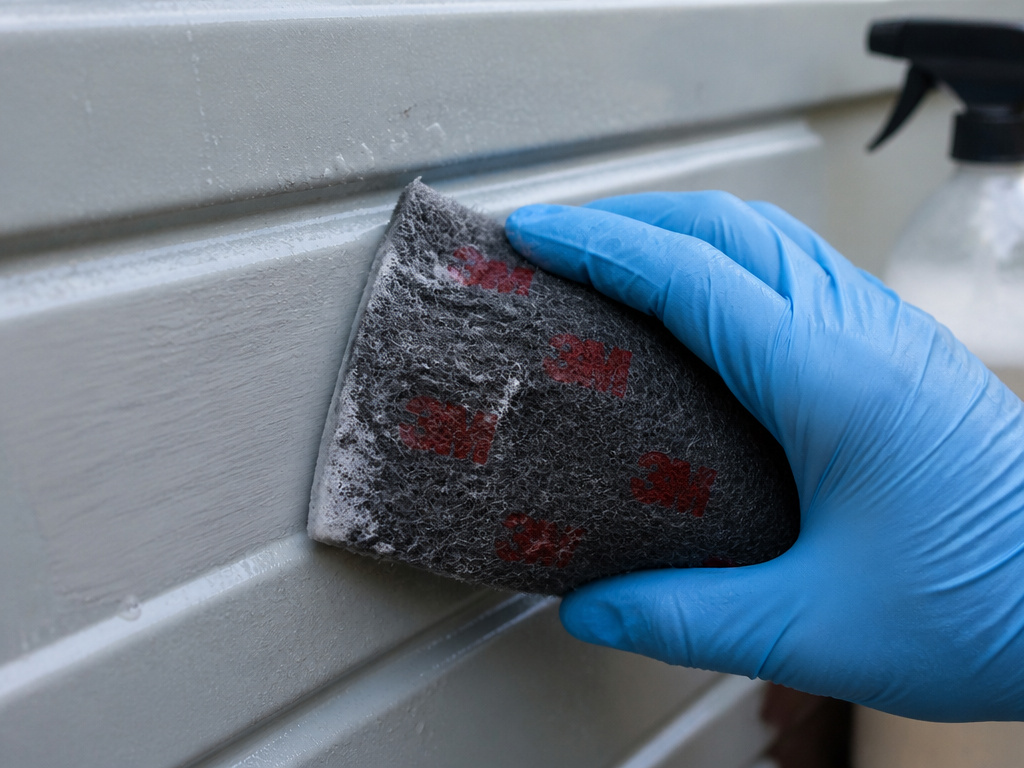
Two years is the cutoff, and it catches almost everyone.
AkzoNobel’s care and maintenance guide says panels installed within the last two years may still carry a layer of factory-applied wax. It’s there to protect the steel during forming and transit. Leave it on and intercoat adhesion fails, and the new coating peels or flakes.
Removing it is fussy work with a specific tool. AkzoNobel calls for a gray 3M Synthetic Steel Wool pad, not green, equivalent to “000” steel wool, saturated with soapy water. Then a final wipe and rinse with clean water only.
The pad comes away with a paste on it, which is wax and soap and a little of the topcoat all at once. That paste is the sign you’re actually removing something.
Here’s the part that matters more than the scrubbing: after the wax step, run the adhesion test in AkzoNobel’s Appendix A. If adhesion is still poor, repeat the wax removal. If it’s poor again after that, stop.
Easy to miss: The factory finish itself has to survive the scuffing. AkzoNobel is explicit that the finish must not be removed during wax removal, so light pressure with the gray pad, not a sanding block.
If two rounds of wax removal still fail the adhesion test, AkzoNobel’s instruction is blunt: do not proceed, and contact the metal panel supplier. Treat that as a hard stop. Contact the metal panel supplier.
I’d rather spend time with a gray pad than fixing a peel, so the test gets run twice on anything I’m unsure about.
Which Surface Prep Standard Applies to Your Panels?
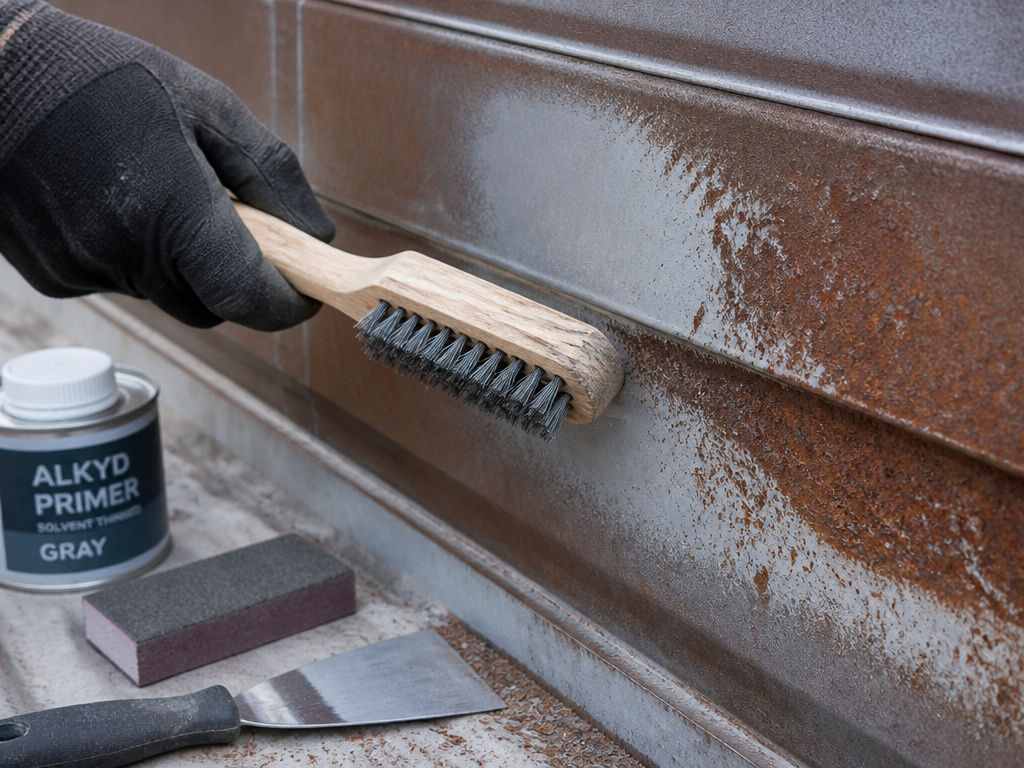
The prep standard you need depends on what the panel looks like right now, and the sources don’t agree on a single answer.
AkzoNobel’s care guide sets a floor: exposed metal needs a minimum of Hand Tool Cleaning per SSPC-SP2. Severely rusted panels get SSPC-SP7, Brush-Off Blast Cleaning.
AkzoNobel’s Interline 984C guideline, written for a different product line, prefers abrasive blast cleaning to Sa2.5 under ISO 8501-1:2007, or SSPC-SP10, or NACE #2. That’s a much higher standard than hand tools.
| Panel Condition | Prep Standard | Source |
|---|---|---|
| Exposed metal, minimum | SSPC-SP2 hand tool cleaning | AkzoNobel care guide |
| Severely rusted panels | SSPC-SP7 brush-off blast | AkzoNobel care guide |
| High-performance coating systems | SSPC-SP10 / Sa2.5 / NACE #2 | Interline 984C |
| Light scratches, substrate intact | Light sand or buff only | AkzoNobel care guide |
| Chalk or oxidation that won’t wash off | Solvent-thinned alkyd primer | Diamond Vogel |
The AISC painting and surface preparation FAQ settles the language question: SSPC designations are the required way to specify how clean a steel surface has to be.
A prep call written as “scuff it and prime it” means nothing to a coatings supplier. SSPC designations are the only language they quote against.
Minor scratches that haven’t exposed the metal can be lightly sanded or buffed. AkzoNobel adds the obvious warning: don’t sand through to the substrate while you’re at it, because that starts the rust clock.
Where loose coatings and rust are already present, the removal step is the same idea as removing old paint from any metal surface. Get down to something sound, then build back up.
The same prep logic carries over to painting exterior metal of any kind, and to aluminum siding, which behaves similarly under a roller.
Primer or No Primer? Where the Two Guidance Sets Split
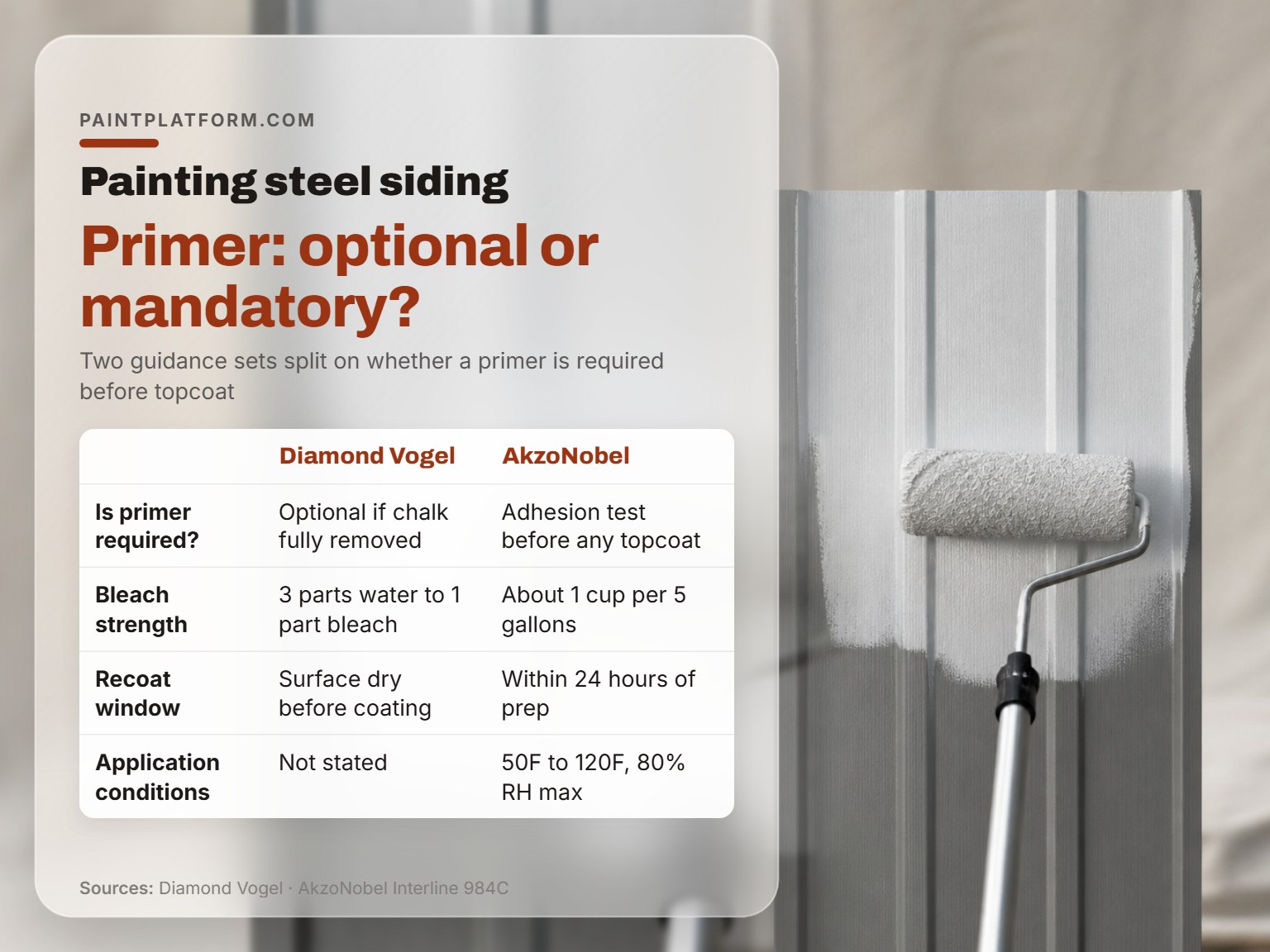
Primer is not automatic according to Diamond Vogel, though AkzoNobel treats an adhesion test and primer as mandatory.
Diamond Vogel says the painting system depends on how well the cleaning went, and that a primer may not always be necessary, while AkzoNobel treats an adhesion test and primer as mandatory. If the chalk and oxidation came off completely, Diamond Vogel says the acrylic topcoat can go straight on.
When severe oxidation or severe chalking can’t be fully removed, Diamond Vogel recommends a solvent-thinned primer: CoteAll Multi-Purpose Alkyd Primer or Iron Prime 600 Fast Dry Universal Primer. Bare spots get spot primed with one of those, or with Vers-Acryl 200 Acrylic Maintenance Primer.
AkzoNobel takes the stricter line. Exposed metal needs a primer designed to protect it, the intercoat adhesion has to be tested before priming, and the primer needs time to dry before the topcoat.
The Alkyd Question, Layer by Layer
Diamond Vogel recommends alkyd primers under acrylic latex topcoats. AkzoNobel states that oil-based alkyd house paint must not be applied over factory-applied finishes. Both statements are about alkyd, and they’re about different layers of the system.
| Question | Diamond Vogel | AkzoNobel |
|---|---|---|
| Is a primer required? | Optional if chalk is fully removed | Adhesion test before any topcoat |
| Alkyd over a factory finish | Alkyd primer under acrylic topcoat | No oil-based alkyd house paint |
| Bleach strength for mildew | 3 parts water to 1 part bleach | Weaker mix, about 1 cup per 5 gallons |
| Recoat window after prep | Surface dry before coating | Within 24 hours of prep |
| Application conditions | Not stated | 50F to 120F, 80% RH maximum |
The safe reading: an alkyd primer under an acrylic topcoat is what Diamond Vogel describes, and an oil-based alkyd house paint as the finished coat is what AkzoNobel forbids. If your panel is a factory-finished coil-coated product, follow AkzoNobel.
Where this goes sideways: An oil-based alkyd house paint rolled straight onto a factory finish. AkzoNobel’s guide forbids it outright, and the failure shows up as delamination after long-term exposure rather than in the first week.
Galvanized panels need their own primer. AkzoNobel specifies one designed for adhesion to galvanized steel, such as Water-Based Epoxy Maintenance Coat WA9C32800/GW9C32796 or an equivalent. A generic rust primer doesn’t count. The galvanized steel sequence covers that prep in more detail.
If you’re comparing steel coatings across brands, the adhesion test matters more than the data sheet. AkzoNobel disclaims responsibility for intercoat adhesion failure from field coating entirely. The applicator carries that risk.
How to Paint Steel Siding: The Coating Sequence
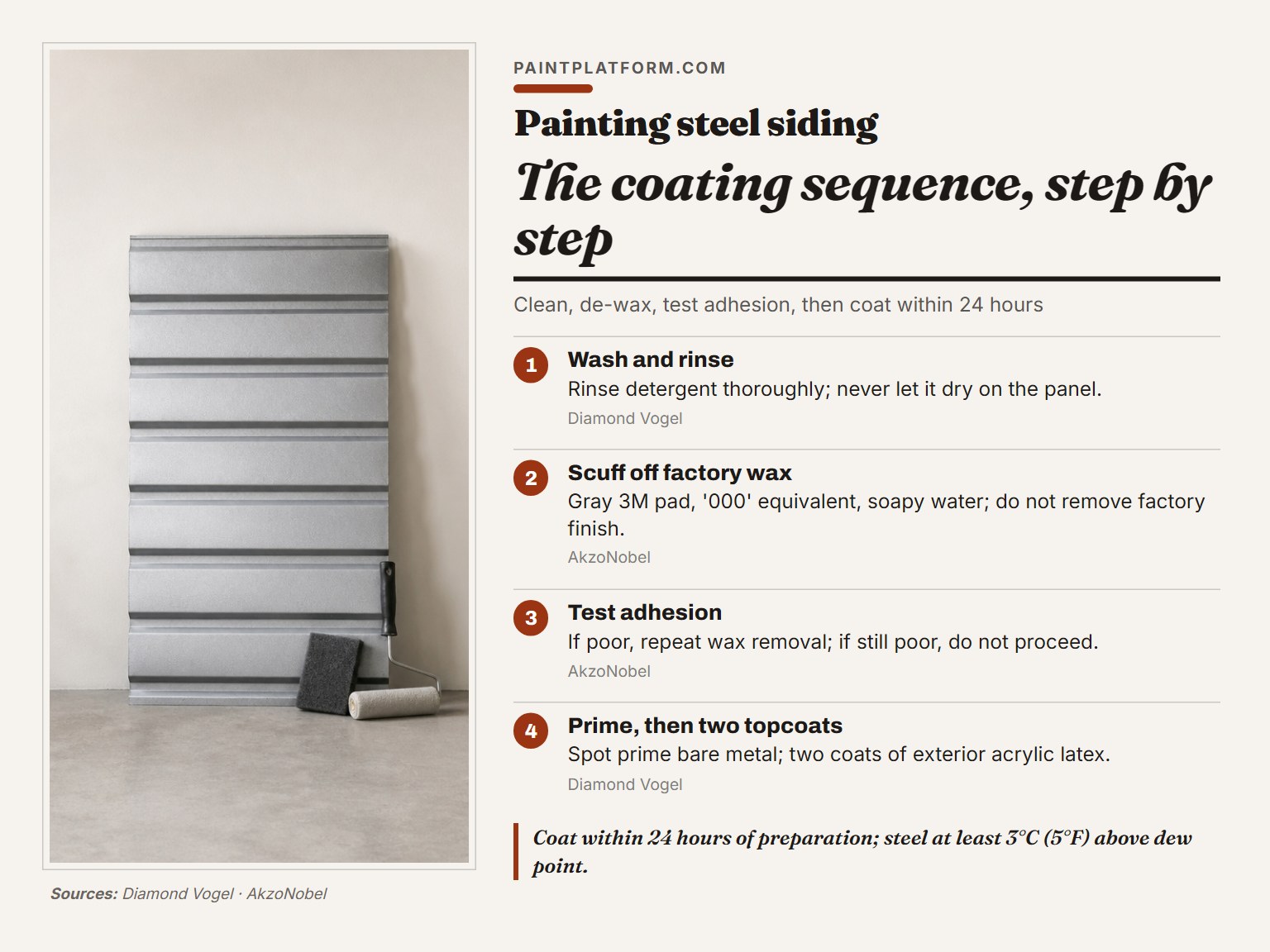
Four things have to be true before the first coat goes on: the surface is clean, the wax is gone, adhesion has been tested, and the weather is inside spec.
Before you start: Steel siding has sharp edges, and Klauer’s installation manual lists safety goggles and a hard hat as essential tools for a reason. Bleach solutions burn skin and eyes, so gloves and eye protection go on before the sprayer. A pressure washer can open a cut in a fingertip, so keep both hands on the wand.
Here’s the order.
- Wash and rinse, then let the surface dry completely. Detergent left to dry on the panel damages adhesion later.
- Scuff off factory wax if the panels are under two years old, then run the adhesion test.
- Remove loose coatings and rust, and dull any glossy or slick areas with sandpaper.
- Spot prime bare metal, and prime the whole panel if oxidation or chalking couldn’t be washed off.
- Topcoat with an exterior acrylic latex, two coats.
- Keep the surface dry and clean until the coating cures.
For the topcoat, Diamond Vogel names four: Palisade Ultra Premium Exterior Acrylic Latex, Durango Acrylic Latex Exterior Finish, EverCryl Exterior Acrylic Latex Finish, and Vers-Acryl 222 Acrylic Maintenance Semi-Gloss. Two coats are recommended for optimal performance.
AkzoNobel allows exterior acrylic latex DTM paint as an alternative to its professional coatings. If you go that route, the DTM paint has to be a direct-to-metal product, not a general exterior wall paint.
Weather Window and Dew Point
Timing is where the two guides part again. AkzoNobel requires panels to be coated within 24 hours of preparation. Diamond Vogel gives no recoat window at all, only that the surface should be dry before coating.
The weather limits come from Interline 984C, and they’re worth borrowing even with a different product. Surface, air, and material temperatures between 10C and 49C (50F to 120F). Relative humidity at or below 80%. Steel temperature at least 3C (5F) above the dew point for more than an hour, with the surface visibly dry and clean, and those conditions held until the coating cures.
Below the dew point, moisture condenses on the steel and gets trapped under the film. That’s how you get a coating that looks perfect at first and blisters later.
On a smooth panel, a roller beats a brush for speed. A roller covered a garage wall for me in about half a day, and the finish was more even than I expected. I still keep a brush in the other hand for the laps and the grooves, because that’s where a roller skips.
For the full range of exterior paint for steel and how the acrylics compare, check the finish specs before you commit to a color.
Doors, Frames, Rails, and the Details That Fail First
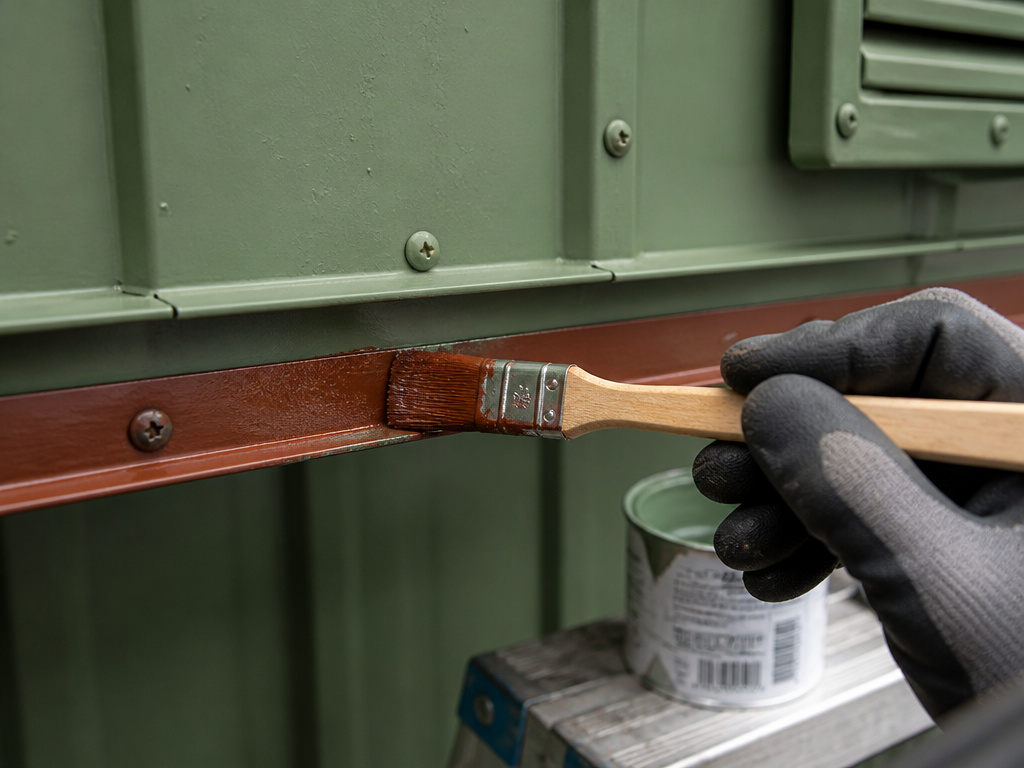
Doors and rails take more abuse than the field of the wall.
Diamond Vogel treats them separately: clean them, prime with a rust-inhibitive solvent-based metal primer, then topcoat. Diamond Vogel treats them separately: clean them, prime with a rust-inhibitive solvent-based metal primer, then topcoat.
The small stuff gets forgotten:
- Vents, kitchen fan hoods, and service cable runs need color-matched touch-up paint, per Klauer’s manual.
- Touch in fastener heads and cut edges while the ladder is still up.
- The bottom course and the lap edges collect water and dirt.
Klauer’s manual is written for installation, not repainting, but its handling rules still apply to any panel you’re working around. Steel siding has sharp edges, boxes should be stored flat with support along the length, and pieces should be lifted rather than slid to avoid scratching.
When to Stop and Hand It to Someone Else
Klauer’s installation manual states plainly that it is written for the qualified siding installer and is not intended for use by homeowners. It goes further and says the manual is not intended for use by homeowners.
Diamond Vogel’s bulletin, by contrast, reads like a homeowner procedure. Hand washing, a test patch, two coats. No installer qualification anywhere in it.
Both can be right at once. Washing and coating a one-story wall is a manageable job. Panel replacement and flashing are not, and that’s where I’d draw my own line.
The one thing that isn’t optional for anyone: test a patch before you commit. Diamond Vogel’s reasoning is the honest part. Coating adhesion can’t be judged by looking at it, so a test patch is the only way to know before you’ve bought the paint.
Frequently Asked Questions
Can you paint steel siding without removing the chalk?
No. Diamond Vogel states chalk must be completely removed before painting. New paint bonds to the powdery layer instead of the panel, and the film fails from underneath. Test by rubbing a bare hand across the siding and checking for transfer.
How soon after cleaning do you have to paint?
AkzoNobel requires coating within 24 hours of surface preparation. Diamond Vogel gives no recoat window, only that the surface should be dry before coating. If you’re following the stricter guide, prep and paint on the same day.
Does steel siding need a primer?
It depends which bulletin you follow. Diamond Vogel says a primer may not be necessary if chalk and oxidation were fully removed, and recommends a solvent-thinned alkyd primer when they weren’t. AkzoNobel treats an adhesion test as mandatory before any topcoat.
Can you use oil-based paint on factory-finished steel siding?
AkzoNobel says no. Its care guide states that oil-based alkyd house paint must not be applied over factory-applied finishes. Diamond Vogel recommends alkyd primers under acrylic topcoats, which is a different layer of the system.
What temperature is too cold to paint steel siding?
Interline 984C sets the range at 10C to 49C (50F to 120F), with relative humidity at or below 80% and steel at least 3C (5F) above the dew point for more than an hour. Below the dew point, moisture gets trapped under the film.
How many coats does steel siding need?
Two. Diamond Vogel recommends two coats of exterior acrylic latex for optimal performance.
The Bottom Line
Here’s the threshold that decides your whole project. Wash the siding, let it dry, and rub a bare hand across it. If your palm comes away white, you are not ready to paint, no matter how clean the wall looks.
That test costs nothing. It’s also the step that separates a repaint that lasts from one that peels.
How to paint steel siding comes down to that hand test far more than any product choice. Give yourself permission to wash twice. Chalk is stubborn, and the second pass is usually the one that gets it.
