
How to Paint Concrete Walls: Wash, Etch, Then Coat
This post contains affiliate links. As an Amazon Associate, we earn from qualifying purchases.
To paint concrete walls, wait until the concrete has cured, confirm the surface pH sits between 6 and 9, and prove the slab is dry with a taped plastic sheet before any coating goes on. Sherwin-Williams defines cured as concrete poured and aged at a material temperature of 75 degrees F or above for at least 30 days.
That 30-day figure carries a condition most people read straight past: the concrete has to have sat at 75 degrees F or warmer for the whole stretch. A slab poured in late October and painted in late November has aged 30 days on the calendar without curing 30 days at temperature.
What follows walks the four checks that decide whether a wall is actually ready, the how to paint concrete walls coating mismatch that ruins damp walls, the two cold-weather cutoffs, and the cure schedule that runs after the last coat.
Key Takeaways
- Test moisture before anything else. Tape an 18 in x 18 in sheet of 4-mil plastic on all four edges and inspect it after at least 16 hours.
- Surface pH must sit between 6 and 9 for Sherwin-Williams coatings; PCA P17 says wait until pH is inside the coating maker’s own range.
- The sources disagree on cure time. Sherwin-Williams says 30 days at 75 degrees F, IS 2395 says 3 weeks for cement paint, and NBS LC-747 treats concrete under 6 months old as still alkaline.
- Skip moisture-sealing systems on new walls per IS 2395, and match the coating to how damp the wall actually runs.
- Fog-spray cement-based paint 2 to 3 times a day for at least 2 days after the final coat, starting 6 to 12 hours after application.
How Long Does Concrete Need to Cure Before You Paint It?
Three credible sources give three different answers, and none of them is wrong.
Concrete cure for coating purposes is defined by material temperature, not calendar age alone. Sherwin-Williams specifies concrete poured and aged at a material temperature of at least 75 degrees F for at least 30 days, with a surface pH between 6 and 9 before any coating is applied to the wall.
Here is the disagreement laid out, because you deserve to see it rather than have one number presented as universal law.
| Source | Minimum age before coating | What it assumes |
|---|---|---|
| Sherwin-Williams | 30 days at 75 degrees F or warmer | The slab stayed warm the whole time |
| IS 2395 (BIS) | 3 weeks for cement paint | Tinted paint on cast-in-place waits several months |
| NBS LC-747 | Under 6 months still counts as new | Cement-water paint suits that alkaline stage |
The IS 2395-1 concrete painting code is the most permissive of the three at 3 weeks, but read the rest of it and the picture changes. The same standard says tinted paint on cast-in-place walls should be postponed several months past curing, which is a much longer wait than 3 weeks.
So which number do you use for how to paint concrete walls? Pick the one that matches your coating and your climate, then add a margin.
Sherwin-Williams is the strictest and it is also the easiest to defend, because it ties cure to temperature instead of a date. If your wall spent two weeks of that month below 75 degrees F, the clock effectively paused.
Plaster gets the same treatment: at least 30 days of thorough drying before paint. Stucco walls can take paint at 30 days if the application followed recommended procedure and normal drying conditions held.
The Moisture Test That Decides Everything
Concrete seldom drops below 15 percent moisture, which is why a wall that looks bone dry can still wreck a coating.
The test costs one sheet of plastic and one night. Tape all four edges of an 18 in x 18 in sheet of 4-mil plastic to the bare surface, seal every edge, and inspect after a minimum of 16 hours. You are looking for moisture, discoloration, or condensation on the concrete or on the underside of the plastic.
If anything shows up, find the source and fix it before painting. Coating over it just traps the problem under a film.
A quicker field check I reach for first: splash a little water on the slab. If it beads and rolls, the surface is sealed or still saturated. If it soaks in and darkens the concrete evenly, you’re closer to ready.
| Check | Standard | Pass condition |
|---|---|---|
| Moisture vapor | ASTM D4263 | No condensation after 16 hours |
| Surface pH | ASTM D4262 (PCA P17) | Inside the coating maker’s range |
| Adhesion | ASTM D3359 or D7234 | Benchmark sample holds |
| Contamination | ASTM D4258 | Etch water stops beading |
| Incompatible prep | ASTM D4259 | Required if the coating won’t bond |
That last row matters more than it looks. If your test patch says the coating is incompatible with whatever is already on the wall, you are into full surface preparation under ASTM D4259, not a second coat of primer.
Whatever exterior concrete wall paint you eventually pick has to survive that residual moisture. A coating that can’t breathe will fail from underneath, and it will fail in sheets rather than in patches.
How to Paint Concrete Walls: Wash, Etch, Then Coat
Prep is where exterior concrete jobs succeed or fail, and it is the part everyone tries to compress.
Before you start: Etching solution burns skin on contact and permanently etches glass, so keep a hose running and mask nearby windows. A pressure washer will strip skin as fast as it strips paint. And a wall that reads dry at the top can be saturated at the base where water pools.
The sequence, with what goes wrong if you skip a step:
- Brush the whole wall with a wire brush. Dust, loose mortar, and flaking paint come off; old paint that survives the brushing can stay, per NBS LC-747.
- Remove grease, oil, tar, glaze, laitance, and efflorescence with a cleaner per ASTM D4258, then etch the surface.
- Check for existing treatments. Hardeners, sealers, form release agents, and curing compounds must be compatible with your coating or be removed entirely. Skip this and the coating delaminates from the top down.
- Patch and dull. Glossy old paint films must be clean and dull before repainting.
- Spot-prime bare patches rather than priming the whole wall.
On tilt-up and poured-in-place concrete, commercial detergents and abrasive blasting may be necessary.
It took several rounds of scrubbing with a stiff brush. When you’re done, the surface should feel like sandpaper under your palm. If it still feels slick, go again.
Washing vs. Etching: What Each One Actually Removes
Washing lifts what sits on the surface: dust, oil, mildew, loose mortar, and chalking paint. Etching changes the surface itself, opening the pores so a coating can key into the concrete mechanically.
You need both, in that order. Etching over a film of oil just etches the oil.
If the wall carries old coating that has to come off entirely rather than be painted over, that is a different job with different tools, covered in this guide to remove paint from concrete.
The Wetting Question, and Why Sources Split
IS 2395 says porous masonry should be wetted no more than 1 hour before painting, and that dense concrete needs wetting in at least 2 operations at least 30 minutes apart. Dense concrete absorbs so slowly that a single wetting just runs off.
NIST letter circular 747 takes a narrower line: dampen the wall only in very dry weather or on quite porous material, and only to reduce suction. It also states plainly that resin emulsion paints may go on damp walls but not wet ones.
Both are describing the same physics. Wet to kill suction, not to soak the wall.
Block walls behave differently again, and cinder blocks drink far more than a poured slab does.
Which Coating Belongs on a Wall That Stays Damp?
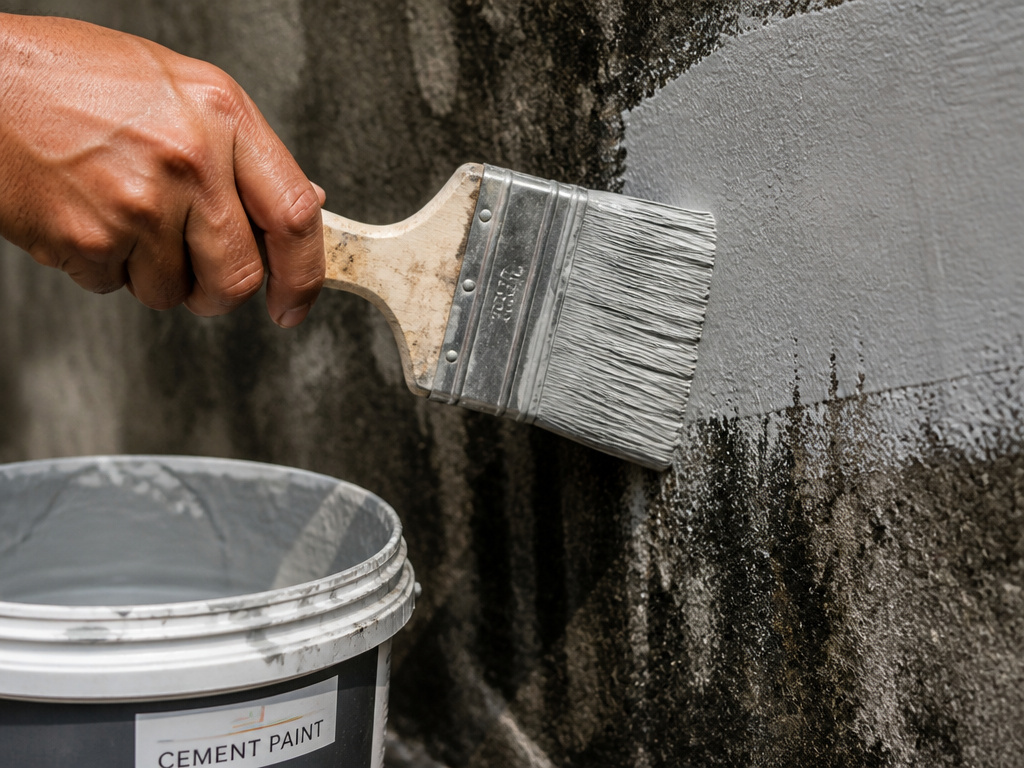
Ask what the wall does after rain, not what color you want, because the coating has to match the moisture.
If a wall is damp when you paint it or likely to become damp, cement-water paint is the coating built for that. Resin emulsion and rubber paints want dry, close-textured surfaces. Oil paint belongs only on walls that stay dry year round.
That ranking comes straight from NBS LC-747, and it is the single most useful sorting rule in this whole job.
IS 2395 pushes in a related direction from the other side. When painting new walls, it says, any paint system that will seal in moisture shall be avoided. Concrete, lime, and cement plasters are strongly alkaline and will attack paint from underneath if that moisture has nowhere to go.
The ACI guide for painting concrete covers the non-portland-cement side of this in more depth than a single wall project needs, but the principle holds: match the film to the substrate’s moisture behavior.
Practical mixing notes, since these trips people up:
- Resin emulsion paint is usually thinned at roughly 2 parts paste to 1 part water, and more if you spray it.
- A cement-and-sand base coat on open-joint or coarse-textured walls should dry 96 hours before resin emulsion goes on.
- Spray application is restricted under IS 2395 to dense concrete, interior, non-waterproofing work. Outdoors on a porous wall, use a brush or roller.
The full menu of concrete paint types is worth a read before you commit, and if you’re still weighing brands, this breakdown of masonry paint covers what separates a breathable film from a sealed one.
One thing I learned the expensive way: primer color is not a detail. Going from a dark navy wall to a pale color took me several coats the first time. With a gray-tinted primer, it dropped to far fewer coats. Ask the paint counter to tint the primer toward your topcoat color. Red walls under a pale topcoat were a whole separate argument.
Temperature, Weather, and Two Cold-Weather Cutoffs
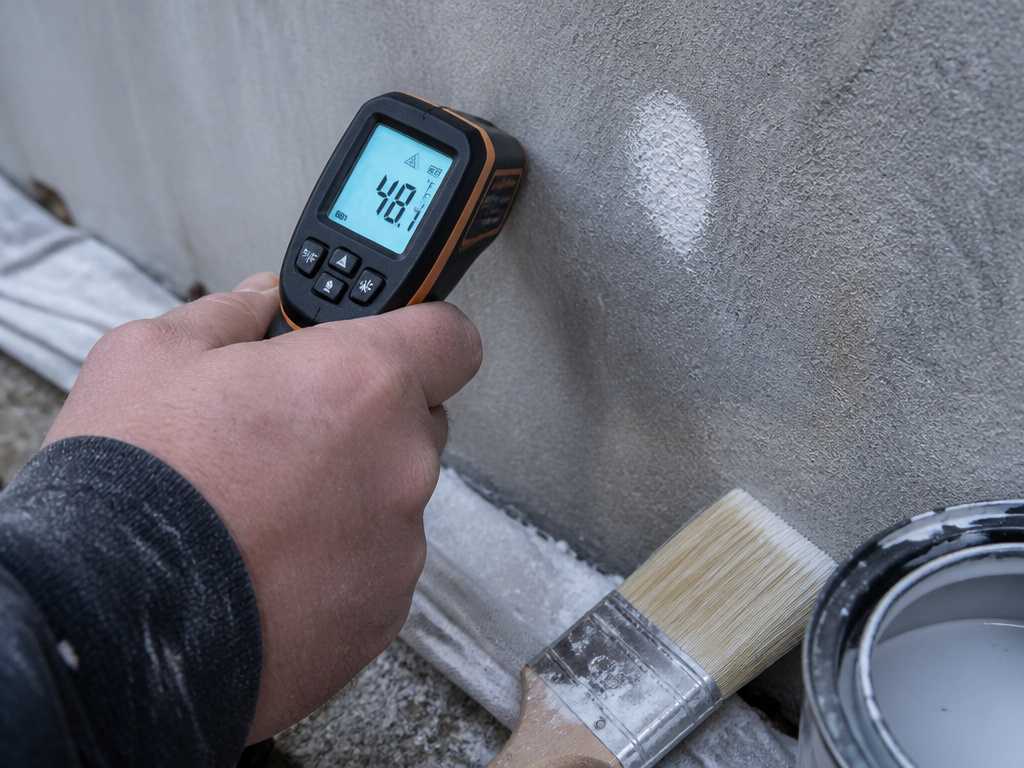
The sky is clear, and the forecast has no rain in it. The wall is still not paintable.
Where this goes sideways: Painting exterior concrete below 50 degrees F stops the film from coalescing properly. It may look fine at first, then chalk and powder under a fingertip.
Sherwin-Williams sets the floor at 50 degrees F for air, surface, and material through cure, unless the coating is rated for use down to 35 degrees F. Some coatings are rated for use down to 35 degrees F, so read the label rather than assuming.
IS 2395 uses a different number entirely: no cement paint if the temperature will fall below 7 degrees C (about 45 degrees F) within 48 hours. That is a forecast rule, not a thermometer rule, and it catches the job you’d otherwise start on a mild afternoon before a cold night.
Weather rules that apply regardless of which standard you follow:
- No painting immediately after rain, during fog, or when rain is predicted.
- In hot, dry weather, work in the shade as far as practical so the film doesn’t flash-dry before it levels.
- On very dry or quite porous material, dampen first to reduce suction.
Indoors, none of this applies, which is why interior concrete wall paint is a genuinely easier problem. Outdoors, weather is half the job.
I would rather lose a week to a cold snap than repaint a whole wall in spring.
Tilt-Up Panels, Bond Breakers, and the Adhesion Test
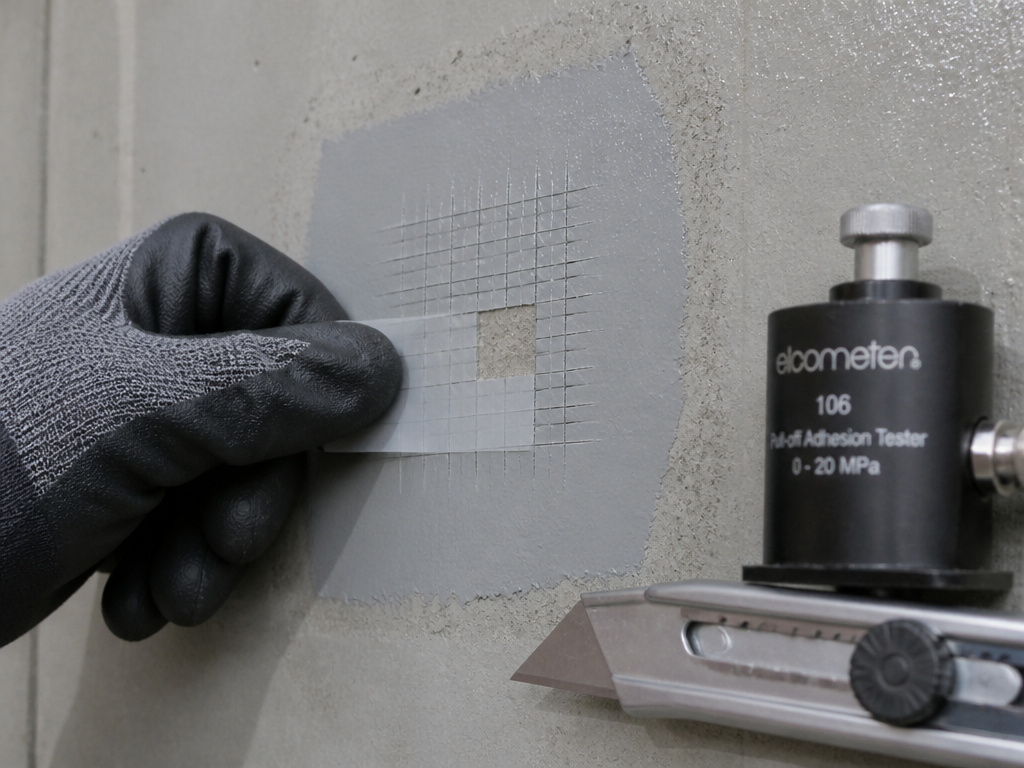
PCA Industry Standard P17 exists because vertical concrete panels fail in a specific, predictable way, and the standard opens by saying so: numerous paint failures have occurred when vertical concrete is field painted.
The reasons are mechanical. Tilt-up and vertical panels come out very smooth, offering little if any mechanical adhesion for a coating to grab. On top of that, bond breakers and curing oils used in manufacturing interfere with adhesion, and unless the contract documents say otherwise, removing them is not the painting contractor’s responsibility.
That last clause is a scope fight, not a technical one, but it explains a lot of failed jobs where everyone assumed someone else had dealt with the release agent.
What P17 asks for instead of guesswork:
- A benchmark sample of the specified coating system, prepared per PCA Standard P5.
- Adhesion testing after cure, per ASTM D3359 or ASTM D7234.
- Additional surface preparation if those results come back unsatisfactory.
- Surface pH determined per ASTM D4262 before any coating starts.
What a Benchmark Sample Buys You
It buys you a small, cheap failure instead of a large, expensive one. You coat a representative patch, let it cure, then try to pull it off with tape or a pull-off gauge.
If it lets go, you have learned that your prep is wrong while the wall is still bare. Bug holes and honeycomb in manufactured panels affect appearance too, and a benchmark patch shows you how much filling that actually needs before the topcoat goes on.
The Cure Schedule After the Last Coat
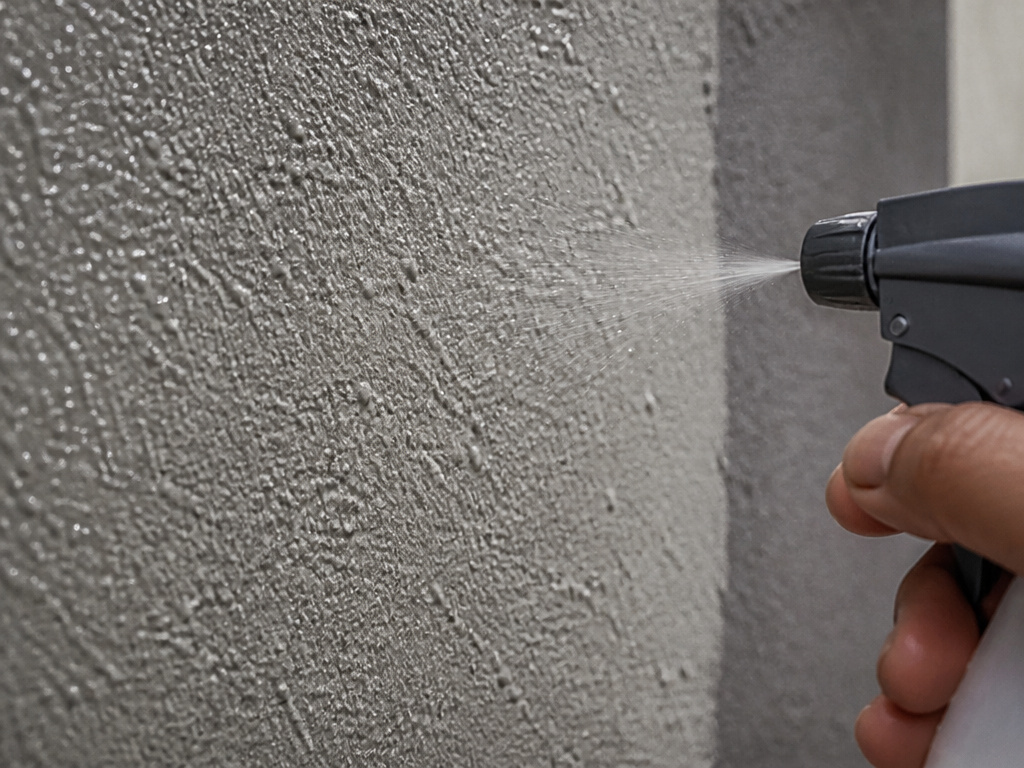
The last coat is not the end of the job, at least not with cement-based paint.
Cement-water paint films harden by chemical reaction with moisture, not by drying. The water already in the wall, in the paint, and in the air usually isn’t enough on its own, which is why both NBS LC-747 and IS 2395 call for fog-spraying the painted surface.
Fair warning: this is the step almost every homeowner skips, and it is the difference between a coating that hardens and one that dusts off on your hand.
The schedule is the same in both sources: sprinkle or fog-spray 2 to 3 times a day, between coats and for at least 2 days after the final coat. Start as soon as the paint has set enough not to be damaged by the spray, usually 6 to 12 hours after application. The spray should hang as a fine mist that wets the film without running.
Cement paint also wants two coats with at least 24 hours between them, per IS 2395.
When I missed a spot, it blended in, whereas a film-forming coating shows every sloppy edge.
If you’re still settling on a product, this guide to paint for concrete walls sorts the options by substrate, and the same prep logic carries over to how to paint masonry walls if your wall is block rather than poured.
Frequently Asked Questions
Can I paint concrete after 28 days?
Sherwin-Williams specifies 30 days at a material temperature of at least 75 degrees F, and IS 2395 allows cement paint at 3 weeks. The number that matters is whether your wall actually cured at temperature, not how many pages the calendar turned.
How do I know if my concrete is too damp to paint?
Tape an 18 in x 18 in sheet of 4-mil plastic on all four edges and check it after at least 16 hours. Condensation, moisture, or discoloration under the plastic means the source has to be found and corrected first. Concrete seldom drops below 15 percent moisture, so some residual dampness is normal.
What happens if I paint below 50 degrees F?
The film may not coalesce, which shows up as chalking and powdering rather than immediately. Sherwin-Williams sets 50 degrees F as the floor unless a coating is rated down to 35 degrees F. IS 2395 uses a separate rule: no cement paint if temperatures will drop below 7 degrees C within 48 hours.
Do I need to wet the wall before painting?
It depends on the surface and the weather. IS 2395 says porous masonry should be wetted no more than 1 hour before painting, and dense concrete needs at least 2 wetting operations at least 30 minutes apart. NBS LC-747 says dampen only in very dry weather or on quite porous material, to reduce suction. Never paint onto a wet wall.
Should I seal a new concrete wall before painting?
IS 2395 is direct about this: when painting new walls, any paint system that will seal in moisture shall be avoided. New concrete and cement plaster are strongly alkaline and will attack paint if moisture gets trapped underneath. Choose a breathable coating instead.
Why is my concrete paint peeling in sheets?
Peeling in sheets usually points to a coating applied over a bond breaker, curing compound, or sealer that was never removed. Sherwin-Williams requires hardeners, sealers, form release agents, and curing compounds to be compatible with the coating or removed. PCA P17 flags the same problem on smooth tilt-up panels.
The Bottom Line
If that plastic sheet shows condensation, stop. Nothing else here matters until the moisture source is found and fixed, and no coating on the market will save a wall that isn’t ready.
The cure-time numbers genuinely disagree, and I’m not going to pretend otherwise. Sherwin-Williams says 30 days at 75 degrees F, IS 2395 says 3 weeks, NBS LC-747 treats anything under 6 months as still alkaline. If you’re in a cold climate or painting a cast-in-place wall in a tinted color, treat the longest number as your floor, not your target.
Here’s your job for tonight: tape a square of 4-mil plastic to the wall, seal all four edges, and walk away. Check it tomorrow. One sheet of plastic will tell you more about your wall than the paint counter ever will.
