
Lead Paint Encapsulation Explained: What Actually Passes
This post contains affiliate links. As an Amazon Associate, we earn from qualifying purchases.
Lead paint encapsulation, explained plainly, is a coating bonded over intact leaded paint so the surface stops shedding dust. Conventional paint does not qualify; only products meeting ASTM E1795 or E1797 do. ASTM E1795 splits non-reinforced products into Type I interior, Type II exterior, and Type III either.
Those three type designations are where projects go wrong. The type has to match where the coating actually lives, and Minnesota requires independent lab documentation that a product meets the ASTM criteria for the specified type. Lead paint encapsulation explained this way shows why the type designation matters.
What follows: the eligibility screen that rules surfaces out, the two ASTM product classes, the four checks that decide pass or fail, and the inspection schedule that outlives a 20-year warranty.
Key Takeaways
- Conventional paint is not an encapsulant. Connecticut’s guide says it outright. Only a product with ASTM E1795 or E1797 documentation behind it counts.
- Friction and impact surfaces are disqualified regardless of condition. Floors, stair treads, thresholds, and window jambs are out before anyone opens a can.
- Minnesota requires a written 20-year warranty against defects in the encapsulant material, and that requirement has been in force since at least November 29, 2004.
- Maryland requires fiberglass-mat products. Non-mat encapsulants need case-by-case Department approval, which is a different default from the ASTM standards.
- Preparing a surface for the patch test is not lead hazard reduction. Minnesota says so explicitly, and it matters if you’re paying someone by the hour.
Which Surfaces Are Eligible Before You Buy Anything?
Start with the surface, not the product. The exclusion list is shorter than the product list, and it kills more projects.
Encapsulation is prohibited on friction surfaces, on surfaces subject to repeated impact, on surfaces with uncorrected moisture damage, on calcimine paint, and on any surface that fails the X-Cut Tape Test or the Patch Test. Floors, stair treads, thresholds, and window jambs fall into the friction category. Conventional paint does not qualify as an encapsulant product.
New York’s guide is blunt about the friction rule: those surfaces are unsuitable regardless of their condition. A stair tread in perfect shape is still a stair tread. The listed friction surfaces include:
- Window jambs, glides, headers, and some stops and parting beads
- Inside close-fitting door jambs and stops
- Floors, stair treads, and thresholds
Where friction exists, the New York guide recommends planing the surfaces rather than coating them. Cabinets with drawers and doors get examined case by case.
Connecticut adds four more prohibitions to the friction rule: uncorrected moisture damage, calcimine paint, a failed X-Cut or Patch Test, and any surface the product manufacturer doesn’t recommend.
| Surface or Condition | Verdict | Why |
|---|---|---|
| Floors, stair treads, thresholds | Prohibited | Friction wears the film and re-exposes paint |
| Window jambs, glides, parting beads | Prohibited | Friction surfaces, no exception for good condition |
| Wall with uncorrected moisture damage | Prohibited | The barrier fails under active water |
| Calcimine-coated ceiling | Prohibited | The coating will not bond to it |
| Intact wall or ceiling, sound substrate | Eligible after testing | Adhesion test still required first |
Here’s where the state guides part company. New York says that if a surface with lead paint is intact, it may be possible to apply an encapsulant without surface preparation, while Massachusetts requires testing the paint layers to make sure the coating will stick. Massachusetts says the opposite in practice: test the paint layers to make sure the coating will stick, and if the paint is peeling or not sticking, find a different deleading method.
Both are describing the same wall. New York is telling you prep can be minimal; Massachusetts is telling you the test isn’t optional. When you compare a lead paint encapsulation explained by each state, run the test either way.
Damp and wet are different verdicts, too. A water-based encapsulant tolerates a surface that’s damp and doesn’t tolerate one that’s wet, which is a distinction you can feel with the back of your hand before you trust a meter.
Non-Reinforced vs Reinforced: The Split That Decides Your Product
ASTM E1795 covers non-reinforced liquid coatings. ASTM E1797 covers systems built around continuous fabric or mesh.
The non-reinforced spec defines three product types: Type I for interior use, Type II for exterior use, and Type III for either. That taxonomy is what the state rules point back to when they talk about matching a product to a location.
What the E1795 Test Battery Actually Measures
Seven performance tests come first: impact resistance, adhesion, dry abrasion resistance, water vapour transmission, water and chemical resistance, surface burning characteristics, and VOC content. Then seven more properties get tested: weathering, aging, scrub resistance, mildew resistance, paintability and repairability, flexibility, and tensile properties.
That’s a real battery. It’s also why, with lead paint encapsulation explained, a can of ordinary topcoat can’t be relabeled as an encapsulant and sold honestly.
Reinforced products work differently. The reinforcement is continuous fabric or mesh applied in the field, typically between a base coat and a top coat. The system relies on adhesion, not mechanical fasteners, and ASTM E1797 states that mechanical fasteners shall not be used in performance testing.
Testing happens on the entire system as applied in the field, with one exception: scrub resistance is measured on the top coat only.
Both specs stop at the same fence. Industrial steel structures like bridges, water towers, and tanks are excluded. E1797 also excludes residential coated metal surfaces, because it carries no corrosion control requirements. E1795 adds that direct-to-metal primers with lead paint encapsulants have not been investigated.
I’d rather see a homeowner buy a product with independent lab documentation and pay for a proper adhesion test than gamble on an unlisted coating. The test is a small job. The do-over is the whole room.
Now the disagreement worth knowing about. Maryland’s regulation requires fiberglass-mat encapsulants that fully cover the surface and are secured at all edges. Non-mat products need case-by-case Department approval.
| Question | Non-Reinforced (E1795) | Reinforced (E1797) |
|---|---|---|
| What it is | Liquid coating, no fabric | Fabric or mesh between base and top coat |
| ASTM types | Type I, II, III | Single or multi-coat system |
| Maryland default | Case-by-case approval required | Required for compliance |
| Testing basis | Product performance battery | Whole system; scrub on top coat only |
Maryland requires fiberglass-mat encapsulants and treats non-mat products as case-by-case exceptions, while ASTM E1795 treats non-reinforced liquid coatings as a fully specified product class. Same hazard, opposite starting point.
Why Do Lead Paint Encapsulation Rules Differ by State?
Because the standards body says so. ASTM E1796 directs users to follow all regulations from authorities having jurisdiction, and it states plainly that the guide is not a training manual and that users shall refer to the manufacturer’s instructions for application and maintenance.
The state gates are real, and they’re not interchangeable:
- Connecticut allows only products on the Department of Public Health’s Registry of Authorized Encapsulant Products, and local health departments must approve abatement plans.
- New York publishes an Acceptable Encapsulant Product List, and any lead-poisoning control measure needs prior approval from the state or local health department.
- Massachusetts requires a lead inspection by a licensed Massachusetts lead inspector before encapsulants are used as a deleading method.
The lead paint regulations for homeowners in your state decide which of those gates you walk through, and the Connecticut liquid encapsulant application guide is the clearest example of a state writing its own product list on top of the ASTM framework.
Easy to miss: Buying an encapsulant before checking your state’s authorized product list. An approved product in one state can be an unlisted product in the next, and the coating has to come off if it fails the wrong checklist.
The Four Tests That Decide Whether a Surface Passes
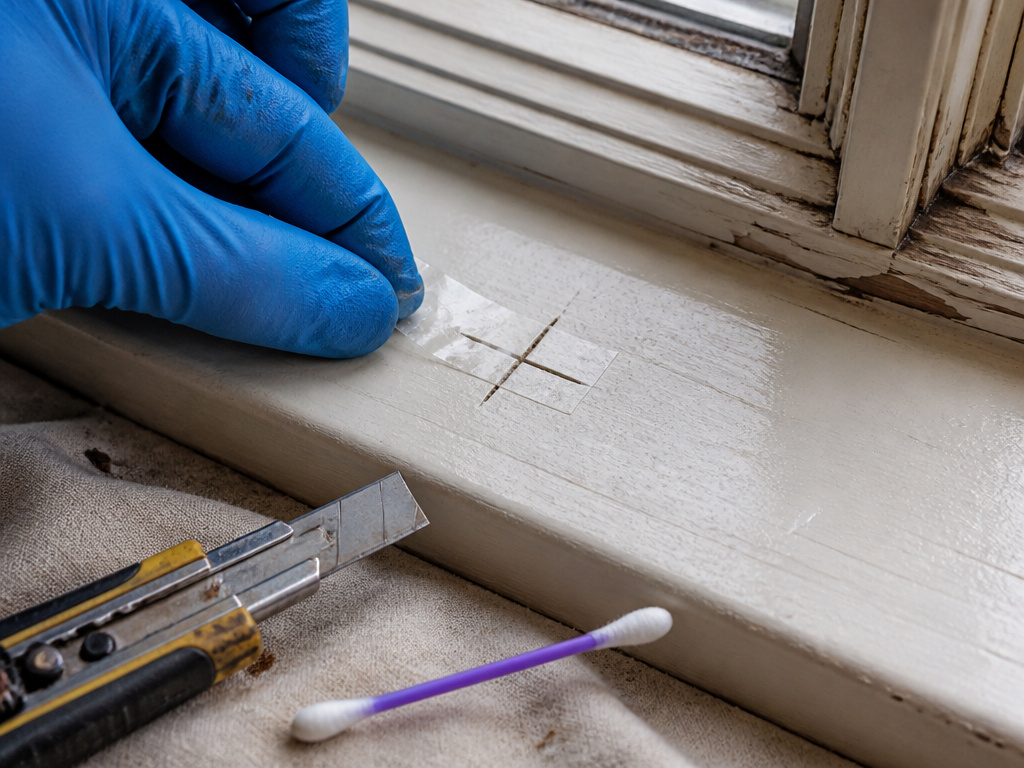
Four checks show up across the state guides: the X-Cut Tape Test, the Patch Test, the adhesion test on the paint layers, and the on-site product test.
Before you start: Test debris is the hazard. Mist and wet clean any dust or paint chips created during testing, because dry-brushing spreads exactly what you’re trying to contain. Occupants should never be in the same room during application, even when no dust is released. If preparation will generate lead dust or disturb the paint, the work must go to a licensed lead contractor with certified workers, or to the property owner.
Here’s the sequence that keeps a project out of trouble:
- Identify the paint before anything else. Swab a representative spot with a lead test kit, and the swab changes color if lead is present. Guessing from the age of a house is how people end up coating a surface they never identified.
- Run the X-Cut Tape Test on the worst component in each group. Connecticut requires one representative component per group of similar architectural systems, chosen because it looks the worst in the group. If that component fails, every component in the group fails unless each one is tested individually.
- Run a patch test per system type, per room. Skip it and you find out the coating doesn’t bond after the full coat is on, when the only fix is taking it back off.
- Write the results down. Massachusetts requires test results recorded on the form in the training booklet. An undocumented test is a test you can’t defend later.
- Mist and wet clean the debris. Dry scraping test dust through a room is the mistake that turns a two-hour job into a clearance problem.
The X-Cut Tape Test and the Worst Component Rule
Connecticut’s version is specific about which component you test. It has to come from a group sharing a common painting history, and it has to be the one that appears to be in the worst condition. That single rule saves money, because one test can clear a whole group. It also means a lazy choice of test spot can condemn a group that would have passed.
Minnesota takes a different route to the same decision: a lead risk assessor or lead supervisor must verify that the surface will pass the patch and adhesion tests described in HUD’s 1995 Guidelines, whereas Massachusetts has a trained person run and document patch tests without a deleader license. The HUD Chapter 13 encapsulation guidelines are the reference document behind that requirement.
Where this goes sideways: Treating test preparation as billable abatement. Minnesota states that preparing a surface for the patch and adhesion tests does not constitute lead hazard reduction, so the prep work isn’t the same thing as the fix.
Patch tests belong somewhere inconspicuous. The patched spot can sit slightly proud of the wall once the full coat goes on, and a row of raised squares across a hallway is a permanent reminder of where you tested.
Whether you swab or send a chip to a lab, the lead paint test kits that give a yes-or-no in the room are the ones that actually get used. If you want the full walkthrough on reading results, the guide on how to test for lead paint covers it step by step.
Who Is Allowed to Test, Verify, and Apply
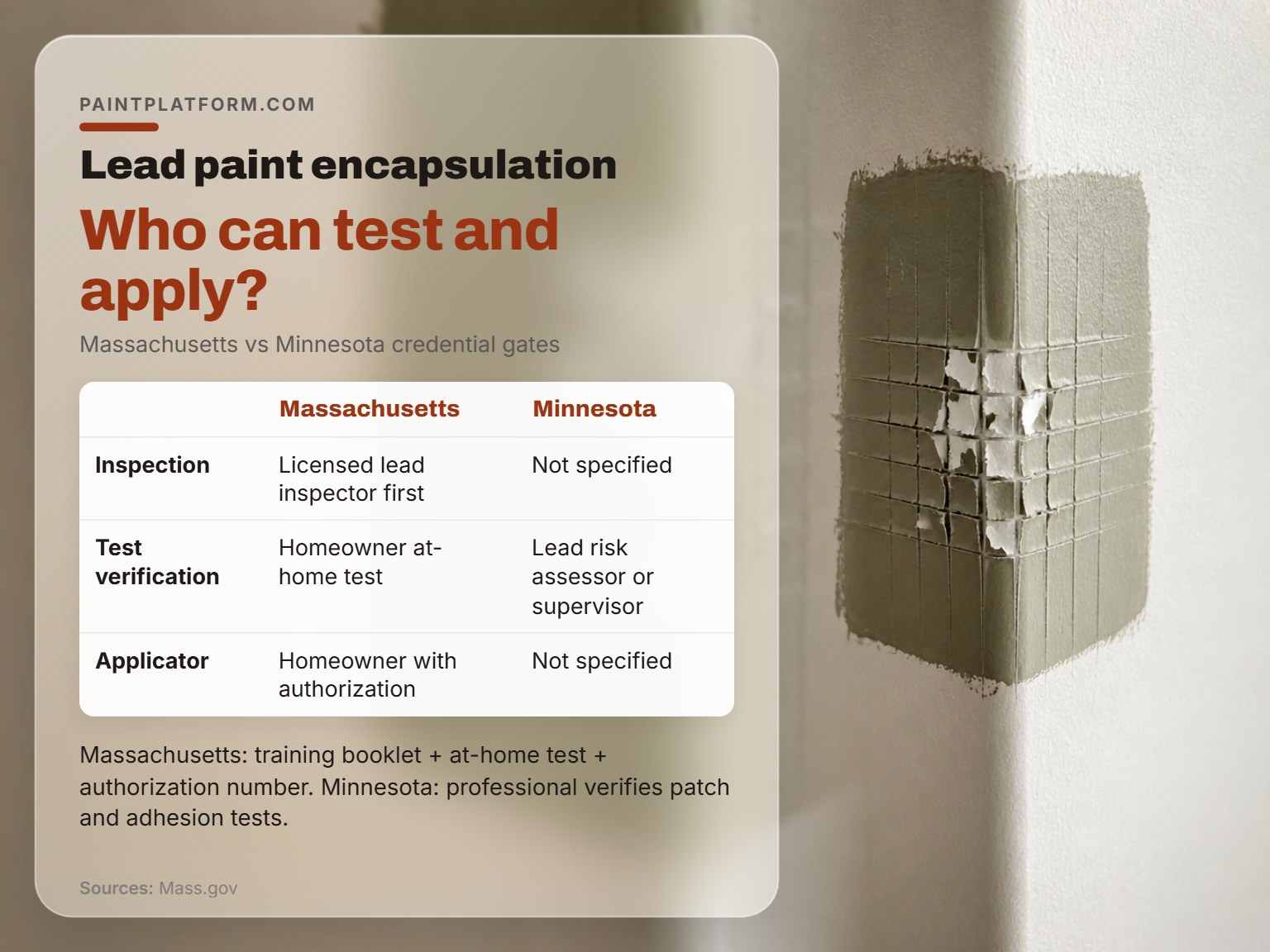
The credential question splits the states cleanly.
Massachusetts separates inspecting from applying. A licensed Massachusetts lead inspector must inspect before encapsulants are used as a deleading method. But you don’t need a deleader license to apply: you review a training booklet, take an at-home test, return it to the Childhood Lead Poisoning Prevention Program, and receive an authorization number.
Minnesota puts a different person at the gate. A lead risk assessor or lead supervisor verifies the patch and adhesion tests. That’s a professional credential, not a homeowner workbook.
Two Credentials, Two Different Gates
New York adds a third layer: the person performing on-site testing must meet standards set by the manufacturer, and the applicator must meet the manufacturer’s specifications. The Massachusetts lead encapsulation guidance lays out the training-and-authorization path in plain language if you want to see what the homeowner route looks like.
Connecticut handles the dust question separately. If preparing a component surface will generate lead dust or disturb lead-based paint, the work goes to a licensed lead contractor using certified workers, or to the property owner.
If the surface has to be scraped, sanded, or cut to get it ready, the job has already left the homeowner lane. Encapsulation over a sound wall is a coating job. Encapsulation after prep work is an abatement job.
That distinction decides your budget more than the product does. A HEPA air scrubber and a set of surface wipes are the two pieces of kit I’d want on hand before anyone touches a test patch, and neither one substitutes for the credential your state requires.
The lead paint safety guide covers the containment side in more depth, including what to do with the debris.
Why Does a 20-Year Warranty Sit Next to an Annual Inspection?
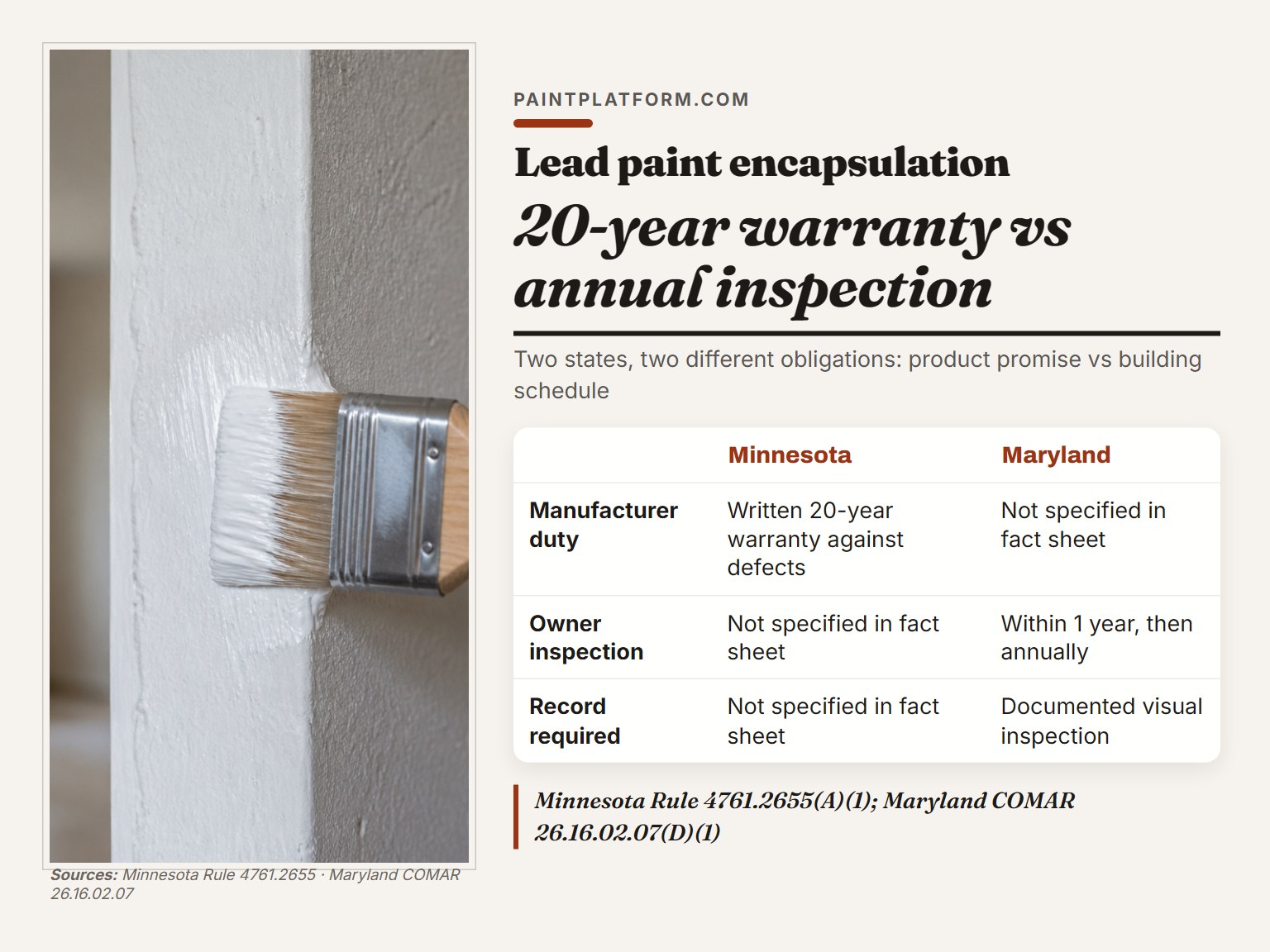
Minnesota asks manufacturers for a written 20-year warranty against defects in the encapsulant material. Maryland asks owners to conduct and document a visual inspection within 1 year of certificate issuance, then annually after that.
Neither state reconciles the two. A 20-year material warranty and a 1-year first inspection are describing different things: one is a promise about the product, the other is a schedule for the building.
The inspection cadence across the guides:
- Maryland: documented visual inspection within 1 year of certificate issuance, then annually.
- New York: periodic inspection for repair or maintenance, with a management plan behind it.
- Connecticut: every encapsulated surface addressed in a management plan and monitored regularly, so wear and damage get identified before a hazard reappears.
New York’s guide is honest about the ceiling here. The only permanent solutions that don’t require periodic maintenance and inspection are replacement of doors and windows, or complete removal of the lead paint.
The standards body says something similar. ASTM E1796 states that limited documentation is available on evaluating field performance of liquid coating encapsulation products, and that a conservative approach is adopted as a result. New York’s guide notes limited experience or information on long-term performance.
That’s not a reason to skip encapsulation. It’s a reason to schedule the inspection and keep the record, because the lead paint dust you’re guarding against shows up between inspections, not during them.
Worth knowing before you start: Water from roof leaks or broken pipes can damage an encapsulant. Fix the leak first, or the barrier is protecting a wall that’s coming apart behind it.
The NY Health Department encapsulant guide is the plainest explanation of the maintenance obligation I’ve found, and it’s worth reading before you sign anything.
Where Encapsulation Fails Anyway
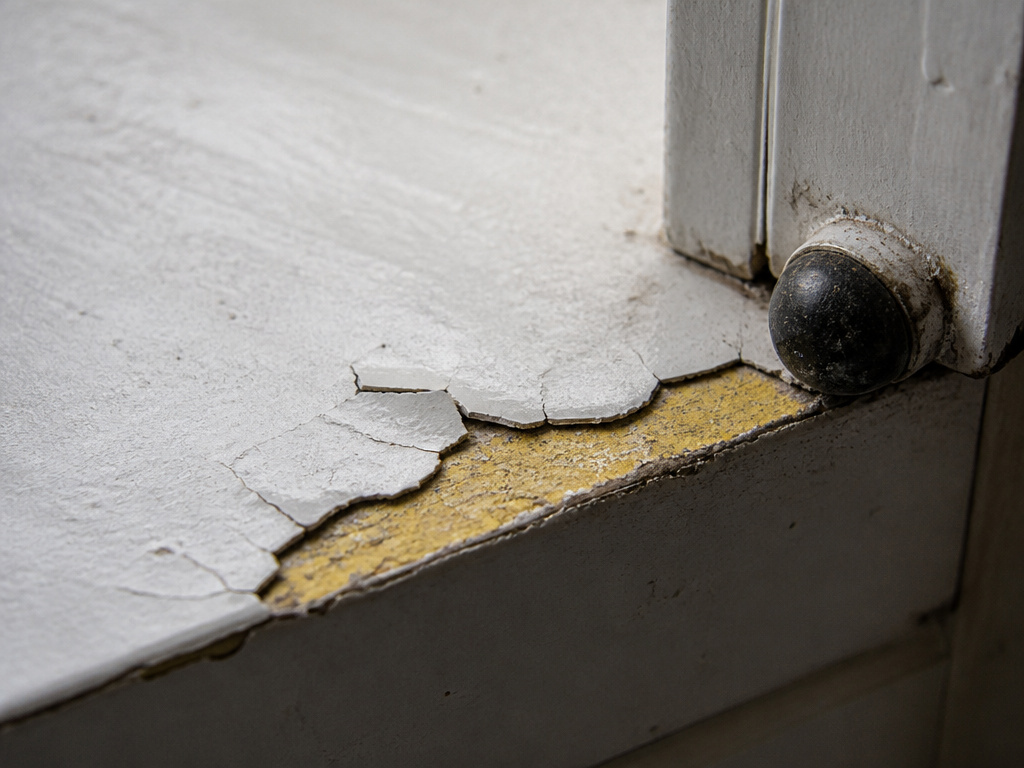
A barrier is only as good as the wall holding it.
Start with the substrate. ASTM E1796 requires an encapsulation product to bond to the surface coating and to not cause subsurface layers to separate or deteriorate. Old undercoats are where that requirement gets tested, and New York’s guide notes that encapsulants may peel off improperly prepared surfaces that have old undercoats of paint.
Water, Impact, and Old Undercoats
Three failure modes account for most of the callbacks:
- Repeated impact. Door stops, window stops, and stair treads wear prematurely, and the wear exposes what’s underneath.
- Water. Roof leaks and broken pipes damage the film, and a surface with an active leak isn’t eligible in the first place.
- Architectural detail. Thicker encapsulants can destroy the profile of moldings, which matters in an old house where the trim is the point.
Connecticut’s rule for friction surfaces explains the mechanism: those surfaces are subject to damage that can re-expose the underlying paint and release chips and dust. The coating didn’t fail on its own. Something hit it.
That’s why I’d tell you to skip the heat gun and the power sander entirely, and skip encapsulation too on any surface that takes foot traffic or repeated contact. On a stair tread, the honest options are planing, a permanent barrier, or lead paint removal. Coating it just moves the problem down the schedule.
If the paint is intact and the surface is a wall or ceiling, encapsulation is often the safer route than removal, and it’s the one that keeps the original trim in the house. The ASTM E1796 liquid coating encapsulation standard frames it as a nondestructive abatement strategy, useful where the primary structure needs to stay intact for historical or economic reasons.
Where the wall is sound, painting over lead paint with an approved encapsulant is a legitimate method. Where it isn’t, you’re looking at lead paint waste disposal instead, and that’s a different project with a different set of rules.
Frequently Asked Questions
Is encapsulation the same as painting over lead paint?
No. Connecticut’s guide states that conventional paints are not encapsulants. An encapsulant is a product with ASTM E1795 or E1797 documentation behind it, and in most states it also has to appear on an authorized product list before it can be used for abatement.
How long does an encapsulant last?
There’s no single number, and the sources say so. ASTM E1796 notes that limited documentation exists on field performance, and New York’s guide cites limited long-term performance data. Minnesota requires a written 20-year warranty against material defects, which is a manufacturer promise rather than a field-tested lifespan.
Can I apply an encapsulant myself?
It depends on the state and on the surface. Massachusetts allows a homeowner to apply after completing a training booklet, passing an at-home test, and receiving an authorization number, but requires a licensed inspector first. If preparation will generate lead dust, Connecticut requires a licensed lead contractor with certified workers or the property owner.
What happens if an encapsulated surface gets damaged?
It goes back into the management plan. Connecticut requires every encapsulated surface to be addressed in a management plan and monitored regularly, so wear and damage get identified and the resulting hazard eliminated. Maryland’s schedule puts the first documented visual inspection within 1 year of certificate issuance.
Does encapsulation remove the lead paint?
No. Connecticut’s guide is direct about this: the lead-based paint has not been removed, which is why the surface needs a management plan and regular monitoring. The only solutions that need no periodic maintenance are replacing the doors and windows or removing the paint completely.
The Bottom Line
Here’s the threshold that decides it. If the surface is a friction surface, takes repeated impact, has an active water leak, or fails the X-Cut or Patch Test, encapsulation is off the table. Not “probably not.” Off. Go to planing, a permanent barrier, or removal.
If the surface is an intact wall or ceiling with sound paint and a passing adhesion test, encapsulation is the method I’d choose over scraping every time. It keeps the original trim in the house, and it doesn’t put lead dust in the air.
Fair warning: the paperwork is the part people skip. The product list, the test results form, the inspection record. That’s the difference between a coating that’s protecting your family and a coating that’s just hiding a problem until the next owner renovates.
Try this today, and it takes ten minutes: swab one windowsill and one door jamb with a lead test kit, write the date and the result on a piece of tape stuck inside the closet door, and then call your local health department about the authorized product list. Start messy. The record is what makes it hold.
