
Drawing Paper Types Explained: What to Actually Buy
This post contains affiliate links. As an Amazon Associate, we earn from qualifying purchases.
Drawing paper types explained in one line: cartridge takes graphite and charcoal, Bristol takes ink and markers, tracing paper takes overlays, and polyester film takes repeat work. Weight comes second, and GSM beats pounds. James Cropper’s Kendal Drawing Cartridge runs 100 to 220 gsm with a plus or minus 5% tolerance.
GSM is the number printed on every pad, and it’s the one that gets misread. It tells you how much paper sits under your pencil, which decides whether a charcoal layer digs into the tooth or skates across the top of the sheet, and it’s the number behind most of the drawing paper types explained here.
What follows: six papers worth knowing by name, the weight bands that genuinely change your results, and four places where the mills and the retailers contradict each other outright.
Key Takeaways
- Match the paper to the medium before you look at weight. A heavy sheet with the wrong surface still fights your charcoal.
- GSM is the number to trust. Pounds come from weighing 500 sheets, and the standard sheet size changes between grades, so pounds don’t compare across brands.
- Kendal’s five weights share one roughness figure at 1400 ml/min, so stepping up in weight leaves the surface feel unchanged.
- Canson draws the fine-paper line at 90 g/m², which is study weight rather than finished-piece weight.
- Skip the oversized pencil sets. The sheet under the pencil decides more of the result than the grade stamped on the barrel.
Drawing Paper Types Explained: The Six That Cover Everything
Six papers cover nearly everything a dry medium asks for: cartridge, Bristol, layout, marker pad, tracing, and film. Each is a different answer to the same question, which is how hard the surface should grab a mark and how much it should let go.
Cartridge paper is an uncoated, wood-free sheet with a light grain that sits between smooth Bristol and rough watercolour paper. The grain, called tooth, holds graphite and charcoal particles in place, so marks stay where they land. Heavier cartridge of 200 gsm or more takes light watercolour and ink with minimal buckling, according to Jackson’s Art.
| Paper | Best for | Watch out for |
|---|---|---|
| Cartridge | Graphite, charcoal, coloured pencil | Light washes only; 200 gsm+ before water |
| Bristol | Ink, markers, gouache | Carries more sizing than watercolour paper |
| Layout | Marker roughs, design sketches | 45-50 gsm, so it bleeds through |
| Marker pad | Layered marker work | Weights run 70 to about 220 gsm |
| Tracing | Overlays and repeat drawings | A crease reads white, permanently |
| Polyester film | Work that must hold its size | Vellum is the humidity-sensitive one |
Two papers in the same row still behave nothing alike, and the reason sits in the furnish and the sizing rather than the weight.
Why “Cartridge” Is a Shape, Not a Recipe
Jackson’s Art describes cartridge as most commonly made of wood-free cellulose. Reflex doesn’t state a furnish for its drawing paper. Canson doesn’t either.
So the word describes a job and a look, not a fixed material. Two pads both labelled cartridge differ in how much sizing they carry, and sizing is what controls absorbency. Koh-I-Noor describes sizing as a water-soluble mix of gelatin or starch, added in a specific amount for each paper’s intended use.
Cartridge Paper: The Paper Your Pencil Already Expects
James Cropper’s Kendal Drawing Cartridge comes in five weights and exactly one surface.
The graphite had nowhere left to go. Now I stop the moment I catch myself fiddling with a line that already works.
That slickness has a cause. Graphite burnishes the tooth flat when you keep going over the same area, and once the grain is polished there’s nothing left to grab fresh marks. Kendal’s answer is a surface the mill calls slightly toothy, aimed at graphite, coloured pencils and charcoal.
Here’s the number that surprised me. Kendal’s Bendtsen roughness is 1400 ml/min with a tolerance of plus or minus 200, and it’s identical across all five weights. So a 100 gsm sheet and a 220 gsm sheet feel the same under the pencil. What changes is how much punishment the sheet takes.
Burst strength tells that story: 200 kPa minimum at 100 gsm, rising through 240, 280 and 320 to 440 kPa at 220 gsm. Thickness runs 150, 180, 210, 240 and 330 µm. Moisture sits at 7.5% with a tolerance of minus 1.0 and plus 0.5.
Reflex Drawing/TDP takes a different route. It’s surface and core glued for high erasure resistance and repeated corrections, which is the spec you want if you redraw constantly. It runs 120, 160, 200 and 350 g/m² in white, and 120, 160 and 200 g/m² in natural.
Caliper is 190, 255, 320 and 530 µm tested to EN 20534, and moisture is 6.5% to EN 20287. Reflex also recommends your own tests before using the material for the first time, which is unusually honest for a data sheet.
Run a fingertip across a sheet of cartridge and you feel a fine nap, closer to a cotton shirt than to glass. That nap is the whole point.
For graphite and charcoal work, the sketching paper question comes down to that nap more than the weight printed on the cover.
Three Smooth Papers That Do the Same Job Differently
Three papers sit on the smooth end: Bristol, layout, and marker pad. They behave nothing alike.
Bristol Board
Bristol is sold with a completely smooth surface or a vellum surface that carries a slight texture. The multiply part matters.
Koh-I-Noor notes that Bristol carries more sizing than watercolour paper, because it’s built for markers, ink and gouache. More sizing means liquid sits up on the surface where you want it instead of sinking straight in.
Layout Paper
Layout paper is the thinnest thing on this list at 45 to 50 gsm. It’s designed for design roughs and quick marker sketches rather than anything you plan to keep.
Canson makes the same point from the marker side: layout paper holds ink and limits smudges.
Marker Paper
Marker pads run from about 70 gsm up to roughly 220 gsm, and the lighter end is sometimes sold as layout paper under a different cover. The surface is smooth, which keeps edges crisp.
For layered marker work, marker paper has to hold the second and third pass without the first one lifting.
If you’re comparing formats rather than papers, a glued pad and a spiral pad behave differently at the drawing table, and drawing pads come in both.
Common mistake: Assuming “drawing paper” on the cover means acid free. The Drawing Source points out that pH neutral and acid free aren’t the same claim, and pads print one without the other. Paper that picks up acidity from tape, finger oils and mounting board discolours over years, not weeks.
What Do Tracing Paper, Vellum, and Film Actually Do?
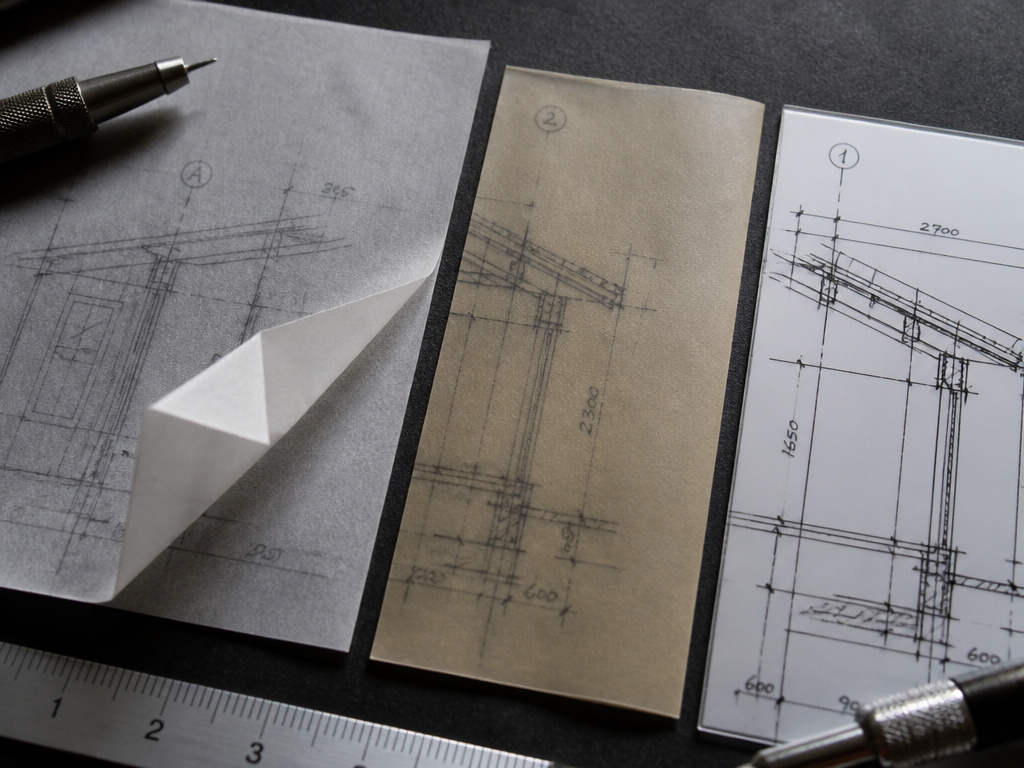
Fold a sheet of tracing paper to fit it in a folder, unfold it, and there’s a bright white line across your drawing that no eraser will touch.
That line is structural. Tracing paper’s short, compressed fibres are what make the sheet look clear. Creasing breaks the bonded fibres, light starts reflecting between them again, and the crease reads white.
Vellum is a different animal in the drafting world. The Illinois State Board of Education defines it as tracing paper treated with wax, oil or a similar substance, and ranks it below polyester film on durability and erasability. It’s also sensitive to humidity.
Polyester film is the stable one. The same curriculum describes it as a plastic drafting material with excellent dimensional stability, durability, erasability and transparency. If a drawing has to line up with another drawing after a week in a damp room, film is the material that holds.
Canson puts numbers on the range: satin tracing papers come as sheets or rolls between 45 and 115 g/m², and polyester and acetate films are completely transparent up to 180 g/m².
Here’s the short version of the family:
- Tracing paper: overlays and repeat drawings, dry or quick-drying media only.
- Vellum: treated tracing paper, humidity-sensitive, less durable than film.
- Polyester film: the dimensionally stable option, with the best erasability of the three.
- Detail paper: pencil only, not for reproduction.
The full taxonomy, including sheet sizes and title block conventions, is documented in the Illinois State Board of Education drafting media curriculum.
What Do the GSM Numbers Actually Mean?
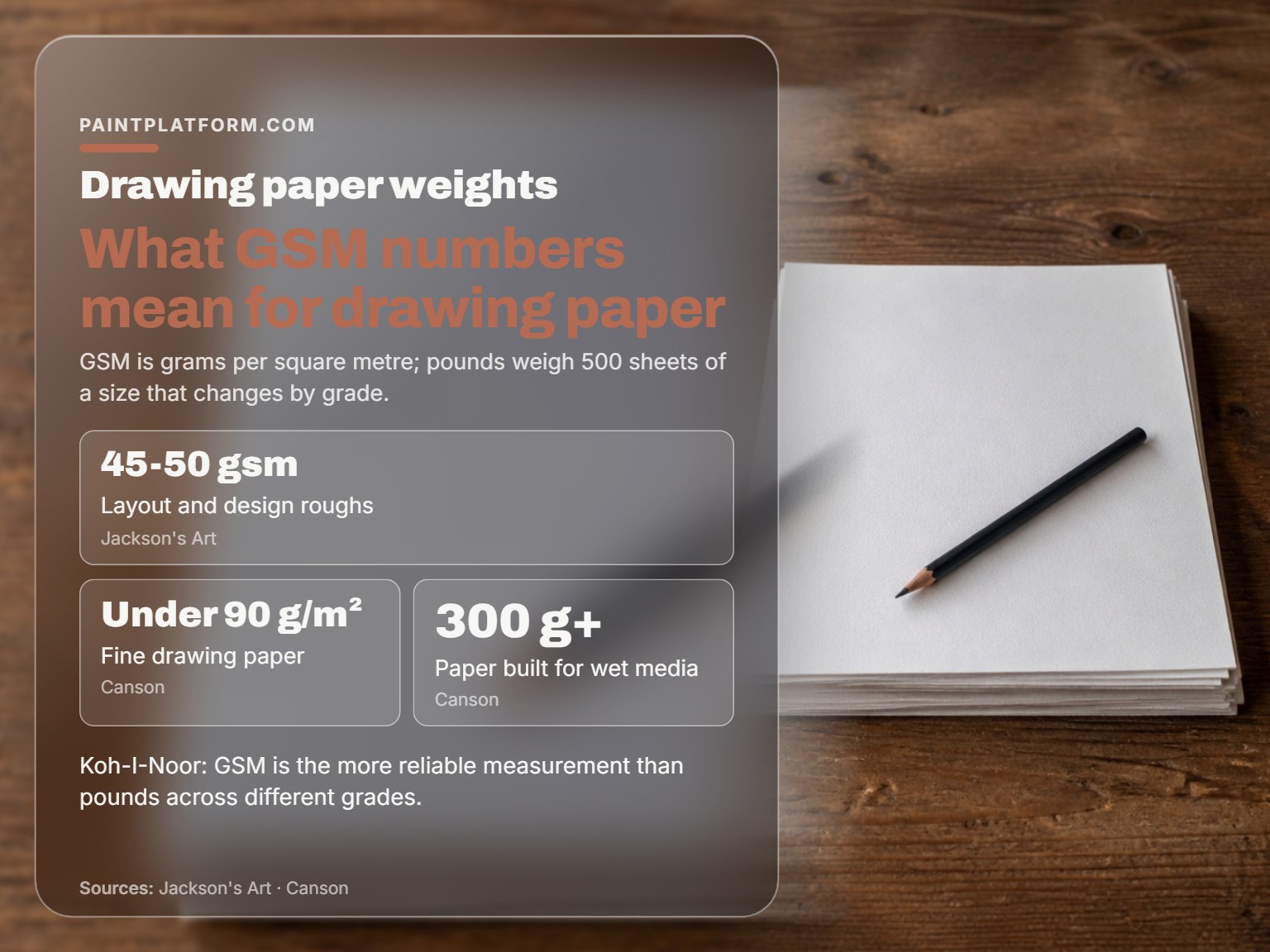
45 gsm is layout paper. 300 gsm is watercolour territory. Everything you draw on sits between those two poles.
GSM means grams per square metre, measured by weighing one sheet cut to 1 m by 1 m. Pounds work differently. Koh-I-Noor explains that the pound figure comes from weighing 500 standard-size sheets, and the standard size changes between grades of paper. That’s why a 90 lb sheet from one brand and a 90 lb sheet from another are different animals.
Koh-I-Noor’s own conclusion is that GSM is the more reliable measurement, especially across different grades.
It’s one less conversion to get wrong at the shop counter.
| Band | Typical use | Source |
|---|---|---|
| 45-50 gsm | Layout and design roughs | Jackson’s Art |
| 70-220 gsm | Marker pads | Jackson’s Art |
| Under 90 g/m² | Fine drawing paper | Canson |
| Up to 200 g/m² | Intermediate drawing paper | Canson |
| 300 g+ | Paper built for wet media | Canson |
Canson’s bands are the clearest published map. Fine drawing paper sits under 90 g/m², intermediate paper runs up to 200 g/m², and thick paper of 300 g or more is designed for wet media.
The feel of graphite on a 220 gsm sheet is nothing like a 45 gsm layout pad. Same pencil, different instrument.
Koh-I-Noor’s paper guide sets out the full weight and sizing explanation if you want the source material.
Where the Manufacturers Genuinely Disagree
Two credible sources can look at the same sheet and describe it differently.
Acid free versus pH neutral. James Cropper defines acid-free paper as paper made with alkaline technology, where the pulp pH is above 7, which is neutral. The Drawing Source warns that pH neutral doesn’t mean the same thing as acid free, because paper picks up acidity from media, finger oils, mounting board and tape. Both statements are about the same word and they don’t line up. A pH above 7 at the mill is the starting condition, and what happens to the sheet afterwards undoes it.
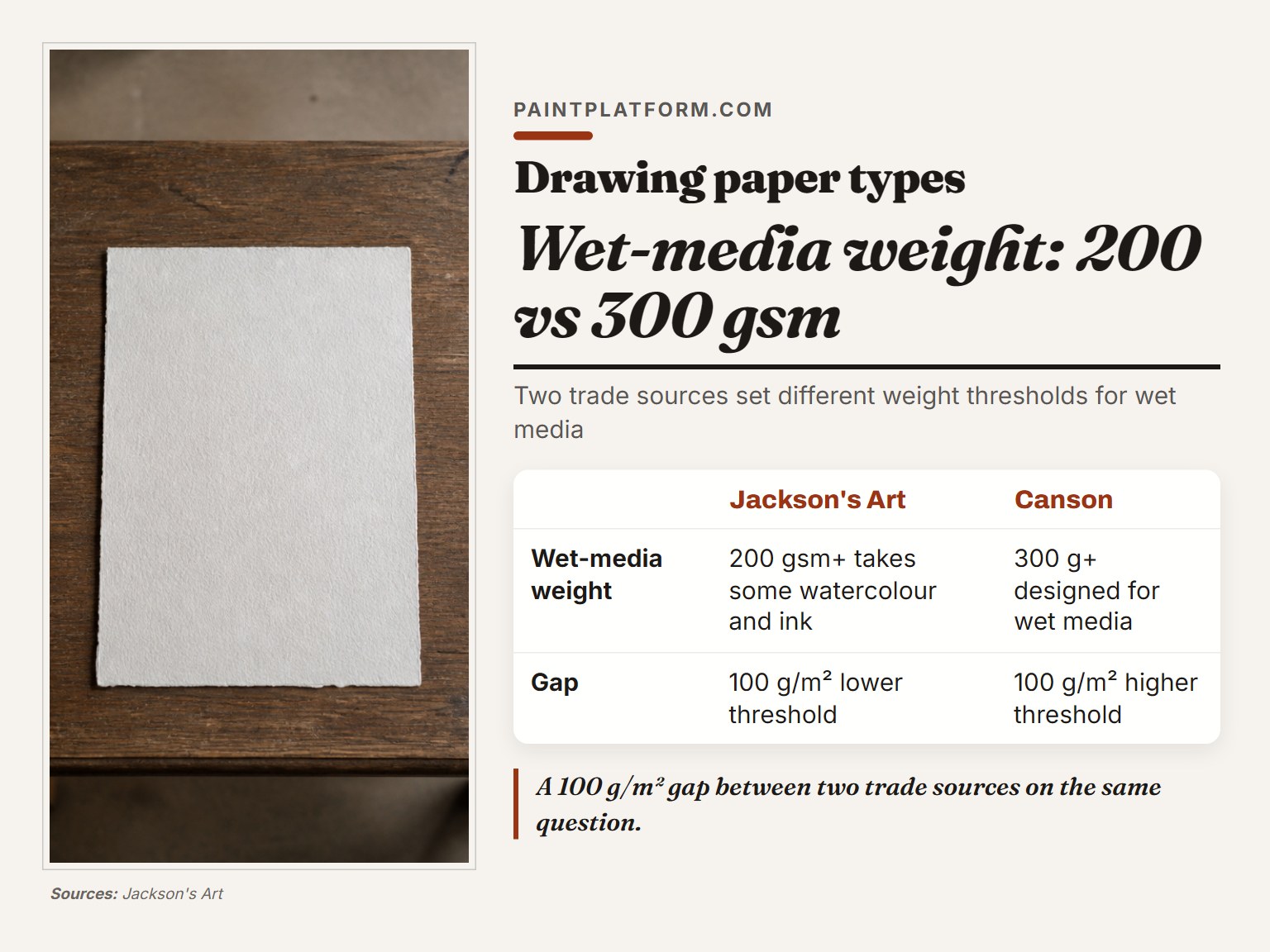
The wet-media weight threshold. Jackson’s Art says heavier cartridge of 200 gsm and up takes some watercolour and ink with minimal buckling. Canson says thick paper of 300 g or more is designed for wet media. That’s a 100 g/m² gap between two trade sources.
Smooth or textured for graphite. Canson recommends slightly textured paper, fine grained or satin, or a completely smooth Bristol board for technical drawing. Strathmore positions its Smooth surface as especially suited to line drawing and technical work. Koh-I-Noor splits it by medium instead: smoother texture for pen and ink, more textured paper for charcoal and pastels.
Whiteness numbers don’t travel. Reflex reports TAPPI whiteness of 111% for white and 94% for natural, tested to DIN 53145. Strathmore publishes no whiteness value at all, only a cream colour. James Cropper publishes none either, only a matt white surface. You can’t compare a TAPPI figure to a colour name.
Erasability claims. Reflex advertises high erasure resistance through surface and core gluing. Jackson’s Art notes that newsprint disintegrates under heavy pressure such as excessive erasing. Those are different papers, so the two claims never actually meet.
If a spec sheet gives you a number, find out which test produced it. TAPPI 111% whiteness and “bright white” are different claims, and only one of them is checkable against another sheet.
If you’re drawing in charcoal rather than graphite, the surface question shifts again, and charcoal paper is where the tooth does most of the work.
The wet-media argument is really a question about watercolor paper types, where the sizing and the surface finish matter more than the weight.
Which Sheet Should You Actually Buy First?
Do you actually know what you’ll draw on it next week?
The pad that suits a two-minute gesture study is a different pad from the one that suits a finished charcoal portrait. Buying one pad to do both is how you end up with a shelf of half-used books.
- Name the medium first. Graphite, charcoal, ink, marker, pastel. The surface follows from that, not from the weight.
- Check the GSM, not the pound figure.
- Decide whether the sheet needs to survive erasing. If you redraw constantly, Reflex Drawing/TDP is surface and core glued for high erasure resistance. If you don’t, you’re buying a property you won’t use.
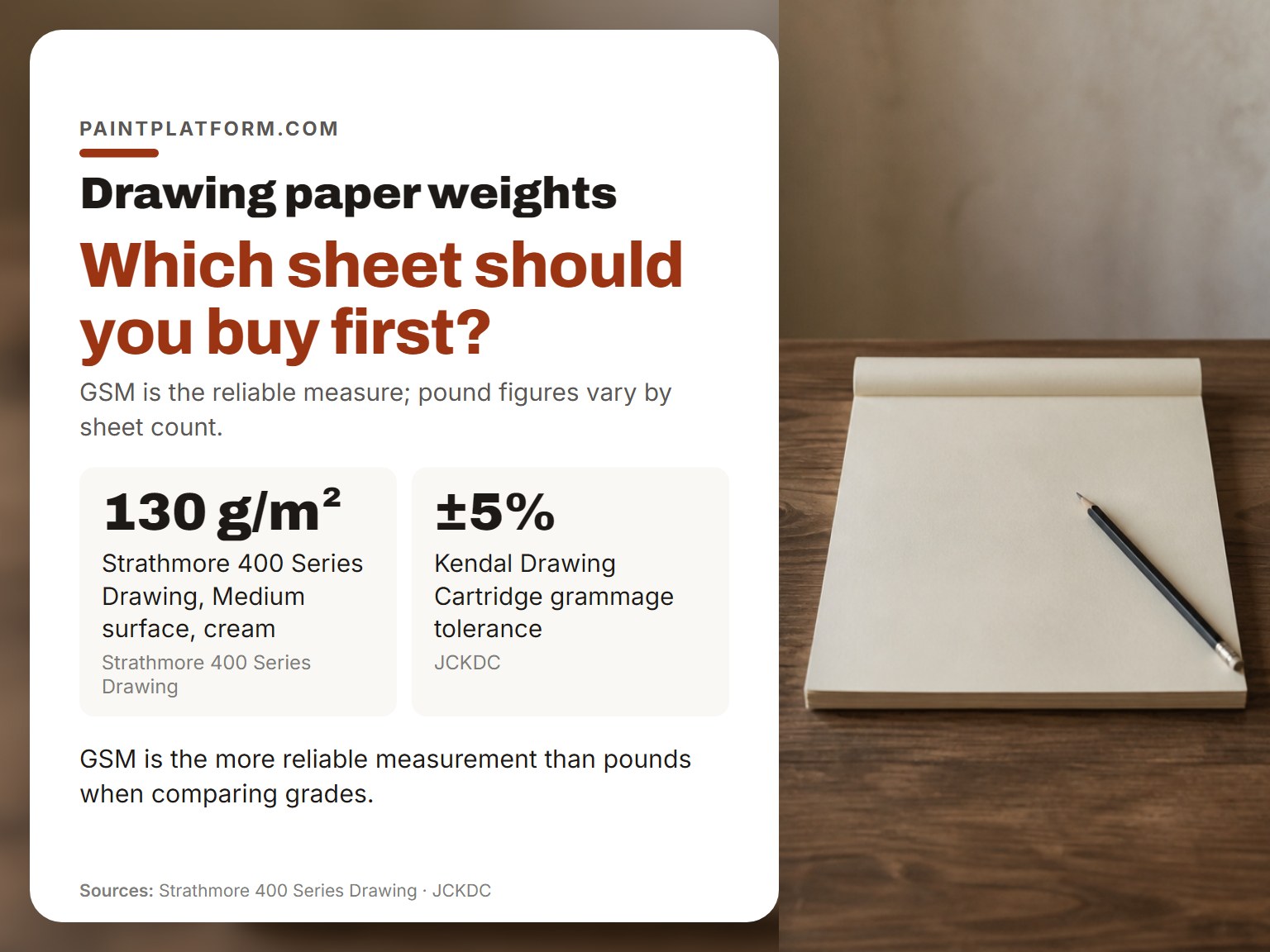
- Buy one pad, not a set. A single Strathmore 400 Series Drawing pad in Medium, at 130 g/m², is cream rather than bright white.
- Test the sheet before you commit a finished drawing to it. Reflex says this on its own data sheet, and the mills are right about it.
The paper isn’t the thing you’re protecting.
The Two-Minute Test
For pastel work the rules change completely, because pastel paper needs enough tooth to hold several layers without the first one disappearing.
And if you want one book to carry everywhere, sketchbook paper is a different buying decision from a pad that lives on a desk.
Skip this if: You only draw in graphite and you never erase. The surface engineering on modern drawing papers exists to survive correction, and you’d be buying a property you won’t touch.
Frequently Asked Questions
Is 200 gsm drawing paper thick enough for watercolour?
Jackson’s Art says heavier cartridge of 200 gsm and up takes some watercolour and ink with minimal buckling. Canson sets the wet-media bar higher, at 300 g or more designed for wet media. For light washes on cartridge, 200 gsm works. For anything wetter, follow Canson.
What’s the difference between cartridge paper and drawing paper?
Drawing paper is a category, and cartridge is one member of it. Jackson’s Art describes cartridge as most commonly made of wood-free cellulose, and the name is a historical label rather than a description of the material.
Does acid-free mean the same as archival?
Not automatically. James Cropper defines acid-free as pulp pH above 7. The Drawing Source points out that pH neutral and acid free aren’t identical claims, and that a sheet picks up acidity from tape, finger oils and mounting board after manufacture.
Why does tracing paper turn white when it creases?
The fibres are pulped until they’re short and compressed. Creasing breaks the bonded fibres, so the crease reads white.
Can I use Bristol board for charcoal?
Bristol carries more sizing than watercolour paper because it’s built for markers, ink and gouache, per Koh-I-Noor. Charcoal wants tooth. A vellum-surface Bristol gives you some texture, but a dedicated charcoal sheet holds layered charcoal better.
What weight is Strathmore 400 Series Drawing?
80 lb, which Strathmore lists as 130 g/m², in a 24 by 36 inch 500-sheet ream. It comes in Smooth and Medium surfaces, in cream.
The Bottom Line
When you catch yourself erasing the same area repeatedly, stop and restate the line on top instead. Every pass burnishes the tooth a little flatter, and once the surface is polished the sheet stops taking graphite long before it looks damaged.
If you want one purchase to start with: a 130 g/m² Strathmore 400 Series Drawing pad in Medium. It’s cream, it takes pencil, charcoal, crayon and marker, and it won’t make you treat every page as precious.
For volume work, the sheet matters less than the mileage. A stack of 45 to 50 gsm layout paper is cheap practice, unlike one careful drawing on a 300 gsm sheet.
One honest limit. Everything above assumes a physical medium. If your drawing happens on a tablet, the paper question disappears and surface settings replace it, which is a subject I’ll leave to people who actually know it.
