
Natural vs Synthetic Brushes for Art: Key Differences
This post contains affiliate links. As an Amazon Associate, we earn from qualifying purchases.
In the natural vs synthetic brushes for art choice, natural hair carries more paint and water and suits oils and heavy impasto, while synthetic filaments suit acrylics, watercolor detail, and glazing. Synthetics clean faster and shrug off alkaline paint. Natural bristle loads heavier per dip.
Alkaline is the word that decides most of this. Acrylic, acryla gouache, and casein all sit on the alkaline side, and JetPens warns that alkaline media damage organic fiber. That single chemistry fact reshapes the whole comparison.
What follows: the mechanism behind color load, a durability argument three sources can’t agree on, and the one filament spec that separates a workhorse from a brush that fights you.
Key Takeaways
- Natural hair carries more paint per load, and hog bristle’s flags are the reason. Squirrel hair has the best water-holding capacity of any natural hair brush.
- Synthetic filaments take alkaline paint like acrylic and casein without the fiber damage JetPens warns about for natural hair, though Princeton and Dick Blick hold that natural bristle can still be used with acrylics.
- Multi-diameter filament is the quality line between a cheap synthetic and one that behaves like hair.
- Dry every brush bristle-down. Glue holds the tuft in the ferrule, and water sitting in there softens it.
Why Natural Hair Holds More Color Than Any Synthetic
The scales along a natural hair shaft do the work.
Dick Blick’s hair-type guide describes those microscopic scales as the reason natural hair has superior paint-holding ability. Isabey puts the same idea in mechanical terms: the scales absorb and hold liquid, which makes natural bristles water- and color-retentive. A synthetic filament is conical too, but its surface is smoother, so it releases faster and holds less.
Natural hair carries microscopic scales along the shaft. Those scales trap pigment and water, so a squirrel or sable brush releases color in a slow, even ribbon. Hog bristle adds a second mechanism: a V-shaped split at the tip, called a flag, plus a natural curve. Interlocked bristles resist fraying and hold the brush’s original shape under pressure.
Princeton’s brush-anatomy guide says the same thing in plainer language: the more flags a bristle has, the more color the brush holds. That’s why a well-made hog brush loads heavier than a soft synthetic of the same width.
If you’re shopping bristle, look for four things:
- Flags at the tip. Split ends, not cut ends. More flags, more color carried.
- Interlocked hairs. They curve inward and keep the brush’s shape under pressure.
- Source and grade. Princeton names Chungking and Shanghai bristle as the stiffest and most sought after.
- Consistency within a grade. Even Kolinsky sable varies hair to hair, per the same guide.
Sable behaves differently from bristle. Dick Blick notes that Kolinsky holds a very fine point and lasts for years with proper care. Pony hair is the least strong of all natural hair options and will not return to a point after a brushstroke.
I notice the difference most when a wash is loaded and the tip still comes to a needle. A natural point with interlocked hairs holds that shape all the way through a stroke.
Do Synthetic Brushes Actually Last Longer Than Natural Hair?
Three sources answer this question and the answers can’t all be right.
Princeton states plainly that synthetics frequently offer greater durability than natural brushes. JetPens states just as plainly that synthetics have a shorter lifespan, because the fibers eventually fray apart. Fine Woodworking lands on a third position: natural bristles wear and break faster than synthetics and are harder to clean.
The split makes sense once you separate two kinds of wear. A synthetic fails at the tip. Artists Network notes that as synthetic bristles wear down, the ends curl or split. Natural bristle fails along the shaft: it snaps, sheds, and leaves pieces in your finish coat.
Which failure you’d rather have depends on the job.
I’ve retired more synthetics for a hooked tip than for any other reason. The point goes first.
So the honest answer is that neither type wins on lifespan in the abstract. Buy the one whose failure mode you can live with, which is the core of choosing a paint brush for any medium.
Can You Use Natural Bristle Brushes With Acrylics?
You load a hog bristle flat with cadmium red, drag it into a wet acrylic layer, and the paint grabs the bristles instead of the canvas.
This is the most contested question in the whole comparison, and the sources split four ways.
| Source | Position on natural hair with acrylic |
|---|---|
| Princeton Brush | Natural bristle works; sable is not recommended |
| Dick Blick | Pure hog bristle recommended for oils and acrylics |
| JetPens | Avoid it; alkaline paint damages organic fiber |
| da Vinci | Acrylic sticks to bristle and resists cleaning |
Read those together and the shape of the disagreement appears. JetPens is making a chemistry argument: acrylic, acryla gouache, and casein are alkaline, and alkaline media damage organic fiber. Princeton and Dick Blick are making a practice argument: plenty of painters use hog bristle with acrylic and like the result. Da Vinci is describing a cleaning problem rather than a destruction problem.
All four can be true at once. Hog bristle survives acrylic well enough to be useful, and it will never come fully clean around the ferrule.
The mechanism is physical. Dick Blick and Isabey both describe the same difference: natural hair has scales, synthetic filament doesn’t. A scaled surface gives drying acrylic more to grip, which is exactly what da Vinci’s cleaning complaint describes, though Princeton attributes synthetic retention to multi-diameter filament quality.
If you paint acrylics regularly, keep a hog set and a synthetic set separate. The hog brush will still work. It just won’t come clean again, and Princeton notes that natural bristle tends to lose its stiffness in acrylic anyway.
The natural vs synthetic bristles comparison gets simpler once you accept that compatibility and cleanliness are two different questions.
The Filament Tier Nobody Talks About: Single vs Multi-Diameter
Filament diameter is the spec that separates a workhorse synthetic from a brush that fights you.
Princeton draws the line clearly: inexpensive synthetic brushes often use a single-diameter filament, while better-quality brushes blend filament sizes. Multi-diameter filaments hold more color and are built to mimic natural hair.
The mechanism is straightforward. A single-diameter filament packs into a uniform bundle with even gaps, so liquid runs through it and out. Mixing diameters creates irregular channels that trap liquid between fibers, which is the job a scaled hair does naturally.
Waterfords describes the same construction from the manufacturing side: polyester or multi-diameter extruded nylon filament, often chemically tapered or cratered to carry more color.
What the Filament Names Actually Mean
- Taklon is the common name for the dyed and baked synthetic filament Dick Blick describes. JetPens notes that dyeing roughens the fibers and increases pigment pickup.
- da Vinci COLINEO uses straight and wavy fibers in different lengths with extra-fine tips, built to imitate Siberian Kolinsky structure.
- da Vinci CHUNEO goes the other way: irregular flags that mimic Chungking bristle tips, extra-long and deliberately bristly.
- Princeton Velvetouch blends multiple filament diameters, and the blend changes depending on the brush style.
Both engineering approaches are legitimate. They solve different problems. COLINEO chases a sable point; CHUNEO chases a bristle’s scrub.
Common mistake: Judging a synthetic by how it feels dry. A dry filament can feel springy and fine and still splay the moment it takes water. Wet the tip and pull it across scrap paper before you commit it to a painting.
Filament choice is only half the decision. The types of paint brushes you keep within reach matter as much as what they’re made of.
What Brush Makers Claim vs What One Tester Found
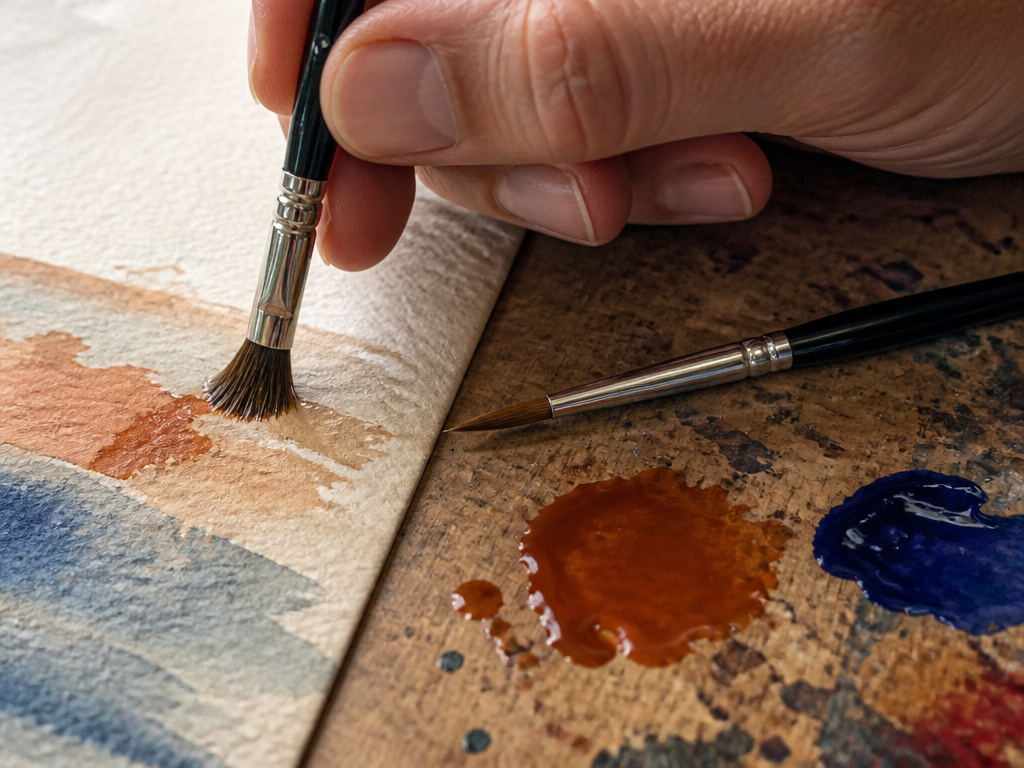
This is where the marketing gets ahead of the testing.
Princeton claims the best synthetics and synthetic sable blends are indistinguishable in performance from many natural hair brushes. That’s a strong statement from a manufacturer, and it deserves a check.
Botanical illustrator Lizzie Harper tested four size-1 synthetics against her Winsor & Newton Series 7 sable and concluded none of them matched it. Her results were uneven in useful ways.
- Princeton Neptune Script held its point for the entire test and was her favourite of the four.
- Rosemary & Co Red Dot Pointed started beautifully and lost tip definition after about 10 minutes of use.
- Jackson’s Kite S561 arrived with a ragged, blunt tip and cost more than her Series 7 brush.
- Raphaël’s synthetic sable, in a later round, had no tip and a lack of accuracy.
That’s one illustrator, one paper, one size. It doesn’t settle anything. It does show that a premium price and a sable-like label don’t guarantee a point.
I’ve stopped trusting a synthetic’s point until I’ve painted a full session with it. The first ten minutes lie.
If you want a shortlist to test from rather than a single verdict, the best artist paint brushes roundup covers the ranges worth trying.
Natural vs Synthetic Brushes for Art: The Medium Decides
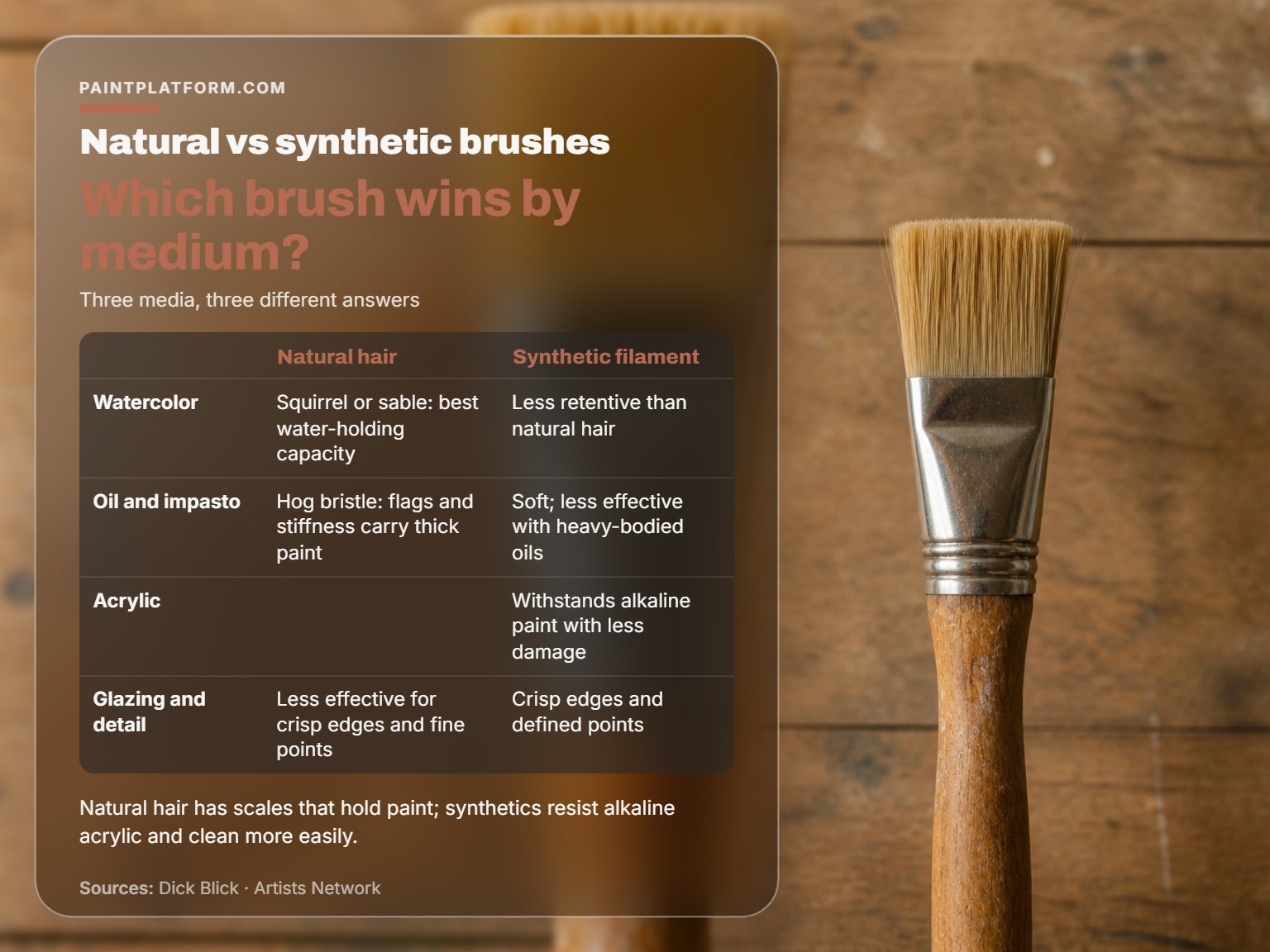
Three media, three different answers.
| Medium | Brush that wins | Why |
|---|---|---|
| Watercolor | Natural squirrel or sable | Best water-holding capacity of any natural hair |
| Oil and impasto | Hog bristle | Flags and stiffness carry thick paint |
| Acrylic | Synthetic filament | Withstands alkaline paint with less damage |
| Glazing and detail | Synthetic | Crisp edges and fine, defined points |
| Wood finishing | Natural bristle or Purdy Syntox | Wet-edge hold; Syntox matches natural on alkyd varnish |
Dick Blick’s entry on squirrel hair is worth reading in full.
For watercolor specifically, Isabey recommends a short handle for precision work and for painting flat on a table. The watercolor brush you pick should match that posture. Easel work in oil or acrylic allows a long handle of about 9 inches, per Waterfords.
Where Blends Make Sense
Artists Network recommends a blend rather than a team: larger natural brushes for block-ins, scrubbing, and wet-in-wet, synthetics for softening edges, smoothing blends, and refining detail. That’s a workflow, not a compromise.
One claim in that workflow is contested. Artists Network lists wet-in-wet as a natural-hair strength. Da Vinci argues the opposite for bristle specifically: natural bristle is too strong for wet-in-wet, tends to wipe back the layer underneath, and muddies it, while CHUNEO lets you layer throughout. Both are describing real behavior. A stiff hog brush does scrub a wet layer back; a soft sable doesn’t.
Standard advice says go big to stay loose. On a small sketchbook page that advice made me clumsy, and a small round gave me more life than the wide flat did.
If oil is the plan, the oil painting brush decision leans on hog bristle for body and a soft synthetic for the final edges.
Care That Keeps Either Type Alive Longer
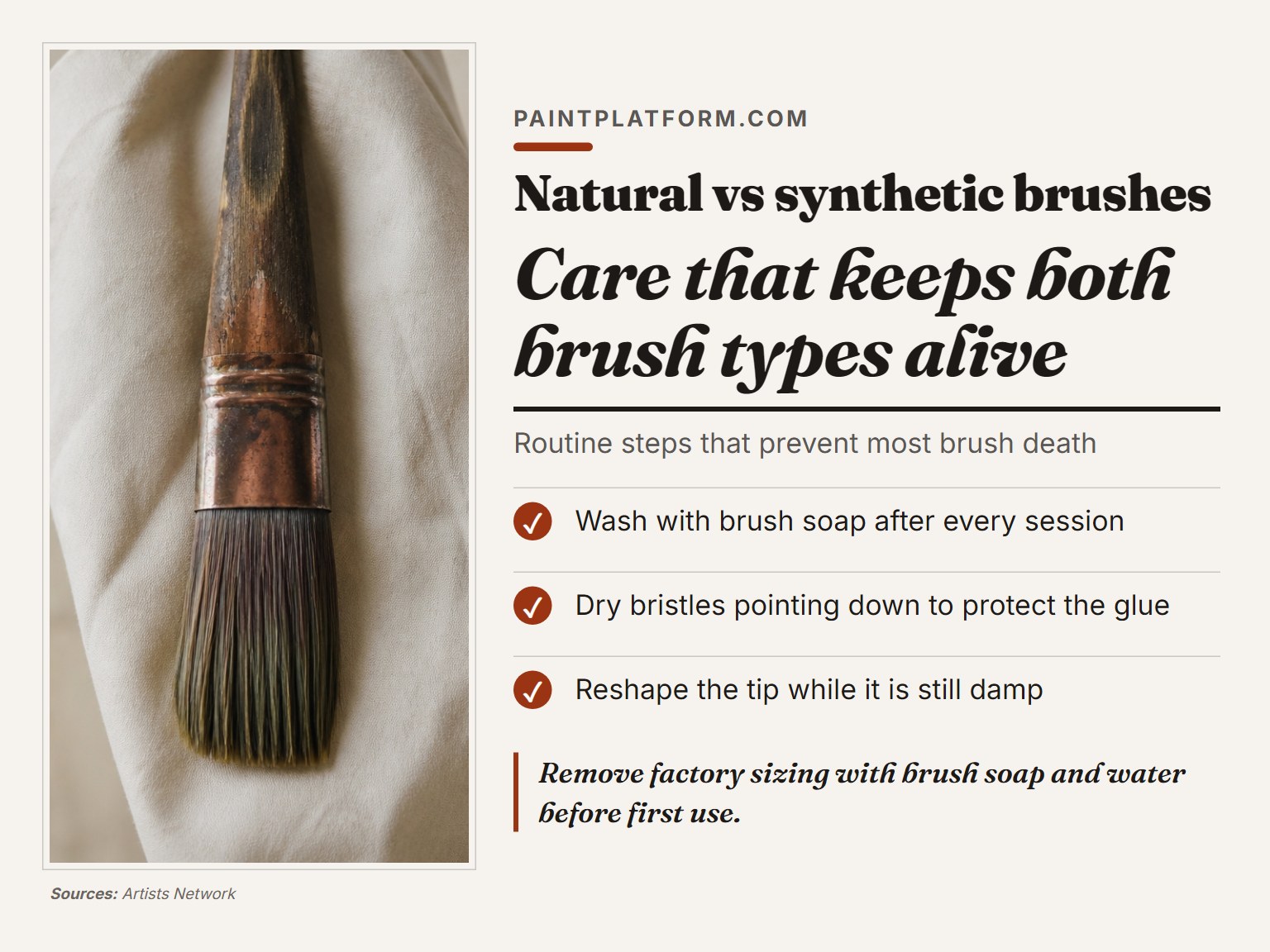
Most brushes die in the sink, not on the paper.
I rinse my brush the moment I switch color families, and I learned that the boring way. Skip the rinse and the next mix comes up duller than the one sitting on your palette, and you won’t know why until it’s already on the page.
Here’s the routine that keeps both types working:
- Wash with brush soap after every session. Artists Network is direct about this. Skip it and dried binder creeps up toward the ferrule.
- Rinse between color families, not just at the end. The dull-mix problem above, in one sentence.
- Dry bristles pointing down. Glue holds the tuft in the ferrule, and water wicking upward softens it over a few weeks.
- Reshape the tip while it’s still damp. A tip that dries splayed stays splayed.
- Wash off the factory sizing before first use. Dick Blick notes most brushes ship with a water-soluble sizing that needs removing with brush soap and water.
- Condition natural bristle occasionally. Artists Network suggests a brush conditioner or oil to stop natural hair drying out and going brittle.
Fair warning: a synthetic that arrives with a tiny hook at the tip isn’t ruined. Dip the bristles about halfway into water just off the boil for 10 to 30 seconds, keep the ferrule and upper bristles dry, and reshape the point on your thumbnail. It buys you a usable brush for lighter work.
When to Retire a Brush Instead of Fixing It
A hooked synthetic can often be rescued. A synthetic whose fibers have frayed apart can’t. JetPens notes that synthetic fibers eventually fray apart, and Artists Network describes the ends curling and splitting as the brush wears. Once the tip splits into two or three separate points, it becomes a scrubbing brush.
| Symptom | Likely cause | Fix |
|---|---|---|
| Tip curls into a small hook | Filament memory after wear | Dip in just-boiled water, reshape on thumbnail |
| Bristles splay and won’t point | Dried paint inside the ferrule | Wash with brush soap, comb, reshape damp |
| Brush feels limp in water | Natural hair waterlogged | Dry bristle-down, condition with oil |
| Lines turn thick and ragged | Worn synthetic tip | Retire it to scrubbing and texture work |
| Stiffness drops in acrylic | Natural bristle with acrylic residue | Keep a separate hog set for acrylic |
Where this goes sideways: Standing a brush bristle-down in a jar of water. The tips bend and stay bent, and no amount of reshaping brings the point back.
The full brush care and storage guide covers the storage side, and how to clean paint brushes walks the washing steps in order.
Frequently Asked Questions
Are synthetic brushes better than natural for beginners?
For acrylic and mixed media, yes. Synthetics take alkaline paint without fiber damage, clean with soap and water, and cost less to replace when a tip goes. For oil and impasto, a hog bristle flat does something no filament quite matches.
Do I need Kolinsky sable to paint watercolor well?
No. Dick Blick calls Kolinsky a professional-grade hair that holds a fine point and lasts for years, and that’s accurate. It’s also the most expensive route into watercolor.
Can I use one set of brushes for every medium?
You can, and you’ll shorten their life. Princeton notes that natural bristle tends to lose stiffness in acrylic, and da Vinci points out that acrylic sticks to bristle and resists cleaning around the ferrule. Keep a synthetic set for water-based work and a hog set for oil.
Why did my synthetic brush’s tip curl?
Filament memory. Artists Network notes that synthetic bristles are more prone to distortion as the ends curl or split with wear. A dip in water just off the boil for 10 to 30 seconds, followed by reshaping on your thumbnail, often restores a usable point.
How long should a brush last?
The sources don’t agree, and neither will your brushes. Princeton says synthetics frequently outlast natural. JetPens says synthetics fray apart sooner. Fine Woodworking says natural bristles wear and break faster. Care matters more than the material label.
The Bottom Line
If you paint acrylics at all, buy your synthetics first. They survive the chemistry, they’re cheap enough to replace without flinching, and a frayed one still earns its place for texture and scrubbing.
Add natural hair when you move into oils, or when you want a wash to sit wet on the page longer than a filament will hold it. That’s the whole natural vs synthetic brushes for art decision in two sentences, and it holds up better than any single-brand loyalty.
One threshold worth keeping: if your only size-1 round develops a hook, fix it before the next session rather than painting around it. A hooked tip changes every line you make, and you’ll spend the whole session correcting instead of drawing.
And the concession. None of this matters much if you paint twice a month. Two mid-priced brushes in two sizes, cared for properly, will outlast your curiosity about the question. Try it on scrap first.
