
Stencil Paint Types Explained: Water-Based vs Solvent
This post contains affiliate links. As an Amazon Associate, we earn from qualifying purchases.
Stencil paint types explained in one line: water-based alkyds, solvent-based nitrocellulose aerosols, and spec-grade stencil inks cover nearly every job, and each one carries its own film thickness and dry time. Water-based 18c Stencil Paint dries to the touch in 10 minutes at 72 F; AEROMARK’s solvent aerosol is fast-drying but wants surface temperatures between 10 and 35 C.
That 0.002 inch wet film is the number that decides whether an edge stays crisp or creeps. Lay paint on thicker than the spec allows and it has nowhere to go but sideways, under the stencil.
What follows: three chemistries, the federal test data behind the spec-grade inks, and the temperature windows that decide whether a coat cures or smears.
Key Takeaways
- Water-based does not mean harmless. 18c Stencil Paint is water-based with reduced flammability, yet its flash point is -4 F and it ships as UN 1950, Class 2.1.
- 0.002 inch wet film is the federal ceiling for stencil ink types I, II and IV under A-A-208B.
- Dew point beats air temperature. AEROMARK wants 3 C of margin above dew point and no rain in the forecast.
- Two or three light passes beat one heavy coat, because thick coats extend curing and recoat time.
- Gloss targets disagree between specs. A-A-208B type II accepts a maximum of 10; 18c measures flat at under 15 on a 60 degree meter.
Stencil Paint Types Explained: The Three Families
Three families cover almost every stencil job you’ll meet: water-based alkyd, solvent nitrocellulose aerosol, and spec-grade stencil ink written against a federal standard.
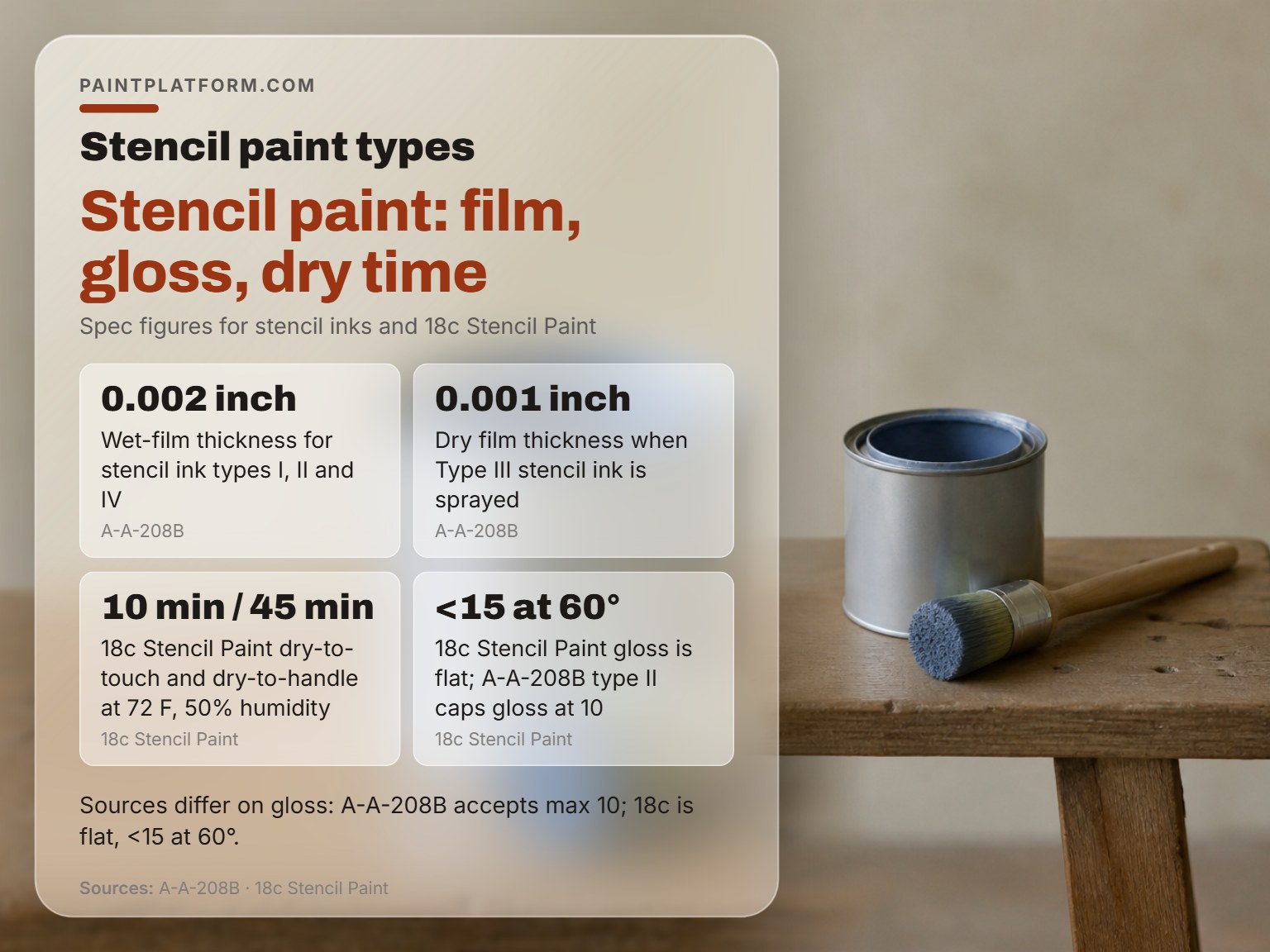
A-A-208B applies stencil ink types I, II and IV at a wet-film thickness of 0.002 inch, while type III is sprayed to a dry film thickness of 0.001 inch. Dried films must show the minimum contrast ratios for their colors under ASTM D 2805, and color is judged visually per ASTM D1729.
The water-based option most people reach for is 18c Stencil Paint from PipeMarker, a V.T. Alkyd resin system at roughly 18% solids. It comes in six colors: HGP-W, HGP-BLK, HGP-G, HGP-R, HGP-Y and HGP-B. The stencil paint you choose matters less than how thin you lay it, but the chemistry sets your ceiling.
AEROMARK Stencil sits at the other end. It’s a solvent-based, fast-drying modified nitrocellulose aerosol, sold in 400 mL cans and aimed at crisp edges with minimal bleed. The federal spec is different again: A-A-208B isn’t a product, it’s a written performance standard for pad printing stencil inks, and it tells you what a film has to do rather than what’s in the can.
| Paint Type | What It Actually Is | Where It Fits |
|---|---|---|
| 18c Stencil Paint | Water-based V.T. Alkyd, ~18% solids | Pipes, concrete, metal, indoor marks |
| AEROMARK Stencil | Solvent modified nitrocellulose aerosol | Sharp stencil edges, fast turnaround |
| A-A-208B inks | Spec-grade pad printing ink, types I to IV | Industrial marking to a written standard |
Water-Based vs Solvent Stencil Paint: Which One Wins
Pick water-based unless speed is the whole point.
The 18c sheet lists VOC content at roughly 56% with a cap of 60%, an MIR value of about 1.10 against a 1.20 cap, and HAPs at 19%. Those are compliance numbers, and they’re the reason a “water-based” can still carries a flammable classification. Specific gravity is 0.80, so the can feels lighter than its 11 oz net weight suggests.
Solvent aerosol wins on edge definition. AEROMARK’s data sheet claims crisp, clean edges with minimal bleed when used with stencils, plus good abrasion resistance. Open a can indoors without ventilation and you’ll know within seconds: a sharp, sweet solvent smell that sits in the room long after the mark is dry.
Here’s where the two diverge in practice:
- Rain tolerance. AEROMARK says check the forecast and don’t paint if rainfall is imminent, because it hurts cure and bonding. 18c is water-based and described as long-lasting paint that will not wash away with water. Those two statements are about different things, and mixing them up ruins outdoor jobs.
- Cure speed. 18c reaches dry-to-touch in 10 minutes and dry-to-handle in 45 at 72 F, 50% humidity, 1.5 mil thickness. AEROMARK is marketed on fast drying, with no comparable published figure.
- Color range. Six named colors for 18c, RAL-matched colors for AEROMARK.
When you layer stencils, the slower chemistry is usually the safer one, because each pass has to be genuinely dry before the next goes down.
Why Film Thickness Decides Whether Your Stencil Bleeds
The first repeat I ever stenciled looked like I’d frosted a cake with it. I loaded the brush the way you load a brush for a wall, and paint crept under the edge on nearly every opening. Not a little. Enough that the pattern read as a smear from across the room.
The mechanism is simple. A stencil edge is a dam, and a dam only works if the volume behind it stays low. Overload the brush and capillary action pulls the excess sideways along the surface, under the film, into the gap between stencil and substrate. Thick coats also extend curing and recoat time, per the 18c sheet, so the bleed you caused stays wet longer and spreads further.
Offload most of the paint onto a paper towel before the brush touches the stencil. If the towel shows a wet patch, you’re still carrying too much.
That’s the whole fix. Dab the loaded brush on a paper towel until it leaves almost nothing behind, then build color in two or three light passes. Most paint bleeding traces back to film thickness rather than to the stencil itself.
Common mistake: Judging the brush by how it looks, not by what it leaves. A brush that still shows a wet sheen will bleed on the first repeat, and you won’t see it until you lift the stencil.
Small bleeds stopped bothering me after a while. On a wall pattern viewed from six feet, nobody sees a fuzzy edge. They see the rhythm. I once tried to fix a smudge with a cotton swab and made it worse than the original bleed.
How Long Does Stencil Paint Take to Dry?
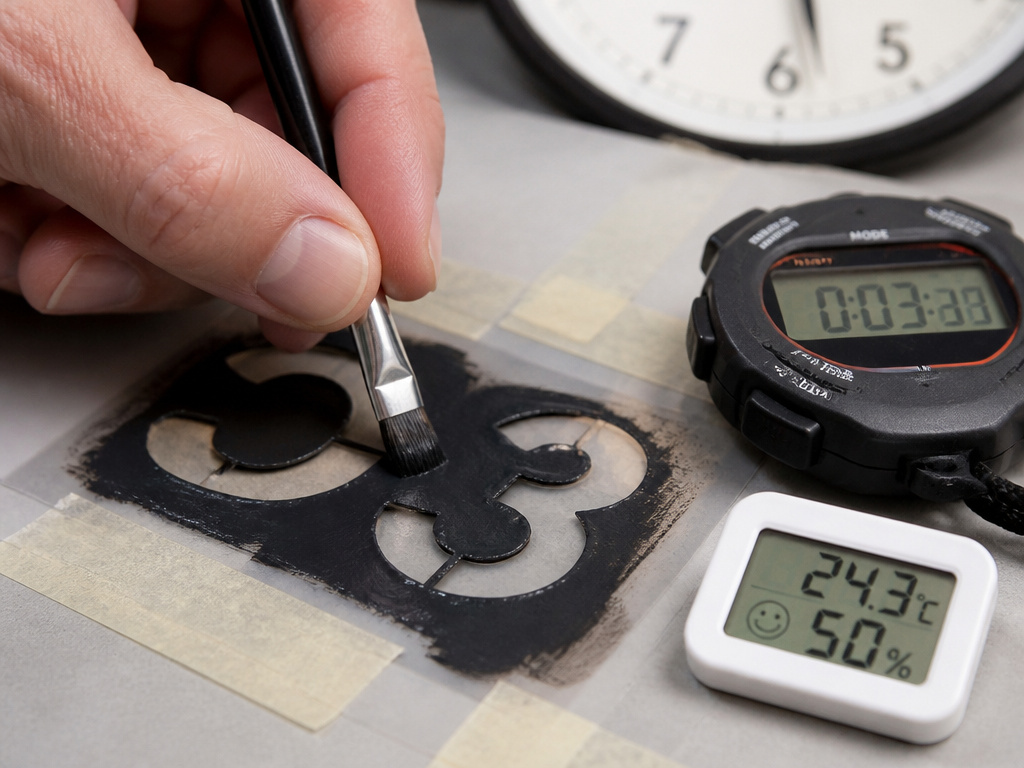
Ten minutes to touch, 45 to handle, and that’s only at 72 F with 50% humidity and a 1.5 mil film.
Change any of those three variables and the numbers move. The 18c sheet is explicit that curing and recoat time extend with multiple coats and excessively thick coats, which is the same lesson as the bleeding section wearing a different hat.
| Condition | 18c Stencil Paint | AEROMARK Stencil |
|---|---|---|
| Application temperature | 50 to 100 F | Surface 10 to 35 C, ambient 15 to 45 C |
| Storage temperature | 40 to 90 F | Not stated on the sheet |
| Humidity limit | Not stated | 85% RH max, or 3 C above dew point |
| Dry to touch | 10 minutes | Fast drying, no figure published |
| Dry to handle | 45 minutes | Not stated |
The application windows overlap but they aren’t the same window. 18c runs 50 to 100 F, which converts to roughly 10 to 38 C. AEROMARK splits surface and ambient, allowing a warmer air temperature than surface temperature. On a cold morning with warm air moving through, those two readings diverge and the aerosol sheet is the stricter of the two.
Heat resistance for 18c is 250 F, and shelf life is guaranteed for two years. There’s no food contact rating on it, so keep it off anything that touches food.
How Do You Match a Paint Type to the Surface?
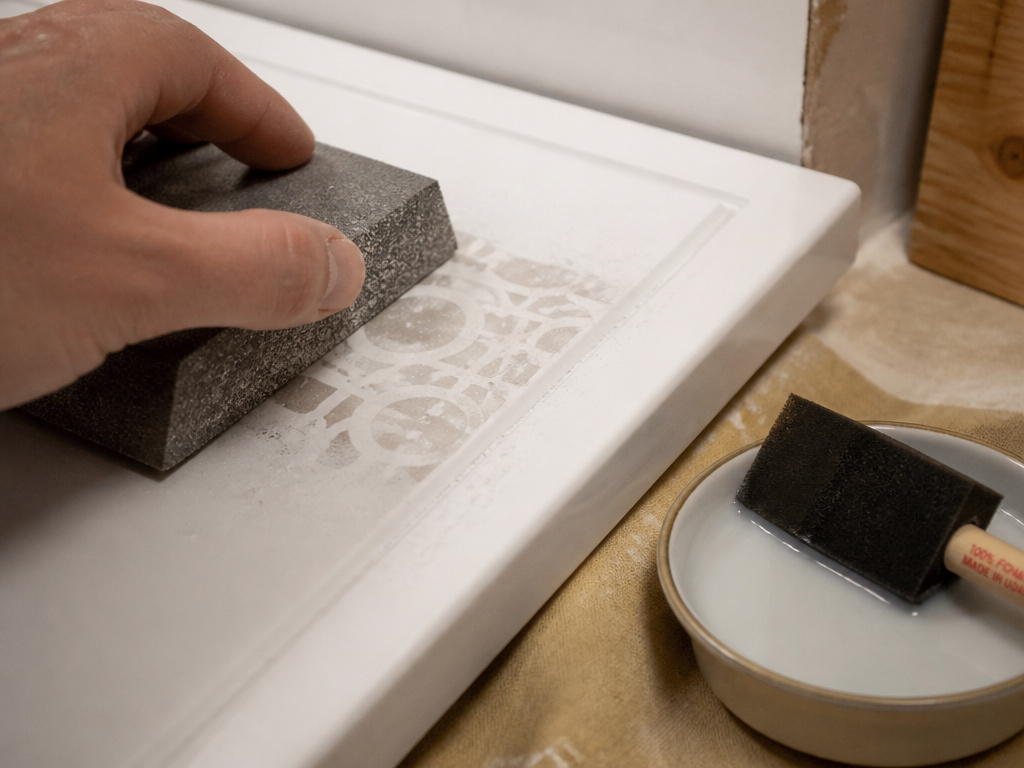
Slick factory finishes need a scuff pass. Raw wood and drywall don’t.
When you stencil furniture, the surface prep is the whole job. I skipped the fine-grit sanding on one drawer front because the finish looked matte already, and the pattern scratched off with a fingernail inside a week. The same prep on the rest of the dresser held fine.
Sealing matters too. I sealed that dresser with wax over chalk-style paint, and the wax took a full day to stop feeling tacky. On a floor I’d skip wax entirely and use a water-based polyurethane at two coats minimum, because foot traffic scuffs a stenciled pattern fast.
A wall stenciling project is more forgiving than furniture. Drywall and plaster pull moisture out of the film, so the paint sets quicker and bleeds less. For tote bags and tees, fabric paint types behave nothing like wall paint, and a stencil paint with no fabric flexibility will crack at the first fold.
Where this goes sideways: Stenciling over a waxed or oiled surface without degreasing. The film bonds to the wax instead of the wood, and the whole pattern lifts in one sheet the first time you wipe it down.
Spray, Brush, or Roll: Picking the Tool for the Paint
Three tools, three different failure modes.
Before you start: 18c Stencil Paint has a flash point of -4 F and ships as Consumer Commodity ORM-D, UN 1950, Hazard Class 2.1, so keep cans away from pilot lights and store between 40 and 90 F. AEROMARK’s aerosol needs 85% RH or lower and 3 C above dew point, and solvent vapor builds fast in a closed room. Ventilate before you spray, not after.
The stencil brush vs roller argument settles quickly once you’ve overloaded a foam roller. A roller holds more paint than a stencil edge can tolerate, and it pushes that excess straight into the gap.
Here’s the sequence that works:
- Prep and degrease the surface. Skip it on a slick finish and the pattern lifts within a week, usually at a corner where you’ll notice it every day.
- Load the tool, then offload it. Dab on a paper towel until almost nothing transfers. Skipping this step is the single most common cause of bleed.
- Dab straight up and down. Angling the brush pushes paint under the edge, and the resulting halo is wider than the stencil line itself.
- Build in two or three light passes. One heavy coat extends cure time and stays soft far longer than the sheet’s 45 minute figure.
- Lift the stencil while the film is still tacky. Waiting until it’s fully hard bridges the paint across the stencil bars and tears the edges when you pull.
- Rinse immediately and clean stencils before the paint skins over. A dried film on a reusable stencil changes the edge profile and every later repeat bleeds a little more.
What the Federal Spec Sheet Actually Tests
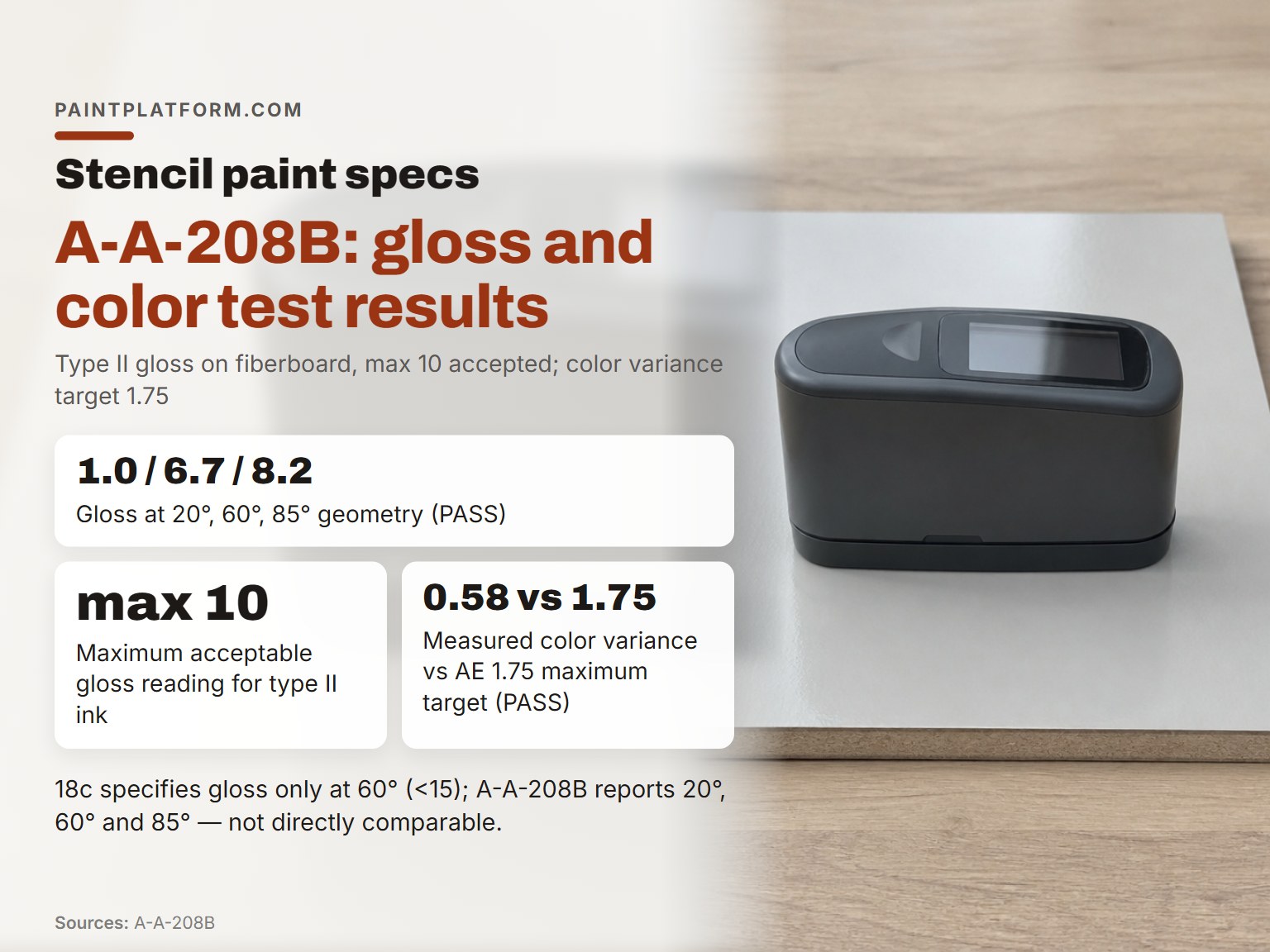
A-A-208B measures gloss on fiberboard for type II ink, with a maximum reading of 10 accepted under ASTM D 523. The reported results were 1.0 at 20 degrees, 6.7 at 60 degrees and 8.2 at 85 degrees. All three passed.
Color gets a two-stage test. Visual inspection under ASTM D1729 illumination comes first, and only if that’s inconclusive does the AE 1.75 maximum variance apply. The measured variance was 0.58 against that 1.75 target.
Now the disagreement worth knowing about. A-A-208B reports gloss at three geometries: 20, 60 and 85 degrees. The 18c sheet specifies gloss only at 60 degrees, where it reads flat at under 15. Those numbers aren’t directly comparable, because a film can pass at 60 degrees and still throw a sheen at 20. If gloss matters for your job, ask which geometry the number came from.
Solids content has the same trap. 18c lists roughly 18% solids. A-A-208B doesn’t specify a solids percentage at all; it specifies film thickness. Quoting “18% solids” next to a spec that never mentions solids is comparing a volume figure to nothing.
I’d rather see a slightly uneven film than a thick one. A thick coat looks better wet and worse dry, every single time, and no amount of sanding gets that edge back.
Frequently Asked Questions
Is water-based stencil paint actually less flammable?
Less flammable than a straight solvent, yes. Non-flammable, no. 18c Stencil Paint is described as water-based with reduced flammability, and the same sheet lists a flash point of -4 F with a Flammable classification and UN 1950 shipping. Treat the can like what it is.
What’s the difference between 0.002 inch wet film and 0.001 inch dry film?
They describe different moments in the film’s life. A-A-208B applies types I, II and IV at 0.002 inch while wet, and sprays type III to 0.001 inch once dry. Wet film shrinks as solvent leaves, so a wet measurement is always the larger number.
Can I recoat before the listed dry time?
No. The 18c sheet notes that curing and recoat time extend with multiple coats and excessively thick coats, so the 45 minute dry-to-handle figure assumes a single 1.5 mil film. A second coat resets the clock rather than stacking on top of it.
Why does my stencil paint bleed even when I use light coats?
Check the surface angle and the tool. Dabbing straight down with an almost-dry brush limits bleed, but angling the brush or using a roller pushes paint into the gap regardless of how little you loaded.
Does stencil paint wash off with water?
Cured film of 18c Stencil Paint is described as long-lasting and will not wash away with water. That’s about the finished mark, not cleanup. Rinse your stencil and tools before the paint skins over.
The Bottom Line
The stencil paint types explained above sort themselves by one question: how fast do you need the mark dry, and how crisp does the edge have to be? If the answer is “reasonably fast, reasonably crisp,” water-based 18c Stencil Paint in HGP-BLK covers most indoor work and cleans up without solvent. If the edge is the whole point and you’re working outdoors in dry weather, AEROMARK Stencil is the one built for it.
One threshold worth taping to the shelf: if the forecast shows rain within a few hours, AEROMARK’s own sheet tells you not to paint, because moisture wrecks cure and bonding. Water-based being water-based does not override that. The two statements answer different questions.
Your first step this week: grab a scrap of the actual surface, load your brush the way you normally would, then dab it on a paper towel until almost nothing comes off. Run one repeat. If the edge is clean, you’ve found your film thickness. If it isn’t, you now know exactly which variable to change instead of guessing at the paint.
