
Step Ladder vs Extension Ladder for Painting: Which Wins?
This post contains affiliate links. As an Amazon Associate, we earn from qualifying purchases.
For step ladder vs extension ladder for painting, the split is height: a stepladder is the right tool for ceilings, trim, and interior walls up to about 10 feet of reach, while an extension ladder is the first choice once the work sits more than 17 feet off the ground.
Seventeen feet is not a random cutoff. Consumer Reports draws the line there because extension ladders stay rigid at lengths where multiuse ladders start to flex, and because a stepladder’s top platform sits well below its nominal height. On a 6-foot stepladder, the highest standing level runs roughly 45 to 54 inches.
What follows is the reach math, the four places where the sources flatly disagree, and the setup rule that every regulator states slightly differently but means the same way.
Key Takeaways
- A 6-foot stepladder tops out near 10 feet of reach, so it covers ceilings and trim but never a second story.
- Extension ladders are the first choice past 17 feet, per Consumer Reports, and they stay more rigid than multiuse ladders used straight.
- Consumer Reports recommends Type IA only for home use, even though RIDGID still lists Type III as the household tier.
- Tie off the top and foot the base. The Massachusetts painter alert documents fatal falls involving damaged or unsecured ladders.
Step Ladder vs Extension Ladder for Painting: Height Decides First
Height sets the ladder class before brand, material, or duty rating enters the conversation. Get the height wrong and every other decision downstream is wasted.
A stepladder’s nominal height measures the side rail rather than the standing surface. On a 6-foot model, the highest standing level falls between roughly 45 and 54 inches, and maximum reach lands near 10 feet 4 inches for a 5-foot-7 user with a 12-inch vertical reach. Reach figures assume that user and that reach.
That gap between the rail length and the standing surface is where the step ladder vs extension ladder for painting question trips up most first purchases. You buy a “6-foot ladder,” you get roughly 3 feet 9 inches of platform, and the ceiling you meant to paint is still out of range.
RIDGID publishes the full table on its selection guide, and it’s worth reading before you walk into a store.
| Ladder size | Highest standing level | Maximum reach |
|---|---|---|
| 4 ft | 1 ft 11 in | 8 ft 6 in |
| 6 ft | 3 ft 9 in | 10 ft 4 in |
| 8 ft | 5 ft 8 in | 12 ft 3 in |
| 10 ft | 7 ft 7 in | 14 ft 2 in |
A stepladder that’s too short announces itself the same way every time. You go up on your toes, the rail digs into your shin, and the whole frame rocks a quarter inch against the wall while you pretend not to notice.
If the numbers feel abstract, measure from the floor to the highest point you’ll actually paint, then subtract your own reach.
What a Stepladder Actually Gives You Indoors
Ceiling line, top of a door frame, the strip above a cabinet. That’s stepladder work, and it’s why most interior painting never needs anything taller.
Consumer Reports notes stepladders tend to be less rigid than multiuse ladders and cannot be used on stairs. It also flags two things the marketing copy skips: stepladders tend to be less rigid than multiuse ladders, and you can’t use them on stairs at all.
Some models carry pinch points at the spreader bars, which matters most on the day you fold the thing up with wet hands.
The “walking feet” problem
Consumer Reports’ lab testing found that even the most stable stepladders twisted enough for their feet to walk slightly when testers simulated the weight shifting typical of painting or sanding. Steps on some 6-foot stepladders bent under a higher-weight version of the industry step-strength test.
That finding is the one that changed how I shop.
A stepladder with walking feet doesn’t announce itself with a bang. You feel a small sideways release under your heel, like a chair leg finding a gap in the floorboards, and then it stops. That half-second is the whole warning.
That’s roughly the shape I’d point a first-time buyer toward: fiberglass, 6 feet, a spreader that actually locks.
I’d rather you own one good 6-foot fiberglass stepladder and a separate 28-foot extension ladder than one transformer that does both jobs badly. The pair covers a two-story house inside and out, and that’s the same conclusion Wirecutter reaches after years of testing.
That’s the cheapest step ladder safety test available, and almost nobody does it.
Extension Ladders: Where They Win and Where They Bite
Past 17 feet, Consumer Reports says extension ladders are the first choice, though sources differ on how far above the work surface they should extend.
Consumer Reports calls extension ladders the first choice for projects more than 17 feet off the ground. They’re light for their length, relatively easy to set up, and more rigid than multiuse models used as straight ladders. The trade-offs are real: straight configuration only, and they need somewhere to live.
Benjamin Moore’s contractor guide points the same tool at stairs and multi-story exteriors, and notes extension ladders are available up to 40 feet.
For a typical two-story house, the model Wirecutter lands on is the Werner D6228-2: 28 feet, Type IA, fiberglass, D-rungs, rated 300 pounds.
The three Massachusetts falls worth knowing
The Massachusetts Department of Public Health documented four house-painter deaths from 2011 through 2012, all from ladder falls. Three of the cases in the state’s safety alert map directly onto setup errors you can fix.
A self-employed painter fell 14 feet from an extension ladder that had bent rungs, bent side rails, and damaged feet. A second painter fell 18 feet when his ladder slipped out; it wasn’t tied off and it was footed on composite decking. A third climbed an unsecured extension ladder while carrying a 2.5-gallon bucket of paint and went to the ground.
The Massachusetts painter ladder safety guide is short, free, and worth reading once. It’s also blunt about what to do with a damaged ladder: remove it from service and tag it “Do not use.”
Common mistake: Carrying paint up in one hand. The Massachusetts alert documents a painter falling while climbing an unsecured extension ladder with a 2.5-gallon bucket in his grip. Use a tool belt, or tie the bucket off and keep both hands on the rails.
Before you shop, it helps to see all the types of ladders side by side, because the category names overlap more than they should. Multiuse, telescoping, and three-section models all sound like upgrades and none of them replace a plain extension ladder at height.
Telescoping ladders deserve a specific warning. Consumer Reports found some telescoping and multiuse models could crush hands and fingers and had feet that slid out easily. Wirecutter adds that they’re compact but usually not tall enough for a two-story home.
How Much Ladder Do You Actually Need for a Two-Story House?
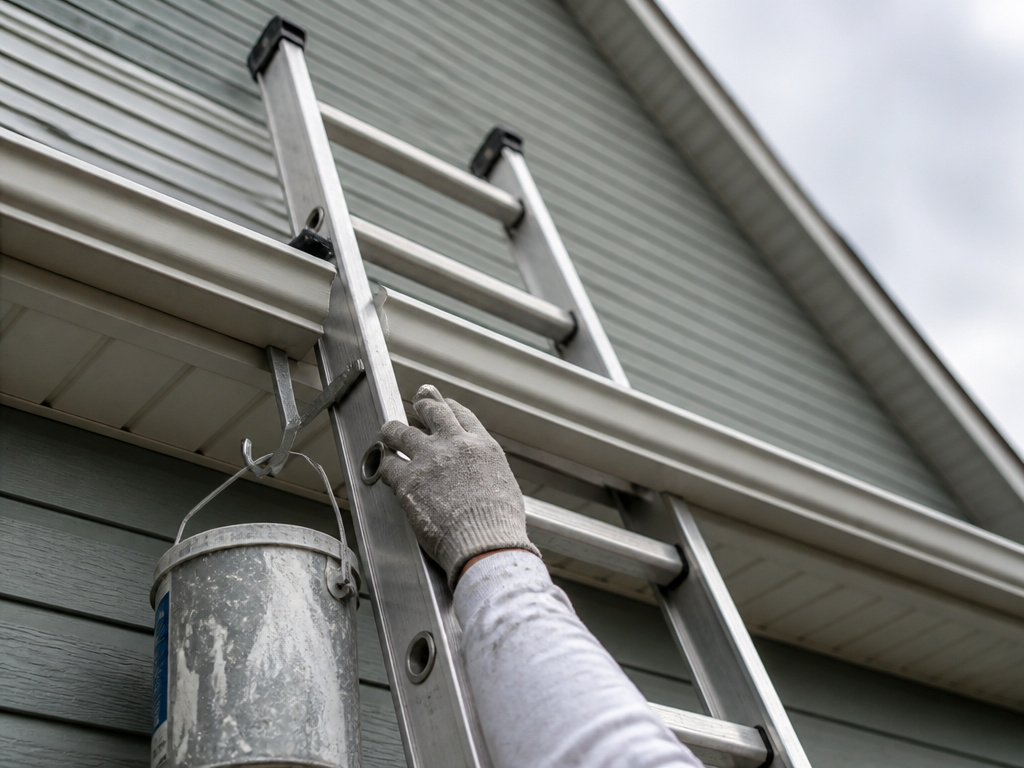
Twenty-eight feet is the number that keeps coming up, and it’s worth understanding why.
Wirecutter sizes a 28-foot extension ladder for a typical two-story house. At its most compact it’s just over 14 feet long, and fully extended it reaches roughly 25 feet. Because Wirecutter says you shouldn’t use the top three rungs as steps, and because three rungs need to extend past the roofline as a handhold, that ladder works with roofs about 21 feet high or less.
RIDGID’s numbers land in the same place from a different direction: a 28-foot ladder gives a maximum extended length of 25 feet, a maximum reach of 27 feet 9 inches, a working range to top support of 13 feet 6 inches to 24 feet, and an accessible roof height of 10 feet 6 inches to 21 feet.
Why 28 feet keeps showing up
Because the working range, not the nominal length, is what you actually use. The top of a 28-foot ladder is off-limits for standing, so the usable band sits well below the headline number.
Step up to a 32-foot model and you get 29 feet extended, a 31-foot-7 reach, and roof access from 12 feet 6 inches to 25 feet. If your eaves sit above 21 feet, that’s the jump you’re making.
| What you’re painting | Stepladder | Extension ladder |
|---|---|---|
| Interior ceiling, 8 to 9 ft | Yes, 6-ft model | No, it needs a wall |
| Interior stairwell | No, can’t be used on stairs | Yes, per Benjamin Moore |
| Multi-story exterior | No | Yes, available to 40 ft |
| Work above 17 ft | No | Yes, first choice |
| Roof edge access | No | Yes, 3 ft above the surface |
The Wirecutter best ladders review walks the same math and lands on the same class, which is a useful sign that the 28-foot figure isn’t marketing.
Three-section models store more compactly but run close to double the cost of two-section versions.
Measure the eave, not the peak.
Once you’re above two stories, stop shopping. Benjamin Moore points to planks or scaffolding for multi-level exterior work that needs a lot of tools or reaches past two stories, and that’s the same trade-off covered in scaffold vs ladder decisions for exterior work.
Which Duty Rating Should You Buy for Home Painting?
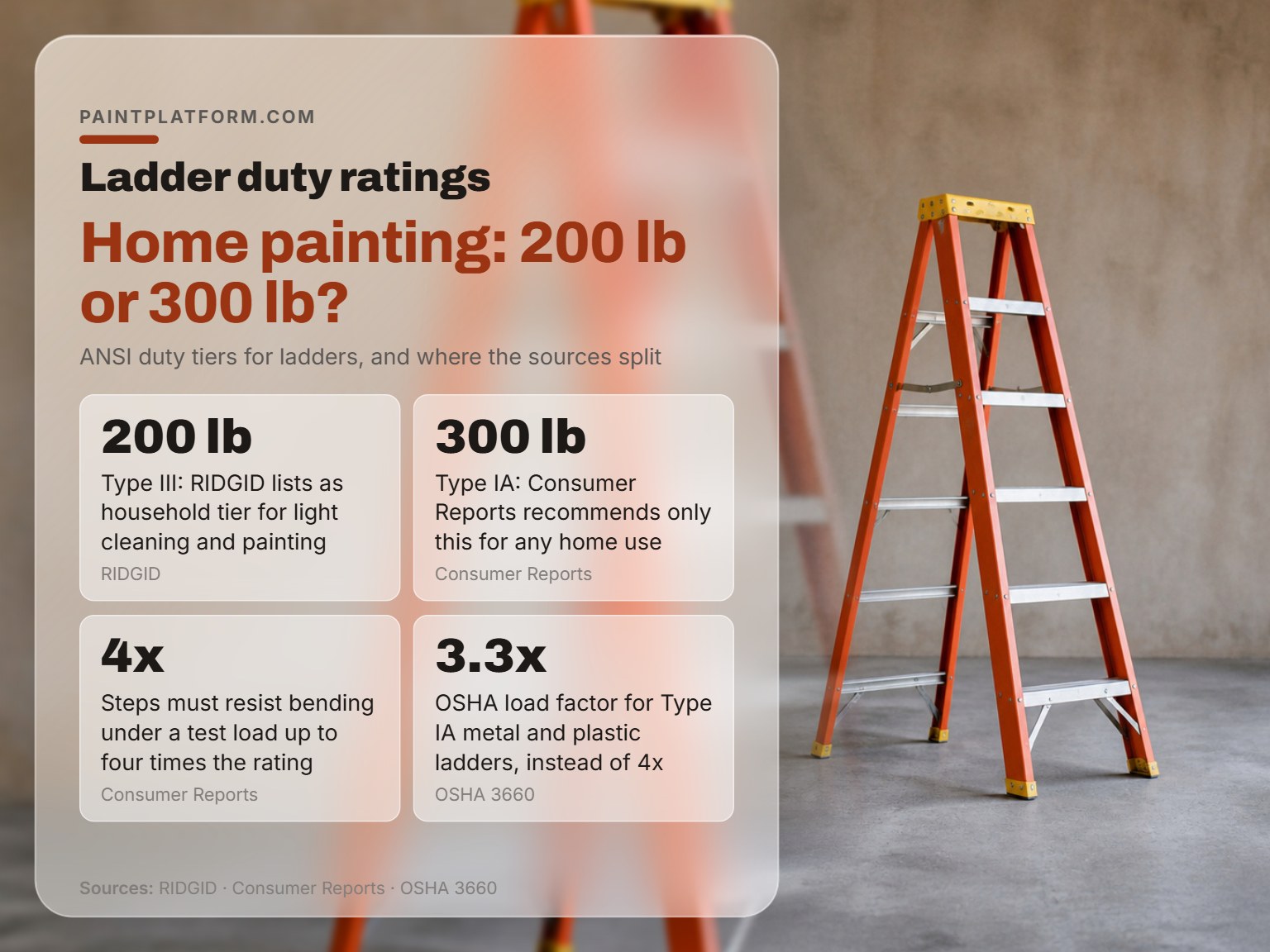
ANSI A14.2 and A14.5 set the duty tiers, and the tiers are where the sources split hardest.
Each figure is the maximum safe load including your body, your tools, and your materials. It’s a ceiling, like the max fill line on a pot. You don’t get better soup by filling it to the line.
| Type | Rated load | ANSI use class | Who says it’s for home use |
|---|---|---|---|
| III | 200 lb | Household, light duty | RIDGID lists light cleaning and painting |
| II | 225 lb | Commercial, medium duty | RIDGID lists general repair and painting |
| I | 250 lb | Industrial, heavy duty | Above typical home needs |
| IA | 300 lb | Professional, extra heavy | Consumer Reports recommends this for any home use |
| IAA | 375 lb | Professional, extra heavy | OSHA notes it traces to non-mandatory 2009 ANSI |
This is a genuine disagreement, not a rounding error. Consumer Reports recommends choosing only Type IA ladders for any home use, and argues all house ladders should be designed to meet that 300-pound standard. RIDGID’s own selection guide still lists Type III, at 200 pounds, as the household tier for light cleaning and painting.
Both positions are defensible. Consumer Reports’ conservative answer is Type IA, while RIDGID lists Type III as the household tier; Type IA is the one I’d take for a ladder you’ll keep for years.
A ladder rated 200 pounds doesn’t feel different underfoot at 190. That’s the problem. There’s no feedback, no creak, no warning, just a step that’s closer to its limit than you think.
Easy to miss: The rating covers you plus tools plus paint, not you alone. A 200-pound-rated ladder and a 190-pound painter carrying a gallon of paint are already over the line before the brush comes out.
The load-test math is where the two sources diverge again. Consumer Reports states that to meet the ANSI standard, a ladder’s steps must resist bending under a test load up to four times its weight rating. OSHA requires a ladder to sustain four times the maximum intended load, except Type IA metal and plastic ladders, which must sustain 3.3 times.
The ladder safety arithmetic is simple enough to do in a store aisle: add your weight, your tools, and the paint, then buy a tier above the total.
Setup, Inspection, and the Rung Rules the Sources Disagree On
Two credible sources give you different answers about which rungs are safe, and neither one is lying.
Benjamin Moore’s guide says many ladder manufacturers state that every rung below the fourth-highest is considered safe to stand on. Wirecutter says you should not use the top three rungs of an extension ladder as steps. The Massachusetts alert says don’t work from the top three rungs of an extension ladder or from the top or top step of a stepladder.
Read them together and the shape is clear even though the counts don’t match. Stay low, keep a handhold above you, and treat the top of any ladder as structure rather than floor.
The ACCC Product Safety ladders guide is worth a look precisely because its numbers differ. That tells you the rung rule is a convention, not a law of physics.
Setting the feet at the right angle
Four sources, four phrasings, one geometry. OSHA says the base should sit one-quarter of the working length from the wall. Massachusetts says one foot out for every four feet of ladder height. RIDGID assumes 75 1/2 degrees. Bob Vila says a straight or extension ladder should slope at 75 degrees.
Those all describe essentially the same geometry. Pick whichever phrasing you can remember and check it with your arm: stand at the base with your fingertips on the ladder at shoulder height and your arm straight out.
Before you start: Composite decking is a documented slip-out surface, so set the feet on firm, flat ground and tie the top off. Keep your belt buckle centered between the rails while you climb and while you paint. Aluminum rails conduct electricity, so keep aluminum away from service drops and live fixtures and use fiberglass instead.
Here’s the setup order that covers what all four sources ask for.
- Set the base one-quarter of the working length out from the wall, which is the same as one foot out per four feet of height. Skip it and the feet creep while you’re up.
- Extend the top three feet above the roof edge or work surface (OSHA, Consumer Reports, Massachusetts) or secure the ladder so it can’t move, though Benjamin Moore notes contractors consider 8 to 10 feet above the highest paint area best practice. An unsecured ladder on composite decking is the exact scenario in the 18-foot Massachusetts fall.
- Lock the spreaders on a stepladder and confirm the A-frame is fully open. A stepladder used half-open folds under load, and there’s no recovery from that.
- Face the ladder, keep three points of contact, and carry tools in a belt or hoist them. The 2.5-gallon bucket case is the reason this rule exists.
- Inspect before you climb, every time, not once a season.
The inspection list from Consumer Reports is short and worth memorizing:
- Aluminum: no loose rivets, dents, or bent parts.
- Fiberglass: no cracks, chips, or missing parts.
- Extension ladders: check hinges or locks for wear and the lanyard for fraying.
- Hinges, reinforcing rods, and bolts: tightened, but not over tightened.
- Any defect at all: tag it “Do not use” and get it out of the rotation.
The OSHA extension ladder fact sheet puts the 3-foot overhang, the quarter-length base, and the nonconductive-rail requirement on a single page.
Where this goes sideways: Chasing the roofline number without deciding which number you’re following. OSHA, Consumer Reports, and Massachusetts all say 3 feet above the surface. Benjamin Moore says contractors consider 8 to 10 feet above the highest paint area best practice. Three feet keeps you legal and safe for access; the extra length buys you a comfortable working band for a long exterior job.
If standing on a rung for an hour is the actual problem, a platform ladder puts a 12-by-19-inch deck under your feet and tops out around 14 feet.
The Gear That Keeps Your Hands Free
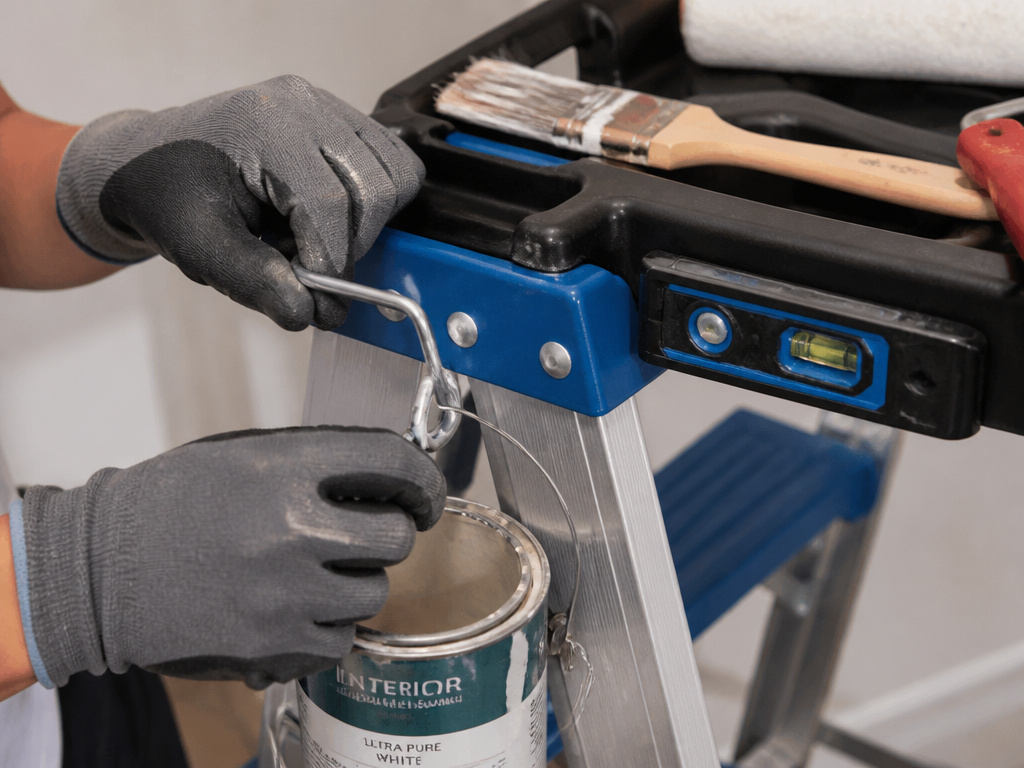
Three things turn a ladder from a perch into a work station: a shelf, a hook, and a belt.
This is the most underrated purchase in the whole category. Benjamin Moore’s guide lists a tool tray, an automatic pail shelf, and slip-resistant steps among the features worth paying for, and it’s right.
That covers a lot of stairwell and vaulted-ceiling work without dragging out an extension ladder.
For the awkward band between ladder heights, painting high walls without moving the ladder is mostly a pole problem. A paint extension pole buys you two or three feet of reach and saves a full reposition.
Two more things worth owning: a ladder hook for the paint can, and a small level you keep in the toolbox for checking the rails. Neither is glamorous. Both get used every job.
Frequently Asked Questions
Can you use a stepladder for exterior painting?
Yes, for low sections. A stepladder is self-supporting and works fine against a one-story wall as long as the feet sit on firm, flat ground. It stops being the right tool once the work goes above roughly 10 feet of reach, which is where a 6-foot model tops out.
How tall should an extension ladder be for a two-story house?
Wirecutter sizes it for a typical two-story house, and RIDGID’s table gives it an accessible roof height of 10 feet 6 inches to 21 feet. If your eaves sit above 21 feet, move up to the 32-foot class.
Is a 6-foot stepladder tall enough to paint a ceiling?
Usually, yes. RIDGID lists a 6-foot stepladder at 3 feet 9 inches of standing height and 10 feet 4 inches of maximum reach, which covers an 8-foot ceiling with room to work. Consumer Reports measured the standing height on 6-foot models at roughly 45 to 54 inches, so check the specific model.
Which is safer, a stepladder or an extension ladder?
Neither design is inherently safer; the setup is what fails. Consumer Reports found some 6-foot stepladders bent under a heavier step-strength test and that even stable models twisted enough for the feet to walk. Extension ladders fail differently, by slipping out when unsecured. Pick the type that fits the job, then set it up properly.
Do I need Type IA for home painting?
Consumer Reports recommends only Type IA, at 300 pounds, for any home use. RIDGID still lists Type III at 200 pounds as the household tier. Type IA is the conservative choice, and the rating covers your weight plus tools plus paint, not your weight alone.
The Bottom Line
Here’s the threshold I’d actually use. If the highest point you need to paint sits above 17 feet off the ground, stop shopping for stepladders entirely and start sizing extension ladders. Everything below that line is stepladder territory, and a 6-footer with a real spreader lock will handle it.
The first thing to do this week costs nothing. Take whatever ladder you already own, set it up outside, and check the feet, the locks, and the lanyard. If anything is bent, cracked, or frayed, tag it and stop using it. That’s the whole inspection.
One concession worth stating plainly: if your house is taller than 21 feet at the eave, the 28-foot class stops working and you’re into 32-foot territory or scaffolding. That changes the decision more than any brand comparison will.
Fair warning: a ladder is the one painting purchase where the failure mode is a hospital visit rather than a ruined canvas. Buy the tier above what you think you need.
