
How to Choose a Ladder Height: The Reach Rule
This post contains affiliate links. As an Amazon Associate, we earn from qualifying purchases.
To choose a ladder height, work backward from the highest point you need to touch, then add what the standards call for: 3 feet of extension above a roof landing, or a stepladder tall enough that the top cap stays empty. The number on the box is the ladder’s length. Its reach is shorter.
That gap between the label and the reach is where painting afternoons go sideways, usually as a stretched arm and a roller that quits six inches short of the ceiling line. Extension ladders make it worse, because the sections overlap and the ladder shrinks as it climbs. Knowing how to choose a ladder height means accounting for that overlap. OCWR’s fast facts put a 24-foot two-section ladder at 21 feet of extended length.
What follows is the sizing math for both ladder families, the duty rating that decides what you can stand on, and the two places where the regulators genuinely disagree about how much ladder belongs above the roof.
Key Takeaways
- Match the ladder to the highest point it touches, not to the height of the building. OCWR pairs a 20-foot ladder with a touch height of 9 to 13 feet.
- A 20-foot extension ladder is 17 feet of ladder. Overlap eats the rest, so the label overstates what you actually get.
- Type III at 200 lb is the floor, and the rating must cover your weight plus the tools and equipment you carry. Add your weight, a gallon, and a tray, and check that the combined load stays under the rating.
- Set the feet 1 foot out for every 4 feet of height. OSHA, OCWR, and Washington L&I all land on the same angle, described three ways.
- Leave at least 3 feet of ladder above a roof landing. OSHA and LANL say 3 feet, OCWR says a minimum of 3 feet and a maximum of 4 feet, and Washington L&I accepts less only if you secure the top and add hand holds.
Why a 20-Foot Ladder Is Really 17 Feet
Los Alamos National Laboratory’s ladder safety manual states it flatly: a 20-foot extension ladder is physically 17 feet long.
Multi-section extension ladders lose usable length to overlap. OCWR guidance requires at least 3 feet of overlap per section for ladders up to 36 feet, and 4 feet for ladders 40 feet and longer, so a 24-foot two-section ladder reaches a maximum extended length of 21 feet.
Overlap is structure. It’s the joint that keeps the upper section from folding when your weight lands on it, which is why the requirement gets stricter as ladders get longer.
OCWR’s own numbers wobble here, and it’s worth saying so out loud. The same page asks for 3 feet of overlap on ladders up to 36 feet. It also calculates a 24-foot ladder at 1.5 feet of overlap at maximum extension, which is how it arrives at 21 feet. LANL goes with a flat 3-foot minimum. Cite whichever you like. They don’t reconcile.
What Overlap Costs You in Reach
The how to choose a ladder height gap between the label and the reach is the whole reason people over-buy.
| Ladder length | Maximum reach | Highest point it will touch |
|---|---|---|
| 16 ft | 15 ft | 9 ft max |
| 20 ft | 19 ft | 9 to 13 ft |
| 24 ft | 23 ft | 13 to 17 ft |
| 28 ft | 27 ft | 17 to 21 ft |
| 32 ft | 31 ft | 21 to 25 ft |
| 40 ft | 37 ft | 28 to 31 ft |
Read the third column, not the first. A 24-foot ladder is the right pick when the highest thing you need to touch sits between 13 and 17 feet, which covers most two-story walls and a fair number of vaulted ceilings. Reach past that and you’re hauling extra weight up a driveway for nothing.
If you’re still deciding between the two families, the step ladder vs. Extension ladder comparison is the place to start.
The rung locks tell you whether the setup is honest. A seated dog makes one clean click. A scrape followed by a rattle means the two locks are on different rungs, and you’ll feel the ladder shift the moment you commit your weight. The OCWR extension ladder fast facts spell out the overlap and inspection rules on a single page.
Try this before you buy: stand where the feet will go and hold a tape to the wall. If the number is 14 feet, you need a 24-footer, not a 28.
The 4:1 Rule, the Quarter-Length Rule, and the 75.5-Degree Rule
Three regulators describe the same angle three ways, and once that clicks the setup stops feeling like guesswork.
OSHA’s construction fact sheet asks for a 4:1 ratio, meaning 1 foot out from the wall for every 4 feet of height. Washington L&I phrases it as a horizontal distance of about one quarter of the ladder’s working length. It adds a tighter 1/8 rule for job-made ladders with spliced side rails. LANL states the same angle as 75.5 degrees, which works out to a 5-foot base for a 20-foot height.
Same angle. Three vocabularies. If you cite one and someone else cites another, you’ll both be right and neither of you will sound like it.
One pace out for every four up. If you can’t hold that, move the ladder instead of stretching.
The angle matters because of load direction. Too steep and your weight pulls the feet toward the wall. Too shallow and the feet want to slide out from under you. There’s a middle where the force runs down the rails instead of sideways through them.
For a painting job, the practical check is where your hips sit relative to the rails. Hanging backward means you’re too steep. Leaning in means you’re too shallow.
The safe ladder setup checklist covers the rest of the placement rules. The Washington L&I ladder safety guide is the cleanest free version of the angle language if you want to read it in the original.
How Do You Size a Stepladder for a Ceiling Line?
Measure to the ceiling, subtract the reach your body adds, then pick the ladder whose standing height clears the difference. LANL’s table does that arithmetic for a 5-foot-6-inch person with a 12-foot vertical reach.
A 3-foot stepladder puts your feet 11 inches off the floor and your hands at about 7 feet. An 8-foot ladder puts your feet at 5 feet 8 inches and your hands at 12 feet. A 16-footer puts your feet at 13 feet 4 inches and your hands at 20.
Notice that the standing height always sits well below the ladder’s nominal size. That’s the top cap rule doing its work.
Before you start: Two things on a stepladder will hurt you before you notice them. The top cap and the top step are not load-bearing, per OSHA’s stepladder fact sheet and Washington L&I, so the highest safe standing point is one step down. And the spreader bars have to be down and locked before you climb; a half-open stepladder folds the moment your weight shifts sideways.
The Top Cap Is Not a Step
Both OSHA and Washington L&I say it directly. OSHA’s stepladder fact sheet lists “use the top step or cap as a step” among its hazards, and L&I adds the bucket or pail shelf to the same list.
That matters for how to choose a ladder height because the top step is usually the one that makes the ladder “reach” the ceiling in your head. Take it out of the math and you’re often a full size short. The step ladder sizing numbers only make sense once you subtract that step, which is why the label always looks generous.
Sizing a Stepladder in Four Steps
- Measure floor to the highest point you need to touch. For a ceiling cut-in, that’s the ceiling line, not the crown molding. Skip this and you’ll size to the room instead of the work.
- Subtract about 6 feet. That’s the reach LANL credits above standing height for a 5-foot-6-inch person with a 12-foot vertical reach. Guess at this step and you’ll buy a ladder that leaves you stretching on the last six inches.
- Pick the ladder whose standing height meets or beats the number. If you land between sizes, go up one. Skipping this is how people end up on the top cap.
- Check the duty rating against your combined weight, including paint, tray, and tools. More on that below.
For interior ceilings, a platform ladder working height is often the better answer than a taller A-frame, because the platform gives you somewhere to set a tray down.
Which Duty Rating Do You Actually Need?
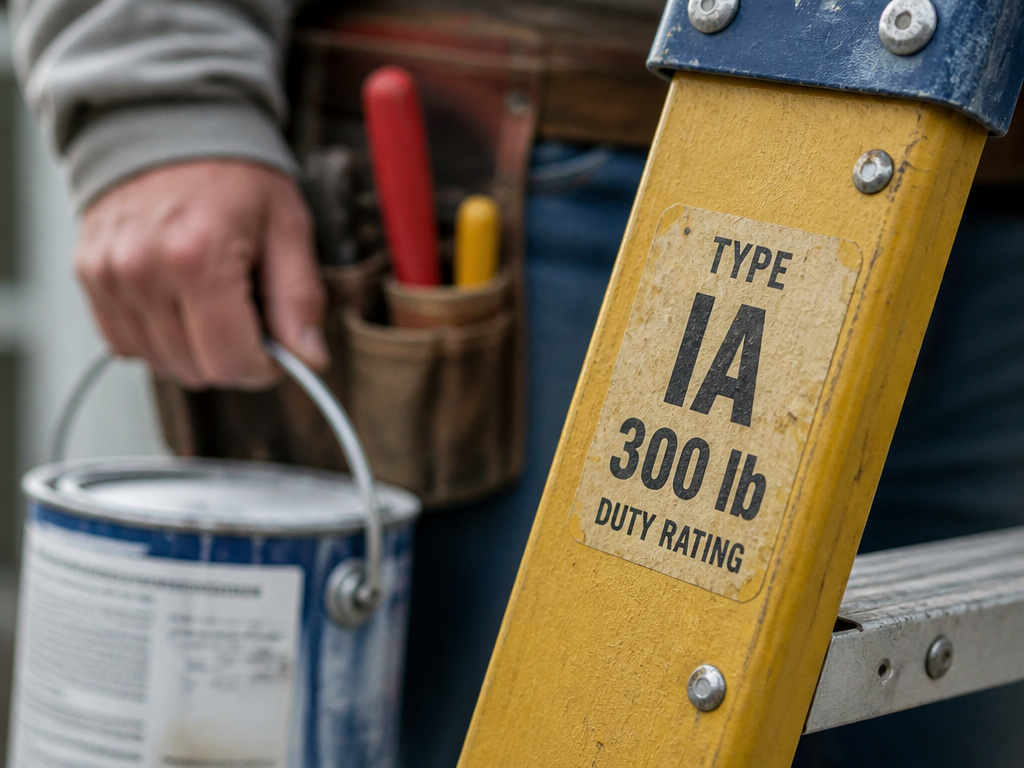
Duty rating is the number on the label that people skip past, and it’s the one that decides whether the ladder holds.
The five ANSI categories, as listed in OSHA’s fact sheet:
- Type III, 200 lb is light duty household. A bare ladder, a bucket, and a careful adult.
- Type II, 225 lb is medium duty commercial.
- Type I, 250 lb is heavy duty industrial.
- Type IA, 300 lb is extra duty industrial, and it’s the sensible floor for anyone carrying paint up with them.
- Type IAA, 375 lb is special duty, rugged.
The ratings are a load limit with real weight behind them. OSHA says plainly that you don’t exceed the ladder’s maximum load rating, and OCWR points out that the limit has to cover you plus the tools and equipment going up and down.
Where this goes sideways: People add up their own weight and stop there. A gallon of paint, a tray, a roller, and a tool belt add to the load, and the rating must cover your weight plus the tools and equipment you carry. The failure mode is a bent rail that never quite sits flat again.
LANL’s training material takes the stricter view. It puts a 275 lb load at a minimum Type IA, which is rated 300 lb. OSHA’s own guidance is narrower: stay under the rating printed on the label. Both are defensible. I’d follow the LANL version if you’re carrying anything up with you.
For a painting setup, a fiberglass stepladder in Type IA covers almost every interior job.
The types of ladders rundown covers which family suits which job, if the duty rating question is settled and the shape question isn’t.
How Much Ladder Should Stick Up Past the Roof?
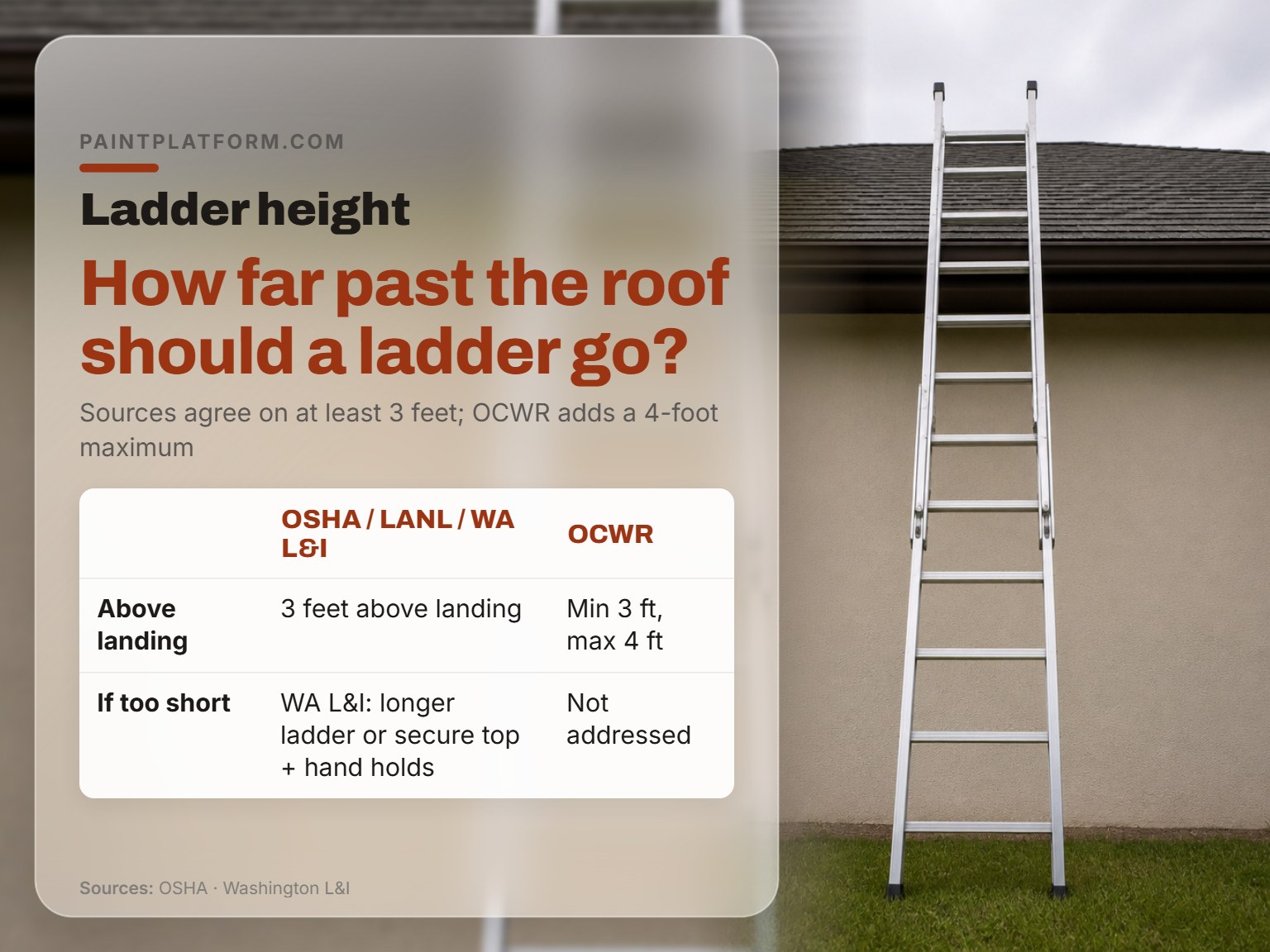
Three feet is the answer most sources give, but they disagree on the details worth knowing.
| Source | How far above the landing | What to do if you can’t get there |
|---|---|---|
| OSHA 3660 | 3 feet above the landing | Not addressed |
| OCWR | Minimum 3 feet, maximum 4 feet | Not addressed |
| Washington L&I | At least 3 feet beyond the support | Get a longer ladder, or secure the top and add hand holds |
| LANL | 3 feet above the roof | Not addressed |
OSHA, LANL, and Washington L&I land on at least 3 feet, OCWR adds a ceiling of 4 feet, and Washington L&I is the only one that gives you a fallback when the ladder is too short to comply.
The reason for the number is grip. You need something above the landing to hold while you step off, and 3 feet puts a rail near chest height when you’re standing at the top. Trim it to a foot and you’re climbing over the top of your own ladder with nothing to grab.
The OSHA extension ladder safety fact sheet is where the 3-foot figure comes from, and it’s short enough to read in one sitting.
Try this: if your ladder tops out 2 feet above the roof instead of 3, don’t climb it and hope. Rent one size up, or follow Washington L&I’s fallback and secure the top with hand holds before you go near it.
Where a Shorter Ladder Beats a Longer One
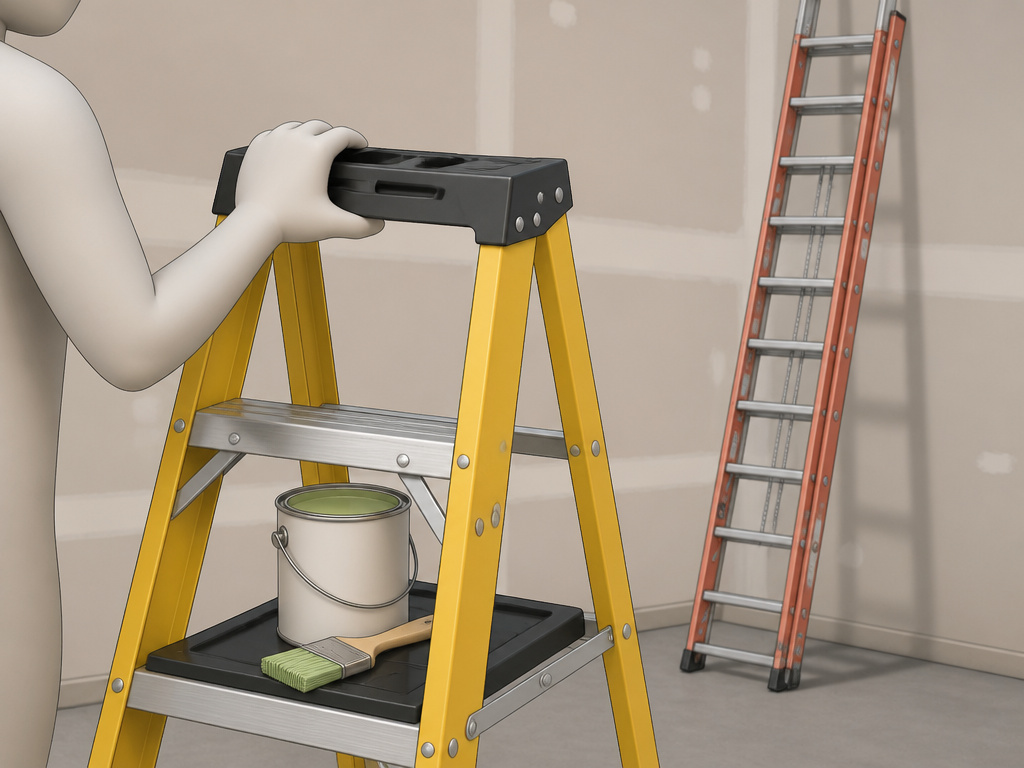
The instinct is to buy one ladder that covers everything, and that instinct is how a 28-footer ends up in a garage serving a 10-foot wall.
LANL’s rule of thumb says pick an extension ladder 7 to 10 feet longer than the highest support point, while OCWR’s table matches the ladder to the highest point it will touch. Those two rules disagree at the edges, and the disagreement matters most for painters, because the highest point you need to touch is usually a wall, not a roofline.
Say you’re cutting in the top of a two-story stairwell wall. The wall goes to 17 feet. The ladder leans against that wall, so the support point and the work point are the same, and a 24-footer is right.
Now say you’re painting a gable end where the wall peaks at 17 feet but you’re only working the bottom 12. The ladder still leans at 17, but you’re standing on rung four all afternoon, which is its own kind of miserable.
That’s the case for owning two ladders instead of one heroic one:
- An 8-foot fiberglass stepladder covers ceilings, trim, cabinet work, and the inside of a closet.
- A 24-foot extension handles two-story walls and anything above a porch roof.
- Rental, for the gable end you’ll paint once.
Fiberglass rails have a chalky, dry feel in the hand. Aluminum goes slick and cold in a January garage, which is one more reason the fiberglass ladder gets carried inside where it actually gets used.
I’d rather own a stepladder I trust and rent the tall one twice a year. A ladder you can carry with one hand gets used. A tall ladder that lives against the garage wall gets avoided until you do something stupid on a chair.
Multi-position ladders sit in the middle and I’ve never loved them for this. Multi-position ladders are clever. For a homeowner painting two rooms a year, the extra joints add weight and setup time.
If the job is genuinely overhead, reaching high ceilings is a different problem with different tools. Painting high ceilings safely comes down to extension poles and moving the ladder more often than you want to.
State plans publish their own portable ladder guidance, and the Oregon OSHA portable ladder guide is one example worth having on hand.
Frequently Asked Questions
Is a 6-foot stepladder tall enough for an 8-foot ceiling?
Usually yes, if you stay off the top cap. LANL’s table credits a 5-foot-6-inch person with 6 feet or a little more of reach above standing height, so a 6-footer puts your hands close to 10 feet. An 8-foot ladder is the safer published number, since LANL lists it explicitly at 5 feet 8 inches of standing height and 12 feet of reach. Measure your own reach before you commit.
Does ladder height include the part that overlaps?
No. The label is the sum of the section lengths, and the sections have to overlap to be safe. OCWR’s own example takes a 24-foot two-section ladder down to 21 feet of maximum extended length, and LANL states that a 20-foot extension ladder is physically 17 feet long. Buy by the reach you need, not the number on the box.
Can I use a stepladder as a straight ladder to reach a roof?
No, and both OSHA and Washington L&I say so directly. OSHA’s stepladder fact sheet lists using a folded stepladder as a single ladder among its hazards, and L&I carries the same rule. The rear rails and spreader aren’t built for that load path.
How do I know my ladder is too short before I climb?
Set it up and look at where the top lands. For roof access you want at least 3 feet of rail above the landing, per OSHA and LANL, while OCWR caps it at 4 feet and Washington L&I allows a fallback of securing the top and adding hand holds. For a wall you’re painting, you want the top of the ladder at or just above the highest point you’ll touch, so you’re not reaching sideways. If either number is short, move the ladder or get a longer one.
What is the difference between working height and reach height?
Working height is where your feet are. Reach height is where your hands get to. LANL’s stepladder table lists both, and LANL’s stepladder table lists both, and the gap between them depends on the ladder and the person’s reach. Sizing off the label alone confuses the two, which is how people end up on the top cap reaching for a ceiling they can’t quite touch.
The Bottom Line
If you take one number away, take the 3-foot minimum. OSHA and LANL say 3 feet of rail above a roof landing, OCWR caps it at 4 feet, and Washington L&I’s fallback if you can’t get 3 feet is to secure the top and add hand holds. Everything else here is sizing arithmetic around that anchor.
The concession: none of this holds if your ground isn’t level. A ladder on soft grass, a sloped driveway, or a drop cloth folded three times will slide no matter how perfect your 4:1 angle is. Fix the footing first.
The first thing to do this week is boring and takes four minutes. Measure the highest point you actually need to touch on your next painting job, subtract 6 feet, and see which ladder that points to. If the answer is a ladder you don’t own, you’ve just saved yourself an afternoon of stretching.
