
What Is Titanium Dioxide in Paint? The White That Hides
This post contains affiliate links. As an Amazon Associate, we earn from qualifying purchases.
Titanium dioxide in paint is the white pigment that scatters light to give a coating its brightness and hiding power. It appears in almost all paints, and typical additions run from 0.5 to 2.5 lb/gal of formula.
That hiding comes from physics. Light entering the film hits particles with a high refractive index and bounces around inside the coating until nothing underneath shows through. A 2020 review on optimizing titanium dioxide pigment performance puts brightness and opacity as the primary role, and notes the effect depends heavily on formulation and on how the paint is made. This is what is titanium dioxide in paint: the pigment behind that hiding.
What follows: the two manufacturing routes, the four grade categories, the tests that measure how much pigment sits in the can, and the durability catch that runs in both directions.
Key Takeaways
- Brightness and opacity are the main job. Durability is a secondary role, and mostly in exterior paints.
- Typical loadings land between 0.5 and 2.5 lb/gal, per DuPont’s technical paper.
- Rutile is the form used in almost all coatings. The chloride process produces it directly.
- TiO2 absorbs UV and shields the resin, but radicals at the pigment-resin interface can offset that.
- Chloride pigments generally read whiter on L and less yellow on b.
Where Titanium Dioxide Sits in the Paint Can
A can of paint holds four things. The four components of paint are binder, pigment, solvent, and additives, and TiO2 sits in the pigment slot.
Titanium dioxide is a finely divided white powder that resists reaction with most chemicals. Its ability to scatter light, compared with extenders such as clay and calcium carbonate, makes it the pigment of choice for coatings that need opacity and high hiding power. Typical additions run from 0.5 to 2.5 lb/gal.
Pigment is a broad category, though. The paint pigments umbrella covers everything from TiO2 to iron oxides and carbon black, and each one behaves differently once the film dries.
What separates TiO2, the what is titanium dioxide in paint pigment, is that it hides by scattering rather than by absorbing. A pigment that hides by absorbing light also drags the film darker. TiO2 throws light back out, so the coating stays bright while it covers.
How Does Titanium Dioxide Actually Hide What’s Underneath?
It scatters. A TiO2 particle has a far higher refractive index than the resin around it, so light bends hard at every particle surface and gets redirected back out of the film.
DuPont’s paper reduces the measurement to Optical Density = Hiding Power = S + K, where S is the scattering coefficient and K is absorption. TiO2 does almost all of its work through S, which is why brightness survives the hiding.
The scattering coefficient itself, the what is titanium dioxide in paint core, depends on three things: the crystal’s refractive index, the purity of the pigment, and particle morphology. Purity here means the actual TiO2 content, which drops as surface oxide dilution increases.
There’s a standard lab check for it. An optical density test measures transmitted light through a TiO2 suspension at 20 ppm, dilute enough that the particles act independently of each other.
That’s the logic behind paint hiding power in general: more scattering per unit weight means less pigment needed to cover a surface.
If a white covers in one coat, the scattering is working. If it takes several coats, check loading and dispersion before you blame the powder.
Sulfate vs Chloride: Two Routes to the Same White Powder
Every TiO2 pigment on the market comes out of one of two commercial processes. The sulfate process is the older one, dating to the early 1900s. The chloride process was pioneered by DuPont in the early 1950s.
The natural product differs between them. Sulfate gives anatase. Chloride gives rutile. Seed the sulfate route with rutile crystals and it can produce rutile as well, which is why crystal form alone doesn’t tell you which process made a grade.
| Route | Natural crystal form | Notes |
|---|---|---|
| Sulfate process | Anatase | Older route, dates to the early 1900s |
| Chloride process | Rutile | Pioneered by DuPont in the early 1950s |
| Sulfate with rutile seeds | Rutile | Same process, different crystal outcome |
For almost all coatings applications, the rutile form is what gets used, so the chloride route is the default for most commercial white pigment.
Why Chloride Pigments Read Whiter
As a general rule, chloride pigments carry a higher whiteness level on L and are less yellow on b. Both are color measurements: L tracks lightness, b tracks the yellow-to-blue axis. Neither one tells you how well the pigment disperses, which is a separate question.
What the Sulfate Route Still Gets You
Anatase. That’s the natural output of the older process, and it’s a real distinction rather than a marketing one. When a spec sheet names anatase, the sulfate route is the usual explanation.
The Four Grade Categories, and Where the Label Stops Helping
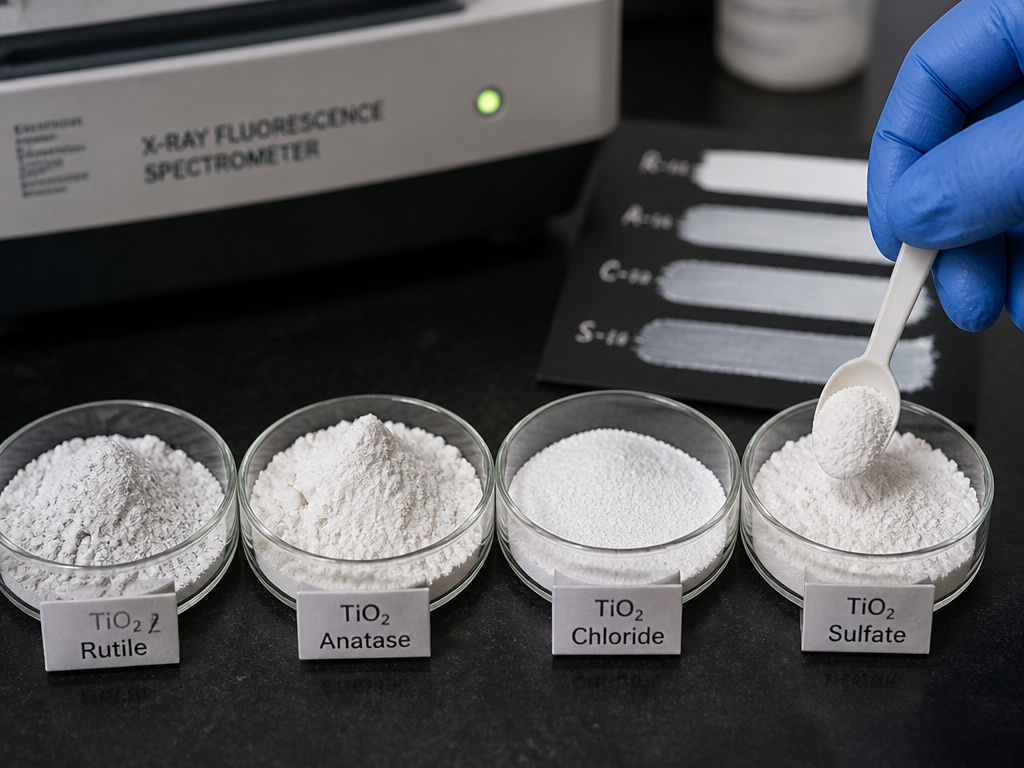
Four. That’s how many categories DuPont’s technical paper sorts TiO2 grades into, and X-ray fluorescence is usually a good way to determine the intended application for the grade.
The paper doesn’t stop at the count. It also notes that grades differ by design and by manufacturing process, which means two pigments with the same crystal form can still behave differently in a can.
Here’s where it gets murky. DuPont’s 2008 paper describes four categories. ISO 591-1:2000 pigment specifications is the current international standard for titanium dioxide pigments for paints, and the material behind this article doesn’t spell out how the ISO scheme maps onto the older four-category framing. Treat the two as related but not interchangeable.
What actually changes between grades comes down to a short list:
- Crystal form. Anatase or rutile, which sets the refractive index baseline.
- Purity. The actual TiO2 content, which falls as surface oxide dilution rises.
- Particle morphology. The size distribution of the underlying particles.
- Process. Sulfate or chloride, which shapes color as measured on L and b.
Common mistake: Reading a TiO2 percentage as a quality score. Brightness and opacity depend on formulation and process as much as on how much pigment is in the can.
A heavily loaded white can read flat and slightly chalky, and it may drag a little under the brush.
Why TiO2 Cuts Both Ways on Durability
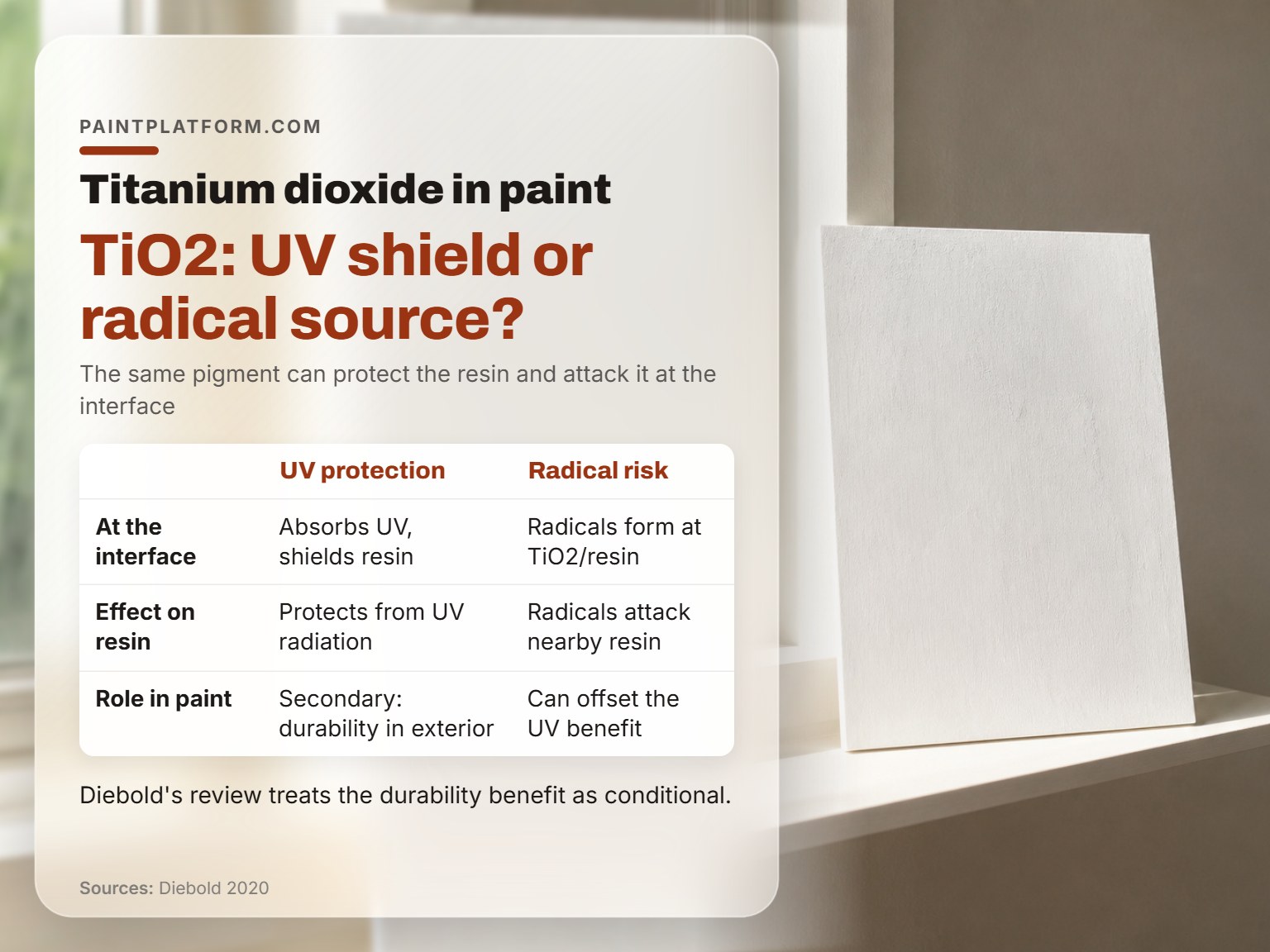
The same pigment that protects a coating can also attack it. TiO2 is an excellent absorber of UV light, and that absorption shields the resin underneath from radiation that would otherwise break it down.
Diebold’s review treats the benefit as conditional. The UV protection can be offset by the formation of radicals at the TiO2/resin interface, right where the pigment and the paint binder meet.
The Radical Problem in Plain Terms
A radical is a reactive fragment with an unpaired electron. When one forms at that boundary, it goes after the resin sitting next to it. Over time that can show up as degradation of the resin.
I once left a white test board on a south-facing windowsill.
How Do You Measure TiO2 Content in a Can of Paint?
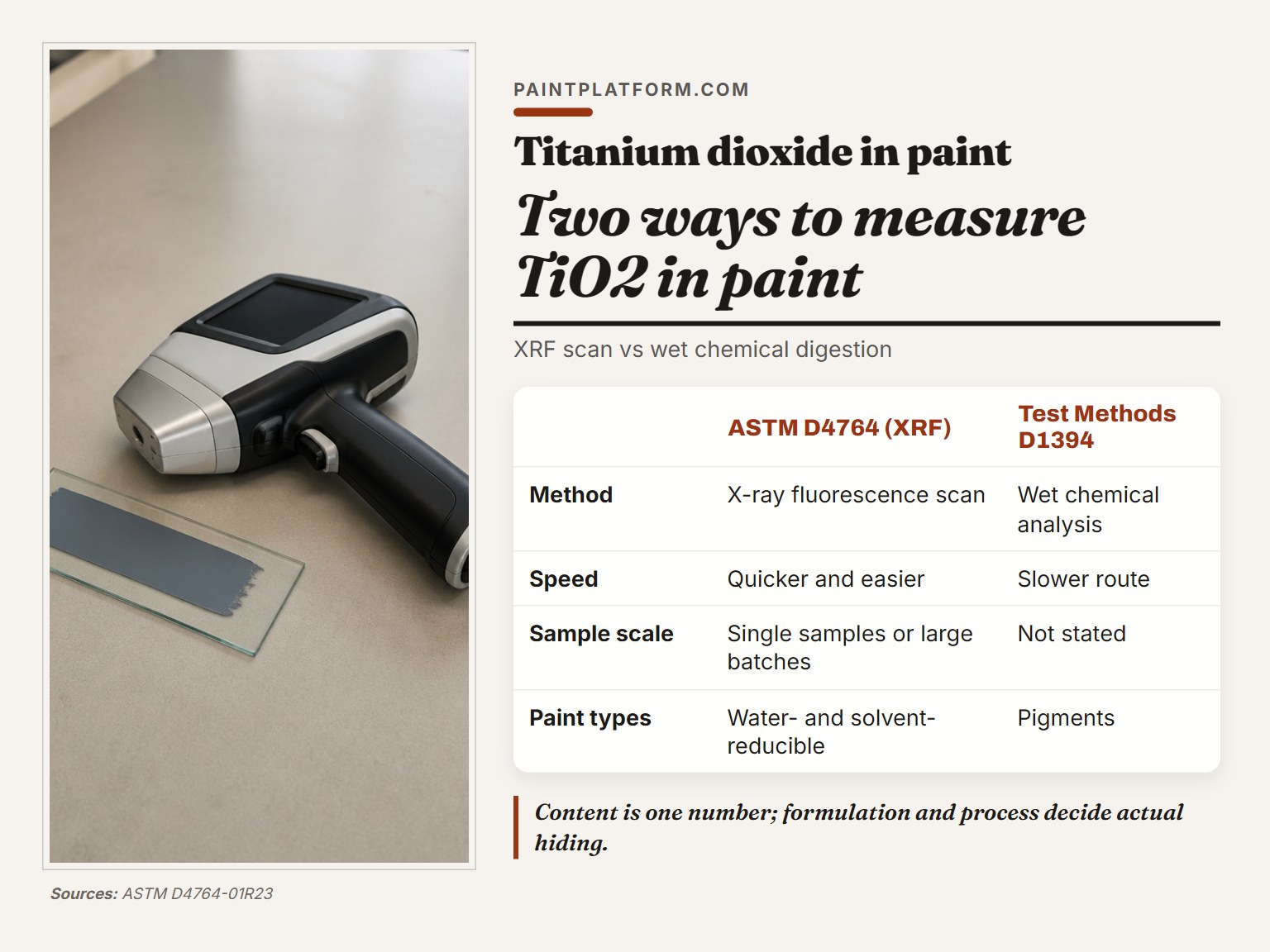
Two routes exist: a wet chemical digestion or an X-ray fluorescence scan. The ASTM D4764 TiO2 content test method is the XRF route, and it covers liquid paint in both water-reducible and solvent-reducible systems.
ASTM positions it as the quicker, easier option next to Test Methods D1394, the wet chemical analysis method for pigments.
| Method or standard | What it covers | Practical note |
|---|---|---|
| ASTM D4764 | TiO2 content in liquid paint by XRF | Works on single samples or large batches |
| Test Methods D1394 | Wet chemical pigment analysis | Slower route to the same question |
| Optical density test | Hiding power potential at 20 ppm | Yields S + K for the grade |
| ISO 591-1:2000 | Specifications and test methods, Part 1 | The international reference point |
What D4764 gives you over the wet method:
- Only a single, relatively stable reagent needs storing.
- Drawdown specimens used as standards can be stored indefinitely and reused.
- It scales from one sample to a full batch without extra fuss.
None of this tells you how the paint will look on a wall. Content is one number, and Diebold’s point holds: formulation and process decide how much of that content turns into actual hiding.
What This Means at the Easel
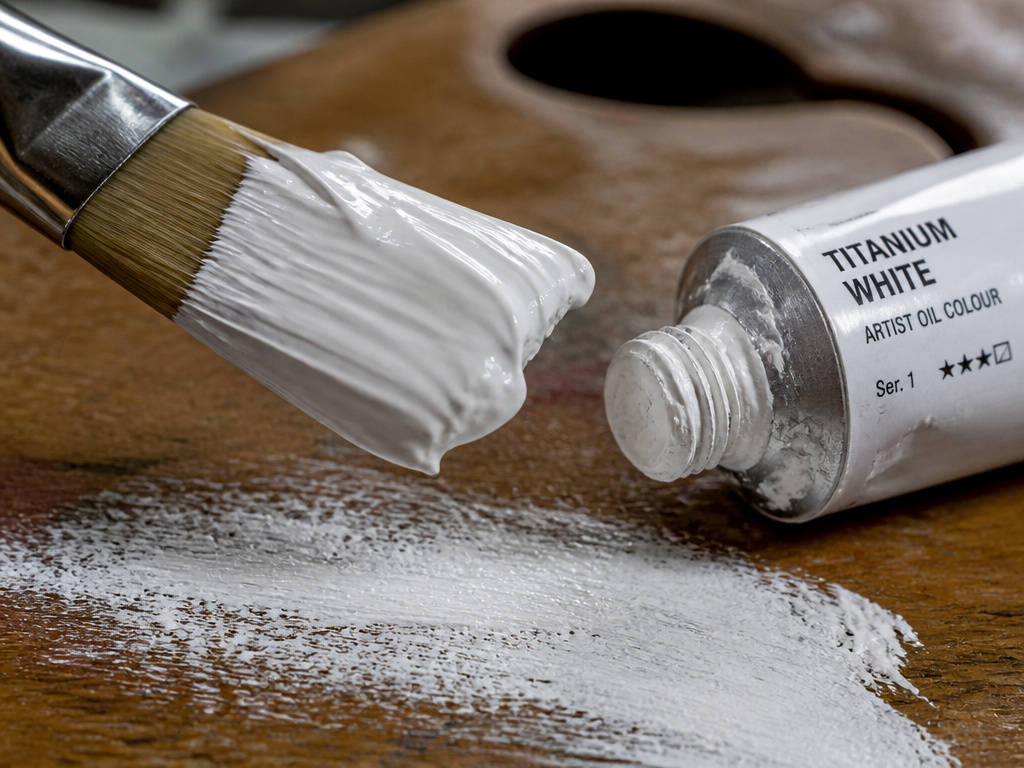
Artist titanium whites are the same family of pigment, sold in tubes instead of totes.
A poorly dispersed white can leave streaks and speckles, and medium won’t fix that once it’s on the panel.
Which Titanium White I Actually Reach For
A heavy-body titanium white is the one I keep buying.
A student-grade titanium white is the tube I hand to someone starting out, because
Artist-grade whites are worth the step up if you work in oils and care about how the paint sits on the brush.
Easy to miss:
None of that is a health answer. If you’re worried about what comes off the film, paint safety is a separate question from what the pigment does optically, and VOCs in paint covers the solvent side of the can. For the regulatory and exposure side, the government report on titanium dioxide is the reference to check.
Frequently Asked Questions
What does titanium dioxide do in paint?
It provides brightness and opacity. That’s the primary role, according to a 2020 review in the Journal of Coatings Technology and Research. In many exterior paints it also plays a secondary role in durability.
Is titanium dioxide in paint dangerous?
That’s an exposure and regulatory question, and it sits outside what this article can settle. The answer depends on the form of the material and on where you live. What the pigment does in a dried film is a separate topic from the health discussion.
Why is rutile used instead of anatase?
For almost all coatings applications, the rutile form is used. It’s the natural product of the chloride process, and seeding the sulfate process with rutile crystals lets that route produce rutile too.
How much titanium dioxide goes into a paint?
DuPont’s technical paper gives a typical range of 0.5 to 2.5 lb/gal. The exact figure depends on the coating type and on what else is in the formula.
Does more titanium dioxide mean better coverage?
Not in any simple way. The effectiveness of TiO2 as a brightener or opacifier is greatly affected by the formulation and by the paint making process, so content alone doesn’t predict performance.
