
What Is Paint Made of? Four Parts, Three Opinions
This post contains affiliate links. As an Amazon Associate, we earn from qualifying purchases.
Paint is made of pigment, a resin binder, a carrier, and additives. That four-part count is the common one, though a federal coatings manual lists three basic components and NIST’s paint model tracks four by mass. The binder sets how the film behaves; the carrier only gets it onto the wall.
The carrier has one job: keep the solids suspended long enough to spread, then leave, which is the short answer to what is paint made of. Water does that in latex, with a glycol or glycol ether riding along to help the polymer particles merge before both evaporate.
What follows is the parts list, what each part does to the finished film, and the numbers behind a generic can of wall paint.
Key Takeaways
- Resin is 25 percent of a generic latex paint by mass, and water is 50 percent, per NIST’s paint model.
- Three credible references count the components differently: four (Benjamin Moore), three (Bureau of Reclamation), four by mass (NIST).
- Solvent-free coatings exist, so the “every paint has a solvent” rule has an exception built in.
- Freezing can ruin latex paint, and thinning a cold can to compensate gives you a thinner dry film than the label promised.
- Titanium dioxide does the hiding, while extenders like limestone bulk out the film and do a different job.
What Is Paint Made Of? Four Parts, Three Opinions
Pigment, binder, carrier, additives. Benjamin Moore publishes that list, and it’s the one you’ll see repeated on every can and every paint aisle explainer.
A generic latex paint is modeled at 25 percent resin, 12.5 percent titanium dioxide, 12.5 percent limestone, and 50 percent water by mass. The primer version holds the same 25 percent resin but drops to 7.5 percent pigment and 7.5 percent extender, with water making up the remaining 60 percent.
Now the awkward part. Three credible references describe the same can three different ways.
| Source | How many parts | What counts as a part |
|---|---|---|
| Benjamin Moore | Four | pigment, resin, solvent, additives |
| Bureau of Reclamation | Three | solvent, resin, pigment; additives folded into pigment |
| NIST BEES model | Four by mass | resin, titanium dioxide, limestone, water |
The Bureau of Reclamation’s coatings guide states that all coatings consist of three basic components: solvent, resin, and pigment. Benjamin Moore counts four and keeps additives on their own line. NIST’s model tracks four constituents by mass and doesn’t list additives at all, because at that scale they don’t move the number.
Honestly, the count matters less than knowing what each part does.
- Pigment gives color and hiding.
- Binder, also called resin, forms the film and holds the pigment particles together. It’s the part that decides whether a coating stays flexible or goes hard and brittle.
- Carrier is water or solvent. It gets everything onto the surface and then leaves.
- Additives are the small stuff: surfactants, defoamers, preservatives, fungicides.
Small ingredients, big effect. Surfactants keep pigment from clumping, defoamers keep bubbles out of the film, and preservatives and fungicides keep the can from growing things between sessions. That’s the whole paint additives story in a line.
Cement-Water Paint: The Formula That Skips the Resin
Not every coating follows the four-part rule. Cement-water paint is white Portland cement with hydrated lime, or a siliceous aggregate, or both. The lime has a ceiling: not more than 30 percent by weight, or the coating stops curing hard. About 1 percent calcium stearate gets added for water repellency.
It ships as a dry powder and stays usable for three or four hours after mixing. Two coats, at least 24 hours apart, then a fog spray two or three times a day starting within 6 to 12 hours of the first coat and running at least 48 hours past the last one. The NIST organic coatings handbook has the full procedure, including the spreading rate of about 100 square feet per gallon on smooth masonry and 50 on rough.
The Binder Decides How the Film Behaves
The binder is the whole ballgame.
In latex paint it’s synthetic latex made from polyvinyl acetate, acrylic polymers, or a copolymer of both. In oil-based paint it’s an alkyd. Benjamin Moore states plainly that resin quality is directly related to a paint’s performance, and that’s the one manufacturer claim I’d defend for them.
I learned the limit of that idea the hard way. I bought artist-grade acrylics early on, certain the tubes were doing the work. Then a friend painted the same subject with student-grade paint and flattened mine. Same subject, cheaper paint, better painting. Resin and pigment load set the ceiling. What you do with them sets the floor, and the floor is where most of us actually live.
The paint binder is also what decides whether a film stays flexible or goes hard and brittle, which is why latex and alkyd feel so different under a thumbnail.
Press a thumbnail into a cured latex film and you get a shallow dent that springs back. Do the same to an alkyd and the film resists first, then chips.
Common mistake: Judging a paint by how it feels in the can. What’s in the can is mostly carrier. What’s left on the wall is mostly binder and pigment, and those two don’t behave alike.
What Do Pigments Do Besides Give Color?
Titanium dioxide does the hiding in nearly every white or light-colored wall paint.
It’s the primary hiding pigment in the NIST model, at 12.5 percent by mass in paint and 7.5 percent in primer. The rest of the pigment load is extenders like limestone, which bulk out the film and tune the sheen rather than cover anything.
Colored pigments are a separate chemistry. Benjamin Moore makes its own colorants in the U.S., and its Gennex system, launched in 2006, was the first zero-VOC waterborne colorant brought to the American market.
You’ll see Colour Index numbers on tubes, five digits and a color name. Beginners memorize them and never use them. I’d rather you know that a paint pigment load of 12.5 percent hides and 7.5 percent hides less than that a tube says PB29.
I keep a scrap page taped up for every new tube. The wet swatch and the dry one are rarely the same color, and the dry one is the one you live with.
I’d rather you mix three greens from two tubes than buy a twelve-tube green family. The mixing is the skill; the tubes are just stock.
Water, Solvent, and What the Carrier Actually Does
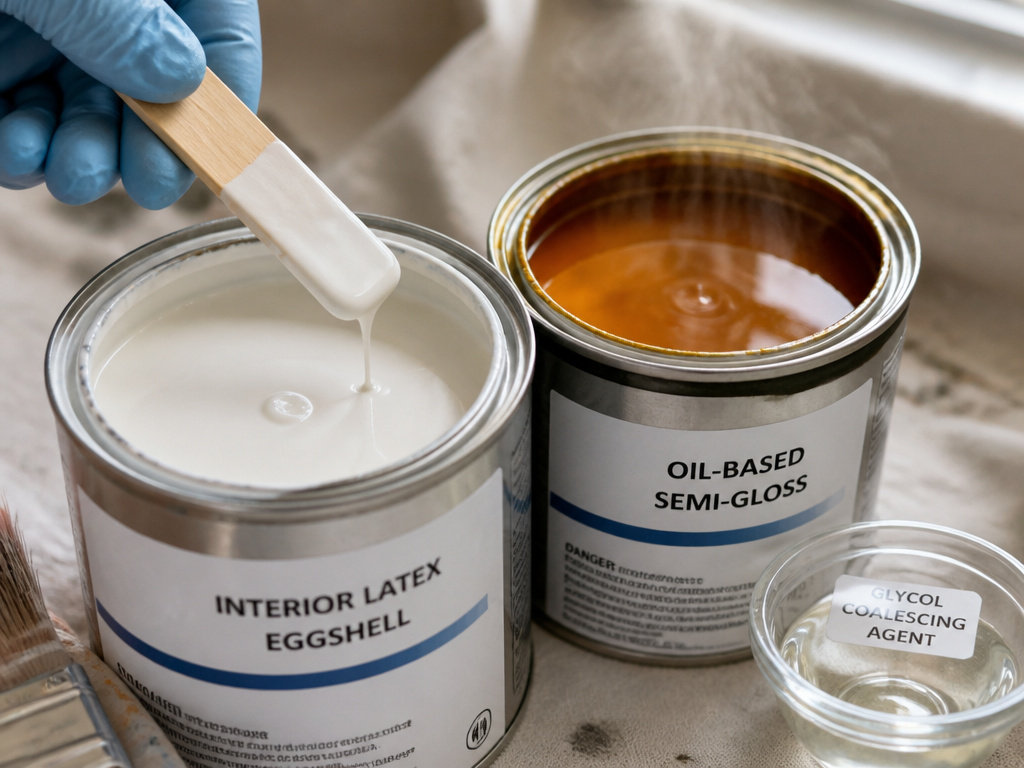
Water is the carrier in latex paint, and it doesn’t travel alone.
A glycol or glycol ether rides along as a coalescing agent. Oil-based paint uses a solvent carrier instead, and the Bureau of Reclamation’s guide notes that those VOCs can adversely affect indoor air quality and the environment. That’s one reason the water-based vs oil-based split matters more than the label suggests.
You can smell an oil-based can from the doorway before the lid is off. That sharp solvent note is the carrier announcing itself.
What Coalescing Actually Does
The coalescing agent softens the polymer particles just enough that they merge as the water leaves. Without it, the particles would sit as a powder on the surface instead of fusing into a film. The paint solvents in an oil-based can do a similar job by a different route, and they linger in the air longer.
Before you start: Solvent-based paint gives off VOCs that can affect indoor air quality, so ventilate the room and keep the lid on between pours. Latex cleans up with water, but the coalescing glycols still want airflow. Keep solvent-based cans out of hot sheds, because high heat can gel them or make them flammable.
Here’s the order of events after the brush leaves the wall:
- The carrier starts leaving immediately, water or solvent first.
- The coalescing agent softens the polymer particles so they can merge, then it leaves too.
- The particles pack and fuse into a continuous film, which is the moment the coating stops being a liquid and starts being a surface.
- The film keeps hardening for days after it’s dry to the touch, which is why a “dry” wall still dents.
I’ll take a water-based can for indoor work every time, and it’s not close.
What the Numbers Look Like on a Real Can
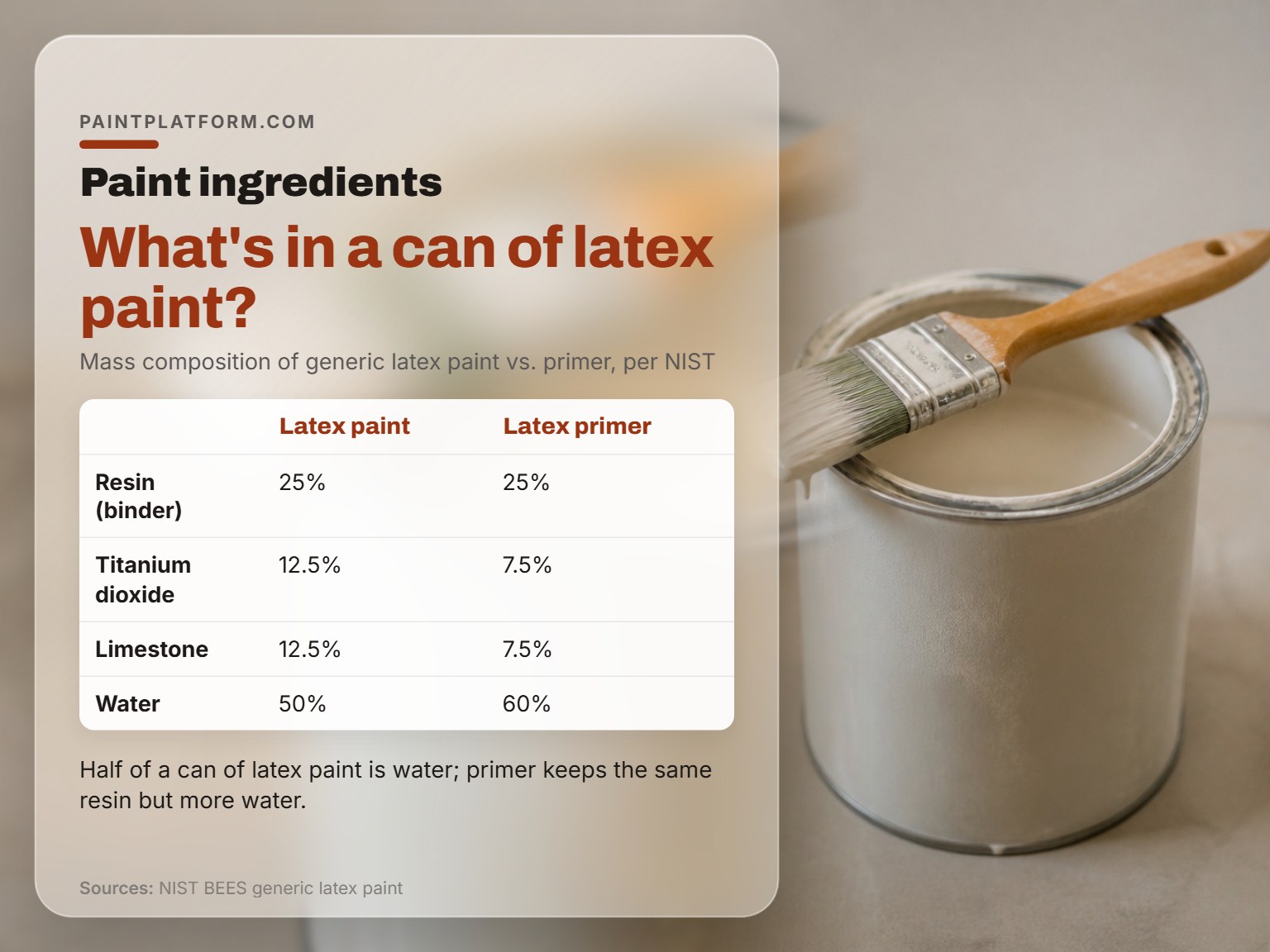
Twenty-five percent resin by mass is what NIST models for a generic latex paint.
| Ingredient | Latex paint (% mass) | Latex primer (% mass) |
|---|---|---|
| Resin (binder) | 25 | 25 |
| Titanium dioxide | 12.5 | 7.5 |
| Limestone (extender) | 12.5 | 7.5 |
| Water | 50 | 60 |
Read that table again. Half of a can of latex paint is water. The primer version keeps the same resin load but drops pigment and extender to 7.5 percent each and pushes water to 60 percent, which is why primer covers poorly and grips well.
NIST also assumes one gallon covers 37.2 square meters, or 400 square feet, with a prime plus two coats, then one maintenance coat every four years. That works out to 12 additional coats across a 50-year life. If you want the sequence from raw material to finished can, how paint is made walks the whole line.
How Thin Is a Cured Coat, Really?
Thinner than you’d guess. Ford’s paint research puts an automotive phosphate layer at 5 micrometers, electrocoat at 20, primer at 25, basecoat at 10 to 20, and clearcoat at 45. The whole stack is measured in tens of micrometers, not millimeters.
Body paint cures at 140 C, and its clearcoat has a glass transition temperature near 80 C. Trim paint cures at 80 C with a glass transition near 20 C, because flexible plastic parts need a softer film. Color matters too: core colors like white, black, and grey silver hold for 5 or more years, while blues, reds, and yellows run a 2 to 3 year life. The automotive OEM paint processes deck goes deeper into the chemistry if that’s your thing.
I’ve never needed the exact mass fractions to paint well. Seeing them did change how I read a label, though. It’s the whole argument for watching solids content instead of trusting a coverage claim on the front of the can.
Why Paint Fails in the Can Before It Reaches the Wall
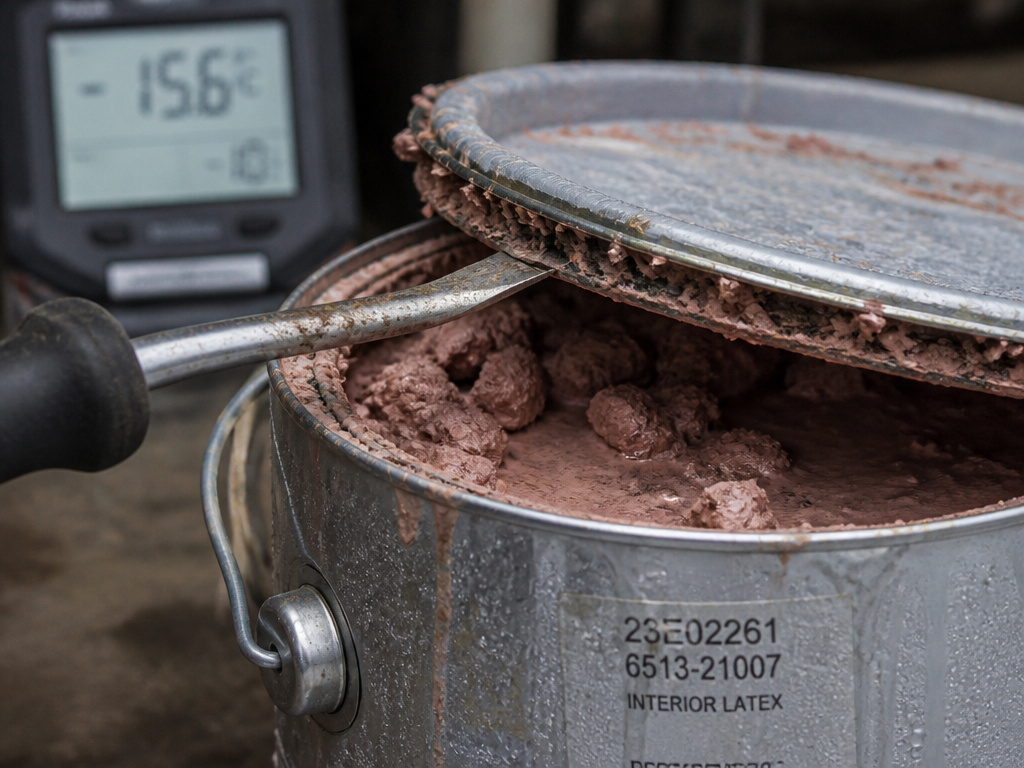
A can of latex paint stored at or below freezing can degrade to the point that it’s unusable.
The Bureau of Reclamation coatings guide is blunt about it: move cold material to a heated area before you open it, and don’t thin it to compensate. Over-thinning a cold can gives you low solids and a dry film thinner than the label promised.
Store two-component coatings together and keep every can with its batch number. When a batch goes bad, you want to know exactly which wall it’s on.
The rest of the storage rules are just as unglamorous:
- Invert containers monthly so pigment doesn’t settle into a brick at the bottom.
- Keep the batch or lot number with the can, not in your head.
- Store two-component systems side by side but clearly distinguishable.
- Keep solvent-based cans out of hot sheds, where high heat can gel them or make them flammable.
Where this goes sideways: Painting straight over fresh galvanized metal. Zinc oxide and zinc hydroxide sit loose on the surface, paint doesn’t grip them, and the coating fails early.
The emissions side of solvent-based paint is its own research field, and the ACS paint emissions study is where the peer-reviewed work sits.
I’d rather buy a fresh quart than gamble on a can that spent a winter in the garage. The gamble costs more than the quart does.
Frequently Asked Questions
Is paint made of the same ingredients as primer?
Mostly, with different ratios. NIST models a generic latex primer at 25 percent resin, 7.5 percent titanium dioxide, 7.5 percent limestone, and 60 percent water. The paint version keeps the same resin but raises the pigment and extender load and drops water to 50 percent. Less hiding pigment is why primer doesn’t cover.
What’s the difference between latex and acrylic paint?
Latex binder is synthetic latex made from polyvinyl acetate, acrylic polymers, or a blend of the two. In practice the word latex gets used loosely for any water-based acrylic, so the terms overlap more than the labels admit. Benjamin Moore lists latex acrylic, alkyd, and combinations as the three resin families.
Do all paints contain solvent?
No. Solvent-free, 100 percent solids coatings exist, and so do clear coatings with no pigment in them. The Bureau of Reclamation’s guide notes that only resin-free coatings don’t exist. Latex paint uses water as its carrier and needs no solvent for cleanup.
Why does paint smell?
The carrier. Oil-based paint uses a VOC solvent, which the Bureau of Reclamation’s guide says can adversely affect indoor air quality and the environment. Latex uses water with a glycol or glycol ether coalescing agent, so it smells milder without being odorless.
How long does latex paint last in the can?
Longer than you’d expect, provided it never freezes. At or below freezing, water-based coatings can degrade past the point of use. Keep cans in a heated space, invert them monthly to stop settling, and write the batch number on the lid.
The Bottom Line
The question of what is paint made of has a four-part answer and three different ways of counting it. None of that changes what you do at the worktable.
Here’s the one habit worth taking from all of this: before you commit a color to a real surface, brush a swatch onto scrap paper and let it dry completely. Wet paint is mostly carrier. Dry paint is mostly binder and pigment. They won’t match, and the dry one is the one you have to live with.
If you work digitally, none of this transfers cleanly. Pigment load and coalescing agents don’t map onto layers and blend modes, and I’m the wrong person to ask about either.
And if a can has been through a freeze, don’t try to rescue it. A fresh can is cheaper than repainting a wall.
