
Paint vs Varnish for Wood: Which Lasts Longer?
This post contains affiliate links. As an Amazon Associate, we earn from qualifying purchases.
Paint vs varnish for wood splits on sun exposure and upkeep. Paint blocks UV and lasts 7+ years; varnish shows the grain but needs recoating every 1 to 2 years in full sun. Pick paint for siding, varnish for doors, trim, and covered furniture.
Full sun is the hinge. The same varnish that gives up in two summers on a south-facing door can hold for years on a porch that only catches morning light, because the film is doing two jobs at once: shedding liquid water and absorbing the UV that breaks it down.
What follows: the Forest Service’s own service-life table, the 11-year field trial that complicated it, and the prep steps that decide which finish you’re actually signing up for.
Key Takeaways
- Paint wins on sun. The Forest Service puts paint at 7+ years and varnish at 1 to 2 years on wood in full sun.
- Varnish shows the grain and shows rot early. A transparent film reveals dark, discolored spots before they become a structural problem.
- Moisture kills more finishes than sunlight. A coating blocks liquid water; it can’t stop humidity from moving through the wood.
- Wait until the wood is dry after washing. Paint applied over a damp surface can blister.
- Keep clear exterior finishes small. Industry guidance limits exterior varnish to doors, trim, and outdoor furniture, not broad siding.
What Do Paint and Varnish Actually Do to the Wood?
Both are film-forming finishes, which means they build a layer on top of the wood instead of soaking in.
Film-forming finishes build a continuous layer over the wood surface. Paints, solid-color stains, and varnishes fall into this group. Penetrating finishes, including water repellents, preservatives, and pigmented semitransparent stains, soak into the fibers instead. The two categories fail in different ways and demand different maintenance schedules.
Film-Forming vs. Penetrating Finishes
The pigments in paint do the heavy lifting. They block the sun’s ultraviolet rays and erosion almost completely, according to the USDA Forest Service finish selection guide.
Varnish has no pigment. The film stays clear, which is the whole point, and UV passes straight through it to the wood below.
That single difference explains most of what follows.
Both types share one limit. A finish slows the humidity-driven moisture changes in wood, and its real value is blocking liquid water from getting in. It can’t do more than that.
Indoors, appearance and a cleanable surface matter most. Outdoors, protection from water, sunlight, and weathering takes priority. That’s the framing the US Forest Service finishing wood chapter uses, and it’s a useful way to sort any finish argument you run into.
The Service Life Numbers, Straight From the Forest Service
Seven years is the floor for paint. Two years is roughly the ceiling for varnish in full sun.
Those come from the same Forest Service bulletin, which lists an expected service life for each finish type.
| Finish | Expected Life | Where It Fits |
|---|---|---|
| Paints | 7+ years | Siding, trim, broad exterior surfaces |
| Semitransparent stains | 3-8 years | Rough sawn siding, log homes |
| Solid-color stains | 3-7 years | Siding where grain texture still matters |
| Varnish | 2-3 years (table); 1-2 years in full sun | Doors, trim, furniture, shaded wood |
| Pigmented water-repellent preservatives | 2-3 years | Quick refresh coats |
| Water repellents | 6-12 months | Short-term water shedding |
The varnish entry is worth reading twice. The bulletin’s text says varnish lasts only 1 to 2 years on wood exposed to full sun, while its own life-span table lists varnish at 2 to 3 years. Same document, two numbers. Plan around the shorter one and treat the longer one as a best case for shaded wood.
I’ve watched the paint-versus-stain version of this on my own siding. When it let go on wood, it let go loudly.
Common mistake: Reading the service-life table as a promise. Those numbers assume sound, dry wood and a finish applied properly. A coat put on over damp wood can blister in two weeks regardless of what the can claims.
Why Does Varnish Fail in Full Sun and Paint Doesn’t?
Sunlight attacks the varnish film and the wood underneath it at the same time.
Because varnish is transparent, UV reaches the wood fibers directly and breaks them down photochemically. The film degrades too. Once it starts to crack and flake, it lifts away with degraded wood fibers stuck to the underside.
Run a hand over failing exterior varnish and you’ll feel it: brittle flakes with grey, fuzzy wood attached.
Fair warning: once that film starts to go, it goes fast. The finish fails cohesively, and the flakes carry wood fibers away with them.
I’ll take a finish that fades quietly over one that fails loudly.
Paint doesn’t have that problem in the same way. Its pigments shield the surface from UV and erosion, and an acrylic latex outdoor house paint will generally outlast an oil-based one.
Latex has a second advantage. It’s more porous than oil, so it can breathe while it sheds water. Oil-based paint tends to go brittle, and if water gets into the wall from an interior source, an oil film can trap it, blister, and encourage decay.
One caveat that gets skipped: paint won’t prevent decay if conditions favor fungal growth. It blocks liquid water. It doesn’t sterilize the wood.
What 11 Years on Weathered Cedar Actually Showed
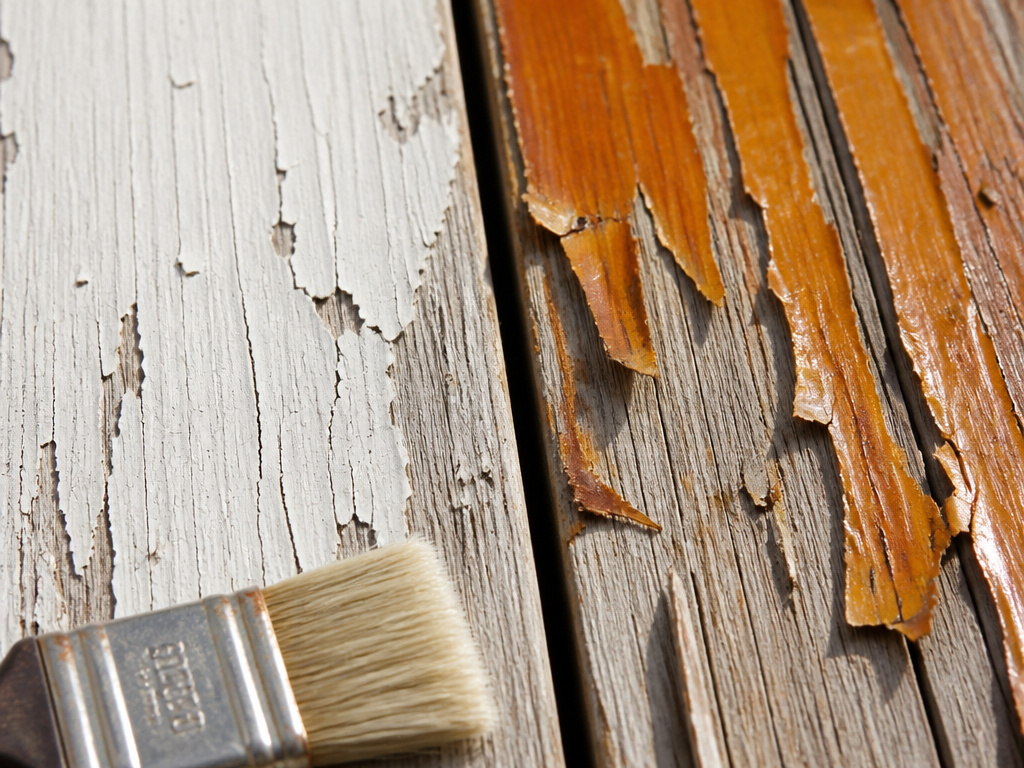
Eleven years is a long time to watch a finish fail.
A coatings industry field trial did exactly that. Six finishes went onto severely weathered western redcedar and redwood boards with no surface pretreatment, and evaluators scored them every year for 11 years.
The result surprised people. After 11 years, all three latex finishes had an average flaking rating above 8, better than the three alkyd finishes.
Those latex products were lean. They ran about 40% nonvolatile content with only 11 to 14% acrylic resin, compared with an earlier comparison latex at 27% acrylic resin and 52% nonvolatile.
Part of the reason is linseed oil. The oil-modified latex finishes carried raw linseed oil that consolidated the weathered surface and plasticized the film, giving it more resistance to cracking.
On severely weathered wood, those latex finishes behaved more like penetrating stains than paints.
One honest limit: mildew and discoloration pulled down the appearance ratings for the latex finishes even where flaking performance was strong. Looking good and holding on are two different scores.
And this trial doesn’t settle the general case. The Forest Service’s broad guidance favors latex paint for exterior wood without conditioning on how weathered the substrate is. The 11-year result is specific to boards that had already been beaten up and left untreated.
Where the Sources Disagree About Varnish Outdoors
Two credible sources look at exterior varnish and reach opposite conclusions.
Here’s who says what.
- USDA Forest Service: treats varnish as a legitimate exterior film-forming finish with a defined maintenance cycle of 1 to 2 years in full sun, longer in shade. Life is extended by staining first, then applying multiple coats.
- Duron, via PaintPRO: exterior clear finishes should be limited to small areas such as a front door. UV causes early failure, and clear products should not go on broad surfaces such as exterior siding.
- WoodenBoat: paint is “frankly a better option” for anyone who lacks the time or inclination to maintain varnish, which asks for a consistent commitment of time and skill each year.
- Canadian Woodworking: calls varnish “the king of finishes” and argues its benefits far outweigh the drawbacks of yellowing, slow curing, and difficult repair.
Read those together and the fight is about surface area and temperament, not chemistry. Everyone agrees the film needs attention every year or two. The disagreement is whether a broad wall of it is worth the attention.
Spar varnish and spar urethane sit in the middle. They’re formulated for more durability, and they’re still usually limited to doors and outdoor furniture.
The part nobody mentions: Exterior coatings get marketed on the durability of the coating rather than its ability to protect the wood. The National Park Service makes that point directly in its National Park Service paints and stains guide, and it’s the right lens for reading any can.
Paint vs Varnish for Wood: Which One Wins Where
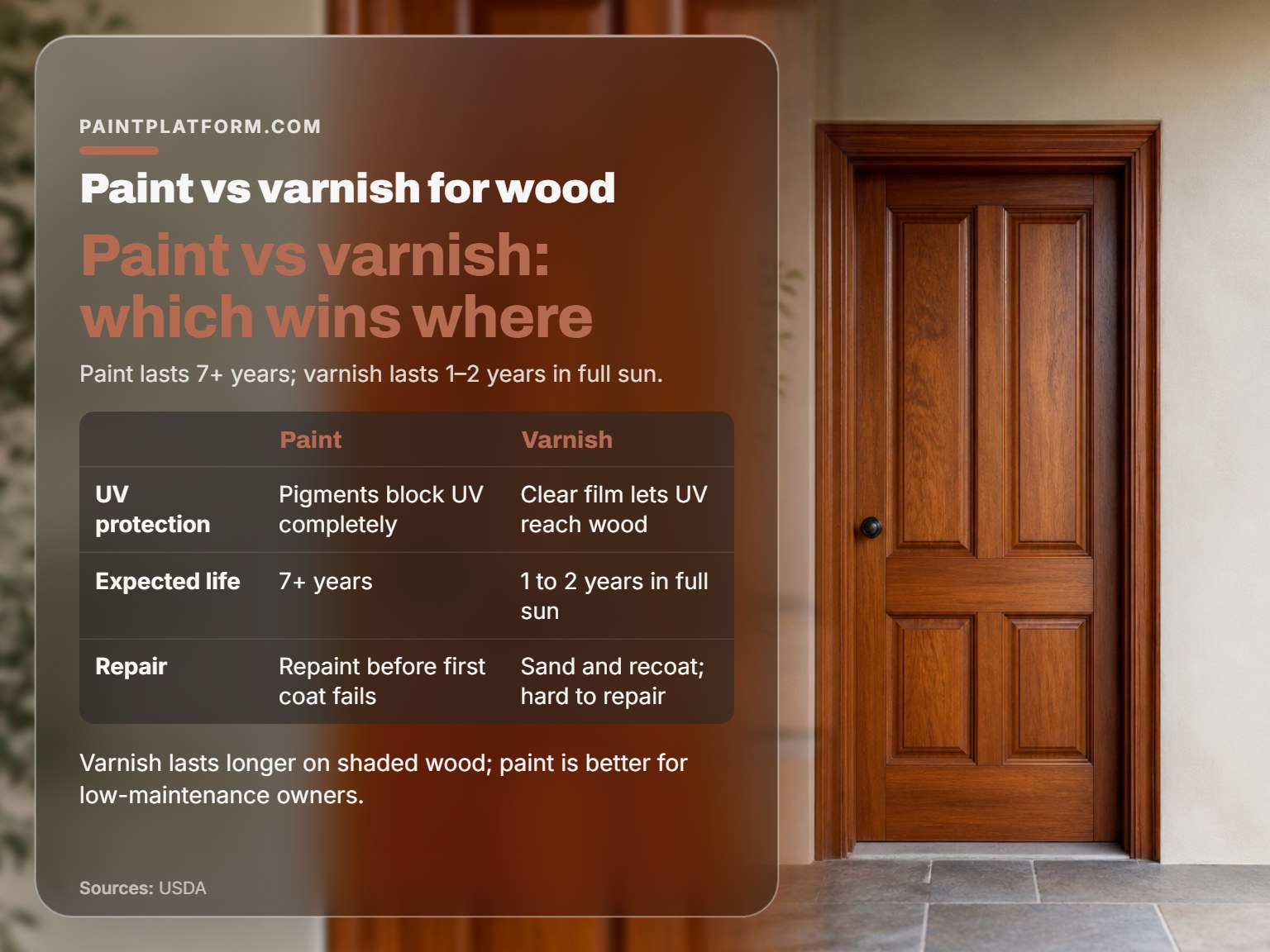
Paint wins on siding. Varnish wins on a front door.
| Question | Paint | Varnish |
|---|---|---|
| UV protection | Pigments block UV completely | Clear film lets UV reach the wood |
| Moisture | Blocks liquid water; latex can breathe | Blocks liquid water; film can trap it |
| Expected life | 7+ years | 1 to 2 years in full sun |
| Appearance | Hides the grain | Shows the grain |
| Repair | Scrape and repaint | Sand and recoat; hard to repair |
| Best use | Siding, trim, broad surfaces | Doors, furniture, shaded wood |
If You Want the Wood Grain to Show
Varnish is the obvious answer, with one upgrade. Staining the wood first and then building multiple varnish coats extends the finish’s life, per the Forest Service.
There’s a bonus to a clear film. Because it’s transparent, it reveals potential rot early, showing up as dark, discolored spots before they turn into something serious. That early-warning property is one of the real varnish pros and cons, and it rarely gets mentioned.
If You Want to Stop Thinking About It
Paint. WoodenBoat says it plainly: paint is a better option for anyone without the time or inclination to maintain varnish.
For exterior wood, go acrylic latex. Pigments protect the surface completely, and acrylic latex generally outlasts oil-based. The best paint for exterior wood narrows fast once you filter for acrylic.
Redwood and cedar throw a curveball. Their water-soluble extractives bleed through latex, so seal with an oil-based or stain-blocking latex primer first, then topcoat with acrylic latex. Cedar sometimes needs a second primer coat in spots. That’s where a short list of primers for wood earns its keep.
If you’re weighing a clear film against a pigmented one, the wood stain vs paint comparison covers the middle ground that neither camp talks about.
Indoors, the ranking flips toward clears. Minwax’s position, as reported by PaintPRO, is that polyurethane is the most durable clear for toughness, abrasion, and scuff resistance, which is why it lands on floors, furniture, cabinetry, and molding.
The trade-off is real. Polyurethanes don’t stick well to other finishes or to themselves, sanding between coats is mandatory, and repair is not easy. They also yellow over time.
A typical polyurethane takes 24 hours to dry. Professional floor finishers using oil-based poly lay one coat a day across three days, which is why dust control matters more than speed.
Skip varnish if:
- The surface faces full sun all day. You’ll be recoating every year or two, forever.
- It’s bigger than a door. Broad exterior clear finishes are where UV wins.
- You want to skip sanding between coats. Varnish layers don’t fuse once cured, so you can’t.
- You’re covering old oil paint. Latex over brittle oil can shrink as it cures and pull the old coat off with it.
The Prep Steps That Decide Whether Either Finish Lasts
That’s the whole lesson. If there’s fog under it in the morning, the brush stays in the can.
It’s not fancy. It has saved me from my own optimism more than once.
Before you start: Any wood on a house built before 1978 may carry lead paint, which the federal government banned from house paints that year. Sanding or scraping it releases dust you don’t want to breathe. Federal rules from 2010 require an EPA-certified firm for lead abatement in housing and child-occupied facilities, though minor repair and maintenance may be exempt.
Before You Sand Anything
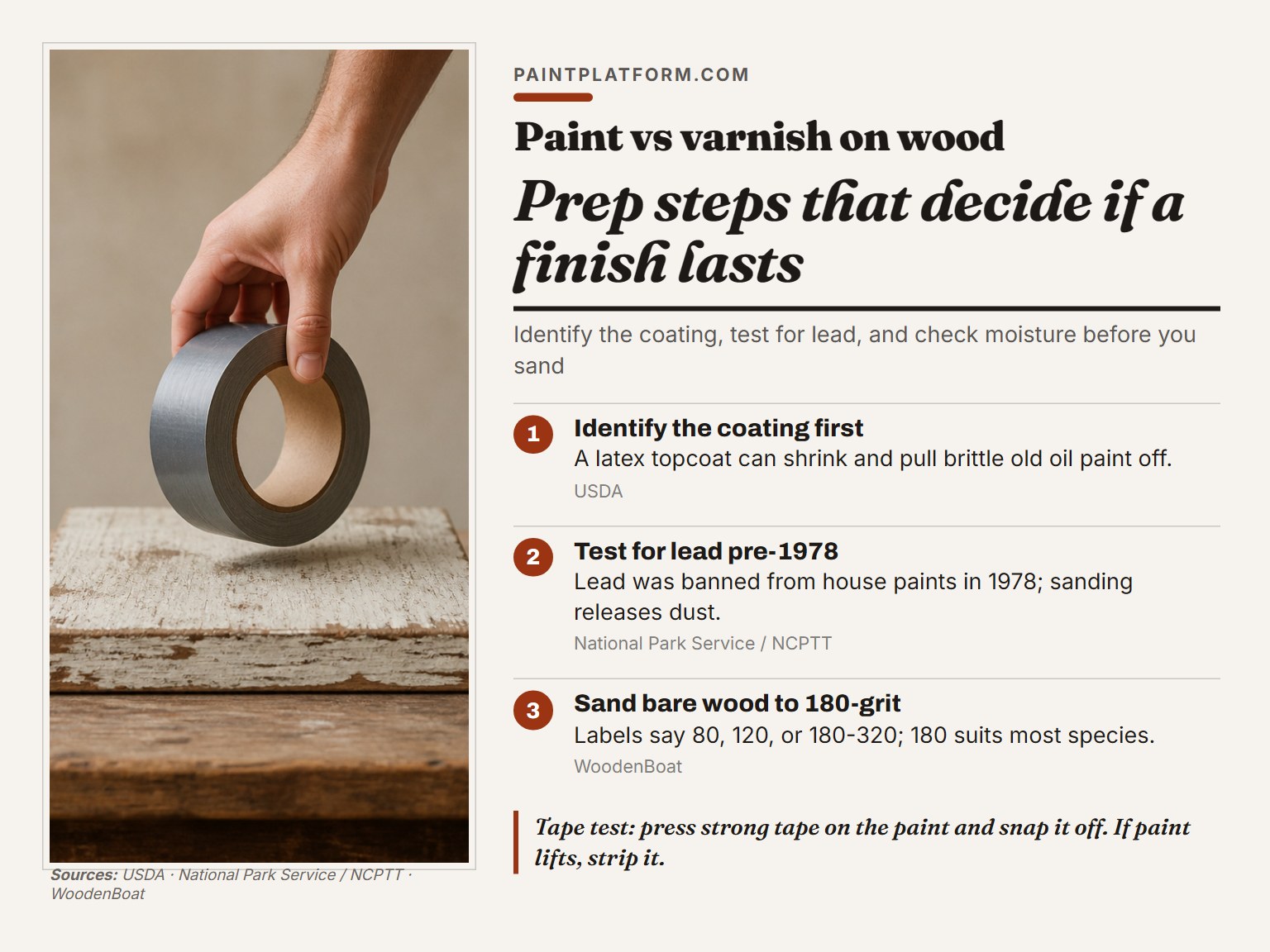
Identify the existing coating first. A paint analysis can flag incompatibility issues and lead-paint hazards before you make any dust.
Then run the tape test. Press strong-adhesive tape firmly onto the paint and snap it off. If paint comes away with it, it’s time to strip, even if the surface looks intact.
If you’re stripping rather than recoating, a dedicated paint remover for wood furniture is the usual route on details and curves.
- Identify the coating before you touch it. Skip this and a latex topcoat can shrink during curing and pull brittle old oil paint off the wall.
- Test for lead on anything pre-1978. Skipping it turns a sanding job into a health hazard.
- Wash, then wait 48 hours. A plastic wrap square taped overnight tells you more than a sunny afternoon does. Paint over damp wood can blister.
- Sand bare wood to 180-grit. Labels disagree wildly here, with one specifying 80-grit, another 120, and another 180 to 320. For most species, 180 is the right call, and sanding with the grain keeps scratches from telegraphing through the finish.
- For a maintenance coat on intact varnish, sand with 220 to 320 grit. Then look for yellow blisters, which mark where the film has separated from the wood. Scrape those to bare wood before sanding.
- Strain the varnish. Pour through a medium or fine paint strainer into a clean container. Cured globs hiding on the can rim will otherwise end up in your finish.
- Build three or four coats, sanding lightly between each. Varnish layers don’t fuse once cured, so the sanding is what makes the next coat hold.
If the surface is littered with blisters, or most of the finish is peeling, strip the whole piece to bare wood instead of spot-fixing. Spot repairs on a failing film look worse every month.
Try this: tape the plastic wrap tonight and check it in the morning.
Frequently Asked Questions
Does varnish last longer than paint on exterior wood?
No. The Forest Service puts varnish at 1 to 2 years on wood in full sun and paint at 7+ years. Varnish can last longer in shade, and staining first then building multiple coats extends it, but it never closes that gap.
Can you put varnish over paint?
Sometimes, and it depends on the product. Polyurethanes generally don’t adhere well to other finishes, though, so test a hidden spot first.
Is polyurethane the same as varnish?
How many coats of varnish do you need?
Three or four is the usual answer.
Why did my paint blister two weeks after I applied it?
Moisture under the film. Paint blocks liquid water but it can’t stop humidity moving through wood, and a coat applied over a damp surface traps that moisture until it pushes the film loose. Wait longer than you think, and test with plastic wrap.
What’s the best finish for a front door?
Both are limited-use answers: exterior clears belong on small areas like a door, not on siding.
The Bottom Line
Here’s the threshold I actually use: if the surface is bigger than a door and catches direct sun, it gets paint. Below that, and out of the worst of the light, varnish earns its keep.
Everything above assumes sound wood. On soft, checked, or punky boards, no finish buys you much time. Fix the wood first, then argue about the coating.
The paint vs varnish for wood question also has a temperament answer that no spec sheet captures.
The finish that gets maintained is the one that lasts.
