
Heat Resistant Paint Guide: What the Spec Sheets Say
This post contains affiliate links. As an Amazon Associate, we earn from qualifying purchases.
A heat resistant paint guide starts with two numbers: the maximum service temperature on the data sheet, and the cure schedule that makes it real. MIL-PRF-14105E demands 1,400 °F (760 °C). Axalta Tufcote 3.5 HH claims 1,200 °F (649 °C), but only after a 600-800 °F (316-427 °C) fusion bake.
Fusion is where those two numbers split apart. Tufcote’s ceiling is a post-bake ceiling. The data sheet states that maximum heat resistance occurs only after the film is fused, and that the ramp should start at least 12 hours after application. Spray that same can onto a cold boiler front and let it air dry, and you own a coating nobody rated at 1,200 °F. The label tells you what the product can do. Your job decides what it actually does.
What follows: five temperature ceilings and the condition attached to each, the film thickness numbers that contradict one another across four data sheets, and the prep rules that decide whether the film stays put.
Key Takeaways
- Rated temperature is conditional. Axalta’s 1,200 °F exists only after a 600-800 °F fusion bake, so an unbaked film never reaches the nameplate number.
- Thicker is not safer. Tufcote fails above 3 mil dry film; 1.5 mil is ideal, and blistering plus disbonding is the documented outcome of a heavy coat.
- Two manufacturers flatly disagree about hot steel. Hempel supports application up to 200 °C (392 °F); Axalta’s sheet says do not apply to hot steel at all.
- Primer advice splits three ways. Axalta says no primer, Benjamin Moore requires V264-78 on bare metal, and a peer-reviewed study found a zinc phosphate primer plus topcoat suitable for steel grill equipment.
- MIL-PRF-14105E is the outlier at 1,400 °F (760 °C), and it earns that number with five quench cycles and 300 hours of accelerated weathering on panels from the 1,400 °F period, plus 100 hours of salt spray on panels from the 800 °F period.
Why Do Heat Resistant Paint Ratings Vary From 200 °C to 760 °C?
Different tests sit behind those numbers. MIL-PRF-14105E is a qualification specification: a coating has to survive a written sequence of tests before it carries the 1,400 °F (760 °C) claim. CSIRO/APAS AP-S0043 is a product certification scheme for paints on steam pipes and boiler fronts running up to 200 °C. Both get called heat resistant on the shelf. Only one of them is promising 760 °C.
Maximum service temperature is a laboratory figure. The number is measured on a steel panel coated to a specified dry film thickness, cured on a specified schedule, then held at temperature and checked for cracking, flaking, or chipping. A coating applied thicker, thinner, or cured colder has not been tested at that figure.
| Spec or product | Stated maximum | Condition attached |
|---|---|---|
| MIL-PRF-14105E | 1,400 °F (760 °C) | Passes quench, salt spray and weathering tests |
| Axalta Tufcote 3.5 HH | 1,200 °F (649 °C) | Only after 600-800 °F fusion bake |
| Benjamin Moore V264 | 800 °F (425 °C) | Air dry, no fusion step |
| AkzoNobel Interbond 2340UPC | 205 °C (401 °F) | Continuous; 230 °C short excursions |
| Hempel hot-substrate guidance | 200 °C (392 °F) | Application onto hot steel only |
| CSIRO/APAS AP-S0043 | 200 °C | Certified product for steam pipes and boiler fronts |
Read that table again and look at the spread. The gap tracks cure chemistry and the cure schedule each product specifies.
MIL-PRF-14105E sits above both because qualification means testing, and the spec writes the tests down. Panels from the 800 °F (427 °C) heating period take 100 hours of salt spray per ASTM B117 in 5 percent salt solution. A panel from the 1,400 °F period takes five quench cycles, each one heated to 650 °F (343 °C) and plunged into tap water at 70 ± 10 °F (21 ± 5 °C). Two more panels absorb 300 hours of accelerated weathering per ASTM G155.
That is what a 1,400 °F claim costs to make honestly.
Heat Resistant Paint Guide: Film Build and the 3 Mil Ceiling
Three mils ruins more heat-resistant jobs than any temperature mistake. Axalta states it plainly: coating thickness in excess of 3 mil is not suitable, and thick film may result in blistering and disbonding. That runs against the usual instinct, since with most coatings more film means more protection.
| Spec or product | Dry film thickness | Note |
|---|---|---|
| MIL-PRF-14105E | 2 to 2.5 mils (50.8-63.5 µm) | Per coat, or per manufacturer TDS |
| Axalta Tufcote 3.5 HH | 1.5 mil ideal; 2 mil sufficient | Above 3 mil not suitable |
| Benjamin Moore V264 | 1.7-2.0 mils dry (4.0-4.6 wet) | 350-400 sq ft per gallon |
| CSIRO/APAS AP-S0043 | 15 µm (0043/1); 30 µm (0043/2) | Thin wet coat, brush or air spray |
Line those up and the disagreement is small in absolute terms and enormous at the bench. The widest target is MIL-PRF-14105E at 2 to 2.5 mils. The narrowest is AP-S0043/1 at 15 µm. Axalta hands you a window rather than a target: 1.5 ideal, 2 acceptable, anything past 3 a liability.
Why does a heavy coat fail? Axalta states that thick film may cause blistering and disbonding.
Thick film looks fine wet, but Axalta states that thick film may cause blistering and disbonding.
Measure film thickness with a gauge. A coat that looks right at arm’s length can be too thick, and Axalta’s own data sheet calls anything past 3 mil a blistering and disbonding risk.
There is one more detail buried in the MIL spec that changes how you measure. Dry film thickness is taken after the coated panel has been baked at 400 ± 4 °F (204 ± 2 °C) for one hour. The spec is not measuring a room-temperature film. It is measuring a film that has already been through a heat cycle, because that is the film that goes into service.
Can You Apply Heat Resistant Paint to Hot Steel?
Two coatings manufacturers looked at the same question and published opposite answers. Hempel issues a technical guideline for application on hot substrate, defined as steel with an internal heat source typically above 120 °C (250 °F), and the guidance holds up to 200 °C (392 °F). Axalta’s Tufcote data sheet says, in bold, do not apply to hot steel.
What Hempel Allows
Hempel’s guideline exists because shutting down process equipment to coat it is expensive, and corrosion under insulation happens at temperature anyway. The method is a 7 to 10 second interval between passes, applying the full film in one process, up to 200 °C (392 °F) substrate temperature.
That last clause is the one that bites. Finishing the full film in one process means the full film goes on in a single pass. Hempel also warns that the paint film may be soft at elevated temperature, so any test method involving contact with the coated surface needs care.
What Axalta Forbids
Axalta’s instruction is a flat prohibition, and it comes from a product with a different cure. Tufcote needs a fusion bake to reach its rating. Axalta’s own numbers show how narrow the fusion window is: 185 °F (85 °C) per hour is the ideal increase, and anything above 300 °F (149 °C) per hour is not recommended.
Which one applies to you? If you are coating a live steam line and the alternative is a shutdown, Hempel’s method is the documented path and 200 °C is the ceiling. If you are painting a stove in your garage, neither applies. You are in cold-application territory, and the film needs to follow the product’s data sheet before the first fire.
Easy to miss: The fusion bake clock. Axalta wants 12 hours or longer after application before the ramp begins. Start the fire before the required 12 hours have passed and you have skipped the step that produces the rating.
Primer or No Primer? Three Sources, Three Answers
The primer question splits three ways in the source material, and none of the three is wrong inside its own envelope. Axalta says do not apply over primer, and to go directly onto the properly prepared surface. Benjamin Moore requires all bare metal to be primed with an initial coat of V264-78 before a full coat goes on. A peer-reviewed study in PMC tested a bilayer of zinc phosphate primer plus barrier topcoat and found it suitable for steel outdoor grill equipment.
The envelopes explain the split. Axalta’s suggested uses run to boiler fronts, heat exchangers, smoke stacks and mufflers, with the coating applied straight to prepared steel. Benjamin Moore’s data sheet covers ferrous metal in severe environmental exposure and treats bare metal as something that needs a first coat before the finish coat.
At the bench, match the system to the sheet in your hand. If you are spraying V264, prime bare metal with V264-78. If you are spraying Tufcote, do not. A Benjamin Moore primer under an Axalta topcoat is a system outside both companies’ published guidance.
Where this goes sideways: Priming a heat-resistant topcoat that the maker says goes direct. The primer becomes the weak layer, and the failure may show up as topcoat lifting rather than primer failure.
The PMC work is worth knowing about because it tested both approaches side by side with salt spray, electrochemical impedance spectroscopy and optical microscopy. Two coating systems, one single-layer and one bilayer, both suitable for the same steel grill application. That is a rare thing in this category: a peer-reviewed comparison of two coating systems.
Surface Prep and Cure: The Rules That Actually Decide It
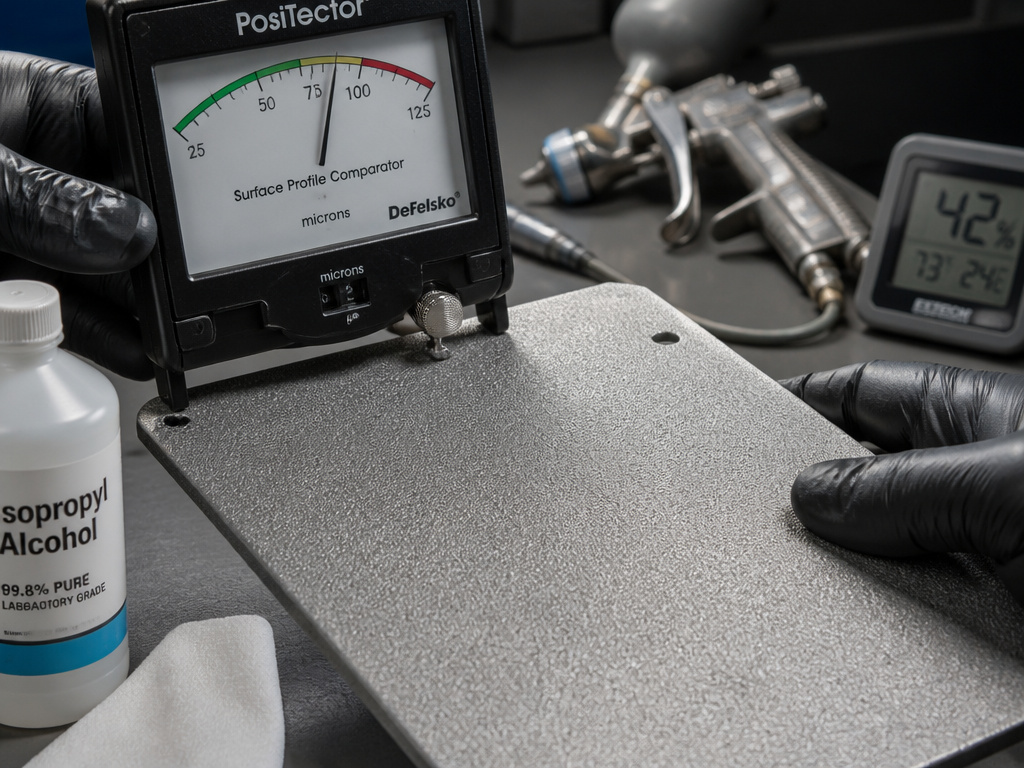
Wipe a panel with the wrong solvent and adhesion can suffer. NASA’s PRC-4002 spells out the cleaning step: isopropyl alcohol or an equivalent such as methyl ethyl ketone, and no reclaimed paint thinner at all, because reclaimed thinner may leave a grease film that prevents adhesion.
Before you start: Two hazards live in this section. Isocyanate-containing coatings can trigger respiratory reactions, and Axalta states that asthma sufferers, anyone with allergies, and anyone with a history of respiratory complaints must not work with them. Spraying also builds static, so NASA requires the gun to be grounded before spraying to prevent explosion or fire from static discharge. Ground the equipment, ventilate the space, and read the SDS before the can is open.
Here is the sequence that the data sheets actually describe, in order.
- Degrease before anything else. Remove wax, silicone, oil, powdery or scaling rust and loose paint. Axalta notes that smooth, slick surfaces should be sanded to give a mechanical tooth. Skip the degrease and the coating bonds to oil rather than steel, risking adhesion failure.
- Blast to the profile the sheet names. Axalta calls for an ideal surface profile of 1.5 mil. AkzoNobel’s Interbond 2340UPC requires Sa2½ to ISO 8501-1:2007 with a 50-75 µm (2-3 mil) profile. Benjamin Moore wants a minimum SSPC-SP 6 Commercial Blast for severe exposure. A slick panel with no profile does not meet the surface preparation the data sheets require.
- Check the dew point, not just the clock. Interbond requires substrate at least 3 °C (5 °F) above dew point. Benjamin Moore requires a dry surface at least 5 degrees above dew point with humidity at 90 percent or less. Steel below the dew point collects condensation, and water under a coating prevents proper adhesion.
- Respect the recoat window. V264 is tack free in 1 hour, recoatable in 4 hours at 77 °F (25 °C) and 50 percent RH, and fully cured in 7 days air dry. Recoating outside the window on a fast-curing coating can compromise the layer underneath.
- If the sheet calls for a bake, bake it. Tufcote wants 12 hours minimum, then a ramp at 185 °F (85 °C) per hour into the 600-800 °F fusion range. Skip the bake and you have a film with a lower ceiling than the can promised.
Humidity is the third place the sources part company. NASA PRC-4002 sets a default of 30 to 60 percent relative humidity unless the manufacturer says otherwise. Benjamin Moore allows up to 90 percent, provided the surface sits at least 5 degrees above dew point. Those are different instructions, and the difference is the audience: NASA writes for flight hardware in a controlled shop, Benjamin Moore writes for a field crew.
Check the blasted panel against the profile the data sheet names. If it feels slick, the profile is not there yet.
PRC-4002 also requires out-time and shelf-life records, and re-qualification if either limit is exceeded. That habit is worth stealing for a garage shelf. A can of high-temp coating opened long ago is worth a second look before it goes on a stove.
Which Heat Resistant Paint for Which Job
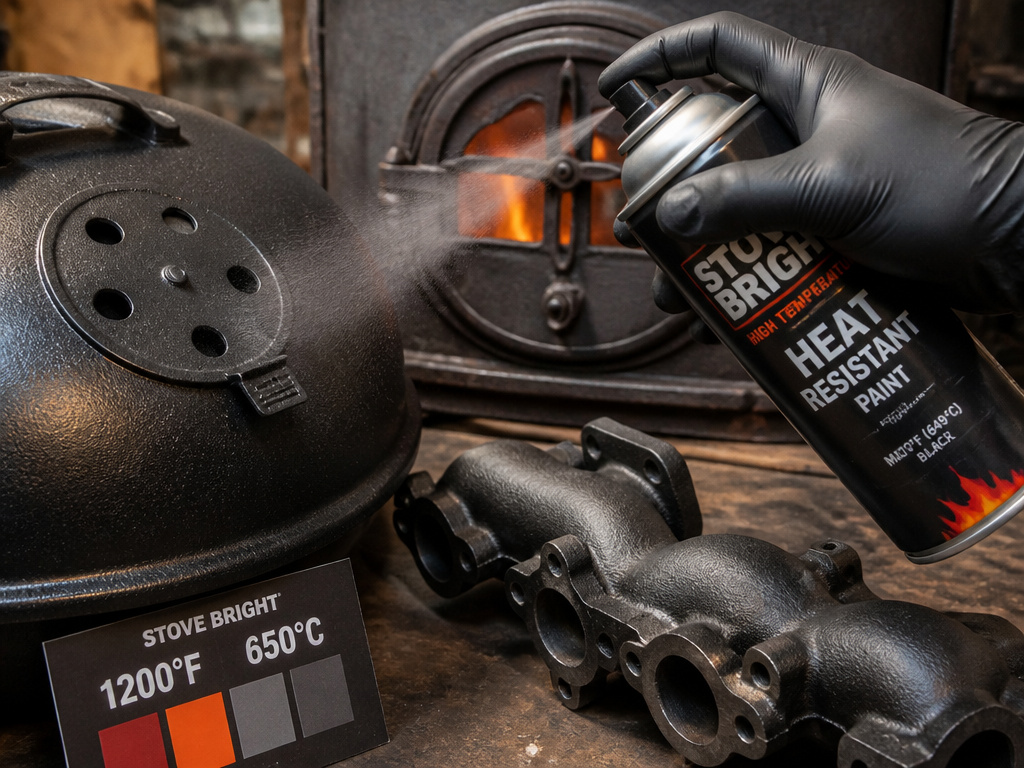
The job picks the product far more than the temperature does. The best high heat paint for a given surface depends on which of these six you are doing.
Grills and Smokers
Grill paint is the one place where a peer-reviewed study hands you a direct answer. The PMC paper tested a single-layer zinc phosphate heat-resistant paint and an ambient-curing bilayer of zinc phosphate primer plus barrier topcoat, and found both suitable for outdoor grill equipment built from steel. Want the simpler path? A single-layer zinc phosphate product does the job. Want the corrosion margin? The bilayer is documented. Either way, that is more evidence than most grill paint on the shelf comes with.
Wood Stoves and Fireplaces
A stove cycles between cold and working temperature, and the coating has to survive that without an oven. Benjamin Moore V264 is rated to 800 °F (425 °C), air dries tack free in an hour, and reaches full cure in 7 days. That profile suits a wood stove paint job you cannot bake. For the firebox itself, where the surface is enclosed and the heat is concentrated, a firebox paint rated for the enclosed space matters more than the finish sheen.
Radiators and Baseboard Heaters
Radiators and baseboard units sit at the low end of the heat range, and the choice is usually as much about temperature as the finish. A radiator paint that stays white through a few winters is worth more than one with a higher number on the label. Same logic for baseboard heater paint: the surface gets warm, not glowing, and film build discipline still applies.
Engine Blocks and Exhaust Parts
Engine paint is where the temperature spread inside one vehicle gets wide. An engine block and a set of headers do not see the same numbers, and the product should match the hottest part you are coating rather than the biggest surface. A high temp engine paint chosen for the block will not necessarily survive the exhaust side.
Frequently Asked Questions
Does heat resistant paint need a primer?
It depends entirely on the data sheet. Axalta Tufcote 3.5 HH says do not apply over primer and to go directly onto prepared steel. Benjamin Moore V264 requires an initial coat of V264-78 on all bare metal. A peer-reviewed study found a zinc phosphate primer plus barrier topcoat suitable for steel grill equipment. Read the sheet for the product in your hand rather than picking a rule.
What temperature can heat resistant paint handle?
Anywhere from 200 °C to 1,400 °F (760 °C), depending on which specification you are reading. CSIRO/APAS AP-S0043 certifies products to 200 °C, AkzoNobel Interbond 2340UPC runs to 205 °C continuous with short excursions to 230 °C, and MIL-PRF-14105E requires 1,400 °F. The number only holds under the cure schedule the maker specifies.
Can I spray heat resistant paint with a regular spray gun?
Benjamin Moore lists an airless tip range of .013 to .017 with total fluid output at the tip of not less than 2200 PSI, preferred at 2500 PSI, for V264. Whatever gun you use, ground it. NASA’s PRC-4002 requires the spray gun to be properly grounded to prevent explosion or fire from static discharge.
How long before a heat resistant coating can take heat?
Read the cure section, because it varies wildly. V264 is tack free in 1 hour and fully cured in 7 days air dry at 77 °F (25 °C) and 50 percent RH. Tufcote needs 12 hours or longer before the fusion ramp starts, and the ramp itself should climb at 185 °F (85 °C) per hour.
Why did my high heat paint blister?
Film thickness is the first suspect. Axalta states that coating thickness in excess of 3 mil is not suitable and that thick film may result in blistering and disbonding. Solvent gets trapped under a heavy coat and collects at the interface until the film lifts. Check the dry film thickness with a gauge before you blame the product.
The Bottom Line
If you take one thing from this heat resistant paint guide, take the film thickness gauge. Not the temperature rating, not the brand name. A 1,400 °F coating applied well above its rated film thickness is a coating that will blister, and a 200 °C coating applied at its specified film thickness on properly blasted steel will quietly do its job.
Here is your first step this week: before you buy anything, find the technical data sheet for the product you are considering and read the cure section first. If the sheet says fusion bake and you have no way to reach 600-800 °F, that product is not available to you, no matter what the front of the can says.
One concession worth stating plainly. Everything above assumes steel, and the whole conversation changes on aluminum or on a surface you cannot blast. If that is your situation, the temperature rating is the least of your problems.
And a small confession: I read the temperature number first for years, the same way I used to pick sheen off a tiny chip and call it decided. The spec sheet is the big sample board. Look at the whole thing before you commit.
