
Elastomeric Paint Pros and Cons: What to Know First
This post contains affiliate links. As an Amazon Associate, we earn from qualifying purchases.
Elastomeric paint pros and cons center on a thick, flexible acrylic coating that bridges cracks up to 1/32 inch and blocks wind-driven rain, weighed against higher cost per gallon, thicker application, and failure on damp surfaces or anywhere water pools.
I keep thinking about paint-and-primer combos whenever elastomeric comes up. I tried a combo paint over a water ring once and the stain bled back through. Combo paints are basically thicker paint, not a true blocking primer, which is worth remembering when weighing elastomeric paint pros and cons. Elastomeric is the same story: thicker paint with more flex, and a water-resistant film.
Here is what follows: the real strengths, the failure modes the marketing skips, and the substrates where this coating is the wrong tool.
Key Takeaways
- Elastomeric bridges cracks up to 1/32 inch per the SWR Institute, and that number depends on proper dry film thickness.
- It goes on at 10-15 wet mils per coat versus 3-5 for standard latex, so a job needs more product.
- Skip it on dead-level roofs and damp surfaces where water pools; SWR Institute and Wilko warn against ponding, though Sealbond Bondflex EWB is recommended for waterproofing roof decks and roof tiles.
- Most manufacturers want 40-50°F and rising with no freezing threat for 12-24 hours after application.
- Elastomeric is water-resistant, not waterproof per Stuc-O-Flex; it blocks liquid water but stays breathable.
What Is Elastomeric Paint Actually Made Of?
Elastomeric paint is a thick acrylic or silicone coating that dries into a flexible membrane, and the “elastomeric” name comes from its two core properties: it expands and contracts with the substrate, and it has the memory to return to its original shape.
The SWRI elastomeric coatings technical bulletin defines it as a fluid-applied material that dries to a solid elastic membrane. Most versions are water-based acrylics, which is why clean-up is easy and VOC compliance is rarely a problem.
An elastomeric coating is a fluid-applied material that dries to form a solid elastic membrane intended to provide water resistance to the substrate. It expands and contracts with the substrate and has the memory to return to its original condition, which allows properly applied coatings to bridge certain cracks that develop after application.
That is the mechanical core. The coating moves with the wall, so when stucco expands in afternoon heat and contracts at night, the film stretches and recovers instead of cracking.
Here is where the combo-paint parallel earns its keep. Thicker paint is not the same thing as a waterproof barrier. Stuc-O-Flex is explicit that a properly formulated elastomeric paint is water-resistant, not waterproof: it blocks liquid water while staying breathable, so vapor can escape from inside the wall.
The Real Pros: Where Elastomeric Paint Wins
Three things make elastomeric worth the extra product: crack bridging, wind-driven rain resistance, and lifespan.
The crack bridging is the headline feature. The SWR Institute caps it at 1/32 inch or less, and that ceiling only holds when the coating goes on at the maker’s specified dry film thickness. Get the mils right and a hairline crack that would telegraph through standard paint stays hidden.
Wind-driven rain resistance is tested, not promised. MAPEI Elastocolor Paint passes ASTM D6904 with no weight gain, which means the coating stops bulk water from migrating into the substrate when rain hits the wall at an angle.
Lifespan is where the math starts to favor elastomeric. Arizona Painting Company puts elastomeric coatings at 10-15 years of service versus 5-7 years for standard exterior paint in a harsh climate. That gap is the reason the higher per-gallon cost often pays back, and it is central to any elastomeric paint pros and cons discussion.
A fourth point rarely makes the marketing sheet: MAPEI Elastocolor Paint shows no mold growth at 28 days per ASTM D3273. MAPEI Elastocolor Paint shows no mold growth at 28 days per ASTM D3273.
The Cons Nobody Puts on the Label
Cost is the first con, and it is a double hit. Elastomeric costs more per gallon than standard acrylic, and because it goes on at 10-15 wet mils per coat instead of 3-5, a job needs more product.
Breathability is the second. Elastomeric is less breathable than standard acrylic, which is fine on stucco and concrete; Arizona Painting Company warns it can trap moisture in wood, though the SWR Institute allows wood with manufacturer consultation. Arizona Painting Company warns that the lower breathability can trap moisture in wood and lead to peeling or rot.
Color choice is the third, and it almost never gets mentioned. The SWR Institute notes that elastomers cannot hold as much pigment as 100% acrylic paint, so some darker colors may not be available. If you have your heart set on a deep navy or a saturated red, check the color card before you commit.
Dirt pick-up is the fourth. The SWR Institute concedes that some elastomeric coatings pick up dirt during their service life, particularly in urban environments.
The fifth con is removal. Once applied, elastomeric coatings are difficult to strip, and painting over them with standard paint later takes proper prep.
Where this goes sideways: Applying elastomeric over a wall with active moisture behind it. The coating blocks liquid water from the outside, so any water already trapped inside has nowhere to go and pushes the film off from behind. Blistering can show up as the trapped moisture pushes the film off from behind.
Which Substrates Work and Which Ones Fail
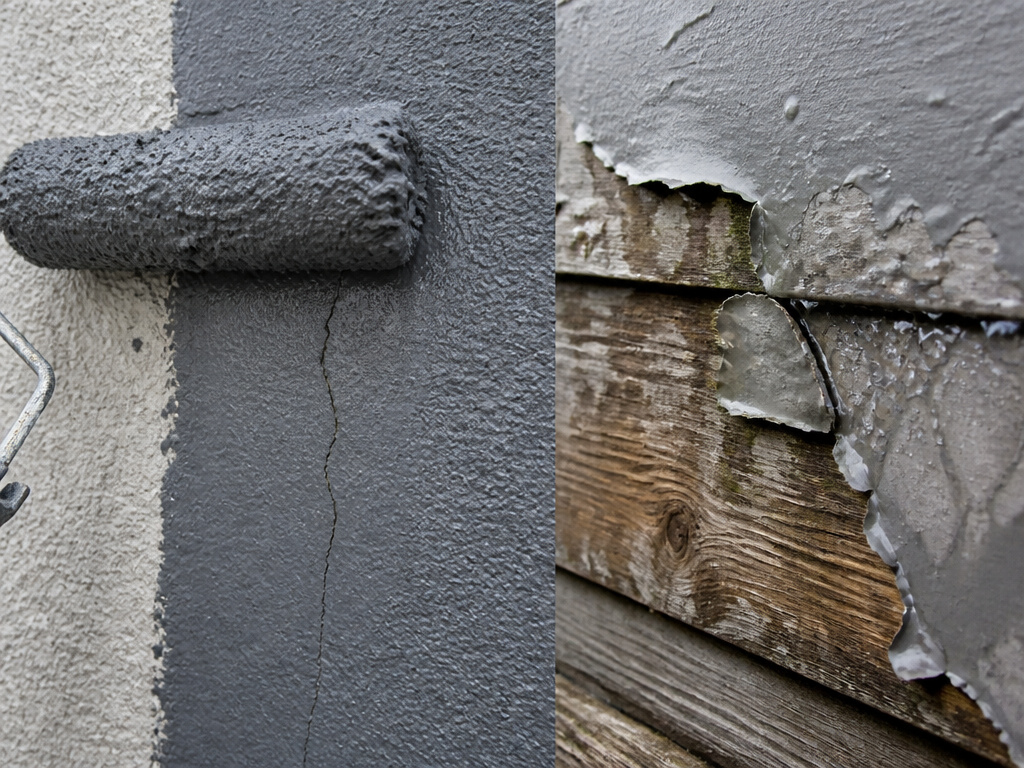
The substrate list settles most of the pros-and-cons arguments, because elastomeric is excellent on some surfaces and the wrong tool on others.
Stucco, Concrete, and Masonry
Stucco, concrete, masonry, and EIFS are the recommended substrates. These are porous, they move with temperature, and they are the surfaces the coating was engineered for. For a deeper look at masonry paint options, that comparison covers the alternatives.
Concrete paint is a similar story, though fresh concrete needs cure time before coating. The SWR Institute warns that applying a coating on fresh stucco or other high-pH substrates may result in blistering, because substrate pH is typically 10 or greater while some coatings only tolerate a pH of 6 or greater.
Wood: Where the Sources Disagree
Wood is the substrate that splits the sources, and the disagreement matters more than the average buyer realizes.
| Substrate | Verdict | Why |
|---|---|---|
| Stucco | Recommended | Porous, moves with temperature |
| Concrete | Recommended | Bridges hairline cracks |
| Masonry/CMU | Recommended with block filler | Needs base coat |
| Wood | Disputed | Traps moisture per Arizona Painting |
| Metal | With primer | Consult manufacturer first |
| Dead-level roof | Not recommended | Water pools, coating fails |
The SWR Institute allows wood with manufacturer consultation. Wilko No. 931.55 claims excellent adhesion to bare wood. Arizona Painting Company says elastomeric is generally not recommended for wood because it is less breathable and can trap moisture. Three sources, three positions. The safe read: on wood, ask the maker before you buy.
Metal, Roofs, and the Primer Question
Metal is possible with the right primer. The SWR Institute says elastomeric may be applied to metal and wood substrates, but the coating manufacturer should always be consulted in advance. Sealbond Bondflex EWB goes further and specifies an epoxy primer for galvanized iron roofing, with three coats and a 2-4 hour undercoating interval.
Roofs are a separate spec entirely. Wilko No. 931.55 markets for sloped roofs but warns against ponding, which is a tension worth knowing before you buy. For products rated for sloped surfaces, elastomeric roof paint covers that category specifically.
How Thick Does Elastomeric Paint Actually Go On?
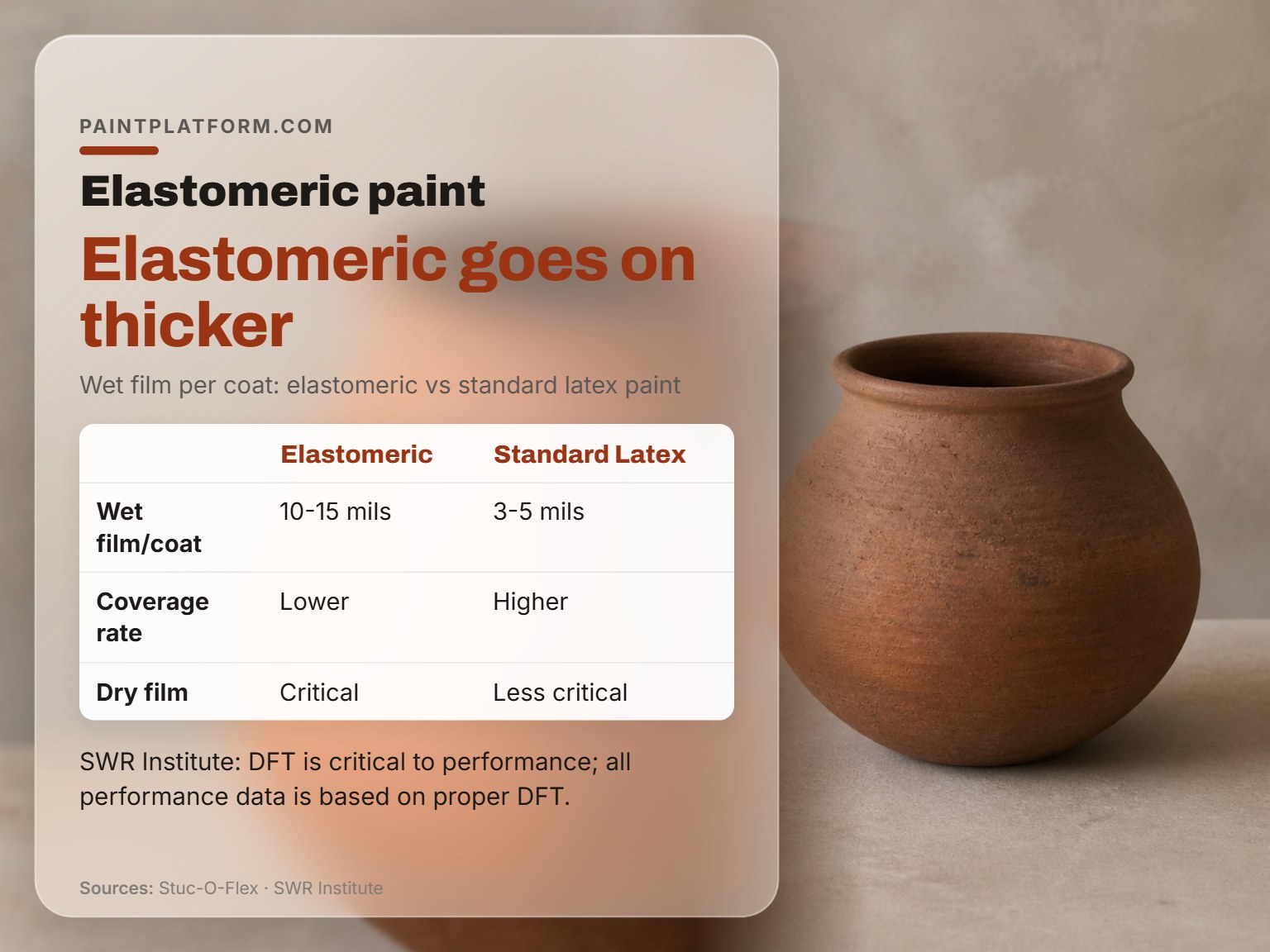
Roughly three times the film build at the low end. That is the number that changes everything about an elastomeric job. Stuc-O-Flex puts elastomeric at 10-15 wet mils per coat versus 3-5 wet mils for standard latex paint.
That is why the same square footage needs more product and why the roller feels different in your hand.
Fair warning: if you have only rolled standard latex, the first pass with elastomeric will feel wrong. It drags, and the roller wants to skip.
Wilko No. 931.55 sets a hard ceiling: do not apply over 10 mils wet per coat. That is a specific product limit, not a universal rule, but it shows why reading the maker’s data sheet matters more than following a generic how-to.
| Metric | Elastomeric | Standard Latex |
|---|---|---|
| Wet film per coat | 10-15 mils | 3-5 mils |
| Dry film | Critical | Less critical |
| Coverage rate | Lower | Higher |
| Product needed | More | Less |
The SWR Institute is blunt about why this matters: DFT is critical to the performance of these coatings, and all performance data is based on the proper DFT. Skimp on thickness and the crack-bridging claim, the wind-driven rain resistance, and the elongation numbers all stop applying to what you actually put on the wall.
The Prep and Weather Rules That Decide the Job
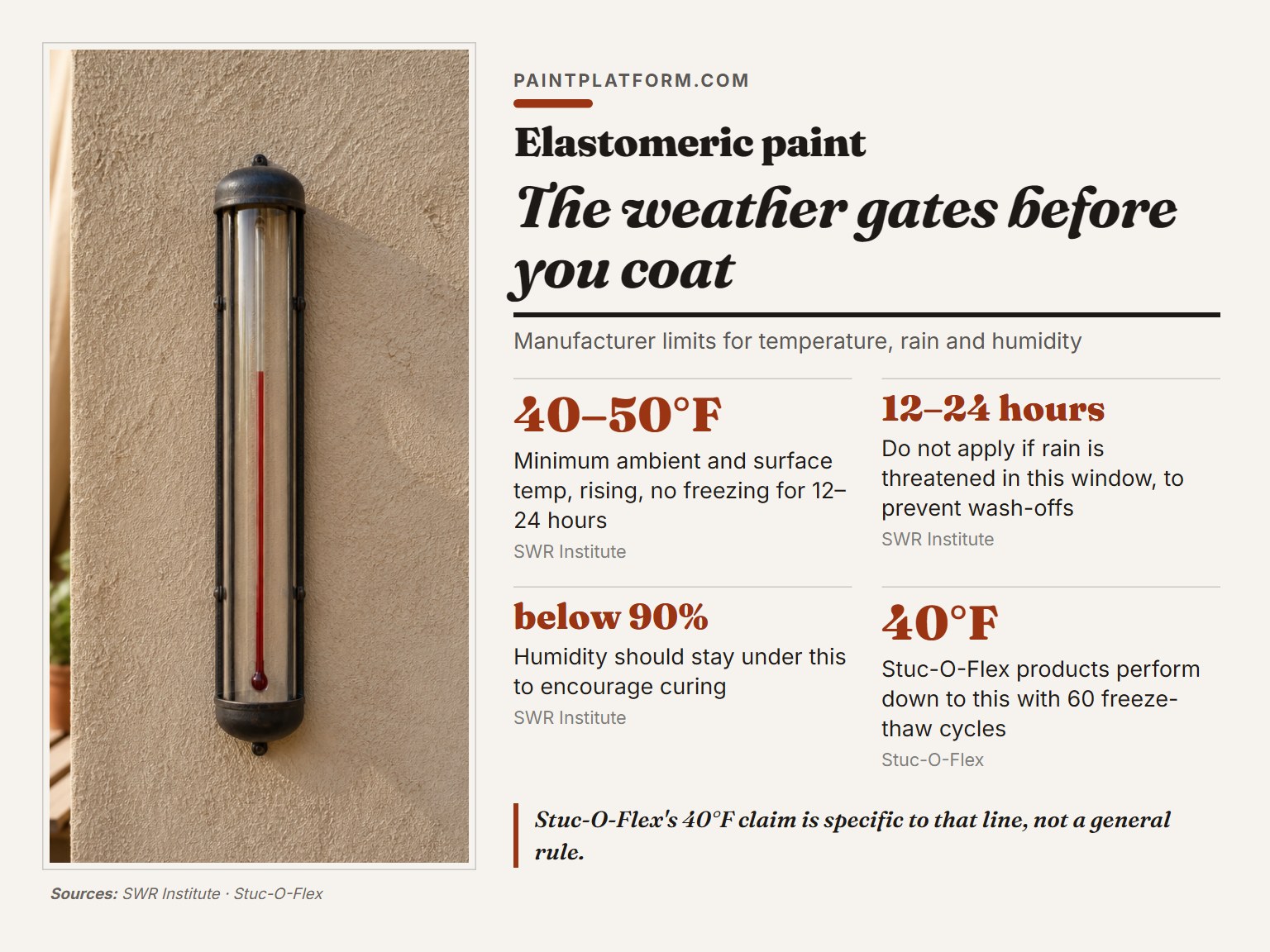
40-50°F and rising, with no freezing threat for 12-24 hours. That is the temperature gate most manufacturers set for elastomeric, per the SWR Institute.
Temperature and Rain Windows
Stuc-O-Flex products perform down to 40°F with 60 freeze-thaw cycles, which is a specific claim for that line, not a general rule. Rain is the second gate. Do not apply if rain is threatened in the next 12-24 hours to prevent wash-offs. Humidity is the third: below 90% to encourage curing.
The 5-Step Prep Sequence
The prep steps run in this order:
- Wash the wall and remove loose paint, dirt, and chalky residue. Skipping this leaves a bond-breaker under the new coating, and the film can peel in sheets.
- Repair cracks and patches before coating. MAPEI specifies Mapeflex EMC-1 for hairline cracks up to 1/16 inch, and larger or structural cracks need proper stucco repair first.
- Treat any mold or mildew, rinse, and let it dry a minimum of 24 hours.
- Prime where the maker specifies it. MAPEI Elastocolor Paint requires two finish coats over primer where specified, and skipping the primer changes the adhesion story.
- Apply at the maker’s wet mils and recoat within the stated window.
The NIST coating service life prediction report breaks coating failure into five root-fault categories: application technique, structure design, manufacturing and processing, material properties, and exposure environment. Only one of those five is about the product itself. The other four are about how and where you put it on.
Peer-reviewed work on coating failures and misapplications makes the same point from the field side, and a polyurea elastomer coating failure case study in a seawater tank shows what happens when film thickness and material spec drift out of agreement.
When to Skip Elastomeric and Use Something Else
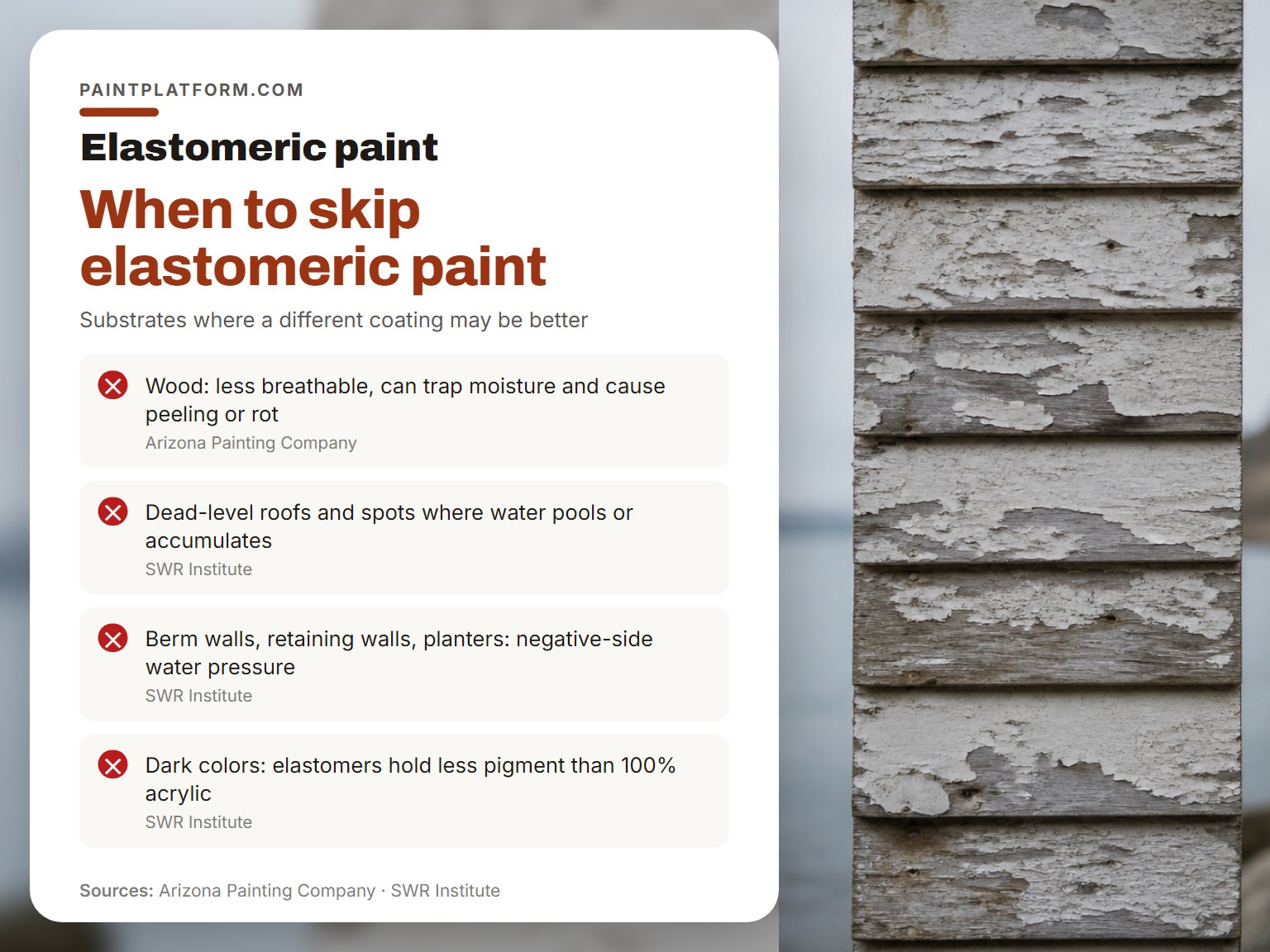
Skip elastomeric on wood if breathability matters more than crack bridging, per Arizona Painting Company, though the SWR Institute allows wood with manufacturer consultation and Wilko claims excellent adhesion to bare wood. An exterior acrylic is usually the better choice for wood trim, fascia, and siding, and the reason is mechanical: wood expands and contracts with moisture, and a less breathable coating traps that moisture inside.
Skip it on dead-level roofs and anywhere water pools, per the SWR Institute and Wilko, though Sealbond Bondflex EWB is recommended for waterproofing roof decks and roof tiles. The SWR Institute is clear that elastomeric wall coatings are not designed for continuous submersion and should not be applied to dead-level substrates where water can accumulate.
Skip it on walls with negative-side water pressure. Berm walls, retaining walls, and planters are explicitly unacceptable substrates because liquid water causes delamination and blistering.
Skip it if you want a dark color the pigment system cannot deliver. The SWR Institute notes that elastomers cannot hold as much pigment as 100% acrylic, so some darker colors may not be available. Check the color card before you commit.
The coating is the raincoat. The wall assembly is the waterproofing. If the wall is already wet, the raincoat just holds the water in.
For a wider view of exterior paint types, that comparison covers where elastomeric sits against latex paint and acrylic paint on the same wall. If you are coating a foundation or garage wall, concrete wall paint has its own set of trade-offs worth reading before you buy.
Frequently Asked Questions
Is elastomeric paint worth the extra cost?
It depends on the substrate and the climate. On stucco, concrete, or masonry in a harsh-weather region, the 10-15 year lifespan versus 5-7 years for standard paint often pays back the higher per-gallon cost. On wood or a wall with active moisture, it is the wrong tool regardless of price.
Can you apply elastomeric paint over existing paint?
Yes, if the existing coating is sound, clean, and compatible.
Does elastomeric paint stop leaks?
It resists wind-driven rain and blocks bulk water from entering the substrate, but Stuc-O-Flex is explicit that a properly formulated elastomeric paint is water-resistant, not waterproof.
How many coats of elastomeric paint do you need?
Most sources say two. MAPEI Elastocolor Paint requires two finish coats over primer where specified. Arizona Painting Company recommends at least two coats for maximum protection. Sealbond Bondflex EWB specifies three coats on galvanized iron roofing, which is a specific product requirement, not a general rule.
What temperature can you apply elastomeric paint?
The SWR Institute says most manufacturers require a minimum ambient and surface temperature of 40-50°F and rising, with no freezing threat for 12-24 hours after application. Stuc-O-Flex products perform down to 40°F, which is a specific claim for that line.
Can elastomeric paint be used on wood?
Sources disagree. The SWR Institute allows wood with manufacturer consultation, Wilko No. 931.55 claims excellent adhesion to bare wood, and Arizona Painting Company says it is generally not recommended because it traps moisture. Ask the specific maker before you buy.
The Bottom Line
Fair warning: the brand on the bucket is not what decides whether an elastomeric job lasts.
One rule most guides skip: if the wall has active moisture behind it, trapped water, or negative-side pressure, stop. Elastomeric cannot rescue a wet wall, and the blistering shows up within a season. Fix the water first, then coat.
If you want one concrete step this week, walk the wall with a hose and watch where water pools or soaks in. That simple test tells you more about whether elastomeric is right for your surface than any spec sheet will.
