
Acrylic Paint Pros and Cons: What Actually Matters
This post contains affiliate links. As an Amazon Associate, we earn from qualifying purchases.
Acrylic paint pros and cons split into speed and sensitivity. Acrylic is dry to touch in 30 minutes and cleans up with water. The same film needs 7 days to fully cure before washing, softens above 70 C, and stays vulnerable to alcohol and aromatic solvents.
That seven-day cure is the part that ambushes hobby painters, because the film feels finished long before it is. The binder is a latex dispersion: polymer particles pack together as the water leaves, then keep fusing into one continuous film for days afterward.
What follows is the honest split. Where acrylic beats oil and alkyd, where it loses, the temperature numbers that decide whether a film survives its first winter, and one ten-minute test you can run before you commit to a whole tube.
Key Takeaways
- Dry to touch in 30 minutes is not cured. The Dulux Professional Interior Acrylic Low Sheen datasheet allows 7 days before you wash the film.
- 70 C is the softening point. Above that, the film sticks to whatever painted surface it touches.
- Alcohol and aromatic hydrocarbons attack acrylic. Mild soap and water is the safe cleaner.
- Cold plus dry air is the cracking combination. At 40 percent relative humidity, some colours went brittle at 5 C; at 5 percent relative humidity, the brittleness threshold rose to 11 C.
- Grade beats brand when you’re starting. According to the learntopaintpodcast blog, student paint costs the same in every colour; professional paint doesn’t, because pigments differ.
The Water-Based Chemistry That Decides Every Acrylic Pro and Con
Acrylic binder is a latex dispersion of polymer particles suspended in water, and that one fact explains most of the pros and cons on this page.
Water-based acrylic paint is a dispersion of acrylic polymer particles in water, typically 20 to 60 percent polymer by suppliers’ figures, alongside 25 to 50 percent pigments and extenders. As the water evaporates, the particles pack together and coalesce into a continuous film. That coalescence continues for days after the surface reads as dry.
Suppliers’ composition data puts water at 10 to 50 percent, pigments and extenders at 25 to 50 percent, acrylic polymer at 20 to 60 percent, additives at 10 to 20 percent, and biocides under 1 percent. Those five numbers are the whole argument in miniature.
| Ingredient | Typical share | What it does |
|---|---|---|
| Water | 10 to 50 percent | Carries the polymer, then leaves |
| Pigments and extenders | 25 to 50 percent | Colour and body |
| Acrylic polymer | 20 to 60 percent | Becomes the film |
| Additives | 10 to 20 percent | Dispersants, thickeners, coalescents |
| Biocides | Under 1 percent | Stops the can spoiling |
The ASTM D5098 acrylic paint specification is what makes a word like “lightfast” mean something. It sets requirements for pigment identification, lightfastness, bleeding, consistency, and drying time, and it explicitly says paints meeting the spec aren’t identical or uniformly excellent.
Which is worth sitting with. Two tubes can both pass and still behave nothing alike.
Tate’s literature review adds a wrinkle: the additives that control flow, open time, and film formation are proprietary and constantly reformulated, and almost nothing has been achieved analytically on their precise identity.
Open a fresh tub and the smell tells you there’s more in there than water and pigment. A 2018 study that ran six artist acrylics through gas chromatography found benzene derivatives with a plastic-like, aromatic, solvent-like odour, plus a butyl acrylate note one panel described as mushroom and geranium leaf.
Thirty Minutes Dry, Seven Days Cured: The Speed Trade-Off
I used to mix big puddles of paint at the start of a session, and by the time I circled back the first one had a skin on it. Now I mix small amounts as I go and waste far less.
The datasheet number is 30 minutes to dry to touch. That’s the fast part, and it’s real. It’s also where most of the confusion starts.
Full cure is 7 days. The same sheet says to allow that long before washing the film. The gap exists because touch-dry only means the water has left the surface. Coalescence, where the packed particles fuse into one continuous skin, keeps going long after.
That gap has a practical cost. The Dulux sheet warns against brushing or rolling back into paint that has been drying for more than 3 minutes. Push past it and you drag a half-formed film instead of laying a new one.
Where acrylic genuinely wins is flexibility. Research on commercial artist paints aged 1 and 27 years found the glass transition temperature of the latex binder sits slightly below normal room conditions, which is why the film ranges from brittle glass to hyperelastic depending on conditions.
Translation: the film bends with the surface instead of sitting on top of it like a shell.
That’s the pro in one line. A flexible film on a wall that expands and contracts is a good film.
Where Acrylic Loses: Heat, Solvents, and Steam
Heat is acrylic’s soft spot, and the ceiling is lower than most painters expect.
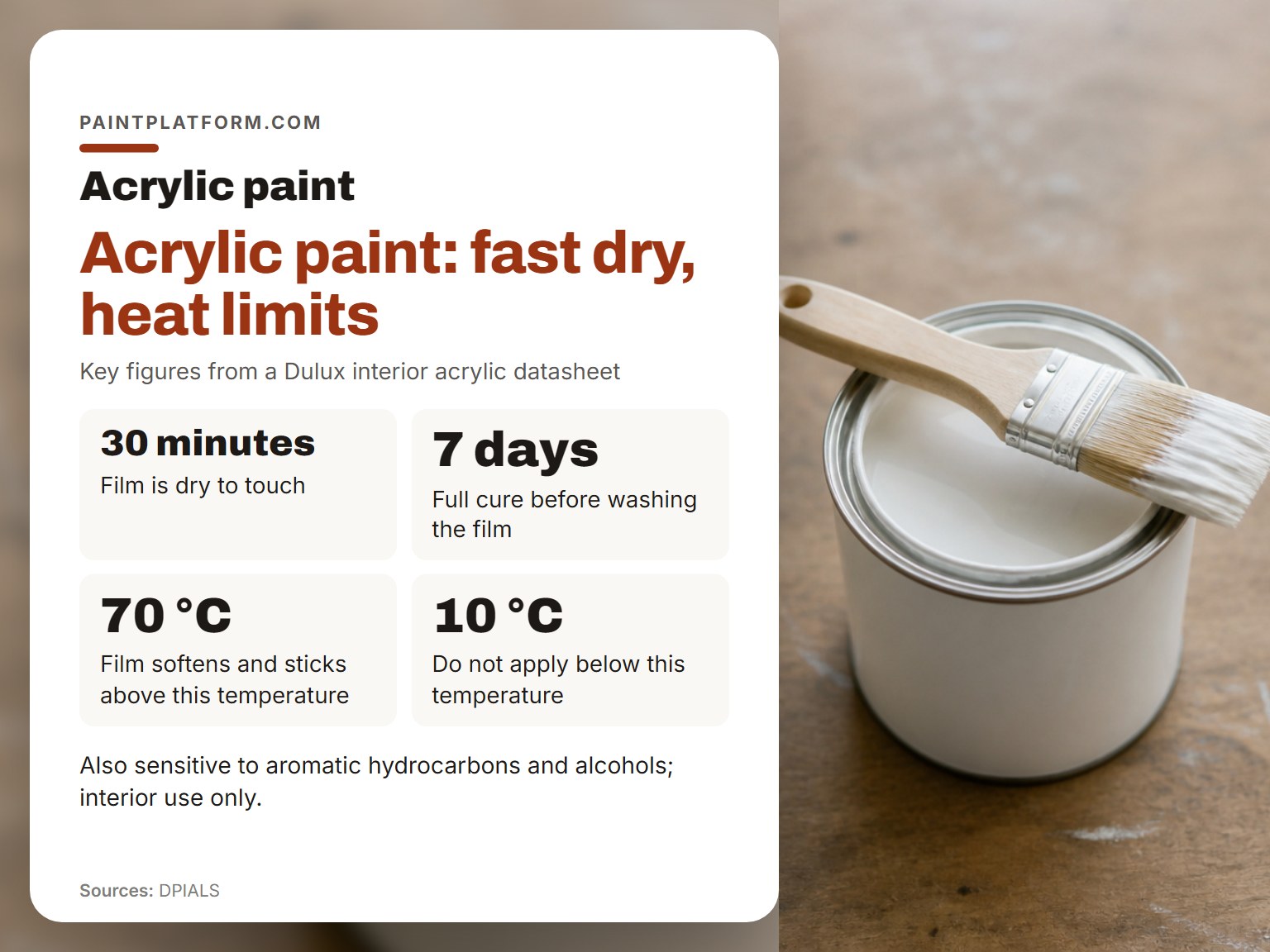
The Dulux datasheet is blunt about it: the film softens and sticks to other painted surfaces above 70 C. That’s a hot car interior, a radiator, a windowsill in direct summer sun, or a pot rested on a painted surface.
Solvents are the other half. The same sheet lists the film as sensitive to aromatic hydrocarbons and alcohols, and Tate’s review notes that acrylic emulsion paints are highly sensitive to the majority of organic solvents and heat, which is exactly why traditional oil-painting conservation treatments don’t transfer.
Here’s what actually attacks a cured acrylic film:
- Alcohols. The datasheet lists the film as sensitive to alcohols.
- Aromatic hydrocarbons. The datasheet lists the film as sensitive to aromatic hydrocarbons.
- Heat above 70 C, above which the film softens and sticks to other painted surfaces.
- Steam and condensation for the first 48 hours, so avoid exposure during that window.
Common mistake: Wiping a fresh acrylic wall with an alcohol-based cleaner to get a scuff off. You’ll take the sheen with it, and the patch will read as a dull smear under a lamp.
On odour, the sources genuinely disagree. Dulux markets the product as low odour. The Frontiers study found 36 odorous compounds across six paints, identified 22 of them, and flagged most as known-harmful, adding that some harmful VOCs have little or no odour at all.
So “low odour” and “low emissions” aren’t the same claim. The Frontiers study on acrylic paint emissions is the one to read if that distinction matters to you.
Why Do Acrylic Films Crack in the Cold?
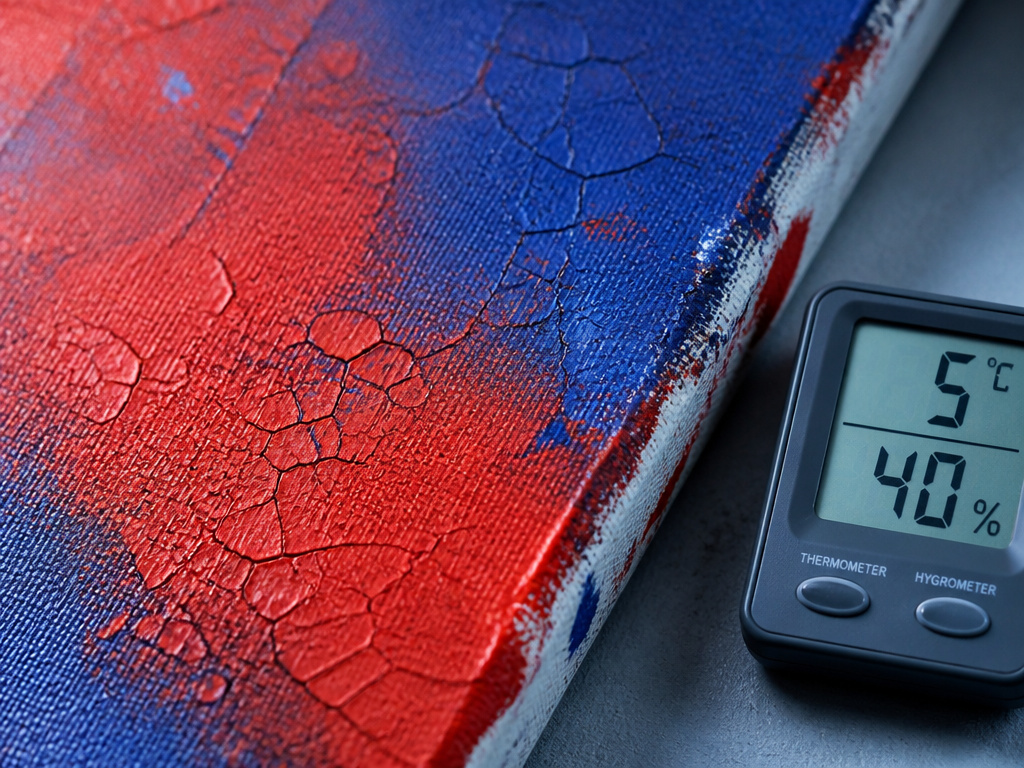
Because cold makes the film stiffer, and dry air makes it stiffer at a warmer temperature than you’d guess.
Erlebacher et al., cited in Tate’s review, found brittleness in some colours at 5 C when relative humidity sat at 40 percent. Drop the humidity to 5 percent and the brittleness threshold rose to 11 C.
That’s the counterintuitive bit. Dry air raises the failure temperature.
The mechanism is straightforward once you see it. Moisture in the film acts as a softener, and the same study found strength and stiffness climbing as temperature and relative humidity fell, particularly at 40 to 50 percent humidity and at or below 15 C. Pull the moisture out and the film stiffens sooner.
Which is why a dry, cold studio in February is worse for a canvas than a damp cold one.
Here the sources point in opposite directions, and both are addressing different moments in the film’s life. Dulux sets a hard floor: don’t apply below 10 C, or if the surface may fall below 10 C while drying. The Smithsonian guide to caring for acrylic paintings goes the other way for storage and display, keeping temperature below standard room temperature to slow film softening.
Application wants warmth so the film can form. Storage wants cool so it stops moving. Neither is wrong.
The part nobody mentions: A cold snap during the drying window is worse than a cold room afterward. The film needs to coalesce first, and it can’t do that below the datasheet’s minimum application temperature.
The Durability Question Has Three Credible Answers
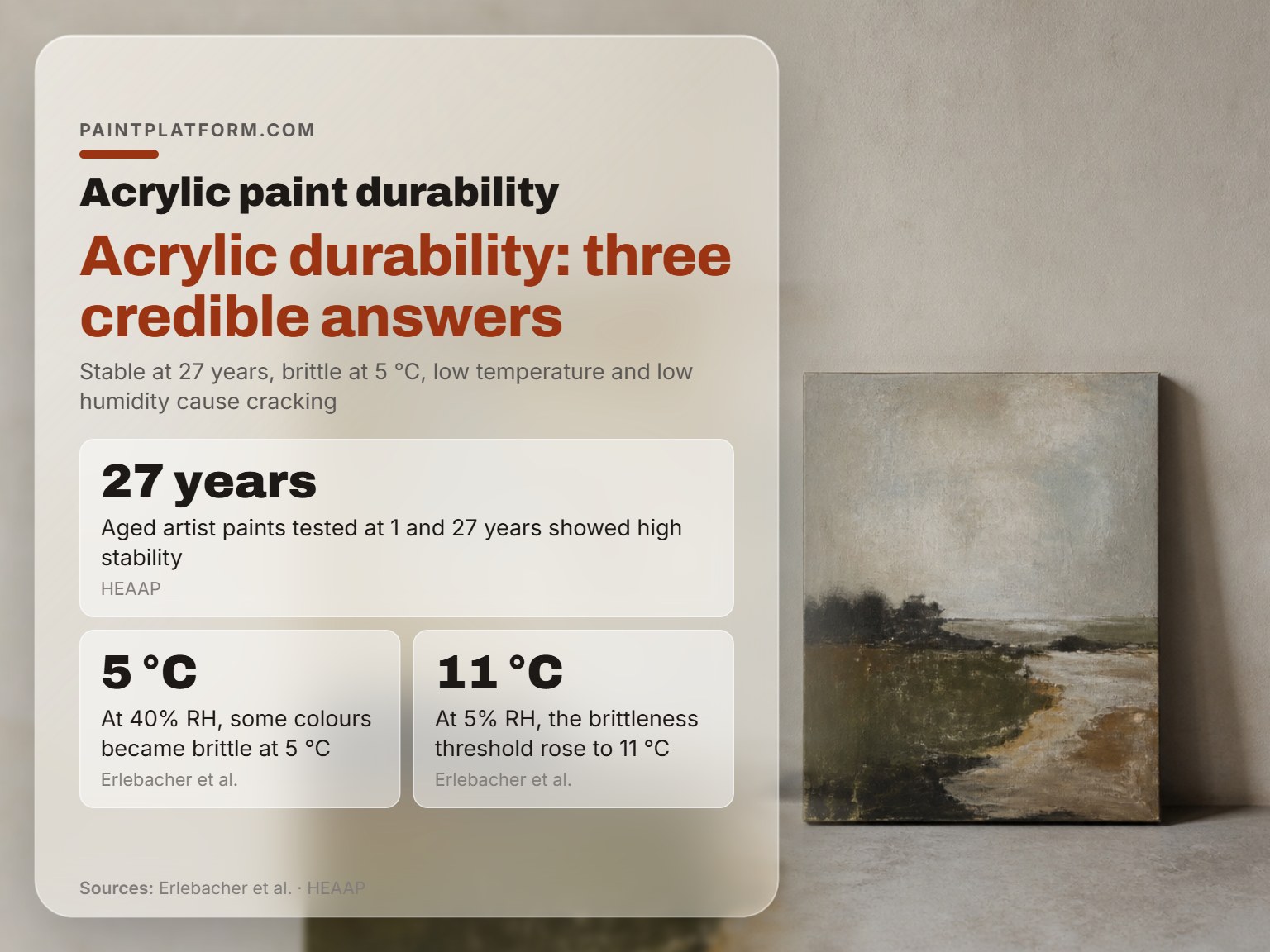
Three credible sources describe acrylic durability three different ways, and none of them is obviously wrong.
Hagan et al. Tested commercial artist paints at 1 and 27 years of age and reported a high degree of stability with age, plus strong similarities in mechanical behaviour between products from different manufacturers. That’s the strongest pro-durability finding in the literature.
Tate’s review, drawing on Erlebacher, documents the opposite failure mode under specific conditions: low temperature combined with low humidity drops elasticity and the film cracks when flexed.
And the Smithsonian’s conservation guidance lands in the middle, noting acrylics develop cracks far less often than oil paintings while still acknowledging that cracks do form.
The Springer study on aged acrylic artist paints is the one I’d hand a skeptic, because 27 years is a real number and the conclusion isn’t marketing.
I’ve stopped treating “acrylic is durable” as one claim. It’s durable against time and durable against nothing at all if you store the work in a dry, cold room and then flex it.
So the honest version of the pro is this: acrylic holds up well over decades in reasonable conditions, and it fails fast in a narrow band of bad ones.
House Paint, Craft Paint, Student Grade, Artist Grade: What the Label Buys You
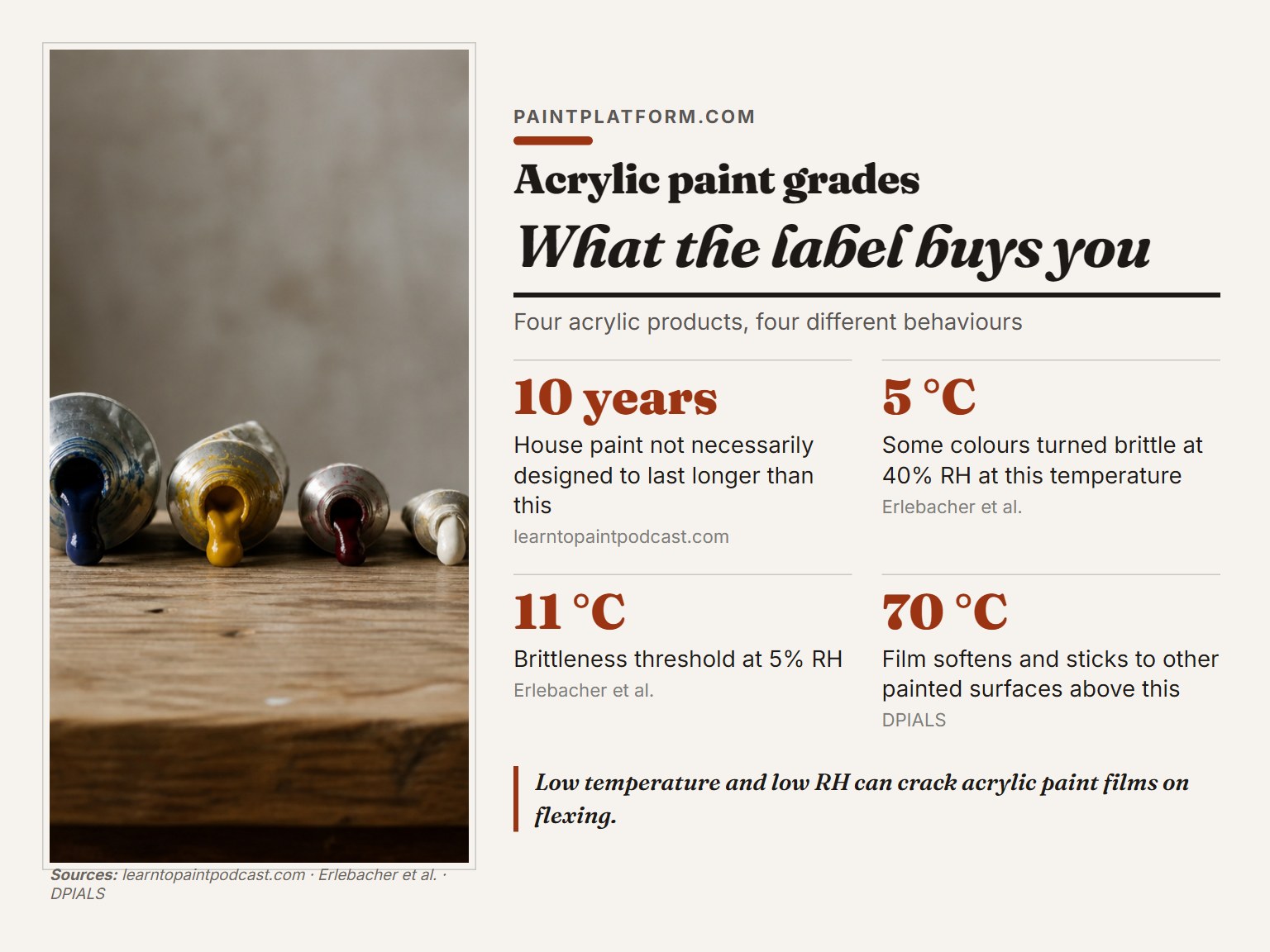
The word acrylic covers four different products that behave nothing alike, and the label tells you which one you’re holding.
House paint is the cheapest route to a lot of colour. According to the learntopaintpodcast blog, it’s also not necessarily designed to last more than about 10 years, and it may fade much faster than other acrylic paints.
Craft paint is the opposite trade. It’s creamy and easy to layer, but according to the learntopaintpodcast blog, thinned down it weakens quickly and turns muddy faster than student or professional grade.
Student grade is the one I’d hand a beginner, and the reason is durability rather than price. According to the learntopaintpodcast blog, it’s designed with longevity in mind, so it won’t fade the way craft and house paint do.
Why Student Grade Costs the Same in Every Colour
According to the learntopaintpodcast blog, in a given brand every student grade colour costs the same, while professional paint prices differ between pigments.
That pricing structure tells you what you’re buying. According to the learntopaintpodcast blog, student paint leans on a higher filler-to-pigment ratio, which makes it more transparent and means a tube doesn’t go as far.
Where Craft Paint Falls Apart
Thinning. According to the learntopaintpodcast blog, craft paint gets weak fast when you add water, and the colour muddies sooner than student or pro grade will.
If you want the longer version of this ladder, the acrylic paint grades breakdown covers what each tier actually buys. And if you’re buying your first set, acrylic paint for beginners is the page that won’t upsell you into a 48-tube box you’ll never open.
I found out the hard way that a paint-and-primer combo isn’t a stain blocker. I rolled it over a brown water ring and the stain bled back through. On a sound, previously painted wall it’s fine, and I still use it there.
Acrylic Paint Pros and Cons Against Oil, Alkyd, Latex, and Enamel
Four comparisons matter here: oil, alkyd, latex, and enamel.
Oil paint gives you a long open time for blending and a slow dry you can work back into for hours. Acrylic gives you the opposite: fast, permanent, and water-cleanable.
Alkyd paint sits between the two, hard and glossy with a solvent cleanup. Enamel paint is the hard-shell option for trim and metal.
Latex paint is the wall category, and it’s where the durability ceiling lives: according to the learntopaintpodcast blog, house paint isn’t built to outlast about a decade.
| Paint type | Reach for it when | Main trade-off |
|---|---|---|
| Acrylic | You want water cleanup and fast recoats | Softens above 70 C, hates alcohol |
| Oil | You need hours of open time | Slow dry, solvent cleanup |
| Alkyd | You want a hard glossy shell | Solvent-based, slower recoat |
| Latex wall paint | You’re covering big interior walls | Per the learntopaintpodcast blog, not designed past about 10 years |
| Enamel | Trim, doors, metal that takes knocks | Hard film can crack on flex |
For most interior walls in a normal house, acrylic wins. It’s the only one on that list you can clean out of a brush in the sink.
How Do You Test a New Acrylic Before Committing?
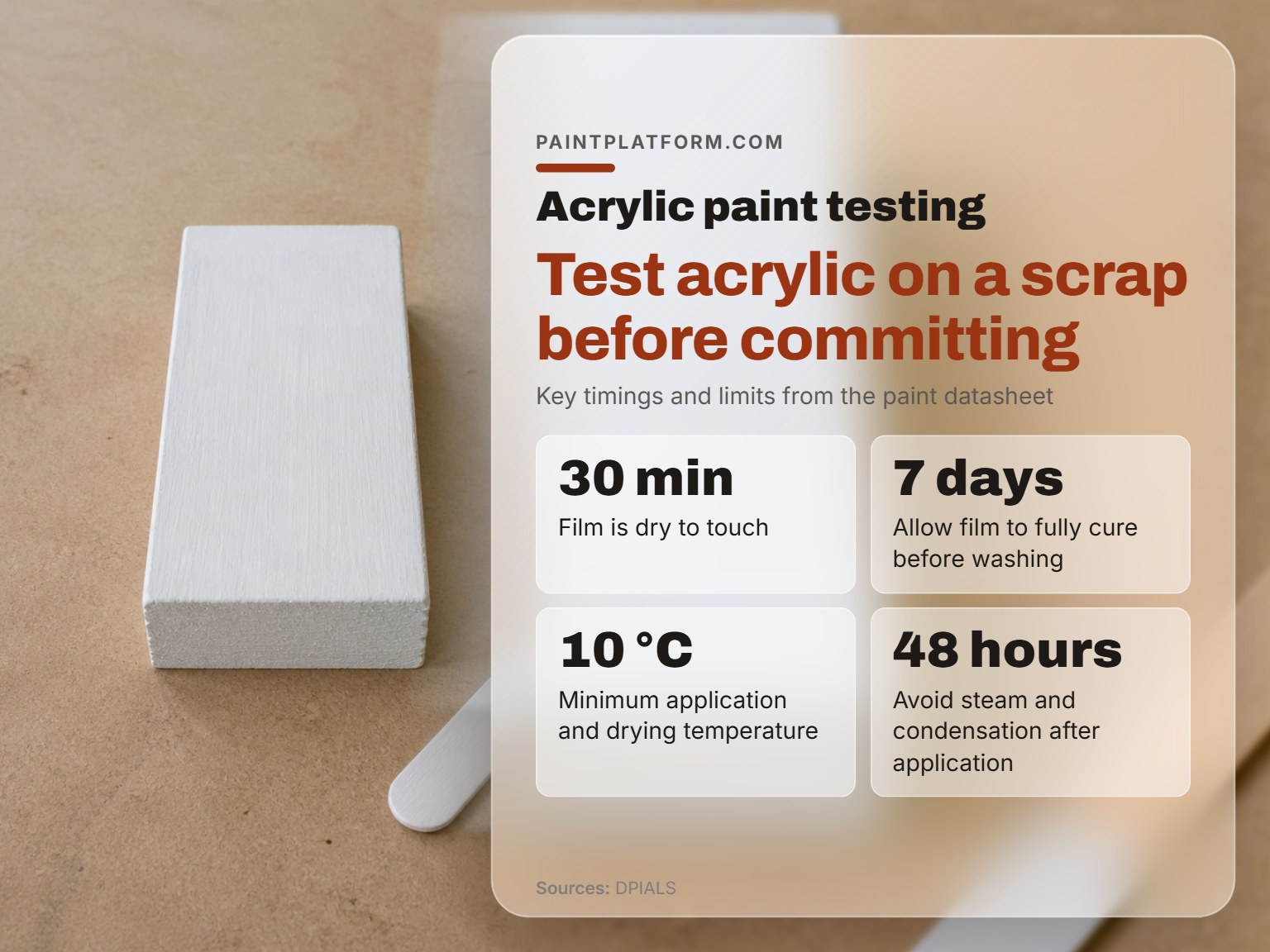
You paint a scrap, wait a week, and try to ruin it. That’s the whole method.
Before you start: Solvent-based cleaners give off vapours, so open a window and crack the door. Keep any solvent-soaked rag away from a pilot light or water heater. Hobby painters report dizziness, headaches, and allergic-like symptoms after long sessions in poor ventilation.
- Grab a scrap of the surface you’ll actually paint. A scrap of drywall tells you nothing about how the paint behaves on primed timber.
- Lay down two coats at the same thickness as the real job. A thin test coat dries faster and hides the problems you’re hunting for.
- Check touch-dry at 30 minutes. If it’s still tacky, the film hasn’t reached the datasheet’s touch-dry time, and the real wall will behave the same way.
- Wait 7 days, then wash a corner with mild soap. Skip the wait and you’ll scrub a film that hasn’t finished forming, and it’ll scuff permanently.
- Wipe a hidden patch with alcohol and watch. If the sheen dulls on contact, keep alcohol cleaners away from the finished surface for good.
I use a stir stick as a thickness gauge now. If the paint clings and globs instead of running off in a thin stream, it’s too thick, and adding thinner a few drops at a time beats overshooting into watery coverage.
Sealing, Thinning, and Two Habits That Keep a Film Alive
Two habits do most of the work: thin sparingly, and seal the colours that show wear.
Thinning Without Breaking the Binder
The Dulux sheet allows up to 100 ml of water per litre to ease application, and under hot conditions up to 60 ml per litre of Dulux Hot Weather Thinner. That’s a ceiling, not a starting point.
Thinning past it costs you film integrity. The pigment load drops and the binder can’t form a continuous skin.
The thinning acrylic paint guide walks the water-only method if you want the slower version.
Sealing: What the Film Actually Needs
Dark colours show marking and scuffing more than light ones. The Dulux sheet’s own advice for a dark colour in a high-traffic area is a higher sheen level or a protective clear coat.
Pick a sealant that won’t attack the film, since acrylic is sensitive to aromatic hydrocarbons and alcohols. The best sealant for acrylic paint comparison covers which formulations are safe over an acrylic base.
One more limitation worth naming: this product is interior only and not recommended for exterior use. Interior acrylic on an exterior wall is a mistake you make once.
Preparation and painting should conform to AS2311, The Painting of Buildings, and APAS approval 0260/3 applies to the White, Deep, Ultra Deep and Extra Bright Bases only. If you’re buying a tinted base, that approval line is worth checking.
Frequently Asked Questions
Is acrylic paint better than oil paint?
It’s faster and easier to clean up, and it stays flexible on a surface that moves. Oil gives you a long open time for blending, which acrylic can’t match without a retarder. Pick based on whether you want working time or drying speed.
Does acrylic paint wash out of brushes?
Yes, while it’s wet. Rinse in tap water before the film forms and you’re done. Once it cures in the bristles, water stops working and you’re into solvent territory, which is worse for the brush.
Can you use acrylic paint outdoors?
Interior acrylic isn’t recommended for exterior use, per the Dulux AUPR00015 datasheet. Exterior acrylics exist as a separate product category with different binders and UV packages. Don’t assume the tube in your hand is one of them.
How long before I can wash a painted wall?
Seven days. Dry to touch happens in 30 minutes, but full cure takes a week, and washing before then scuffs a film that hasn’t finished forming.
Does acrylic paint smell strong?
It can, even when it’s marketed as low odour. One study identified 36 odorous compounds across six artist acrylics, and noted that some harmful VOCs have little or no smell at all. Ventilate regardless of what your nose tells you.
The Bottom Line
The trigger is temperature. If the room can’t hold 10 C while the film dries, don’t start the job, because the film won’t coalesce properly.
The concession is this: everything above assumes a normal interior wall. If you’re working in dry air, the brittleness threshold climbs to 11 C and the whole calculation changes.
So here’s your first step this week. Take one scrap of the surface you plan to paint, put two coats on it, and leave it alone for seven days. Then try to wash it, scratch it, and wipe it with alcohol.
That scrap will tell you more about acrylic paint pros and cons than any spec sheet, including this one.
