
Which Paint Sheen for Ceilings? The Case for Dead Flat
This post contains affiliate links. As an Amazon Associate, we earn from qualifying purchases.
Dead flat is the right paint sheen for ceilings in most rooms. Dunn-Edwards specifies dead flat to beat critical light, and Consumer Reports lists flat and matte as best for ceilings, while MPI stops short of prescribing dead flat and treats gloss choice as a balance between abrasion resistance and hiding power. Go above MPI Gloss Level 1 only on ceilings you actually scrub.
Critical light is the term Dunn-Edwards uses for light that rakes across a ceiling at an acute angle, and it’s the reason a finish that looks calm on a chip turns into a relief map of every roller ridge. A window opposite the wall, a floor lamp aimed up, a hallway sconce: each one throws that raking light and each one punishes sheen.
What follows is the numeric side of the which paint sheen for ceilings question. You’ll get what MPI Gloss Level 1 actually measures, where the data sheets contradict each other about the word flat, and the ceiling situations where dead flat is the wrong call.
Key Takeaways
- Dead flat is the default for ceilings in living rooms, bedrooms, and hallways, per Consumer Reports.
- MPI Gloss Level 1 caps gloss at 5 units at 60 degrees and sheen at 10 units at 85 degrees, tested to ASTM D 523.
- Ceiling data sheets report sheen at 85 degrees only, so their numbers don’t line up with a wall paint’s 60-degree gloss figure.
- Prime first. Dunn-Edwards calls for VINYLASTIC Plus on Level 5 drywall and VINYLASTIC or ULTRA-GRIP on Level 4.
- Wash timing is product-specific: Benjamin Moore K625 says two weeks, PPG 17-45 says 30 days.
What MPI Gloss Level 1 Actually Measures
MPI Gloss Level 1 is the bottom rung of a seven-level scale, and Dunn-Edwards and Consumer Reports would put a ceiling there, while MPI treats gloss choice as a balance between abrasion resistance and hiding power.
MPI Gloss Level 1 describes a traditional matte finish, capped at a maximum gloss of 5 units measured at 60 degrees and a maximum sheen of 10 units measured at 85 degrees. Testing follows ASTM D 523, the standard method for measuring specular gloss on paint films at both angles.
The UH master spec Section 099123 adopts that scale wholesale, which is why the numbers are worth learning. Two angles, two numbers, and both of them matter.
| MPI Gloss Level | Gloss at 60 degrees | Sheen at 85 degrees |
|---|---|---|
| Level 1 (traditional matte) | Max 5 units | Max 10 units |
| Level 2 (velvet) | Max 10 units | 10 to 35 units |
| Level 3 (eggshell) | 10 to 25 units | 10 to 35 units |
| Level 4 (satin) | 20 to 35 units | Min 35 units |
| Level 5 (semi-gloss) | 35 to 70 units | Not listed |
| Level 7 (high gloss) | More than 85 units | Not listed |
Here’s where it gets slippery. MPI standardized the scale because names like eggshell and velvet mean different things at different manufacturers, and the ceiling paint sheen labels on the shelf still carry that drift.
Then the trap: ceiling data sheets report a single sheen figure at 85 degrees and no 60-degree gloss at all. Benjamin Moore K625 reads flat at 3.5 to 5.5 at 85 degrees. PPG Bright Ceiling Paint 17-45 reads 0 to 3 at 85 degrees. Sherwin-Williams Eminence A27W03815 reads 0 to 5 at 85 degrees.
Those three numbers can’t be compared to a wall paint’s 60-degree gloss figure. Different angle, different measurement, different animal.
Sherwin-Williams makes the point directly. Gloss is measured at 60 degrees and sheen at 85 degrees, five degrees off the surface plane, and both numbers describe how a finish behaves. A ceiling product that publishes only one of them is telling you half the story.
Which Paint Sheen for Ceilings? What the Manufacturers Specify
Ask four manufacturers which paint sheen for ceilings they recommend and you get four answers that don’t quite match. Four answers, none identical.
What Dunn-Edwards Specifies
Dead flat, and the reasoning is mechanical rather than aesthetic. Dunn-Edwards warns that topcoats with angular sheens let critical lighting magnify surface imperfections. Their recommended ceiling products are all dead flat: ULTRA-SCRUB (ULSB10), SPARTAWALL (SWLL10), SPARTAZERO (SZRO10), ACRI-WALL (ACWL10), and VERSAFLAT (W6240).
They also name a color, DEHW08 Classic White, on the grounds that it improves hide and makes a room look larger.
What MPI and Consumer Reports Say
MPI stops short of prescribing dead flat. Its position is that ceilings have essentially no contact, so hiding minor imperfections matters less than on a high-traffic wall, and gloss choice becomes a balance between abrasion resistance and hiding power.
Consumer Reports lands closer to Dunn-Edwards. Flat and matte are best for ceilings, living rooms, bedrooms, and anywhere without much wear and tear.
I’ll say the quiet part. If your ceiling has a window throwing light across it, the manufacturer who says dead flat is right and the standard that says “balance” is answering a different question. Balance matters on a wall you touch. Nobody touches a ceiling.
Where the Ceiling Paint Data Sheets Land
Benjamin Moore’s flattest product is Waterborne Ceiling Paint (N508), described as ideal for ceilings and very low-traffic areas. Valspar 4000 Ceiling Paint dries to a matte finish that reduces reflection and glare in all lighting conditions.
So the range across the industry runs from “dead flat, and here’s why” to “matte, and it’s fine.” None of the ceiling products covered here recommends a satin or semi-gloss finish.
The paint finishes for ceilings shortlist is narrower than most people expect, and the flat vs matte distinction is smaller than the label suggests.
Why Critical Light Wrecks a Satin Ceiling
Picture a wall with a window opposite it. Late sun comes in low, rakes across the ceiling, and every roller ridge you thought you’d smoothed stands up in relief.
Fair warning, I’ve done exactly this. I picked satin off a small chip because it looked soft and pretty, and on a full wall with a window across from it, it turned into a mirror for every roller mark. Now I paint a sample board and look at it morning and evening before I commit.
The mechanism is simple. Light hitting a surface at an acute angle skims along the film instead of bouncing straight back, so any ridge, lap mark, or thin spot casts a small shadow. The glossier the film, the sharper that shadow reads.
Dunn-Edwards calls this critical light and treats it as the primary reason to go dead flat. That’s the whole argument in one sentence.
A flat film scatters that raking light in every direction, so the shadow gets diluted. A satin film reflects it in a narrower cone, so the shadow survives.
Lower sheen buys you tolerance for a bad surface. Higher sheen buys you scrub resistance. On a ceiling, you’re buying the first one.
If you’re still weighing low sheen vs high sheen for the walls in the same room, keep the two decisions separate. A wall you brush past and a ceiling you never touch don’t need the same answer.
Where this goes sideways: Judging sheen from a paper chip in your hand. Chips are small and flat, so they show color and hide everything else. You find out the truth once the second coat dries and the light hits it, and fixing it means sanding back and re-priming.
What Does a 2×3 Foot Sample Board Tell You?
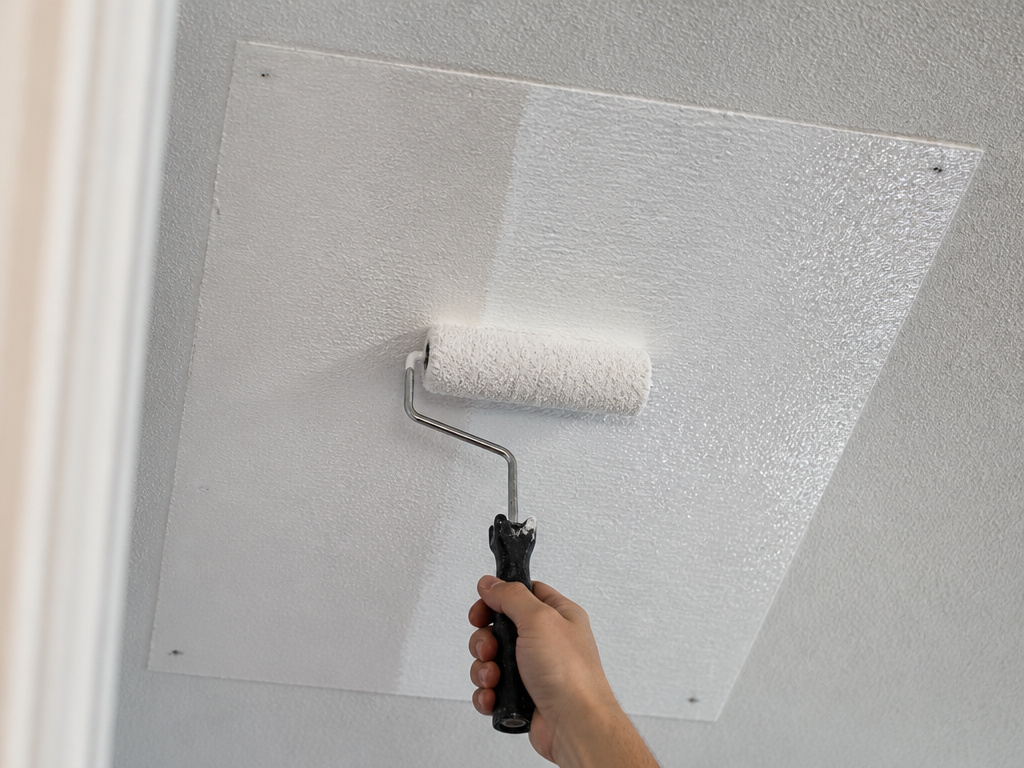
A sample board is a useful way to judge sheen, and it costs you a scrap of drywall.
Tape it flat to the ceiling rather than propping it on a wall. Sheen reads differently overhead, and a board on a wall is testing a different question.
What the board shows you, if you look properly:
- Roller texture under raking light. Stand at the doorway and look across the board, not at it.
- Whether the hide is real. One coat lies. Two coats at the data sheet spread rate tell you the truth.
- How the color shifts with the light. Morning and evening give you two different colors from the same paint.
- Whether you can live with it. Some people find dead flat slightly chalky in a bright room, and that’s a preference, not a defect.
If you want a touch more depth than dead flat gives you, the paint sheen guide for every room walks through what each step up the scale looks like.
Try this: tape the board up before you buy the gallon, not after. Ten minutes of walking past it beats a weekend of re-coating.
Where Dead Flat Is the Wrong Answer
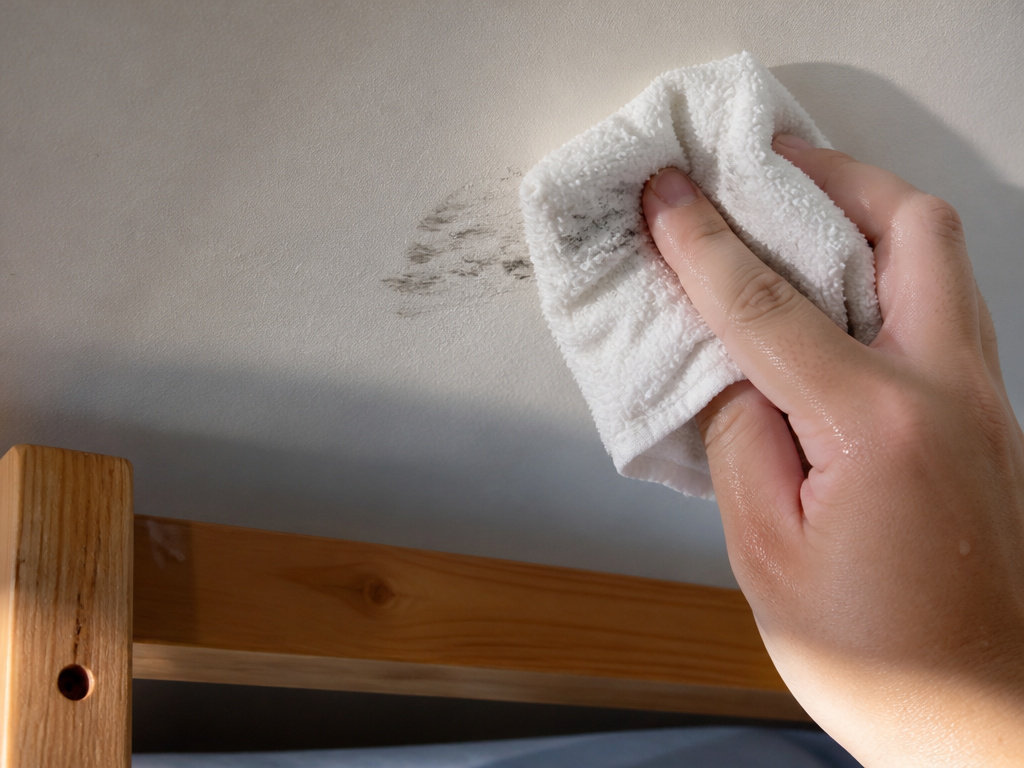
Dead flat is wrong on any ceiling that actually gets touched or scrubbed, and that’s a narrower category than most people think.
Consumer Reports is blunt about the trade-off. Flat and matte are the least stain resistant finishes, per engineer Rich Handel. Benjamin Moore adds the burnishing warning, noting that constant rubbing or cleaning of low-sheen flat paint can leave a shiny patch.
So the exception isn’t “high-traffic room.” It’s “ceiling somebody wipes.” Ceilings get wiped, or they don’t.
| Ceiling situation | Sheen to use | Why |
|---|---|---|
| Living room, bedroom, hallway | Dead flat | Nothing touches it, so raking light is the only risk |
| Ceiling above a bunk bed | Matte or low-sheen flat | Handprints and scuffs need to wipe off |
| Ceiling near a kitchen range | Matte | Grease film needs a cleanable surface |
| Ceiling with water stains | Dead flat, after the leak is fixed | Stain-blocking primer goes on a dry, repaired surface |
That last row is the one people get wrong. Dunn-Edwards is explicit: repair the leak before you apply a stain-blocking primer. Sealing over a live leak traps the moisture and the mark can bleed back through.
The rule of thumb: match the sheen to the contact, not the room name. A ceiling in a busy hallway still gets zero contact. A ceiling above a top bunk gets plenty.
If you want the product shortlist rather than the sheen decision, the flat ceiling paint picks cover the dead-flat end properly.
Prime, Temperature, and the Numbers That Void a Good Topcoat
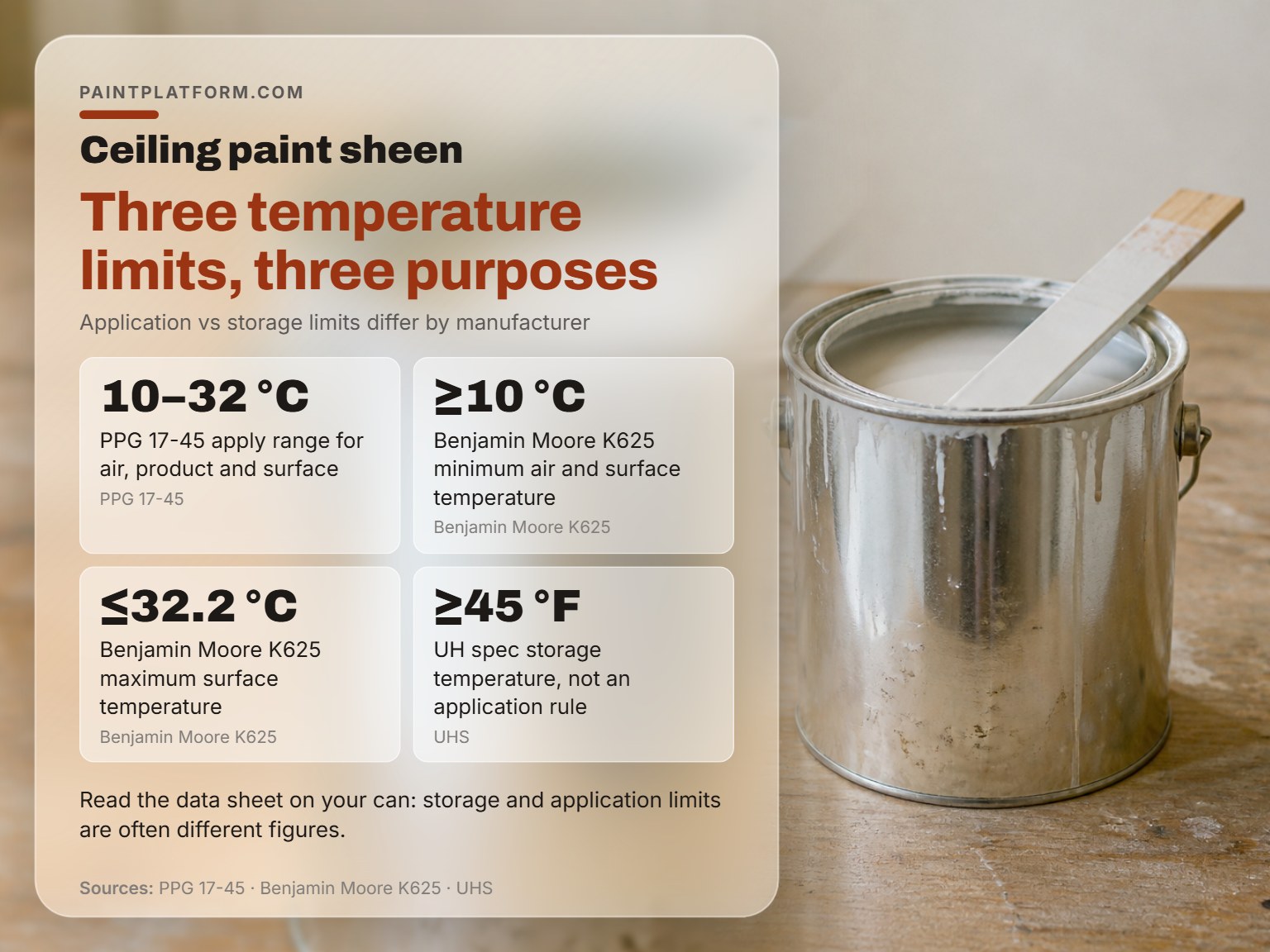
Temperature and primer decide whether dead flat cures to an even film or dries patchy, and the data sheets don’t agree on the floor.
Benjamin Moore K625 says do not paint when air and surface temperature is below 10 C (50 F), with a maximum surface temperature of 32.2 C (90 F). PPG 17-45 says apply when air, product, and surface temperatures sit between 50 F (10 C) and 90 F (32 C). The UH spec takes a third position, requiring storage at not less than 45 F, which is a storage rule rather than an application rule.
Three different numbers for three different purposes. Read the one on your can.
Before you start: Scraping or sanding old paint can release lead dust, which is toxic, especially to children. Wear a NIOSH-approved respirator, clean up with a HEPA vacuum and a wet mop, and keep pregnant women out of the room. Sanding a dried film can also release crystalline silica, so ventilate the space or wear a respirator.
The prep order that actually holds up:
- Fix any water stain at the source first. Dunn-Edwards is explicit that the leak gets repaired before a stain-blocking primer goes on.
- Prime bare drywall before the finish coat. Dunn-Edwards calls for VINYLASTIC Plus on Level 5 drywall and VINYLASTIC or ULTRA-GRIP on Level 4.
- Check the substrate. PPG wants new concrete and masonry cured at least 30 days, preferably 90, with pH below 10 before priming.
- Check the temperature against the can, not against the forecast. A surface in direct sun runs hotter than the air around it.
I’ve stopped trusting the number on the can and started reading the data sheet, because the storage limit and the application limit are often two different figures from the same manufacturer.
The ceiling paint types breakdown is worth a look here, since a specialty ceiling product can carry a different temperature window than a general wall paint.
Easy to miss: Wash timing is not universal. Benjamin Moore K625 says painted surfaces can be washed after two weeks. PPG 17-45 says wait at least 30 days before cleaning with a non-abrasive, mild cleanser. Scrubbing at day 15 on the PPG product dulls the film permanently.
How to Apply Dead Flat Without Sheen Bands
Three things cause sheen bands on a ceiling: an uneven film thickness, a dry edge you rolled back into, and a spray pattern that overlapped wrong.
- Uneven film. Thin spots read darker under raking light, so keep the same spread rate across the whole lid.
- A dry edge. Paint sets faster than you expect, and rolling back into a half-dry edge leaves a ridge.
- A bad spray overlap. Dunn-Edwards calls for a crisscross, overlapping pattern when airless spraying, specifically to avoid sheen uniformity issues.
Rolling follows the same logic. Valspar 4000 Ceiling Paint dries to a matte finish that reduces reflection and glare in all lighting conditions.
The dry-edge problem is the one that catches DIY painters. It’s also the one that catches people who paint for a hobby.
I learned a version of this the hard way with a painting I kept fiddling with after it was actually done. The fresh color turned to mud. Now I step away when the urge hits, and most of the time it was finished already. Ceilings work the same way. Stop while the film is still open.
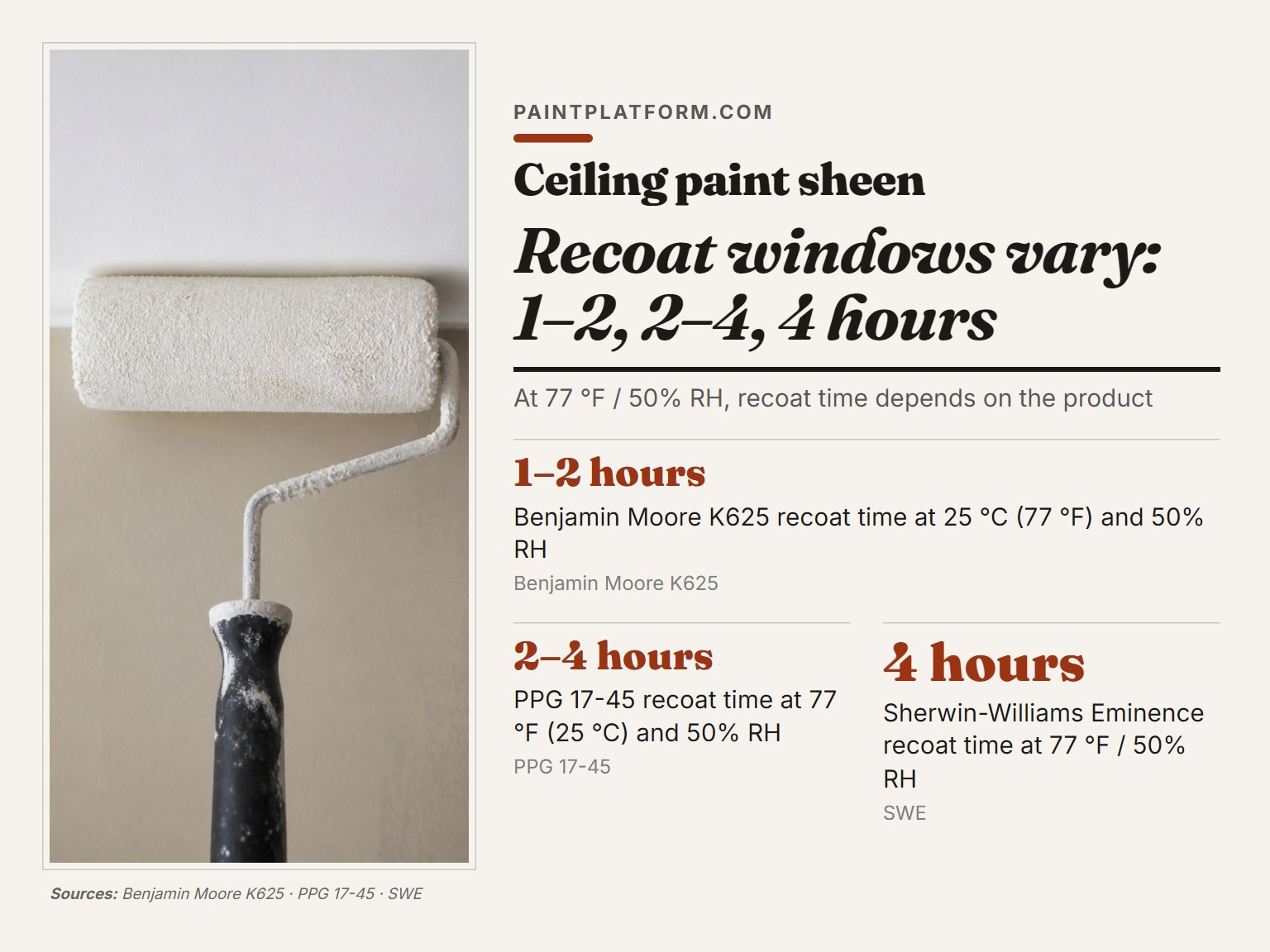
Recoat windows vary enough to matter. Benjamin Moore K625 is 1 to 2 hours at 25 C and 50 percent relative humidity. PPG 17-45 is 2 to 4 hours at 77 F and 50 percent relative humidity. Sherwin-Williams Eminence is 4 hours at the same conditions.
That spread is real, and pushing a second coat early on a slow product traps solvent and softens the first.
If you want the full technique, the guide on how to avoid ceiling streaks walks the cut-in and roll sequence in order.
Frequently Asked Questions
Is flat or matte better for a ceiling?
Both work, and the difference is smaller than the labels suggest. Consumer Reports groups flat and matte together as best for ceilings and low-wear rooms. Dunn-Edwards goes further and specifies dead flat specifically, because a dead-flat film scatters raking light and hides surface imperfections better than a low-sheen matte does.
Can I use eggshell on a ceiling?
You can, and you’ll probably regret it in a room with a window opposite the ceiling. MPI Gloss Level 3 eggshell runs 10 to 25 units of gloss at 60 degrees, well above the Level 1 ceiling of 5 units. That extra reflectivity is what turns roller ridges into visible shadows under critical light.
Does ceiling paint sheen matter if the ceiling is textured?
Less than it does on a smooth ceiling, but it still matters. Texture breaks up raking light on its own, so a low-sheen matte survives better there than it would on a smooth ceiling. Dead flat is still the safer choice if the room has strong directional light.
How soon can I wash a painted ceiling?
It depends on the product, and the two data sheets disagree. Benjamin Moore K625 allows washing after two weeks. PPG 17-45 asks for at least 30 days before cleaning with a non-abrasive, mild cleanser. Check your own can rather than assuming.
Why does my ceiling show roller marks even with flat paint?
Flat paint reduces the shadow but doesn’t erase it. Uneven film thickness, a dry edge rolled back into, or a spray pattern that overlapped wrong will all show through a dead-flat film under raking light. Dunn-Edwards recommends a crisscross, overlapping pattern for spraying for exactly this reason.
The Bottom Line
One concession before you buy: everything above assumes a ceiling with reasonably even light. If yours sits under a window with no direct sun and no uplighting, a matte will look nearly identical to a dead flat and you can choose on availability instead.
The trigger to switch off dead flat is contact. If you can reach the ceiling from a top bunk, if it sits near a range hood, or if you’ve already wiped a mark off it once, go to a matte or low-sheen flat.
For everyone else, buy the dead flat, prime the drywall properly, and stop rolling while the film is still wet.
