
What Causes Paint to Chalk: UV, Binder, and Moisture
This post contains affiliate links. As an Amazon Associate, we earn from qualifying purchases.
What causes paint to chalk is ultraviolet light breaking down the binder, the resin that holds pigment particles in place. Once that resin degrades, the exposed pigment sits loosely on the surface and wipes off as a fine powder. Moisture, pollution, and heat speed the process.
Binder is the part of paint nobody photographs. It’s the clear film that locks pigment to the wall, and it’s the first thing sunlight attacks. Break that film down and the pigment has nothing left holding it.
What follows covers the four conditions that drive chalking, how to tell chalk from dirt and from plain colour fade, and where the published repaint intervals flatly contradict each other. By the end you’ll know whether to wash, repaint, or leave the wall alone.
Key Takeaways
- UV light is the primary driver. It degrades the binder and frees the pigment, and Dulux notes all paints are affected to some degree over time.
- Some chalking is normal. AS 3730 (2006) sets an acceptable deterioration level for exterior latex, which means a chalky wall can still be within spec.
- A finger rub is not proof. Dirt, salt spray, and pollution leave similar residue, which is why ISO 4628-6:2023 uses a tape method instead.
- Repaint intervals disagree. Queensland’s BU633 says 7-10 years, Purdue says up to 10 with two top coats, and the NPS says 7 on bare wood.
- Moisture outranks sun on wood. Purdue Extension names it the most common cause of premature paint failure.
What Causes Paint to Chalk?
Ultraviolet radiation from sunlight hits the binder in the film and starts breaking chemical bonds. Dunn-Edwards describes the mechanism as free radicals forming inside the film under prolonged UV, moisture, or chemical exposure, and those radicals go on to damage the binder itself.
Chalking is defined in AS/NZS 2310:2002 as the appearance of a loosely adherent fine powder on the surface of a paint film, arising from the degradation of one or more of its constituents. The powder is pigment that has lost the resin holding it, and it wipes away on a cloth or a fingertip.
Five conditions drive that degradation, and they stack on top of each other:
- UV radiation. The dominant driver, and the one you cannot remove from an exterior wall.
- Moisture. Rain and dew from outside, plus vapour moving from a warm interior toward a cold exterior.
- Heat and thermal movement. Queensland’s BU633 notes darker colours cause greater thermal movement of the substrate through heat absorption.
- Pollution load. Sulphur dioxide and nitrogen oxides combined with humidity and UV appear as a weathering cause in Jinwei’s defect manual.
- Application faults. Wrong hardener ratio, coats applied too thick, and recoating over a chalky surface all show up in that same manual.
Worth flagging: Jinwei’s document is written for automotive refinish, not house paint. The chemistry transfers because the binder problem is the same, but I wouldn’t quote it as an exterior-architecture source. Treat it as a list of mechanisms rather than a spec.
Why the Binder Fails Before the Pigment Does
Picture a south-facing wall in its fourth summer. The colour still looks right from the street. Run a finger along it and the fingertip comes back white.
That smear is pigment that used to sit inside a resin film. The resin degraded and the pigment simply outlived it.
Free Radicals, in Plain English
Sunlight carries enough energy to snap molecular bonds in the binder, and the fragments left behind are highly reactive. Dunn-Edwards calls these free radicals and notes they keep damaging the rest of the film after they form.
Moisture and certain chemicals generate the same radicals. That’s why a shaded wall near the coast still chalks even without direct sun.
What Colour Fade Looks Like Without Chalking
Dunn-Edwards draws a line worth remembering. In true colour fade with no chalking, the binder has not degraded, so film performance and gloss are typically unaffected. The paint changed colour and nothing else happened to it.
Chalking runs a different course. The film loses binder, the surface goes matte and powdery, and the gloss leaves with it.
The three-part paint composition is the key to all of this: pigment for colour, binder for the film, carrier to get it onto the wall. Chalking is a binder story from start to finish.
I’d stop chasing pigment quality for exterior work. The binder is what fails, and a premium pigment sitting in a weak binder chalks just as fast as a cheap one.
I’ll be honest about my limits. I paint on paper and canvas far more than on siding, and I’m not the person to ask about long-term pigment permanence. What I can tell you is that the binder-first explanation holds on a sketchbook page too.
The NIST fading study exposed panels facing south at 45 degrees from horizontal and measured accelerated-weathering speed-up factors ranging from about 3 times for a chrome yellow paint to about 20 times for a para-red tinted one. Fading and chalking run on different clocks, which is why one can outpace the other on the same wall.
Why Moisture Beats Sunlight on Wood
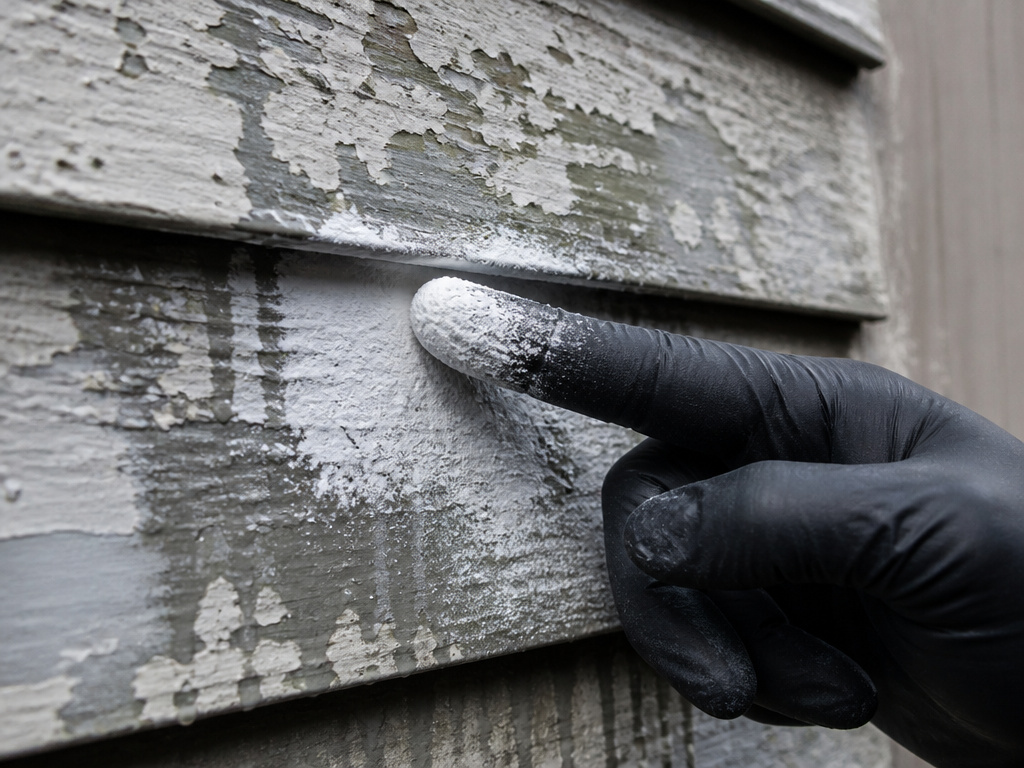
Purdue Extension names moisture as the most common cause of premature paint failure on wood. That single line reframes most chalking questions.
Their reasoning is that exterior walls take water from two directions. Rain and dew hit from outside, and unseen vapour moves from the warm interior toward the cold exterior. Both paths end at the same film.
Dulux frames the same phenomenon differently, pointing at UV degradation of the binder as the chalking driver. Dunn-Edwards splits the difference by listing prolonged UV, moisture, and certain chemicals together as radical generators.
On wood, chase the water before you chase the sun. A wall that stays damp will chalk, blister, and peel no matter which UV-resistant system you put on it.
That’s my read of the disagreement, not a manufacturer’s line. Both sources are credible, and they’re describing different failure paths that happen to end in the same white powder.
The NPS exterior woodwork painting guide documents the clearest case I’ve found. Paint applied at Gallaudet College in 1980 started peeling within a year, and by 1984 the failure was extensive. Investigators attributed it to excessive wall moisture, the wrong paint system, and cold-weather application, all three at once.
How Do You Tell Chalk From Dirt, Fade, and Chalk Paint?
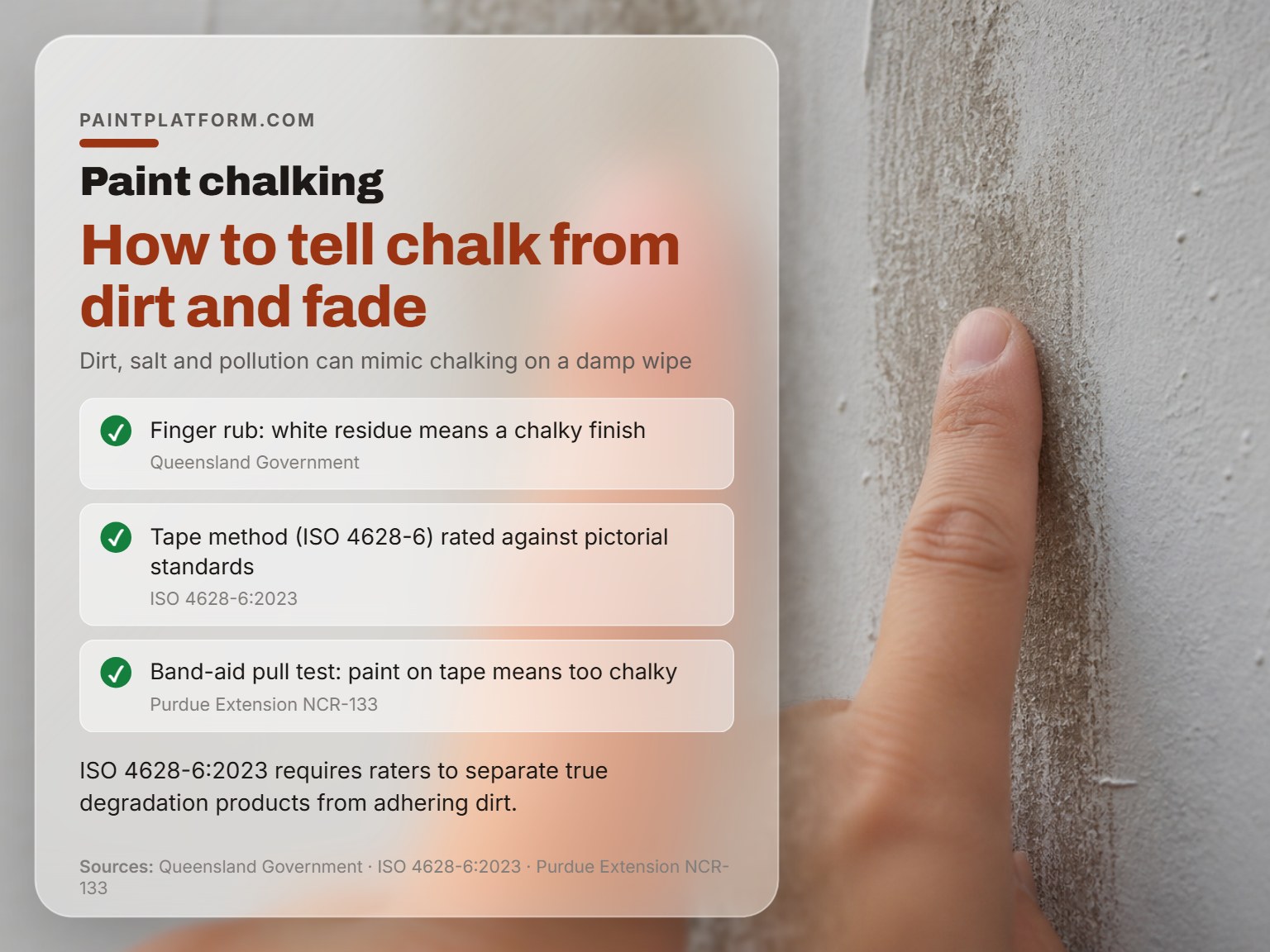
Ever wiped a wall with a damp rag and gotten a grey smear you couldn’t identify? That smear is the whole diagnostic problem in one swipe.
Dulux is blunt about it. Residue on a damp cloth may simply be dirt, dust, grime, industrial pollution, or salt deposits with no relation to the coating. ISO 4628-6:2023 makes the same point from the other direction, warning that raters must separate true degradation products from adhering dirt, especially when chalking is slight.
The ISO 4628-6:2023 paint defect standard is the fourth edition, published in October 2023, and it runs to five pages of pictorial reference cards.
| Method | What it shows | Watch out for |
|---|---|---|
| Finger rub | White residue means a chalky finish | Dirt rubs off the same way |
| Damp cloth wipe | Residue colour and volume | Salt and pollution mimic chalk |
| Black cloth rub | Contrast makes light chalk visible | Needs a genuinely clean patch |
| Tape method (ISO 4628-6) | Rated against pictorial standards | Requires the reference cards |
| Band-aid pull test | Whether new paint will bond | Needs a two-day cure first |
The finger rub is the fastest field check, and it’s the one Queensland’s BU633 uses: rubbing a finger over the paint leaves a white residue, so repaint, whereas Dulux notes some chalking is expected and not necessarily a repaint trigger. The catch is that a dirty wall passes the same test.
The Test That Actually Settles It
If you’re about to spend a weekend repainting, the tape pull test from Purdue NCR-133 is worth the two-day wait. Clean the surface, paint a small test patch, let it dry at least two days, then press a band-aid type adhesive bandage on and snap it off. Paint on the tape means the old surface is too chalky and needs more cleaning or an oil-based primer.
One more word worth separating: chalk paint and chalking share a syllable and nothing else.
Actual chalking is a failure mode. The powder transfers onto whatever touches it, including the sleeve of the jacket you wore while checking.
Washing is the step that makes every test above trustworthy. The full method for cleaning exterior walls is worth doing once a year anyway, since both Dulux and BU633 call for annual washing to strip dirt, salt spray, moss, and mildew.
When Chalking Means Repaint and When It Means Wash
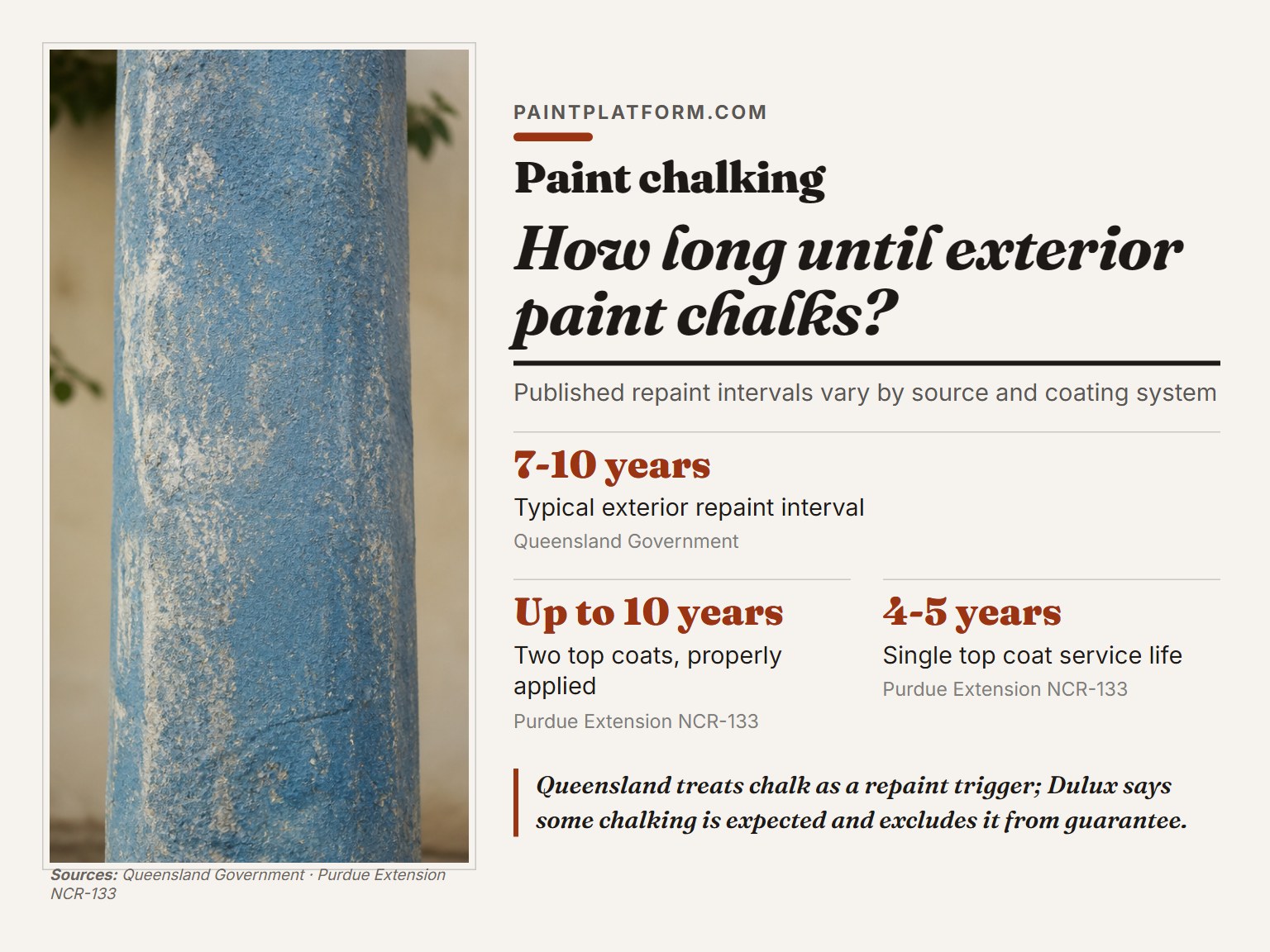
Everyone from the paint counter to the warranty leaflet has a position on whether chalk means repaint. The published sources don’t agree, and the disagreement is worth knowing before you buy a bucket.
| Source | Interval given | Basis |
|---|---|---|
| Queensland BU633 | 7-10 years | Typical exterior repaint |
| Purdue NCR-133 | Up to 10 years | Two top coats, properly applied |
| Purdue NCR-133 | 4-5 years | Single top coat |
| NPS Tech Note | 7 years | Bare wood, properly prepared |
Queensland’s BU633 treats a chalky finish as a repaint trigger in its own right, while Dulux notes some chalking is expected and not necessarily a repaint trigger. Dulux takes the opposite position, noting that some chalking is expected because all paints are affected by UV to some degree. Their Weathershield guarantee covers premature blistering, flaking, and peeling, and it explicitly does not cover fading or chalking.
Chalk on a wall you repainted three years ago is a failure. Chalk on a wall you repainted nine years ago is a schedule.
Purdue sits between those two camps. They frame chalking as a normal stage in the deterioration sequence, right after soiling and flattening, and their advice is to scrub again with detergent if the surface is still chalky after the first wash. That reads as a wash instruction.
The distinction matters because repainting over a chalky surface is one of the reliable routes to paint peeling within a season or two. New paint bonds to powder, and powder has no structural loyalty to the wall.
Application Mistakes That Make Chalking Worse
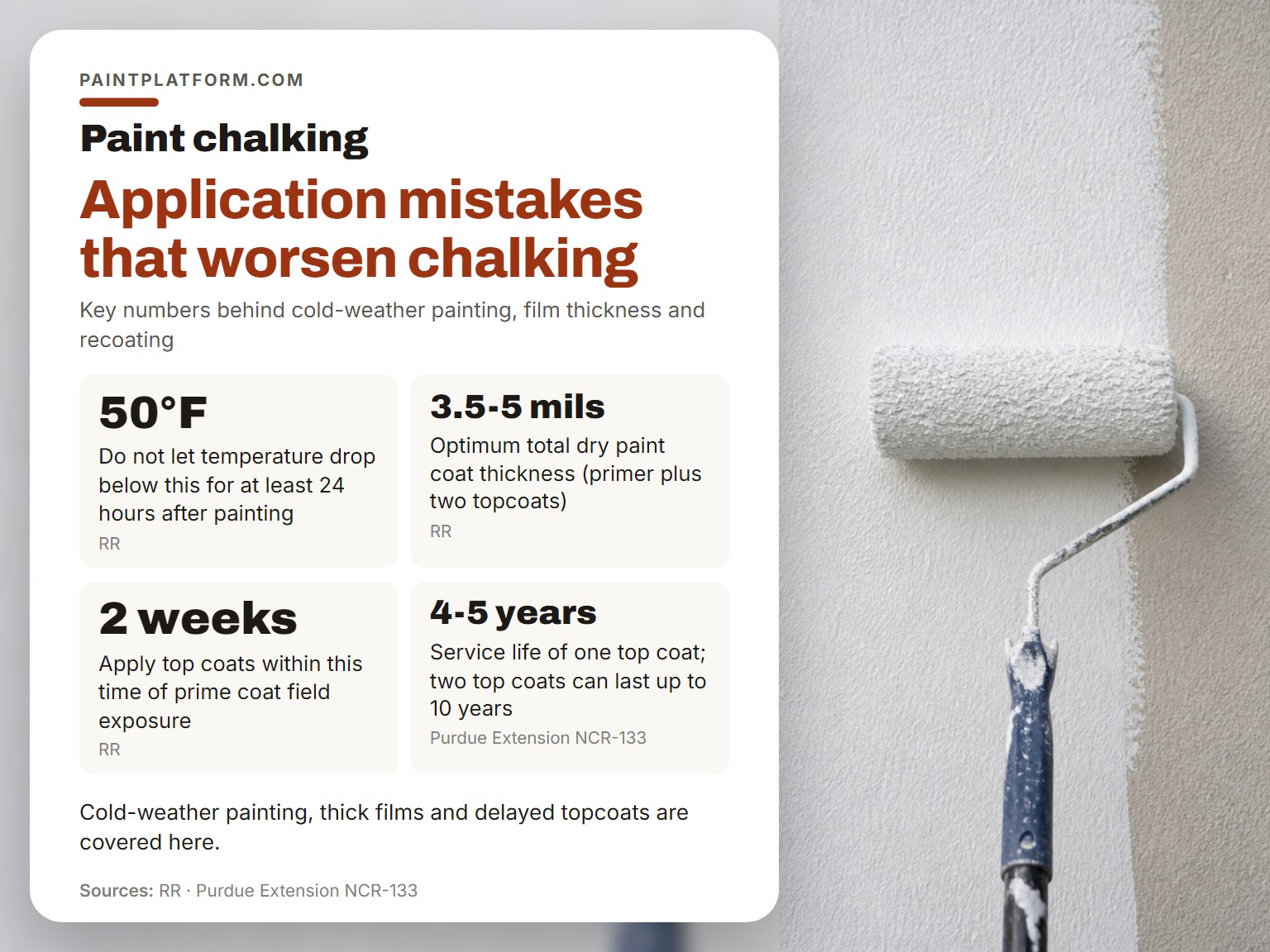
Most early chalking traces back to how the paint went on.
Before you start: A ladder plus wet paint is the obvious hazard, so keep three points of contact and move the ladder rather than lean out. The less obvious hazard is temperature. Below 50 degrees Fahrenheit for the first 24 hours and the film never cures right, which is the failure mode Building Science Corporation warns about and NPS documented at Gallaudet College as cold-weather application.
- Coating over a chalky surface. Jinwei’s defect manual lists poor repair over a previously chalking finish as a direct cause. The new film bonds to powder instead of paint, and it comes off in sheets.
- Applying colour coats too thick. The same manual flags excessive film thickness. A thick film cures unevenly, and the outer skin takes the UV hit while the layer beneath stays soft.
- Using the wrong hardener or mixing ratio. Listed as cause number one in two-pack systems. For house paint the equivalent is thinning a product past what the label allows.
- Painting below the temperature floor. Get this wrong and the film never develops its full resistance.
- Letting the prime coat weather too long.
Easy to miss: Primer that sat exposed before topcoat. Wash it, or re-prime.
Film thickness is the number most people never check. Under that, the film ages faster and chalks unevenly across the wall.
What Actually Slows Chalking Down
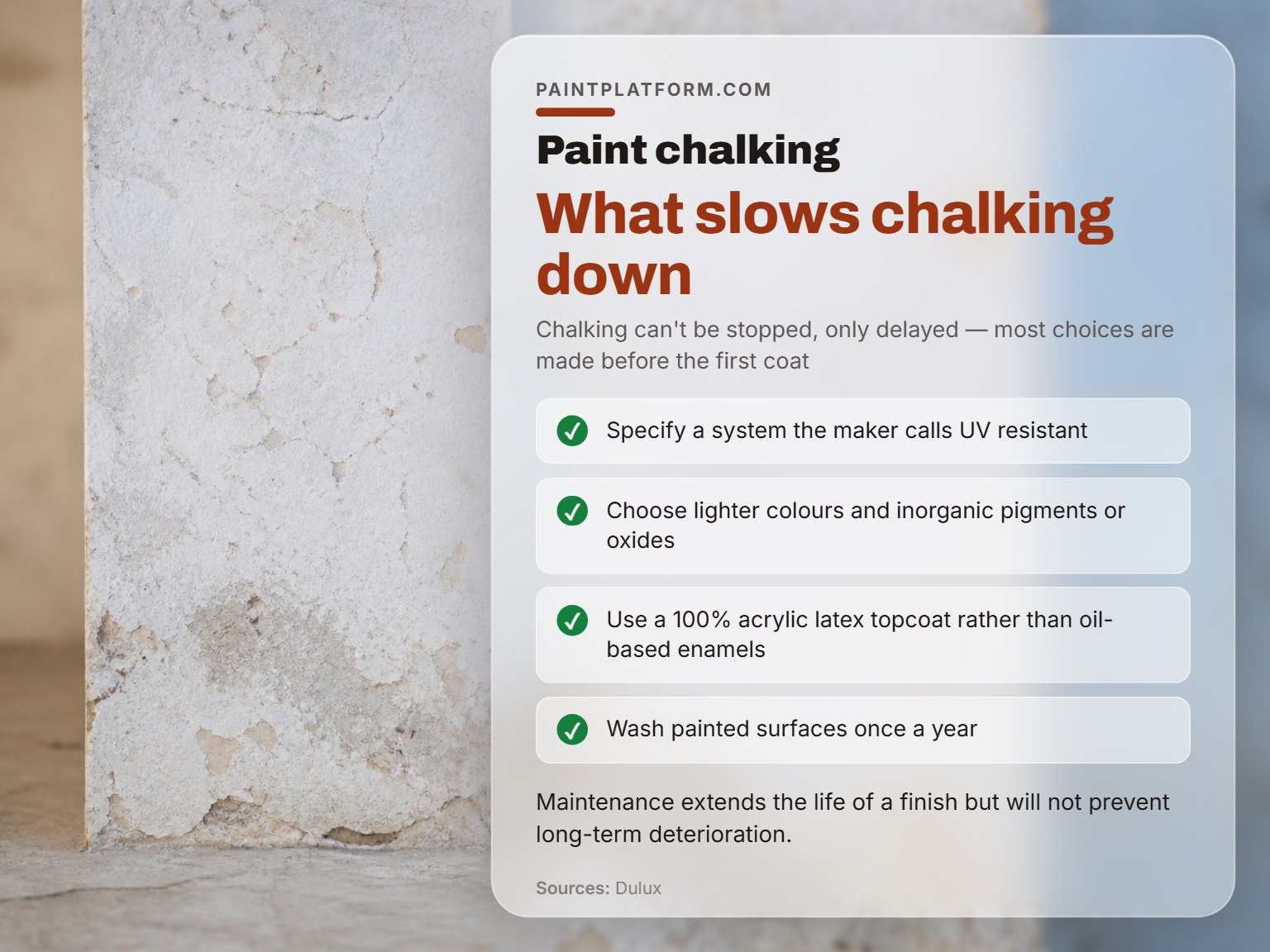
Chalking cannot be stopped. It can be delayed, and most of the levers get decided before the first coat goes on.
- Specify a system the maker calls UV resistant. Dulux uses that exact wording in its own prevention guidance, and it’s a claim you can check on a technical data sheet.
- Go lighter and go inorganic. Dulux advises lighter colours because they absorb less heat and UV, and inorganic pigments and oxides hold up better, while Queensland’s BU633 notes some darker colours cause greater thermal movement though infrared reflective pigments can reduce this effect.
- Use 100% acrylic latex as the topcoat. Dulux rates it above oil-based enamels for exterior durability and gloss retention, though Building Science Corporation recommends oil-based primers for extractive woods like redwood and cedar.
- Wash once a year. Both Dulux and BU633 call for annual washing to strip dirt, salt spray, moss, and mildew, though BU633 notes regular maintenance extends the life of a finish but will not prevent long-term deterioration.
- Repaint on a schedule. BU633 is explicit that regular maintenance extends the life of a finish but will not prevent long-term deterioration, while Dulux recommends a maintenance program to minimise chalking.
Building Science Corporation adds a wrinkle Dulux doesn’t emphasise: gloss paints carry more resin than semi-gloss, and semi-gloss more than flat, so gloss resists UV and moisture best while flat resists least, whereas Dulux’s guidance leans on pigment chemistry instead. Dulux’s guidance leans on pigment chemistry instead. Both point the same direction for a sun-beaten wall.
If you want to see the guarantee carve-out in writing, Dulux Weathershield is the clearest example I can point to. Premature blistering, flaking, and peeling are covered. Chalking and fading are not, on the stated grounds that climate sits outside the manufacturer’s control.
If you want to see what an inorganic pigment looks like before it goes into a can,
The honest limit: none of this prevents chalking forever. UV gets everything eventually, and the Purdue Extension paint chalking guide is upfront that deterioration is a process rather than a defect you can design out.
Frequently Asked Questions
Does chalking mean the paint has failed?
Not on its own. Dulux treats some chalking as expected weathering, and AS 3730 (2006) sets an acceptable deterioration level for exterior latex. The failure signal is chalking plus peeling, flaking, or blistering, or chalking that shows up well inside the expected interval.
Can you paint over a chalky surface?
You can, and it usually comes off within a season or two. Purdue’s guidance is to scrub with detergent and rinse if the surface is still chalky after the first wash, then test a patch with the band-aid pull before committing. If paint lifts onto the tape, the surface needs more cleaning or an oil-based primer.
Why does one side of my house chalk more than the other?
Orientation drives UV dose. Purdue says the south and west sides deteriorate fastest in the northern hemisphere. Dulux frames it from the southern hemisphere and equatorial side, noting north-facing aspects and lower latitudes receive more UV per square metre.
How long does exterior paint last before it chalks?
The published answers differ. Queensland’s BU633 says repainting is typically required every 7-10 years. Purdue says one top coat lasts four to five years and two top coats can reach 10.
Is chalk paint the same as chalking?
They share a name and nothing else. Chalk paint is a decorative finish with a matte, mineral look. Chalking is binder degradation that leaves loose pigment powder on the surface. One is a product you buy, and the other is a failure you diagnose.
Does washing stop chalking?
It slows the visible symptom and it doesn’t stop the chemistry. BU633 states plainly that regular maintenance extends the life of an exterior finish but will not prevent long-term deterioration, while Dulux recommends annual washing to minimise chalking. Washing removes the dirt and salt that make chalking look worse than it is, and it buys you an honest look at the film underneath.
The Bottom Line
Here’s the trigger I’d use. If a finger rub on a dry wall leaves white residue and the last repaint was under five years ago, treat it as a failure and find out why before you recoat.
This all assumes the wall is dry. On a wall with a moisture problem, every product recommendation above is money thrown at a symptom, and Purdue’s line about moisture being the top cause of premature failure on wood is the one to act on first.
The answer to what causes paint to chalk is almost always the binder. The trigger for doing something about it is the calendar and a moisture reading, not the colour of the powder on your finger.
Most chalking advice starts in the paint aisle. I’d start with a hose and a moisture meter, and walk into the aisle only once the wall has proven it’s dry.
