
How to Varnish an Acrylic Painting: Step-by-Step
This post contains affiliate links. As an Amazon Associate, we earn from qualifying purchases.
To varnish an acrylic painting, let the paint cure fully, apply a removable isolation coat, then brush on thin coats of acrylic varnish in the 65-75 F range Golden specifies. Thin paint needs at least 24 hours of drying per Winsor & Newton; thick impasto needs a week or more.
That isolation coat is the layer doing the quiet work. It sits between your paint and your varnish as a clear film, so a future cleaning has something to dissolve that isn’t your painting.
What follows is the order I actually use for how to varnish an acrylic painting: a drying window, an isolation coat, a temperature check, then thin coats with a wide soft brush. I’ll show you where the manufacturers contradict each other, because they do, and you’ll have to pick a side.
Key Takeaways
- Wait longer than feels reasonable. Thin acrylic wants at least 24 hours per Winsor & Newton, 72 hours per Jackson’s Art, or 1–2 days before isolation then 2 days to a week before varnish per Golden; thick impasto can want a week or a month, depending on which source you trust.
- The isolation coat is required on highly absorbent surfaces before matte or satin varnish, and Golden treats it as standard practice, though the Smithsonian notes many artists refuse to varnish acrylics at all.
- 65-75 F at 50-75% humidity is Golden’s published window. Outside it you risk a white cast that won’t buff out.
- Winsor & Newton recommends one to three thin layers instead of a single thick coat, while Royal Talens argues for one layer only because multiple layers may cause inconsistencies in sheen.
- Never stack paintings, and never let bubble wrap, glassine, or any plastic touch the surface.
How Long Should Acrylic Paint Dry Before You Varnish It?
Longer than the paint feels. An acrylic film that’s dry to the touch is still curing underneath, and the four sources below give four different answers on how to varnish an acrylic painting for the same thin layer.
Acrylic paint dries by water evaporation but cures by polymerization, so a dry-to-touch film is not a cured film. Manufacturers publish different waiting periods because film thickness, retarders, and gel content all slow the cure. Varnishing a film that is still releasing volatiles traps them under the resin, and the coat turns cloudy.
| Source | Thin acrylic | Thick impasto |
|---|---|---|
| Winsor & Newton | At least 24 hours | Up to one week |
| Golden Artist Colors | 1-2 days, then 2 days to a week | 1-2 weeks |
| Royal Talens | 4-5 days at normal film thickness | Not stated |
| Jackson’s Art | At least 72 hours | Up to a month |
Four answers for one thin film. The spread comes from film thickness, gel content, and retarder use slowing the cure at different rates.
Thin Layers vs Thick Impasto
Golden splits the two cases cleanly. Thin work gets a day or two before the isolation coat, then another two days to a week before varnish. Impasto gets a week or two before either layer goes down.
Winsor & Newton’s version is shorter on the front end: at least 24 hours for thin paint, up to a week for heavy layers.
What If You Used a Retarder?
Then the clock stops being useful. Jackson’s Art warns that retarders and slow-drying acrylics push the wait past a month, and mentions thick gel layers that took three months to go from cloudy to fully clear.
Where this goes sideways: Varnish a film that’s still off-gassing and the volatiles get trapped under the resin. The coat clouds over, and it stays cloudy.
Why the Isolation Coat Decides Whether Varnish Comes Off Later
Skip the isolation coat and, per Winsor & Newton, varnish can’t be removed later without risking the paint, though the Smithsonian notes many artists refuse to varnish acrylics at all.
Winsor & Newton is direct about the reason: the isolation layer is what lets varnish be removed later without dragging paint with it. Golden treats it as standard practice and requires it outright on highly absorbent surfaces before any matte or satin varnish goes down.
Golden treats the isolation coat as standard practice and requires it outright on highly absorbent surfaces before any matte or satin varnish goes down. Let it cure a full day before the varnish.
Here’s the awkward part. The Smithsonian Museum Conservation Institute varnishes reference notes that many artists refuse to varnish acrylics at all, because acrylic varnish and acrylic paint share solubility. Removing the varnish later means solvents that can attack the paint layer. Golden’s answer is the isolation coat, but that coat is permanent, so the concern doesn’t fully disappear.
If you want to weigh that trade, the varnish pros and cons come down to one question: do you want a removable top layer badly enough to accept a solvent in the room?
I won’t varnish a matte painting without an isolation coat. The matting agent settles into an absorbent surface as a white solid, and no cloth is bringing that back.
A plain sealer is the other route. How to seal acrylic paint on canvas skips the removable layer entirely and dries faster, which suits work heading behind glass anyway.
What Temperature and Humidity Actually Do to a Varnish Coat
Between 65 and 75 F, at 50% to 75% relative humidity. That’s the window Golden publishes, and it’s narrower than most people expect.
Outside it, two failures show up:
- Bloom, where moisture is trapped between varnish and paint and reads as a white haze.
- Condensation cast, where a cold painting meets a warm room and water forms under the film.
Golden describes the first. Royal Talens describes the second, and adds that the varnish itself should be at room temperature too.
You’ll see it first in the dark passages, a milky film where the color should be deepest.
Royal Talens adds that the varnish itself should be at room temperature too, otherwise a white cast may appear from condensation under the varnish layer. The full spec sheet, including humidity tolerance and isolation coat intervals, is in Golden’s varnish application guidelines.
The Brush Loading Nobody Teaches You
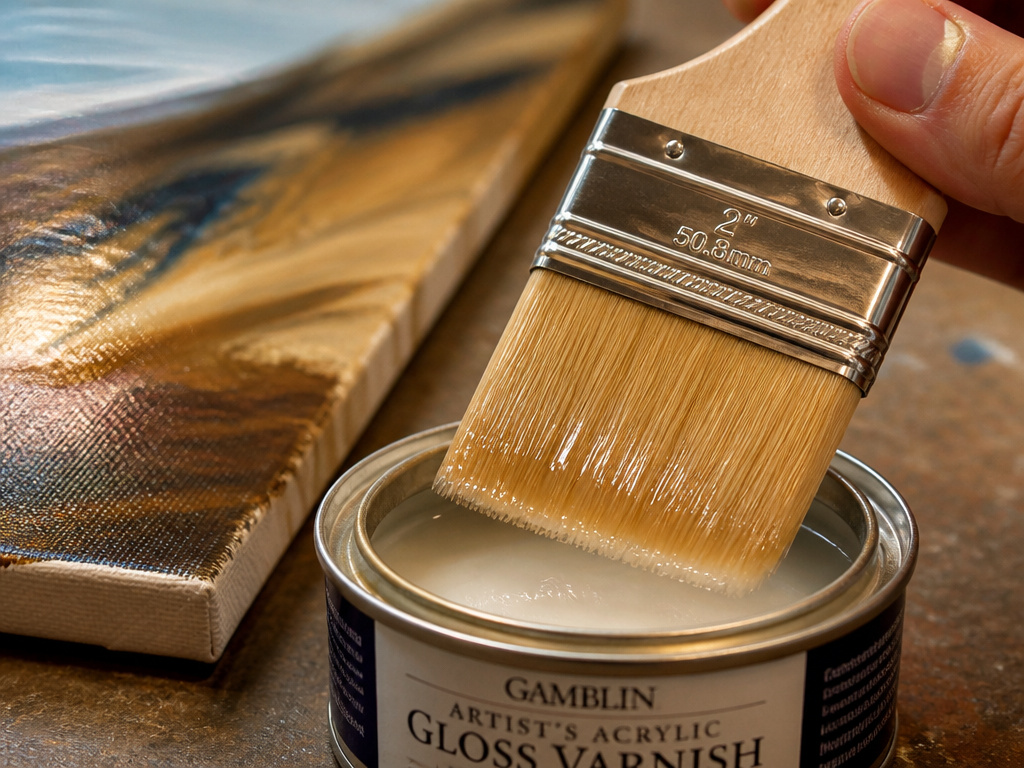
I killed a flat brush by walking away with varnish still in the bristles. Came back two days later to something stiff enough to comb with. Now I rinse the second I stop, and the same brushes have lasted me years instead of months.
Get the brush right and half the other problems never happen. Winsor & Newton specifies a 1 inch to 4 inch flat, soft, tightly packed varnishing brush, and names the Winsor & Newton Monarch glazing and varnishing brush as the example. Keep it for varnish only.
Loading the Brush
Three rules cover most of it:
- Load the brush lightly, per Golden. Overloading floods the surface on first touch.
- Shake the can well, especially matte or satin, per Royal Talens.
- Apply in one direction so the sheen lands even.
Don’t thin it, either. Winsor & Newton notes that thinned varnish is more prone to bubbling, and bubbles that pop leave craters.
Golden’s own coverage numbers reference spray coats alongside brush coats, so a can is a legitimate option if brush marks worry you. Most sealants for acrylic paint come in both forms.
How to Varnish an Acrylic Painting: The 7-Step Order
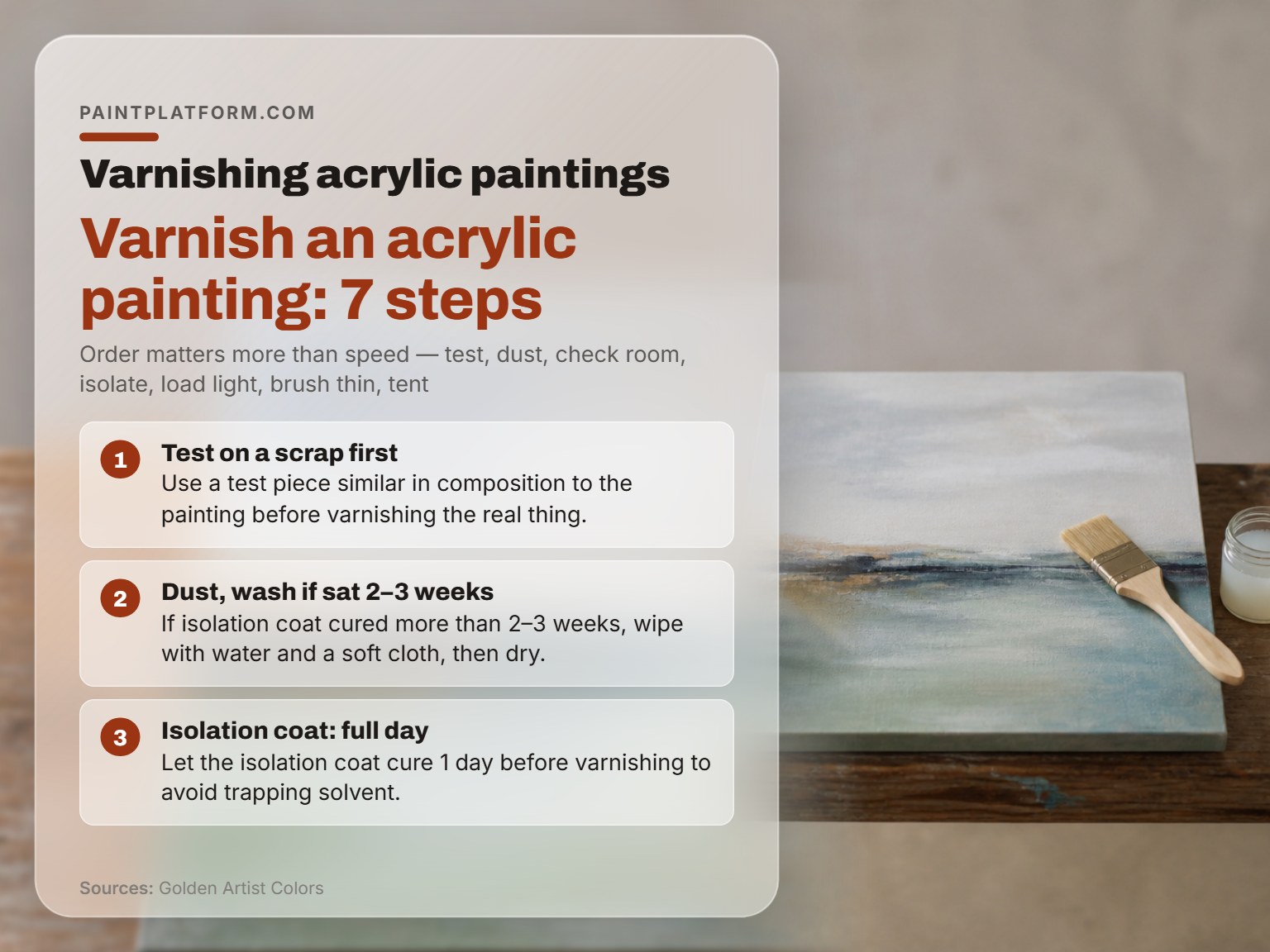
Seven steps, in this order, and the order matters more than the speed.
Before you start: Varnish is highly flammable, and Royal Talens says so plainly, so cap the jar between coats and keep it away from pilot lights. The sharp solvent smell that hits when you open the can means fumes are building, so open a window before you start rather than after. And lay the painting flat, because a sag on a vertical canvas dries exactly where it runs.
- Test on a scrap first. Golden asks for a test piece similar in composition to the painting. Skip it and you learn how the varnish shifts your colors after it’s already on the real thing.
- Dust the surface, and wash it if the isolation coat has sat a while. Golden says a coat cured more than 2 to 3 weeks should get a wipe with water and a soft cloth to lift migrated surfactants, then dry completely. Skip the wash and adhesion can fail.
- Check the room. 65-75 F, 50-75% humidity, per Golden. Varnish cold and you’re gambling on a white cast.
- Lay on the isolation coat and give it a full day. That’s Golden’s cure time. Varnish sooner and you trap solvent between layers.
- Load the brush lightly. Overload it and the first stroke sags.
- Brush thin, one direction, and leave it alone. Winsor & Newton’s range is 1 to 3 thin layers. Reworking drags partly dry resin into wet, and it dries cloudy over dark colors.
- Tent it and walk away. Winsor & Newton suggests a plastic film tent against dust while it dries, while Golden warns against plastic touching the surface during transport and storage. Golden wants several days of cure before the painting is packed or moved.
Common mistake: Going back to fix a missed patch while the coat is still wet. Winsor & Newton’s fix runs opposite to your instinct: let the whole coat dry, then varnish that area again.
One Coat or Three? Where the Brands Disagree
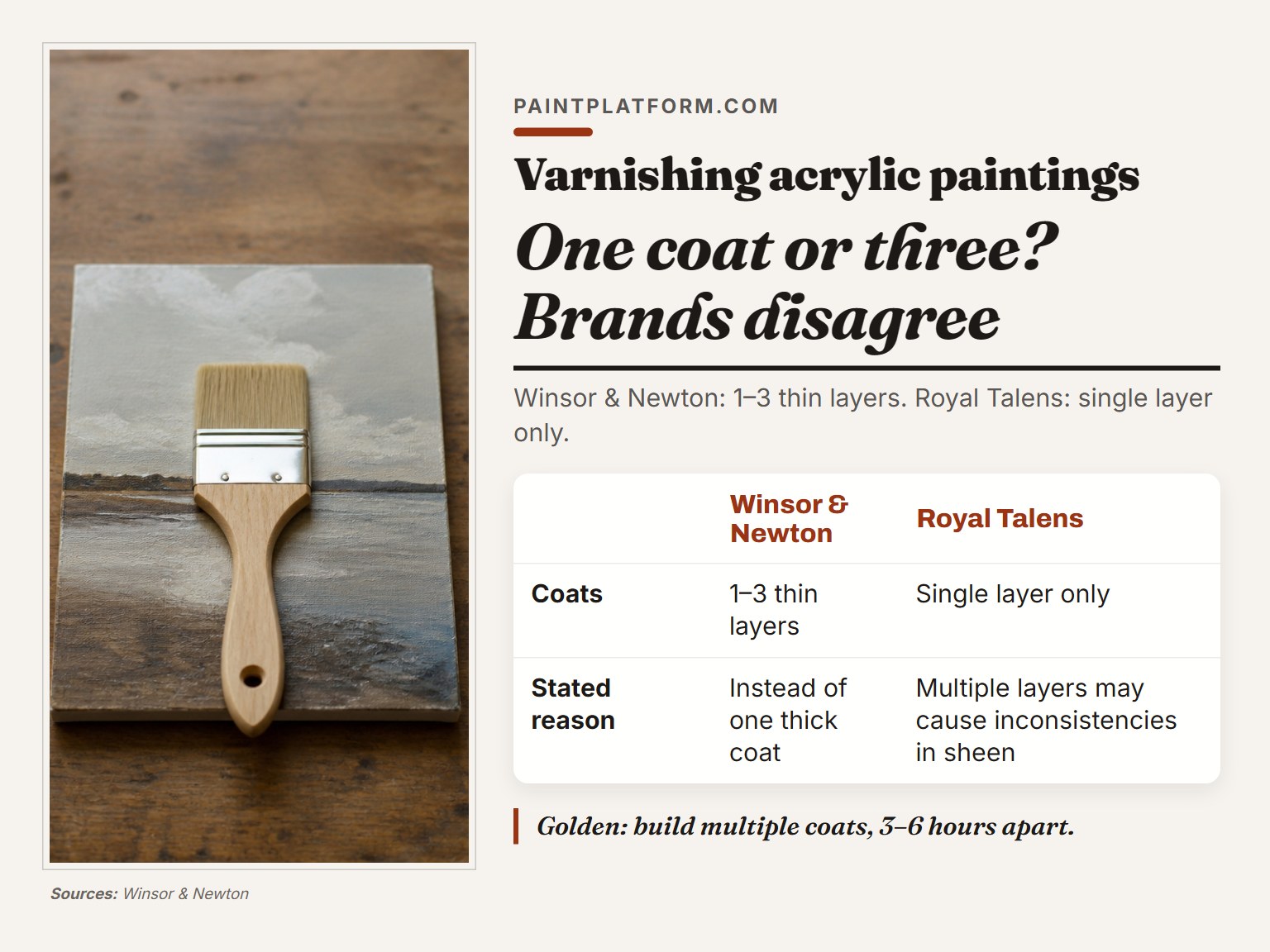
Winsor & Newton says one to three thin layers. Royal Talens says one, full stop.
| Brand | Coats | Stated reason |
|---|---|---|
| Winsor & Newton | 1-3 thin layers | A thick coat dries slower and may dry cloudy |
| Golden Artist Colors | Multiple, 3-6 hours apart | Matte and satin capped at two coats |
| Royal Talens | Single layer | Multiple layers can shift the sheen |
Royal Talens is protecting sheen consistency. Winsor & Newton is protecting drying behavior. Both are right about their own product, and that’s the part to hold onto.
For gloss on a small panel, two thin coats and stop. For matte or satin, one coat, then look at it in raking light before you decide, because Golden caps matte and satin at two and extra layers on matte show every brush edge.
Run the back of a knuckle along a hidden edge between coats. A faint tack means the coat isn’t ready, and Golden says to check for exactly that.
Choosing the finish is its own decision, and matte vs gloss sealer changes what the painting looks like more than the brand does.
Varnishing Vertically, Outdoors, or on a Big Mural
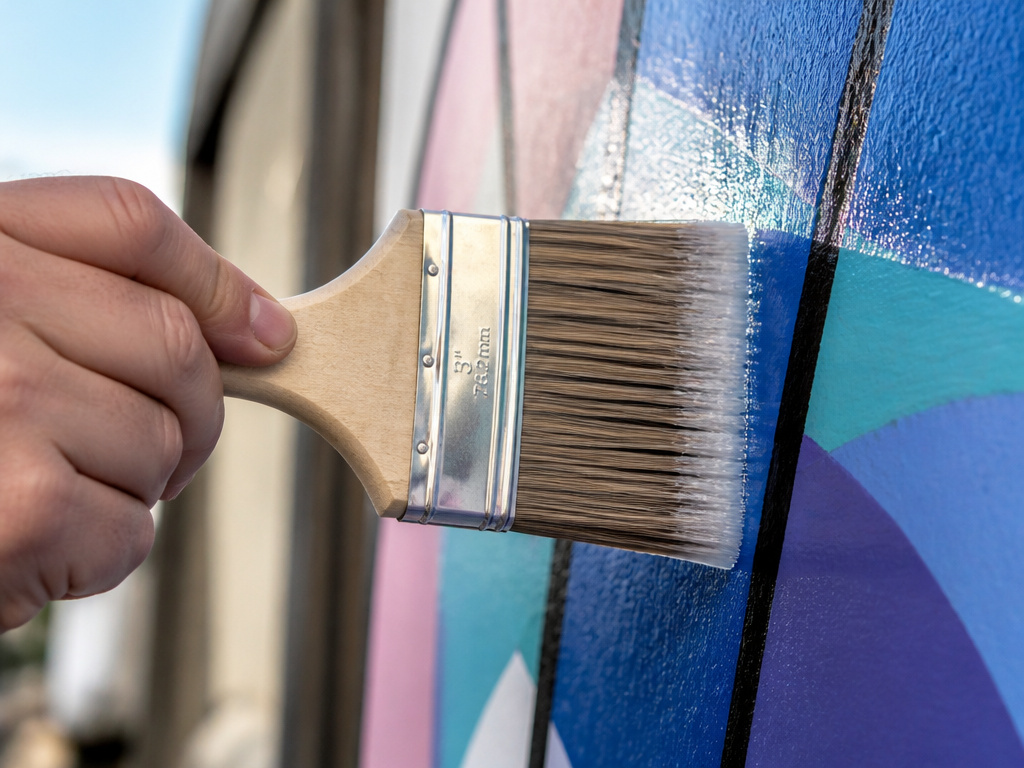
Golden’s guidelines put horizontal first as always best, and treat vertical as a compromise to use only if unavoidable. Winsor & Newton says work flat, not vertical.
When the standard procedure breaks:
- Murals and vertical panels: thin enough that it barely reads as a coat, per Golden.
- Outdoor work: Golden’s Polymer Varnish is interior only, so pick a different line.
- Furniture and floors: wrong product entirely. Golden points at polyurethane instead, and notes aromatic urethanes yellow significantly while aliphatic types don’t.
- Oil paintings: Golden varnishes are acrylic only. Oil vs acrylic varnish is a separate process with its own drying clock.
How to Fix a Cloudy or Streaky Varnish Job
What do you do when the coat dries milky?
First, figure out which failure you have. Cloudiness from trapped volatiles and cloudiness from a cold surface look identical and have different fixes.
Cloudy Over Dark Colors
Winsor & Newton’s cloudy-over-dark warning is about reworking. If you dragged partly dry resin into a wet patch, that haze is in the film, and another coat won’t cover it.
Removing Varnish Without Hurting the Paint
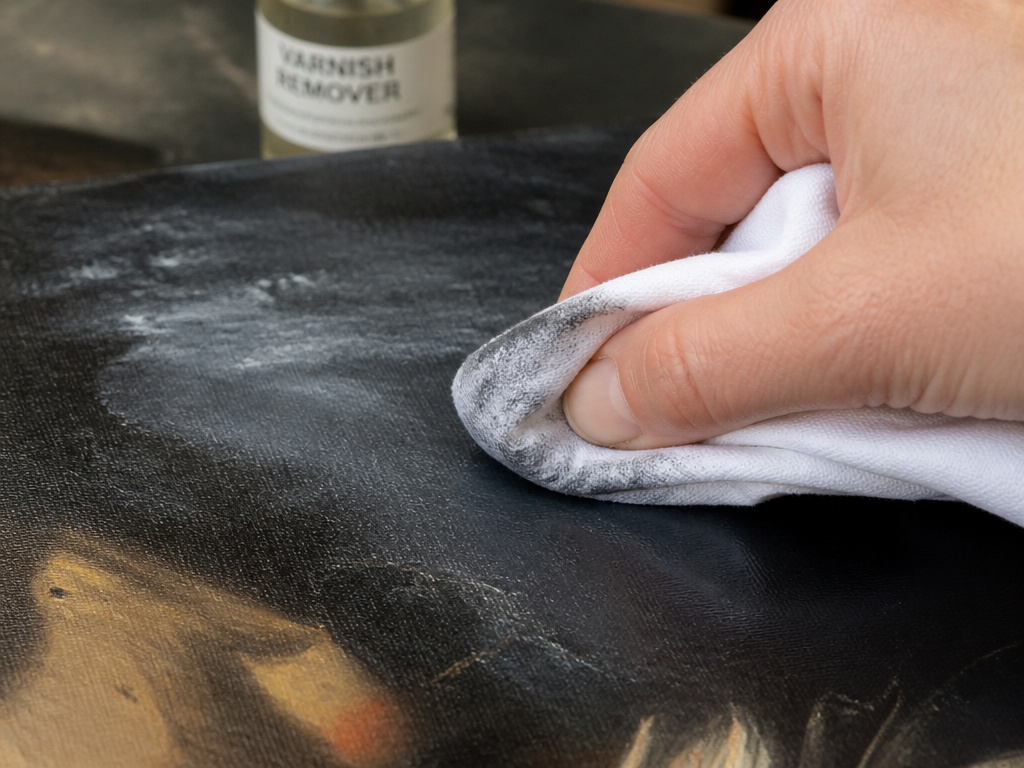
Winsor & Newton’s method: varnish remover on a lint-free cloth, rubbed gently. A slight color transfer on the cloth is the sign the varnish has lifted. That’s only safe if you laid an isolation coat first, which is the whole argument for step four above.
The full removal sequence is in Winsor & Newton’s varnish guide.
If the varnish has cured for more than a few weeks and the surface feels slick rather than clean, wipe it with water before you touch it with anything else. Surfactants migrate to the top over time, and varnish won’t grip through them.
Drying, Stacking, and Storing a Varnished Painting
A varnished painting is still fragile for days after the surface feels dry.
Golden wants several days of cure before packing or transport, and the storage rules are stricter than most studios follow.
- Never stack paintings. Varnished or not, per Golden.
- No contact with glassine, bubble wrap, or any plastic during transport and storage.
- Watch the plastic tent advice. Winsor & Newton suggests a plastic film tent as a dust shield while the piece dries. Golden warns against plastic touching the surface during storage. A tented film hovers above the surface; film pressed against it is a different thing.
If a painting is leaving the studio this week, varnish it last week. Golden’s several-day cure is the floor, and a wrapped canvas that’s still soft will take the texture of whatever it’s pressed against.
Long-term painting storage adds humidity and framing to the list, and it’s where unvarnished work needs the most care.
Frequently Asked Questions
Can you varnish an acrylic painting without an isolation coat?
You can, and plenty of people do. Winsor & Newton and Golden both treat the isolation layer as the thing that makes later removal safe, and Golden requires it on highly absorbent surfaces before matte or satin varnish. Without it, a matte varnish can settle into the canvas as a white solid.
Why did my varnish dry cloudy?
Two common causes. Jackson’s Art points at varnishing before the paint finished releasing volatiles, which traps them under the film. Royal Talens points at temperature, where condensation forms under the varnish if the painting or the varnish was cold. Winsor & Newton adds a third: reworking a wet area and dragging partly dry resin into it.
How many coats of varnish should you apply?
It depends on the brand. Winsor & Newton recommends one to three thin layers, Royal Talens recommends a single layer because extra coats can shift the sheen, and Golden builds multiple coats with 3 to 6 hours between them while capping matte and satin at two. Pick one brand’s method and stay with it.
How long before you can hang a varnished painting?
Golden wants several days of cure before the piece is packed or moved, and hanging counts as moving it. Keep it flat, dust-free, and out of direct sun until then. Winsor & Newton’s plastic tent is one way to keep dust off while it sets.
Does acrylic varnish go yellow over time?
The artist-grade ones are formulated not to. Royal Talens describes Amsterdam acrylic varnish as a durable, non-yellowing layer, and Winsor & Newton’s Professional Acrylic varnishes are described as removable and UV-resistant. The yellowing warning in Golden’s guidelines is about aromatic urethanes, which aren’t artist varnish.
The Bottom Line
If any part of your painting has a ridge you can see from a palette knife, ignore every 24-hour figure here and give it one to two weeks per Golden, or up to a month per Jackson’s Art. Golden’s impasto window is one to two weeks, and Jackson’s Art puts gel-heavy work at up to a month.
The one thing I’d push back on: all four manufacturers assume you’ll varnish. The Smithsonian conservation note is the honest counterweight, and if the piece is going behind glass anyway, an isolation coat plus a frame is a respectable finish.
This week, buy one 2-inch flat soft brush and tape a label on the handle that says varnish. That’s the whole start.
