
How to Paint Concrete Steps: Stop Trapped Moisture
This post contains affiliate links. As an Amazon Associate, we earn from qualifying purchases.
How to paint concrete steps: cure the slab first (28 days for Rust-Oleum EpoxyShield, 30 at 75F for Sherwin-Williams, 30 to 90 for PPG Speedhide 6-15XI), prove it’s dry with a taped plastic sheet, etch the surface, then coat inside the product’s own temperature window.
Those three cure numbers measure the same thing. They’re counting how long the slab keeps releasing water and pushing its pH up while the cement hydrates. Trap that chemistry under a film and it works its way out through the coating instead.
What follows is the order that actually holds up: the moisture test, the etch, seven application steps, and the coating comparison that tells you which temperature window you’re working inside.
Key Takeaways
- Cure time is product-specific. Rust-Oleum EpoxyShield wants 28 days, Sherwin-Williams wants 30 days at a material temperature of at least 75F, and PPG Speedhide 6-15XI wants 30 with 90 preferred.
- Test moisture before anything else. Tape an 18 in x 18 in sheet of 4-mil plastic down for a minimum of 16 hours and look for condensation underneath.
- Etch until the surface has enough profile to grip. If water beads on the tread instead of soaking in, the surface is still sealed.
- Stay inside the coating’s window. Rust-Oleum runs 60-85F, PPG runs 50-90F, H&C runs 40-90F. Cold nights stall all three.
- One coat or two is printed on the can. H&C Colortop requires two; Rust-Oleum says one is usually enough.
How Long Should New Concrete Cure Before You Paint It?
Twenty-eight days is the shortest window in the set, and that number comes from Rust-Oleum’s EpoxyShield data sheet. Sherwin-Williams stretches it to 30 days with a condition attached: the slab has to sit at a material temperature of at least 75F the entire time. PPG asks for 30 days and calls 90 preferable.
Concrete must be poured and aged at a material temperature of at least 75F for at least 30 days before coating, per Sherwin-Williams surface preparation guidance. Surface pH should land between 6 and 9. Moisture testing follows ASTM D4263: an 18 in x 18 in sheet of 4-mil plastic, taped on all four edges, inspected after a minimum of 16 hours.
Read those three side by side and the how to paint concrete steps floor ranges from Rust-Oleum’s 28 days to Sherwin-Williams’ and PPG’s 30 days, with PPG calling 90 days preferable. Cool weather stretches it further, because a slab curing below Sherwin-Williams’ 75F material temperature is not hydrating at the rate that guidance assumes.
| Requirement | Sherwin-Williams | PPG Speedhide 6-15XI | Rust-Oleum EpoxyShield |
|---|---|---|---|
| Cure before coating | 30 days at 75F material temp | 30 days minimum, 90 preferred | 28 days minimum |
| Surface pH | 6 to 9 | Under 10 | Not stated |
| Application temperature | 50F and above | 50-90F | 60-85F |
| Rain-free window | Not right after rain | 48 hours | Not stated |
PH is the second split. A step sitting at 9.5 passes PPG’s spec and fails Sherwin-Williams’, which is the kind of gap that shows up later as an edge lifting off the riser.
ACI 515.3R-20 settles which number wins. The ACI guide for coating concrete states plainly that it does not supersede the protection system manufacturer’s requirements, and that installers should flag divergences to the owner. Buy the can, follow the can, and note where the standard disagrees.
How to Paint Concrete Steps Without Trapping Moisture
Tape a square of plastic to the bottom step on a Friday afternoon. Peel it back Saturday morning and look at the underside.
Sherwin-Williams specifies the method exactly: an 18 in x 18 in sheet of 4-mil plastic, all four edges sealed, inspected after a minimum of 16 hours. Condensation, a dark patch, or discoloration under the sheet means moisture is moving through the slab.
The same source notes that moisture seldom drops below 15% in concrete, which is why the instruction is to locate the source and correct it rather than coat over it. H&C takes a different route and puts a number on it: moisture content should not exceed 3 lb/1,000 sq ft of surface, tested to ASTM F710.
Splash water across the tread and watch. If it beads and rolls off like water on a waxed car hood, the surface is still sealed and nothing you roll on will grip. If it darkens and soaks in, you’re clear to keep going.
Signs the step isn’t ready:
- Water beads and sits. Sealed, or contaminated with a curing compound or release agent.
- The plastic sheet fogs overnight. Moisture is pushing through. Find the source first.
- A patch stays dark after everything else dries. Old oil or grease, and it needs a degreaser before anything else happens.
- The surface chalks onto your hand. Laitance and dust, and it has to come off.
That last one is the quiet killer. Chalk is just concrete dust sitting on top of concrete, and paint bonds to dust about as well as tape bonds to a wet towel.
The same test decides whether you can move on to how to paint a concrete patio or a garage slab. Test first, decide second.
Etching: The Step That Decides Whether It Sticks
Skip the etch and the coating hangs on dust.
Etching opens the pores so the film can key into the concrete. H&C gives a measurable benchmark: after etching, the surface should feel like 120-grit sandpaper. Run your palm flat across the tread. If it still feels slick and glassy, etch again.
Before you etch, everything loose has to go. Sherwin-Williams lists what counts as contamination: grease, oil, dust, dirt, loose rust, peeling paint, laitance, form release agents, moisture curing membranes, loose cement, and hardeners. Pressure washing handles most of it at 2,000 to 2,500 psi and 4 to 14 gallons per minute.
What “Etched Enough” Actually Feels Like
Rough, uniform, and slightly dusty. Not gouged. If you can see deep scratch marks from a stiff brush, you’ve gone past etching into scarifying, and those scratches will telegraph through a thin film.
If It Doesn’t Bubble, Stop
Sherwin-Williams flags a specific failure: if no bubbling occurs during etching, the surface is contaminated with grease, oil, or a concrete treatment that’s blocking the acid. Clean it with a cleaner per ASTM D4258, then etch again.
I won’t put muriatic acid on a front stoop anymore. A citric-based etch took two rounds of scrubbing on my garage floor and got me a rough, grippable surface without the fumes. Slower, and I stopped holding my breath.
Fair warning: more than one pass is often needed. A single pass that looks fizzy and done may be too few.
The 7-Step Application, Start to Finish
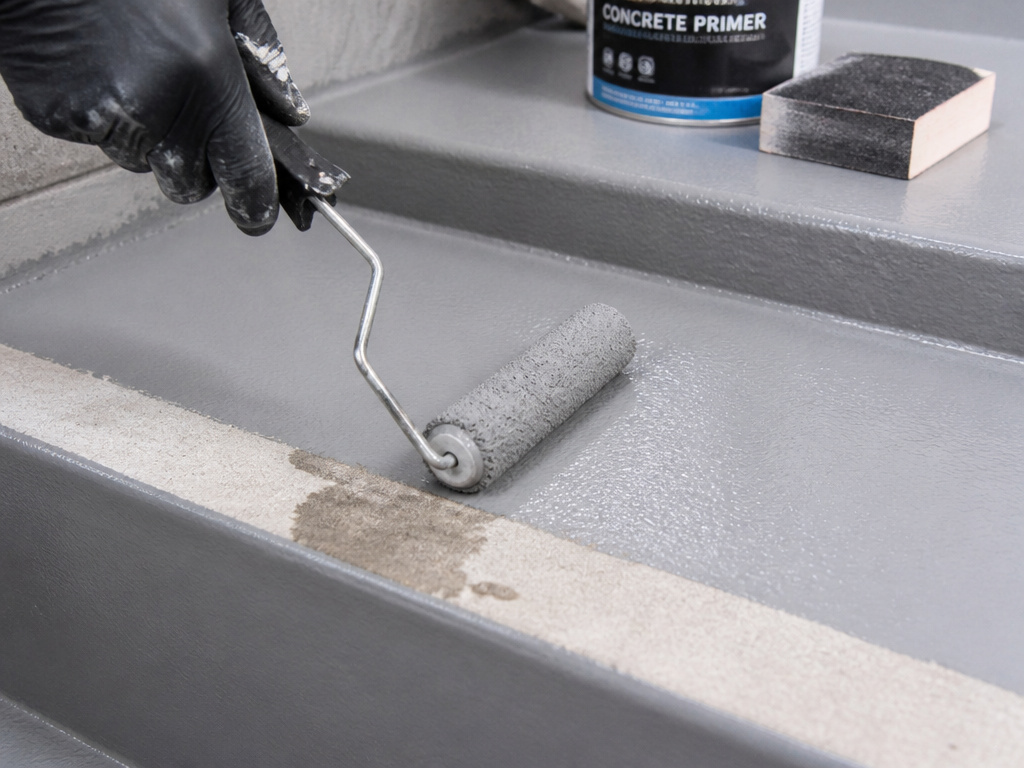
Seven steps, in this order: clean, etch, rinse and dry, patch, prime, coat, cure.
Before you start: Scraping or sanding old paint on steps can release lead dust, which causes brain damage in children. Wear a NIOSH-approved respirator, clean up with a HEPA vacuum and a wet mop, and call 1-800-424-LEAD before you start. Coatings containing crystalline silica need ventilation, and a freshly coated step stays slick until the film fully cures.
- Strip and clean. Rust-Oleum requires a sealed floor be stripped by grinding or shot blasting before recoating, and scuff sanding the whole surface afterward. Skipping this step means the new coat bonds to the old sealer, and the whole film lifts together.
- Etch. Get to the 120-grit feel. A slick tread means the coating sits on top instead of locking in.
- Rinse and dry completely. Residual acid kills adhesion. Let it dry thoroughly in good weather.
- Patch cracks and voids. PPG calls for large voids, cracks, and surface imperfections to be filled with cement-sand grout, and “hot” grout needs a spot prime with an alkali-resistant primer. Skip it and the patch telegraphs through as a shadow.
- Prime where the product calls for it. A primer for cement steps buys you a uniform surface and a better bond on porous or patched treads. PPG’s Speedhide 6-15XI is self-priming in most applications.
- Coat inside the temperature window. Rust-Oleum specifies a synthetic 1/2-inch nap roller cover on a 9-inch frame, working 4×4 foot sections and keeping a wet edge. H&C calls for a 3/8 to 1/2-inch nap roller and recommends back rolling after spraying.
- Cure before you walk on it. Rust-Oleum’s dry times at 70-80F and 50% relative humidity: light foot traffic in 12-16 hours, normal foot traffic at 24 hours, vehicle traffic at 7 days. Walking up the steps before the light-foot-traffic window leaves a permanent print.
One coat or two is printed on the can, and it isn’t negotiable. Rust-Oleum EpoxyShield says one coat handles most situations. H&C Colortop requires two, applied perpendicular, with at least two hours between them. Splitting the difference gets you a thin film that scuffs at the nosing first.
If the steps turn a corner or land on a landing, the sequencing changes a little. The order for treads and risers is risers first, then treads, so you’re never standing on wet paint to reach the next one.
Which Coating Belongs on a Step?
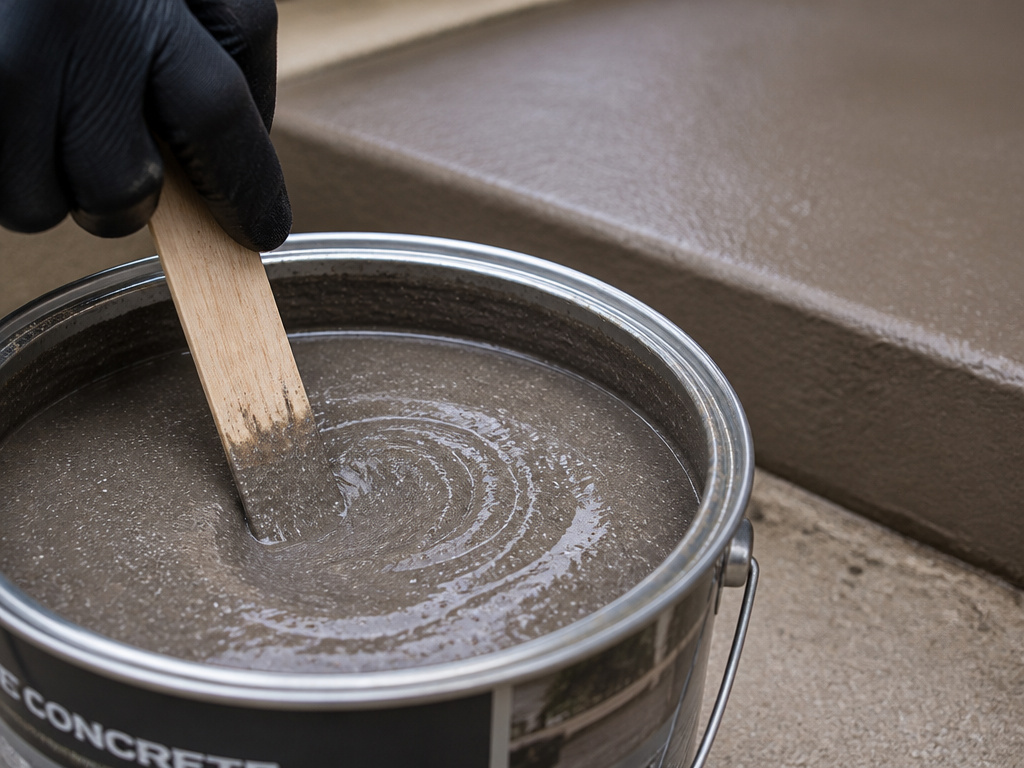
Garage epoxy kits promise a showroom floor. On an exterior step, that promise is the problem.
Rust-Oleum EpoxyShield 1-Part Concrete Paint is rated at 3.0-3.5 mils dry film thickness per coat, covering roughly 200-240 sq ft per gallon with 15% material loss figured in. It’s a solid choice for a covered porch or a garage-adjacent step. It is not intended for unsound previous coatings or floors with a moisture problem, and Rust-Oleum says so directly.
PPG Speedhide 6-15XI is a block filler, self-priming in most applications, and exterior applications must be topcoated. It’s the pick when the concrete is porous and hungry.
H&C Colortop Water-Based Solid Color Concrete Stain is the one I reach for on exterior steps. Two coats minimum, 2 hours apart, second coat perpendicular to the first. Extremely porous surfaces may want a third.
Why Masonry Stain Is More Forgiving Than a Film
The most forgiving thing I’ve put on a patio was a plain masonry stain. When I missed a spot, it blended into the surrounding color instead of showing a hard edge the way a film-forming coating does. On a step, that difference is the whole job.
A film shows every sloppy cut line at the riser. A stain just looks slightly uneven, and uneven is fine on outdoor concrete.
There’s a whole spread of concrete paint types beyond these three, and the film-versus-penetrating split matters more than the brand name on the label. If you want a single default and you’re coating exterior steps in a cool climate, a water-based solid-color stain gives you a wide temperature window and the most forgiveness.
For the tread surface itself, a non-slip additive is not optional. On the steps I mixed fine grit into the coat. Without it, the first wet morning turned the tread into a skating rink and I nearly became a cautionary tale. Stir it in consistently across every tread so one step doesn’t grab better than the next.
Neither is a substitute for the prep.
If you’re still deciding between a floor-style film and a stair-specific product, the concrete stair paint comparison comes down to traffic and exposure. Covered steps tolerate a film. Open, weather-facing steps want something that breathes.
Where Concrete Step Paint Fails, and How Fast
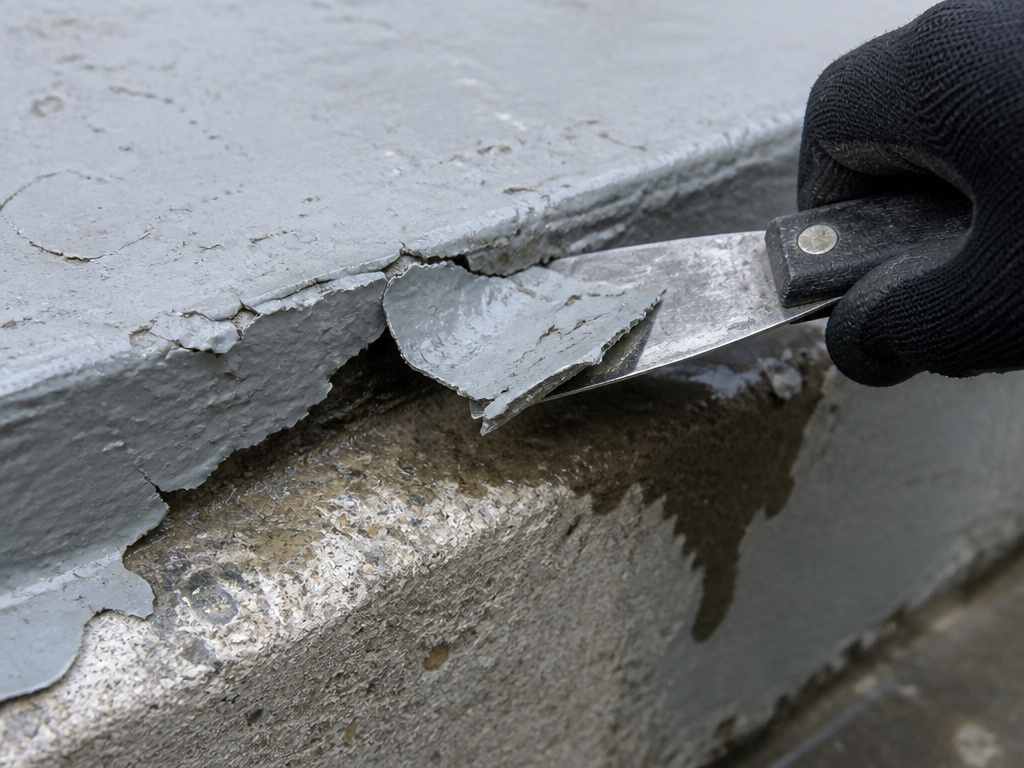
Blistering almost always starts behind the film. The top of the coating is just where it shows up.
PPG states it plainly: blistering and peeling are commonly caused by moisture behind the paint film, and whatever is driving that moisture has to be repaired before painting. That’s the same conclusion the plastic sheet test was built to catch.
| Symptom | Likely cause | What to do |
|---|---|---|
| Blisters under the film | Moisture moving through the slab | Find and correct the water source first |
| Peeling in sheets at the edges | Silicone water repellent underneath | PPG forbids coating over it; strip instead |
| Coating lifts on the tape test | Incompatible sealer or curing compound | Remove it, then re-test adhesion |
| Film stays soft and scuffs | Cure stalled below the temperature floor | Wait for the window and recoat |
| Lap marks and patchy sheen | Dry rolling, no wet edge maintained | Work 4×4 ft sections, keep it wet |
Where this goes sideways: Coating a step when the temperature will drop overnight. PPG wants air and surface temperatures held for 24 hours after application, and H&C wants above 40F for a full 7 days. A cold night inside that window stalls the cure, and the film stays soft.
Common mistake: Rolling over a previously sealed or coated step without checking what’s on it. Rust-Oleum requires a sealed floor be stripped by grinding or shot blasting before recoating, and etching alone won’t cut through a sealer.
A third failure is quieter. PPG says not to apply over silicone-type water repellents at all, and a lot of exterior masonry steps have been treated with exactly that at some point. The coating crawls back from the edges and peels in sheets. If you suspect a repellent on a step you’ve never coated, test a small patch first.
Sherwin-Williams gives you the patch procedure: coat 2 to 3 square feet, let it dry a week, then test adhesion per ASTM D3359. One week of waiting beats a full recoat.
Frequently Asked Questions
Do I really have to wait 28 days before painting new concrete steps?
Yes, and possibly longer. Rust-Oleum requires a minimum of 28 days, Sherwin-Williams requires 30 days at a material temperature of at least 75F, and PPG asks for 30 days with 90 preferred. Cool weather slows the cure, so a slab poured in cool conditions needs more calendar time, not less.
What happens if I paint concrete steps that are still damp?
The coating blisters and peels from underneath. PPG attributes blistering and peeling specifically to moisture behind the paint film. Sherwin-Williams notes that moisture seldom drops below 15% in concrete, so the fix is to locate and correct the water source before coating, not to wait for the slab to dry out entirely.
Can I skip etching?
Only if the surface already has enough profile to grip. H&C’s benchmark is that the surface should feel like 120-grit sandpaper after etching, and if it doesn’t, you etch again. On a slick, troweled step, skipping the etch means the film sits on the surface and lifts.
How long before I can walk on painted concrete steps?
Rust-Oleum lists light foot traffic at 12-16 hours, normal foot traffic at 24 hours, and vehicle traffic at 7 days at 70-80F and 50% relative humidity. Cooler conditions may stretch all three. Plan the job so nobody needs the steps that evening.
What temperature is too cold for painting concrete steps?
It depends on the product. H&C permits 40-90F, PPG permits 50-90F, and Rust-Oleum permits 60-85F. Sherwin-Williams will not sanction exterior painting below 50F unless the coating is rated down to 35F. Below the floor, the film may not coalesce properly.
The Bottom Line
Here’s the trigger that ends the debate: if the plastic sheet shows condensation after 16 hours, stop. Rust-Oleum says outright that EpoxyShield is not intended for floors that have a moisture problem. Fix the water, then come back.
Everything above assumes bare, uncoated concrete. If your steps have been sealed, painted, or treated with a water repellent, the sequence changes completely. Rust-Oleum wants a sealed floor ground or shot blasted, and PPG won’t let you coat over a silicone repellent at all. Test a patch before you buy the coating.
And one concession worth making out loud. I’d rather see a slightly mottled step that still looks decent in a few years than a showroom-smooth finish that lifts at the nosing. The mottled one was applied inside its temperature window by someone who tested the slab first. That’s the whole difference.
