
How to Paint a Faux Brick Wall: Step-by-Step
This post contains affiliate links. As an Amazon Associate, we earn from qualifying purchases.
To paint a faux brick wall, you work in three layers: a caulked and cleaned surface, a base coat that matches the mortar, and a thin top coat you take off almost as fast as you put on. Factory-finished panels carry a warranty that painting can void, so check that first.
That warranty line splits the job in two. A bare panel needs caulk at the seams, joints, and fastener holes before anything else, while a factory-finished panel may already be sealed and covered. Paint the second kind without checking and you can spend an afternoon erasing a 25-year finish. Knowing how to paint a faux brick wall starts with that same check.
What follows: three drying clocks, the primer argument the sources never settled, the tool that does the actual work, and the exact pass where most people ruin it.
Key Takeaways
- Cure real masonry 30 days before paint touches it, and longer in cool weather. Factory-finish panels only need caulk.
- Test on a separate board. The Brick Industry Association prefers standalone mock-ups over designating a patch of the permanent wall.
- Stop before the rag passes merge the colors. Past that, the brick and mortar colors merge into one brown smear.
- Check the warranty first. AZ Faux voids coverage on painted factory-finish panels. GenStone sells paint kits as part of its system.
- Flat for looks, semi-gloss for cleanup. Benjamin Moore notes semi-gloss and high-gloss are easier to clean than flat.
What Are You Actually Painting: Panel, Brick, or Concrete?
The substrate decides everything downstream, and four different surfaces get sold under the name “faux brick.”
Faux brick panels are factory-cast from high-density polyurethane or hardboard and molded into a brick pattern. Because the surface is sealed during manufacture, paint adhesion depends on the factory finish and on caulking seams, joints, and fastener holes before any coating goes on. Real brick is porous and must be dry and chemically neutral first.
AZ Faux finishes its panels in three styles and up to six colors, including Dove White, Chicago Red, and Historic Brick, and painting a factory-finished panel voids the warranty. GenStone goes the other way. It sells paint kits as part of the standard finishing system and covers the result under a 25-year warranty.
So ask whose panel is on your wall before you ask what color.
If the wall is poured concrete molded into a brick pattern rather than a panel, the job shifts toward a concrete look instead, and the roller nap and prep change with it.
Porous surfaces drink paint, a lesson that applies whether you are learning how to paint a faux brick wall or coating real block. My first pass at a cinder block wall used a drywall roller, and the block pulled the paint in so fast I ran out two-thirds of the way up. Budget generously and use a stiff, thick-nap roller.
30 Days, 24 Hours, and 16 Hours: The Three Clocks That Decide If Paint Sticks
Three waiting periods sit between you and a first coat, and every one has a number attached.
| Stage | Minimum wait | Source |
|---|---|---|
| New or repaired masonry cure | At least 30 days, longer in cool weather | BIA TN 6 |
| Same cure, second opinion | At least one month | Benjamin Moore |
| After cleaning | At least 24 hours | BIA TN 6 |
| Plastic sheet dryness test | Minimum 16 hours | BIA TN 6, ASTM D4263 |
| Cement-sand base coat before resin emulsion paint | 96 hours | NIST LC 747 |
Those two cure figures agree. BIA and Benjamin Moore land on the same month, and BIA adds the part people skip: cooler weather stretches it out.
Faux panels have no cure clock at all. AZ Faux only asks for caulk at the gaps, joints, and nails. Applying a 30-day masonry rule to a factory-sealed panel is a category error, and none of the top search results flag it.
Two more conditions come first. BIA wants the surface chemically neutral, because prep products leave acidic or basic residue, and recommends a neutralizing product in the regimen. It also wants efflorescence removed and the surface watched for reoccurrence before treatment.
Before you start: Oil and solvent-based paints will not dry on high-density polyurethane, per AZ Faux, so read the can before you buy. Trisodium phosphate cuts fireplace soot, but it’s a stronger agent than detergent, so glove up and ventilate. And a 4 mil sheet taped over masonry holds moisture against the wall for 16 hours, so pick a spot you can leave alone for a day.
The Plastic Sheet Test, Step by Step
- Tape a 4 mil plastic sheet to the brick and seal the perimeter tightly with adhesive tape. Seal the perimeter tightly with adhesive tape so the test reads accurately.
- Leave it at least 16 hours. Pull it early and you’re guessing.
- Check the underside for moisture. Any moisture means more drying time.
- Repeat on another patch. BIA notes brick masonry doesn’t dry at a uniform rate or evenly across a building, so one dry spot proves nothing.
The NIST Letter Circular 747 draws a line worth stealing: resin emulsion paints may be applied to damp walls but should not be applied to wet walls. On the real thing rather than a panel, the drying rules for painting masonry surfaces like brick run deeper than this.
Primer or No Primer? The Sources Genuinely Disagree
Benjamin Moore requires a dedicated primer. AZ Faux skips primer entirely and rolls a latex satin base coat straight onto the panel. BIA doesn’t require primer for interior decorative work and points at moisture and pH instead.
| Source | Position | What it assumes |
|---|---|---|
| Benjamin Moore | Fresh Start High-Hiding All Purpose Primer or INSL-X Aqua Lock Plus, then paint | Interior brick with stain or adhesion risk |
| AZ Faux | No primer. Latex satin base coat that mimics mortar | Factory-finished polyurethane panels |
| BIA TN 6 | No primer required. Dry, neutral surface first | Real brick masonry |
| NIST LC 747 | Wire brush off dust and flaking paint; old paint need not be removed | Porous exterior masonry |
Three starting points, one substrate name. The tiebreaker is what’s actually under the paint.
Stain, smoke residue, or a slick factory face all argue for primer, and Benjamin Moore’s reasoning is adhesion plus stain blocking, a point worth weighing when you research how to paint a faux brick wall. A clean, sound, already-sealed surface argues for skipping it. I’d still prime a fireplace surround, because soot is a stain risk.
After priming, fill cracks and small holes with acrylic caulk. Flaws get more noticeable once paint is on, not less.
Where this goes sideways: Priming over a surface that’s still damp traps the moisture under a sealed film. The coating blisters and you’re back to bare brick with more work than you started with.
The Third Pass Is Where Faux Brick Turns to Mud
I tried a sponge technique straight onto a living room wall once. It came out looking like a bad sunburn, and I spent a long time sanding it back. Now every effect gets a few test swatches on a scrap of foam board, taped beside the wall so I can see both in the same light.
That habit matters more on faux brick than anywhere else, because the technique is deliberately unfinished.
The effect is layering and glazing wearing a costume. Roll or sponge a thin coat over the base, then take most of it back off with a rag, leaving color in the texture and the shadow lines. Around the third pass with a rag, the mortar and brick colors blend into one brown mush, and there’s no fixing it except another full coat.
Stop when it still looks a little too rough.
Sponge, Rag, or Crumpled Plastic
- A natural sponge leaves soft, round blotches, and it’s a forgiving tool for a first wall.
- A crumpled plastic bag or cheesecloth gives hard, angular marks that read as wear and age. It’s a cheap option and often the one I keep.
- A dry brush pulls long streaks if you overdo it.
- Rags can ruin a wall, because they keep working after the effect is finished.
There’s a wider vocabulary in these faux finish techniques, and sponge painting a wall covers the blotch-and-blend rhythm in more detail. The same glazing logic shows up in a faux marble finish, where the whole trick is thin layers you can still see through.
I won’t put a sponge on a client’s wall without test swatches taped up first. The tool I expect to love may be the dud, and the surprise one goes on the wall.
Walk to the other side of the room before you dab again. It often already looks done.
Sheen Is the Decision You Make Before Color
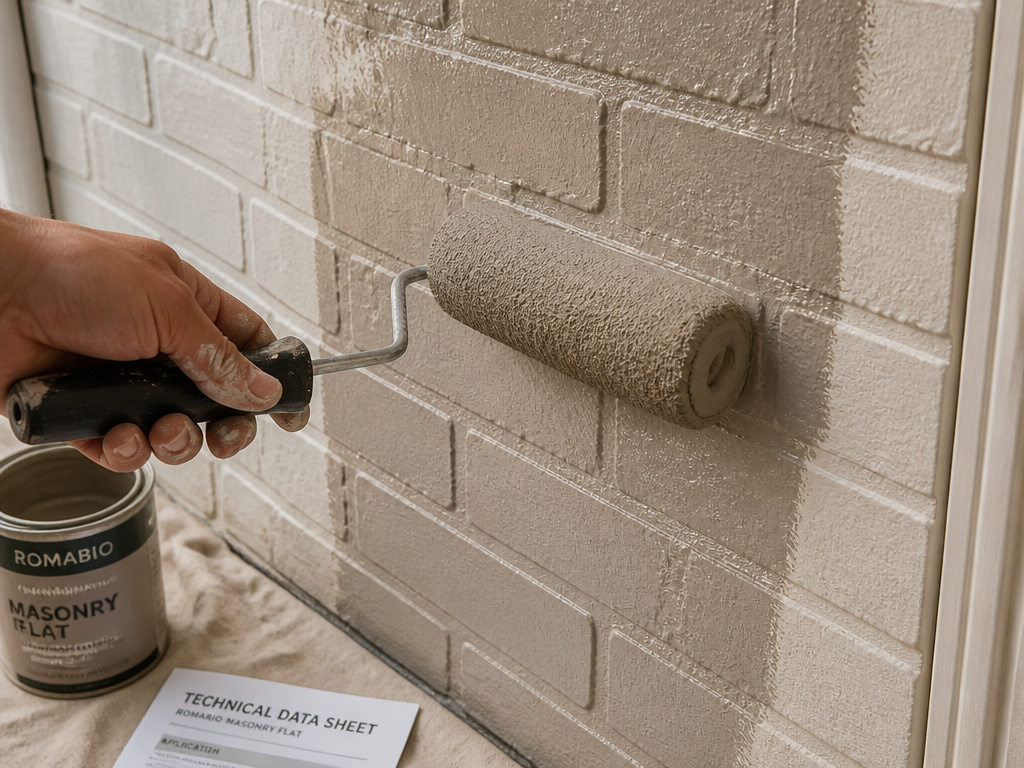
Sheen changes how the wall reads from across the room, and it decides how often you’ll be scrubbing it.
Benjamin Moore notes many homeowners choose flat for a traditional look, and that semi-gloss and high-gloss finishes are easier to clean. AZ Faux recommends latex satin as the base coat. Different reasoning, similar product.
Flat hides the seams between panels. Satin hides the fingerprints. Pick whichever one you’ll be annoyed by in six months.
On a faux brick wall the seams matter more than the shine. A flat finish can soften the line where one panel slides into the next.
If you want the brick to read lighter without going fully opaque, whitewashing brick is the same job with a thinner coat.
A satin wall can show every roller lap. I’d rather fix the lap than change the sheen.
Check the can and the Technical Data Sheet for dry and cure times, because the two differ and Benjamin Moore publishes both for every product.
GenStone and AZ Faux Panels Have Their Own Rules
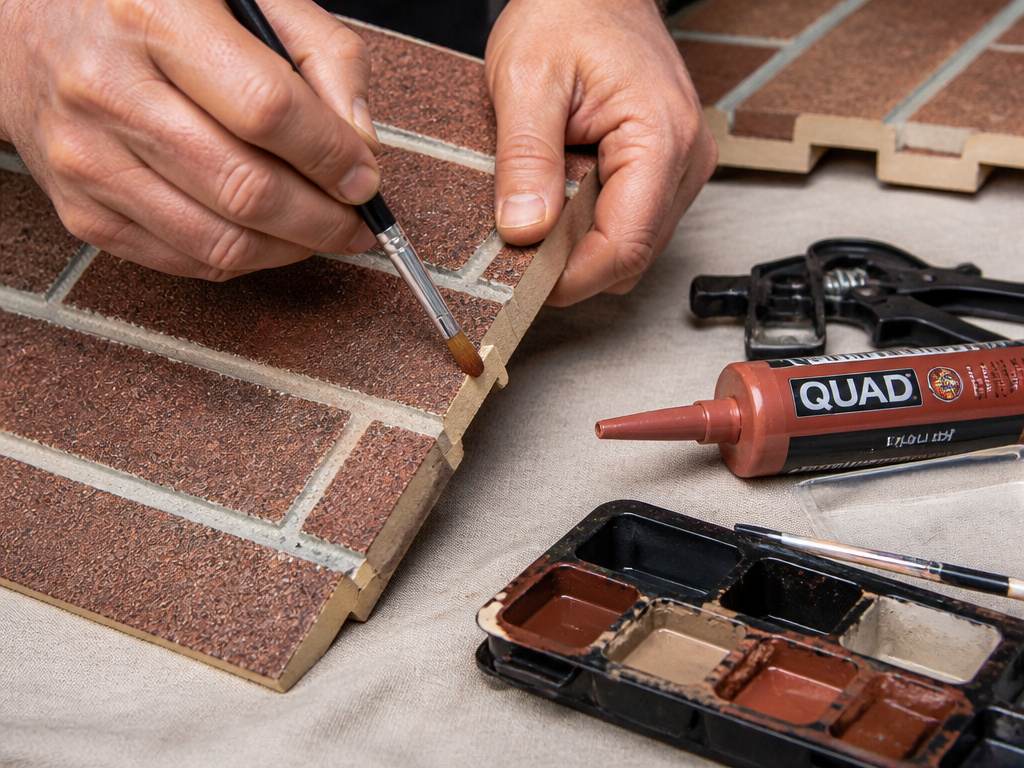
GenStone builds its paint kits around the three primary colors that make each panel, and it treats caulk and paint as part of the 25-year warranty rather than an optional extra.
The quantities are specific enough to plan around. Buy one paint kit for every 400 square feet of installed panel for raw-material touch-up, plus one kit for tinting each tube of Exact Color caulking. One tube of caulking covers a small project, or 400 square feet on a large one.
Big Stretch caulk goes where bricks from one panel slide into the next. Exact Color conceals fastener holes in ledgers, trim, and face-screw locations, and it paints over raw material exposed by a cut. Both are water based and paintable.
Construction adhesive is required for all exterior installations and suggested for all interior work except over drywall. It goes on in an S pattern on the back of every panel, ledger, and trim. If the substrate is existing brick, concrete, or stucco you might want back later, Tyvek HomeWrap protects it from the adhesive.
The part nobody mentions: Every cut edge exposes raw material that no longer matches the face color. That’s exactly what the touch-up kit is for, and one kit covers 400 square feet of installed panel.
If you’re building the brick look rather than painting an existing panel, applying texture paint is where the depth comes from.
The Prep Nobody Enjoys: Seams, Nail Holes, and Soot
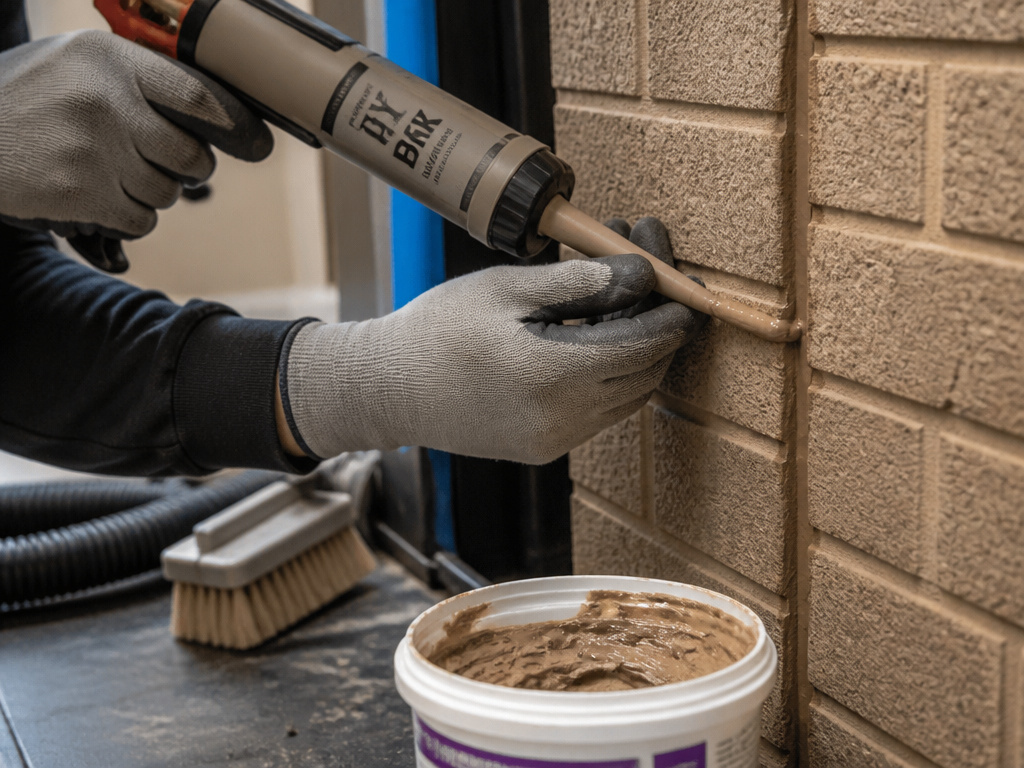
The paint is the fun part and the least important part. What shows through a finished wall is every seam you skipped and every nail hole you filled badly.
AZ Faux wants gaps, joints, and nails caulked on newly installed panels, and textured caulk plus paint for touching up gaps or exposed screws. That’s a quick bit of work that decides whether the wall reads as brick or as a printed sheet.
Cleaning is where the sources split. Benjamin Moore says wire brush, then vacuum. NIST says the same and adds that old paint left after brushing need not be removed. BIA, writing about fireplace surrounds, says dry brush with a non-metallic stiff-bristled brush and then vacuum, pre-wet, and clean with a grease-cutting detergent or trisodium phosphate.
I’d follow the BIA version on a surround. A non-metallic brush lifts soot; a wire brush is for masonry that’s already sound and just dusty.
Wire-brushing a sooty surround throws a fine black dust that settles on everything nearby, so tape off the room before you start.
- Caulk every seam and joint on a new panel before paint. Skipping it leaves a shadow line that no topcoat hides.
- Fill nail and fastener holes with tinted caulk, not plain white filler.
- Vacuum after brushing, not before. Dust you knock loose later lands in wet paint.
- Wipe down with a citrus cleaner such as INSL-X All-Purpose Citrus Cleaner and let it dry completely.
I keep a scrap of primed cardboard beside the wall the whole time I’m working. It’s where the next color decision gets tested before it goes anywhere permanent.
Grab a scrap of foam board and make a few ugly swatches before you open the wall.
Frequently Asked Questions
Can you paint faux brick panels without sanding?
Yes, in most cases. AZ Faux and GenStone both treat caulking and painting as finishing steps rather than surface-removal jobs, and neither calls for sanding a factory panel. Test a hidden corner first before painting a factory panel.
How long should you wait before painting new brick?
At least 30 days, per the Brick Industry Association, and longer in cool weather. Benjamin Moore gives the same figure as at least one month. That clock applies to real mortar, not to factory panels, which need only caulk at the joints.
What happens if you paint a factory-finished faux brick panel?
With AZ Faux, painting voids the warranty outright. GenStone takes the opposite approach and sells paint kits as part of its system. Read your panel’s warranty before you buy a can, because the two policies point in different directions.
Do you have to prime faux brick before painting?
The sources disagree. Benjamin Moore requires a stain-blocking primer such as Fresh Start High-Hiding All Purpose Primer. AZ Faux skips primer and rolls a latex satin base coat. BIA doesn’t require primer for interior decorative work and stresses dryness and pH instead. Prime when you have stain, smoke, or adhesion risk.
Can you whitewash faux brick instead of painting it solid?
Yes. Whitewashing is a coat of watered-down paint that lets the texture and some original color show through. It’s a lighter version of the same job, and it hides panel seams less than a flat opaque coat does.
What’s the best paint finish for a faux brick wall?
Flat reads most like brick and softens panel seams. Semi-gloss and high-gloss are easier to clean, per Benjamin Moore. AZ Faux recommends latex satin for a base coat. Pick based on whether the wall is decorative or gets touched.
The Bottom Line
Here’s the concession first: if your wall is a factory-finished panel still under warranty, the honest answer is that you probably shouldn’t paint it. AZ Faux will void the coverage, and a panel that already looks like brick doesn’t need help.
If you’re painting anyway, or the panel is bare, the trigger to watch is the plastic sheet. Run the 16-hour test twice on two different patches. If both come back wet, stop and find the moisture source before you buy paint, because more drying time is needed.
Your first step this week is small. Tape a scrap of foam board beside the wall, mix your mortar color, and make swatches with a sponge, a rag, and a crumpled bag. Let it be messy first. The one you didn’t expect is the one going on the wall.
