
How to Clean Paint From Clothes: Step-by-Step
This post contains affiliate links. As an Amazon Associate, we earn from qualifying purchases.
To clean paint from clothes, first identify the paint: water-based paint rinses out in cool water while it’s still wet, and oil-based paint needs the thinner named on the can, or mineral spirits if the label is gone. Treat it before it dries, work from the back of the fabric, and never machine-dry a stained garment.
Read the back of the paint can before you read anything else. That label names the thinner the manufacturer built the paint around, and both the University of Georgia Extension and SQ Commercial’s fabric care guide point to it first. When the can is already in the bin, the fallback splits: mineral spirits on one side, turpentine or white spirit on the other.
What follows walks the two paint families separately, shows where the credible guides actually contradict each other, and flags the three moves that turn a how to clean paint from clothes question into a permanent stain.
Key Takeaways
- Water-based paint comes out in cool water while it’s wet, according to SQ Commercial and UGA Extension. Good Housekeeping’s lab uses warm running water instead.
- Oil-based paint needs the thinner named on the can. UGA and SQ fall back to mineral spirits, while ACI and Tide fall back to turpentine or white spirit.
- Acetone is fiber-gated. Good Housekeeping allows it on latex residue only when the fabric has no acetate or triacetate, which acetone melts.
- Never machine-dry a garment that still holds solvent. SQ Commercial warns that solvent residue can cause a fire or explosion in the washer, and that articles cleaned with flammable substances should never go into a washer or dryer.
- Dried paint is genuinely contested. ACI calls it permanent; PNW 440 says “may be permanent” and still lists an alcohol procedure for dried acrylic; SQ Commercial says dried water-based paint can be softened with soapy water or an acrylic paint and varnish remover.
How to Clean Paint From Clothes While It’s Still Wet
Wet paint is the only version of this job that’s genuinely easy. The film hasn’t bonded to the fibers yet, so it lifts instead of staining.
Water-based paint is removed by flushing the stain from the back of the fabric with cool water before the film sets, then washing. Oil-based paint requires the thinner specified on the paint container, followed by detergent pretreatment, rinsing, and a wash cycle. Blended fabrics follow the method for the most sensitive fiber in the garment.
Timing beats technique here. The American Cleaning Institute says the less time a stain has to soak in, the easier it comes out. SQ Commercial’s guide puts it harder: many soils never become stains at all if you get to them promptly, while older ones may be difficult or impossible to remove.
Direction matters as much as speed. SQ Commercial is explicit about treating from the back of the fabric, because pushing from the front drives pigment deeper into the weave instead of lifting it off the surface.
Before you start: Solvent-based thinners are flammable. SQ Commercial’s guide states that fabric holding solvent residue must be rinsed until no trace remains before it goes into a washer or dryer, because the residue can cause a fire or explosion. Items cleaned with flammable substances should be hand-washed with detergent first. The University of Georgia Extension adds that products and containers should be stored and disposed of as directed and kept out of reach of children.
Here’s the wet-paint sequence, in order:
- Blot, don’t wipe. Press a dry white cloth onto the stain from the front. Wiping drags pigment sideways into clean fibers and doubles the area you have to treat.
- Flip the garment and flush from the back with cool water. SQ Commercial and UGA Extension both specify cool. SQ notes that hot water sets some stains, protein-based ones especially.
- Work in liquid detergent while the fabric is still wet. UGA’s sequence is sponge with water, rub in detergent, rinse.
- Add a pre-wash stain remover if any color remains. ACI’s order is pretreat, let it soak in, then launder.
- Wash, then look before you dry. ACI is blunt about this one: don’t put a stained garment in the dryer until the stain is gone.
Common mistake: Reaching for hot water because it feels more effective. SQ Commercial’s guide notes that heat sets certain stains, and the pigment locks into the fiber before the wash cycle even starts. Cool first, always.
Water-Based Paint: Cool Rinse or Warm Flush?
Three credible guides give three different answers on water temperature, and none of them is wrong for every fabric.
SQ Commercial says to rinse the fabric in cool water while the stain is still wet. UGA Extension says to soak in cool water to loosen the paint. Good Housekeeping’s cleaning lab says to flush the stain from the back under warm running water.
SQ Commercial and UGA Extension specify cool water, while Good Housekeeping’s lab uses warm running water; cool is the safer starting point for anything you haven’t tested, because SQ Commercial’s guide warns that hot water sets some stains.
Good Housekeeping’s method for latex and acrylic is the one most people can run with household supplies. Mix equal parts dish soap and warm water, sponge the stain vigorously with a sponge you don’t mind ruining, rinse, and repeat until no more paint comes off. A plain dish soap does the job; you don’t need a specialty product for a wet splatter.
Household latex paint is the most common water-based case, and it’s the one Good Housekeeping treats with that dish soap and warm water mix.
| Paint type | First move | Agent | Watch out for |
|---|---|---|---|
| Latex or water-based | Flush from the back | Cool water, then dish soap | Hot water sets the film |
| Acrylic | Flush with warm water | Equal parts dish soap and warm water | Keep sponging until nothing lifts |
| Oil-based | Blot, then sponge from the back | Labeled thinner, else mineral spirits | Solvent residue left in the washer |
| Spray paint | Spot test on a hidden seam | Rubbing alcohol | Alcohol can fade fabric color |
The Red and Yellow Watercolor Exception
PNW 440, the tri-state extension publication, scopes its own paint entry: watercolor except red and yellow. Those two pigments are excluded from the standard cool-rinse procedure the guide gives for everything else.
UGA Extension makes no such exclusion and simply says to sponge water-based paint with water. If your splatter is red or yellow watercolor, spot test before you commit to the flush.
Oil-Based Paint Needs a Solvent, and the Label Wins
Get the solvent wrong on oil paint and you push pigment deeper instead of lifting it.
Every guide in this set starts in the same place: use the thinner the paint container recommends. UGA Extension says to treat the stain with that solvent, and only if the container or label isn’t available should you reach for mineral spirits. SQ Commercial’s guide says the same thing in nearly the same words.
The oil-based paint case is the one where the can outranks every guide, including this article.
When the Can Is Gone
The fallback is where the sources split. UGA Extension and SQ Commercial both name mineral spirits. The American Cleaning Institute names turpentine. Tide names white spirit or turpentine, after spot checking on an inconspicuous area.
Mineral spirits smell like a hardware aisle and the smell stays in the fabric long after the paint is gone. If you can still smell it, it’s still in there, and it isn’t ready for the machine.
Tide’s sequence after the solvent is specific. Apply Tide Ultra Stain Remover directly to the stained area, brush it in with a clean, soft-bristled toothbrush, wash as normal, and repeat if the stain persists.
Good Housekeeping’s version runs longer. Sponge the stain from the back over a stack of white paper towels, replacing them as they load up with paint, then rub dish soap into the stain and soak the garment in a tub of water overnight.
UGA takes a third route. Work liquid detergent into the stain while it’s still wet with solvent, then soak in hot water overnight if color remains, launder, and repeat if necessary.
Where this goes sideways: Skipping the spot test. SQ Commercial’s guide says to apply any stain removal product to a small, hidden part of the fabric first, because a solvent strong enough to cut cured oil paint is also strong enough to lift dye.
Does Dried Paint Ever Come Out?
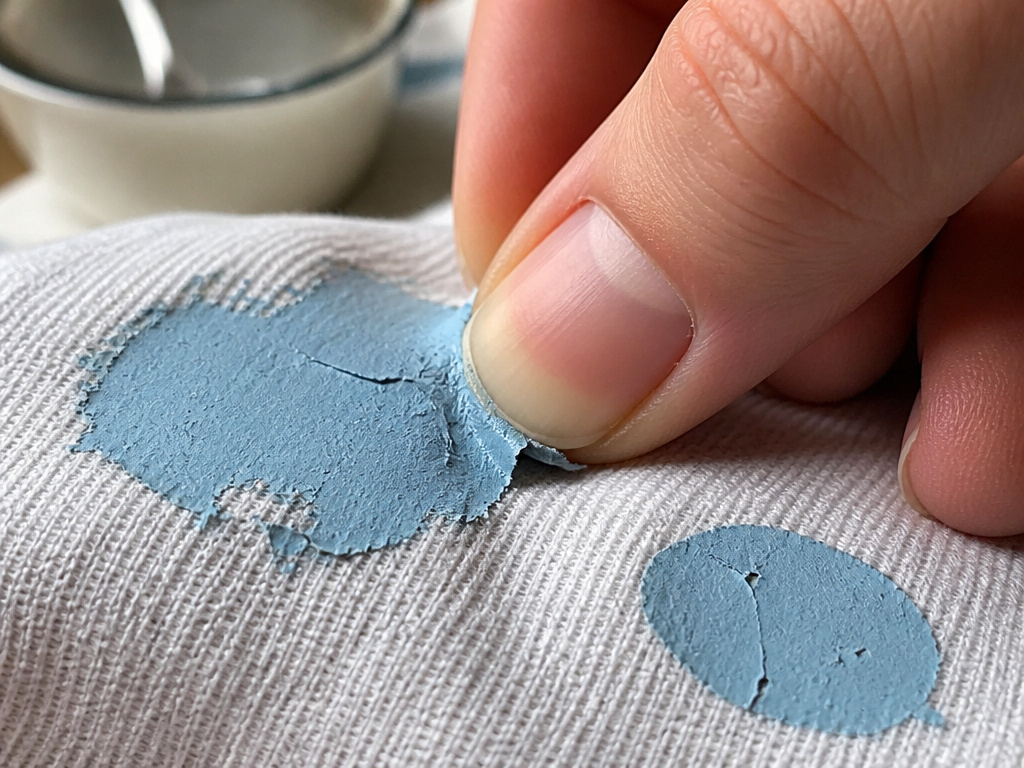
The American Cleaning Institute says flatly that once paint is dry, it cannot be removed. PNW 440 says dried paint may be permanent, and SQ Commercial says dried water-based paint can be softened with soapy water or an acrylic paint and varnish remover.
PNW 440 says dried paint may be permanent, and then still gives an alcohol procedure for dried acrylic. UGA Extension says a dried stain may become permanent. SQ Commercial says dried water-based paint can be softened with soapy water or an acrylic paint and varnish remover, then rinsed and washed.
Read that as a range of confidence rather than a contradiction about chemistry. ACI states the absolute version, PNW 440 and UGA Extension state the conditional one and hand you a method anyway, and SQ Commercial says dried water-based paint can be softened with soapy water or an acrylic paint and varnish remover.
Dried latex has a rubbery give when you press a fingernail into it. Cured oil paint doesn’t give at all. It’s a thin, hard shell sitting on top of the weave, and that shell is what you’re trying to break.
| Question | One position | The other |
|---|---|---|
| Water temperature, latex | SQ Commercial and UGA: cool | Good Housekeeping: warm running water |
| Fallback solvent, oil paint | UGA and SQ: mineral spirits | ACI and Tide: turpentine or white spirit |
| Rinse before washing? | Tide: no, wash with the cleaner still on | SQ and UGA: rinse, then wash |
| Dried paint removable? | ACI: no, not once dry | PNW 440: may be permanent; SQ: soften with soapy water |
The Scrape-First Method
Good Housekeeping’s lab scrapes and tamps dried latex with the back of a spoon or a fingernail before the garment gets wet at all. The idea is to break the film mechanically so the soap has an edge to work under.
The Soften-First Method
SQ Commercial goes the other way and softens the film first, with soapy water or an acrylic paint and varnish remover, then rinses and washes.
PNW 440 and UGA Extension both stress prompt wet treatment and warn against excessive rubbing, which cuts against scraping. On a delicate fiber, soften first and skip the spoon.
Fiber Rules That Override the Paint Rules
PNW 440 sets three limits that beat whatever the paint type tells you:
- Blends follow the most sensitive fiber in the garment. A wool-polyester blend gets the wool method, not the polyester one.
- No chlorine bleach on silk, wool, spandex, urethane fabrics, or polyurethane foam.
- Don’t exceed 160°F water with any synthetic fabric. That ceiling applies even when a hotter soak is recommended for the stain.
The stain removal guide for washable fabrics is where those three rules come from, and it’s worth reading before you decide a fiber is tough enough to take a scrub.
Why Acetone Is the Riskiest Thing in the Cabinet
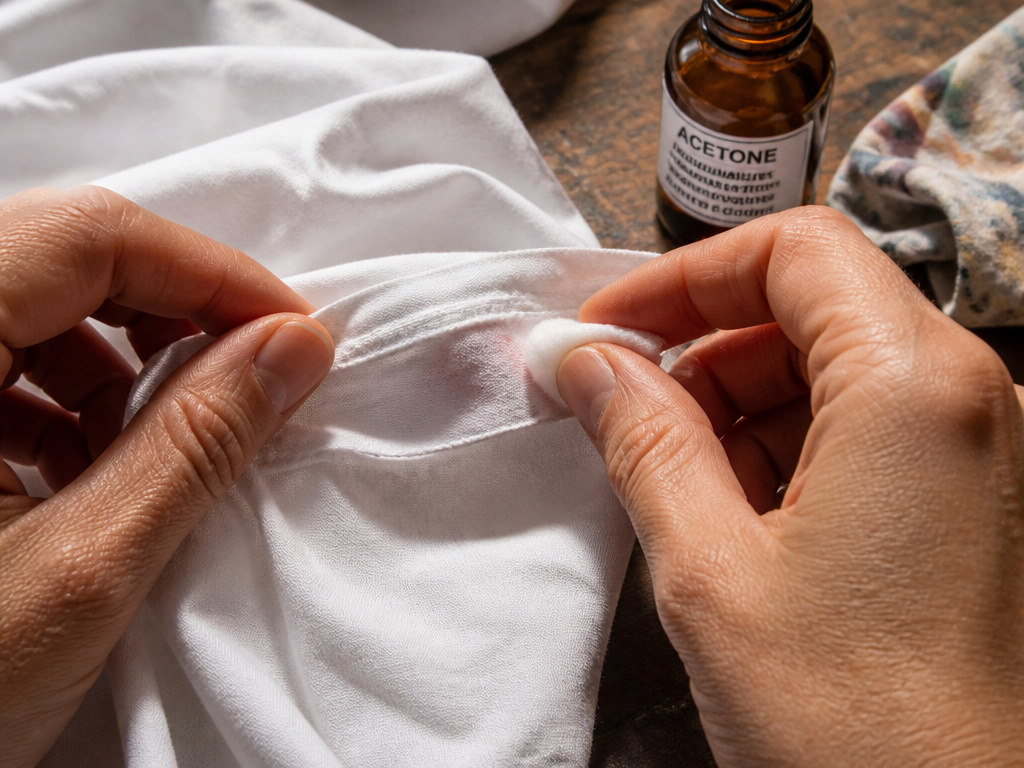
Acetone dissolves acetate and triacetate on contact, which is why Good Housekeeping gates it behind a fiber check before it ever touches a stain.
Their rule is precise: if latex residue remains and the fabric contains no acetate or triacetate, you can blot it with a little acetone. If the fabric does contain them, the acetone melts the fiber.
SQ Commercial’s guide says the same thing from a different angle: don’t use nail polish remover on acetate or Arnel fabrics.
Tide is the outlier. It lists acetone or nail polish remover as a second option for spray paint, after spot testing for colorfastness. Good Housekeeping allows a little acetone on remaining latex residue only if the fabric has no acetate or triacetate, and SQ Commercial says not to use nail polish remover on acetate or Arnel fabrics. PNW 440, UGA Extension, and ACI don’t endorse acetone for paint stains at all.
Rubbing alcohol is the gentler first try. Tide notes it can be effective against paint but can also fade the color of clothes, so the spot test isn’t optional.
PNW 440 gives a dilution no consumer brand source mentions: on acrylic and modacrylic fabrics, sponge with alcohol diluted with 2 parts water.
Test on the inside of a hem before you touch the stain. A solvent that lifts paint will also lift dye, and a hidden seam is the cheapest place on the garment to find that out.
I keep the acetone on a high shelf I have to reach for. That single inconvenience has saved more of my shirts than any technique I’ve read.
Paint That Misses the Clothes: Upholstery, Carpet, Skin, Hair
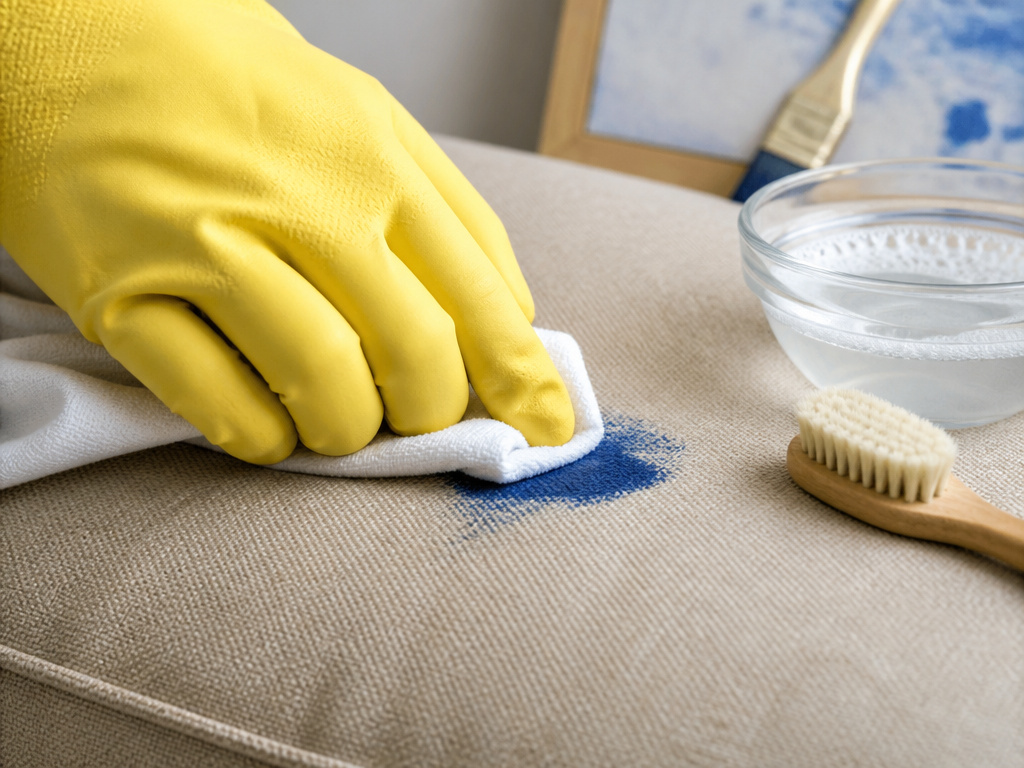
A brush slips off the edge of the canvas and there’s a stripe on the sofa cushion. Same paint, different surface, and the method changes completely.
Upholstery is the hard case because you can’t flip it over. Getting paint from upholstery means working from the front with as little liquid as you can get away with, since the cushion underneath will hold whatever you pour on.
Carpet is worse in a different way. The fibers are dense and the paint sits at the base of the pile, so blotting beats scrubbing every time. Paint from carpet is a patience job, not a muscle job.
Skin and hair are their own category. Paint from skin and paint from hair both involve surfaces you can’t spot test, which changes the whole risk calculation.
Spray paint gets its own note because Tide treats it separately: rubbing alcohol applied directly to the stain after spot testing, then Tide Ultra Stain Release Detergent worked in and left for 10 to 15 minutes before washing. Tide says not to rinse before washing, since the embedded cleaners are supposed to boost the wash cycle. SQ Commercial and UGA both say rinse and then wash. On a spray-paint splatter, follow the product you actually used.
Removing spray paint from skin safely is a separate problem again, and it’s the one place where the solvent advice above really doesn’t transfer.
The Dryer Is the Point of No Return
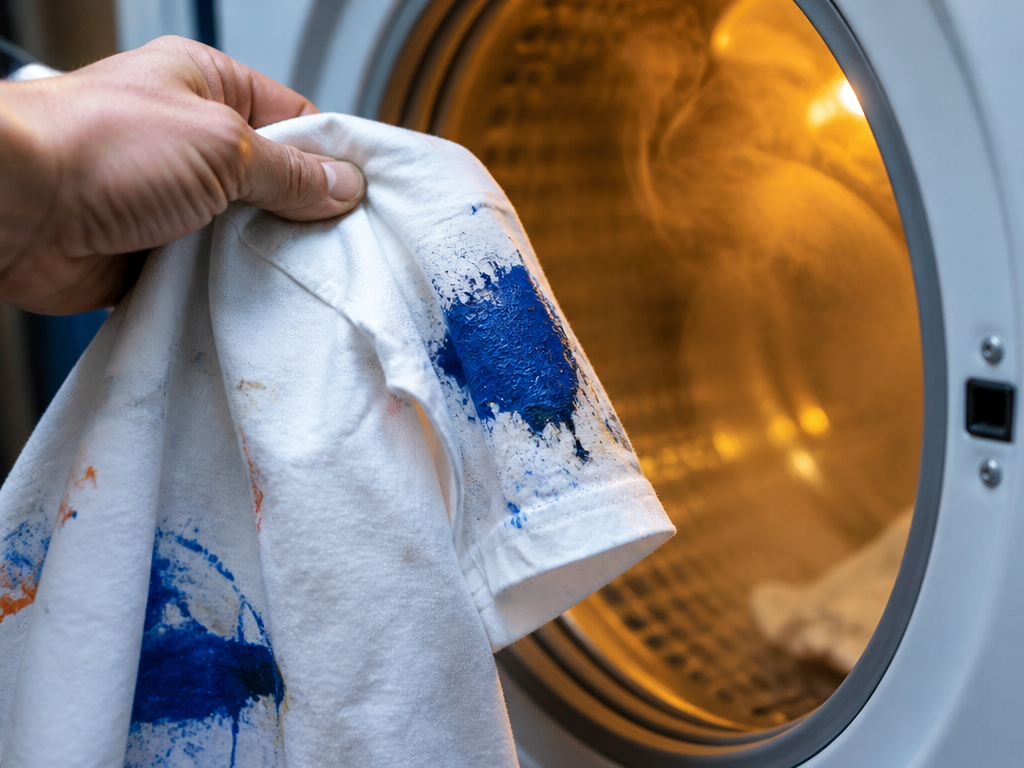
Heat sets paint into fiber, and it’s the one mistake in this whole process you can’t walk back.
ACI’s instruction is short: don’t put a stained garment in the dryer until the stain is removed. Good Housekeeping’s lab says the same thing with more detail, noting that dryer heat causes stains to set and may make them impossible to remove.
There’s a second reason to check the drum before you close it. SQ Commercial’s guide warns that articles cleaned with flammable substances should never go into a washer or dryer, and that failure to comply could result in fire, explosion, or serious burns.
I don’t keep a dedicated paint-stain spray in the studio anymore. Dish soap, warm water, and a rag get a wet acrylic splatter out before a specialty product would finish soaking. Fair warning: that only holds while the paint is wet.
The American Cleaning Institute stain removal guide is worth bookmarking for the general rule it repeats: deal with a stain as early as possible, pretreat, let it soak in, and use the warmest water setting that’s safe for the fabric on the tough ones.
Frequently Asked Questions
Can you get dried paint out of clothes at all?
It depends on the paint and the fiber, and the sources don’t agree. ACI says once paint is dry it cannot be removed. PNW 440 says dried paint may be permanent but still gives an alcohol procedure for dried acrylic, and SQ Commercial says dried water-based paint can be softened with soapy water or an acrylic paint and varnish remover. Try the soften-first method before you give up on the garment.
What water temperature should you use on water-based paint?
Cool water is the safer default. SQ Commercial and UGA Extension both specify cool, while Good Housekeeping’s lab uses warm running water. SQ Commercial’s guide warns that hot water sets some stains, so start cool and only go warmer once you’ve confirmed the stain is lifting.
Is acetone safe on paint stains?
Only on fabrics with no acetate or triacetate, because acetone melts those fibers. Good Housekeeping allows a small amount of acetone on remaining latex residue under that condition. SQ Commercial says not to use nail polish remover on acetate or Arnel. PNW 440, UGA Extension, and ACI don’t recommend acetone for paint at all.
Do you rinse the stain before washing?
The sources split. Tide says not to rinse, because the embedded cleaners boost the wash cycle. SQ Commercial says to rinse and then wash, and UGA Extension’s sequence includes a rinse step. On oil-based paint, SQ Commercial warns that solvent residue can cause a fire or explosion in the washer, so thorough rinsing matters.
What if the paint can and its label are gone?
UGA Extension and SQ Commercial both fall back to mineral spirits. ACI names turpentine, and Tide names white spirit or turpentine after a spot test. Spot test on a hidden seam first either way, because a solvent strong enough to cut cured oil paint can also lift dye.
The Bottom Line
Here’s the concession. None of this helps once a cured oil-based enamel has been through a wash cycle and a dryer. At that point ACI’s position is the realistic one, and the shirt becomes a painting shirt. Keep it. Every studio needs one, and mine has four.
Most of how to clean paint from clothes comes down to one timing decision: blot in the first few minutes, or negotiate with a set film later. The technique barely changes. The outcome changes enormously.
Try this today: put a bar of plain soap and a folded white cloth next to your water jar before your next session. Then the first time you splash, you’ll blot instead of wipe.
