
How to Clean a Paint Sprayer: The 30-Minute Rule
This post contains affiliate links. As an Amazon Associate, we earn from qualifying purchases.
To clean a paint sprayer, flush the gun with the solvent your manual names before the paint sets, then strip and dry the parts. Harbor Freight’s 58149 manual calls for cleaning after every use and any idle stretch over 30 minutes, because cured paint clogs the gun permanently.
That 30-minute threshold is a much shorter leash than the end-of-day cleanup most of us default to, and it is the heart of how to clean a paint sprayer. Harbor Freight prints it in the 58149 manual, which tells you how often it gets ignored.
What follows is the order of operations: what to gather, how to flush a cup-fed gun and an airless unit, and where the six manuals I read flatly contradict each other.
Key Takeaways
- Clean after more than 30 minutes of idle, not after the day is over. Harbor Freight’s 58149 manual states it in the notice at the top of the page.
- Match the solvent to your own manual. The 58149 allows water or mineral spirits. The 59825 calls for a solvent-based cleaner instead.
- Never dunk the gun body. Harbor Freight’s 58149 and 59825 manuals ban immersion and warn that solvent in the air inlet ruins the gun, though Titan permits soaking only the tip and guard.
- Flash point minimums differ by brand. Harbor Freight’s 58149 sets 100°F. QTech’s iQ Series 3 sets 140°F.
- Skip the lubricant. Harbor Freight’s 58149 manual says oil mixes into the paint and spoils the finish.
Why Paint Hardens Faster Than You Think
Paint sets on a clock you can’t see.
Latex is the worst offender. Harbor Freight’s 94572 manual says latex paint hardens quickly and permanently inside the spray gun. That word “permanently” is doing real work. Once the resin cross-links, no solvent you own will bring it back.
Solvent-based paint cures in two stages. The liquid carrier evaporates first, thinning the film and letting the resin draw together. The resin then cross-links into a solid that solvents can no longer redissolve. Once the second stage starts inside a fluid passage, flushing pushes cleaner past the blockage rather than through it.
Run a finger along the cup wall after a latex job and it comes away with a rubbery skin, not a smear. That skin is the same thing forming inside the fluid passage, just where you can’t see it.
Thin paint drains out of those passages more completely, which is why thinning paint for a sprayer belongs in the same conversation as how to clean a paint sprayer. A thick mix leaves a film behind even after a flush with water or mineral spirits.
I’ve watched a brush ferrule go from “I’ll get that in a minute” to a rock-hard plug in the time it takes to answer the door. Same chemistry, smaller scale.
The 30-Minute Idle Rule Nobody Follows
Thirty minutes. That’s the whole grace period Harbor Freight puts on a cup gun.
The 58149 spray gun manual says to clean the gun body and cup immediately after every use and whenever it will sit idle for more than 30 minutes. The 94572 and 59825 manuals carry the same “immediately after every use” line, though only the 58149 states the 30-minute idle threshold.
That’s a shorter leash than most of us work on. End-of-day cleanup is the habit. The manual wants a flush between coats.
Common mistake: Leaving a loaded gun on the bench while you cut in one more wall. Harbor Freight’s 94572 manual says latex hardens permanently inside the gun, so you finish the wall and lose the tool.
Why the airless side runs on different rules
Airless units and cup guns don’t share a cleanup schedule. The architecture decides it. If you’re still sorting out which family you own, airless vs HVLP covers the split.
I’d rather flush twice than diagnose once. That’s my whole position on this.
What You Actually Need on the Bench
Four things, and three are probably already in your garage.
- The manual for your exact model, printed or on your phone. Thread counts and solvent rules differ by part number, not by brand.
- The solvent your manual names. Harbor Freight’s 58149 says water or mineral spirits only. QTech’s iQ Series 3 forbids anything with a flash point under 140°F.
- A waste container you don’t plan to use for anything else, plus a second nonmetal container for transfer.
- Clean cloths and a class ABC fire extinguisher, which Harbor Freight’s 58149 asks for, while QTech requires fire extinguishing equipment to be readily available.
If you haven’t bought the sprayer yet, how to choose a paint sprayer will save you a return.
My bench has a coffee tin that has held nothing but mineral spirits for years. It’s labeled with tape, because I have absolutely forgotten what was in an unlabeled tin before. (Your sleeve will pay for this.)
How to Clean a Paint Sprayer, Step by Step
The flush itself is quick work. The disassembly and drying take longer.
Before you start: Solvent vapors pool low and travel, so keep the work away from pilot lights and water heaters. The gun stays pressurized after the sprayer shuts off, so point it into the waste container and pull the trigger before you loosen anything. And keep the gun body upright, because solvent in the air inlet ruins it.
The cup-fed gun, in order
- Set out a waste container and keep the gun pointed into it for the whole flush. Solvent sprayed at a wall bounces back at you.
- Fill the cup to a quarter full with mineral spirits. That’s the 58149’s number. The 59825 uses 2 to 4 ounces of solvent-based cleaner instead, so check which gun is in your hand.
- Replace the cup and open the air control by turning it counterclockwise until it stops.
- Turn the fluid control counterclockwise until two threads show on the 58149, or four threads on the 59825. Skip this and the needle stays seated, so solvent never reaches the passage.
- Plug into a grounded 120VAC outlet and switch on. Harbor Freight’s 58149 manual specifies the grounded outlet for a reason.
- Trigger in short bursts and shake the gun slightly while the solvent sprays into the container. A clean flush sounds like a steady hiss. A gun that’s still loaded spits and stutters, and that spitting is paint coming out in slugs.
- Switch off, unplug, and trigger once more into the container to dump the residual pressure. Skipping this means the gun is still charged when you start unscrewing things.
- Remove the cup and lid, wipe with a clean cloth, and let them air dry. Don’t reach for a towel you like.
- Turn the lock ring counterclockwise by hand, lift out the air cap, air valve, and spring (58149 only), and let them dry.
- Reassemble dry, with no lubricant. Harbor Freight’s 58149 manual says any oil will mix with the paint and give you a poor finish.
What to do with the parts afterward
Nothing fancy. Air dry, reassemble, and store the gun somewhere dry. QTech’s iQ Series 3 manual specifies its own storage regime.
If your sprayer has a pressure control, sprayer pressure is worth setting before the next job rather than during it.
I check the trigger twice before I loosen anything. Every time. The one time I skipped it, I got a face full of air and a lesson I only needed once.
The Settings That Change From Gun to Gun
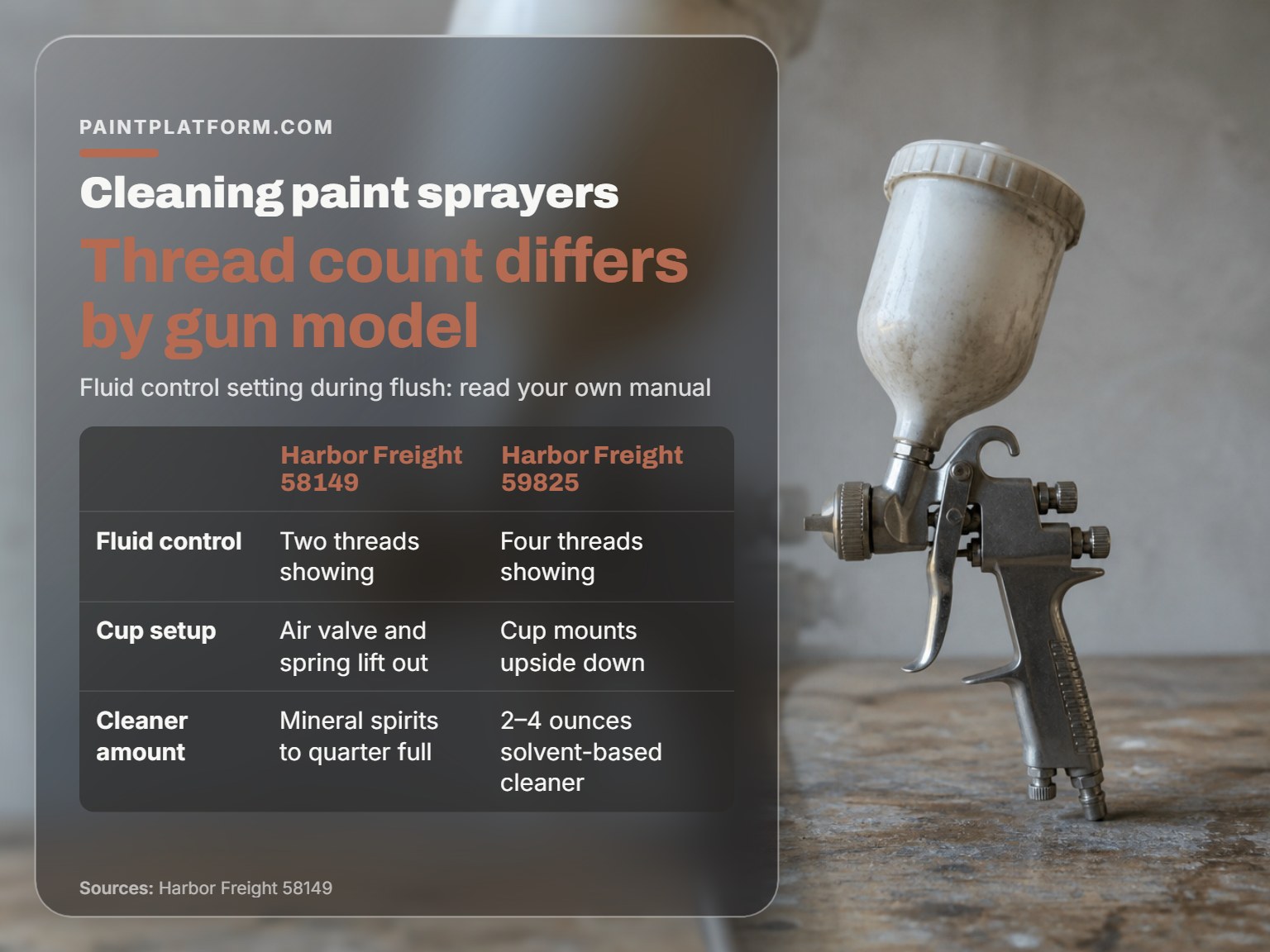
The Harbor Freight 59825 wants four threads showing. The 58149 wants two.
Two different guns, two different needle assemblies. Both numbers are correct for the gun they came from.
| Model | Fluid control during flush | The detail that trips people up |
|---|---|---|
| Harbor Freight 58149 | Two threads showing | Air valve and spring lift out for drying |
| Harbor Freight 59825 | Four threads showing | Cup mounts upside down on the adapter |
| QTech iQ Series 3 | Minimum pressure only | Spray tip comes off before flushing |
If you’re running a big unit and spraying walls all afternoon, flush volume matters more than thread count. Come back to the thread count when you switch guns.
Read the number off your own manual, write it on the gun with a paint pen, and stop guessing.
Why Do Two Sprayer Manuals Disagree on the Same Setting?
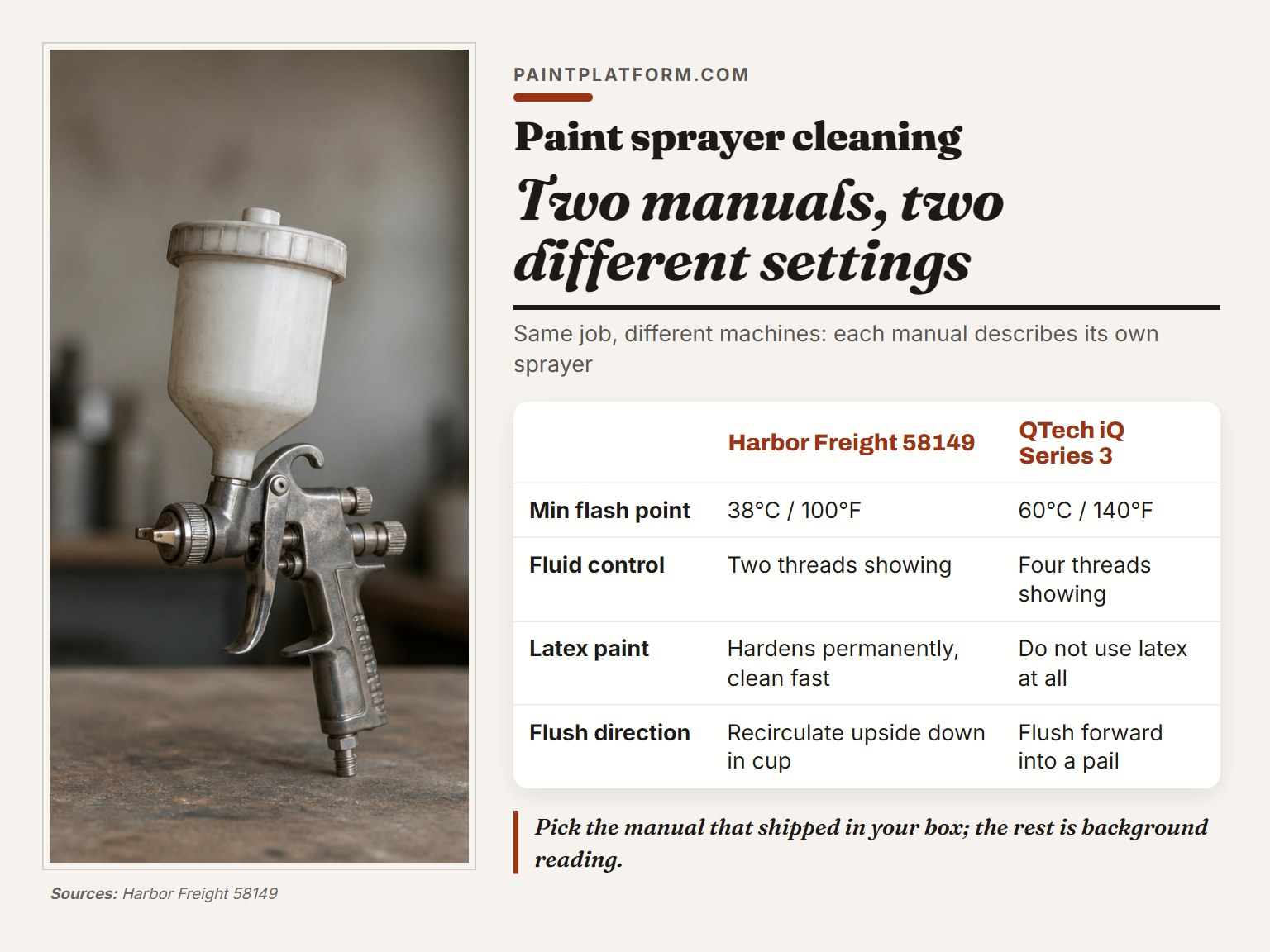
Ever wondered why the same job has two different answers in two different manuals?
Because they’re describing two different machines. Averaging them gets you a setting that’s wrong for both.
| Question | One manual says | Another says |
|---|---|---|
| Minimum flash point | 100°F / 38°C (Harbor Freight 58149) | 140°F / 60°C (QTech iQ Series 3) |
| Fluid control during flush | Two threads (Harbor Freight 58149) | Four threads (Harbor Freight 59825) |
| Latex paint | Hardens permanently, so clean fast (Harbor Freight 94572) | Do not use latex at all (Harbor Freight 59825) |
| Flush direction | Recirculate upside down through the cup (Titan 3A2308D) | Flush forward into a pail (QTech iQ Series 3) |
I don’t average two manuals. If the 59825 is in your hand, four threads is correct and two threads belongs to somebody else’s gun. Pick the manual that shipped in your box and treat the rest as background reading.
The water argument
This one splits clean down the middle. Titan’s 3A2308D manual tells you to protect the internal parts from water and never submerge the sprayer in cleaning fluid. 3M’s ScotchBlue manual tells you to clean the sprayer with soap and water.
Both are right for their own unit. The Titan warns against exposing its electronics to flushing solvents. The 3M unit calls for soap and water instead. Copy the wrong one and you’ll either flood a circuit board or leave paint in a gun that water would have cleaned.
Solvent storage splits the same way. Titan permits mineral spirits only. QTech recommends pump conditioner for oil-base, water for water-base, and motor oil mixed into spirits for long-term storage. 3M rules out oil-based and flammable materials entirely.
Three manuals, three storage regimes. Each one is describing a different product.
Solvent, Sparks, and the 25-Foot Rule
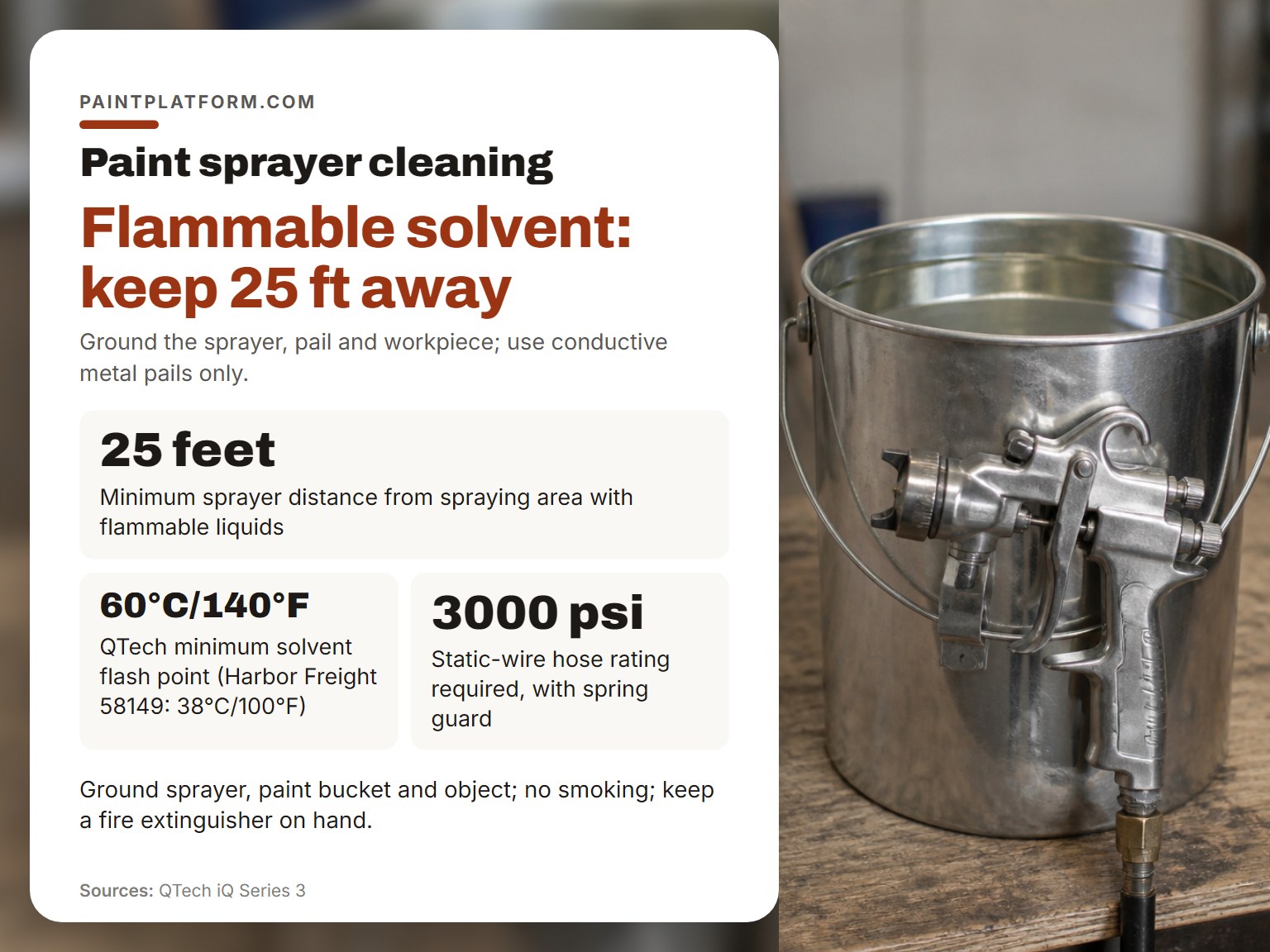
A garage, a half-full pail of mineral spirits, and a space heater running in the corner. That combination is what every warning page in this stack is written about.
QTech’s iQ Series 3 manual puts the unit a minimum of 25 feet from the spraying area when you’re working with flammable liquids, in a space with enough ventilation to stop vapors collecting. It also bans smoking in the area and requires a fire extinguisher on hand.
Grounding is the other half:
- QTech’s iQ Series 3 says to ground the sprayer, the paint bucket, and the object you’re spraying. Static sparking is the ignition source these manuals worry about most.
- QTech’s iQ Series 3 requires conductive metal pails only, properly grounded, while Harbor Freight’s 58149 says to transfer collected solvent to a nonmetal container. A non-conductive pail gives static nowhere to go.
- QTech’s iQ Series 3 requires hoses with a static wire rated for 3000 psi and a spring guard, and says to replace any hose with cuts, bulges, or moving couplings.
- QTech’s iQ Series 3 manual says never tape a hose or try to recouple one. It is blunt about this: it isn’t possible to recouple a high-pressure hose.
Where this goes sideways: Flushing into whatever bucket is closest. QTech requires conductive metal pails, and Harbor Freight’s 58149 manual adds that solvent collected in a metal container should be transferred to a nonmetal one and the metal container flushed.
Overspray and vapor drift are the same problem wearing two hats, and avoid overspray covers the containment side of it.
Dispose of the waste the way the solvent maker and your local hazardous waste rules say. Not down the sink. (Your pipes will pay for this one.)
Can a Clogged Spray Gun Be Saved?
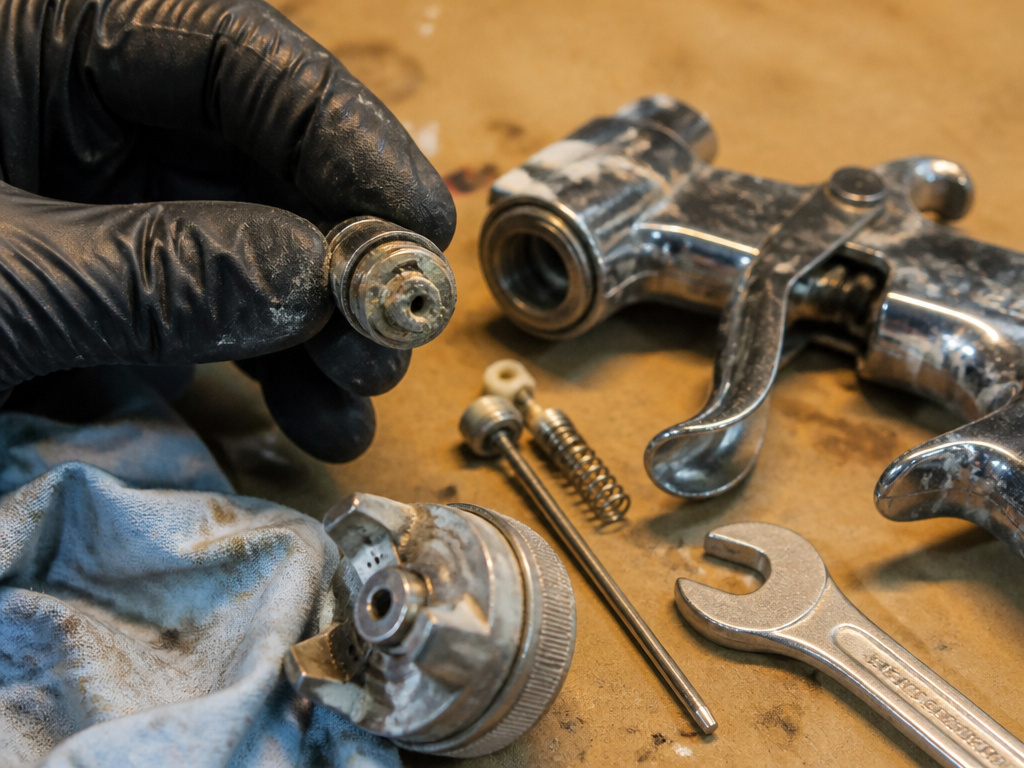
A gun that’s already clogged doesn’t need a longer soak.
Harbor Freight’s 58149 and 59825 manual both use the same phrase: delayed or inadequate cleaning will permanently clog the spray gun. Permanently is the operative word. A soak softens a film. It doesn’t reopen a passage that cured paint has sealed.
Small guns and airbrushes are the exception worth knowing. If that’s the tool in your hand, clean an airbrush walks the same sequence at a smaller scale.
If the gun is a Harbor Freight 58149 and the air valve or spring is seized, price the part before you price a new gun. Those two pieces are listed for removal and drying in the 58149 manual, which is why they’re worth checking.
Frequently Asked Questions
How often should I clean a paint sprayer?
After every use, and again whenever it will sit idle for more than 30 minutes. Harbor Freight prints that threshold in the 58149 manual. End-of-day cleanup is the habit most of us have. The manual wants a flush between coats.
Can I clean a paint sprayer with water?
Only if your manual allows it. Harbor Freight’s 58149 permits water or mineral spirits. QTech’s iQ Series 3 bans solvents below a 140°F flash point and specifies its own regime. Titan’s 3A2308D manual warns against water reaching the internal parts. Check the book that came with your unit.
What happens if I skip cleaning and let the paint dry?
The gun clogs permanently. Harbor Freight’s 58149 and 59825 manuals say delayed or inadequate cleaning will permanently clog the spray gun, and the 94572 manual warns that latex paint hardens permanently inside the gun. Latex is the fastest to set, but oil-based paint does the same thing on a longer clock.
Can I use acetone or lacquer thinner to flush a spray gun?
Not in a QTech iQ Series 3. That manual names acetone, benzene, ether, gasoline, and naphtha as examples of solvents with flash points below its 140°F minimum. Harbor Freight’s 58149 sets a lower 100°F floor, which still rules out several of them. Follow your own manual’s number.
Do I need to clean a new spray gun before the first use?
Yes, if it’s a Harbor Freight 59825. That manual says the material used for testing and corrosion prevention will contaminate paint if you don’t remove it first. Run the pre-use cleaning step before the gun ever sees paint.
How do I know the gun is actually clean?
Listen to it. A clean flush runs as a steady hiss with no spitting. If the spray stutters or comes out in slugs, there’s still paint in the passage, and you’re flushing solvent past it rather than through it.
The Bottom Line
Here’s the trigger I’d give you: if the paint in the cup has already skinned over, stop flushing and take the gun apart. Solvent pushed through a sealed passage just runs around the blockage. Disassembly first, flush second.
The first thing to do this week, if you own a cup gun, is write your manual’s thread count on the gun body with a paint pen. Two threads or four. It’s quick, and it’s the number people get wrong.
One concession: none of this applies cleanly to a sprayer with electronics in the shroud. Those units want the manufacturer’s procedure and nothing else, and a generic “rinse it out” habit will cost you the tool.
Progress beats perfection. A gun that gets flushed after more than 30 minutes of idle is a gun you still own next spring.
