
How to Thin Paint for a Sprayer: Dilution Bands Explained
This post contains affiliate links. As an Amazon Associate, we earn from qualifying purchases.
To thin paint for a sprayer, add the thinner the coating is based on (water for latex, mineral spirits for oil) in small increments, then stop when the paint drains from a viscosity cup inside the maker’s window. Knowing how to thin paint for a sprayer matters most with thick coatings. Wagner’s Control Pro runs interior wall paint at 0-10%; Earlex’s Gemini calls for at least 10% on latex.
Those two numbers describe the same material, and the gap between them is where the how to thin paint for a sprayer question goes wrong. The sprayer manual sets a ceiling for the equipment; the paint can’s technical data sheet sets the requirement for the coating.
What follows is the measured version: the bands each manufacturer actually publishes, how to run a drain test with the cup in your own box, and the two conditions that break a fixed percentage.
Key Takeaways
- Dilution is the paint maker’s call, not the sprayer maker’s. Wagner’s own FAQ sends you to the coating’s technical data sheet and gives its bands alongside.
- A fixed percentage fails on two variables: temperature and tint depth. Pettit changes thinner speed above 80F and below 60F; Wagner sends dark colors past the standard fill line.
- Never thin with a solvent below 100F flashpoint (38C), per Wagner’s Home Décor manual.
- Skip the sprayer for one small room.
Why the Same Latex Needs 0% in One Manual and 10% in Another
Wagner’s airless FAQ puts interior wall paint at 0 to 10 percent dilution for the Control 150 M and Control Pro. Earlex’s Spray Station Gemini manual says all latex-based coatings need at least 10 percent when sprayed from the quart cup.
Dilution bands published by sprayer manufacturers describe what the equipment can tolerate, not what the coating requires. Wagner lists interior wall paint at 0-10 percent for the Control 150 M and Control Pro. Earlex sets a 10 percent floor for latex sprayed from the Gemini’s quart cup. The paint manufacturer’s technical data sheet outranks both.
Both statements are honest. They describe different pumps, different fluid passages, and different feed setups. Earlex’s Spray Station Gemini manual says all latex-based coatings need at least 10 percent dilution when sprayed from the quart cup.
Three things move the number:
- The sprayer’s pump and the size of its fluid passage.
- Whether you’re feeding from a quart cup or drawing straight from the can.
- The coating’s own viscosity at the temperature you’re spraying in.
Here’s what the primary documents actually say, side by side.
| Material | Wagner Control 150 M / Control Pro | Other published guidance |
|---|---|---|
| Interior wall paint (latex, emulsion) | 0-10% dilution | Earlex Gemini: at least 10% from quart cup |
| Wood and metal paint | Undiluted | Pettit 121: enamels and primers 10-20% |
| Varnishes, primers, thick paints | 5-10% dilution | Wagner Home Décor: clear topcoats usually need none |
| Stains, oils, wood preservatives | Undiluted | Wagner Home Décor: transparent stains need no thinning |
| Chalk, milk, tempera paint | Not listed | Wagner Home Décor: thin with water |
Neither manual publishes the geometry of its cup or the orifice it measures through. That’s the reason a percentage lifted from a forum thread is worth so little. Not every coating belongs in the gun anyway, and the paint for spraying question narrows fast once you rule out masonry and acetone-based products.
How Do You Run a Drain Test With the Cup That Came in the Box?
Two manufacturers publish drain-time pass marks that differ widely. Earlex sets the Gemini at 180 seconds. Gepro sets the Easy Sprayer at 30-35 seconds.
Both are drain tests. Neither number travels.
The Gepro cup is a thinning cup, part 410695. The Earlex cup holds one tenth of a quart. A 180-second drain through one cup and a 35-second drain through another can describe paint of identical thickness. Without cup geometry, the figures only mean something to the machine they shipped with.
Before you start: Paint mist and solvent vapour are harmful to breathe, so wear a respirator and spray only in a ventilated space or with forced air. Keep solvent-based thinners clear of ignition sources. Never thin with a material whose flashpoint sits below 100F (38C), and check that flashpoint on the container before you open it.
Here’s the sequence I’d run, in order.
- Stir the whole container first, about two minutes with a stirrer. Settled pigment reads as thickness, and you’ll thin a batch that never needed it.
- Fill the cup to the top, lift it clear, and start timing the moment continuous flow begins.
- Stop the clock when the flow breaks into drips instead of a stream. That break point is the number.
- Compare against your own machine’s figure. Under 180 seconds passes an Earlex Gemini; 30-35 seconds passes a Gepro Easy Sprayer. Anything outside the window gets thinner.
- Add thinner in the increments the manual specifies, then re-test. Earlex steps in 10% first, then 5% (half a viscosity cup) until the target is reached.
No cup in the box? A stir stick does the same job. Dip it, lift it, and watch the drip. Paint that clings and globs is too thick; paint that runs off in a thin stream is ready. That’s the milk consistency test for paint without a stopwatch, and it’s the check I reach for first.
The Percentage Rule vs the Cup Test: Which One Do You Trust?
Pick one how to thin paint for a sprayer method and stay with it for the whole job. Switching mid-batch is how you end up with two half-thinned containers and no idea which is which.
The percentage rule is faster and works fine on a fresh can of a coating you’ve sprayed before. The cup test catches everything the percentage misses, at the cost of a few minutes and a bit of mess.
| Situation | Fixed percentage | Drain test |
|---|---|---|
| Fresh can, familiar product | Reliable, start at the low end | Also works, adds a few minutes |
| Paint stored a year or more | Under-thins; viscosity has crept up | Catches the creep |
| Dark or heavily tinted color | Misses the extra water needed | Catches it |
| Cold garage in winter | Misses the thinner-speed change | Catches it only if you change thinner too |
One caution that applies to both methods. Pettit’s technical bulletin is blunt about the failure mode: over-thinning a varnish, enamel, undercoat or primer can cut gloss on drying or reduce the product’s performance outright. Watery paint sprays beautifully and then dries flat and chalky.
That’s the mechanism worth understanding. Pettit warns that over-thinning a varnish, enamel, undercoat or primer can reduce gloss on drying or cut performance.
Thinner Choice Changes With Temperature, Not Just Percentage
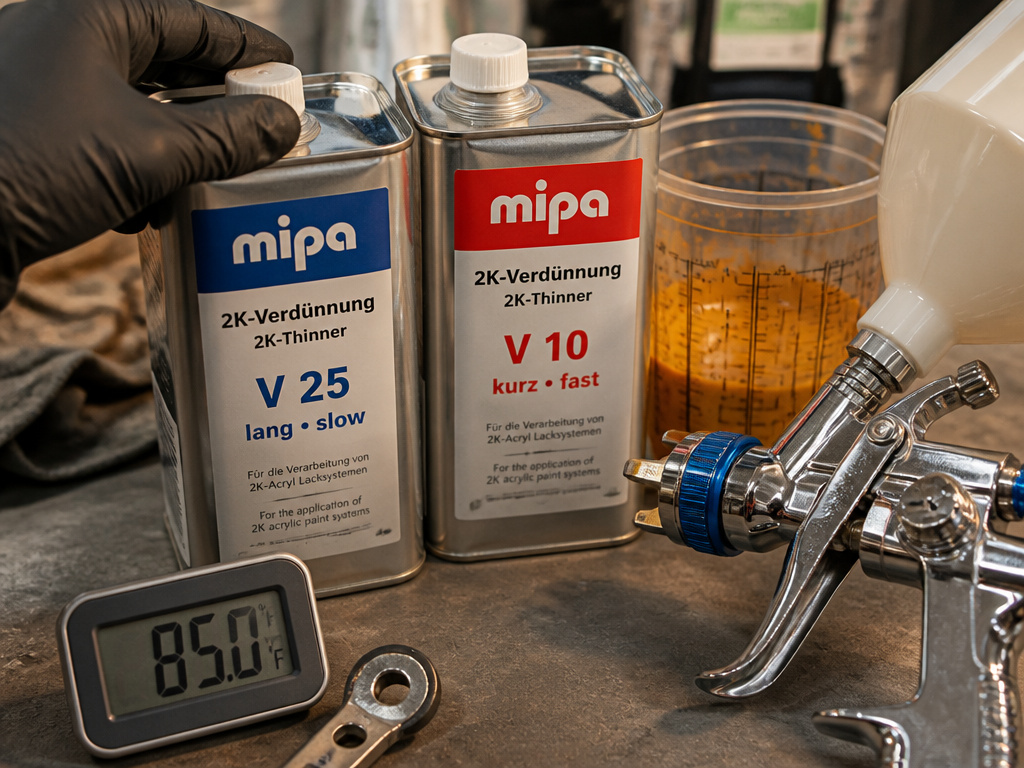
A single 10 percent figure can’t cover the temperature range Pettit addresses. Pettit’s bulletin treats thinner as a matched component rather than a generic solvent, and the matching happens on temperature first.
Slow Thinner Above 80F, Fast Thinner Below 60F
At 80F and above, Pettit recommends slow thinners to improve flow and brushability. At 60F and below, it recommends fast-evaporating thinners, because a slow solvent can get trapped under the drying film and blister weeks later.
A finish that looks perfect on day one can blister later, and the cause was a thinner chosen for the wrong season.
Wagner’s Home Décor manual takes a different approach, giving one 10 percent starting dilution. Both documents are legitimate. They just describe different products with different solvent packages.
Pettit’s own framing is worth borrowing regardless of brand: paint thinners are matched to the product, the application method, and the atmospheric conditions on the day.
Pick the thinner for the temperature you’re spraying in, then pick the amount. Reversing that order is how a finish blisters after it looked perfect.
What Do Dark Colors and Thick Exterior Latex Need?
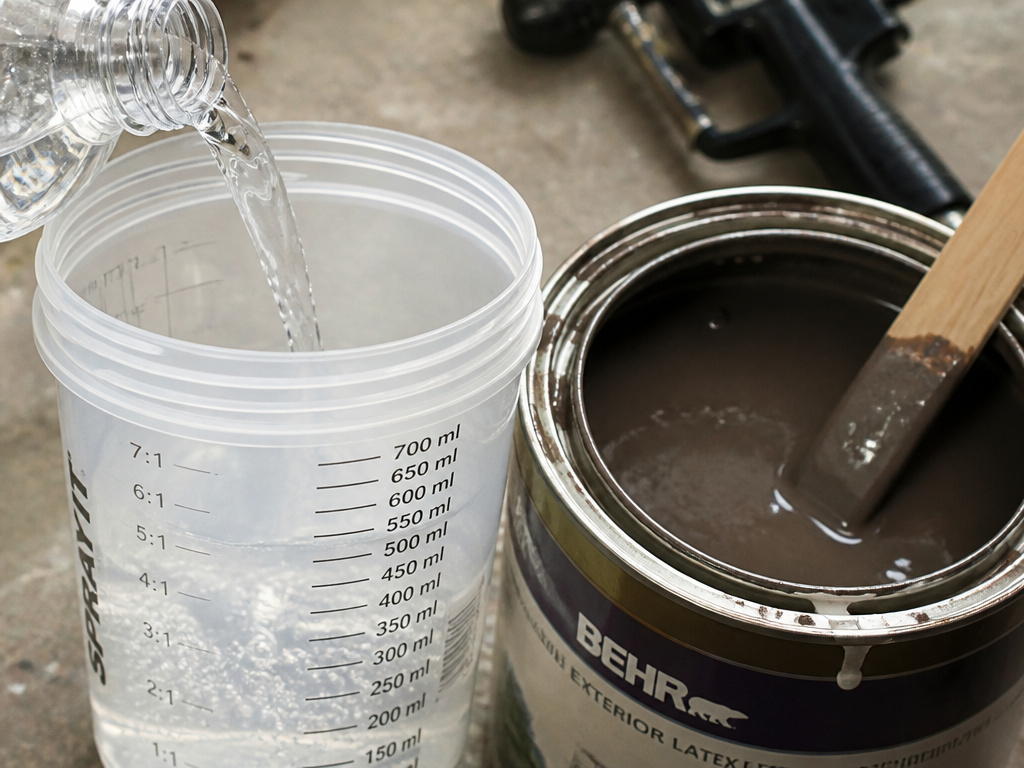
Wagner’s Home Décor manual gives dark tints more room in the container: for darker colors, adding water to the 550 ml line may be necessary. For darker colors, the manual sends you to the 550 ml line instead.
Why Dark Tint Behaves Like Thicker Paint
Wagner notes that for darker colors, adding water to the 550 ml line may be necessary.
The same logic covers thick exterior latex. Earlex notes that when spraying straight from the can, you may need up to 10 percent dilution if the coating is very thick, exterior latex being the example given. The Gemini manual also offers a lighter touch for ordinary interior latex drawn from the can: one viscosity cup of water, about 3 fl oz, per gallon, stirred through, improves coverage and surface finish.
That’s a small addition. It’s also a different instruction from the quart-cup rule, and the manual states both.
Overdo it and you’ll be chasing paint runs down a wall instead of a finish. Wagner’s own warning is simple: never thin beyond the paint manufacturer’s recommendation.
Easy to miss: Facade and masonry paint pours like thick latex and looks like a candidate for thinning. Wagner states it contains abrasive components that wear the equipment out too quickly, and that wear does not reverse.
The Materials a DIY Sprayer Should Never See
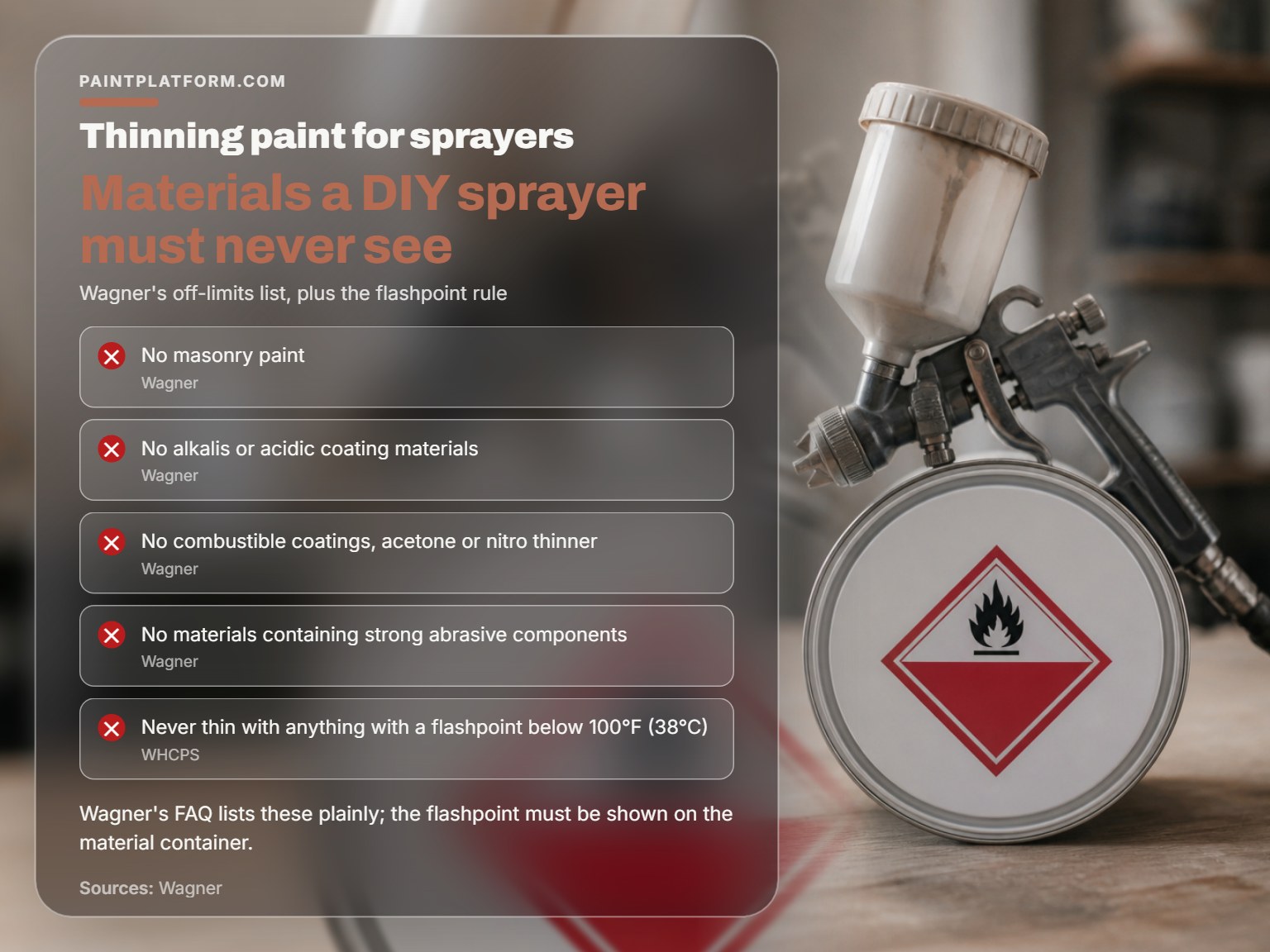
Three categories are off limits: masonry and facade paint, alkalis and acidic coatings, and anything combustible or containing acetone or nitro thinner.
Wagner’s FAQ lists them plainly, along with materials containing strong abrasive components. Facade paint is called out specifically, with the note that abrasive filler wears the equipment out too quickly and coarse surface texture makes full coverage unlikely anyway.
There’s a flashpoint rule running alongside it.
What you can spray is a shorter list than most people expect. Wood and metal paints go through the Control 150 M and Control Pro undiluted. Stains, oils, wood preservatives and plant protection products go through undiluted too. Varnishes, primers, car top coats and thick paints take 5-10 percent.
Nozzle choice follows the same logic. Wagner pairs a 311 nozzle with a red filter for thin, fluid material and a 515 or 517 with a white filter for thick material. That’s a sprayer tip size decision as much as a thinning one, and getting it wrong makes good paint behave like bad paint.
Distance, Speed, and the Cardboard Test
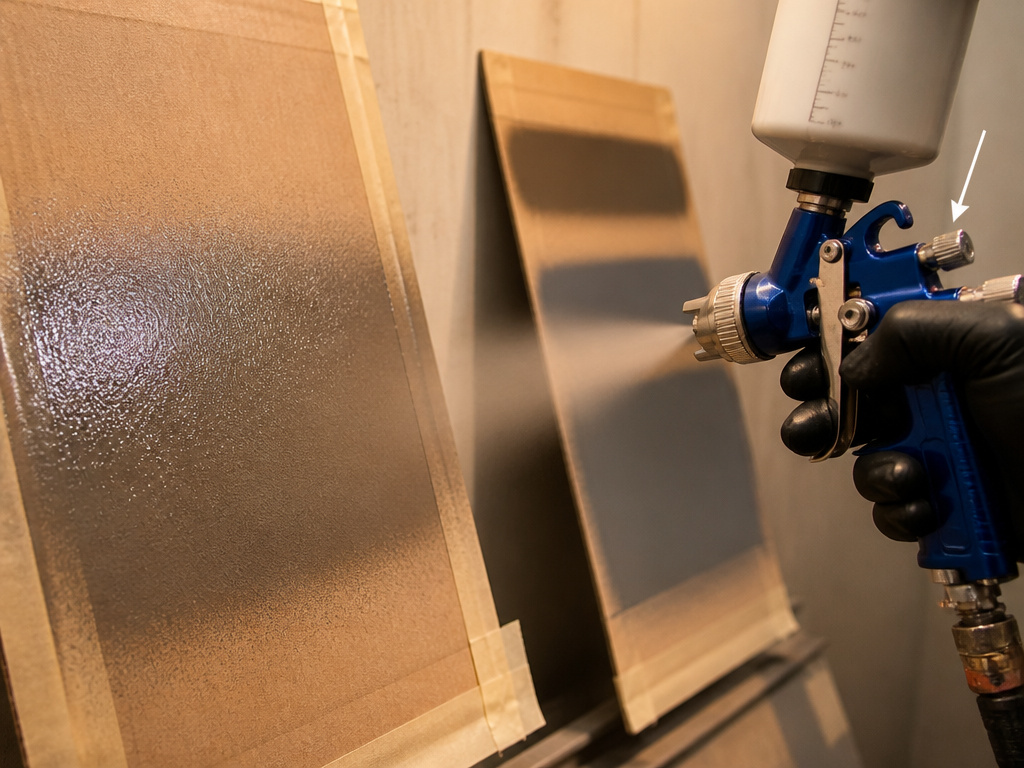
The gun is running, the cardboard is taped to the wall, and the first pass goes down wet and heavy at the near edge. That’s the pass that tells you everything.
Wagner’s guidance is a spray distance of 10-15 cm from the object at a consistent speed. Start the pass before you reach the edge of the piece and carry on past it, so the overlap lands where the stroke is already moving.
The 10-15 cm Rule and What It Actually Controls
Distance sets how much solvent flashes off before the droplets land. Too close and the coat goes on wet and heavy, which is where sags start. Too far and the droplets dry in the air, arriving as a gritty dust that never flows out into a film.
Earlex’s manual is equally direct about practice. Spend time on cardboard, newspaper or scrap wood to learn the flow rate first, regardless of experience level. Start with the paint flow adjuster at minimum so the trigger can’t be pulled, then open it up.
For chairs and rattan, thin passes beat one heavy coat every time. The weave drinks paint in the crevices, and a wet coat bridges the gaps and sags before it dries. Light passes, rotating the piece as you go, get into the weave without the runs. Spray spray painting technique in overlapping bands rather than one continuous sweep, and check your sprayer pressure before you blame the paint.
I’d rather see you waste a sheet of cardboard than a whole chair. Start with the paint flow adjuster at its minimum setting so the trigger cannot be pulled, then open it up. That’s your distance for the day.
Frequently Asked Questions
Can I thin latex paint with water even if the can says not to?
Follow the can. Wagner’s Home Décor manual states plainly that you should never thin beyond the paint manufacturer’s recommendation, and Earlex’s manual says the same thing about following the coating maker’s guide in conjunction with a spray gun. The sprayer band is a tolerance range, not permission.
How much thinner is too much?
When the coating stops behaving like paint. Pettit warns that over-thinning a varnish, enamel, undercoat or primer can reduce gloss on drying or cut performance. In practice, if the drain time is well inside the pass window and the finish dries flat, you went too far.
Do I need a viscosity cup, or can I eyeball it?
Cup gives you a repeatable number, which matters when you’re spraying a large batch. Earlex and Gepro both supply one, and Gepro sells its thinning cup as a separate part, number 410695. For a single small piece, a stir stick and a drip check will get you close enough.
Why does my sprayer still spit after thinning?
Thinning fixes thick paint, not a mismatched nozzle. Wagner pairs a 311 nozzle with a red filter for thin material and a 515 or 517 with a white filter for thick material. Check the nozzle and filter before you add more thinner.
Can I thin a whole gallon at once?
Yes, and Earlex gives the ratio: four viscosity cups of thinner is roughly 10 percent of a gallon, with two more cups (about 5 percent) if further thinning is needed. Stir thoroughly and re-measure after each addition rather than dumping in a calculated total.
Before You Go
Here’s the trigger that ends the guessing. Never over-thin a varnish, enamel, undercoat, primer or other paint product; always follow the thinning instructions on the label or technical data sheet. Something else is wrong: the coating is old and its viscosity has crept up, the garage is cold enough to need a faster thinner, or the product was never meant for that gun in the first place. More solvent fixes none of those three.
One last thing worth doing before you commit a whole room to a sprayer. Tape a sheet of cardboard up, mix a small batch, and spray three passes. If the finish goes on even and stays that way, you’ve earned the right to fill the cup. If it doesn’t, you’ve lost a piece of cardboard instead of an afternoon.
